
Korean shine muscat grapes are premium seedless varieties that taste like ripe mango and sell for $17-20 per pound in the USA[1]—about 10 times the cost of regular green grapes. These luxury fruits were originally developed in Japan in 1988 and later cultivated in Korea, where they’ve become a high-demand export[2]. What often gets overlooked is that the 33-year development process created a grape variety that doesn’t crack in high rainfall—solving a problem that plagued European grape cultivation in East Asia[3]. FruitGarden synthesizes current horticultural research and market data to help you understand these exceptional grapes.
Quick Answer
- Shine Muscat is a seedless hybrid developed in Japan over 33 years[1], now widely grown in Korea
- The grapes taste like ripe mango with a sweet muscat aroma and contain 15-18g sugar per 100g[4]
- Retail prices range from $17-20 per pound[1] at H Mart and Asian specialty stores in the USA
- Peak harvest runs from August to September in open-field vineyards[5]
What Are Korean Shine Muscat Grapes
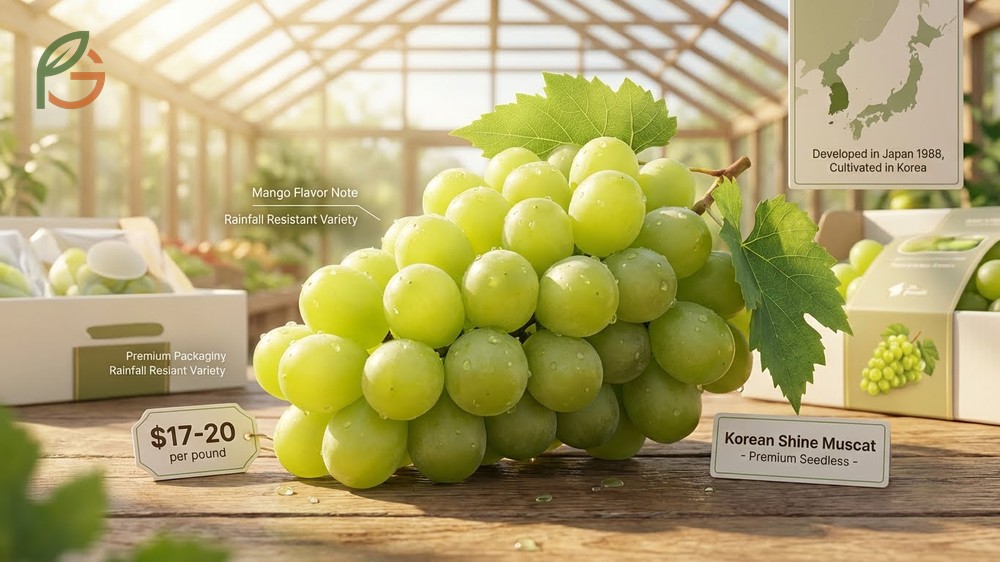
Shine Muscat grapes are premium seedless green grapes originally developed by Japan’s National Agriculture and Food Research Organization (NARO) in Hiroshima[6]. Research shows that breeders created this variety by crossing Akitsu No. 21 with Hakunan grapes to produce a hybrid that combines European grape quality with Japanese climate resilience[2]. The grapes grow in large, beautiful bunches weighing 600-800 grams each, with individual fruits reaching plum size.
Korea adopted this Japanese cultivar and scaled production significantly. Today, Korean growers export millions of pounds annually to markets across North America and Asia. The variety earned its “shine” name from the glossy, milky-green skin that distinguishes it from standard table grapes.
Unlike traditional muscat varieties that struggle in humid climates, Shine Muscat thrives in East Asian rainfall patterns. This resilience makes it commercially viable in regions where European grapes typically fail without greenhouse protection.
Development History
The breeding program began in 1973 when NARO created Akitsu No. 21 by crossing Steuben grapes with Muscat of Alexandria[5]. Breeders then spent 24 years refining the genetics before releasing Shine Muscat in 1997. The cultivar underwent six additional years of field testing before its official registration in 2003 and commercial release in 2006[6].
Japan initially protected the cultivar with strict export controls. You can face a 10-year prison sentence for smuggling Shine Muscat seeds out of Japan[1]. Despite these measures, Korean growers obtained the variety legally and now produce substantial commercial quantities.
Genetic Breeding Process
Shine Muscat is a diploid variety, meaning each cell contains two sets of chromosomes from parent cultivars[5]. The parent grape Hakunan itself was a cross between Cattacurgan and Kaiji varieties. This multi-generation breeding created a grape that retained the muscat aroma without the foxy scent typical of American grapes.
The genetic combination solved three critical problems. First, it eliminated seeds while maintaining fruit size. Second, it created disease resistance without sacrificing flavor. Third, it enabled thin, edible skin that doesn’t require peeling.
Shine Muscat Taste and Texture
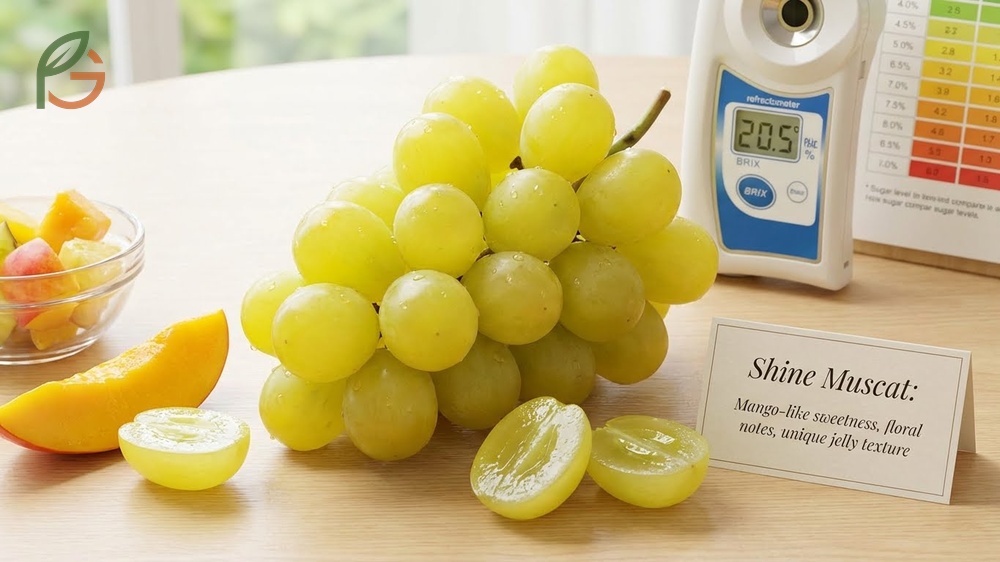
Shine Muscat grapes deliver a distinctive mango-like sweetness that sets them apart from standard table grapes[7]. The flesh has a jelly-like texture that’s firmer than regular green grapes but not overly crunchy. Each bite releases a combination of tropical fruit flavors with floral muscat notes.
Current data indicates the grapes measure 2-3 brix levels higher than Thompson or Crimson varieties[7]. This translates to 15-18 grams of natural sugar per 100 grams of fruit[4]. The sweetness lingers on the palate without the bitter or sour aftertaste common in conventional grapes.
The skin adds a slight astringency that balances the intense sweetness. Most people find they can eat the skin comfortably, though it peels off easily if you prefer[1]. The absence of seeds makes eating effortless—you can pop them whole without pausing to remove pits.
Unique Flavor Profile
Studies demonstrate that Shine Muscat’s aroma comes from muscat compounds that resemble ripe mango and grapefruit juice[7]. The scent is so pronounced that you’ll smell it before tasting. This aromatic quality makes the grapes popular for gift-giving in Asian markets.
The flavor complexity increases as the grapes reach full ripeness. Early-harvest fruits taste sweeter but less aromatic. Late-harvest grapes develop deeper muscat notes with hints of honey and floral elements.
Important Note: Shine Muscat grapes don’t ripen further after harvest. Buy them when they’re already yellow-green and fragrant—greenish fruits won’t develop the full mango-like flavor at home.
Eating Experience
Each grape delivers consistent quality due to careful cultivation methods. Growers use a thinning process that removes one-third of every 100 grapes on the vine[5]. This allows remaining fruits to grow larger and concentrate sugars more effectively.
The packaging protects each grape during shipping. You’ll typically find them wrapped in foam netting with individual bunches in plastic containers. This careful handling means crushed or damaged grapes are rare, even in imported shipments from Korea.
Shine Muscat Price Analysis
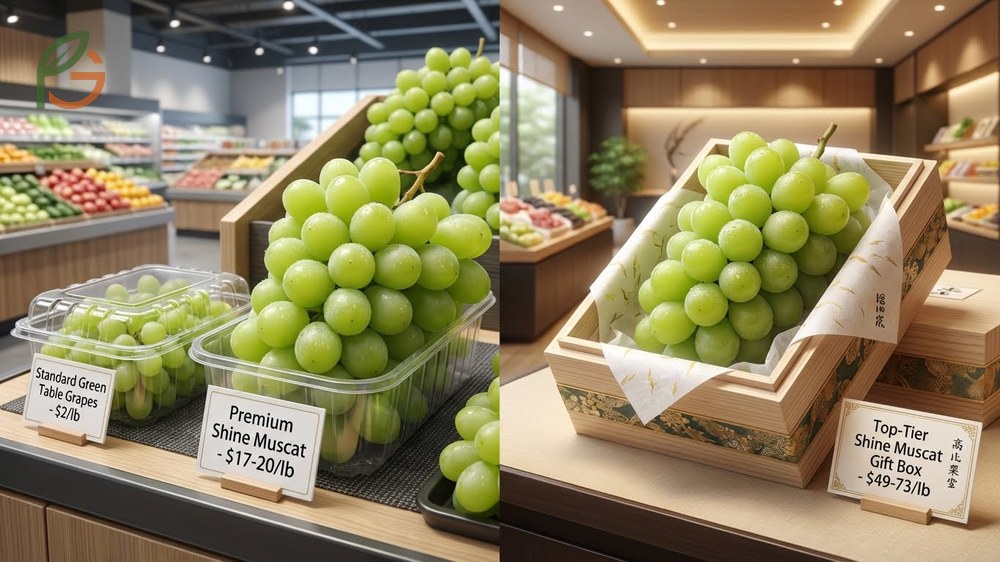
Shine Muscat grapes command premium pricing across all markets. In the USA, you’ll pay $17-20 per pound at Asian specialty retailers[1]. This compares to $2 per pound for standard green table grapes at the same stores—making Shine Muscat roughly 10 times more expensive.
Japan’s domestic market sees even higher prices. Luxury fruit shops in Tokyo sell premium Shine Muscat for $49-73 per pound[1]. These top-tier grapes come in decorative gift boxes and target the gift-giving market where expensive fruit serves as status symbols.
Recent oversupply in China has created price drops in some Asian markets. Vietnam now sees wholesale prices as low as $0.55 per kilogram, with retail at $1.20-2.35 per kilogram[8]. However, US prices remain stable due to limited import volumes and strong demand.
USA Market Pricing
Current agricultural data shows specific retailer pricing across the United States. H Mart sells Korean Shine Muscat at $19.99 per pack, with packs typically weighing 1-1.5 pounds[9]. Weee! Asian Market offers similar pricing with delivery options in major metropolitan areas.
Seasonal availability affects cost. August and September harvest months bring slightly lower prices due to fresh supply. Off-season pricing can reach $25-30 per pound when retailers sell cold-stored inventory.
- Import costs from Korea including shipping and refrigeration during transit
- Premium packaging with foam protection and plastic containers
- Limited growing regions and restricted production volumes
- High demand from Asian-American communities familiar with the variety
- Retailer markups at specialty stores versus mass-market grocers
- Quality control standards that reject damaged or undersized fruits
Why They’re So Expensive
The 33-year development timeline created substantial research costs that growers recoup through premium pricing[1]. Japan’s variety protection laws and Korea’s licensed cultivation create controlled supply chains. Growers can’t simply plant Shine Muscat without proper authorization.
Labor-intensive cultivation drives costs higher. Vineyards shelter grape clusters with paper bags to protect against insects[5]. Workers manually thin each cluster and monitor ripeness individually. This hands-on approach ensures quality but increases production expenses significantly.
Gift-giving culture in Japan and Korea supports luxury fruit markets. Expensive fruit carries social prestige, creating demand that keeps prices elevated even when production expands.
Where to Buy Shine Muscat Grapes
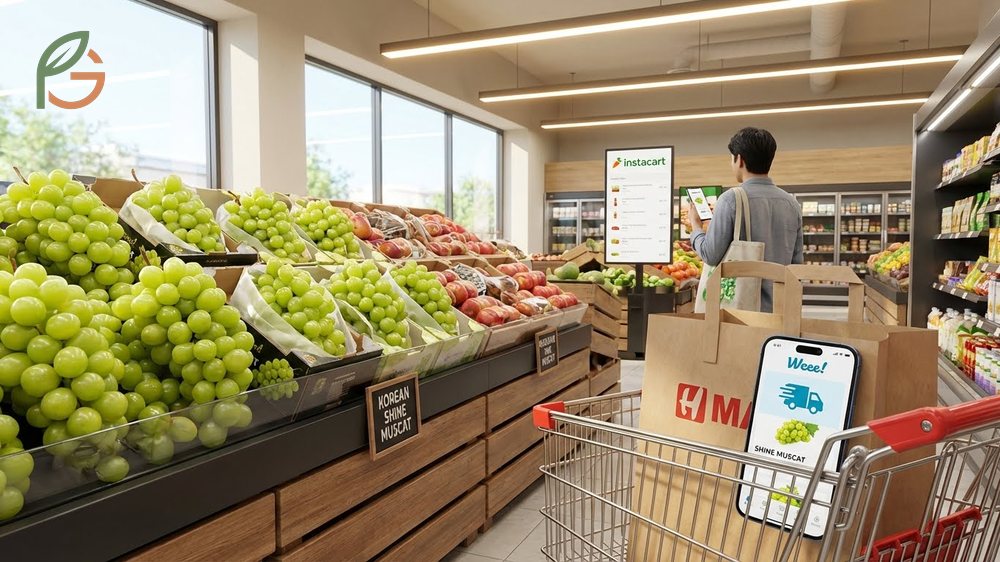
You can find Korean Shine Muscat grapes at Asian specialty retailers throughout the United States. H Mart operates over 90 locations across the country and stocks them regularly during harvest season[9]. Weee! Asian Market delivers to major cities including New York, San Francisco, Los Angeles, Seattle, and Chicago[10].
Online platforms expand access beyond physical store locations. Instacart partners with Korean grocery stores to offer same-day delivery in many metropolitan areas[11]. You’ll pay standard Instacart fees plus the premium grape pricing.
Availability peaks from August through October when fresh harvests arrive from Korea. Off-season purchases rely on cold storage inventory, which affects both price and quality. Check with stores in advance during winter months to confirm stock.
- H Mart Korean grocery stores with 90+ locations nationwide
- Weee! Asian Market online delivery service covering 50+ cities
- 99 Ranch Market Asian supermarket chain in Western states
- Instacart delivery from partnered Korean and Asian grocers
- Local Korean grocery stores and Asian produce markets
- Specialty fruit retailers in major metropolitan Chinatowns and Koreatowns
Shopping Tip: Call ahead before visiting stores, especially if you’re traveling specifically for Shine Muscat. Stock varies by location and season, and popular stores often sell out within hours of receiving shipments.
Shine Muscat vs Green Grapes Comparison
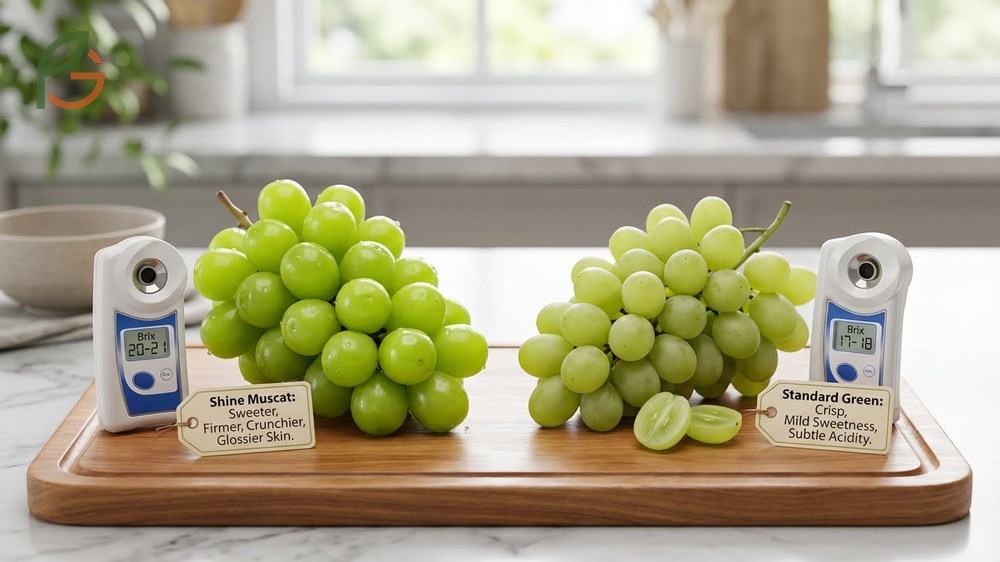
Research demonstrates clear differences between Shine Muscat and standard green table grapes. Shine Muscat measures 2-3 brix levels higher in sweetness and contains more soluble dietary fiber[12]. The texture feels firmer and crunchier, with glossier skin that reflects light differently than Thompson Seedless or other common varieties.
Standard green grapes like Thompson Seedless have a crisp bite with mild sweetness and subtle acidity. They’re refreshing but lack the complex flavor profile of Shine Muscat. Most people describe regular green grapes as “clean” tasting without strong aromatic qualities.
Nutritionally, Shine Muscat contains higher natural sugars but delivers comparable vitamins and minerals. Both provide vitamin C, vitamin K, and potassium in similar amounts. The calorie difference is minimal—Shine Muscat has about 69-80 calories per 100 grams[4] compared to 67 calories for standard green grapes.
This table compares key characteristics between Shine Muscat and standard green grapes including flavor, texture, price, and availability across five dimensions
| Characteristic | Shine Muscat | Standard Green Grapes |
|---|---|---|
| Flavor Profile | Mango-like, muscat aroma, sweet with floral notes | Mild, clean sweetness with slight acidity |
| Sugar Content | 15-18g per 100g[4] | 12-15g per 100g |
| Texture | Firm, crunchy, jelly-like flesh | Crisp, watery, softer flesh |
| Price (USA) | $17-20 per lb[1] | $2-4 per lb |
| Availability | Asian specialty stores, seasonal (Aug-Oct peak) | All supermarkets, year-round |
The most significant difference lies in the eating experience. Thompson Seedless requires chewing and has seeds in non-seedless varieties. Shine Muscat grapes are completely seedless, larger, and burst with juice when bitten. The skin-to-flesh ratio favors Shine Muscat with thinner, more tender skin.
Growing Shine Muscat Requirements
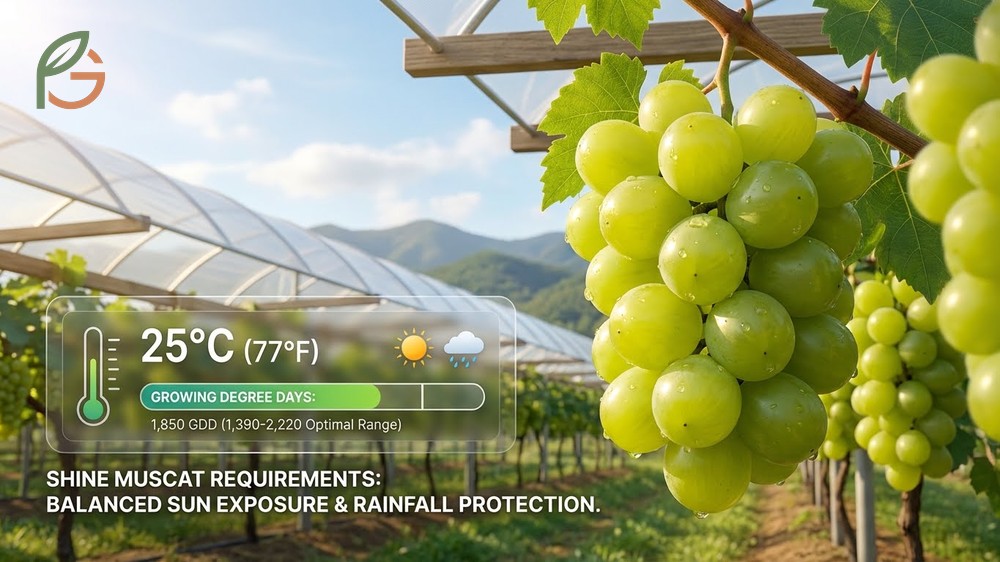
Shine Muscat cultivation requires specific climate conditions that balance sun exposure with adequate rainfall protection. The variety needs approximately 1,390-2,220 growing degree days measured above 50°F (10°C)[13]. This range allows proper ripening while developing the characteristic muscat aroma and high sugar content.
Vineyards in Korea and Japan provide the ideal environment. These regions offer warm summers with sufficient sunlight but also reliable irrigation systems to manage water stress. Growers typically plant in areas where daytime temperatures reach 77-86°F (25-30°C) during the growing season with cooler nights that preserve acidity.
Commercial cultivation employs trellising systems that maximize sun exposure to grape clusters. The vines need partial shade during peak afternoon heat to prevent sunburn on fruits. Paper bags protect developing clusters from insects without requiring chemical pesticides—this aligns with premium quality standards buyers expect.
- Well-drained soil with pH between 6.0-7.0 for optimal nutrient uptake
- Full sun exposure for 6-8 hours daily with afternoon shade protection
- Consistent irrigation delivering 1-2 inches of water weekly during fruit development
- Trellis or support structures allowing proper air circulation around clusters
- Manual cluster thinning to maintain 60-70 grapes per bunch for optimal size
- Paper bagging of clusters 4-6 weeks before harvest for pest protection
- Harvest timing when brix levels reach 18-20 for peak sweetness
The variety resists common grape diseases better than European cultivars. This disease resistance reduces fungicide requirements and makes organic cultivation more feasible. However, growers must still monitor for powdery mildew and downy mildew during humid periods.
Harvest runs from August through September in open-field vineyards[5]. Growers test brix levels regularly and pick clusters when sugars peak but before overripening causes flavor degradation. Each bunch requires hand-harvesting to avoid damage—machine harvesting isn’t suitable for this premium variety.
Conclusion
The evidence is clear: korean shine muscat grapes represent a horticultural achievement that combines Japanese breeding expertise with Korean agricultural scale. These premium fruits deliver unmatched sweetness, distinctive mango-like flavor, and convenient seedless eating—though at prices 10 times higher than standard varieties. For fruit enthusiasts willing to invest $17-20 per pound, they offer a tasting experience that standard table grapes can’t match.
Current guidance emphasizes buying during peak season (August-October) from reputable Asian specialty retailers like H Mart or Weee! Asian Market. FruitGarden tracks market availability and pricing trends to help growers and consumers navigate this evolving premium fruit category as production expands and prices potentially stabilize.
Frequently Asked Questions
What makes Shine Muscat grapes taste different from regular grapes?
Shine Muscat grapes contain 15-18 grams of natural sugar per 100 grams and produce muscat compounds that create a mango-like flavor with floral notes. The breeding process combined European muscat aroma with Japanese sweetness levels, resulting in a taste that’s 2-3 brix levels higher than Thompson Seedless or Crimson varieties. The jelly-like flesh texture also differs from the crisp, watery bite of standard green grapes.
Are Shine Muscat grapes worth the high price?
That depends on your priorities and budget. If you’re comparing pure nutrition, standard green grapes provide similar vitamins and minerals at $2 per pound versus $17-20 for Shine Muscat. However, the unique flavor, larger size, seedless convenience, and premium texture justify the cost for fruit enthusiasts and gift-givers. Most people who try them describe the taste as exceptional enough to warrant occasional splurges rather than regular purchases.
Can I grow Shine Muscat grapes in my backyard?
Growing Shine Muscat requires specific conditions that limit home cultivation success. You’ll need 1,390-2,220 growing degree days above 50°F, proper trellising, consistent irrigation, and protection from pests using paper bags. The variety is also legally protected—obtaining authentic Shine Muscat vines requires purchasing from licensed nurseries, and availability for home growers remains limited in most regions outside of commercial growing zones.
Where can I buy Korean Shine Muscat grapes in the USA?
H Mart Korean grocery stores stock Shine Muscat at 90+ locations nationwide, typically priced at $19.99 per pack. Weee! Asian Market delivers to 50+ cities including New York, Los Angeles, San Francisco, Seattle, and Chicago. You can also find them at 99 Ranch Market, local Korean grocers, and through Instacart delivery from partnered Asian specialty stores. Availability peaks August through October during fresh harvest season.
How do I know if Shine Muscat grapes are ripe?
Shine Muscat grapes don’t ripen after harvest, so buy them when they’re already yellow-green with a glossy sheen. Ripe grapes emit a strong muscat or mango-like aroma that you can smell before opening the package. Avoid bunches with greenish coloring or lack of fragrance—these were picked early and won’t develop full sweetness. The grapes should feel firm but yield slightly to gentle pressure.
What’s the difference between Japanese and Korean Shine Muscat?
Japanese Shine Muscat represents the original cultivar developed over 33 years by NARO researchers and typically commands higher prices ($49-73 per pound) in luxury markets. Korean Shine Muscat uses the same variety but benefits from scaled commercial production that reduces costs to $17-20 per pound in US markets. Quality differences are minimal—both deliver the characteristic mango flavor and sweetness when properly cultivated and handled.
Can I eat the skin on Shine Muscat grapes?
Yes, you can eat the skin on Shine Muscat grapes. The skin is thin and tender compared to other grape varieties, though it carries slight astringency that balances the sweet flesh. Most people find the skin-on experience enjoyable and don’t bother peeling. However, if you prefer skinless grapes, the peel separates easily from the flesh without tearing the fruit.





