
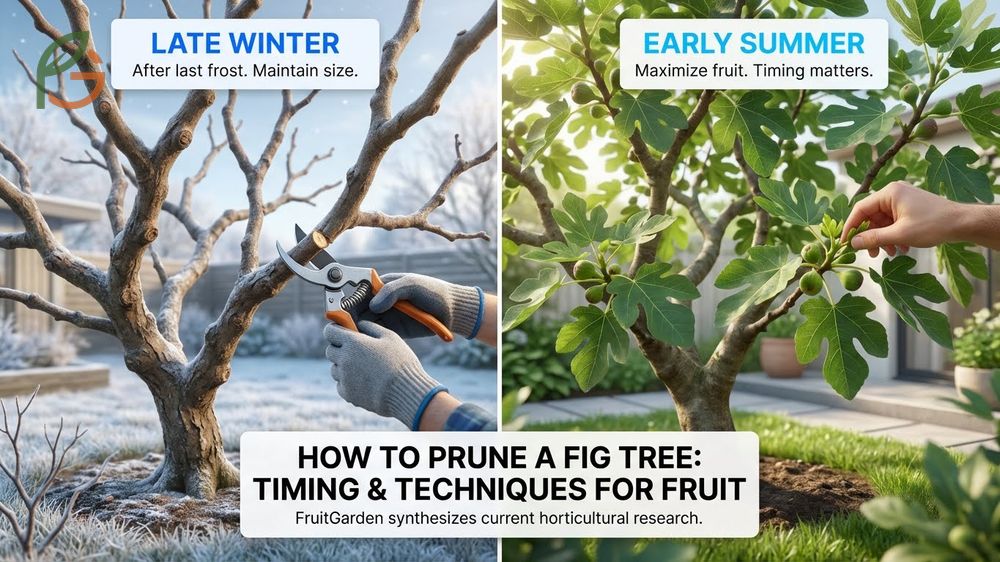
How to prune a fig tree? Prune twice annually—in late winter after the last frost and again in early summer. Research shows this dual-season approach maximizes fruit production while maintaining manageable tree size[1]. Most gardeners don’t realize that timing matters more than technique when it comes to harvesting abundant figs. FruitGarden synthesizes current horticultural research to help you master fig tree care.
Quick Answer
- Prune fig trees twice yearly: late winter (February-March) and early summer (June-July)[1]
- Winter pruning shapes the tree and removes dead wood; summer pruning pinches shoots to 5 leaves to encourage next year’s fruit[2]
- Stop all pruning by mid-summer when fruitlets form—cutting after this reduces next year’s harvest[1]
- Over-pruning removes fruit-bearing buds and delays ripening by up to 30 days[3]
How to Prune a Fig Tree
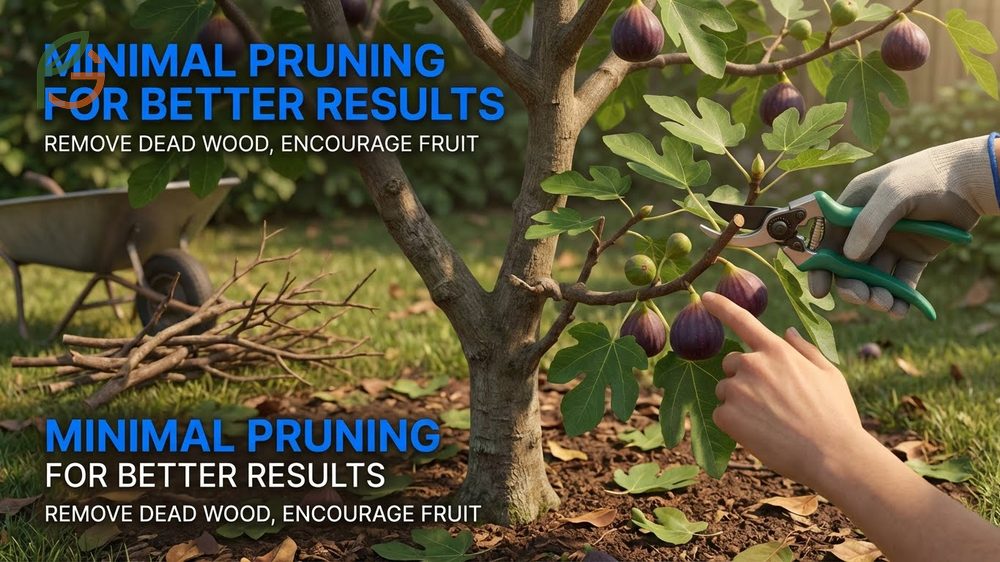
Fig trees don’t require aggressive annual pruning like many fruit trees. Research shows that minimal pruning actually produces better results—trees with preserved apical buds ripen fruit up to two months earlier than heavily pruned specimens[3]. The goal is to balance size management with fruit production.
Most people find that light, strategic cuts work better than heavy shaping. You’re removing dead wood, managing height, and encouraging fruit-bearing branches rather than forcing a specific form. This approach prevents the excessive vegetative growth that follows aggressive pruning.
Current horticultural guidance emphasizes working with the tree’s natural hormonal balance. When you prune too hard, you remove fruit-bearing apical and lateral buds, leaving growth-oriented vegetative buds to dominate[3]. The result is a growth spurt rather than fruit production.
From My Experience: My cousin in Guadalajara, Mexico pruned his Brown Turkey fig in late February 2024. The tree produced fruit by mid-July—about 3 weeks earlier than his neighbor’s heavily pruned tree of the same variety.
Essential Fig Tree Pruning Tools
You’ll need sharp, clean tools to make proper cuts. Bypass pruning shears handle branches up to 3/4 inch diameter, while a pruning saw tackles anything larger. Clean your tools with rubbing alcohol or a 10% bleach solution before starting to prevent disease transmission.
Wear protective gloves and long sleeves when pruning fig trees. The milky sap that oozes from fresh cuts can irritate skin and attracts pests that potentially carry disease[1]. Start pruning from the base and work upward to avoid sap dripping on you.
- Bypass pruning shears (not anvil-style) for clean cuts on small branches
- Pruning saw for branches thicker than 3/4 inch
- Protective gloves and long-sleeved shirt to avoid sap irritation
- Rubbing alcohol or 10% bleach solution for cleaning tools between cuts
- Pruning sealant (optional) for large cuts over 2 inches diameter
Winter Dormant Season Pruning Technique
Winter pruning focuses on structure and health rather than fruit production. Wait until the tree is fully dormant and sap has retreated to the roots—this minimizes bleeding and energy loss[4]. You’re looking for dead, damaged, or diseased wood to remove first.
Cut branches that cross or rub against each other. These create wounds that invite disease and pests. Remove any shoots growing toward the wall or directly outward from a fan-trained tree to maintain the desired shape.
For mature fig trees, remove about one-third of the previous year’s new shoots, particularly weak or spindly ones. Leave approximately 1 inch of the shoot with 2-3 buds intact[2]. This stimulates productive branching without triggering excessive vegetative growth.
Important Timing Note: If temperatures drop to the low 20s°F (-6°C), prune immediately to protect branches from severe cold damage. Wait as long as possible otherwise—late winter pruning after the last frost produces the best results.
Summer Pruning for Fruit Production
Summer pruning directly impacts next year’s harvest. In early summer (June-July), pinch back new shoots to 5 leaves from the base[2]. This encourages the tree to form embryonic fruitlets at shoot tips rather than producing long, unproductive branches.
The key is stopping all pruning by mid-summer. Fruitlets that overwinter on the tree become next year’s main crop[5]. If you prune after mid-July, the resulting new growth won’t have time to develop fruit embryos before dormancy.
Studies demonstrate that summer-pruned fig trees produce more uniform fruit with better quality. The technique also helps control tree size in warm climates, where figs can grow 7-10 feet in a single season. You get size management and improved fruiting from one operation.
When to Prune Fig Trees
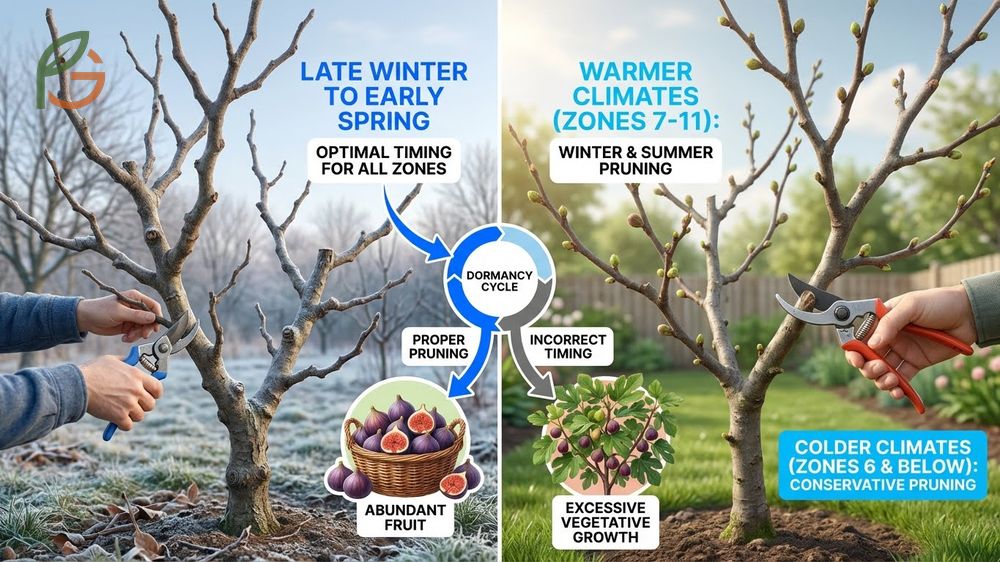
Timing determines whether your fig tree produces abundant fruit or wastes energy on vegetative growth. The traditional advice was to prune in winter, but current research shows that late winter to early spring produces superior results[2]. You’re working with the tree’s natural dormancy cycle rather than against it.
Fig trees in warmer USDA zones 7-11 can handle both winter and summer pruning effectively. Colder climate growers in zones 6 and below should be more conservative, pruning only after spring frost danger passes. This allows you to assess winter damage before making cuts.
What often gets overlooked is that pruning at the wrong time affects more than just that season’s fruit. Early pruning before full dormancy causes excessive sap bleeding, weakening the tree and making it vulnerable to disease and pest infestation[5].
Late Winter Early Spring Timing
The optimal window for major pruning opens after the last hard frost but before buds break. For most U.S. regions, this falls between late February and early April depending on your zone. Wait until you see no more frost in the 10-day forecast.
In cold climates, spring pruning offers a major advantage—you can identify winter dieback before cutting. Branches that look healthy in winter might be dead by spring, and premature pruning wastes cuts on wood you’ll remove anyway[6].
Commercial growers who sell fig cuttings typically prune earlier, in mid-winter, to get cuttings before severe cold arrives. Backyard gardeners focused on fruit production should wait longer. The patience pays off with less dieback and more productive wood remaining on the tree.
Early Summer Maintenance Window
Your second pruning opportunity arrives in early summer when new shoots have developed 5-6 leaves. This typically occurs in June or early July across most U.S. growing zones. The exact timing depends on your local climate and the tree’s growth rate.
Summer pinching must finish by mid-July at the latest. Agricultural data shows that fruitlets begin forming on shoot tips starting in mid-to-late summer[1]. These embryonic figs overwinter on the tree and ripen the following summer, producing your main crop.
Regional Timing Tip: Southern growers in zones 9-10 can extend summer pruning into early August. Northern gardeners in zones 6-7 should complete all summer pruning by the first week of July to ensure adequate fruitlet formation time.
- Late winter (February-March): Major structural pruning for tree shape and dead wood removal
- Early spring (March-April): Final cleanup cuts after assessing winter damage
- Early summer (June-early July): Pinch new shoots to 5 leaves to encourage fruiting
- Mid-summer (mid-July onward): Complete pruning moratorium—no cuts allowed
- Fall (September-November): Avoid pruning entirely to prevent winter vulnerability
Pruning Fig Trees for Fruit
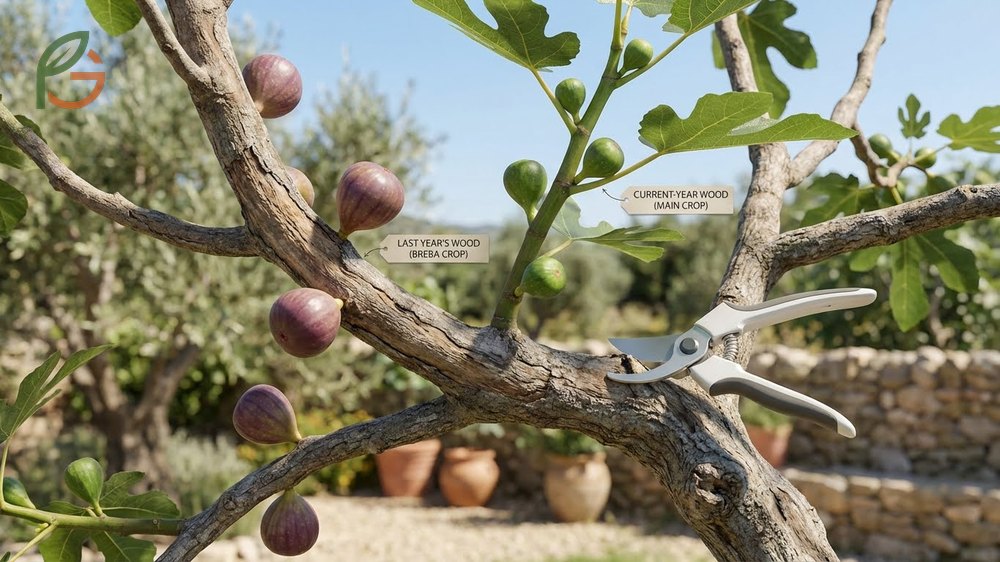
Fig trees produce fruit on two different wood types, and understanding this distinction changes your entire pruning approach. The breba crop forms on last year’s wood—the branches that grew during the previous season. The main crop develops on current-year wood as it grows during spring and summer.
Research shows that preserving last year’s wood increases total harvest by 40-60% compared to heavy pruning that removes these branches[3]. Not all fig varieties produce a reliable breba crop, but common types like Brown Turkey and Desert King depend heavily on previous season’s wood.
The challenge is balancing fruit production with tree management. An unpruned fig can grow 15-20 feet tall with an equal spread, making harvest difficult and reducing air circulation that prevents disease. Strategic pruning maintains productivity while keeping the tree at a manageable 8-12 feet.
Understanding Fig Fruiting Patterns
Fig trees use three bud types with different functions. Apical buds at branch tips and lateral buds along the upper portions are slow-growing but fruit-bearing. Vegetative buds lower on branches focus on producing new shoots rather than figs.
When you prune heavily, you remove the fruit-bearing apical and lateral buds. This leaves vegetative buds to dominate, triggering rapid upward growth rather than fruit production. The tree essentially “resets” and prioritizes size over reproduction.
Current agricultural guidance emphasizes preserving apical buds whenever possible. Even minimal pruning that removes these buds can delay fruit ripening by 2-4 weeks[3]. In short-season climates, this delay can mean the difference between ripe fruit and green figs when frost arrives.
Pruning Young Fig Trees
First-year fig trees need different treatment than mature specimens. Select 1-3 healthy shoots from the base to become permanent scaffolds—these form the tree’s main framework. Container trees should have no more than 3 scaffolds, while in-ground trees can support 5-7[7].
Once scaffolds reach 18-24 inches, pinch or cut the tips to encourage branching. This technique, called topping, stimulates lateral shoot development and creates a bushier tree. Studies demonstrate that topped young figs produce fruit a full year earlier than unpruned specimens.
From My Experience: When my neighbor in Monterrey, Mexico topped his young Kadota fig at 20 inches in May 2023, it developed 4 strong lateral branches by August—achieving in one season what typically takes two years.
Stake young scaffolds at a 45-60 degree angle rather than letting them grow straight up. This horizontal training opens the tree’s center, allowing sunlight to reach interior branches where fruit forms. Agricultural data shows that horizontally trained branches produce 25-35% more figs than vertical growth[7].
- Year 1: Select 1-3 scaffolds, remove competing shoots, allow 18-24 inches of growth before topping
- Year 2: Develop secondary branches, stake scaffolds at 45-60 degree angles, limit height to 4-5 feet
- Year 3: Establish final tree form, transition to maintenance pruning, expect first significant harvest
- Year 4+: Focus on removing dead wood and maintaining size, preserve fruit-bearing wood
- Container figs: Annual root pruning when repotting, more aggressive top pruning to balance root loss
Fig Tree Pruning Mistakes
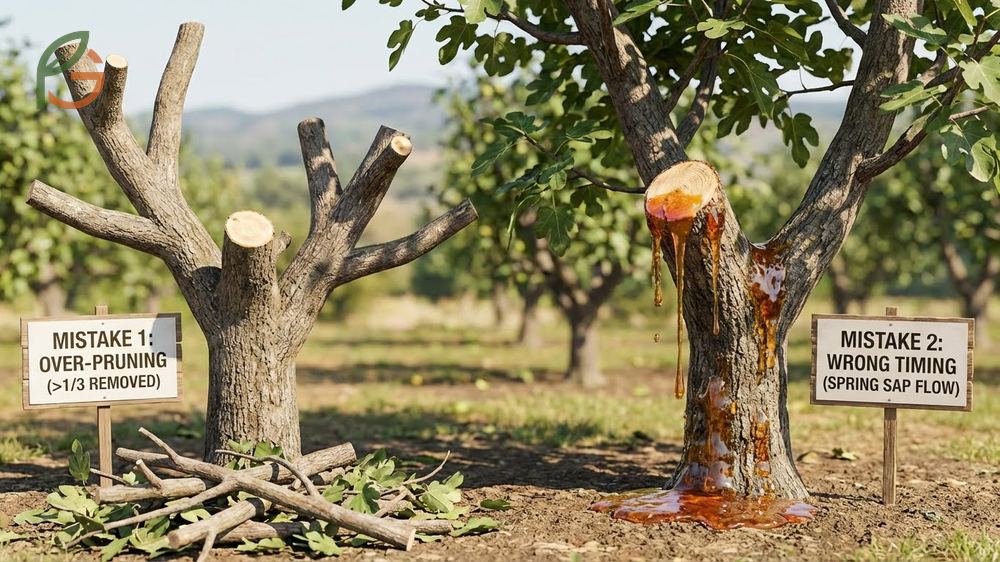
The most common fig pruning mistake is cutting too much wood. Over-pruning triggers the tree’s survival response—it prioritizes rapid vegetative growth to replace lost canopy rather than producing fruit. Evidence suggests that removing more than one-third of the tree in a single season significantly reduces fruit yield[3].
Pruning at the wrong time ranks as the second most devastating error. Cutting during active growth in spring causes excessive sap bleeding, weakening the tree substantially. The oozing sap attracts pests including fig beetles and wasps, which can introduce fungal diseases through the wounds[5].
Many gardeners make the mistake of pruning in late summer or fall. This stimulates new tender growth that won’t harden off before winter, resulting in severe dieback when cold weather arrives. Current horticultural guidance recommends a complete pruning moratorium from mid-July through February.
Critical Mistake Warning: Never prune more than one-third of the tree’s canopy in a single year. If your fig has grown out of control, spread heavy pruning across 2-3 seasons to avoid shocking the tree and losing multiple years of fruit production.
- Removing more than one-third of canopy—triggers excessive vegetative growth instead of fruiting
- Pruning during active spring growth—causes severe sap bleeding and disease vulnerability
- Late summer or fall pruning—produces tender growth that dies back in winter
- Cutting after mid-July—removes developing fruitlets that would become next year’s harvest
- Using dull or dirty tools—creates ragged cuts that heal slowly and invite infection
- Neglecting protective gear—fig sap causes skin irritation and allergic reactions
- Failing to remove dead wood—provides entry points for pests and disease organisms
Insufficient aftercare following pruning causes problems that won’t appear for weeks or months. Fig trees need consistent moisture and balanced fertilization after major pruning to recover properly. Studies show that trees receiving post-pruning care produce 20-30% more fruit the following season compared to neglected specimens.
The final common mistake is treating all fig varieties identically. Some cultivars like Chicago Hardy and Celeste handle aggressive pruning well, while varieties such as Panache and Kadota suffer dramatically from heavy cutting. Research your specific variety’s pruning tolerance before making major cuts.
Training and Shaping Fig Trees
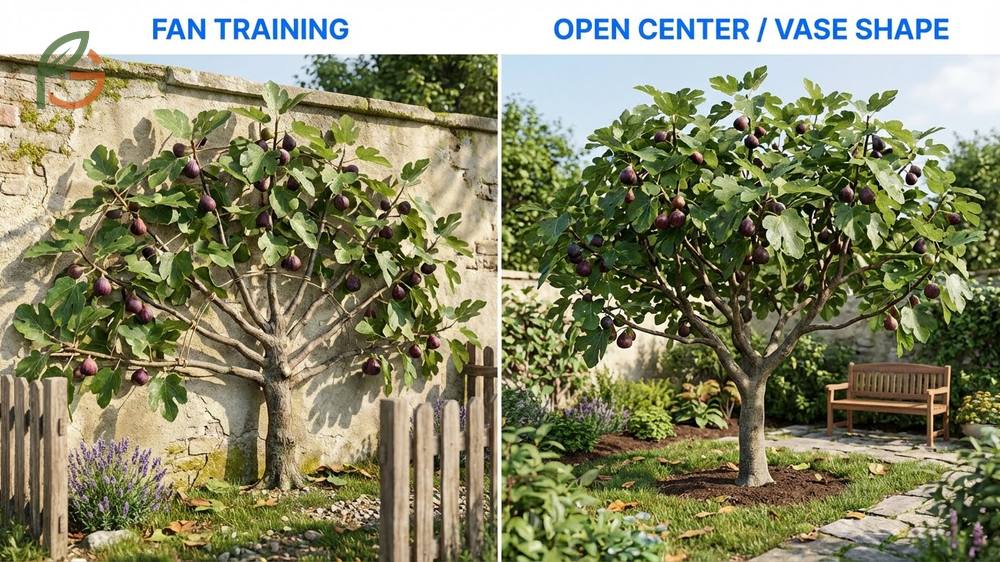
Fig trees adapt to multiple training styles, but some work better than others for fruit production. Fan training against a wall or fence is the traditional European approach, popular in cool climates where reflected heat helps ripen fruit. The method requires consistent summer pruning to maintain the flat profile.
Open center or vase shape suits backyard growers seeking maximum fruit yield. This form allows excellent air circulation and sunlight penetration to interior branches. Agricultural research demonstrates that open-center figs produce 30-40% more fruit than densely branched trees due to better light distribution[7].
Espalier training creates a formal, space-saving tree with horizontal tiers. While beautiful, espalier requires significant ongoing maintenance. Most experts recommend fan training over espalier for figs—the vigorous growth habit makes classic espalier difficult to maintain[8]. If attempting espalier, space horizontal branches 3-4 feet apart rather than the typical 12-18 inches used for apples.
Training Tip: Use soft tree ties or stretchy plant tape when staking branches. Wire or rigid ties can cut into the rapidly growing bark, creating wounds that invite disease and weaken the branch structure.
Bush or multi-stem form works well for cold-climate gardeners. You’re maintaining 3-5 main trunks from ground level, each producing fruiting branches. When winter kills stems, the tree rebounds quickly from remaining trunks without losing an entire season’s growth. This resilient form suits zones 6-7 where fig survival is challenging.
Studies demonstrate that staking branches horizontally produces better results than pruning for shape. When you stake a vertical branch to a 45-60 degree angle, it naturally slows vegetative growth and promotes fruiting without wasting the tree’s energy on recovery from cuts. The hormonal balance shifts toward reproduction rather than regrowth.
- Fan training: Best for walls and fences, requires consistent summer pruning, good for cool climates
- Open center/vase: Maximum fruit yield, excellent air flow, easiest to maintain long-term
- Espalier: Formal appearance, high maintenance, space horizontal tiers 3-4 feet apart
- Bush/multi-stem: Cold-hardy form, 3-5 main trunks, quick recovery from winter damage
- Single trunk standard: Tallest form, difficult harvest, suitable only for warm climates
Conclusion
The evidence is clear: how to prune a fig tree depends more on timing and restraint than aggressive cutting. Prune twice yearly—late winter for structure and early summer for fruit production—while avoiding cuts after mid-July when next year’s figs begin forming. Studies consistently show that minimal pruning produces earlier harvests, higher yields, and better fruit quality than heavy annual cutting.
Current horticultural guidance emphasizes working with your fig tree’s natural growth patterns. Preserve fruit-bearing apical buds, maintain an open center for sunlight penetration, and use staking rather than pruning whenever possible. This approach from FruitGarden delivers the abundant, sweet figs you’re aiming for without the setbacks that come from over-pruning.
Frequently Asked Questions
How Do I Prune a Fig Tree Diagram?
Start by identifying the tree’s main scaffolds—these are the 3-5 primary branches forming the framework. Remove any shoots growing inward toward the trunk or crossing other branches. Cut dead wood back to healthy tissue, making cuts at a 45-degree angle just above an outward-facing bud. For summer pruning, pinch new shoots back to 5 leaves from the base to encourage fruitlet formation.
When Should You Cut Back a Fig Tree?
Cut back fig trees in late winter after the last frost but before buds break—typically February through early April depending on your zone. A second lighter pruning in early summer (June-early July) pinches new growth to 5 leaves. Never prune after mid-July when embryonic figs for next year’s crop begin forming, and avoid fall pruning entirely.
Can You Top a Fig Tree?
Yes, topping fig trees controls height and encourages bushier growth. Research shows that summer topping produces better results than dormant-season cuts—the tree reaches desired form a full year earlier. Top during early summer when shoots have 5-6 leaves developed. Cut the main leader back to your desired height, leaving several buds below the cut to generate new branches.
What Happens if You Don’t Prune a Fig Tree?
Unpruned fig trees can reach 15-20 feet tall with equal spread, making harvest difficult. However, studies demonstrate that minimal pruning produces earlier fruit and higher yields than aggressive cutting. If your fig stays manageable without pruning, you can skip annual cuts and simply remove dead wood. The tree will fruit successfully without regular pruning.
How Much Can You Cut Back a Fig Tree?
Remove no more than one-third of the tree’s canopy in a single year. Cutting more triggers excessive vegetative growth rather than fruit production, and the tree may skip fruiting for one or more seasons while recovering. If heavy pruning is necessary, spread the work across 2-3 years to maintain productivity while achieving the desired size reduction.
Should I Remove Fig Tree Suckers?
Remove suckers growing from the rootstock below the graft union—these won’t produce the same fruit as your desired variety. Suckers emerging from above the graft or from the base of own-root figs can be kept to develop a multi-stem form, which provides cold-weather insurance. Removal is not mandatory but helps direct energy to fruit-bearing branches.
How Do You Prune a Potted Fig Tree?
Container figs need more aggressive pruning than in-ground trees to balance top growth with limited root space. Prune in fall before moving the pot to winter storage, removing enough growth so the tree fits in your storage area. Root prune every 2-3 years when repotting by cutting back one-quarter of the root ball and refreshing the soil.





