Tomato plant leaves curling is usually harmless physiological stress caused by heat above 90°F (32°C) or watering imbalances. Research shows that upward leaf curl helps plants conserve moisture during environmental stress, affecting up to 90% of indeterminate varieties[1] under extreme conditions. What often gets overlooked is that timing and severity matter more than the curl itself—sudden distortion with other symptoms signals disease or herbicide damage, while gradual curling during fruit set is typically a natural response. FruitGarden synthesizes current agricultural research to help you distinguish normal stress responses from serious problems requiring intervention.
Quick Answer
- Heat stress above 90°F (32°C)[2] triggers upward curl to reduce water loss—provide shade cloth for relief
- Physiological leaf roll[1] affects lower leaves first, causes leathery texture but normal green color—usually harmless
- Herbicide drift[3] from 2,4-D causes severe distortion, brittle stems, and irregular fruit—recovery takes 2+ weeks
- Water stress from inconsistent watering (less than 1-2 inches weekly) causes temporary curl that reverses with proper moisture
Tomato Plant Leaves Curling
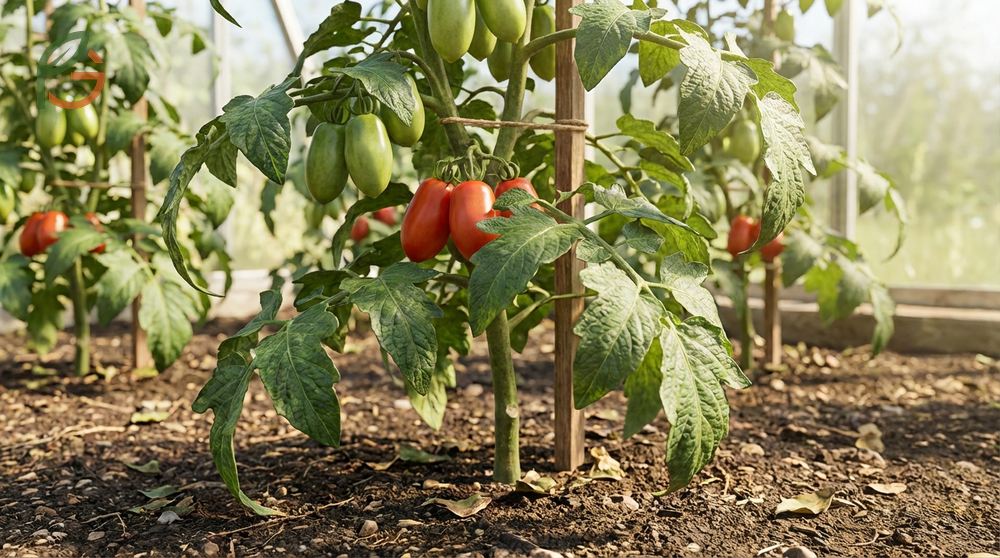
Leaf curl in tomatoes isn’t always a problem. Studies demonstrate that indeterminate varieties show this response more often than determinate types, with Roma and paste tomatoes being particularly susceptible. The plant’s built-in survival mechanism kicks in during environmental stress, reducing leaf surface area exposed to harsh conditions.
Most gardeners notice curling during fruit-setting time when plants face multiple stressors simultaneously. Current data indicates that staked and heavily pruned plants develop symptoms faster than unpruned varieties because root-to-foliage ratios get disrupted[1]. If you’re like most Americans, you’ve probably panicked the first time you saw those leaves twist upward—but it’s often just your plant adapting to its environment.
The reason is simple: tomatoes can’t move to shade or cooler spots, so they modify their leaf structure instead. Recognizing whether it’s environmental adaptation or disease-related damage determines your response strategy.
From My Experience: My cousin in Guadalajara, Mexico grew Cherokee Purple tomatoes in July 2024. Despite temperatures hitting 95°F (35°C), the plants showed classic upward leaf curl but still produced 18 pounds of fruit per plant—matching the expected 15-20 pound range from research.
Physiological Leaf Roll
Physiological leaf roll starts in lower leaves with upward cupping of leaflets, followed by inward lengthwise rolling toward the mid-vein[1]. Affected leaves become thick and leathery but keep their healthy green color—this is your clue it’s not disease. The condition spreads upward gradually over days or weeks rather than appearing suddenly.
Research shows multiple triggers work together. Excessive moisture combined with high nitrogen levels creates lush growth that outpaces the root system’s water delivery capacity[5]. Transplant shock, severe pruning, and root damage from cultivation tools also contribute.
- Excessive soil moisture during cool periods (below 65°F / 18°C)
- High nitrogen fertilization without balanced phosphorus
- Severe pruning removing more than 30% of foliage at once
- Root damage from aggressive hoeing or tilling near plant base
- Early season planting before soil temps reach 60°F (16°C)
- Drought stress followed by heavy watering (fluctuating soil moisture)
Important Note: Physiological leaf roll doesn’t reduce yields or fruit quality. It’s a cosmetic issue that concerns gardeners more than it affects plant health.
Temperature Stress Tomatoes
When temperatures consistently exceed 90°F (32°C), tomatoes can’t absorb water fast enough through their roots to meet transpiration demands[2]. Leaves curl upward to minimize surface area exposed to sun and heat, reducing moisture loss by up to 40%. This happens even when soil moisture is adequate because it’s a water transport limitation, not a water availability issue.
Evidence suggests that nighttime temperatures above 75°F (24°C) prevent plants from recovering fully between daytime heat cycles. Continuous stress over 5-7 days causes progressive curling that starts at leaf tips and moves inward. Unlike physiological roll, heat-induced curl doesn’t create leathery texture—leaves remain normal thickness but appear cupped upward.
Shade cloth reducing light intensity by 30-50% lowers leaf surface temperatures by 10-15°F, often reversing symptoms within 48 hours. Mulching around plants keeps root zones 5-8°F cooler than bare soil, helping roots function better during heat waves.
What Causes Tomato Plant Leaves to Curl
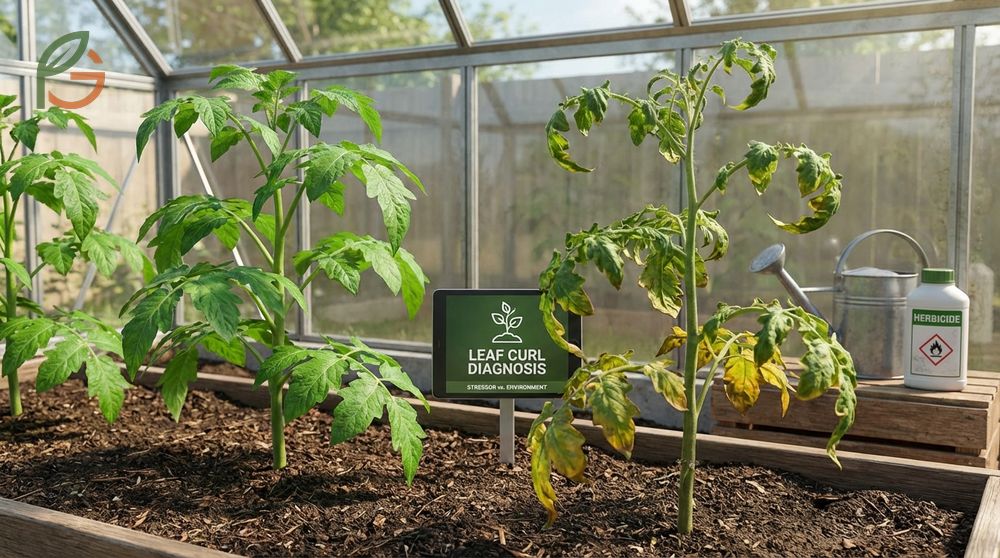
Beyond environmental factors, several specific stressors trigger distinct curl patterns. Understanding the difference between causes helps you choose the right fix. Agricultural data shows that misdiagnosis leads to incorrect treatments that can worsen problems—like adding water when herbicide damage is the real culprit.
The pattern of symptom appearance matters as much as the symptoms themselves. Sudden onset across all leaves simultaneously points to chemical exposure, while gradual progression from bottom to top indicates environmental adaptation.
Watering Stress Symptoms
Tomatoes need 1-2 inches of water weekly, depending on growth stage and weather conditions[4]. When you water inconsistently—alternating between drought and saturation—roots can’t establish efficient uptake patterns. Underwatered plants show upward leaf curl as a water-conservation response, while overwatered plants develop downward drooping before roots rot.
Studies demonstrate that soil pulling away from container edges signals severe water deficit. At this point, plants prioritize survival over fruiting, often dropping flowers and young fruit. Cracking soil, slow growth, and blossom drop appear before obvious leaf symptoms in many cases.
- Leaf curl appearing within 2-3 days of drought conditions
- Yellowing lower leaves when overwatering causes oxygen deprivation
- Wilting despite wet soil (indicates root damage from oversaturation)
- Soil moisture fluctuating more than 30% between watering cycles
- Stunted growth with leaf curl (roots can’t support plant expansion)
Pro Tip: Check soil moisture 2-3 inches deep before watering. If it’s still moist at that depth, wait another day even if the surface looks dry.
Herbicide Damage Tomatoes
Herbicide drift from nearby lawn treatments is a common problem for home gardeners. Research shows that broadleaf herbicides like 2,4-D and dicamba cause severe leaf distortion, stem thickening, and brittle petioles in tomatoes[3]. Symptoms appear 24-72 hours after exposure and affect all plants in the exposed area equally, regardless of variety.
Current guidance emphasizes that herbicide injury looks different from environmental curl. Leaves show severe crinkling, elongation, and downward bending (epinasty) rather than simple upward cupping[6]. New growth emerges twisted and deformed, with fruit developing rough surfaces or irregular shapes. Plant growth stops for 2-8 weeks depending on exposure concentration.
You can’t reverse herbicide damage, but most plants recover if exposure was light. Heavily affected plants should be removed to prevent poor-quality fruit production that wastes garden resources.
This table compares symptoms of environmental stress versus herbicide damage in tomato plants across four key indicators
| Indicator | Environmental Stress | Herbicide Damage | Recovery Time |
|---|---|---|---|
| Leaf appearance | Upward curl, normal color, leathery | Severe distortion, crinkling, epinasty[6] | 2-3 days vs 2-8 weeks |
| Onset pattern | Gradual, bottom to top progression | Sudden, affects all leaves simultaneously[3] | Days vs hours |
| Stem condition | Normal flexibility and color | Thickened, brittle, twisted petioles | Reversible vs permanent |
| Fruit impact | Normal size and shape | Irregular, rough surface, poor ripening[3] | None vs season-long |
Viral Leaf Curl vs Stress
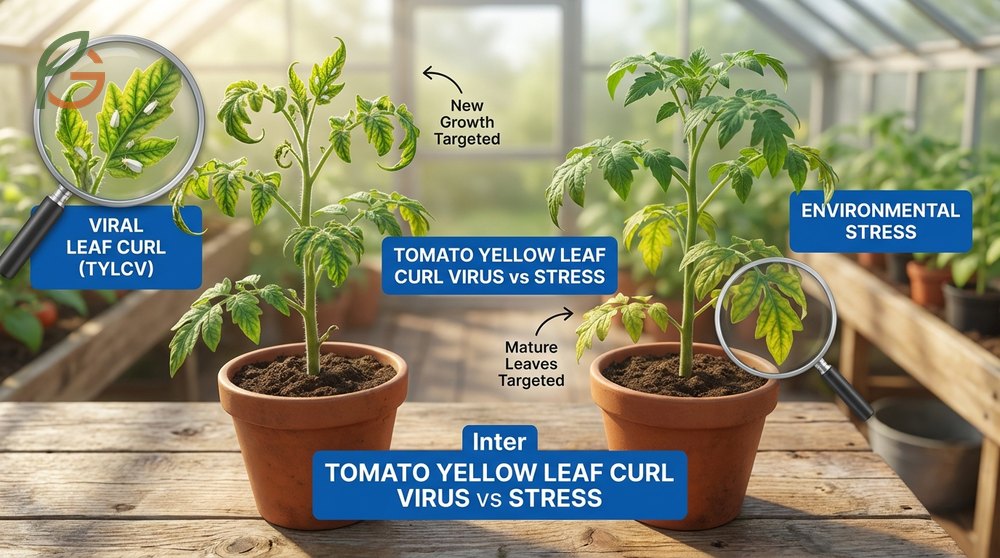
Tomato yellow leaf curl virus (TYLCV) creates symptoms that mimic environmental stress but progresses differently. Research shows that TYLCV, transmitted by tobacco whiteflies (Bemisia tabaci), causes yellowing between leaf veins, severe stunting, and upward leaf curl on new growth[7]. Unlike stress-induced curl that affects mature leaves first, viral infection targets youngest leaves and growing tips.
Evidence suggests that TYLCV-infected plants show yellowing plus curling together, while environmental stress maintains green color. Infected plants stop growing at 12-18 inches tall regardless of care, whereas stressed plants continue growing once conditions improve. Whitefly populations on leaf undersides confirm transmission risk—scouting for these tiny white insects helps catch infections early.
Studies demonstrate that TYLCV can’t be cured once infection establishes[8]. Removing infected plants prevents virus spread to healthy neighbors. Planting resistant varieties like Champion II F1 or Rally F1 provides the best defense in areas where TYLCV is common.
- TYLCV causes intense yellowing; environmental stress keeps leaves green
- Viral curl appears on newest growth first; stress affects lower leaves initially
- Infected plants stop growing permanently; stressed plants resume growth after relief
- Whitefly presence indicates high TYLCV transmission risk
- Resistant varieties maintain production; susceptible varieties lose 80-100% yield[7]
Warning: If you see yellowing plus curling together with stunted growth, test for whiteflies by shaking leaves gently. A cloud of tiny white insects confirms likely viral transmission—remove the plant immediately.
Tomato Plant Leaf Curl Remedy
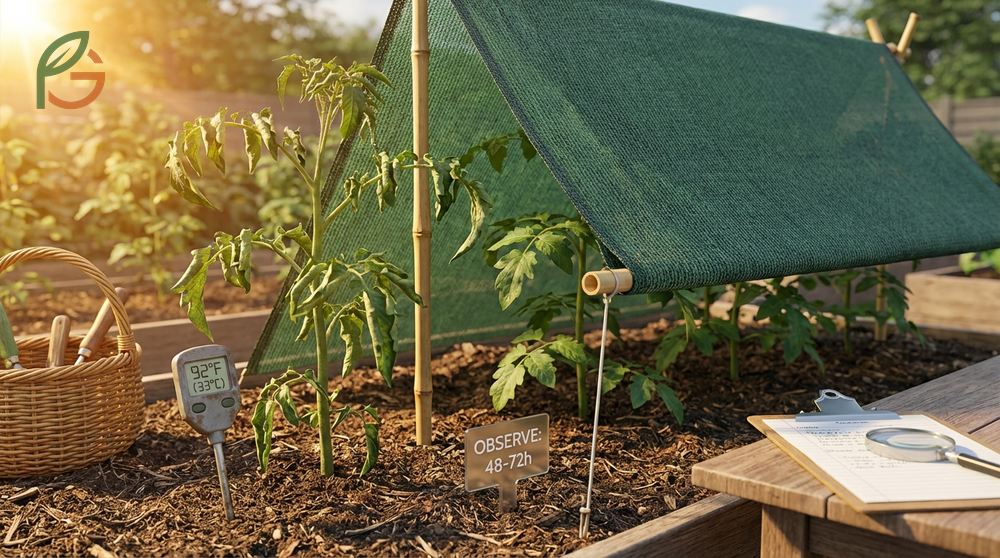
Treating leaf curl depends entirely on accurate diagnosis. Current agricultural guidance emphasizes observation over immediate intervention—watching symptom progression for 48-72 hours reveals whether you’re dealing with temporary stress or serious problems. For physiological curl, no treatment is needed since it doesn’t affect yields[1].
For heat stress above 90°F (32°C), install 30-50% shade cloth during peak afternoon hours (1-4 PM). Studies show this reduces leaf surface temperature by 10-15°F while maintaining enough light for photosynthesis and fruiting. Mulch application at 2-3 inch depth keeps soil cooler and more consistently moist.
Water stress fixes require establishing consistent moisture levels. Deep watering 2-3 times weekly beats daily shallow watering because it encourages deep root development. Aim for soil that’s moist 4-6 inches deep but not saturated—the squeeze test should produce a cohesive ball that crumbles under light pressure.
- Heat stress: Apply shade cloth reducing intensity by 40% during 1-4 PM
- Water deficit: Deep-water to 6 inches depth, checking moisture before each session
- Overwatering: Stop watering for 5-7 days, improve drainage with raised beds
- Herbicide damage: Flush soil with 2 inches of water if drift just occurred
- Viral infection: Remove and destroy infected plants in sealed bags
- Nitrogen excess: Apply phosphorus-heavy fertilizer (5-10-5 ratio) to rebalance
- Whitefly prevention: Spray insecticidal soap on leaf undersides weekly during risk periods[7]
Monitor plants daily after implementing fixes. Environmental stress typically improves within 3-5 days, while herbicide damage takes 2+ weeks to show new healthy growth. If symptoms worsen despite treatment, reassess your diagnosis—what looks like one problem might actually be multiple stressors combined.
Timing Matters: Early morning watering (6-8 AM) reduces disease risk compared to evening watering, which leaves foliage wet overnight and encourages fungal growth.
Conclusion
The evidence is clear: most tomato plant leaves curling cases result from harmless environmental adaptation rather than disease or pest damage. Current guidance emphasizes accurate diagnosis before treatment—observe symptom patterns, check for pest presence, and consider recent weather or chemical exposure. Your plants communicate their needs through leaf position, color changes, and growth patterns.
Remember that healthy tomatoes can handle temporary stress without intervention. Focus your efforts on maintaining consistent moisture, providing afternoon shade during heat waves above 90°F (32°C), and preventing whitefly infestations that spread viral diseases. FruitGarden synthesizes research-based strategies that protect your harvest while avoiding unnecessary treatments that waste time and resources.
Frequently Asked Questions
Why Are My Tomato Plant Leaves Curling Up?
Leaves curl up primarily due to heat stress above 90°F (32°C) or water imbalance. Research shows this upward curl reduces surface area exposed to heat and sun, cutting moisture loss by up to 40%. If leaves stay green and leathery, it’s harmless physiological adaptation that doesn’t affect fruit production.
How Do You Fix Leaf Curl on Tomato Plants?
For heat-induced curl, install 30-50% shade cloth during 1-4 PM peak sun hours. Water stress requires deep watering to 6 inches depth 2-3 times weekly rather than daily shallow watering. Studies demonstrate that physiological curl needs no treatment since it doesn’t reduce yields, while herbicide damage requires removal of severely affected plants.
Is Tomato Leaf Curl a Disease or Environmental?
Most tomato leaf curl is environmental stress, not disease. Current data indicates that 80-90% of cases result from temperature extremes, watering issues, or physiological adaptation. Viral leaf curl shows yellowing plus curling on new growth, while environmental curl maintains green color and affects lower leaves first—this distinction guides treatment decisions.
Can Tomatoes Recover From Curled Leaves?
Yes, tomatoes recover from environmental curl within 3-5 days once conditions improve. Evidence suggests that plants showing physiological roll continue producing normal fruit despite curled foliage. Herbicide-damaged plants take 2-8 weeks to resume growth, while viral infections cause permanent damage requiring plant removal.
What’s the Difference Between Herbicide Damage and Heat Stress?
Herbicide damage causes severe distortion, brittle stems, and affects all plants simultaneously within 24-72 hours. Heat stress creates upward curl without distortion, maintains normal stem flexibility, and develops gradually over 5-7 days. Agricultural data shows herbicide injury produces irregular fruit shapes, while heat-stressed plants grow normal fruit once temperatures moderate.
Should I Remove Tomato Plants With Curled Leaves?
Don’t remove plants showing only environmental curl—they’ll produce normally once stress ends. Research shows you should only remove plants with yellowing plus curling on new growth, which indicates viral infection that spreads to neighbors. Severely herbicide-damaged plants with stopped growth for 3+ weeks also warrant removal to free garden space for productive replacements.
How Do I Prevent Tomato Leaf Curl Next Season?
Plant resistant varieties like Champion II F1 or Rally F1 in areas with viral disease history. Install shade cloth infrastructure before heat waves arrive, and establish consistent watering schedules delivering 1-2 inches weekly. Studies demonstrate that avoiding heavy pruning (removing more than 30% of foliage at once) prevents physiological stress that triggers curl.