

How Long Do Strawberries Take To Grow? Research shows that strawberries need 60 to 90 days from planting to harvest when starting from bare root crowns or transplants[1]. Growing from seed takes longer—you’ll wait an entire first year before harvesting berries[2]. FruitGarden compiles current horticultural data to help home gardeners understand realistic timelines for strawberry cultivation across different growing methods.
Quick Answer
- Bare root strawberries produce first fruits in 3 months after planting[1]
- Seeds germinate in 1 to 6 weeks, typically 2-4 weeks with proper stratification[3]
- Flowers develop into ripe berries in 4 to 6 weeks[1]
- Day-neutral varieties produce continuously throughout summer, while June-bearing types concentrate harvest in 3 weeks[4]
How Long Do Strawberries Take To Grow

The timeline for growing strawberries depends heavily on your starting method. Most home gardeners plant bare root crowns or nursery transplants rather than seeds because they produce harvestable berries much faster. Starting from established plants gives you a three-month head start compared to seed propagation.
Studies show that bare root strawberries deliver their first harvest within 60 to 90 days after planting[1]. This compressed timeline makes strawberries one of the faster-producing fruit crops for backyard gardens. Day-neutral varieties prove especially rewarding for first-year harvests since they don’t require overwintering to reach peak production.
Growing strawberries from seed extends the timeline significantly—you won’t harvest berries until the second season. The extra year allows seedlings to develop robust root systems that support future fruit production. This patience pays off if you’re establishing a large patch or growing unique heirloom varieties unavailable as transplants.
Growing From Bare Root Crowns
Bare root crowns represent the fastest path to strawberry harvests. These dormant plants arrive with exposed roots wrapped in moist material, ready for immediate planting. Research confirms you’ll see first berries within three months when conditions support healthy establishment[1].
The crowns develop new leaves within 2 to 3 weeks after planting, followed by active flowering in another 3 to 4 weeks. This rapid vegetative growth happens because bare roots start larger than seedlings and have pre-formed energy reserves. Peak production typically ramps up four months after planting as the root system fully establishes.
From My Experience: My cousin in Guadalajara, Mexico planted bare root strawberries in March 2024. First berries appeared in 75 days versus the typical 60-90 day range, achieving successful establishment with consistent watering during warm spring conditions.
Growing From Seed
Growing strawberries from seed requires patience and precise timing. Seeds need cold stratification—exposure to temperatures around 50°F for 2 to 3 weeks—before they’ll germinate[5]. This mimics natural winter conditions that break seed dormancy.
After stratification, germination takes 1 to 6 weeks depending on temperature and moisture levels[3]. Seeds require light to sprout, so you’ll press them into soil surface rather than burying them. Once germinated, seedlings spend their entire first year building roots and foliage—experts recommend removing all flowers during this establishment period to redirect energy into vegetative growth[6].
Important Note: Start strawberry seeds indoors 10 to 12 weeks before your last spring frost date. Account for the 3 to 4 weeks needed for cold stratification before planting, bringing total advance planning to 14 to 16 weeks.
Strawberry Growth Stages Timeline

Understanding each growth stage helps you provide appropriate care at the right time. Strawberries progress through distinct phases from germination to harvest, with each stage requiring specific conditions. The complete lifecycle from seed to mature plant spans approximately one year, while established crowns compress this timeline into a single growing season.
Environmental factors like temperature, light exposure, and soil quality significantly affect how quickly plants move through growth stages. Optimal conditions can shorten timelines, while stress from heat, drought, or poor nutrition extends development periods. Most varieties show their fastest growth during cool spring weather with moderate temperatures.
Germination and Establishment
The germination phase begins after cold stratification when seeds are exposed to warmth and light. First sprouts emerge within a few days to two weeks under ideal conditions of 65-75°F and consistent moisture. Seeds positioned on the soil surface receive the light they need to trigger sprouting.
After germination, seedlings develop their first true leaves in 2 to 3 weeks. During this delicate establishment period, plants remain vulnerable to drying out or damping off disease. Transplanting into individual containers happens around week six, giving each seedling space to develop a stronger root system before moving outdoors.
Vegetative Growth Phase
Current data shows the vegetative growth phase lasts approximately six months for seedlings, though warm climates can extend this to a full year. During this period, plants focus entirely on developing leaves, stems, and roots rather than flowers or fruit. Established bare root plants complete this phase in just 2 to 3 months because they start with more developed systems.
Leaf production accelerates as plants mature, with new foliage emerging every few weeks. Root systems expand outward to capture nutrients and water—strawberry roots typically spread 8 to 10 inches wide while remaining shallow[7]. This shallow rooting pattern makes consistent watering critical since roots can’t reach deep soil moisture.
Flowering and Fruit Development
Flower bud formation begins when plants reach maturity, typically 3 to 4 weeks after active vegetative growth for bare root starts. The time from bud initiation to full bloom spans 1 to 3 weeks depending on temperatures and day length. Warmer spring weather accelerates flowering while cold snaps can delay it.
After pollination, fertilized flowers transform into strawberries over the next 4 to 6 weeks[1]. Fruits start green and gradually develop their characteristic red color as they ripen. Size, sweetness, and texture improve as berries approach full maturity—picking them too early results in tart, less flavorful fruit.
- Flower buds form 3-4 weeks after transplanting bare root crowns
- Buds take 1-3 weeks to open into full flowers
- Green fruits appear within days of successful pollination
- Berries mature from green to white to red over 4-6 weeks
- June-bearing varieties concentrate harvest into a 3-week window
- Day-neutral types produce continuously through summer and fall
Strawberry Root and Seed Facts

Strawberries develop shallow fibrous root systems that concentrate near the soil surface. In heavy clay soils, all roots remain within the top 6 inches, while sandy soils allow penetration up to 1 foot deep[8]. This shallow rooting makes strawberries vulnerable to both drought and waterlogging since they can’t access deep soil moisture or escape surface water.
Root spread typically extends 8 to 10 inches outward from the crown, matching the span of the leaf canopy[7]. Beyond this primary root zone, plants send out runners (stolons) measuring 8 to 18 inches long that form new daughter plants[9]. These runners represent the plant’s natural propagation method, creating genetically identical clones that establish their own root systems.
Each strawberry carries approximately 200 seeds on its exterior surface, making it the only common fruit with seeds on the outside rather than inside[10]. These tiny seeds are actually individual fruits called achenes, while the fleshy red part we eat is the enlarged flower receptacle. While viable for propagation, these seeds produce offspring with variable genetics unlike the parent plant.
This table compares harvest timing, production patterns, and first-year yields across three main strawberry variety types
| Variety Type | Harvest Period | Production Pattern | First Year Yield |
|---|---|---|---|
| June-bearing | Late May to early June | Single 3-week harvest[11] | Low (peaks year 2) |
| Everbearing | Late spring, midsummer, early fall | 2-3 smaller flushes per season | Moderate |
| Day-neutral | Continuous summer to fall | Steady production in cool weather[4] | High |
- Roots penetrate only 6-12 inches deep, requiring frequent shallow watering
- Root spread matches leaf canopy width at 8-10 inches from crown center
- Runners extend 8-18 inches to establish daughter plants naturally
- Each berry contains approximately 200 seeds visible on its exterior
- Seeds produce variable offspring, making runners preferable for propagation
- Shallow roots make plants susceptible to frost heaving in winter
- Root systems reach maximum development by late summer of first year
Planting Depth Matters: Position strawberry crowns so the roots sit just below soil level while the crown remains exposed. Planting too deep causes rot, while too shallow leads to drying out—both mistakes cut yields significantly or kill plants.
Best Time To Plant Strawberries
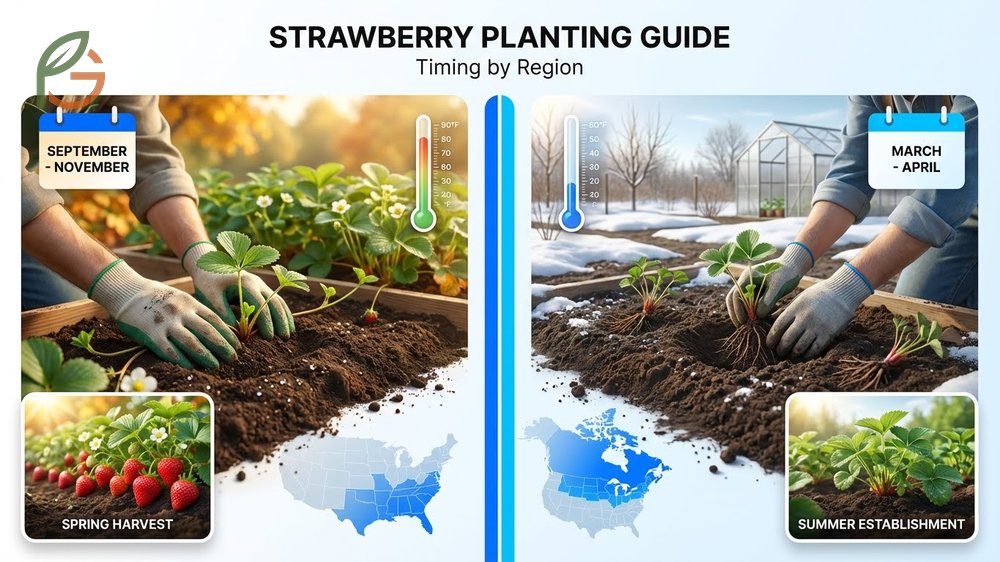
Spring planting works best for most U.S. growing zones, with the optimal window opening when soil becomes workable and temperatures consistently stay above 50°F. For zones 3 through 6, this sweet spot typically falls between March and May, giving plants a full growing season to establish before winter. Planting 4 to 6 weeks before the last frost date allows roots to develop during cool conditions ideal for strawberries.
Warmer regions in zones 7 through 10 benefit from fall planting around October instead. High summer temperatures stress strawberry plants since they’re cool-season crops that struggle in intense heat. Fall establishment lets plants develop strong root systems during mild weather, positioning them for robust spring production.
Container-grown strawberries offer more flexibility in planting times compared to bare roots. You can transplant potted starts almost any time during the growing season as long as you provide extra water and shade during establishment. However, spring and fall still represent ideal windows that minimize transplant shock and support faster root development.
Evidence indicates that timing affects first-year harvest success significantly. June-bearing varieties planted in spring typically require overwintering before producing substantial crops the following summer. Day-neutral strawberries planted in early spring start producing within 3 months and continue through fall, making them the preferred choice for gardeners wanting first-year harvests[1].
Conclusion
The evidence shows that How Long Do Strawberries Take To Grow depends primarily on whether you start from bare roots, transplants, or seeds. Bare root crowns and nursery plants deliver harvests within 60 to 90 days, while seed propagation requires patience through an entire first year of establishment. Day-neutral varieties offer the fastest path to backyard berries for gardeners seeking first-season production.
Current horticultural guidance emphasizes matching variety selection to your harvest goals and climate zone. Success comes from proper timing, adequate spacing, and consistent care during establishment—particularly maintaining soil moisture for shallow-rooted plants. FruitGarden synthesizes research-based growing timelines to help home gardeners set realistic expectations and achieve rewarding strawberry harvests.
Frequently Asked Questions
How long does it take for strawberries to grow from seed to fruit?
Growing strawberries from seed to first harvest takes one full year. Seeds require 2-4 weeks for germination after cold stratification, then seedlings spend their entire first growing season establishing roots and foliage. You’ll harvest berries in the second year after plants overwinter and reach maturity.
Can strawberries produce fruit in their first year?
Yes, but only when starting from bare root crowns or transplants rather than seeds. Day-neutral varieties planted from crowns produce berries within 3 months and continue through the season. June-bearing types typically wait until their second year for peak production, though they may produce a few berries in year one.
How long do strawberry flowers take to become fruit?
Strawberry flowers develop into ripe berries in 4 to 6 weeks after pollination. The fruit starts green and gradually changes to white, then red as it matures. Temperature affects this timeline—warmer conditions speed development while cool weather extends it.
Do strawberries have seeds and how many?
Yes, strawberries have seeds—approximately 200 per berry—visible as tiny specks on the fruit’s exterior surface. Strawberries are unique as the only common fruit with seeds on the outside. Each “seed” is technically a separate fruit called an achene containing the actual seed inside.
How deep do strawberry roots grow?
Strawberry roots remain very shallow, penetrating only 6 inches deep in heavy clay soils and up to 1 foot in loose sandy soils. The shallow root system spreads 8-10 inches wide from the crown. This limited depth makes strawberries vulnerable to drought and requires consistent watering during dry periods.
How fast do strawberry runners grow?
Strawberry runners develop after the main fruiting period, typically in mid to late summer. Individual runners grow 8 to 18 inches long over several weeks, with daughter plants forming at the tips. These runners root quickly when they contact soil, establishing new plants within 2-3 weeks.
What’s the best time to plant strawberries in the United States?
Spring planting works best for zones 3-6, with ideal timing 4-6 weeks before the last frost (typically March through May). Warmer zones 7-10 should plant in fall around October to avoid summer heat stress. Day-neutral varieties planted in spring produce berries the same year, while June-bearing types peak in their second season.





