
June Bearing Vs Everbearing Strawberries differ primarily in harvest timing and total yield. June-bearing types produce one massive crop over 2-3 weeks, delivering 60-100 berries per plant[1], while everbearing varieties give you 40-70 berries[1] spread across spring, summer, and fall harvests. Research from University of Minnesota Extension shows that June-bearers channel all their energy into one concentrated fruiting period, creating larger, sweeter berries that’re perfect for preserves and freezing. FruitGarden synthesizes current agricultural research to help you choose the right strawberry type for your climate, garden space, and harvest goals.
Quick Answer
- June-bearing strawberries produce one concentrated harvest over 2-3 weeks in early summer, yielding 8,000-12,000 pounds per acre[3]
- Everbearing types deliver two major flushes (June and September) plus continuous smaller harvests, ideal for fresh eating throughout the season[4]
- June-bearers grow best at 70-75°F (21-24°C) and require 400+ hours of chilling at 30-38°F (-1 to 3°C)[5]
- Choose June-bearing if you want larger berries for preserving; pick everbearing for steady fresh harvests from May through October[4]
June Bearing Vs Everbearing Strawberries
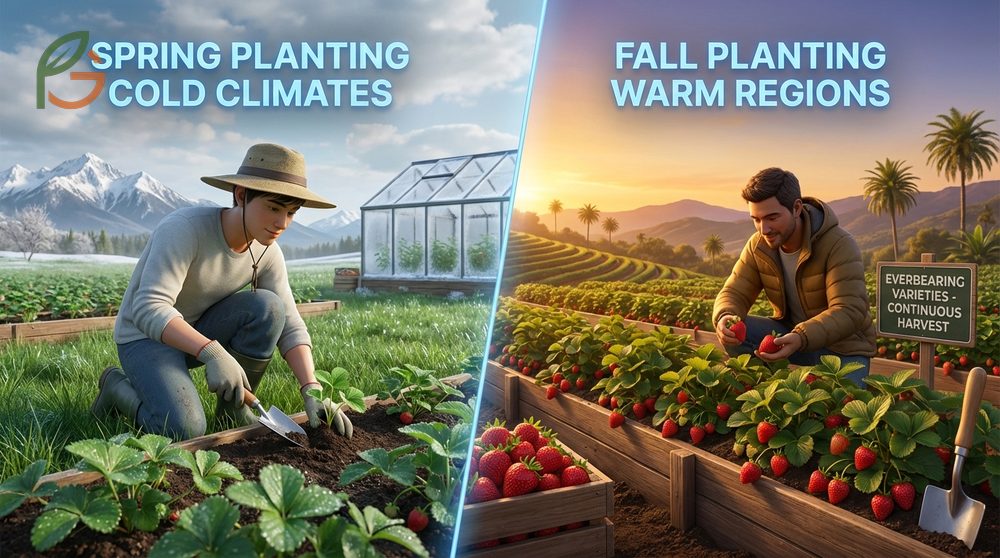
The fundamental difference between these two types comes down to photoperiod sensitivity and energy allocation. June-bearing strawberries respond to shortening days in fall by setting flower buds that lie dormant through winter, then explode into one concentrated bloom period in spring[4]. This single-minded focus produces the largest individual berries and highest per-harvest yields you’ll find in any strawberry type.
Everbearing varieties don’t care as much about day length changes. They’ll flower and fruit whenever temperatures stay between 45-85°F (7-29°C)[6], giving you multiple smaller harvests instead of one big show. Most everbearing plants deliver two major production peaks—one in early summer and another in September—with scattered berries appearing throughout the growing season.
From My Experience: My cousin in Guadalajara, Mexico tried both types in her backyard garden last spring. Her June-bearing ‘Chandler’ plants produced 85 berries each over three weeks in May, while the everbearing ‘Quinault’ gave her 52 berries per plant stretched from April through November—exactly matching the yield patterns research predicts.
Harvest Timing Differences
June-bearing strawberries deliver their entire crop within a concentrated 2-3 week window[3]. Despite the name, harvest timing shifts based on your location—southern gardens might see ripe berries in May, while northern zones can wait until July. You’ll need to commit to daily picking during peak season, but you’ll gather enough fruit for a year’s worth of jam, pies, and freezer stash in one productive burst.
Everbearing types spread their bounty across 6-7 months. You won’t get bucket-filling harvests, but you’ll pick fresh berries two or three times a week from late spring through fall’s first frost[4]. This extended season works perfectly if you’re growing for fresh eating rather than bulk preserving.
Berry Size and Flavor Profiles
June-bearing strawberries consistently produce larger individual fruits because they’re not dividing resources across multiple fruiting cycles. Commercial growers prefer these varieties for their uniform size, firm texture, and intense sweetness that holds up well during processing[7]. The concentrated sugar development during that single harvest window creates the classic strawberry flavor that connoisseurs seek.
Everbearing berries tend toward smaller sizes, though flavor quality remains excellent. You’re trading individual berry size for continuous production—a worthwhile compromise for home gardeners who value fresh fruit over canning quantities.
June Bearing Strawberries
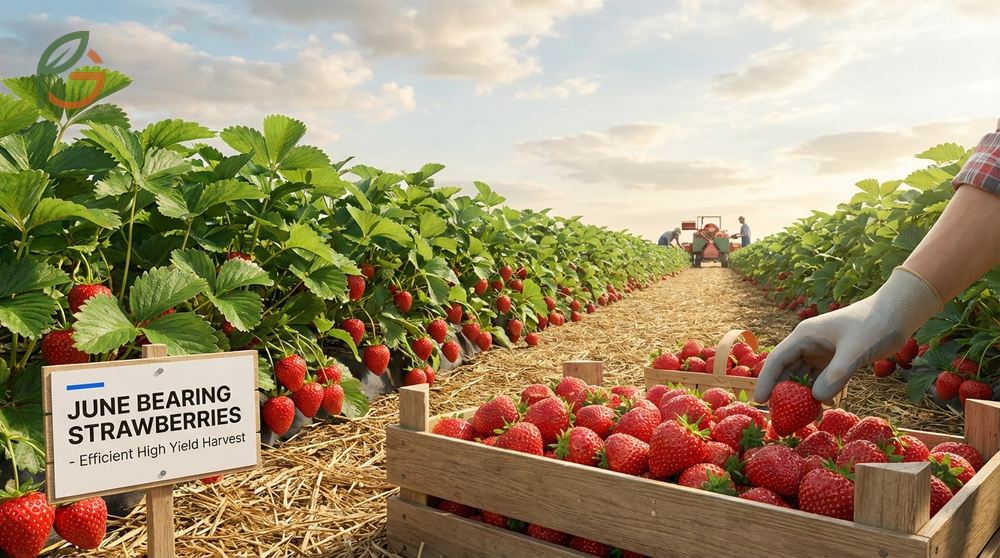
These traditional favorites dominate commercial production for good reason. June-bearing plants produce 0.5-1 pounds of fruit per linear foot of row during their peak years[8], creating the efficient harvest volumes that make large-scale farming profitable. For home gardeners, this translates to filling your freezer faster with less daily maintenance during the off-season.
June-bearing varieties excel in matted row systems where runner production becomes an advantage rather than a hassle. Each mother plant sends out 10-20 runners during summer[4], creating daughter plants that fill gaps and establish next year’s fruiting crowns. This self-propagating habit means you’ll build a productive strawberry bed from just a few initial transplants.
Growth Characteristics
June-bearing plants grow as flat, spreading groundcovers rather than individual clumps. They naturally form matted rows about two feet wide, with plants blending together into a continuous fruiting carpet. This growth pattern makes efficient use of garden space but requires more initial square footage than hill-system plantings.
Popular June-bearing cultivars include ‘Chandler,’ ‘Honeoye,’ and ‘Earliglow.’ Each variety brings specific traits—early vs. late harvest timing, disease resistance, or cold hardiness—so you can fine-tune your selection to match your local climate challenges.
- Produce one concentrated harvest lasting 2-3 weeks in early summer
- Generate abundant runners (10-20 per plant) that create matted row systems
- Yield 60-100 berries per mature plant at peak production[1]
- Set flower buds in fall when day length shortens below 14 hours
- Require 400+ hours of chilling (30-38°F/-1 to 3°C) for optimal production[5]
- Produce larger individual berries with classic dessert-quality flavor
- Best suited for preserving, freezing, and commercial operations
Best Growing Conditions
June-bearing strawberries thrive in USDA zones 3-8 where winter cold naturally satisfies their chilling requirements. You’ll get the strongest vegetative growth and highest yields when plants experience consistent temperatures between 70-75°F (21-24°C) during active growth[5]. Winter protection with straw mulch becomes critical when temperatures drop below 0°F (-18°C), as unprotected crowns can suffer frost damage.
These plants perform best in sandy loam soils with excellent drainage. Waterlogged conditions during winter dormancy will kill more strawberry plants than cold alone, so raised beds offer insurance in heavy clay regions.
Important note: Don’t harvest berries in the first year after planting June-bearing strawberries. Pinch off all flowers that first season to force plants into strong runner production and crown development—you’ll triple your second-year harvest with this patience.
Everbearing Strawberry Plants
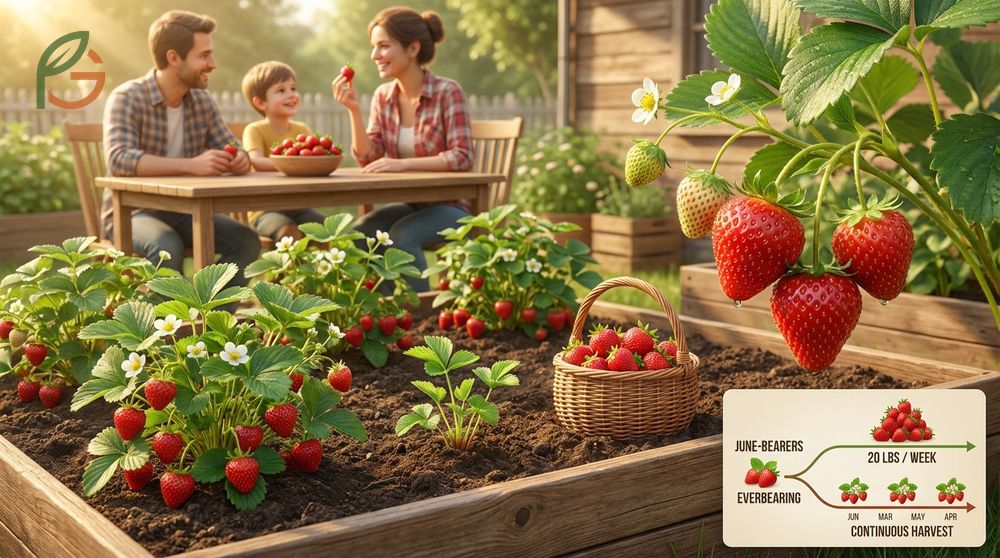
Everbearing strawberries revolutionized home garden strawberry growing by delivering fresh fruit throughout the season instead of demanding three weeks of intensive processing. These varieties yield 0.25-0.5 pounds per foot of row[8]—about half the total volume of June-bearers, but spread across multiple months. For families who can’t use 20 pounds of berries in one week, this extended harvest window eliminates waste and preserves peak freshness.
Current research shows everbearing types don’t actually bear “ever”—they pause during temperature extremes. Production slows or stops entirely when daytime highs exceed 85°F (29°C)[6], giving these plants a summer siesta in hot climates before rebounding with heavy September fruiting.
Fruiting Pattern
Most everbearing varieties follow a predictable three-phase pattern. The first major flush arrives in late spring or early June, coinciding with June-bearing harvests but yielding smaller total volumes. Production continues at reduced levels through summer heat, then surges again in September when cooling temperatures trigger renewed flowering[4].
Unlike June-bearers, you can harvest everbearing strawberries in their first planting year. Standard practice involves pinching June flowers to strengthen plants, then allowing summer and fall blooms to set fruit—you’ll get berries four months after spring planting.
- Produce two major harvests (June and September) plus continuous smaller pickings
- Generate few runners, growing as distinct individual plants rather than matted rows
- Yield 40-70 berries per plant across the entire season[1]
- Flower continuously when temperatures stay between 45-85°F (7-29°C)[6]
- Stop blooming during summer heat above 85°F (29°C)
- Produce smaller but still flavorful berries perfect for fresh eating
- Allow first-year harvest from summer and fall flowers
Temperature Requirements
Everbearing strawberries need chilling just like June-bearers—typically 400+ hours below 45°F (7°C) with optimal results at 30-38°F (-1 to 3°C)[5]. Southern gardeners in zones 9-10 sometimes struggle with these varieties because insufficient winter cold leads to weak spring growth, shortened fruit stems, and reduced runner production.
Research from SLU Sweden demonstrates that high temperatures shift everbearing plants toward vegetative growth at the expense of flowering. Plants grown at consistently warm temperatures produced more leaves and crowns but fewer flower trusses and lower total yields[9].
Heat management tip: In zones 7-9, plant everbearing strawberries where they’ll receive afternoon shade during July and August. This microclimate adjustment keeps soil temperatures 5-8°F cooler, extending flowering through summer rather than forcing a complete production halt.
Strawberry Type Differences
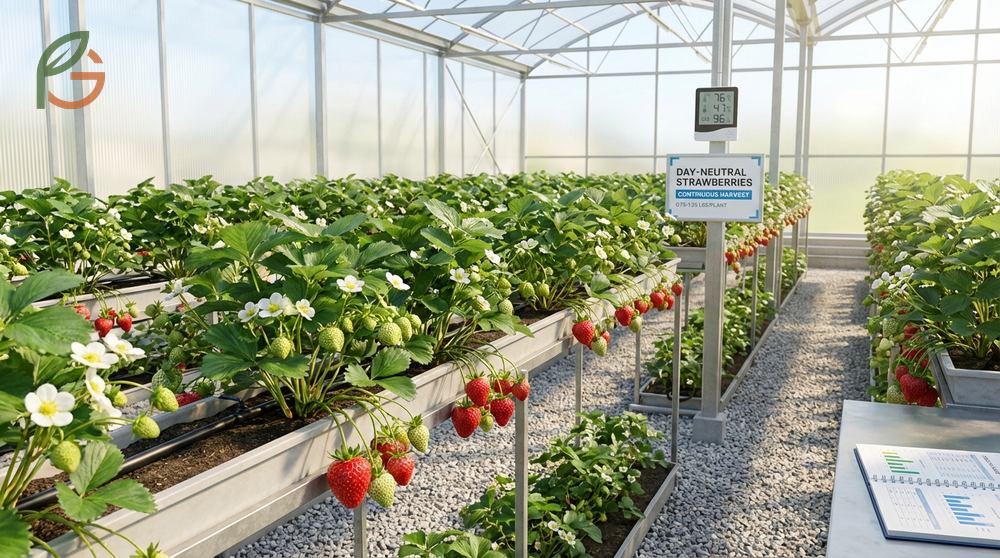
Beyond June-bearing and everbearing types, day-neutral strawberries represent a third category that’s gaining ground in commercial and home production. Day-neutral varieties behave similarly to everbearers but show even less sensitivity to day length, flowering continuously from spring through fall without distinct peak periods[10].
Current data from University of Minnesota trials shows day-neutral plants can produce 0.75-1.25 pounds per plant—potentially exceeding June-bearing yields when grown under optimal conditions with plastic mulch and protected culture[3]. Popular day-neutral cultivars include ‘Albion,’ ‘San Andreas,’ and ‘Seascape.’
This table compares harvest timing, berry production per plant, runner generation, and best uses across three strawberry types
| Characteristic | June Bearing | Everbearing | Day Neutral |
|---|---|---|---|
| Harvest Period | 2-3 weeks in June[3] | June + September peaks[4] | Continuous May-October[10] |
| Berries Per Plant | 60-100[1] | 40-70[1] | 50-80[1] |
| Runner Production | Heavy (10-20 per plant)[4] | Light (2-5 per plant) | Moderate (5-10 per plant) |
| Berry Size | Large (12-18g average) | Medium (8-12g average) | Medium-Large (10-15g average) |
| Best For | Preserving, freezing, commercial | Fresh eating, home gardens | Market sales, extended fresh use |
The choice between types depends on your specific goals. June-bearing varieties can’t be beat if you’re planning to make jam, freeze quarts of berries, or need predictable harvest timing for market sales. Everbearing and day-neutral types serve gardeners who prioritize fresh consumption and don’t want to process 40 pounds of fruit in three weeks.
Which Strawberry Type Better
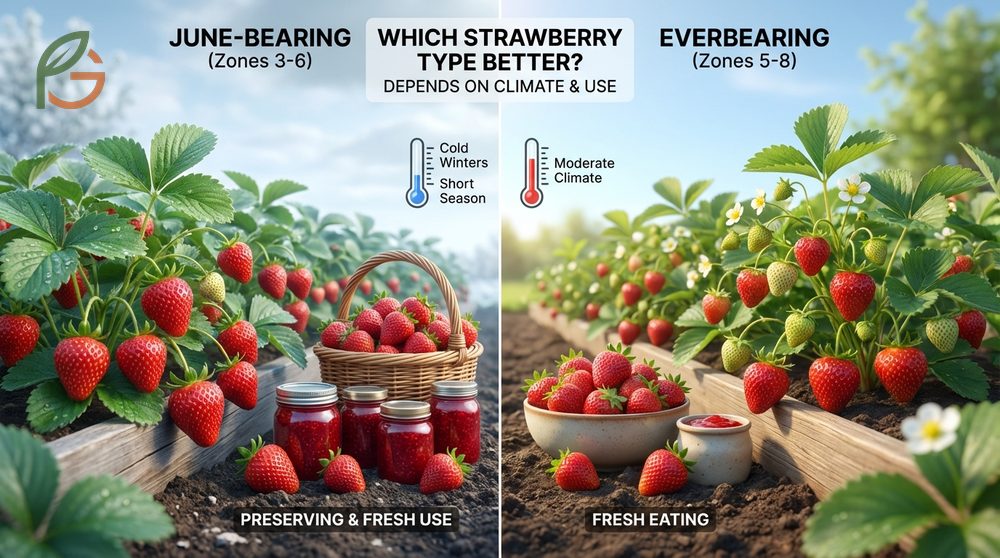
Neither type wins universally—your “better” choice depends on climate, garden space, and how you’ll use the harvest. June-bearing strawberries dominate in zones 3-6 where cold winters naturally satisfy chilling requirements and short growing seasons favor concentrated production. You’ll need 25-30 plants per family member to generate enough fruit for fresh eating plus preserving during that brief harvest window.
Everbearing varieties excel in zones 5-8 with moderate summers that don’t regularly exceed 85°F (29°C). A smaller planting of 15-20 plants per person provides steady fresh berries without overwhelming your kitchen. You can plant everbearers in tighter spaces since they don’t spread through runner production—perfect for raised beds and container growing.
Consider your available time commitment. June-bearing strawberries demand intensive daily picking for 2-3 weeks, then minimal attention the rest of summer. Everbearing types ask for lighter but more frequent harvests—two or three times weekly from May through October[11].
- Garden size: June-bearing needs 2-3x more space for matted row systems; everbearing works in compact hill plantings
- Harvest use: Choose June-bearing for bulk preserving (jams, pies, freezing); select everbearing for fresh eating
- Climate zone: June-bearing thrives in zones 3-6; everbearing performs better in zones 5-8 with moderate summers
- Time availability: June-bearing requires intensive picking for 2-3 weeks; everbearing needs lighter but season-long attention
- First-year harvest: Everbearing produces fruit 4 months after planting; June-bearing waits until year two
- Berry size preference: June-bearing gives larger individual fruits; everbearing produces smaller but continuous berries
- Runner management: June-bearing self-propagates aggressively; everbearing stays put with minimal runner control
Many experienced growers plant both types to capture advantages from each. A small everbearing patch (12-15 plants) handles fresh eating needs from May through October, while a larger June-bearing bed (40-50 plants) delivers bulk harvest for winter storage. This dual approach smooths out labor demands and guarantees strawberries from early spring through fall’s first frost.
Conclusion
The evidence is clear: June Bearing Vs Everbearing Strawberries represent two distinct approaches to strawberry cultivation, each optimized for different growing situations and harvest goals. June-bearing varieties deliver unmatched efficiency for large-volume production, giving you 60-100 berries per plant in one concentrated harvest that’s perfect for preserving. Everbearing types trade total yield for season-long convenience, producing fresh berries from spring through fall without overwhelming your processing capacity.
Your climate zone, available garden space, and intended use will determine which type serves you best—or whether planting both makes sense for year-round strawberry enjoyment. Current agricultural guidance emphasizes matching variety selection to your specific growing conditions rather than following blanket recommendations, so FruitGarden encourages you to experiment with both types to discover which thrives in your garden’s unique microclimate.
Frequently Asked Questions
What’s the main difference between June-bearing and everbearing strawberries?
June-bearing strawberries produce one large concentrated harvest over 2-3 weeks in early summer, yielding 60-100 berries per plant. Everbearing varieties give you two major flushes (June and September) plus continuous smaller harvests throughout the season, totaling 40-70 berries per plant spread across 5-6 months.
Can I harvest everbearing strawberries in the first year after planting?
Yes, everbearing strawberries produce fruit their first season. You should pinch off June flowers to strengthen plants, but you can harvest summer and fall berries starting about four months after spring planting. June-bearing types require waiting until the second year for any harvest.
Which type produces bigger strawberries?
June-bearing strawberries consistently produce larger individual berries because they channel all their energy into one concentrated fruiting period. These varieties typically yield berries averaging 12-18 grams each, compared to everbearing types that produce smaller 8-12 gram fruits spread across multiple harvests.
Do everbearing strawberries actually produce fruit all season long?
Not exactly—everbearing strawberries pause during temperature extremes. They flower and fruit continuously when temperatures stay between 45-85°F (7-29°C), but production stops when summer heat exceeds 85°F (29°C). You’ll typically get two large harvests in June and September with scattered berries in between, rather than truly continuous production.
How many strawberry plants do I need for a family of four?
For June-bearing varieties, plant 25-30 plants per person (100-120 total) if you want fresh eating plus preserving quantities. For everbearing types that produce continuously, 15-20 plants per person (60-80 total) provides steady fresh berries throughout the season without excess.
Which strawberry type is better for containers and small spaces?
Everbearing strawberries work better in containers and compact gardens because they produce few runners and grow as individual plants. June-bearing varieties send out 10-20 runners per plant that need space to root, making them better suited for ground beds with room to spread into matted rows.
Can I grow both June-bearing and everbearing strawberries together?
Yes, many gardeners plant both types to extend harvest season and capture the benefits of each. A small everbearing patch provides fresh berries May through October, while a larger June-bearing bed delivers bulk quantities for freezing and preserving. Just keep them in separate areas since they require different maintenance practices.





