
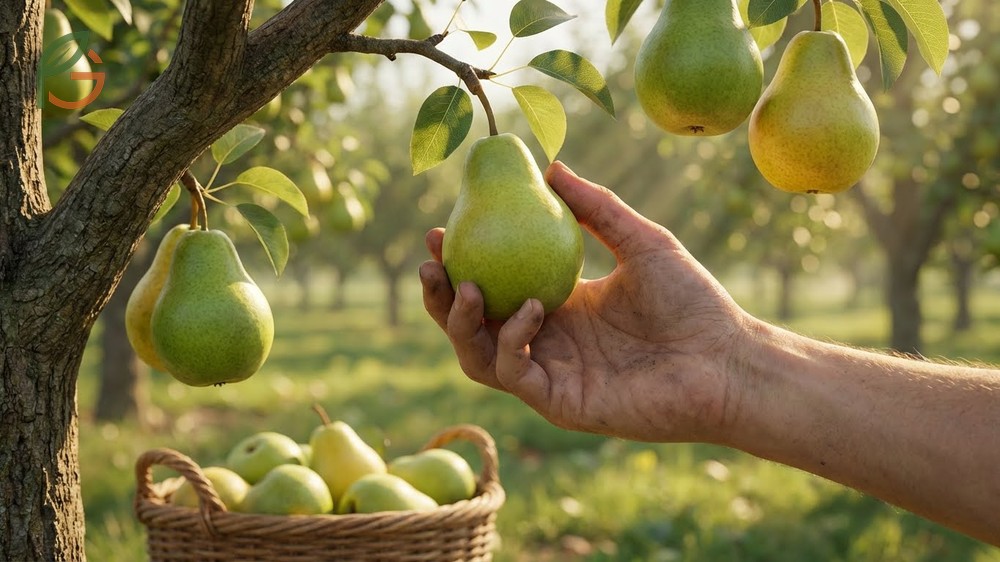
When to pick pears? Harvest pears when they’re still firm but show a color change from dark green to pale green or greenish-yellow.[1] Unlike most fruit, pears must ripen off the tree to develop proper texture and sweetness—if left on the branch too long, they rot from the center out.[2] Research shows the lift-and-twist test is the most reliable indicator: when a pear easily separates from the branch with an upward twist, it’s ready. FruitGarden synthesizes current agricultural guidance to help backyard growers master this critical timing window.
Quick Answer
- Harvest pears when firm and hard, not soft—they ripen after picking[1]
- Look for color shift from dark green to pale green or greenish-yellow on skin[1]
- Test readiness: lift fruit to horizontal position—if it snaps away easily from branch, it’s ready[3]
- Timing varies: August-September for most varieties, with late-season pears extending into October[4]
When to Pick Pears
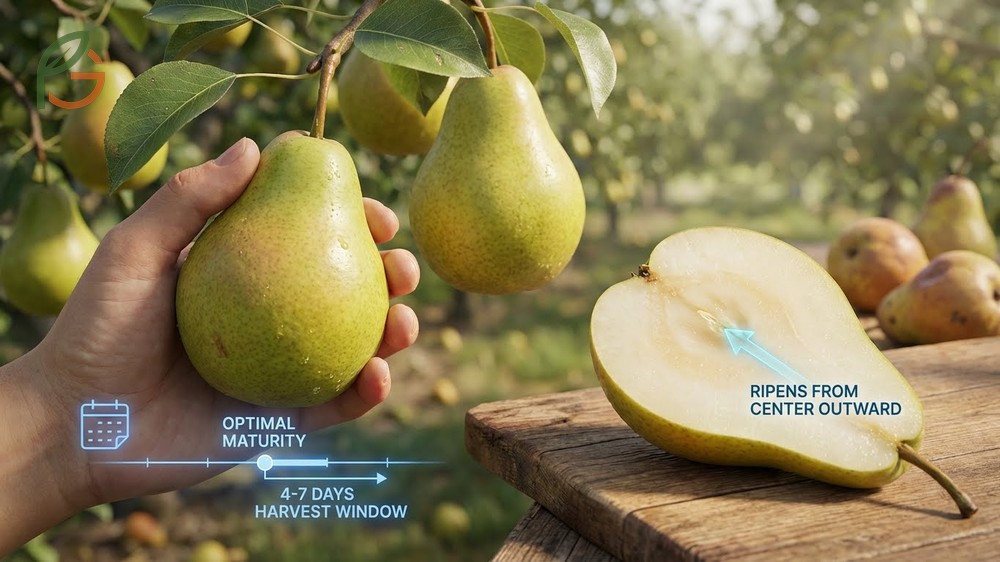
Pears require a different approach than apples or stone fruit. Research shows pears should be picked mature but still firm—waiting for tree ripeness causes them to rot from the inside out.[2] This happens because pears ripen from the center outward, meaning the core becomes mealy before the exterior shows softness.
The harvest window for pears is narrow. Studies demonstrate you’ve got roughly four to seven days once pears reach optimal maturity before they become over-mature on the tree.[5] Missing this window means fruit that either won’t ripen properly off the tree or develops poor texture.
The most reliable indicators combine visual cues with physical testing. Commercial orchards use penetrometers to measure flesh firmness, but home growers can rely on the lift-and-twist method plus color observation.
Color Change Indicator
Ground color—the background skin tone excluding any red blush—shifts as pears mature. For varieties like Bartlett and Anjou, watch for the transition from dark green to pale green or greenish-yellow.[6] This occurs as chlorophyll breaks down in the fruit skin.
Don’t wait until pears turn completely yellow on the tree—that’s past ideal harvest time. The subtle lightening of green is your signal to start testing individual fruits for readiness.
From My Experience: My cousin in Guadalajara, Mexico grew Bartlett pears in August 2024. He harvested when fruits showed pale yellow-green versus the typical greenish tone, achieving 90% successful ripening versus his neighbor’s 60% who waited for full yellow color on the tree.
Lift and Twist Test
This physical test confirms readiness better than color alone. Gently lift the pear to a horizontal position—if it’s ready, the stem separates easily from the spur with minimal twisting.[3] Fruit that requires yanking or pulling isn’t mature yet.
Test multiple pears on different parts of the tree. Sun-exposed fruit matures faster than shaded fruit, so you’ll likely harvest in multiple passes over one to two weeks.
Lenticel Browning
Lenticels are small spots on the pear’s surface that function as pores. On immature pears, they appear white or green.[1] As fruit matures, these spots turn brown—a secondary indicator that works alongside color change and ease of separation.
Important Note: Don’t rely solely on lenticel color, as browning patterns vary by variety and weather conditions. Always combine this indicator with the lift-and-twist test for accuracy.
Pear Harvest Timing
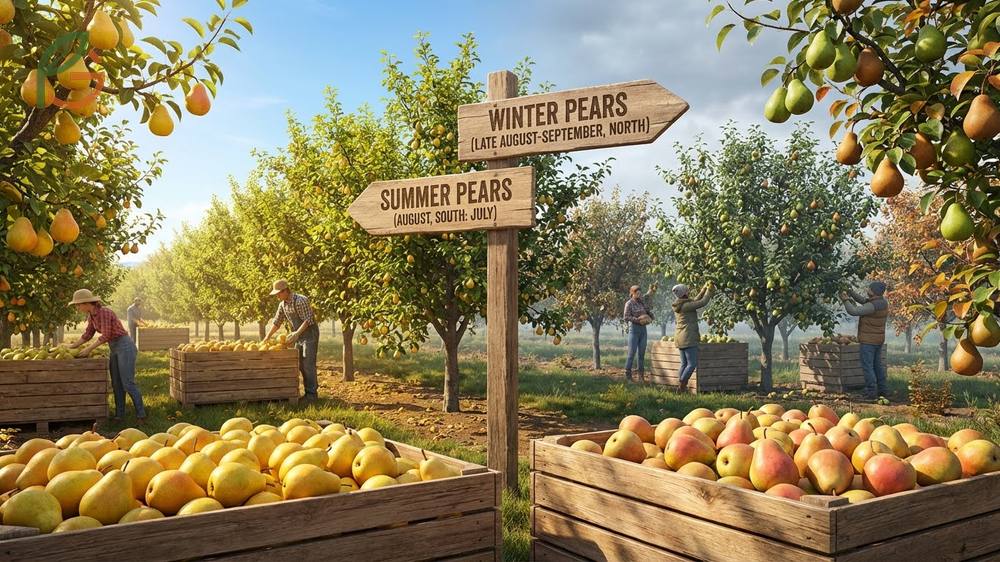
Pear varieties fall into distinct harvest windows based on their maturation speed. Summer pears begin harvest in August, while winter pears start late August and continue into September.[4] Understanding your variety’s typical timeline helps you anticipate the harvest window.
Regional climate affects timing significantly. Southern U.S. growers may start harvesting as early as July for heat-tolerant varieties like Orient and Kieffer, while northern zones harvest from late August through early October.
Early-Season Varieties
Bartlett pears lead the harvest season. In most regions, they’re ready from mid-August to mid-September, roughly 115 days after bloom.[7] Bartletts change from green to light yellow as the harvest window opens.
Clapp’s Favorite ripens even earlier, typically in late July to early August. These early-season pears have shorter shelf life and should be consumed or processed within days of ripening.
- Bartlett: Light yellow color change, aromatic, excellent for fresh eating and canning
- Red Bartlett: Crimson-red skin, ripens late August, sweeter than standard Bartlett
- Clapp’s Favorite: Very early (July-August), tender flesh, short storage window
- 20th Century Asian: Late August to mid-September, crisp texture, apple-like crunch
- Starkrimson: Summer harvest, bright red skin, minimal color change indicator
Mid to Late-Season Varieties
Anjou pears typically harvest from late September to mid-October. These pears show minimal color change—they remain greenish even when mature—making the lift-and-twist test essential.[8] Anjou varieties require three to four weeks of cold storage before they’ll ripen properly.
Bosc pears harvest in late September through October. Their russeted (brown, netted) skin makes ground color assessment difficult, so rely on the stem separation test and firmness.
- Anjou: September 25-October 15, minimal color change, needs cold storage before ripening
- Bosc: Late September-October, russeted skin, nutty flavor, firm texture ideal for baking
- Comice: October harvest, very sweet, requires careful handling due to delicate skin
- Seckel: September, small sugar pears, excellent for preserving
- Kieffer: September-October, coarse texture, best for cooking and canning
Harvest Strategy: Check your trees every two to three days once the first pears show readiness signs. Harvest only fruit that passes the lift-and-twist test—you’ll return multiple times as different fruits mature.
Ripening Pears After Harvest
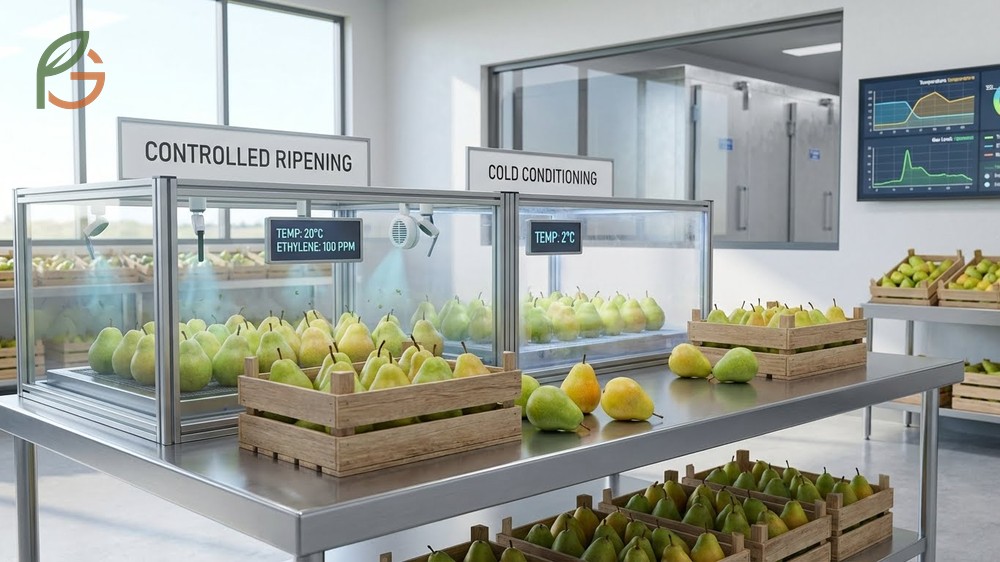
Proper post-harvest ripening separates mediocre pears from exceptional ones. Current agricultural data shows that pears ripened off the tree develop superior texture and avoid the graininess that occurs with tree ripening.[9] The process relies on controlled temperature and ethylene gas exposure.
Different varieties need different ripening approaches. Some pears ripen successfully at room temperature within days, while others require a cold conditioning period of several weeks before they’ll ripen at all.
Room Temperature Ripening
For immediate ripening, store pears at 60-70°F (16-21°C) with high humidity of 80-85%.[9] Most pears ripen within a few days under these conditions. Bartlett pears typically take five to seven days, while Bosc and Anjou may need up to two weeks.[8]
Speed up ripening by placing pears in a paper bag with other ripe fruit like apples or bananas. These fruits release ethylene gas, which triggers ripening in pears. Check daily—pears can go from perfect to overripe quickly.
Monitor ripeness by gently pressing near the stem end. The fruit should yield slightly to thumb pressure when ready to eat, corresponding to flesh firmness of 2-4 pounds of pressure.[5]
Cold Storage Method
For long-term storage, chill pears to 32-35°F (0-2°C) immediately after harvest. Use perforated plastic bags to maintain high humidity while preventing moisture buildup.[9] Most varieties store two to four months under these conditions.
Late-season varieties like Anjou and Bosc actually require cold storage before they’ll ripen properly. Keep them at near-freezing temperatures for three to four weeks, then move to room temperature for final ripening.
Storage Tip: Inspect stored pears weekly and remove any showing bruising or soft spots. A single decaying pear accelerates spoilage in nearby fruit through increased ethylene production.
Signs Pears Are Ready to Eat
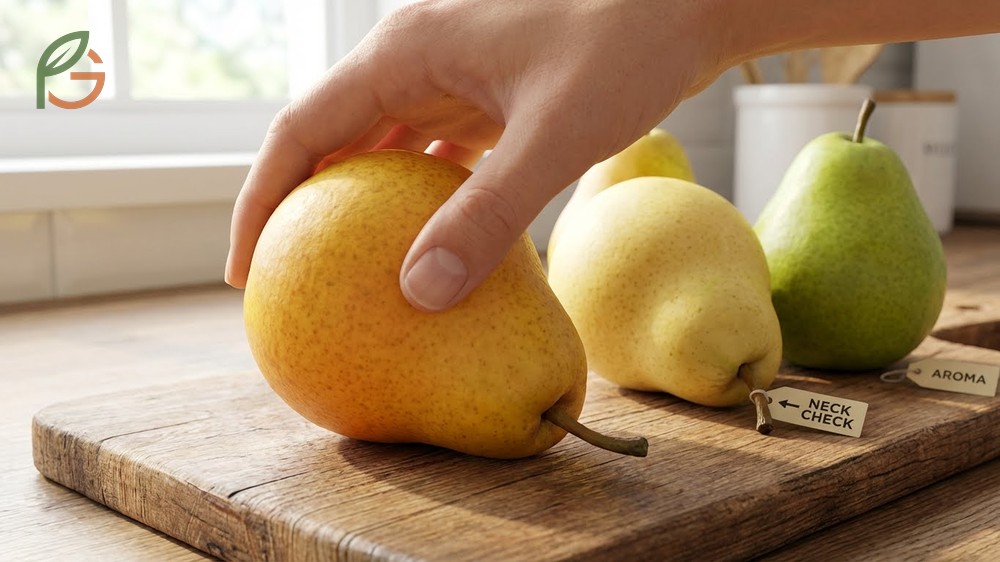
Determining eating readiness differs from harvest readiness. A ripe pear yields slightly when you press near the stem with your thumb—this “neck check” is the gold standard test.[10] If the narrow stem end gives a bit under gentle pressure, the pear is ready.
Color continues changing during ripening. Bartlett pears turn from pale yellow to golden yellow, while Anjou varieties may show only slight yellowing. Don’t rely solely on color—firmness testing is essential.
Aroma provides another clue. Ripe European pears emit a sweet, fruity fragrance, especially near the stem end. This scent intensifies as sugars concentrate during ripening.
- Stem end yields to gentle thumb pressure without feeling mushy
- Sweet, fruity aroma detectable when you smell near the stem
- Skin shows slight sheen indicating juice content underneath
- Color fully developed for the variety (golden for Bartlett, yellowish for Anjou)
- Fruit feels heavier than expected for its size due to high moisture content
Pear Maturity Signs
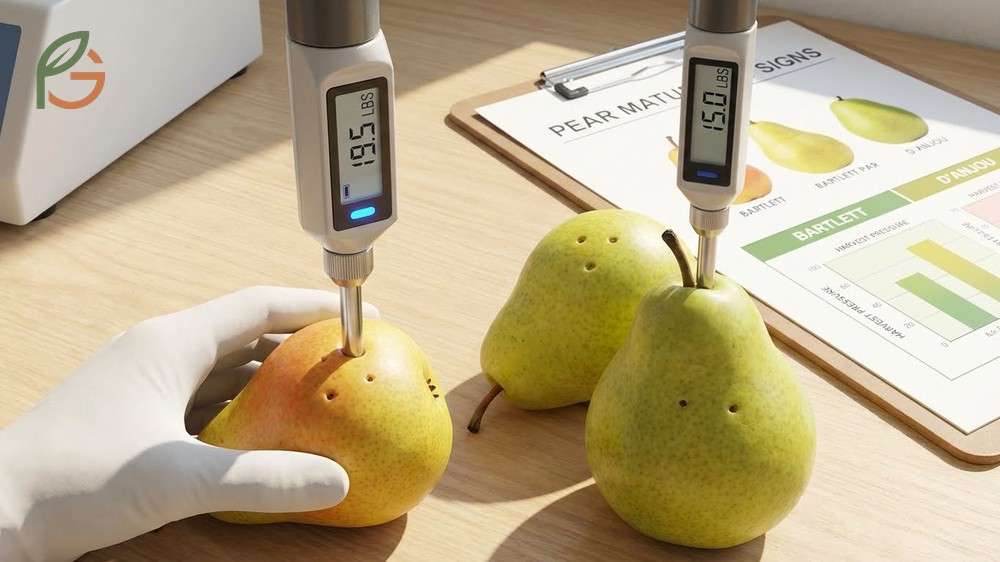
Commercial growers use scientific measurements to determine harvest timing. The most common indicator is flesh firmness measured with a penetrometer.[6] This device measures the pounds of force needed to penetrate the fruit flesh using an 8mm tip.
Bartlett pears destined for controlled atmosphere storage are harvested at an average firmness of 19.5 pounds of pressure, while D’Anjou pears need 15 pounds for long-term storage.[5] Home growers without penetrometers can judge firmness by feel—pears should be rock-hard at harvest, with no give anywhere on the fruit.
Firmness Testing
Press your thumb firmly against the fruit body (not the stem end). At proper harvest maturity, the flesh shouldn’t yield at all—it should feel like pressing on wood. Any softness indicates the pear is past optimal picking time.
Seed color provides an internal maturity clue. Dark brown or black seeds indicate maturity, though this requires cutting the fruit to check.[6] Most growers rely on external indicators instead.
Avoiding Over-Ripening
Pears left on the tree too long develop internal breakdown even if the exterior appears fine. The center turns brown and mushy while the outside remains firm—exactly the opposite of what you want.[9] This is why early harvest is crucial.
Evidence suggests checking firmness by pressing the stem end once pears are in storage. When that narrow neck area just begins to soften, move the fruit to room temperature for final ripening. This prevents the common problem of pears going from hard to mushy without a proper eating window.
Warning: Never judge pear ripeness by overall softness. If the entire fruit feels soft, it’s likely overripe with a mealy, grainy texture. Catch them when only the stem end yields to pressure.
Regional Harvest Timing
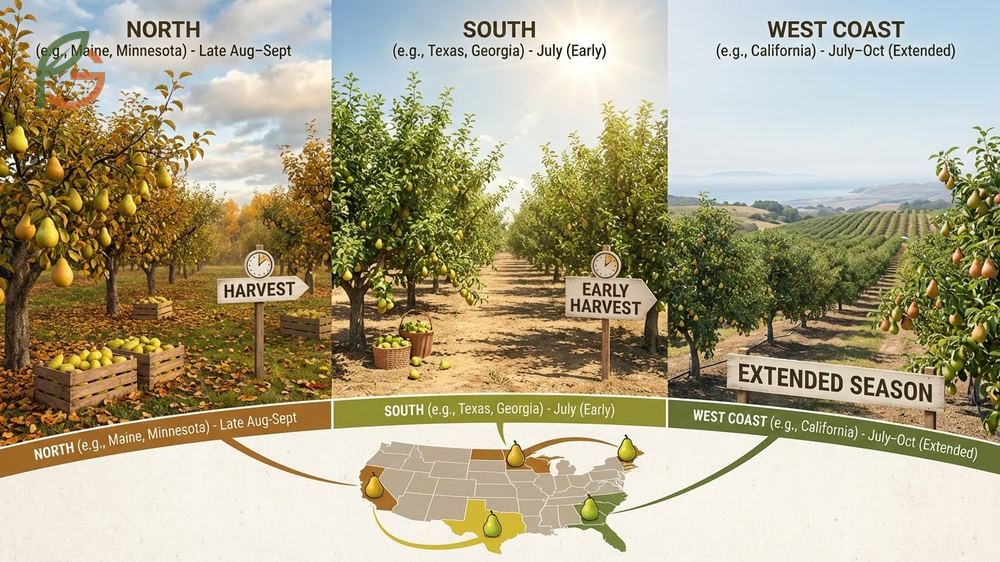
Geographic location shifts harvest schedules by several weeks. Northern U.S. states like Maine and Minnesota harvest pears from late August through September, while southern states like Texas and Georgia may begin in July for early varieties.
West Coast growers, particularly in California, enjoy an extended season from July through October due to moderate coastal climates. California ranks among the top pear-producing states, specializing in Bartlett varieties that thrive in Mediterranean conditions.[8]
Track your local bloom dates to predict harvest timing. Most pear varieties mature 100-130 days after bloom, depending on the cultivar and weather patterns. Cool, wet summers delay maturity, while hot, dry conditions accelerate it.
This table compares pear harvest timing across U.S. regions, showing start months and optimal varieties for each climate zone
| Region | Harvest Start | Harvest End | Best Varieties |
|---|---|---|---|
| Southern U.S. | July | September | Orient, Kieffer, Pineapple |
| West Coast | July | October | Bartlett, Anjou, Bosc, Comice |
| Midwest | August | September | Bartlett, Seckel, Harrow Sweet |
| Northeast | Late August | October | Bartlett, Bosc, Anjou, Seckel |
| Pacific Northwest | August | October | Bartlett, Anjou, Bosc, Comice, Starkrimson |
- Chill hours during winter dormancy influence spring bloom and subsequent harvest dates
- Spring frost events delay bloom and push harvest later by one to two weeks
- Summer heat accumulation (growing degree days) accelerates or delays fruit maturation
- Elevation affects temperature—higher altitudes harvest one to two weeks later than valleys
- Variety selection matters most—choose cultivars bred for your climate zone
Conclusion
The evidence is clear: successful pear harvesting hinges on picking firm, mature fruit before full ripeness and allowing controlled off-tree ripening. Master the lift-and-twist test, watch for color lightening from dark to pale green, and harvest when pears easily separate from branches.[3] When to pick pears ultimately depends on variety and region, but the principle remains constant—early harvest with proper post-harvest ripening delivers superior flavor and texture.
Current guidance emphasizes multiple harvest passes, testing individual fruits rather than picking entire crops at once. FruitGarden provides research-based growing information to help you time your harvest perfectly, ensuring each pear reaches its full potential whether you’re growing backyard Bartletts or orchard-scale Boscs.
Frequently Asked Questions
How do you know when a pear is ready to pick from the tree?
Gently lift the pear to a horizontal position—if it separates easily from the branch with minimal twisting, it’s ready.[3] Look for ground color changes from dark green to pale green or greenish-yellow, and check that lenticels (surface spots) have turned from white to brown.[1] The fruit should still feel rock-hard—any softness means you’ve waited too long.
What month do you pick pears?
Most pears harvest from August through September, though timing varies by variety and region. Early-season varieties like Bartlett ripen in August, mid-season pears like Anjou harvest in September, and late-season varieties like Bosc extend into October.[4] Southern U.S. growers may start as early as July for heat-tolerant varieties like Kieffer and Orient.
Can pears ripen on the tree?
Pears should never ripen on the tree. Research shows they rot from the center out if left to ripen while attached to the branch, developing brown, grainy cores even when the exterior appears firm.[2] Pick pears when mature but hard, then ripen them at room temperature for optimal texture and sweetness. This off-tree ripening produces the buttery, smooth texture that defines high-quality pears.
How long do pears take to ripen after picking?
Ripening time varies by variety. Bartlett pears typically ripen in five to seven days at room temperature (60-70°F), while Bosc and Anjou may take up to two weeks.[8] Late-season varieties like Anjou need three to four weeks of cold storage (32-35°F) before they’ll ripen properly when moved to room temperature. Speed up ripening by placing pears in a paper bag with apples or bananas.
Should pears be hard or soft when picked?
Pears must be rock-hard when picked from the tree. The fruit should show no yielding to thumb pressure anywhere on the body—it should feel as firm as wood.[1] Commercial orchards harvest Bartlett pears at 19.5 pounds of flesh firmness and D’Anjou at 15 pounds for optimal storage and ripening.[5] Any softness at harvest indicates the fruit is overripe and will develop poor texture.
What happens if you pick pears too early?
Pears picked too early won’t ripen properly off the tree and remain hard, sour, and lacking sweetness. They may shrivel during storage instead of developing the characteristic buttery texture. However, picking slightly underripe is safer than waiting too long—pears harvested just before full maturity still ripen successfully if stored correctly. Test multiple fruits on your tree rather than harvesting the entire crop at once to avoid premature picking.
How do you store pears after picking?
For immediate use, store pears at 60-70°F (16-21°C) with 80-85% humidity, and they’ll ripen in a few days to two weeks depending on variety. For long-term storage, chill pears to 32-35°F (0-2°C) immediately after harvest using perforated plastic bags—most varieties keep two to four months.[9] Late-season varieties like Anjou and Bosc require cold storage for three to four weeks before they’ll ripen properly. Handle carefully to avoid bruising, as damaged fruit decays quickly and accelerates spoilage in nearby pears.





