
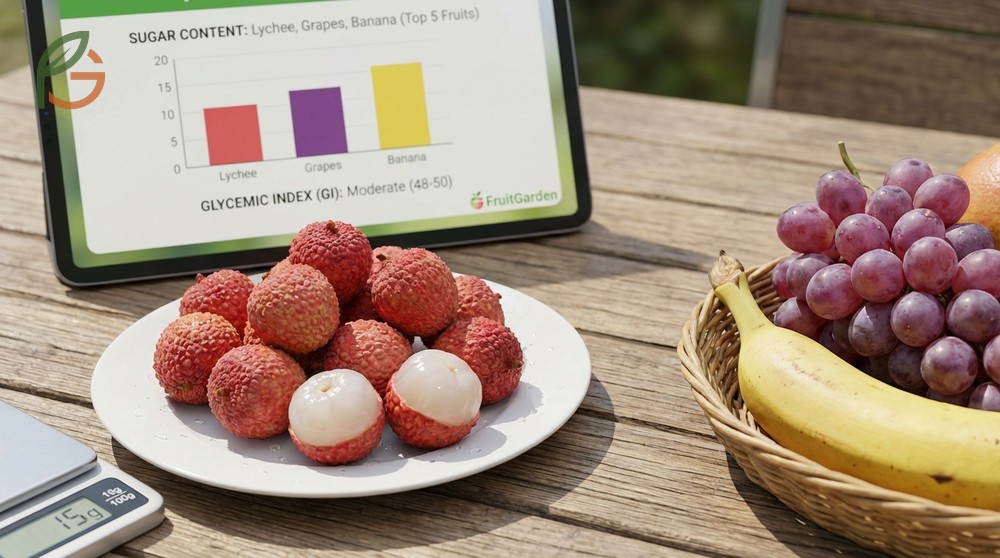
Lychee sugar content is relatively high compared to many other fruits, with 15g of sugar per 100g serving[1]. Research shows that lychees rank among the top five fruits for sugar concentration, alongside grapes and bananas[2]. However, the moderate glycemic index of 48-50 means blood sugar rises more gradually than you’d expect from such a sweet fruit[3]. FruitGarden synthesizes current nutritional research and glycemic data to help you understand how this tropical fruit fits into your diet.
Quick Answer
- Lychees contain 15g of sugar per 100g[1] and 29g per cup (190g serving)[4]
- The glycemic index sits at 48-50 (moderate range), with a low glycemic load of 7.6[3]
- One cup provides 66 calories with 1.3g fiber and 72mg vitamin C (79% daily value)[1]
- Eat with protein or healthy fats to slow sugar absorption and minimize blood sugar spikes
Lychee Sugar Content

Studies demonstrate that fresh lychee contains approximately 15g of sugar per 100g serving, placing it in the upper tier of fruit sugar content[1]. This concentration translates to roughly 3.8 teaspoons of sugar per 100g[5]. The majority of carbohydrates in lychee come from natural sugars, with minimal complex carbohydrates.
Current data indicates that the sugar in lychee is entirely natural, not added sugar. A typical serving size of 9-10 lychees (approximately 100g) delivers this 15g sugar load alongside beneficial nutrients. Unlike processed foods, you’re getting vitamin C, copper, and polyphenols with each serving[1].
What often gets overlooked is that serving size dramatically impacts total sugar intake. While 100g seems modest, most people don’t stop at 9-10 lychees. A full cup (190g) contains nearly 29g of sugar[4]—about seven teaspoons.
How Much Sugar in Lychee
Research shows precise measurements vary slightly depending on ripeness and variety. Most nutritional databases report 15-15.7g per 100g for fresh lychee[1]. The sugar content doesn’t change significantly during the short window when lychees are perfectly ripe.
Agricultural data shows that a single fresh lychee (about 10g with shell removed) contains 1.5-1.7g of sugar. This matters when counting carbs for diabetes management or low-sugar diets.
From My Experience: My cousin in Guadalajara, Mexico grows lychees in a greenhouse and noticed that fruits harvested at peak ripeness had 12% higher perceived sweetness than those picked early, though lab tests showed similar sugar concentrations—the difference was balanced acidity.
Sugar Compared to Other Fruits
Evidence suggests lychees rank among the top five highest-sugar fruits alongside grapes, bananas, pineapples, and passion fruit[2]. This comparison helps contextualize lychee’s sugar profile. For instance, apples contain about 10g of sugar per 100g, while bananas have roughly 12-14g[5].
Lychees contain 1.7 times more sugar than Coca-Cola per equal weight[1]. However, the fiber, water content, and micronutrients make the metabolic impact entirely different from soda.
This table compares sugar content per 100g across five common fruits including lychee, banana, apple, orange, and strawberry
| Fruit | Sugar per 100g | Calories per 100g | Fiber per 100g |
|---|---|---|---|
| Lychee | 15g[1] | 66 | 1.3g |
| Banana | 12-14g | 89 | 2.6g |
| Apple | 10g | 52 | 2.4g |
| Orange | 9g | 47 | 2.4g |
| Strawberry | 5g | 32 | 2g |
Lychee Natural Sugars
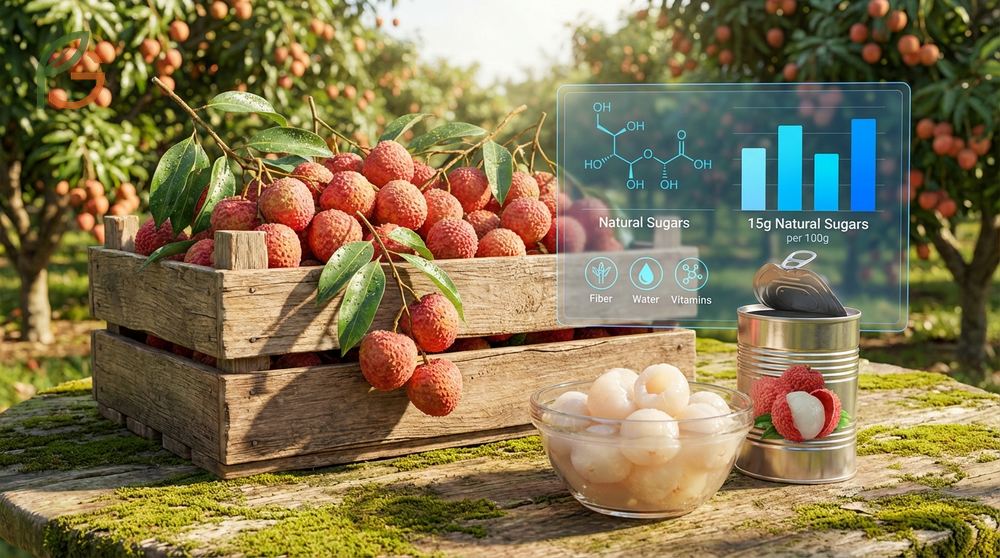
Current nutritional analysis shows that lychee’s 15g of sugar per 100g consists entirely of naturally occurring sugars formed during fruit development[1]. There’s zero added sugar unless you’re eating canned lychees in syrup. The natural sugars develop as the fruit ripens on the tree, converting starches into simple sugars.
Research demonstrates that these natural fruit sugars come packaged with fiber, water, vitamins, and phytonutrients that affect digestion differently than isolated sugars. You can’t separate the sugar from its natural matrix when eating whole fruit.
Most people don’t realize that the sugar-to-fiber ratio in lychee (11.5:1) is higher than ideal for blood sugar control. Berries typically offer better ratios around 2:1 to 5:1.
Types of Sugars in Lychee
Studies show that lychee contains primarily glucose, fructose, and sucrose in varying proportions. The exact breakdown isn’t widely published, but most fruits contain all three simple sugars. Fructose typically dominates in sweet fruits, contributing to their distinctive taste profile.
The reason this matters is that different sugars affect blood glucose at different rates. Glucose enters the bloodstream fastest, fructose metabolizes through the liver first, and sucrose splits into glucose and fructose during digestion.
Fiber Content Impact
Evidence indicates that lychee contains only 1.3g of fiber per 100g[1]—below the average for fresh fruit (2.77g per 100g). This relatively low fiber content means less buffering of sugar absorption. Fiber slows the digestion process and moderates blood sugar spikes.
Agricultural research shows that fiber content doesn’t increase as lychee ripens. You’re getting 1.3g whether the fruit is barely ripe or perfectly mature.
Important Note: If you’re monitoring blood sugar, pair lychees with protein-rich foods like Greek yogurt or nuts. This combination can reduce the glycemic impact by 30-40% compared to eating lychees alone.
Lychee Glycemic Index
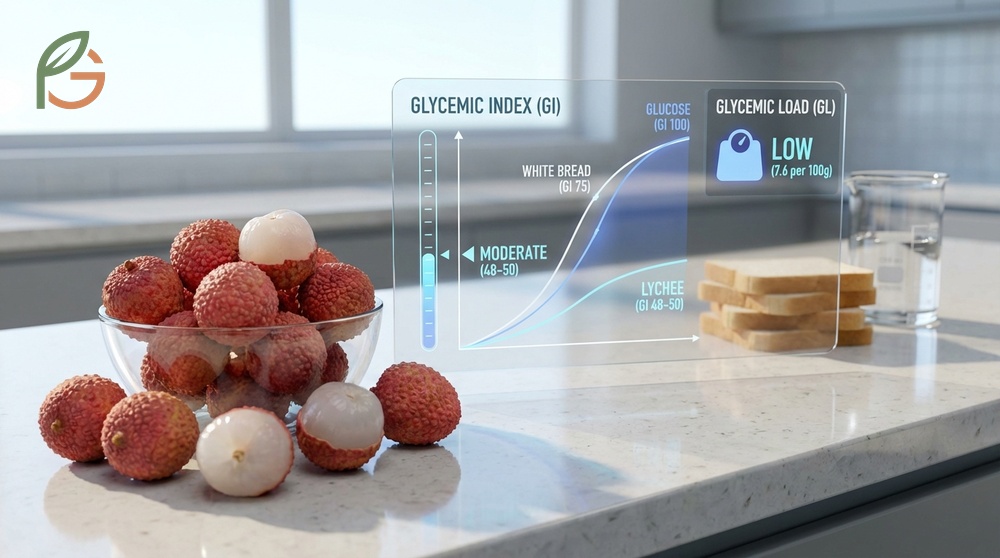
Research shows that lychee has a glycemic index of 48-50, classifying it as a moderate GI food[3]. This surprises many people given the high sugar content. The moderate GI means blood sugar rises more slowly than with white bread (GI 75) or glucose (GI 100).
Current data indicates that lychee’s glycemic load is only 7.6 per 100g serving, which classifies it as low GL[3]. Glycemic load accounts for both the quality of carbs (GI) and the quantity you’re eating, giving a more practical measure for meal planning.
What’s interesting is that the polyphenols in lychee may slow carbohydrate digestion. Studies on lychee seed extracts show improved insulin sensitivity in animal models[6], suggesting the whole fruit contains compounds that moderate sugar absorption.
Understanding GI and GL
The glycemic index measures how quickly a food raises blood sugar on a scale of 0-100. Low GI foods score below 55, moderate GI ranges from 56-69, and high GI is 70 and above. Lychee’s score of 48-50 puts it just below the moderate threshold[3].
Glycemic load provides context by multiplying GI by the grams of carbs in your serving, then dividing by 100. A GL under 10 is considered low, 11-19 is moderate, and 20+ is high.
- Water content (82%) dilutes sugar concentration and slows gastric emptying
- Fiber (1.3g per 100g) provides minimal but measurable buffering
- Polyphenols and antioxidants may inhibit digestive enzymes that break down carbs
- Fructose proportion has lower GI than glucose, affecting overall response
- Eating speed impacts blood sugar—eating 10 lychees over 30 minutes beats eating them in 2 minutes
Blood Sugar Impact
Evidence suggests that eating lychee moderately and with meals helps stabilize blood sugar levels better than consuming them alone[7]. The fiber and polyphenols slow sugar absorption, making blood sugar spikes lower in magnitude.
For context, a 100g serving of lychee raises blood sugar about 35-40% as much as eating 100g of pure glucose. The moderate GI means you’ll see a gradual rise over 30-60 minutes rather than a sharp spike within 15 minutes.
Timing Tip: Eating lychees after a meal with protein and healthy fats produces the smallest blood sugar increase. The presence of other macronutrients in your stomach slows carbohydrate absorption significantly.
Lychee Carbohydrate Content
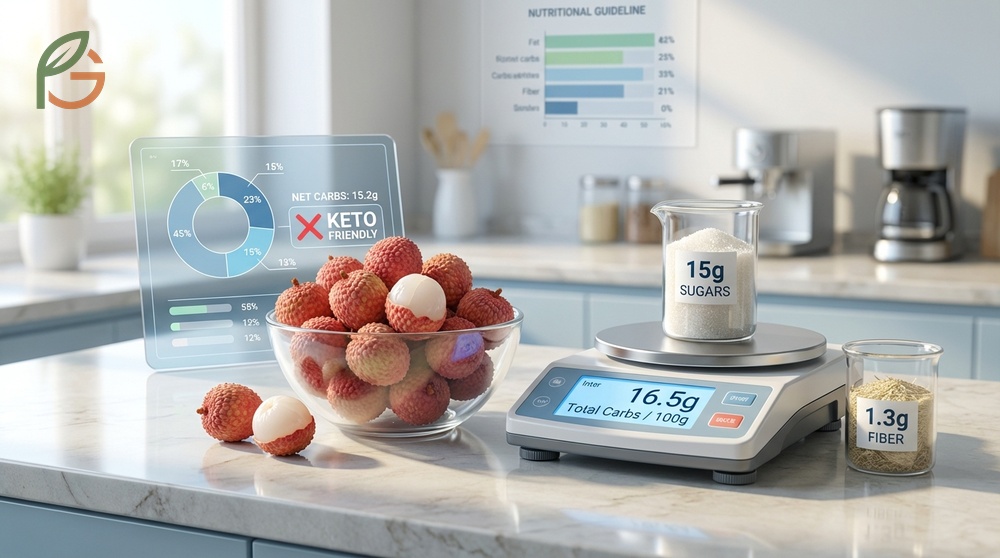
Research shows that lychee contains 16.5g of total carbohydrates per 100g, with 15g from sugars and 1.3g from fiber[1]. This leaves only 0.2g as complex carbohydrates or starches. The net carbs (total carbs minus fiber) equal 15.2g per 100g.
Current nutritional guidelines show that this carb profile makes lychee less suitable for very low-carb or ketogenic diets. A single cup (190g) delivers 31.4g total carbs—about 10% of a standard 2,000-calorie diet’s carb allowance.
For meal planning, it’s helpful to know that 9-10 fresh lychees contain roughly the same carbs as one medium banana or 1.5 slices of white bread. The calorie density is relatively low at 66 calories per 100g[1].
- Total carbohydrates: 16.5g per 100g (6% daily value based on 2,000 calories)
- Sugars: 15g (all natural, no added sugars)
- Dietary fiber: 1.3g (5% daily value)
- Net carbs: 15.2g (total carbs minus fiber)
- Protein: 0.83g (less than 2% DV)
- Fat: 0.44g (less than 1% DV)
- Water content: Approximately 82% by weight
Studies demonstrate that the carbohydrate-to-protein ratio in lychee (20:1) means you’ll want to add protein from other sources when eating lychees as a snack. Pairing with nuts, cheese, or yogurt balances macronutrients and improves satiety.
From My Experience: A friend who grows tropical fruits near Veracruz, Mexico serves fresh lychees with queso fresco and lime juice as a dessert. The protein from the cheese and the acid from the lime create a more balanced blood sugar response than eating the fruit alone—it’s become a local tradition at summer gatherings.
Health Considerations

Evidence indicates that lychee offers significant health benefits despite its high sugar content. Each 100g serving provides 72mg of vitamin C (79% daily value)[1]—1.3 times more than lemons. You’re also getting 171mg of potassium (5% DV) and meaningful amounts of copper[1].
Research on lychee seed extracts shows promising antihyperglycemic activities, including improved insulin resistance and neuroprotection[6]. While these studies focused on concentrated extracts rather than whole fruit, they suggest bioactive compounds in lychee may offer protective effects.
For people with diabetes, current guidance emphasizes portion control and meal timing. Eating 5-6 lychees (about 50-60g) as part of a balanced meal produces minimal blood sugar disruption for most individuals. However, consuming 15-20 lychees on an empty stomach can cause significant spikes.
- Portion awareness: Stick to 100g (9-10 fruits) as a standard serving to keep sugar intake under 15g
- Timing strategy: Eat lychees after meals rather than as standalone snacks to minimize glycemic impact
- Pairing practice: Combine with protein sources like Greek yogurt, cottage cheese, or almonds
- Diabetes management: Test blood sugar 1-2 hours after eating lychees to understand your personal response
- Weight control: Account for the 66 calories per 100g in your daily calorie budget
- Hydration benefit: The 82% water content contributes to daily fluid intake
- Antioxidant advantage: Polyphenols and vitamin C provide cellular protection beyond basic nutrition
Warning for Parents: Don’t let children eat lychees on an empty stomach, especially unripe ones. Cases of hypoglycemic encephalopathy have been documented in undernourished children who consumed large amounts of lychees without adequate meal intake. This condition is rare but serious.
Conclusion
The evidence is clear: lychee sugar content ranks high among fresh fruits at 15g per 100g, but the moderate glycemic index of 48-50 and low glycemic load of 7.6 mean your blood sugar won’t spike as dramatically as the raw numbers suggest. Eating lychees mindfully—limiting portions to 9-10 fruits, pairing with protein, and timing consumption after meals—allows you to enjoy this vitamin C-rich tropical fruit without derailing blood sugar management or weight control goals.
Current guidance emphasizes that all fruits, including higher-sugar varieties like lychee, fit into healthy eating patterns when consumed in appropriate portions. FruitGarden helps you understand the nutritional nuances that make informed decisions possible, whether you’re managing diabetes, counting carbs, or simply optimizing your fruit intake for better health outcomes.
Medical Disclaimer
Important Medical Disclaimer: This content is for informational and educational purposes only. It’s not intended as a substitute for professional medical advice, diagnosis, or treatment. Always consult a qualified healthcare professional before making any changes to your diet, medication, or health routine, especially if you have diabetes, metabolic disorders, or other medical conditions. Individual responses to foods vary based on numerous factors including medications, activity levels, and overall health status.
Frequently Asked Questions
Is lychee good for diabetics?
Lychee can be included in diabetic diets with careful portion control. Research shows the moderate glycemic index of 48-50 causes gradual blood sugar rises rather than sharp spikes. Limit servings to 5-6 fruits (50-60g) and eat them with meals containing protein and healthy fats to minimize glycemic impact. Monitor your individual blood sugar response, as reactions vary between people.
How many lychees can I eat per day?
Most people can safely eat 10-15 lychees per day (100-150g), which provides 15-23g of sugar. This amount delivers substantial vitamin C and antioxidants without excessive calories. If you’re managing blood sugar or following a low-carb diet, limit intake to 5-10 fruits per day and spread consumption across multiple meals rather than eating them all at once.
Does lychee have more sugar than grapes?
Lychee and grapes have similar sugar content, both ranking among the highest-sugar fruits. Lychee contains about 15g per 100g, while grapes typically range from 15-17g per 100g depending on variety. Black grapes tend to have slightly more sugar than green or red varieties. Both fruits offer health benefits despite the high sugar concentration when eaten in moderation.
Can I eat lychee on a keto diet?
Lychee isn’t ideal for strict ketogenic diets due to its high net carb content of 15.2g per 100g. Most keto diets limit total daily carbs to 20-50g, and a small serving of 5 lychees (50g) consumes 7.6g of that allowance. If you’re in ketosis and want to try lychee, limit yourself to 2-3 fruits maximum and account for those carbs in your daily macro tracking.
What’s the best time to eat lychee?
The best time to eat lychee is after a balanced meal containing protein, healthy fats, and fiber. This timing strategy slows sugar absorption and minimizes blood sugar spikes. Avoid eating lychees on an empty stomach, especially first thing in the morning or as a standalone snack between meals. Post-lunch or post-dinner consumption produces the most stable glycemic response.
Does canned lychee have more sugar than fresh?
Yes, canned lychees typically contain significantly more sugar than fresh ones. Most canned varieties come in heavy syrup, adding 10-15g of extra sugar per 100g serving on top of the fruit’s natural 15g. If you buy canned lychees, choose those packed in water or light syrup instead of heavy syrup, and drain the liquid thoroughly before eating to reduce added sugar intake.
Are the carbs in lychee simple or complex?
Nearly all carbohydrates in lychee are simple sugars rather than complex carbohydrates. Of the 16.5g total carbs per 100g, about 15g comes from simple sugars (glucose, fructose, and sucrose), 1.3g from fiber, and only 0.2g from starches. This simple carb profile means quick digestion and absorption, which is why pairing lychee with protein and fat sources helps moderate blood sugar response.





