
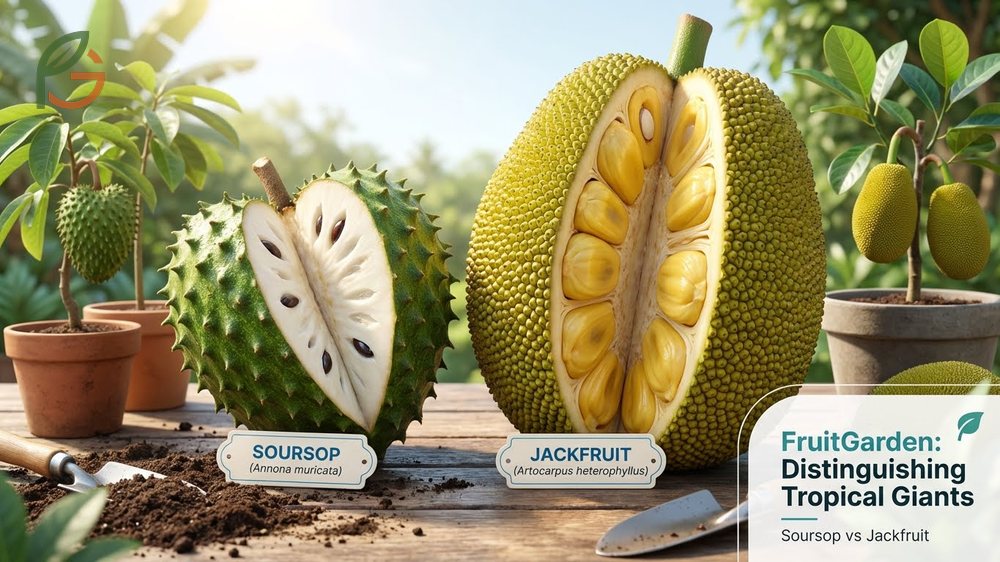
Soursop vs Jackfruit highlights two distinct tropical fruits that gardeners often confuse. Research shows that while both display spiky green exteriors, soursop delivers creamy, tangy-sweet flesh with 20.6mg vitamin C per 100g[1], whereas jackfruit produces stringy, meat-like texture with fruits reaching up to 80 pounds[2]. FruitGarden synthesizes current horticultural data to help US growers understand these tropical species for successful cultivation.
Quick Answer
- Soursop weighs 4-15 lbs with soft spines; jackfruit reaches 10-80 lbs with hexagonal nubs[2]
- Soursop offers creamy, yogurt-like texture; jackfruit delivers stringy, fibrous pods[3]
- Soursop provides 59% more vitamin C (20.6mg vs 13.7mg per 100g)[1]
- Soursop thrives in USDA zones 9-11[4]; jackfruit in zones 10-12[2]
Soursop vs Jackfruit
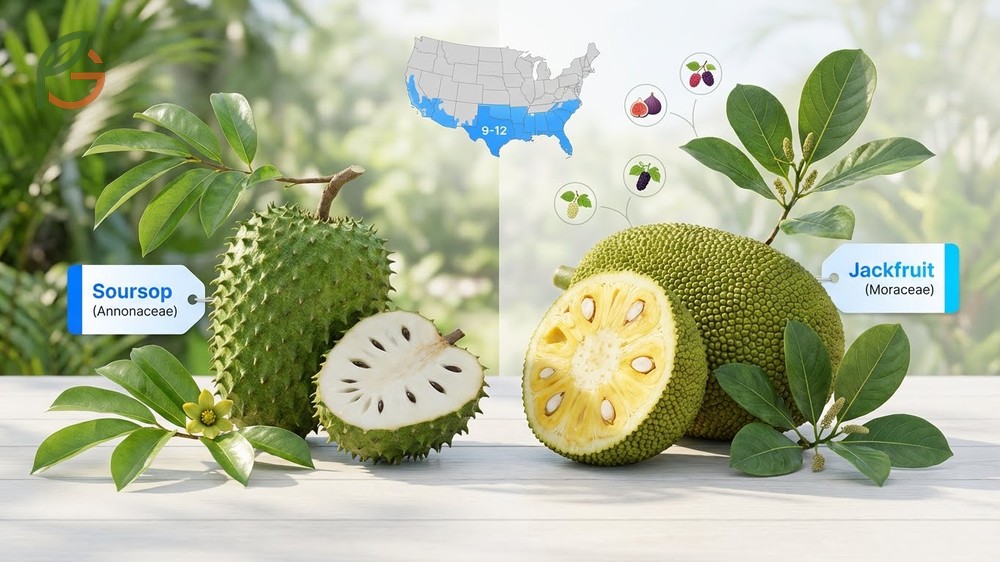
These two tropical fruits belong to entirely different botanical families despite their visual similarities. Soursop (Annona muricata) comes from the Annonaceae family, while jackfruit (Artocarpus heterophyllus) originates from the Moraceae family alongside figs and mulberries[5]. The classification difference explains why their growth patterns, fruit development, and cultivation needs vary significantly.
Current horticultural data shows that US growers in zones 9-12 can cultivate both species with proper frost protection and humidity management. Soursop trees mature at 15-20 feet tall[4], while jackfruit reaches 30-70 feet in optimal conditions[6]. Space planning becomes critical for home orchards, particularly in suburban settings where jackfruit’s massive canopy spread demands 25-40 feet clearance.
From My Experience: My cousin in Guadalajara, Mexico planted a jackfruit seedling in March 2023. The tree reached 8 feet by December versus the typical 4-6 foot range for first-year growth, though it required 15 gallons of water weekly during the dry season—matching the high-moisture needs cited in cultivation studies.
Botanical Classification
Soursop belongs to the custard apple family (Annonaceae), sharing characteristics with cherimoya and sugar apple species. Jackfruit’s placement in Moraceae links it to breadfruit and fig trees rather than true fruits. This distinction matters for grafting compatibility and pest management strategies.
The flowering patterns differ substantially between families. Soursop produces flowers directly on branches and trunks (cauliflory), while jackfruit exhibits the same cauliflorous habit but with larger, compound flowers. Both adaptations allow heavy fruits to develop on sturdy wood rather than delicate twigs.
Size and Weight Differences
Jackfruit claims the title of world’s largest tree-borne fruit, with specimens documented at 30-90 cm length and weights between 10-110 pounds[7]. Soursop rarely exceeds 15 pounds and typically measures 15-30 cm long. The size disparity influences harvest methods—soursop allows hand-picking from ladders, whereas jackfruit often requires lowering ropes and two-person teams.
Tree productivity varies by species and cultivar. Mature jackfruit trees yield 75-200 pounds annually across multiple harvests[8]. Soursop trees produce 12-24 fruits per season in established groves, translating to roughly 50-150 pounds depending on cultivar and climate.
Fruit Appearance Differences
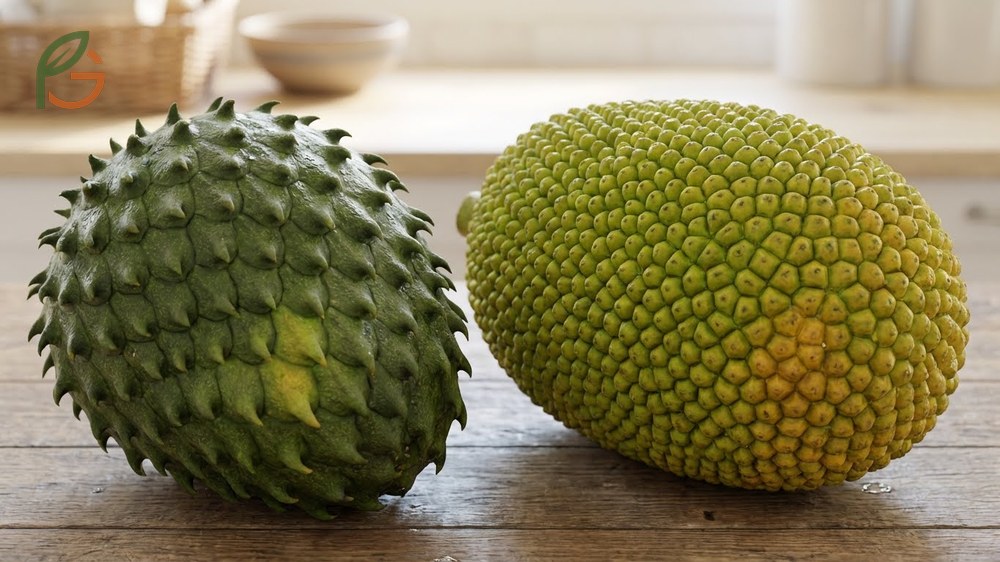
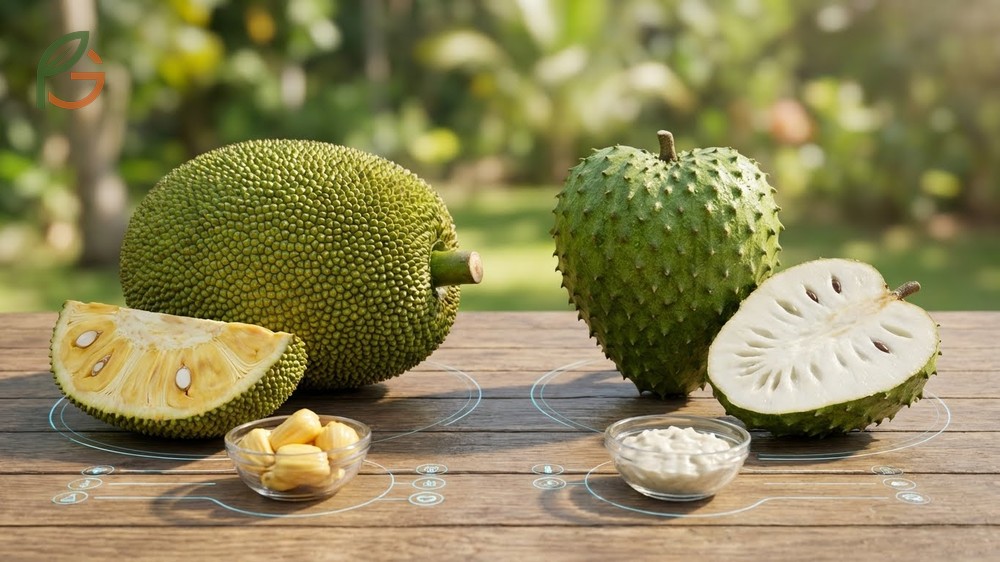
Visual identification becomes straightforward once you examine the exterior texture closely. Soursop displays soft, fleshy spines arranged in a pattern resembling overlapping scales. Jackfruit shows hexagonal segments with blunt nubs that flatten as the fruit ripens[8].
The color progression during ripening offers another distinguishing factor. Soursop transitions from dark green to yellow-green with slight softening when ready to harvest. Jackfruit shifts from bright green to brownish-yellow, and mature fruits emit a strong, sweet fragrance detectable from several feet away.
Exterior Characteristics
Soursop’s spines feel pliable and bend under gentle pressure without penetrating skin. The fruit’s surface appears slightly segmented, with each section corresponding to individual carpels fused during development. This segmentation creates the characteristic bumpy appearance that confuses it with jackfruit.
Jackfruit’s exterior features raised hexagonal patterns formed by fused flower parts. The nubs vary by cultivar—some display sharp spines while others show completely flattened surfaces. The skin thickness ranges from 3-6 mm, significantly tougher than soursop’s 1-2 mm rind.
Important Identification Tip: If you can easily press the spines flat with your palm, you’re holding soursop. Jackfruit’s bumps resist hand pressure and require a knife to penetrate the thick rind.
Interior Structure
Cutting open soursop reveals white, creamy segments surrounding shiny black seeds. The flesh separates easily into individual sections, each containing 1-3 seeds. The edible portion makes up approximately 65-70% of total fruit weight.
Jackfruit’s interior shows bright yellow to orange pods (bulbs) attached to a thick central core. Each pod encases a large brown seed and connects via fibrous strands. The edible flesh percentage ranges from 25-40% depending on cultivar, with the remainder consisting of rind, core, and seeds[8].
Taste and Texture Differences
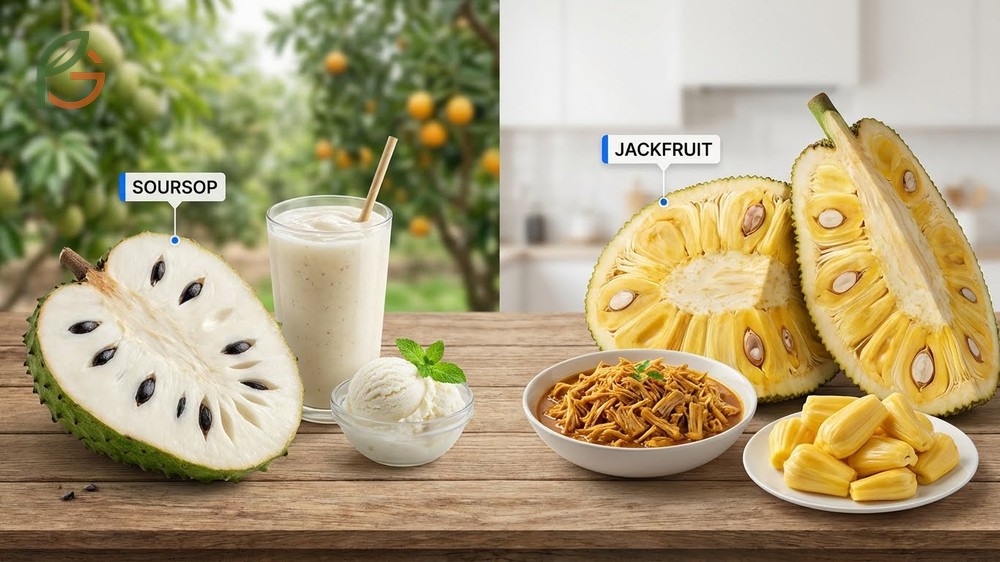
Soursop delivers a tangy-sweet flavor profile reminiscent of strawberry, pineapple, and citrus combined[3]. The creamy texture resembles banana or yogurt, making it ideal for smoothies, ice cream, and fresh consumption. The slight acidity provides a refreshing quality that balances the natural sugars.
Jackfruit offers a sweet, musky taste with subtle banana and pineapple notes but without soursop’s tartness[3]. The stringy, chewy texture works well in both sweet and savory applications. Unripe jackfruit’s neutral flavor and meat-like consistency make it popular as a pulled pork substitute in plant-based cooking.
- Fresh consumption straight from the fruit
- Smoothies and breakfast bowls with Greek yogurt
- Ice cream and frozen desserts
- Fruit juices and cocktail mixers
- Puddings, mousses, and custards
- Tea made from leaves and fresh pulp
- Fresh ripe consumption for sweet snacking
- Meat substitute in tacos, sandwiches, and curries (unripe)
- Dried chips and chewy fruit snacks
- Desserts including halwa, pudding, and ice cream
- Jams, preserves, and fruit leather
- Seeds roasted as nuts or ground into flour
Storage Note: Ripe soursop lasts 2-3 days at room temperature or 5-7 days refrigerated. Jackfruit bulbs stay fresh refrigerated for up to one week when stored in airtight containers, but whole fruits should be processed within 2-3 days of ripening.
Nutritional Tropical Fruit Comparison
Studies demonstrate that jackfruit contains more total calories, carbohydrates, and protein than soursop[1]. Jackfruit provides 95 calories per 100g versus soursop’s 66 calories, making jackfruit more energy-dense for active individuals. The higher carbohydrate content (23.2g vs 16.8g) explains jackfruit’s traditional role as a staple food in tropical regions.
Soursop excels in vitamin C content with 20.6mg per 100g compared to jackfruit’s 13.7mg—a 59% difference that supports immune function and collagen production[1]. Soursop also delivers more than double the fiber content at 3.3g versus 1.5g, benefiting digestive health and blood sugar regulation. However, jackfruit provides significantly more potassium (448mg vs 278mg), supporting cardiovascular function and electrolyte balance.
This table compares calories, macronutrients, key vitamins, and minerals between soursop and jackfruit per 100 gram serving
| Nutrient | Soursop | Jackfruit | Winner |
|---|---|---|---|
| Calories | 66 kcal[1] | 95 kcal[1] | Soursop (lower) |
| Protein | 1.0g[1] | 1.72g[1] | Jackfruit |
| Carbohydrates | 16.8g[1] | 23.2g[1] | Jackfruit |
| Fiber | 3.3g[1] | 1.5g[1] | Soursop |
| Vitamin C | 20.6mg[1] | 13.7mg[1] | Soursop |
| Potassium | 278mg[1] | 448mg[1] | Jackfruit |
The vitamin B complex shows jackfruit with advantages in B1, B2, and B6 content[3]. These vitamins support energy metabolism and nervous system function. Jackfruit also edges ahead in minerals like calcium, iron, magnesium, and phosphorus, making it more suitable for addressing mineral deficiencies in tropical diets where it serves as a dietary staple.
Growing Conditions and Requirements
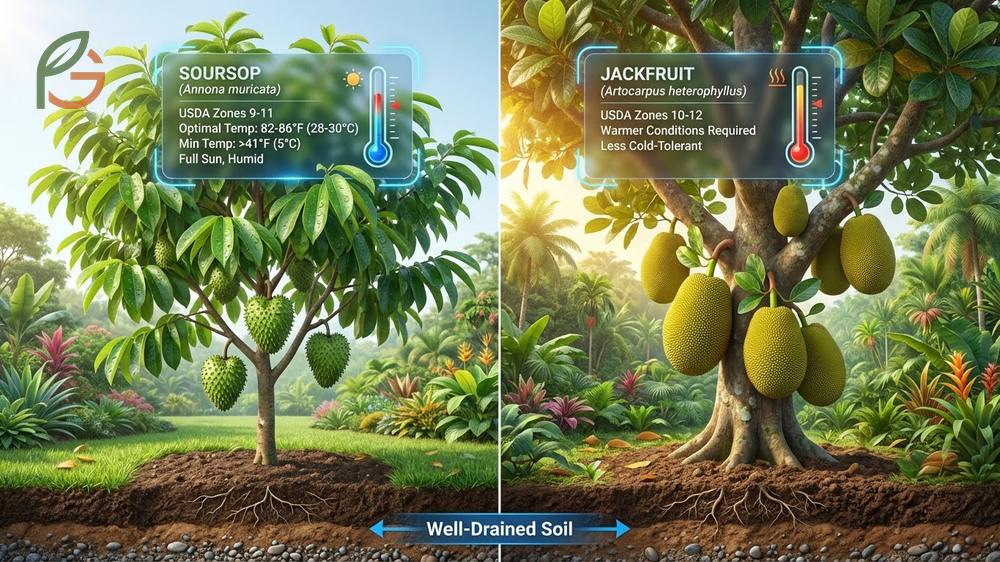
Soursop thrives in USDA hardiness zones 9-11 and requires temperatures consistently above 41°F (5°C)[9]. The tree cannot tolerate frost and performs best in humid, tropical conditions with full sun exposure. Optimal growing temperatures range from 82-86°F (28-30°C), with performance declining significantly when temperatures drop below 68°F[10].
Jackfruit requires warmer conditions in zones 10-12, making it less cold-tolerant than soursop[2]. The trees demand well-draining soil, full sun (6-8 hours daily), and protection from strong winds that can damage the heavy fruit loads. Space requirements differ dramatically—plant soursop trees 15-20 feet apart, while jackfruit needs 25-40 feet spacing to accommodate its spreading canopy.
- Hardiness zones 9-11 with frost protection
- Temperature range: 68-90°F (20-32°C) optimal
- Well-draining, slightly acidic soil (pH 5.5-7.0)
- Full sun exposure (6-8 hours daily minimum)
- Moderate to high moisture with consistent watering
- Tree spacing: 15-20 feet between specimens
- Mature height: 15-20 feet in cultivation
- Hardiness zones 10-12, no frost tolerance
- Temperature range: 72-95°F (22-35°C) preferred
- Deep, well-draining soil with organic matter
- Full sun required for fruit production
- High water needs during fruit development
- Tree spacing: 25-40 feet for full-size varieties
- Mature height: 30-70 feet (dwarf cultivars 10-15 feet)
Both species grow successfully in containers when young, allowing northern gardeners to overwinter them indoors[2]. Soursop adapts better to pot culture long-term, while jackfruit typically requires in-ground planting by year three due to aggressive root systems. Dwarf jackfruit cultivars like ‘Black Gold’ stay manageable at 6.5-8 feet with annual pruning, producing 120-200 pounds per tree[8].
Cold Protection Strategy: When temperatures threaten to drop below 40°F, wrap tree trunks with burlap and cover canopies with frost blankets. Young trees (under 3 years) need protection below 50°F. Remove coverings once daytime temperatures exceed 60°F to prevent fungal issues.
Conclusion
The evidence is clear: Soursop vs Jackfruit represents a choice between two fundamentally different tropical fruits that suit distinct growing spaces and culinary purposes. Soursop’s manageable size, creamy texture, and vitamin C content make it ideal for small gardens and fresh consumption. Jackfruit’s massive yields, meat-like texture, and higher calories position it as both a novelty crop and potential staple food for warmer US zones.
Current agricultural guidance emphasizes matching species to available space and climate zone accuracy. FruitGarden recommends zone 9-10 gardeners prioritize soursop for reliability, while zone 11-12 growers with ample space can successfully cultivate both species with proper irrigation and wind protection.
Frequently Asked Questions
Which Fruit Is Better for Small Gardens?
Soursop works better for small gardens due to its compact 15-20 foot mature size and narrower 10-15 foot spread. Jackfruit requires 25-40 feet spacing and reaches 30-70 feet tall, making it suitable only for large properties unless you select dwarf cultivars that stay under 15 feet with annual pruning.
Can You Grow Soursop and Jackfruit in the Same Garden?
Yes, you can grow both in zones 10-11 where their hardiness ranges overlap. Plant soursop in slightly cooler microclimates with afternoon shade, while placing jackfruit in the warmest, sunniest spot with maximum wind protection. Maintain at least 30 feet separation between mature specimens to prevent root competition and canopy shading.
How Long Until These Trees Produce Fruit?
Grafted soursop trees typically fruit within 2-3 years after planting, while seedling trees take 3-5 years. Grafted jackfruit produces in 3-4 years, but seedlings may require 7-10 years before bearing. Dwarf jackfruit cultivars often fruit by year 3-4 even from seed.
Which Fruit Has More Health Benefits?
Research shows that soursop provides 59% more vitamin C and over twice the fiber content, making it superior for immune support and digestive health. Jackfruit delivers more calories, protein, and potassium, which benefits active individuals and those managing blood pressure. Both offer distinct nutritional advantages depending on your health priorities.
Do These Fruits Taste Similar?
No, they taste distinctly different despite some shared tropical notes. Soursop delivers tangy-sweet flavor with citrus acidity and creamy texture similar to yogurt. Jackfruit offers pure sweetness without tartness, with stringy, chewy texture that resembles meat when unripe and candy-like consistency when fully ripe.
Can You Eat Both Fruits Raw?
Yes, both fruits are excellent eaten fresh when fully ripe. Soursop’s soft flesh scoops out easily with a spoon, while jackfruit bulbs separate from the core and eat like natural candy. Discard soursop’s black seeds and jackfruit’s large brown seeds, though jackfruit seeds become edible when roasted or boiled.
Which Fruit Is Easier to Grow for Beginners?
Soursop proves more forgiving for beginners due to its smaller size, earlier fruiting, and tolerance of zone 9 conditions. Jackfruit demands more space, warmer zones (10-12), and patience for first harvests. Soursop also adapts better to container growing, allowing beginners to start small and learn proper tropical fruit care before committing to in-ground planting.





