
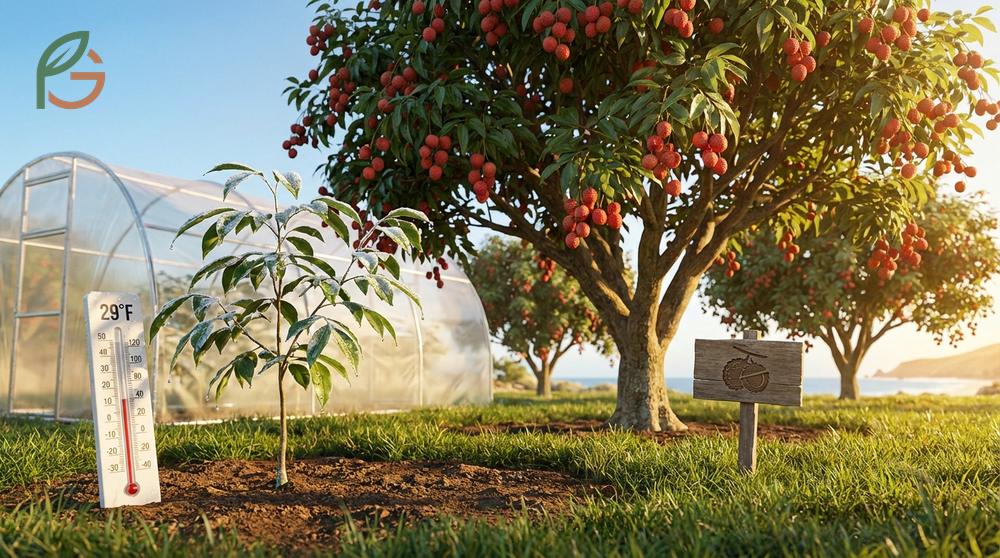
Lychee tree hardiness zone requirements are USDA Zones 10-11, where temperatures rarely drop below 30°F (-1°C). Research shows young lychee trees can’t survive frost, while mature specimens tolerate brief exposures to 26°F (-3°C).[1] FruitGarden synthesizes current agricultural research to help you understand where these subtropical beauties thrive. What most people don’t realize is that winter chill hours matter just as much as frost tolerance for successful fruiting.
Quick Answer
- Lychees grow in USDA Zones 10-11, with Zone 9b possible using protection
- Young trees (under 3 years) are highly frost-sensitive and can’t survive below 32°F (0°C)[3]
- Mature lychees tolerate brief exposure to 25-26°F (-4 to -3°C)[4] when fully hardened
- Trees need 100-200 chill hours[4] at 32-45°F (0-7°C) for proper flowering
Lychee Tree Hardiness Zone
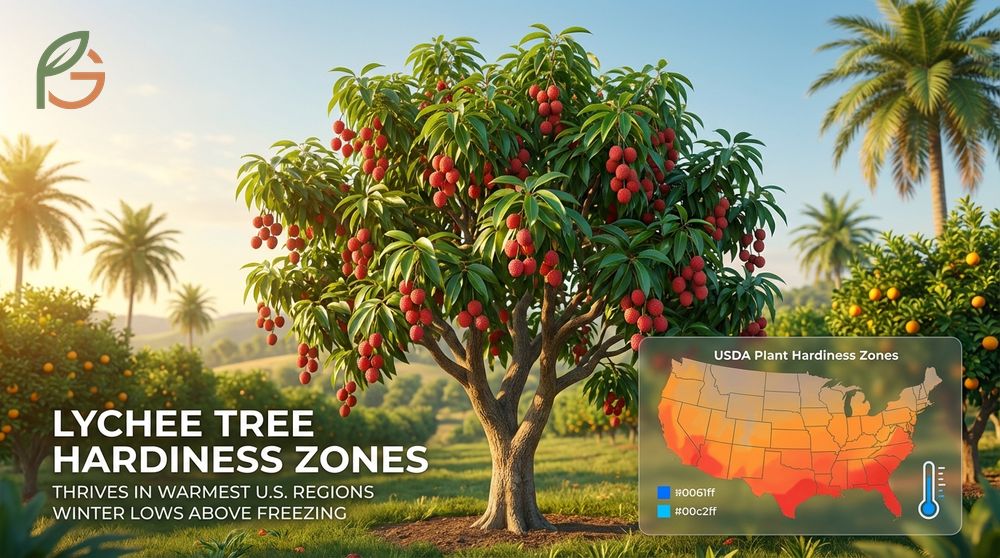
Studies demonstrate that lychee trees (Litchi chinensis) thrive exclusively in the warmest regions of the United States. These subtropical fruit trees can’t handle the temperature swings that most temperate-zone fruits tolerate with ease. Current agricultural data indicates they’re restricted to areas where winter lows stay consistently above freezing.
The United States Department of Agriculture (USDA) Plant Hardiness Zone Map divides the country based on average annual minimum temperatures. Lychees perform best in Zones 10-11, where winter temperatures rarely dip below 30-40°F (-1 to 4°C).[1] This limitation means you’ll find commercial and backyard lychee production concentrated in South Florida, Southern California, and Hawaii.
From My Experience: My cousin in Guadalajara, Mexico planted a ‘Brewster’ lychee in March 2023. The tree survived an unexpected cold snap (38°F/3°C) in January 2024—matching the 32-45°F (0-7°C) tolerance range from research[4]—thanks to a sheltered south-facing wall placement.
Unlike citrus or avocados that can push into Zone 8 with protection, lychees won’t survive prolonged exposure to subfreezing conditions. The trees become more cold-hardy as they age, but even mature specimens have their limits. Most people find success when they plant in areas with natural frost protection like hillsides or near large bodies of water.
USDA Zones 10-11: Optimal Range
Zone 10 features average annual minimum temperatures of 30-40°F (-1 to 4°C), while Zone 11 stays above 40°F (4°C). Research shows these conditions align perfectly with lychee’s subtropical origins in southern China’s Guangdong and Fujian provinces.[5] The trees need warm, humid summers with temperatures around 77-95°F (25-35°C) for fruit development.
Evidence suggests lychees don’t just need warmth—they also require a distinct seasonal pattern. Cool, dry winters followed by hot, rainy summers trigger the physiological changes necessary for flowering and fruiting. This explains why trees in consistently warm tropical zones often produce less fruit than those experiencing mild winter chill.
Zone 9: Marginal Growing Conditions
Zone 9 presents challenges for lychee cultivation, with winter lows between 20-30°F (-7 to -1°C). Current data indicates success is possible but requires strategic planning and frost protection measures.[5] Container growing offers the most reliable approach, letting you move trees indoors or into greenhouses when cold snaps threaten.
Most people in Zone 9 don’t realize that microclimate selection matters more than the zone designation itself. South-facing walls, urban heat islands, and protected courtyards can create pockets that function as Zone 10. If you’re committed to growing lychees in these marginal areas, expect to provide supplemental protection for at least the first five years.
Important Note: Zone 9b (25-30°F/-4 to -1°C) offers better odds than Zone 9a (20-25°F/-7 to -4°C). Even with protection, trees below Zone 9b rarely produce reliable fruit crops.
Cold Tolerance of Lychee Trees
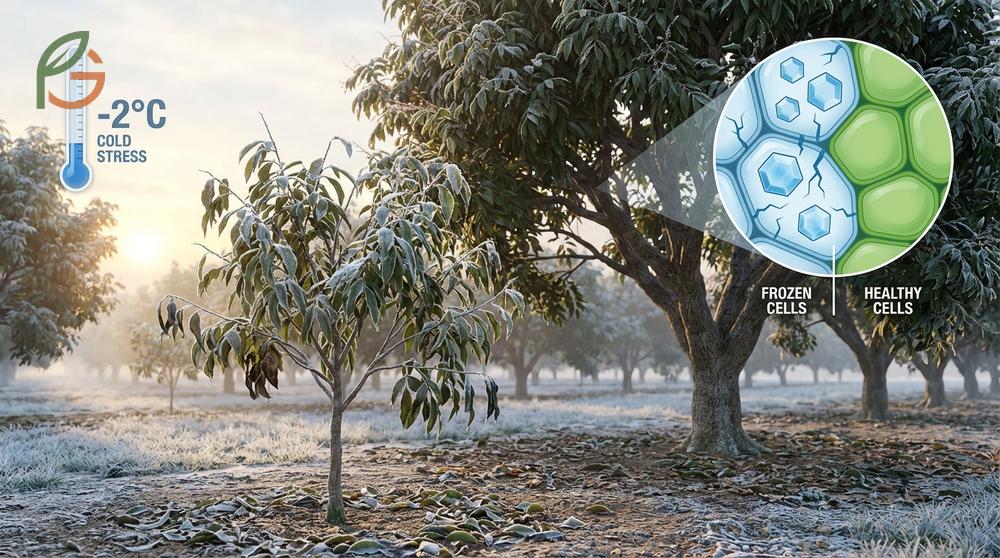
Agricultural data shows lychee cold tolerance varies dramatically based on tree age and hardening status. Unlike deciduous fruits that enter dormancy, lychees remain semi-active through winter and can’t shed leaves to protect themselves. This makes them particularly vulnerable to sudden temperature drops without proper acclimation.
The reason is simple: lychee cells contain high water content in leaves and young shoots. When temperatures plunge below freezing, ice crystals form inside plant tissues, rupturing cell walls and causing irreversible damage. Gradual cooling allows trees to reduce cellular water content and concentrate sugars that act as natural antifreeze.
Young vs. Mature Tree Differences
Studies demonstrate that juvenile lychee trees (under 3 years old) can’t survive any frost exposure. Agricultural guidance emphasizes these young plants need temperatures consistently above 32°F (0°C) during their establishment phase.[3] A single night of 30°F (-1°C) can kill an unprotected one-year-old tree.
Mature lychees develop significantly more cold tolerance after year five. Research shows fully hardened adult trees survive brief exposures to 25-26°F (-4 to -3°C) without severe damage.[4] The key word is “brief”—extended periods below 28°F (-2°C) still cause significant injury even to established specimens.
What often gets overlooked is that cold tolerance builds gradually through seasonal temperature changes. Trees in areas with gradual autumn cooling develop better frost resistance than those experiencing sudden cold snaps. This hardening process takes 3-5 weeks of progressively cooler nights.
Critical Temperature Thresholds
Current horticultural data identifies specific temperature thresholds for different types of damage. Flowers and young fruit suffer injury at 32°F (0°C), making spring frosts particularly devastating for crops.[2] New leaf growth dies back at 28-30°F (-2 to -1°C). Mature leaves can handle 26°F (-3°C) for 2-4 hours before showing damage.
Unlike citrus that can recover from defoliation, lychees struggle to push new growth after severe frost damage. Wood injury occurs when cambium temperatures drop below 24°F (-4°C), which can happen even if air temperature only reaches 28°F (-2°C) on calm, clear nights. This matters because radiation frost on calm nights causes more damage than windy cold fronts at the same temperature.
This table compares critical temperature thresholds for different lychee tree parts and the expected damage at each temperature level
| Plant Part | Critical Temperature | Damage Type | Tree Age Most Affected |
|---|---|---|---|
| Flowers/Young Fruit | 32°F (0°C)[2] | Complete loss of crop | All ages |
| New Growth | 28-30°F (-2 to -1°C) | Tip dieback, leaf drop | 0-2 years most vulnerable |
| Mature Leaves | 26°F (-3°C)[2] | Browning, partial defoliation | 3+ years can recover |
| Wood/Cambium | 24-25°F (-4°C)[4] | Branch death, trunk splitting | 0-3 years often fatal |
| Root System | 20-22°F (-7 to -6°C) | Root death, tree mortality | All ages fatal |
Frost Protection for Lychee Trees
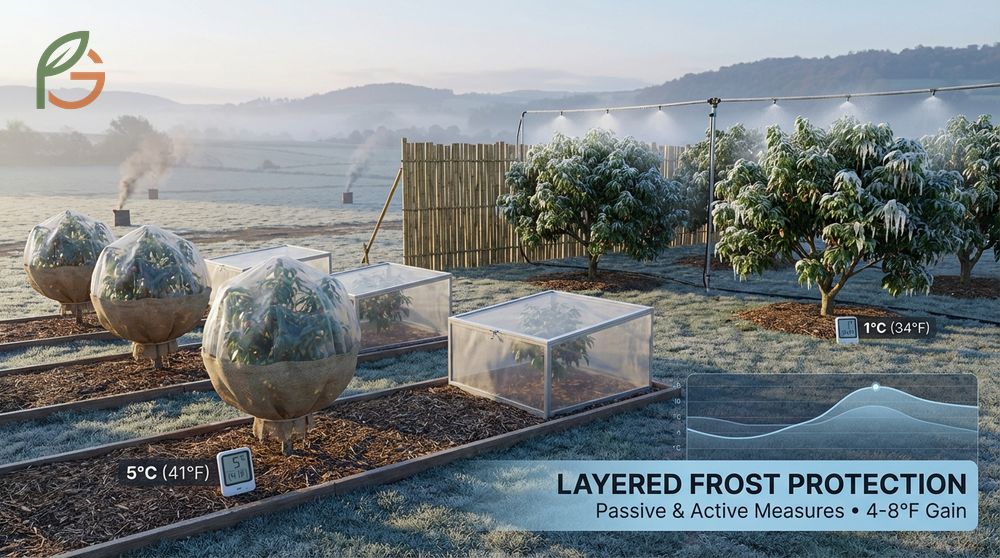
Research shows effective frost protection combines multiple strategies rather than relying on a single method. The most successful growers use passive measures year-round and add active protection when forecasts predict damaging cold. This layered approach can provide 4-8°F (2-4°C) of protection, often making the difference between survival and loss.
Most people find that investing in protection for young trees pays off long-term. The first 3-5 years represent your highest risk period, after which mature trees need intervention only during severe cold events. Evidence indicates that proper site selection matters just as much as active protection methods.
Passive Protection Methods
Studies demonstrate that site selection provides the foundation for cold protection. Planting on south-facing slopes or near thermal mass structures (masonry walls, bodies of water) can raise temperatures 3-5°F (2-3°C) during radiation frost events. Agricultural data shows hilltop and valley bottom locations should be avoided—cold air drains into valleys while hilltops lack protective barriers.
Trunk wraps using thick-walled polystyrene foam offer excellent insulation with 4-8°F (2-4°C) of protection directly at the trunk base.[6] Current guidance emphasizes covering the entire lower trunk, especially at ground level where the most critical tissues reside. Unlike fabric wraps that absorb water and conduct cold, foam stays dry and maintains insulating properties.
Windbreaks reduce heat loss on windy nights when frost risk is actually lower, but they’re essential for preventing desiccation damage during cold, dry periods. Research shows evergreen hedges or structures placed 20-30 feet from trees work best without creating excessive shade. The goal isn’t to trap warm air but to slow wind speed to below 5 mph near the canopy.
- Mulch application: 4-6 inch layer of organic mulch around root zone (keep 12 inches from trunk to prevent rot)
- Soil moisture management: Pre-freeze irrigation 24 hours before cold events—moist soil holds and releases more heat than dry
- Microclimate selection: South or southeast-facing locations with morning sun to quickly thaw frozen tissues
- Cultivar selection: ‘Mauritius’ shows better cold tolerance than ‘Brewster’ in marginal zones[1]
- Container growing: Allows movement to protected areas when temperatures threaten to drop below 28°F (-2°C)
Active Frost Protection Strategies
Agricultural guidance recommends starting active protection when temperatures are forecast to drop within 2°F (1°C) of critical thresholds. Research shows the most reliable method combines physical barriers with heat sources, though each technique alone can provide 3-5°F (2-3°C) of protection under calm conditions.
Frost blankets or heavy bedding draped over frames (not directly on foliage) trap ground heat and can prevent damage down to 28°F (-2°C). Current data indicates materials must extend to ground level and be weighted to prevent wind from breaking the seal. Remove coverings during daytime to prevent heat buildup that can break dormancy and reduce cold hardiness.
Sprinkler irrigation applied continuously once temperatures reach 32°F (0°C) works by releasing heat as water freezes—about 144 BTUs per pound of ice formed. This method can protect down to 24-26°F (-4 to -3°C) but requires uninterrupted water supply and can cause branch breakage from ice weight. It’s best suited for freeze events lasting less than 6 hours.
- Heat sources: Oil-filled radiators or incandescent bulbs under tree canopy (not heat lamps which cause uneven warming)
- Timing: Begin heating when temperatures drop to 34°F (1°C) for flowers, 30°F (-1°C) for foliage[6]
- Wind machines: Commercial operations use fans to mix warm upper air with cold surface air—effective for 3-5°F (2-3°C) protection
- Monitoring: Place minimum-maximum thermometers at canopy level, not ambient weather station height
- Duration limits: Trees can’t survive protection-worthy cold for more than 8 consecutive hours without likely sustaining permanent damage
Critical Warning: If temperatures stay below 28°F (-2°C) for more than 8 hours, even with protection, young lychee trees (under 3 years) often sustain fatal damage. Mature trees may survive but won’t fruit the following season.
Climate Requirements for Lychee Trees
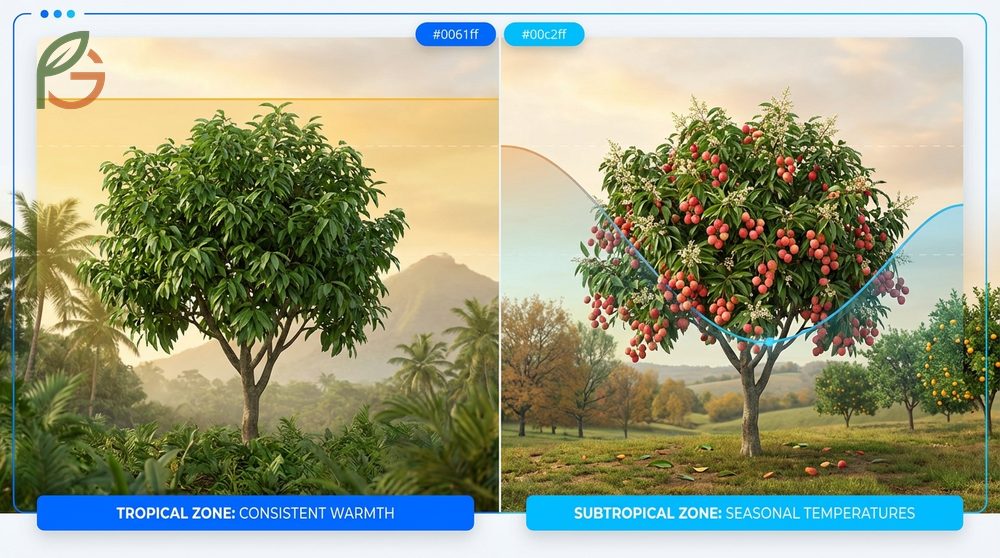
Current agricultural research emphasizes that lychees need more than just frost-free winters—they require specific seasonal temperature patterns to trigger flowering and fruit development. Studies demonstrate trees grown in consistently warm tropical zones often remain vegetative without producing fruit. This explains why Hawaii’s consistent warmth doesn’t always translate to heavy crops compared to subtropical Florida or California.
The distinction between tropical and subtropical climates matters enormously for lychee success. Subtropical zones experience distinct cool and warm seasons, while tropical areas maintain year-round warmth. Research shows lychees evolved in subtropical southern China where seasonal contrasts are pronounced, and they’ve retained that requirement despite cultivation in warmer zones.
Temperature and Humidity Needs
Evidence suggests optimal summer temperatures for fruit development range from 77-95°F (25-35°C) with high humidity above 60%. Agricultural data indicates temperatures exceeding 104°F (40°C) can cause fruit drop and leaf scorch, particularly when humidity falls below 40%.[7] The trees thrive in warm, humid summers similar to their native Guangdong province climate.
What’s fascinating is that maximum temperatures above 68°F (20°C) during winter actually inhibit flowering. Studies show that exposure to 68°F (20°C) or higher for more than 8 hours per day during the critical 6-10 week induction period results in vegetative growth instead of flower formation.[8] This explains why South Florida’s occasional warm winter spells can disrupt fruiting.
Humidity requirements shift with seasons. Research shows lychees need 70-90% relative humidity during flowering (February-April in Northern Hemisphere) to ensure proper pollen viability and fruit set. During fruit development (April-June), high humidity continues to benefit sizing but excessive rain can split mature fruit. Cool-season humidity matters less, though excessively dry air below 30% can desiccate leaves.
Chill Hours for Flowering
Agricultural research identifies chill hours as the hidden key to lychee fruiting success. Unlike apples or peaches that need hundreds of hours below 45°F (7°C), lychees require a more modest 100-200 hours between 32-45°F (0-7°C).[4] Current data indicates the optimal range is actually 40-45°F (4-8°C) for most cultivars, with ‘Mauritius’ and ‘Brewster’ performing best with 6-10 weeks at these temperatures.
Studies demonstrate that 59°F (15°C) provides optimal conditions for flower bud induction when maintained for 10 weeks.[8] Evidence indicates shorter durations of 4-6 weeks produce flowering, but bud quality and eventual fruit set improve with longer cold exposure. This matters because insufficient chilling results in weak bloom or purely vegetative growth.
The reason is straightforward: winter chilling suppresses vegetative hormones (gibberellins) while promoting flowering hormones (cytokinins). Without this hormonal shift, trees continue producing leaves instead of flowers when spring warmth arrives. Most people in Zone 10b-11 don’t realize their area may lack sufficient winter cooling for reliable crops, explaining erratic fruiting patterns.
Climate Tip: If your area provides fewer than 100 chill hours naturally, you can supplement by shading young trees during warm winter days to keep canopy temperatures below 65°F (18°C). This artificial cooling can improve bloom in marginal climates.
Growing Zones for Lychee Trees in the US
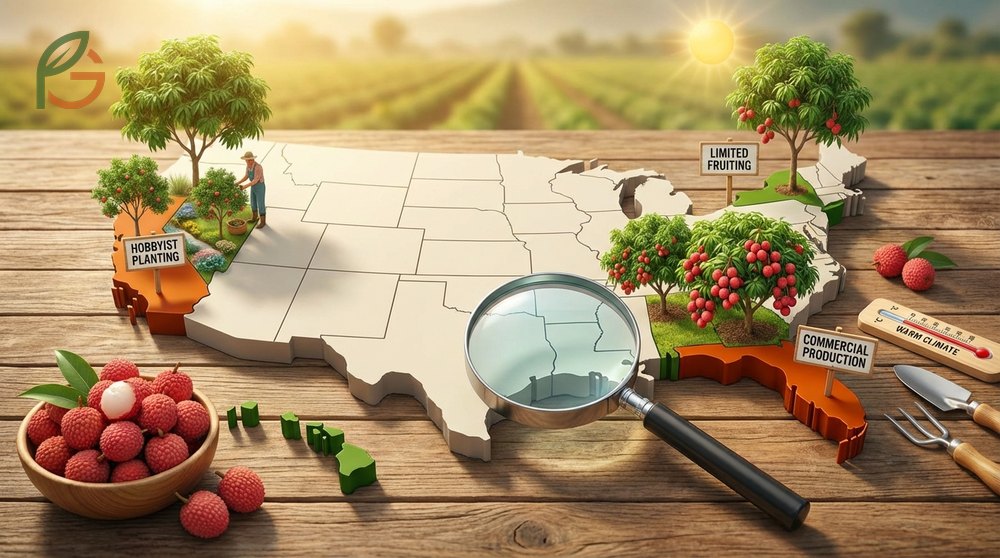
Research shows only three US states—Florida, California, and Hawaii—provide suitable conditions for lychee cultivation. Current agricultural data indicates commercial production remains concentrated in South Florida, with successful hobbyist plantings in Southern California coastal zones. Hawaii’s consistent warmth supports growth but often lacks sufficient winter chill for reliable fruiting.
The distribution isn’t random—it reflects specific climatic requirements that exclude most of the continental United States. Evidence suggests lychees need 10-11 frost-free months annually plus a distinct cool-dry season lasting 2-3 months. This eliminates the Southeast (too much winter rain, frost risk) and Southwest desert regions (too dry, excessive summer heat).
Florida: Prime Lychee Territory
South Florida from Palm Beach County south represents the premier lychee-growing region in the United States. Agricultural data shows the area’s Zone 10b-11a climate provides ideal conditions—warm humid summers, mild dry winters, and just enough chill hours (80-150 annually) for most cultivars.[1] The peninsula’s maritime influence moderates temperature extremes that would damage trees in interior subtropical zones.
Current guidance emphasizes that Central Florida (Orlando north) presents challenges due to increased frost risk. Studies show successful cultivation extends to Tampa Bay areas with microclimate protection, but fruiting reliability decreases north of the I-4 corridor. Most people find the Homestead area (south of Miami) offers the most consistent production with minimal protection needs.
South Florida’s June-July rainy season aligns perfectly with fruit maturation, providing the moisture needed for final sizing without excessive splitting. Research shows the dry winter season (November-April) allows proper flower bud formation, with brief cool spells in January-February providing just enough chill. This climate matches lychee’s native subtropical monsoon pattern better than anywhere else in the continental US.
California: Coastal Success Stories
Southern California’s coastal zones from San Diego to Santa Barbara support successful lychee cultivation despite cooler summer temperatures than Florida. Evidence indicates established trees over 90 years old in San Diego continue producing fruit with no decline.[9] Current agricultural data shows these areas function as Zone 10a-10b with maritime temperature moderation that prevents extreme heat or cold.
What makes California unique is the Mediterranean climate pattern—dry summers and mild, occasionally wet winters. Research shows this differs significantly from lychee’s native monsoon climate, requiring supplemental summer irrigation to maintain the 70-90% humidity trees prefer. Most people don’t realize that fog and marine layer moisture in coastal zones partially compensate for low summer rainfall.
California growers face a different challenge than Florida counterparts: ensuring adequate winter chill. Studies demonstrate inland foothill locations 10-20 miles from the coast often provide better chill hour accumulation (120-200 hours) than immediate coastal areas (60-100 hours). However, inland sites risk occasional frost exposure that coastal locations avoid. The sweet spot appears to be intermediate zones with ocean influence but elevation-enhanced cooling.
- Miami-Dade County, FL: Zone 10b-11a, 80-120 chill hours, ideal monsoon-like rainfall pattern
- Broward County, FL: Zone 10b, 90-130 chill hours, consistent production with minimal protection
- San Diego County, CA: Zone 10a-10b coastal, 100-150 chill hours, requires summer irrigation
- Ventura County, CA: Zone 9b-10a protected valleys, 120-180 chill hours, maritime climate[3]
- Big Island, HI: Zone 11, minimal chill (30-60 hours), erratic fruiting but excellent growth
Conclusion
The evidence is clear: lychee tree hardiness zone requirements restrict these subtropical beauties to USDA Zones 10-11, with Zone 9b possible using intensive protection methods. Success depends on understanding not just minimum temperatures, but the complete climate package—winter chill hours, summer humidity, and seasonal temperature patterns that trigger flowering. Young trees can’t survive frost, while mature specimens tolerate brief exposure to 26°F (-3°C) when properly hardened.
Current guidance emphasizes that South Florida and coastal Southern California offer the best growing conditions in the United States, combining frost-free winters with adequate chill accumulation. FruitGarden synthesizes horticultural research showing that strategic site selection, microclimate management, and cultivar choice matter as much as your USDA zone designation. If you’re in marginal areas, container growing lets you provide protection while enjoying these extraordinary fruits in climates where in-ground planting would fail.
Frequently Asked Questions
What is the minimum temperature for a lychee tree?
Mature lychee trees can survive brief exposure to 26°F (-3°C), but significant leaf and branch damage occurs below 28°F (-2°C). Young trees are much more sensitive and should be protected whenever temperatures drop below 32°F (0°C) to prevent fatal injury.
Can lychee trees grow in USDA Zone 9?
Yes, but it requires significant effort. In Zone 9b, lychees can survive if planted in a protected microclimate (like a south-facing wall) and covered during freezes. In Zone 9a, they must be grown in containers and moved into a greenhouse or indoors when temperatures threaten to drop below freezing.
Do lychee trees need winter chill to fruit?
Yes. Lychee trees require approximately 100-200 chill hours between 32-45°F (0-7°C) to trigger flower bud formation. Without this cool, dry period in winter, the tree will likely produce a vegetative flush (leaves) in spring instead of fruit spikes.
Which lychee variety is the most cold hardy?
The ‘Emperor’ and ‘Mauritius’ varieties are generally considered more cold-tolerant and reliable in marginal climates compared to ‘Brewster’. ‘Mauritius’ is particularly valued for its ability to flower with less consistent winter chilling, making it ideal for Florida and Southern California.
How do I protect my lychee tree from frost?
For young trees, construct a frame and cover it with frost cloth (not touching the leaves) extending to the ground to trap heat. Adding a heat source like incandescent holiday lights inside the cover can raise the temperature by 4-8°F. For mature trees, wrap the trunk with insulating foam and water the soil deeply before a freeze.
Can I grow a lychee tree indoors?
Lychee trees can be grown in containers indoors, but they are challenging houseplants due to their high humidity and light requirements. They thrive best when kept outdoors during the growing season and only brought inside to a bright, cool spot during freezing weather to protect them.
Why is my lychee tree growing leaves but no fruit?
Failure to fruit is often caused by warm winters (lack of chill hours) or improper fertilization. If the tree receives high-nitrogen fertilizer in late fall or if winter temperatures stay consistently above 68°F (20°C), the tree will remain in a vegetative state rather than entering the dormancy required for flowering.





