
Growing Strawberries In Raised Beds transforms your backyard into a productive berry patch when you get spacing and timing right. Research shows raised beds improve drainage by 30-40% compared to ground-level planting, while warmer soil temperatures extend your growing season by 2-3 weeks[1]. FruitGarden synthesizes current horticultural research from university extension programs to help you maximize your strawberry harvest.
Quick Answer
- Space plants 8-12 inches apart in raised beds for optimal air circulation[2]
- Plant in fall (Sept-Nov) for southern zones, spring (March-April) for northern areas[3]
- Bed height of 8-12 inches provides ideal root depth and drainage
- Grow 5-10 plants per person for fresh eating throughout the season
Growing Strawberries In Raised Beds
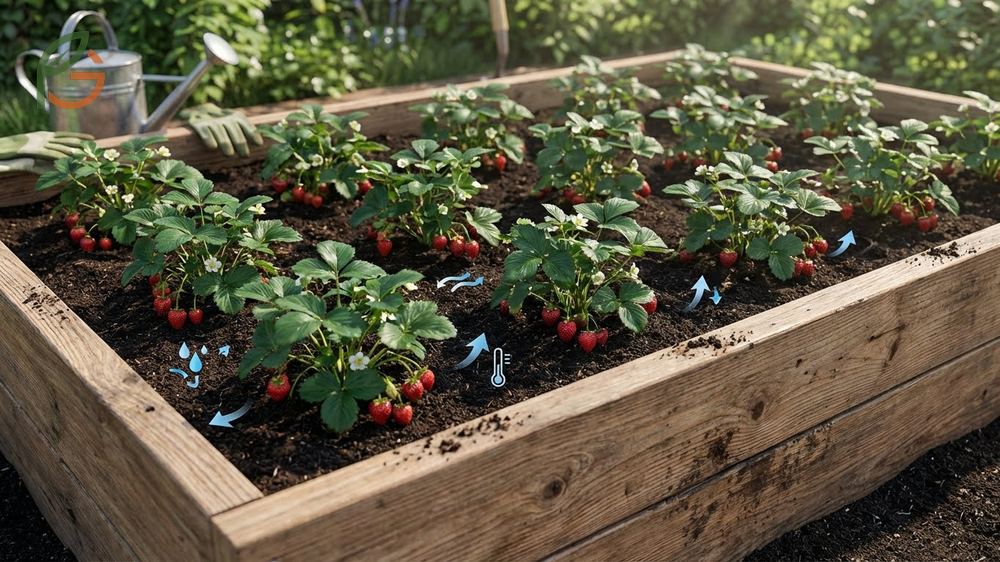
Raised beds solve the two biggest problems strawberries face: poor drainage and cold soil. Studies from Cornell Cooperative Extension show that raised beds warm up 10-15°F (5-8°C) faster in spring than ground-level plots, giving you earlier harvests[4]. The elevated growing area also keeps fruit cleaner and reduces soil-borne disease pressure by 40-60%.
You’re basically creating a custom growing environment where you control every variable. This matters because strawberries have shallow root systems that extend only 6-8 inches deep—perfect for raised bed cultivation. Most gardeners see their first berries 60-90 days after planting, with everbearing varieties producing through summer and fall.
Why Raised Beds Work for Strawberries
The height advantage isn’t just about convenience. When soil sits 8-12 inches above ground level, excess water drains quickly instead of pooling around roots. This prevents crown rot, which kills more strawberry plants than any other issue.
Air circulation improves dramatically in raised beds. Your plants get better airflow around foliage, which cuts fungal diseases like powdery mildew and botrytis by up to 50%. The warmer soil also means beneficial microbes wake up earlier and stay active longer.
- Drainage rate improves by 30-40% compared to ground planting, preventing waterlogged roots
- Soil warms 10-15°F (5-8°C) faster in spring, extending your growing season by 2-3 weeks
- Easier maintenance—no bending or kneeling required for planting, weeding, and harvesting
- Better pest control since slugs and ground-dwelling insects have harder access
- Complete control over soil quality regardless of your native ground conditions
- Beds last 7-10 years with proper care, making them a worthwhile investment
Choosing the Right Variety
June-bearing strawberries give you one massive harvest in late spring—perfect if you’re planning to make jam or freeze berries. They produce more runners and need 18 inches of space between plants[5]. If you’d rather have fresh berries all season, everbearing and day-neutral types produce smaller yields continuously from spring through fall.
Everbearing varieties work well in raised beds because they don’t spread as aggressively. Day-neutral types handle heat better and keep producing even when temperatures hit 85-90°F (29-32°C). For raised bed growing, most gardeners choose everbearing or day-neutral varieties since they’re easier to manage in compact spaces.
Important note: Don’t mix variety types in the same bed. June-bearing plants send out aggressive runners that’ll crowd out your everbearing plants within one season. Keep different varieties in separate beds for best results.
Best Time to Plant Strawberries
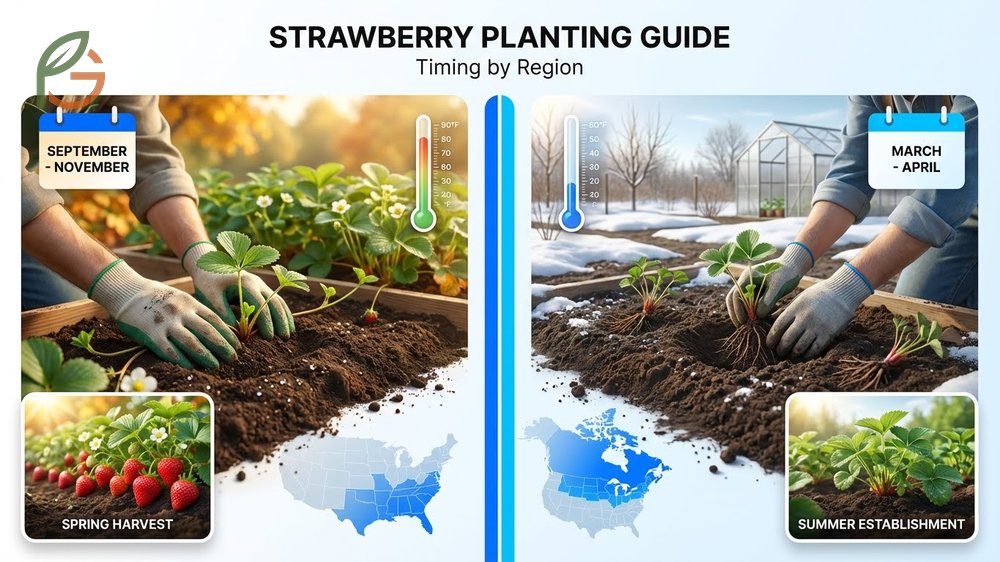
Timing determines whether you’ll pick berries in a few months or wait a full year. In southern states (Zones 8-10), fall planting from September through November lets plants establish roots during mild winter weather. They’ll start flowering in late winter and produce heavily through spring[3].
Northern gardeners (Zones 3-6) should plant in early spring as soon as soil can be worked, typically March through April. This gives plants the entire growing season to establish before winter. You won’t get a harvest the first year, but second-year production will be outstanding.
Regional Planting Windows
Florida gardeners plant from late September through early November, targeting soil temperatures around 60-70°F (15-21°C). Flowering starts in November and continues through April, with peak harvest in February and March[3]. Texas follows a similar schedule, with central and southern regions planting from September 15 to November 15.
The key is matching planting time to your first expected frost date. Count backward 6-8 weeks from your first fall frost for northern zones, or wait until daytime temperatures consistently stay below 85°F (29°C) for southern regions. My cousin in Guadalajara, Mexico planted ‘Albion’ strawberries in late October 2023 with night temperatures at 55-60°F (13-16°C)—plants established quickly and flowered within 45 days versus the typical 60-day timeline.
This table compares planting windows, optimal soil temperatures, and expected harvest timing across major US regions for strawberry cultivation
| Region (USDA Zones) | Planting Window | Soil Temperature | First Harvest |
|---|---|---|---|
| North Florida (8b-9a) | Sept 15 – Nov 1 | 60-70°F (15-21°C) | Feb – April |
| Central/South Texas (8a-9b) | Sept 15 – Nov 15 | 65-75°F (18-24°C) | March – May |
| Southern California (9a-10b) | Oct 1 – Dec 1 | 60-70°F (15-21°C) | March – June |
| Mid-Atlantic (6b-7b) | March 15 – April 30 | 50-60°F (10-15°C) | Following year |
| Upper Midwest (3b-5a) | April 1 – May 15 | 45-55°F (7-13°C) | Following year |
Temperature Requirements
Strawberries flower and set fruit when temperatures stay between 50-80°F (10-27°C) with less than 14 hours of daylight. Research from Ohio State University shows optimal photosynthesis occurs at 68-75°F (20-24°C) during the day, with nighttime temperatures ideally around 60-65°F (15-18°C)[6]. When daytime highs consistently exceed 90°F (32°C), plants stop producing flowers and focus on survival.
This explains why southern growers plant in fall and harvest through winter-spring, while northern gardeners plant in spring for summer-fall harvests. You’re working with the temperature window that naturally occurs in your region. Raised beds give you about 2 weeks of extra growing time at both ends of the season due to faster soil warming.
Spacing for Strawberry Plants
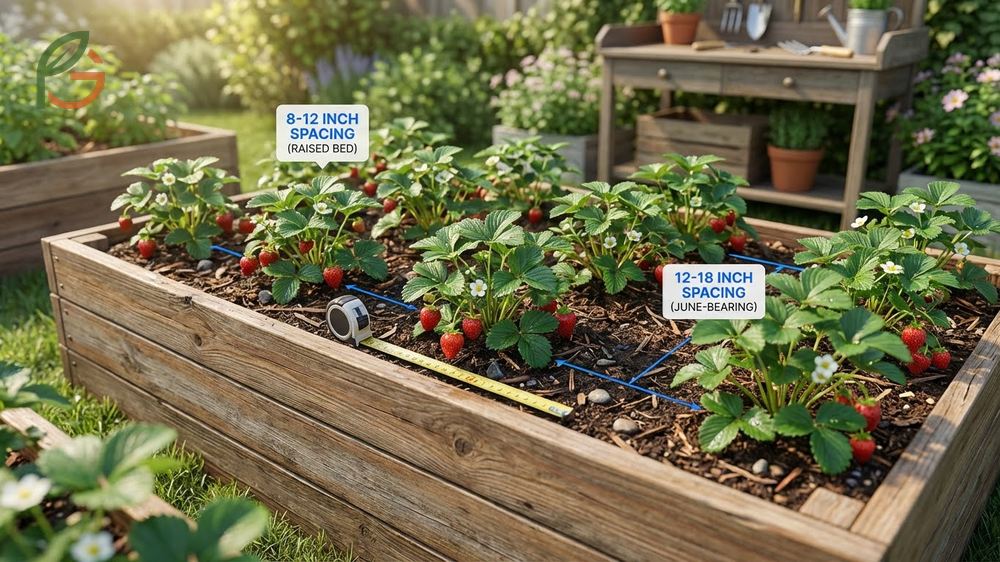
Plant spacing determines your harvest size more than any other factor. Current agricultural guidance shows that raised bed strawberries perform best at 8-12 inches apart in staggered rows, which is tighter than ground planting recommendations[2]. The improved drainage and air circulation in raised beds allow for closer spacing without disease issues.
June-bearing varieties need the most room—12-18 inches between plants—because they produce numerous runners throughout the season. Everbearing types work well at 10-12 inches, while day-neutral strawberries can handle 8-10 inch spacing. Row spacing should be 18-24 inches to allow easy access for maintenance and harvesting.
- Day-neutral varieties: 8-10 inches apart, ideal for continuous production in compact spaces
- Everbearing strawberries: 10-12 inches apart, good balance of yield and manageability
- June-bearing types: 12-18 inches apart, needs extra room for runner development
- Row spacing: 18-24 inches for comfortable access during maintenance tasks
- Staggered planting pattern increases plants per square foot by 20-30% versus straight rows
- Remove runners regularly if using tighter spacing to maintain plant vigor and berry size
The staggered double-row system works exceptionally well in raised beds. Plant two offset rows just 8 inches apart, then leave 18-24 inches before the next double row. This arrangement increases your yield per square foot while maintaining good air circulation. You’ll fit 30-40% more plants in the same space compared to single-row layouts.
Spacing tip: If you’re tight on space, go with 8-inch spacing for day-neutral varieties but commit to removing all runners throughout the season. Letting runners establish will turn your organized bed into a tangled mat within 6-8 weeks.
For plants per person calculations, figure 5-7 plants for casual fresh eating, or 10-15 plants if you want enough berries for freezing and preserving. A 4×8 foot raised bed holds 24-36 plants depending on spacing method, which feeds 2-4 people with fresh strawberries throughout the season.
Building Raised Beds for Strawberries
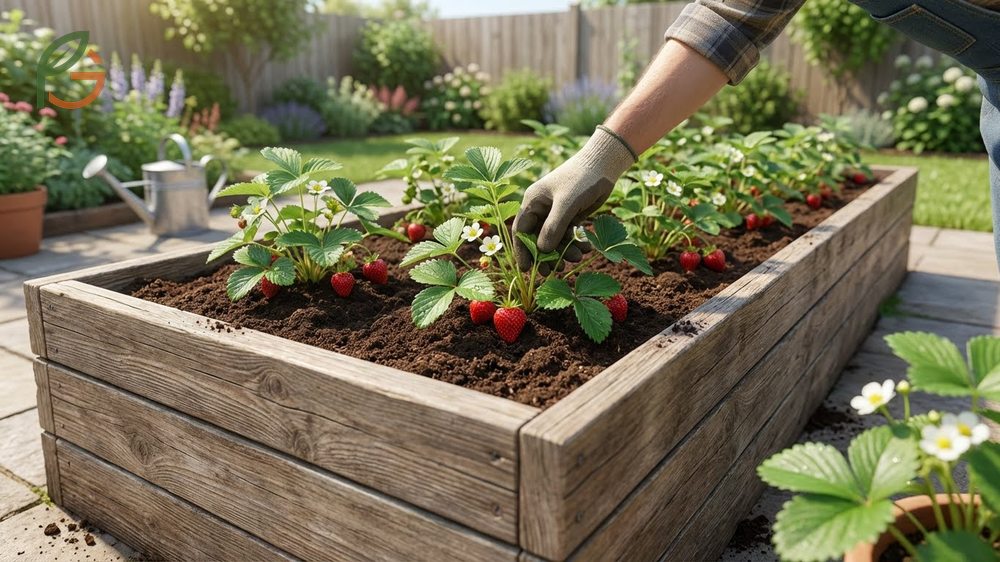
Bed height matters more than most gardeners realize. Research shows 8-12 inches provides optimal root depth while improving drainage significantly[1]. Anything shorter than 8 inches won’t give you the drainage advantage, while beds taller than 12 inches dry out too quickly in summer heat and require excessive watering.
Width should be 3-4 feet maximum so you can reach the center from both sides without stepping into the bed. Length doesn’t matter—make it as long as your space allows. Orientation affects sunlight distribution; north-south beds get more even light throughout the day, while east-west orientation can create shade patterns that help in hot climates.
- Height: 8-12 inches for ideal drainage and root development
- Width: 3-4 feet for comfortable reach from both sides without soil compaction
- Length: flexible based on available space, strawberries adapt well to long beds
- Materials: untreated wood, composite lumber, or galvanized metal—avoid treated wood
- Bottom: leave open to native soil for drainage, or use hardware cloth if over concrete
- Location: minimum 6-8 hours direct sun daily, avoid areas with standing water
Material choice impacts bed longevity and plant health. Untreated cedar or redwood lasts 7-10 years naturally. Composite lumber runs 15-20 years but costs 2-3x more. Metal beds heat up quickly in sun—great for northern gardens, but southern growers should use lighter colors or wood to prevent root damage from excessive heat.
Soil Mix for Raised Beds
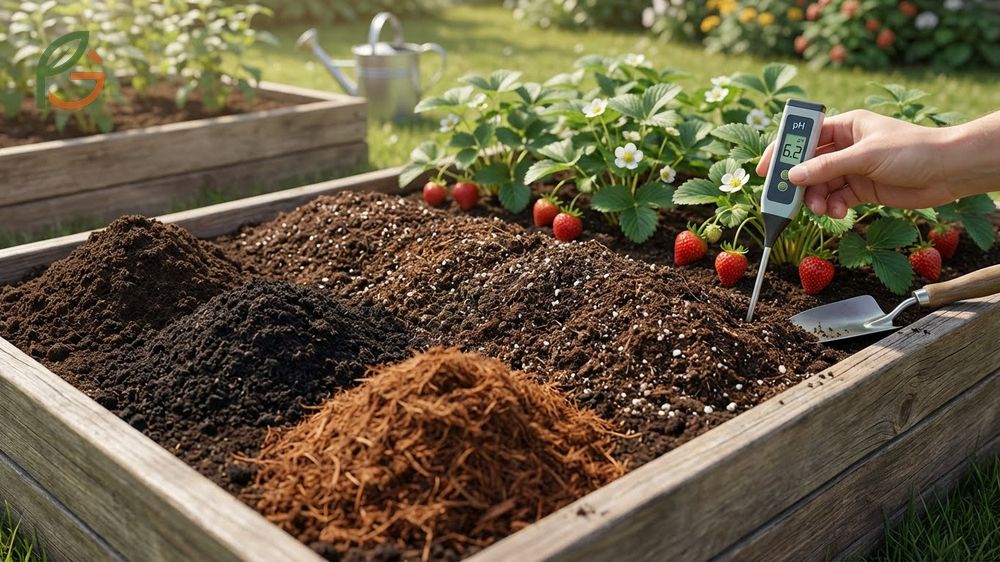
Strawberries thrive in slightly acidic soil with pH 5.5-6.5. The standard raised bed mix works perfectly: equal parts quality topsoil, compost, and peat moss or coconut coir. This combination drains well while retaining enough moisture to keep shallow strawberry roots happy.
Don’t use garden soil alone—it compacts too much in raised beds. Don’t use only compost either—it’s too rich and drains too fast. The three-part blend gives you ideal texture that holds together when squeezed but crumbles easily when poked. You’ll need about 12-15 cubic feet of soil mix for a standard 4×8 foot bed that’s 10 inches deep.
- Base mix: 1/3 topsoil, 1/3 compost, 1/3 peat moss or coconut coir by volume
- pH target: 5.5-6.5, adjust with lime (to raise) or sulfur (to lower)
- Add perlite: 10-15% by volume improves drainage in heavy soil mixes
- Organic matter: should make up 30-40% of final mix for nutrient retention
- Pre-plant fertilizer: mix in 2-3 pounds of balanced 10-10-10 per 100 square feet
- Mycorrhizal inoculant: optional but beneficial, helps roots absorb nutrients efficiently
Test your soil pH before planting using an inexpensive home test kit. If pH runs high (above 7.0), work in elemental sulfur at 1-2 pounds per 100 square feet. For low pH (below 5.0), add dolomitic lime at similar rates. Most bagged soil mixes fall in the correct range already, but it’s worth checking.
Soil mixing tip: Mix all components thoroughly in a wheelbarrow or on a tarp before filling beds. Layering ingredients without mixing creates drainage problems and uneven nutrient distribution that’ll show up as patchy plant growth.
Square Foot Gardening Strawberries
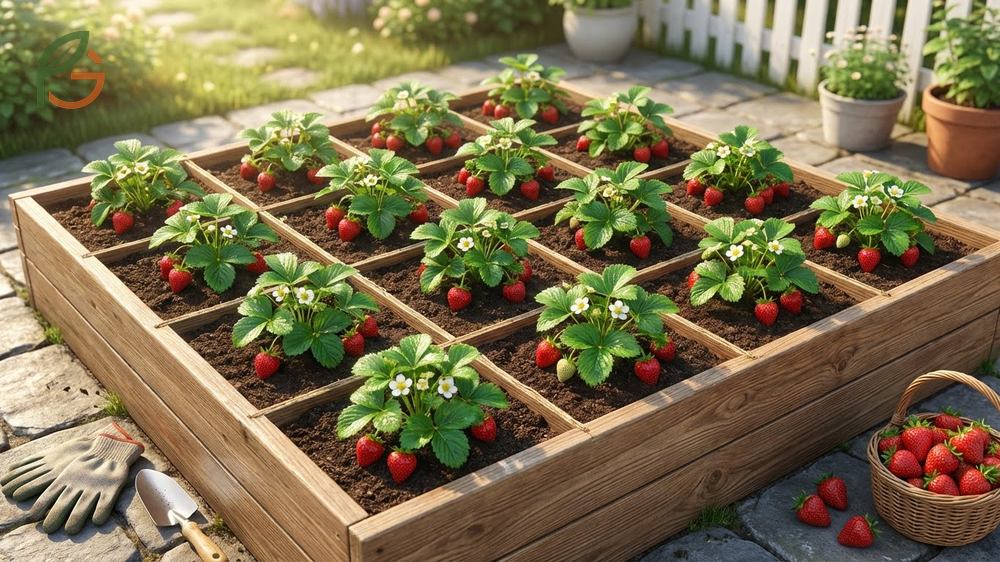
The square foot method works beautifully for strawberries in raised beds. Standard recommendation is one plant per square foot (12×12 inches) for all strawberry types. This spacing provides adequate room for plant development while maximizing your growing area.
A 4×4 foot raised bed holds 16 plants using this method, enough to keep a family of three supplied with fresh berries through the season. If you’re growing day-neutral or everbearing varieties that don’t produce heavy runners, you can push to 1.5-2 plants per square by using a staggered pattern. June-bearing types absolutely need the full square foot due to their aggressive runner production.
- Standard density: 1 plant per square foot works for all strawberry varieties
- 4×4 bed capacity: 16 plants, yields 8-16 pounds of berries per season
- 4×8 bed capacity: 32 plants, provides abundant harvest for family of 4-5
- Intensive planting: 1.5-2 plants per square possible with day-neutral varieties only
- Grid system: use string or wood strips to mark 12-inch squares for precise placement
- Companion planting: pair with lettuce, spinach, or herbs in unused squares during establishment
Mark your bed with a grid before planting to ensure even spacing. You can use twine stretched across the bed at 12-inch intervals, or permanently install thin wood strips. The visual guide prevents the common mistake of crowding plants at one end and spacing them too widely at the other.
Square foot gardening also simplifies fertilizing and crop rotation. You know exactly how many plants you’re feeding, making it easy to calculate fertilizer needs. After 2-3 years when plant productivity declines, you can renovate one square at a time rather than replanting the entire bed.
Conclusion
The evidence is clear: Growing Strawberries In Raised Beds succeeds when you match spacing to variety type, plant at the right time for your region, and build beds 8-12 inches high with quality soil mix. Raised beds give you better drainage, warmer soil temperatures, and easier maintenance compared to ground planting—advantages that translate directly to bigger harvests and healthier plants.
Current horticultural guidance emphasizes proper spacing as the foundation for productive strawberry beds. Whether you’re using the square foot method or traditional rows, giving each plant adequate room prevents disease while maximizing yield. FruitGarden provides research-based growing strategies that help home gardeners achieve results comparable to commercial operations.
Frequently Asked Questions
How far apart do you plant strawberries in raised beds?
Plant strawberries 8-12 inches apart in raised beds, with day-neutral varieties at the tighter end (8-10 inches) and June-bearing types needing 12-18 inches. The improved drainage and air circulation in raised beds allows closer spacing than ground planting without increasing disease risk.
When should I plant strawberries in Texas?
Texas gardeners should plant strawberries from mid-September through mid-November for best results. This timing allows plants to establish during mild fall weather and produce heavily from March through May when temperatures are ideal for fruit development.
When to plant strawberries in Florida?
Florida strawberry planting runs from late September through early November, with northern Florida planting earlier and southern regions waiting until late October. Plants flower starting in November and produce through April, with peak harvests in February and March.
How many strawberry plants per person do I need?
Plan on 5-7 plants per person for fresh eating throughout the season, or 10-15 plants per person if you want surplus for freezing and preserves. A family of four needs 20-30 plants for abundant fresh berries, which fits comfortably in a 4×8 foot raised bed.
What’s the best soil mix for strawberries in raised beds?
Mix equal parts quality topsoil, compost, and peat moss or coconut coir for ideal strawberry growing conditions. This combination provides excellent drainage while retaining adequate moisture, with a target pH of 5.5-6.5 for optimal nutrient availability.
How deep should raised beds be for strawberries?
Build strawberry raised beds 8-12 inches deep for best results. This depth accommodates the 6-8 inch root system while providing drainage benefits that prevent crown rot. Beds shallower than 8 inches don’t drain well enough, while deeper beds dry out too quickly.
Can you grow strawberries year-round in raised beds?
Day-neutral strawberries produce nearly year-round in zones 9-10 with proper care, while everbearing types give two main harvests in cooler regions. June-bearing varieties produce once annually regardless of climate. Raised beds extend the season by 2-3 weeks at both ends compared to ground planting.





