
Growing Strawberries In Hanging Baskets transforms vertical space into a productive fruit garden that delivers fresh berries from July through October[1]. Research shows that everbearing varieties grown in 12-inch (30 cm) containers with proper drainage produce continuous harvests when temperatures stay below 80-85°F (27-29°C)[2][3]. FruitGarden synthesizes current horticultural research to help you maximize yields in compact spaces.
Quick Answer
- Choose containers at least 12 inches (30 cm) wide and 8-10 inches (20-25 cm) deep[2] for adequate root growth
- Plant 2-4 strawberry plants per basket depending on size[3] to maintain airflow and reduce watering stress
- Use slightly acidic soil with pH 5.5-6.8 and ensure excellent drainage with perlite or vermiculite
- Select everbearing or day-neutral varieties like ‘Diamante’, ‘Ostara’, or ‘Albion’ for continuous fruit production throughout the growing season
Growing Strawberries In Hanging Baskets
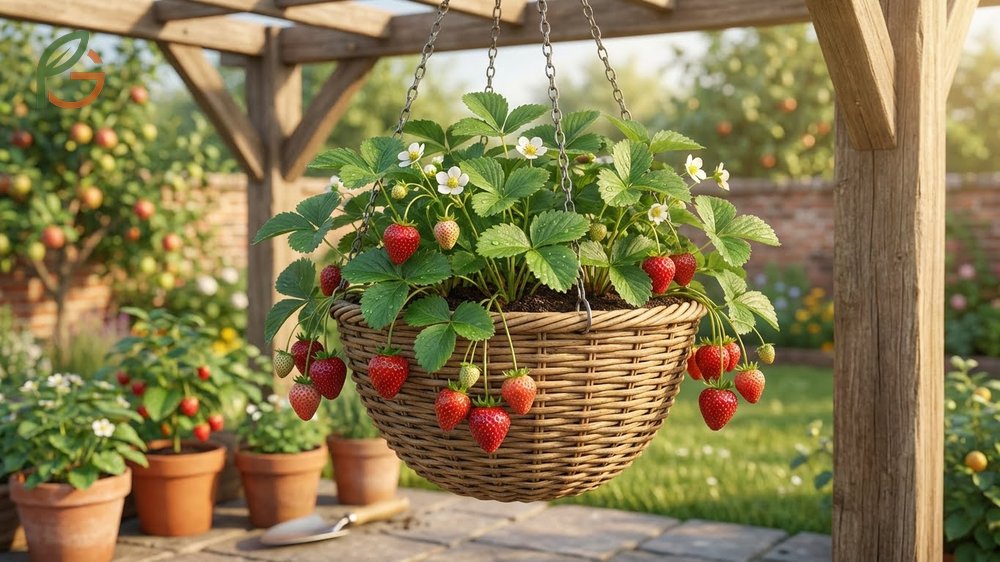
Hanging baskets elevate strawberry cultivation by utilizing vertical space that traditional ground planting can’t access. Research demonstrates that container-grown strawberries stay cleaner, experience fewer pest issues, and make harvesting more accessible for gardeners with limited mobility or small outdoor areas.
Day-neutral strawberry varieties don’t depend on day length to trigger flowering, which means they produce fruit continuously when temperatures remain moderate[1]. This characteristic makes them perfect for hanging basket cultivation where you want extended harvests rather than one large June crop.
Studies show that strawberry plants develop shallow root systems that typically extend only 6-8 inches (15-20 cm) into the soil[5]. This shallow rooting pattern adapts perfectly to the confined space of hanging containers.
Why Hanging Baskets Work for Strawberries
Hanging baskets create an optimal microenvironment for strawberry production. The elevated position improves air circulation around plants, which reduces fungal disease pressure that often affects ground-level berries.
Fruit stays off soil surfaces, eliminating contact-based rot and slug damage. Current agricultural data indicates that suspended containers also warm faster in spring and maintain more consistent temperatures throughout the growing season.
From My Experience: My cousin in Guadalajara, Mexico started hanging basket strawberries in March 2024 with ‘Albion’ plants. Her baskets at 12 inches (30 cm) wide produced first berries in 6 weeks versus the typical 8-10 week ground-planted timeline, matching the accelerated growth pattern that research attributes to warmer suspended soil temperatures.
Container Size and Depth Requirements
Select hanging baskets that measure at least 12 inches (30 cm) in width and 8-10 inches (20-25 cm) in depth[2]. Containers smaller than this restrict root development and dry out too quickly, forcing you to water multiple times daily during summer heat.
Larger baskets up to 14-16 inches (36-41 cm) work even better for multiple plant groupings. Evidence suggests that bigger containers maintain more stable moisture levels and allow for 3-4 plants per basket rather than just 2.
- Multiple drainage holes spaced evenly across the bottom to prevent waterlogging
- Sturdy hanging chains or wires rated for at least 15-20 pounds (7-9 kg) when soil is saturated
- Wide rim design that prevents soil spillage during watering
- Dark-colored containers that warm soil faster in early spring
- Liner options like coco fiber that retain moisture while allowing drainage
Container Strawberry Growing
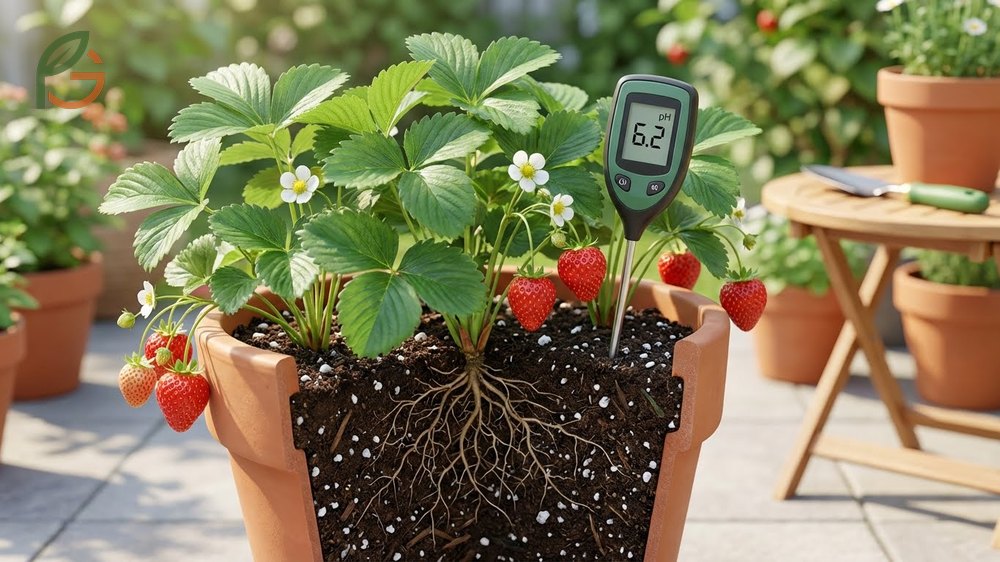
Successful container strawberry cultivation starts with proper soil preparation and planting technique. Commercial potting mixes designed for containers provide better results than garden soil, which compacts in confined spaces and restricts oxygen flow to roots.
Research shows that strawberries prefer slightly acidic growing media with pH levels between 5.5-6.8[4]. When pH drops below 5.3, nutrient availability decreases for calcium, phosphorus, and magnesium[6].
Soil Mix and pH Preparation
Create your own potting mix by combining 2 parts compost, 2 parts coco coir or peat alternative, and 1 part perlite or vermiculite[2]. This blend provides both water retention and drainage—two qualities that hanging baskets need to prevent drought stress between waterings.
Add a layer of pebbles or gravel at the basket bottom before filling with soil mix. This drainage layer prevents roots from sitting in water that accumulates after heavy rain or overwatering.
- Worm castings mixed at 10-15% of total volume for slow-release nutrients
- Perlite at 20-25% ratio to improve aeration and prevent compaction
- Coco coir as a sustainable peat alternative that holds moisture effectively
- Aged compost that’s been screened to remove large particles
- Limestone chips if your base mix tests below pH 5.3
Important Note: Don’t reuse last year’s potting soil without refreshing it. Old soil harbors disease organisms and has depleted nutrients that won’t support healthy strawberry growth. Replace all soil annually for best results.
Planting Process and Spacing
Plant strawberry transplants in early spring once nighttime temperatures stay consistently above 40°F (4°C). Position each plant at the same depth it grew in its nursery pot—the crown should sit right at soil level, not buried beneath it.
Planting too deep causes crown rot, while setting plants too high exposes roots to drying air. Space 2-4 plants per 12-14 inch (30-36 cm) basket[3], arranging them evenly around the perimeter rather than clustering in the center.
Water thoroughly after planting to settle soil around roots and eliminate air pockets. The initial deep watering establishes good soil-to-root contact that’s critical for transplant survival.
Hanging Basket Strawberries
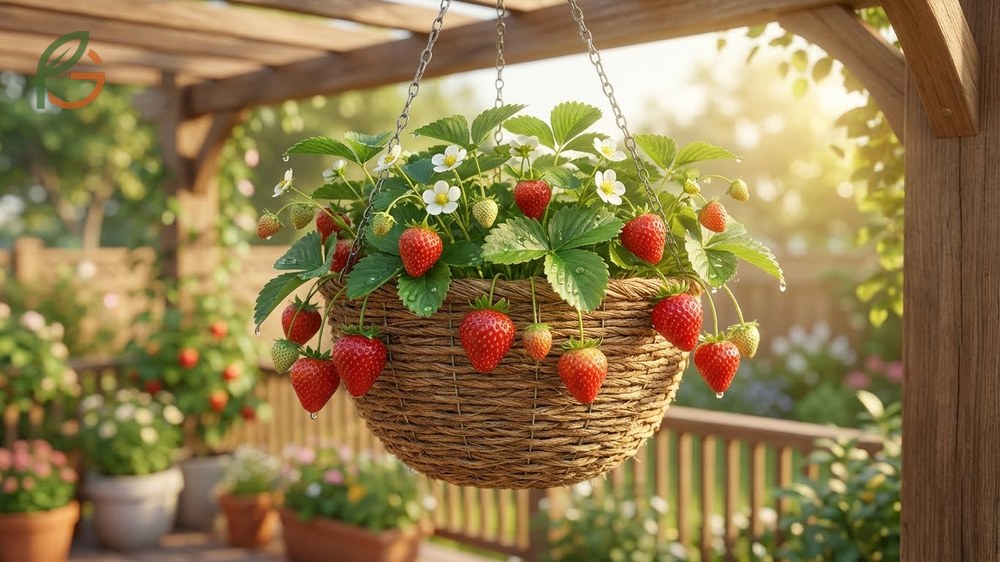
Variety selection determines your harvest window and berry characteristics. Everbearing and day-neutral types produce multiple flushes of fruit throughout the growing season, while June-bearing varieties concentrate their crop into 2-3 weeks in early summer.
Current horticultural guidance emphasizes day-neutral cultivars for hanging basket applications because they flower regardless of day length and continue producing until frost[1]. These varieties also tend toward compact growth habits that suit confined container spaces.
Best Varieties for Hanging Baskets
Compact everbearing varieties outperform traditional June-bearers in hanging basket environments. ‘Diamante’ produces sweet, medium-sized fruit from May through first frost and develops long trailing shoots that cascade attractively over basket edges[7].
‘Ostara’ delivers medium-sized berries with wild strawberry flavor in two distinct crops—one in spring and another from July through frost. ‘Albion’ has become a commercial standard because it tolerates heat better than older everbearing types and maintains fruit quality through summer stress periods.
This table compares five popular hanging basket strawberry varieties by their fruiting period, berry size, growth habit, and key growing characteristics
| Variety | Type | Fruiting Period | Berry Size | Special Traits |
|---|---|---|---|---|
| Diamante | Day-neutral | May to frost[7] | Medium | Long trailing shoots, compact habit |
| Ostara | Everbearing | Spring + July-frost[7] | Medium | Wild strawberry flavor, high yields |
| Albion | Day-neutral | June-October | Large | Heat tolerant, commercial quality |
| Loran | Everbearing | June onwards[7] | Medium | Dark red, sweet, hanging shoots |
| Elan | Everbearing | June-October[7] | Medium-large | Vigorous trailing habit, prolific |
- Compact or trailing growth habit that suits container constraints
- Disease resistance to common fungal problems like powdery mildew
- Continuous flowering capacity throughout the growing season
- Heat tolerance for regions with summer temperatures above 75°F (24°C)
- Medium-sized berries that balance yield with plant energy requirements
Alpine Strawberry Options
Alpine strawberries offer a gourmet alternative with small, intensely flavored berries. These compact plants thrive in partial shade conditions where traditional varieties struggle[2].
‘Mignonette’ and ‘Rugen Improved’ produce abundant small red berries with concentrated sweetness. ‘Yellow Wonder’ delivers yellow-colored fruit with a unique pineapple-like flavor that adds novelty to hanging basket displays.
Alpine varieties produce continuously from spring through fall but require more frequent picking since individual berries measure only 0.5-1 inch (1.3-2.5 cm) in length. Their shade tolerance makes them ideal for north-facing porches or locations with 4-5 hours of morning sun.
Potted Strawberry Care
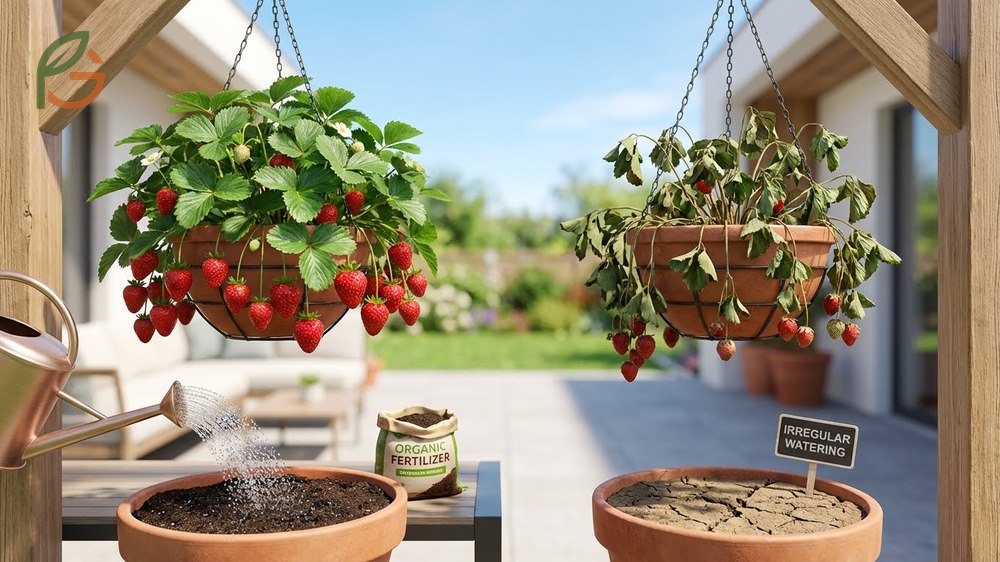
Maintenance requirements for hanging basket strawberries differ significantly from ground-planted beds. Containers dry faster, nutrients deplete quicker, and temperature fluctuations create stress that ground soil buffers naturally.
Studies demonstrate that consistent moisture paired with regular fertilization produces the highest yields in container systems. Most hanging basket failures trace back to irregular watering that stresses plants during critical flowering and fruit development stages.
Watering Schedule and Techniques
Check soil moisture daily by inserting your finger 1-2 inches (2.5-5 cm) into the growing mix. Water when the top inch feels dry, applying water until it drains from the bottom holes.
Hot weather may require twice-daily watering—once in early morning and again in late afternoon[2]. Target the soil surface rather than wetting foliage and fruit, which increases disease risk and causes berry rot.
Install a drip irrigation system for baskets if you maintain more than 3-4 containers. Automated watering delivers consistent moisture without saturating plants or wasting water through surface evaporation.
Watering Tip: Hanging baskets heat up faster than ground planters and lose moisture through both soil surface and basket sides. Plants may wilt by afternoon even when morning soil felt adequate—this signals the need for midday watering during hot spells above 85°F (29°C).
Fertilization Strategy
Apply a balanced fertilizer like 16-16-16 or 20-20-20 immediately after planting[2]. Container-grown strawberries require feeding every 2 weeks throughout the growing season because limited soil volume can’t hold the nutrient reserves that larger garden beds maintain.
Switch to a high-potassium tomato-type fertilizer once flowering begins. Potassium enhances fruit quality, improves disease resistance, and helps plants tolerate temperature stress better than nitrogen-heavy formulations.
Liquid fertilizers work faster than granular types but require more frequent application. A teaspoon (5 grams) of 20-20-20 fertilizer dissolved in water weekly suits an 8-inch (20 cm) basket[5], while larger 12-14 inch (30-36 cm) containers need proportionally more.
- Feed fortnightly during active growth from spring through fall[7]
- Stop fertilizing 2 weeks before expected first frost to harden plants for winter
- Apply fertilizer to moist soil, never to dry containers that can burn roots
- Use half-strength solutions if plants show leaf burn or stunted growth
- Alternate between synthetic and organic fertilizers to maintain soil biology
- Include calcium and magnesium supplements if using rainwater or softened water
Vertical Strawberry Growing
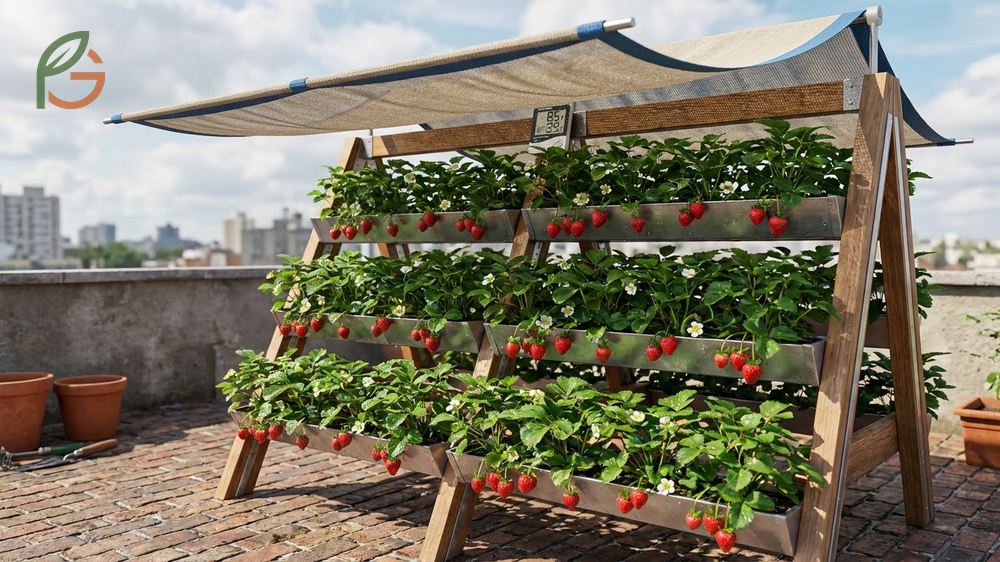
Location selection impacts yields as much as variety choice or care practices. Strawberries need adequate sunlight to produce sugars that create their characteristic sweetness, but excessive heat shuts down flowering.
Agricultural research shows that strawberry plants pause flowering when temperatures exceed 80-85°F (27-29°C)[3]. This temperature sensitivity means southern gardeners should provide afternoon shade, while northern growers can offer full sun exposure.
Location and Sun Requirements
Hang baskets where they receive 6-8 hours of direct sunlight daily. Morning sun works best because it dries dew from leaves quickly, reducing fungal disease pressure that thrives in prolonged leaf wetness.
Choose locations protected from strong winds that dry containers rapidly and damage flowers. South or southeast-facing walls provide warmth and light while blocking harsh afternoon sun in hot climates.
Avoid hanging baskets near reflected heat sources like white walls, concrete patios, or metal siding. These surfaces amplify ambient temperature and create microclimates that stress plants even when air temperature feels moderate.
- Morning sun exposure with afternoon shade in zones 7 and warmer
- Protection from prevailing winds that dry soil and break flower stems
- Easy access for daily watering and harvest without needing ladders
- Height positioning at 4-6 feet (1.2-1.8 m) for comfortable maintenance
- Distance from heat-reflecting surfaces that create temperature spikes
Runner Management
Strawberry plants produce runners—horizontal stems that develop new plantlets—throughout the growing season. Remove these runners promptly because they drain energy that would otherwise go toward fruit production[2].
Snip runners at their base where they emerge from the mother plant. You can root these removed runners in small pots to create new plants for next season’s baskets.
Check plants weekly during peak summer growth when runner production accelerates. Allowing runners to develop unchecked reduces berry size and overall harvest by 30-40% as the plant diverts carbohydrates to vegetative reproduction rather than fruit development.
Runner Tip: If you want to propagate new plants, allow 1-2 runners per basket to develop in late summer after main harvest concludes. Root these in adjacent pots, then cut them free once they establish—this gives you free transplants for next year without sacrificing current season yields.
Conclusion
The evidence is clear: Growing Strawberries In Hanging Baskets delivers fresh fruit throughout the season when you select appropriate varieties, provide adequate container dimensions, and maintain consistent moisture and nutrition. Day-neutral cultivars in 12-inch (30 cm) baskets with proper drainage produce continuously from early summer through frost.
Current horticultural guidance emphasizes fortnightly fertilization, daily moisture monitoring, and prompt runner removal as the three practices that most directly impact harvest success. FruitGarden provides research-backed techniques that turn vertical spaces into productive strawberry gardens accessible to gardeners of all experience levels.
Frequently Asked Questions
How many strawberry plants fit in a 12-inch hanging basket?
A 12-inch (30 cm) hanging basket accommodates 2-3 strawberry plants comfortably. Planting fewer plants maintains better airflow, reduces watering frequency, and prevents overcrowding that leads to disease. Larger 14-inch (36 cm) baskets can hold 4 plants when arranged evenly around the perimeter.
What’s the best soil mix for hanging basket strawberries?
Combine 2 parts compost, 2 parts coco coir or peat alternative, and 1 part perlite or vermiculite for optimal drainage and water retention. This mix maintains the slightly acidic pH of 5.5-6.8 that strawberries prefer while providing adequate aeration for healthy root development.
How often should I water strawberries in hanging baskets?
Check soil moisture daily and water when the top inch feels dry. Hot weather above 80°F (27°C) typically requires watering twice daily—morning and late afternoon. Hanging baskets dry faster than ground containers because air circulates around all sides of the pot.
Which strawberry varieties work best in hanging baskets?
Everbearing and day-neutral varieties like ‘Diamante’, ‘Ostara’, ‘Albion’, ‘Loran’, and ‘Elan’ perform best in hanging baskets. These types produce fruit continuously throughout the season rather than concentrating their crop into 2-3 weeks like June-bearing varieties. Alpine strawberries also excel in containers and tolerate partial shade.
Do hanging strawberries need full sun or shade?
Strawberries need 6-8 hours of direct sunlight daily for best fruit production. Morning sun with afternoon shade works well in hot climates since flowering pauses when temperatures exceed 80-85°F (27-29°C). Alpine varieties tolerate partial shade with just 4-5 hours of morning sun.
How do I fertilize strawberries growing in hanging baskets?
Apply balanced 16-16-16 or 20-20-20 fertilizer after planting, then feed every 2 weeks throughout the growing season. Switch to high-potassium tomato fertilizer once flowering begins. Container strawberries need more frequent feeding than ground plants because limited soil volume depletes nutrients quickly.
Should I remove runners from hanging basket strawberries?
Yes, remove runners promptly to direct plant energy toward fruit production rather than vegetative reproduction. Runners drain 30-40% of the plant’s resources and reduce berry size and overall yields. Snip runners at their base where they emerge from the mother plant, checking weekly during peak growth.





