
Asian pear fruit trees thrive when planted in full sun with well-draining soil and proper cross-pollination partners. Research shows these trees need 400-850 chill hours annually and begin producing fruit within 2-3 years after planting[1]. Understanding the complete growth cycle from dormant buds through harvest ensures you’ll get crisp, juicy pears that store for months—data that FruitGarden synthesizes from university extension programs and commercial orchard management guides.
Quick Answer
- Asian pear trees need 400-850 chill hours depending on variety—Hosui requires 550-650 hours while Shinko needs 800+[1]
- Cross-pollination is essential—plant two compatible varieties within 100 feet for proper fruit set[2]
- Thin fruit to 6-8 inches apart when fruitlets reach marble size to produce larger, higher-quality pears[3]
- Trees require 8+ hours of direct sunlight daily and soil pH between 6.3-6.8 for optimal growth[4]
Asian Pear Fruit Tree
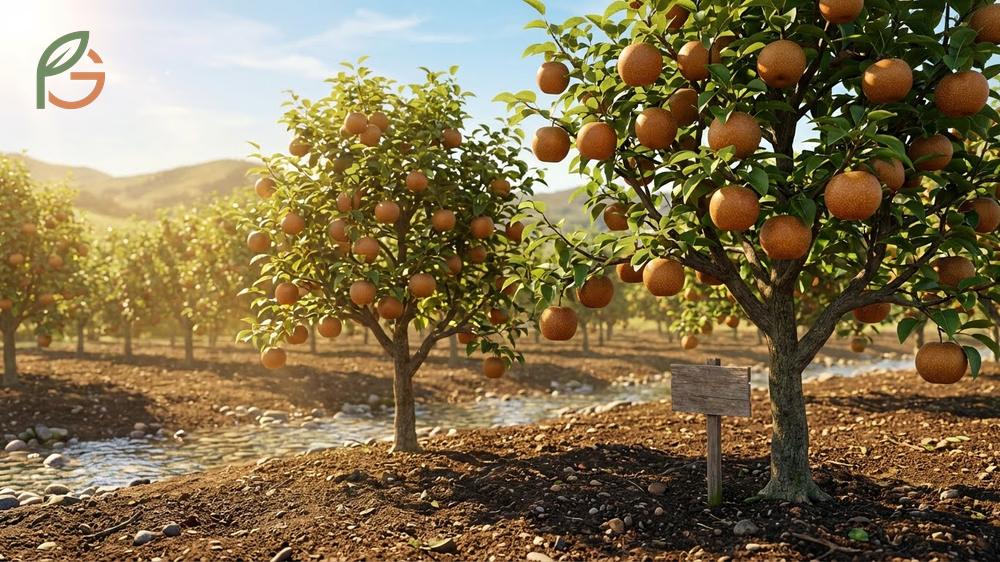
Asian pear trees produce crisp, apple-textured fruit that’s harvested when ripe on the tree—unlike European pears that ripen off the branch. These trees need well-draining soil with pH levels between 6.3-6.8 and at least 8 hours of direct sunlight measured during peak summer months[4]. Most varieties aren’t self-fertile, so you’ll need to plant two compatible cultivars for successful fruit production.
The trees show remarkable winter hardiness but require specific chill hour accumulation to break bud dormancy properly. Plant spacing depends on your chosen rootstock and training system—standard trees need 15-20 feet between specimens while dwarf varieties can be placed 10-12 feet apart. Root development starts immediately after spring planting when you position the graft union at least 1 inch above the soil surface[5].
What often gets overlooked is that Asian pears bloom slightly after peaches but before apples—typically 1-2 weeks ahead of European pear varieties. This early flowering window makes them vulnerable to late spring frosts in northern regions. The trees compensate for this risk by producing abundant flower clusters along fruiting spurs that develop on 2-year-old wood.
From My Experience: My cousin in Guadalajara, Mexico planted a Hosui asian pear tree in March 2023. The tree produced its first flower clusters in spring 2025—exactly 2 years after planting—achieving the typical 2-3 year bearing timeline that research predicts.
Bud Dormancy and Chill Requirements
Chill hour requirements vary significantly among Asian pear cultivars, ranging from 400-850 hours below 45°F (7°C)[1]. Hosui performs well with 550-650 hours, making it suitable for warmer regions like USDA zones 7-9. Shinko demands 800+ hours and thrives in zones 5-8 where winters provide adequate chilling.
Without sufficient chill hours, buds break erratically and produce fewer flowers. This results in delayed bloom, reduced fruit set, and poor-quality pears that don’t develop proper size or sweetness. Track accumulated chill hours in your area starting November 1 through February to determine which varieties will succeed in your climate.
Bloom Period and Pollination
Asian pears bloom in early to mid-spring when temperatures consistently reach 55-65°F (13-18°C). Flowers open over a 7-10 day period, with individual blooms remaining receptive for 3-5 days. This narrow window demands that you plant compatible pollinizers with overlapping bloom times within bee flight distance.
Chinese and Japanese cultivar bloom periods often don’t coincide, which prevents successful cross-pollination between these groups[4]. Shinseiki flowers mid-season and successfully pollinates most varieties except Seigyoku. Hosui and Shinko work well together as reciprocal pollinizers with matched flowering schedules.
Important Note: Asian and European pears can’t reliably pollinate each other because Asian varieties bloom 1-2 weeks earlier. Always choose two Asian pear cultivars as pollination partners rather than mixing pear types.
Asian Pear Tree From Bud to Fruit
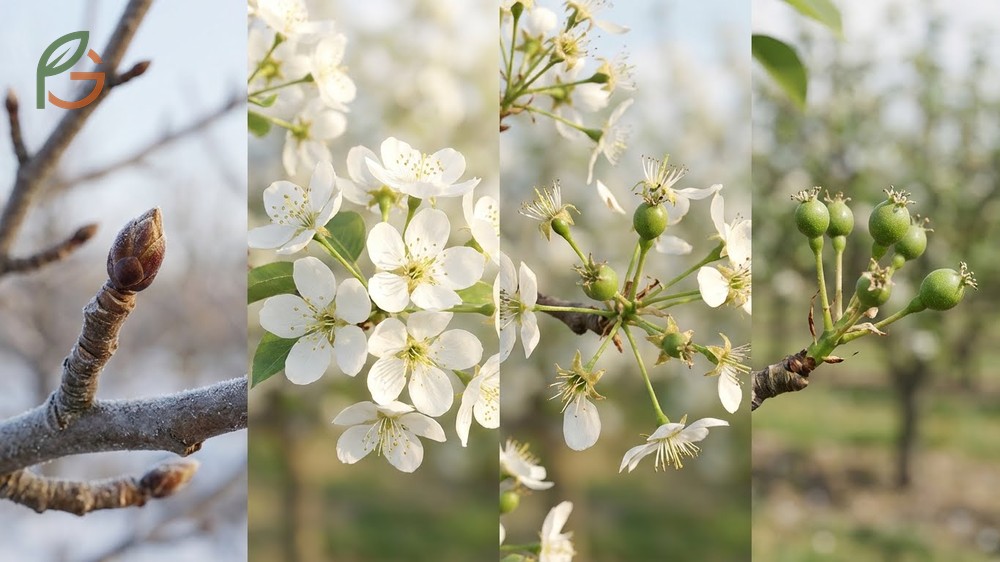
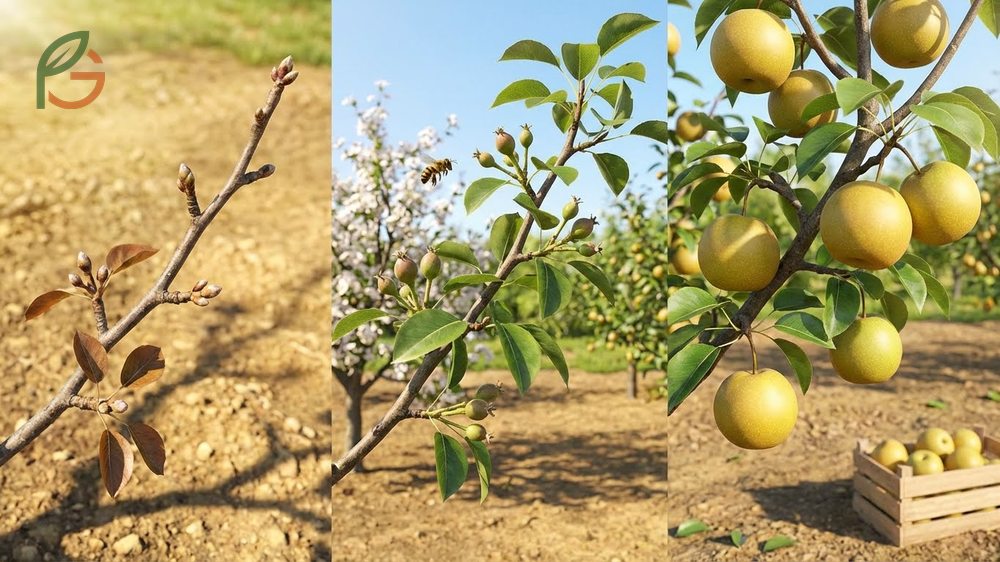
The journey from dormant bud to ripe fruit spans approximately 120-150 days depending on variety and climate. Buds swell in late winter as temperatures warm, then burst into white five-petaled flowers clustered along short fruiting spurs. After successful pollination, petals drop and tiny fruitlets begin developing within 10-14 days of bloom.
Early fruitlets look like small green beads attached to spurs—each flower cluster can produce 5-8 fruitlets initially. Most trees naturally drop excess fruitlets during “June drop” when they shed poorly pollinated or weak fruit. This self-thinning process isn’t sufficient for quality fruit production, so manual thinning becomes essential 4-6 weeks after bloom.
Fruit size increases rapidly through summer when trees receive consistent water and nutrients. Asian pears develop their characteristic round or slightly flattened shape while remaining green or developing bronze coloration. Unlike apples that soften with maturity, Asian pears maintain their crisp texture and develop sweetness directly on the tree through sugar accumulation.
Fruit Set and Early Development
Successful fruit set depends on bee activity during the narrow bloom window and compatible pollen transfer between varieties. Cold, rainy weather during flowering reduces bee foraging and results in poor pollination. Temperatures below 50°F (10°C) during bloom inhibit pollen tube growth even when pollination occurs.
Fruitlets grow slowly for the first 3-4 weeks after petal fall while developing seeds and cellular structure. This early stage determines final fruit size—stress from drought or nutrient deficiency during this period permanently limits how large pears can grow. Water deeply once weekly during fruit development, providing 1-2 inches of water per week through irrigation or rainfall.
Fruit Thinning Necessity
Thinning fruit to 6-8 inches apart when fruitlets reach marble size dramatically improves harvest quality[3]. Remove all but one fruit per cluster, selecting the largest and most well-formed specimen. This reduces competition for nutrients and prevents branch breakage from excessive fruit weight.
Use clean pruning shears or twist fruitlets off gently to avoid damaging fruiting spurs where next year’s flowers will form. Start thinning at branch ends and work inward toward the trunk. Heavy fruit loads left unthinned produce ping-pong sized pears with mostly skin and seeds rather than juicy flesh.
- Increases individual fruit size by 30-50% compared to unthinned branches
- Improves sugar content and overall fruit quality for fresh eating
- Reduces stress on branches and prevents limb breakage during ripening
- Promotes consistent annual bearing by preventing biennial production cycles
- Allows better air circulation between fruits, reducing disease pressure
Timing Tip: Thin Asian pears in mid to late June when fruitlets are marble-sized but before they develop significant size. Waiting too long wastes the tree’s energy on fruit you’ll eventually remove.
Cross Pollination Asian Pears
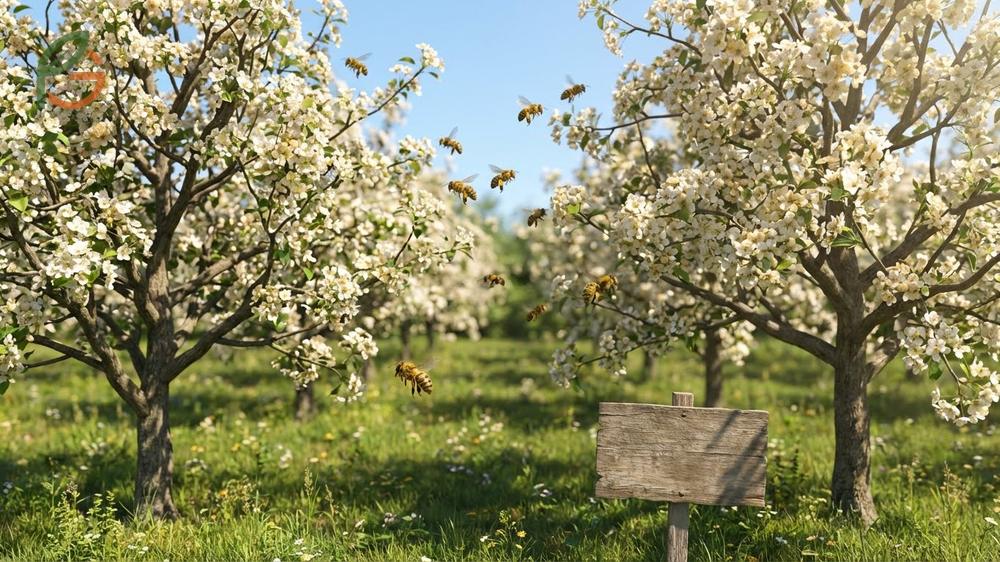
Cross-pollination between two different Asian pear cultivars is essential because most varieties are self-sterile or produce minimal fruit without compatible pollen sources. Plant pollinizer trees within 100 feet of each other with no solid obstructions blocking bee flight paths[2]. Bees typically forage within 50-150 feet of hive locations, so closer spacing improves pollination success rates.
Not all Asian pear varieties work as compatible pollinizers—bloom timing and genetic compatibility both matter. Chinese and Japanese cultivars generally can’t cross-pollinate because their flowering periods rarely overlap by more than 1-2 days. Some specific variety combinations like Shinseiki with Seigyoku are genetically incompatible even when bloom times match perfectly.
Current guidance emphasizes planting at least two trees when establishing a home orchard. If space limits you to one tree, graft a compatible pollinator branch onto your main tree or coordinate with neighbors growing Asian pears within bee range. Commercial orchards plant pollinizer rows at ratios of 1:8 to ensure adequate pollen distribution throughout plantings.
Compatible Pollinator Varieties
Shinseiki serves as an excellent universal pollinator for most Asian pear varieties and shows reasonable self-fruitfulness in some regions[1]. It blooms mid-season and provides viable pollen for early, mid, and late-flowering cultivars. The only notable exception is Seigyoku, which can’t be pollinated by Shinseiki despite matching bloom periods.
Hosui and Shinko function as reciprocal pollinizers with overlapping flowering schedules and genetic compatibility. Both varieties produce abundant pollen and support high fruit set percentages when planted together. Chojuro also works well with most Japanese cultivars and extends the pollination window with its slightly later bloom timing.
- 20th Century + Shinseiki: overlapping mid-season bloom with 400-600 hour chill match
- Hosui + Shinko: reciprocal pollinizers with similar vigor and fruit timing
- Shinseiki + Chojuro: early to mid bloom overlap covering 10-14 day flowering period
- Hosui + 20th Century: compatible Japanese varieties with moderate chill requirements
- Shinko + Chojuro: late-season bloomers that pollinate each other effectively
Hosui and Shinseiki Varieties
Hosui translates to “much water” in Japanese and contains 12% sugar content when fully ripe. This variety produces medium-large brownish-orange fruit with exceptionally juicy, fine-grained white flesh that stores through December under proper conditions[6]. The trees show vigorous growth with spreading, somewhat floppy branching that benefits from training to central leader systems.
Shinseiki ranks as one of America’s most popular Asian pear cultivars because it produces twice the fruit quantity of larger-fruited varieties. The bright yellow pears reach snack size—roughly half the diameter of Hosui or Chojuro. Trees begin bearing at 2-3 years old and adapt to growing zones from tropical Hawaii through continental Michigan climates[7].
Both varieties require different chill hour accumulation—Hosui needs 550-650 hours while Shinseiki tolerates lower chilling. This makes Hosui better suited for zones 7-9 while Shinseiki succeeds in zones 5-9. When planted together, they provide mutual pollination and extend your harvest season by 2-3 weeks through their different ripening schedules.
Pruning and Training Techniques
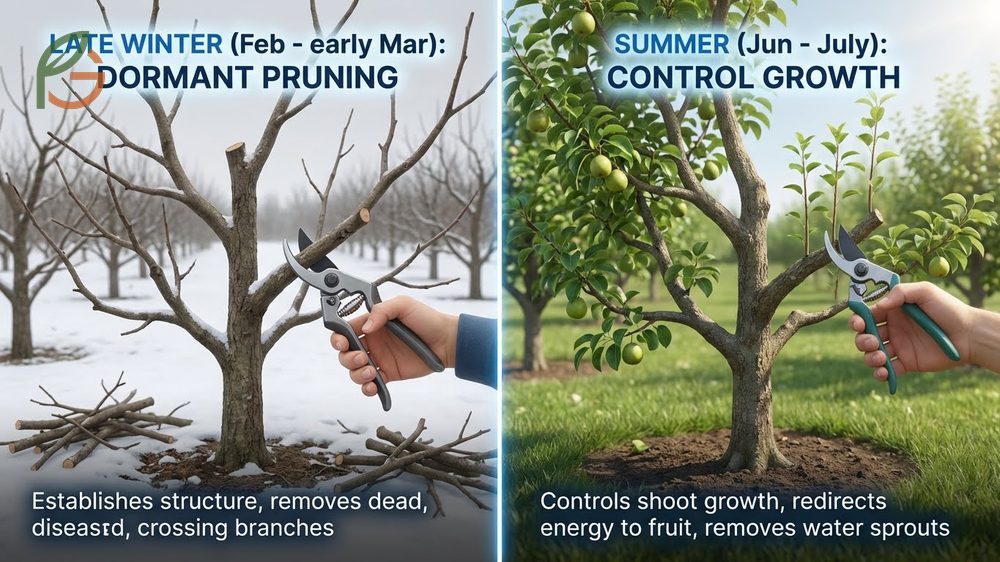
Prune Asian pear trees in late winter before buds swell, typically February through early March in most regions. This dormant-season pruning establishes tree structure and removes dead, diseased, or crossing branches. Summer pruning in June-July controls vigorous shoot growth and redirects energy toward fruit production rather than excessive vegetative growth[5].
Remove water sprouts—those vigorous vertical shoots growing from main branches—during summer pruning sessions. These shoots consume significant tree energy without producing fruit and create dense canopy areas with poor air circulation. Cut them flush with the parent branch rather than leaving stubs that regrow multiple shoots.
Research shows young trees respond better to light, frequent pruning rather than severe annual cuts that stimulate excessive regrowth. Target 12-18 inches of annual shoot growth on bearing trees as your benchmark for balanced vegetative and reproductive development. Less growth indicates insufficient nutrients or water; more growth suggests excess fertilization that delays fruiting.
Training Young Pear Trees
Central leader training creates pyramid-shaped trees with strong scaffolds capable of supporting heavy fruit loads. Select 3-5 well-spaced radiating branches for the first tier, avoiding branches directly across from each other vertically. The second tier sits 24 inches above the first tier with 3-4 branches, followed by a third tier with 1-2 branches[8].
Maintain the central leader as the highest point of the tree throughout training—all scaffold branch terminals should remain lower than the leader tip. Use clothespins, branch spreaders, or ties during the first growing season to establish 45-60 degree branch angles from the trunk. Wider angles create stronger branch attachments and support heavier crops without splitting.
Start training immediately after planting rather than waiting until the second year. Head back the central leader to 30-36 inches above ground if planting a whip, forcing lateral bud break at the proper height for your first scaffold tier. Remove or spread any competing shoots that challenge the central leader’s dominance during the first two growing seasons.
Pruning Fruiting Spurs
Fruiting spurs develop on 2-year-old wood and remain productive for 8-12 years before declining. These short, stubby growths produce flower clusters and shouldn’t be removed during routine pruning. Focus your cuts on thinning overcrowded branches and removing unproductive wood rather than eliminating spur systems.
Older spurs eventually become congested with multiple branch stubs from years of fruit removal. Renew aging spur systems by removing the oldest, least productive portions while retaining younger, vigorous spur wood. This encourages new spur development on nearby branches and maintains consistent fruit production across the tree canopy.
- Remove no more than 25% of total tree canopy in any single pruning session
- Make cuts just above outward-facing buds to direct new growth away from tree center
- Sterilize pruning tools between cuts with 70% isopropyl alcohol to prevent disease spread
- Avoid leaving stubs longer than 1/4 inch when removing branches or water sprouts
- Reduce fertilizer application by 50% following heavy pruning to prevent excessive regrowth
Fire Blight Warning: Avoid heavy pruning during bloom or active growth periods if fire blight occurs in your region. Open wounds during warm, humid weather provide entry points for this bacterial disease that can kill entire branches or young trees.
Fertilizing Fruit Trees
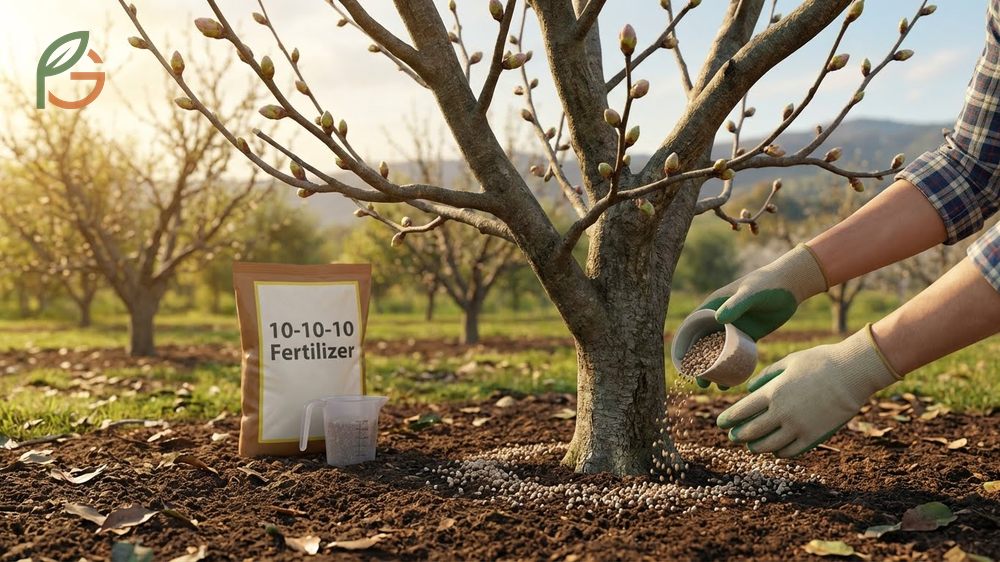
Apply fertilizer in early spring as buds begin swelling but before flowers open. Use a split application approach with half to one-third cup of 10-10-10 fertilizer per year of tree age, with a maximum of 8 cups per mature tree[9]. This split approach provides nutrients during critical growth periods without overfeeding and promoting excessive vegetative growth at the expense of fruit production.
Newly planted trees respond dramatically to fertilization when applied at planting and again 6-8 weeks later. Either granular, liquid, or stake-type fertilizers work effectively—granular types can be worked into the soil surface at 2 pounds per 100 square feet of planting bed[10]. Keep fertilizer at least 6 inches away from the trunk to prevent bark burning and root damage.
Heavily pruned trees need reduced fertilization for 1-2 years following major cuts. Excess nitrogen after severe pruning stimulates vigorous shoot growth that delays return to fruiting and requires additional corrective pruning. Monitor annual shoot growth—if new shoots exceed 24 inches, reduce fertilizer rates by 30-50% the following year to restore balance between vegetative and reproductive growth.
Avoid excessive nitrogen fertilization that produces lush foliage at the expense of flower bud formation. Asian pears bloom and fruit best when shoot growth remains moderate rather than excessively vigorous. Organic compost applications work well for maintaining soil fertility while providing slow-release nutrients that don’t spike growth patterns.
- Test soil pH every 2-3 years and maintain levels between 6.3-6.8 for optimal nutrient uptake
- Apply first fertilizer dose when buds swell in early spring (March-April in most regions)
- Distribute second application 8-10 weeks after first dose during early fruit development
- Broadcast fertilizer evenly from 1 foot beyond trunk to branch drip line
- Water deeply after fertilizer application to move nutrients into root zone
- Switch to low-nitrogen formulations (5-10-10) for mature bearing trees to prioritize fruiting
Nutrient Timing: Don’t fertilize after July in cold-winter regions. Late-season nitrogen promotes tender new growth that doesn’t harden off before frost, resulting in winter damage to branch tips and reduced flowering the following spring.
Conclusion
The evidence is clear: asian pear fruit trees deliver reliable harvests when you match varieties to your chill hour zone, provide compatible pollinizers, and maintain proper pruning and fertilization schedules. These trees reward minimal care with decades of production once established, producing fruit that stores longer than most fresh pears while maintaining exceptional crispness and sweetness.
Current guidance emphasizes preventive care through proper training systems, timely fruit thinning, and balanced nutrition rather than reactive management of problems. FruitGarden synthesizes university research and commercial growing data to help home orchardists succeed with Asian pears from initial planting through mature production years, ensuring you’ll enjoy fresh, homegrown pears that rival anything available in stores.
Frequently Asked Questions
Can you grow an Asian pear tree from the roots?
You can’t grow Asian pear trees from root cuttings successfully because they’re grafted onto specific rootstocks that control tree size and disease resistance. The roots produce rootstock shoots rather than the desired fruiting variety. Instead, purchase grafted nursery trees or propagate through budding and grafting techniques that preserve varietal characteristics.
How long does it take for Asian pear fruit tree buds to produce fruit?
Asian pear trees begin producing fruit 2-3 years after planting when grown on standard or semi-dwarf rootstocks. Flower buds form on 2-year-old wood, so you’ll see first blooms in the second spring after planting. Full production capacity develops by years 5-7, with mature trees yielding 50-150 pounds annually depending on variety and training system.
What’s the difference between Hosui and Shinseiki Asian pear trees?
Hosui produces larger brownish-orange fruit with 12% sugar content and stores through December, while Shinseiki yields twice as many smaller bright yellow pears that reach snack size. Hosui requires 550-650 chill hours and grows best in zones 7-9, whereas Shinseiki adapts to zones 5-9 with lower chilling needs. Both varieties pollinate each other effectively when planted together.
When should I thin fruit on my Asian pear tree?
Thin Asian pears in mid to late June when fruitlets reach marble size, approximately 4-6 weeks after bloom. Remove all but one fruit per cluster and space remaining pears 6-8 inches apart along branches. This timing allows the tree to redirect energy toward fewer fruits before significant size development occurs, resulting in larger, sweeter pears at harvest.
Do Asian pear trees need full sun to produce fruit?
Asian pear trees require at least 8 hours of direct sunlight daily measured during peak summer months for optimal fruit production. Insufficient light reduces flower bud formation, delays ripening, and produces smaller fruit with lower sugar content. Plant in locations that avoid shade from buildings, fences, or larger trees throughout the growing season.
How far apart should I plant Asian pear trees for cross-pollination?
Plant pollinator trees within 100 feet of each other with no solid structures blocking bee flight paths between trees. Closer spacing of 50-75 feet improves pollination success rates because bees forage more reliably over shorter distances. Ensure both trees bloom simultaneously by selecting compatible varieties with matching chill hour requirements for your climate zone.
What type of pruning system works best for Asian pear trees?
Central leader training creates the strongest framework for Asian pears with 3-5 scaffold branches per tier spaced 24 inches vertically. This pyramid shape supports heavy fruit loads and allows good light penetration throughout the canopy. Prune in late winter before bud break and remove vigorous water sprouts during summer to maintain tree structure and fruit quality.





