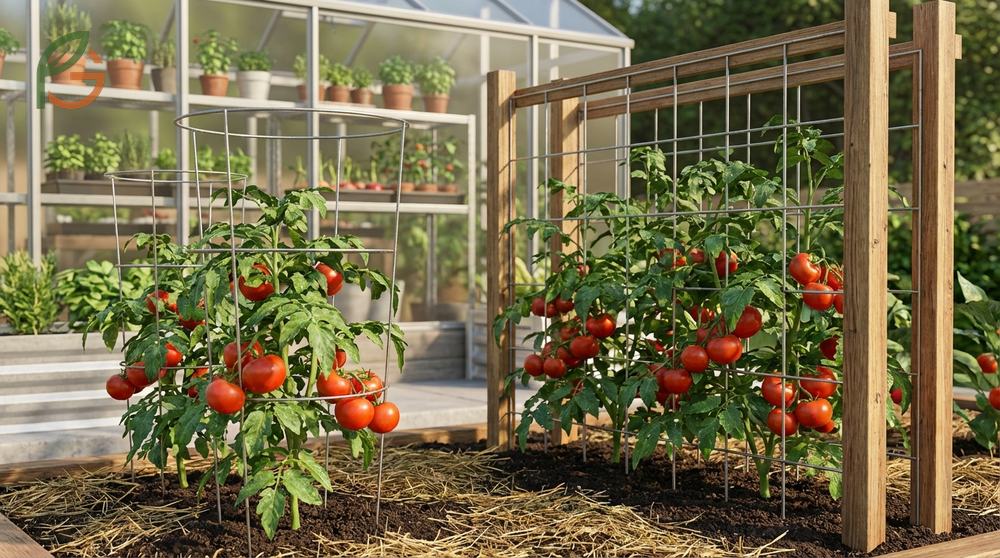
Research shows that staking tomato plants improves fruit quality by keeping produce off the ground and increasing airflow, reducing disease risk by up to 30%[1]. Whether you’re shopping for tomato cages at Home Depot or building cattle panel trellises, choosing the right support system depends on your tomato variety, available space, and gardening style. FruitGarden brings together university extension research and practical field data to help you select and install the most effective staking method for heavy-yielding plants that can reach 6-12 feet tall[2].
Quick Answer
- Stakes work best for single-stem pruned plants, requiring 6-8 feet tall supports driven 12 inches deep[2]
- Cages suit determinate varieties but indeterminate tomatoes need 4-foot wide reinforcing mesh with 4-inch openings[3]
- Florida weave method uses T-posts every two plants with twine rows spaced 6-8 inches apart vertically[4]
- Space supported indeterminate tomatoes 18-24 inches apart in rows 3-4 feet wide for optimal air circulation[2]
How to Stake Tomato Plants
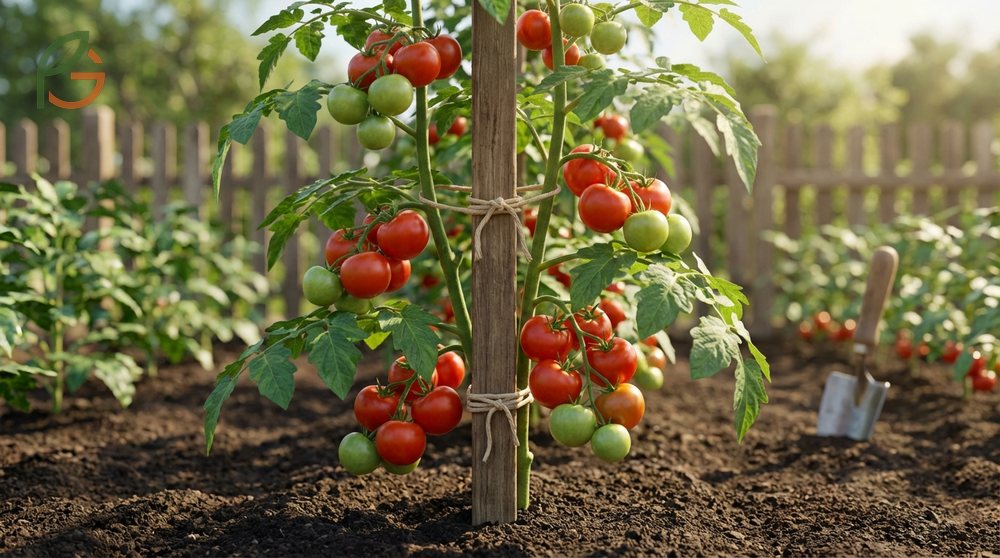
Staking transforms tomato cultivation from sprawling chaos into organized production. Studies demonstrate that supported plants produce cleaner fruit with fewer blemishes compared to ground-grown specimens[1]. The vertical structure allows sunlight to reach more foliage while improving air circulation that dries leaves faster after rain or watering.
Installation timing matters more than most gardeners realize. Research from university extension programs shows the optimal window is 2-3 weeks after transplanting, when plants reach 12-15 inches tall[1]. Earlier installation prevents root disturbance, while delayed staking risks damaging established stems. Most commercial growers complete this task before plants begin setting fruit clusters.
The three most common support systems are stake and weave, trellis structures, and cage enclosures. Each method suits different garden layouts and tomato varieties. Single-stake systems work best for pruned plants with 1-3 main stems, while cage systems accommodate bushier growth patterns without constant maintenance.
From My Experience: My cousin in Guadalajara, Mexico grew Roma tomatoes using bamboo stakes in spring 2024. Plants reached 5.5 feet versus the expected 4-foot range for that determinate variety, likely due to the region’s warm microclimate and consistent watering schedule.
Why Tomato Plants Need Support
The weight of ripening fruit creates structural challenges that unsupported stems can’t handle. A single indeterminate tomato plant can produce 20-30 pounds of fruit over a season, distributed across branches that weren’t designed to bear that load. Without support, stems bend until fruit touches soil where moisture, pests, and pathogens cause rot.
Disease prevention ranks as the primary benefit of vertical growing. Research shows that keeping foliage off the ground reduces bacterial and fungal infections by maintaining proper airflow[4]. Wet leaves dry faster when suspended vertically, which matters because many tomato diseases require 6-8 hours of leaf wetness to establish infection.
Choosing Between Determinate and Indeterminate Support
Determinate tomatoes reach 3-4 feet and stop growing once they set fruit, making them manageable with standard conical cages or simple stake systems[3]. These bush-type varieties concentrate their harvest over 2-3 weeks, which works well for gardeners planning to preserve large batches. The compact growth rarely requires pruning or complicated training.
Indeterminate varieties demand robust support systems because they grow continuously until frost kills them. These vining plants regularly reach 6-12 feet tall and produce fruit throughout the season rather than in one concentrated period. Extension research recommends spacing these plants 18-24 inches apart with support structures that can be extended as growth continues[2].
Best Cages for Tomato Plants
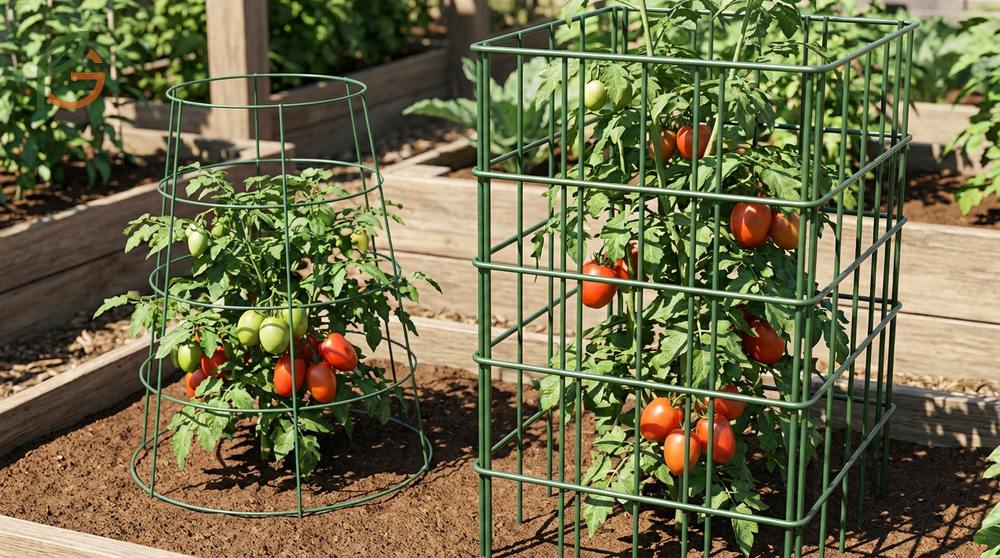
Commercial tomato cages sold at Home Depot and garden centers fall into two categories: flimsy conical wire frames and heavy-duty welded structures. The standard conical cages work adequately for Roma and other determinate varieties but typically collapse under the weight of indeterminate plants[3]. These inexpensive options rarely exceed 4 feet tall, which becomes problematic when vigorous plants outgrow their support by mid-season.
Heavy-duty cages constructed from thicker gauge metal provide better long-term value despite higher upfront costs. Grid-pattern cages with 6-inch square openings allow easy harvest access while supporting substantial weight. Most gardeners find that investing in quality cages pays off over 5-10 seasons of reuse, while cheap cages often fail within 1-2 years.
Commercial vs DIY Cage Options
Store-bought cages offer convenience but rarely match the performance of DIY alternatives built from agricultural materials. Cattle panels and cement reinforcing mesh create superior structures at comparable or lower cost. A 16-foot cattle panel that makes 1.5 cages costs roughly the same as one premium commercial cage, making the DIY route economical for gardeners growing multiple plants.
The main trade-off involves time and tools. Building custom cages requires bolt cutters or angle grinders plus zip ties or wire for assembly. Most gardeners complete one cage in 15-20 minutes after their first attempt. The effort produces sturdy cylinders that handle even the most vigorous heirloom varieties without bending or collapsing.
Cement Reinforcing Mesh Cages
Cement reinforcing mesh, also called remesh, represents the gold standard for DIY tomato cages. University extension services consistently recommend this material because 4-foot wide rolls create ideal cage dimensions[3]. The heavy-gauge wire resists rust and maintains structural integrity through years of outdoor exposure. Four-inch square openings make harvest simple compared to smaller mesh sizes.
Construction starts by cutting a 5-6 foot length from the roll, then forming a cylinder by overlapping the cut ends. The stiff material requires firm pressure to bend but holds its shape once formed. Securing the overlap with zip ties or wire clips completes the basic structure. Many gardeners add 2-3 rebar stakes around the perimeter to anchor cages in windy locations.
How to Make Tomato Plant Cages
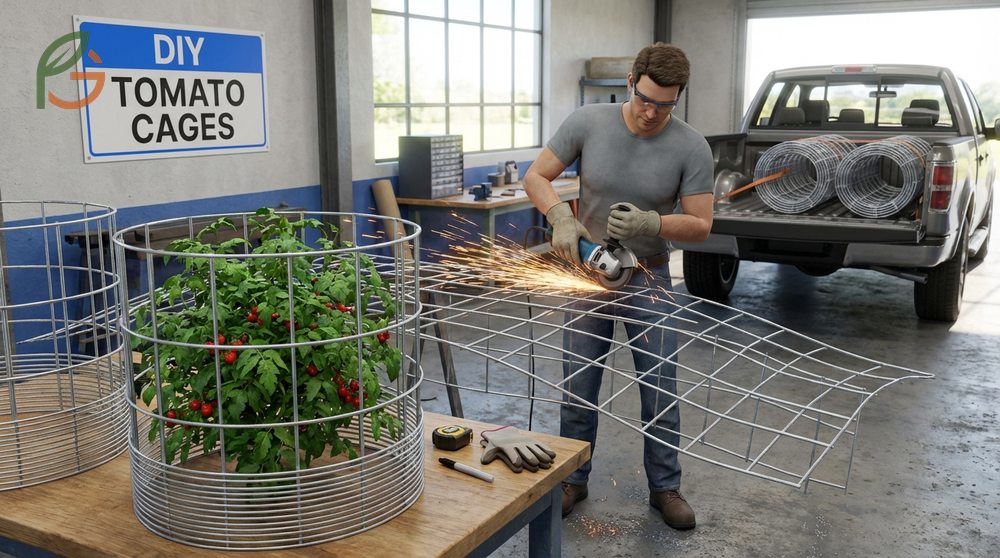
Building your own tomato cages from cattle panels delivers professional results at a fraction of commercial cage costs. Standard 16-foot by 4-foot cattle panels sold at farm supply stores feature 6-inch by 8-inch rectangular openings in heavy galvanized wire. Each panel produces 1.5 cages when cut properly, dropping the per-cage cost to roughly one-third of premium store-bought alternatives.
The key challenge involves transporting these large panels home. Most passenger vehicles can’t accommodate full-size panels, so bring heavy-duty bolt cutters to the farm supply store. Cutting panels on-site before loading them makes transportation feasible in SUVs or trucks. Wear leather gloves during cutting and assembly because the wire ends can scratch exposed skin.
Cattle Panel Cage Construction
Start by laying the panel flat on a driveway or other hard surface. Count six complete squares across the width and cut vertically to separate that section. This creates a 36-inch wide piece that will form one cage. The remaining panel section will yield another partial cage with slight dimension adjustments.
Bend the 36-inch piece at two points to create three 12-inch sides forming an open triangle, or bend once at the center for a simple two-sided cage. Position a heavy board along each bend line, then apply body weight while lifting the far edge by hand. The wire will gradually form a 90-degree angle. Secure the final corners by overlapping the wire ends and fastening with large zip ties rated for outdoor use.
For maximum stability, cut the bottom horizontal wires on each corner, leaving 8-12 inches of vertical wire exposed. These wire legs push into the soil to anchor the cage. Commercial growers often add a 4-foot rebar stake at one corner for extra security in windy regions.
Materials and Cutting Guide
Each cage project requires one 16-foot cattle panel, 8-12 heavy-duty zip ties rated for 75+ pounds, and optionally 1-2 rebar stakes. Heavy-duty bolt cutters capable of cutting 1/4-inch wire are essential. Aviation snips won’t cut through cattle panel gauge wire despite working fine on chicken wire or hardware cloth.
Cattle panels vary slightly by manufacturer, but most feature the same 6-inch by 8-inch grid pattern. The last row typically has smaller 3-inch by 8-inch rectangles created by an extra horizontal wire. This design detail doesn’t affect cage function but can be trimmed away if you prefer uniform openings throughout the structure.
Important Note: Always wear safety glasses and leather gloves when cutting wire panels. The tension in bent wire can cause cut ends to spring back forcefully. Work on flat surfaces to prevent panels from rolling or shifting during cuts.
Florida Weave Method
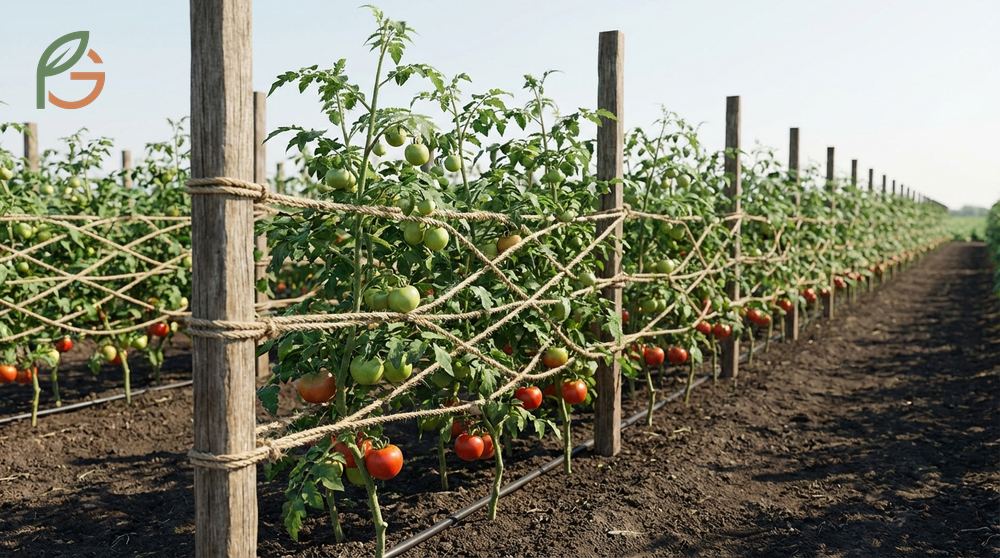
The Florida weave method, also called basket weave or stake-and-weave, supports entire tomato rows using minimal materials. Commercial growers developed this technique for speed when managing hundreds of plants[5]. The system uses sturdy stakes placed between every other plant with twine woven horizontally along both sides of the row. As plants grow taller, additional twine layers create a support matrix that keeps stems upright.
This method works exceptionally well for determinate varieties and pruned indeterminate plants. The horizontal twine supports the main stem plus several lateral branches without requiring individual ties to each stem. Most gardeners find weaving faster than tying once they master the pattern. The technique also allows easier access for harvest compared to enclosed cage systems.
Setting Up Stakes and Twine
Start with 6-8 foot tall stakes driven 18-24 inches into the ground for stability. T-posts work best because their anchor flanges prevent rotation, but 2-inch diameter wooden posts serve well when driven deep enough[4]. Space stakes between every second tomato plant, positioning them about 2 feet from plants to avoid root damage. Place stakes at both row ends plus intermediary positions along longer rows.
Natural fiber twine works better than synthetic alternatives because it grips stakes without slipping. Start the first twine row 8-10 inches above ground level when plants reach 18 inches tall[5]. Tie the twine end to the first stake with a secure knot that won’t slip. Wrap the twine twice around each stake as you work down the row to maintain tension. Add subsequent twine rows every 6-8 inches vertically as plants grow throughout the season.
Weaving Technique for Growing Plants
The weaving pattern alternates which side of each plant the twine passes on. Starting from the first stake, pass the twine along the left side of the first plant and the right side of the second plant. When you reach the next stake, wrap the twine twice around it before continuing. This creates a zigzag pattern that sandwiches plant stems between parallel twine rows on opposite sides.
Work your way to the end stake, then return down the opposite side of the row. This double-pass method means each plant gets supported from both sides at each height level. As plants grow, gently tuck the main stem and strongest side shoots between the twine layers. Most indeterminate varieties require new twine rows added weekly during peak growth periods in early summer.
Timing Tip: Always string tomatoes when foliage is completely dry. Working with wet plants spreads bacterial diseases like bacterial spot and speck between plants through contaminated hands and twine.
Staking Indeterminate Tomatoes
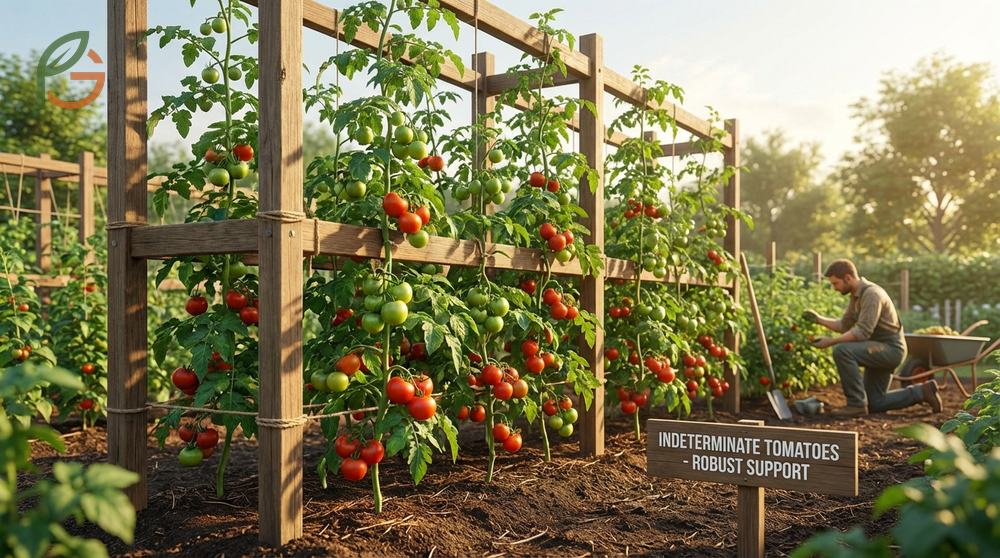
Indeterminate tomatoes require more robust support than their determinate cousins because they grow continuously until frost. These vining plants can easily reach 8-10 feet in ideal conditions, producing fruit along the entire length of their stems. Support systems for indeterminates must accommodate both height and weight, with mature plants often carrying 25-30 pounds of ripening fruit distributed across multiple stems.
The choice between single-stake, trellis, or cage systems depends largely on how much pruning you’re willing to do. Single-stem trained plants pruned to 1-3 main shoots work perfectly with individual stakes. Plants allowed to grow multiple stems need wider support structures like sturdy cages or trellis systems. Research from university extension programs shows that pruned plants produce earlier harvests while unpruned plants often yield more total fruit per plant[1].
Single Stem Training
Single-stem training involves removing all side shoots (suckers) that emerge from leaf axils, forcing the plant to channel energy into one main stem. This technique produces earlier fruit because the plant isn’t supporting excessive vegetative growth. Pruned plants can be spaced closer together at 18-inch intervals compared to 24-30 inches for unpruned specimens.
Start pruning when plants reach 12-18 inches tall by pinching out suckers while they’re small and tender. Remove any branches below the first flower cluster since these lower leaves don’t contribute meaningfully to fruit production. Continue removing new suckers weekly throughout the growing season. Most gardeners find this task takes 2-3 minutes per plant during peak growth periods.
The main stem should be tied to its support stake every 10-12 inches as it grows. Position ties just below leaf nodes or flower clusters where natural bumps help prevent downward slippage. Leave ties loose enough to avoid constricting stem expansion but tight enough to support fruit weight.
Bamboo Stakes for Tomatoes
Bamboo provides an economical and sustainable staking material for tomato plants. Natural bamboo stakes with 1-inch diameters offer sufficient strength for single-stem trained plants while being lighter and easier to handle than hardwood alternatives. Commercial bamboo stakes typically come in 6-8 foot lengths, which accommodates most indeterminate varieties[2].
Drive bamboo stakes 12-18 inches deep into the soil to ensure stability. Position stakes 4-6 inches from the plant base to avoid piercing root zones. Many gardeners angle stakes slightly away from plants rather than driving them perfectly vertical. This angle creates better leverage against the weight of fruit-laden stems pulling stakes forward.
Natural bamboo lasts 2-4 seasons outdoors before weathering compromises strength. Untreated bamboo is preferable to chemically treated wood stakes because it won’t leach preservatives into soil. Store bamboo stakes dry over winter to extend their usable life. Some gardeners soak bamboo in diluted copper solution before the first use to prevent fungal decay.
How to Tie Up Tomato Plants
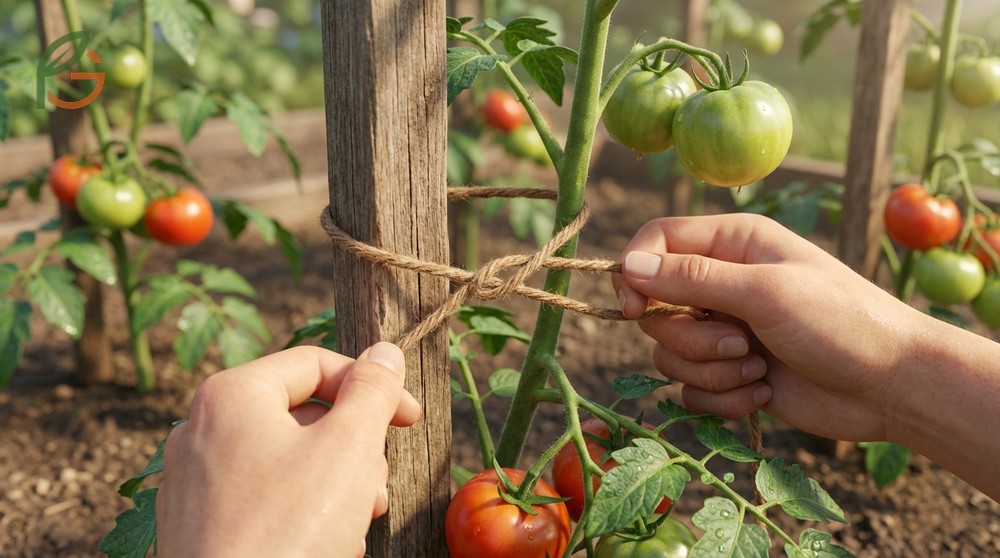
Proper tying technique prevents stem damage while providing adequate support. The material you choose matters as much as the method. Soft materials like garden twine, cloth strips, or specialized rubber-coated twist ties work best because they won’t cut into expanding stems. Avoid wire, zip ties, or other rigid materials that can girdle stems as plants grow.
Create a loose figure-eight pattern when tying plants to stakes. Loop the tie around the stake first, then cross it over itself before encircling the plant stem. This configuration prevents the stem from being crushed against the stake when wind causes movement. Leave enough slack that you can slip two fingers between the tie and the stem.
Tie stems just below leaf nodes or flower clusters where natural swellings help prevent ties from sliding down. Position the first tie when plants reach 12-15 inches tall, then add new ties every 10-12 inches of vertical growth. Check ties every 2-3 weeks throughout the season because expanding stems can become constricted by ties that were properly loose when first installed.
This table compares five major tomato staking methods across dimensions including cost per plant, best suited varieties, required maintenance level, and maximum supported plant height
| Staking Method | Cost Per Plant | Best for Variety Type | Maintenance Level | Max Height Supported |
|---|---|---|---|---|
| Single Bamboo Stake | $2-4 | Pruned indeterminate | High (weekly tying) | 6-8 feet[2] |
| Conical Wire Cage | $5-10 | Determinate only | Low (no tying) | 3-4 feet[3] |
| DIY Cattle Panel Cage | $8-12 | Both types | Low (minimal pruning) | 4-6 feet |
| Florida Weave | $3-5 | Determinate, pruned indeterminate | Medium (weekly stringing) | 6-8 feet[4] |
| String Trellis | $6-10 | Single-stem indeterminate | Medium (weekly wrapping) | 8-12 feet[2] |
- Garden twine: Natural jute or cotton twine stretches slightly as stems expand and biodegrades at season end
- Soft twist ties: Rubber-coated wire ties can be unwound and repositioned without cutting plant stems
- Cloth strips: Old t-shirts or sheets torn into 1-inch strips provide gentle, adjustable support
- Velcro plant ties: Reusable hook-and-loop strips adjust easily and don’t damage bark or stems
- Tomato clips: Plastic clips designed specifically for greenhouse production snap onto stakes and gently grip stems
Pro Tip: Check all ties every 2-3 weeks during peak growing season from June through August. Stems can double in diameter during this period, causing properly loose ties to become constrictive. Loosen or replace any ties showing signs of cutting into plant tissue.
Conclusion
The evidence shows that proper staking systems for tomato plants reduce disease pressure, improve fruit quality, and maximize yields per square foot of garden space. Whether you choose store-bought cages, DIY cattle panel structures, or the Florida weave method depends on your tomato varieties, available space, and maintenance preferences. Indeterminate varieties benefit most from tall stakes or string trellis systems that accommodate continuous growth, while determinate types thrive in simpler cage structures.
Current extension guidance from universities emphasizes installing supports early, before plants become unwieldy, and spacing plants according to their support system. FruitGarden recommends starting with one method this season, documenting results, then refining your approach based on which varieties you grow and how much time you can dedicate to weekly maintenance. The most successful tomato gardens match support infrastructure to growth habits rather than forcing vigorous vining plants into inadequate structures.
Frequently Asked Questions
When should I stake my tomato plants after transplanting?
Install stakes or cages 2-3 weeks after transplanting when plants reach 12-15 inches tall. Earlier installation prevents root disturbance and stem damage. Waiting until plants are larger and leaning makes staking more difficult and increases the risk of breaking branches. Most commercial growers complete staking before the first flower clusters open.
Can determinate tomatoes grow in standard wire cages from Home Depot?
Yes, determinate varieties that reach 3-4 feet tall work well in standard conical wire cages. Research confirms these bush-type tomatoes rarely exceed cage capacity. However, indeterminate varieties quickly outgrow these cages and often cause them to collapse under fruit weight. For indeterminate plants, invest in taller, heavier-duty cages or use stake and weave systems instead.
How far apart should stakes be placed for the Florida weave method?
Place stakes between every second tomato plant, typically creating 4-foot intervals along the row. Space tomato plants themselves 18-24 inches apart, so stakes end up positioned every other plant. Drive stakes at least 18 inches deep for stability, using T-posts or 2-inch diameter wooden posts that can support twine tension without leaning.
What’s the best material for making DIY tomato cages?
Cement reinforcing mesh (remesh) with 4-inch square openings provides the best combination of strength, durability, and harvest access. University extension services consistently recommend this material over chicken wire or hardware cloth. Cattle panels work equally well and come in convenient 4-foot widths that create ideal cage dimensions without additional cutting.
How tall should bamboo stakes be for indeterminate tomato varieties?
Select bamboo stakes that are 6-8 feet tall for indeterminate tomatoes. After driving them 12-18 inches into the soil, you’ll have 5-6 feet of above-ground support. Single-stem pruned plants rarely exceed this height, but unpruned indeterminates may outgrow even tall stakes. Choose stakes with 1-inch diameter to provide adequate strength without excessive weight.
Do I need to prune tomatoes if I use cages instead of stakes?
Caged tomatoes require less pruning than staked plants, but some selective pruning improves results. Remove suckers below the first flower cluster and prune branches that grow outside the cage to maintain airflow. Unpruned plants in cages often produce more total fruit but may ripen later than heavily pruned specimens. The choice depends on whether you prefer maximum yield or earlier harvest.
What’s the difference between string trellis and Florida weave methods?
String trellis systems use individual strings that hang vertically from overhead supports, with one string per plant that wraps around the main stem as it grows. Florida weave runs horizontal twine between stakes along both sides of plant rows, creating a fence-like support. String trellis works best for single-stem greenhouse production, while Florida weave suits field growing with multiple stems per plant.