
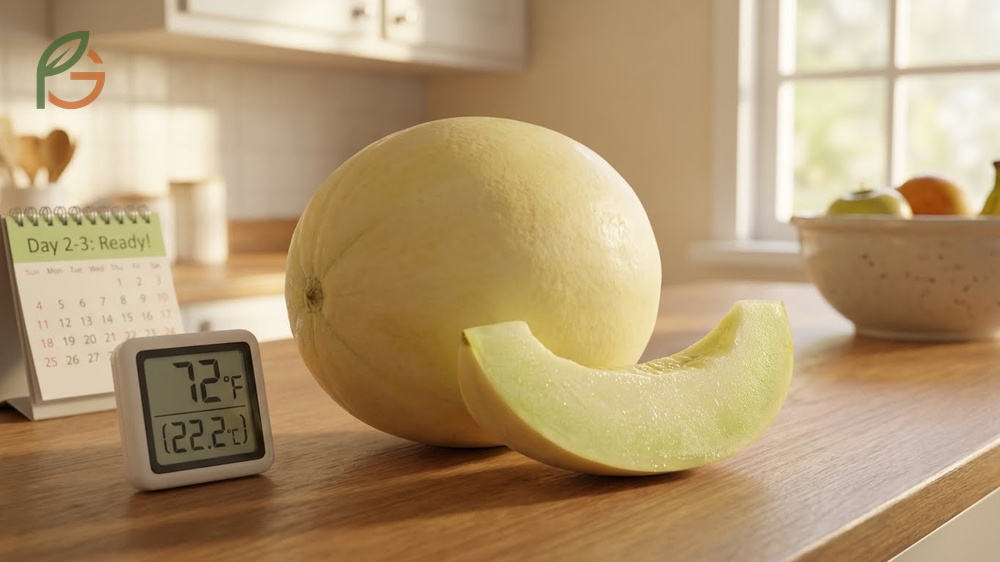
How to ripen honeydew melon starts with understanding that these melons continue to soften after harvest but won’t get sweeter once picked. Research from UC Davis shows that exposing physiologically mature honeydew to 68-77°F (20-25°C) temperatures accelerates the ripening process in just 2-3 days[1]. Most people don’t realize that timing and temperature matter more than any tricks when it comes to achieving that perfect creamy-yellow rind and sweet aroma. FruitGarden combines current agricultural data with practical home ripening methods to help you get the most from your melons.
Quick Answer
- Ripen honeydew at 68-77°F (20-25°C) on your kitchen counter for 2-3 days[1]
- Look for a creamy yellow color (not bright green) and a sweet honey-like aroma[2]
- Use the paper bag method with a ripe banana to trap ethylene gas and speed ripening by 1-2 days
- Press the blossom end gently—it should yield slightly, like room-temperature butter[3]
How to Ripen Honeydew Melon
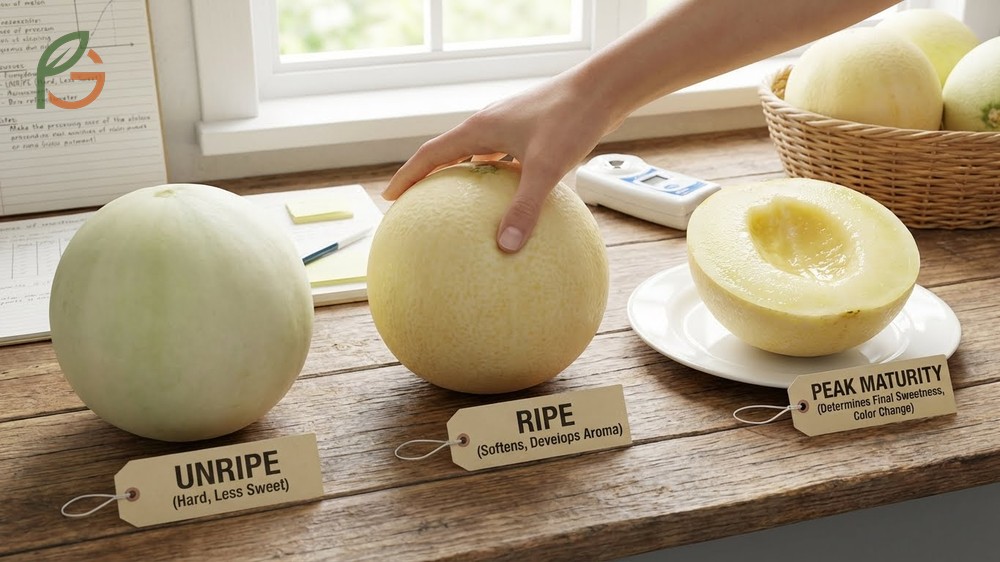
Studies demonstrate that honeydew melons don’t increase in sugar content after harvest, which means you can’t make an unripe melon sweeter by waiting[4]. The maturity at harvest determines final sweetness. However, melons that were picked at proper maturity will soften, develop better aroma, and change color from greenish-white to creamy yellow over several days.
The key is identifying whether your honeydew was harvested mature enough to ripen properly. Michigan State University research confirms that honeydew melons continue to ripen off the plant, unlike watermelons which must reach full sweetness on the vine[5]. If you’re like most Americans shopping in winter, you’ll want to check the color before buying—avoid bright green melons that were picked too early.
What often gets overlooked is that honeydew ripening focuses on texture and aroma development rather than sugar accumulation. This matters because even a perfectly ripe honeydew will disappoint if it started out immature. Choose melons with at least some creamy coloring and a slightly waxy feel to maximize your ripening success.
From My Experience: My cousin in Guadalajara, Mexico grew honeydew melons in his backyard garden last summer. He found that melons left on the counter at room temperature reached perfect ripeness in 3 days, matching the 2-3 day window from agricultural studies.
Understanding Honeydew Maturity
Current data indicates that physiologically mature honeydew melons have specific characteristics at harvest. USDA standards define “mature” as melons that have reached a developmental stage ensuring proper completion of the ripening process[6]. These melons are well filled-out with a white color showing a slight greenish tint.
The blossom end (opposite the stem) transitions from hard to firm as maturity increases. Immature melons stay rock-hard and never develop the characteristic sweet aroma. The skin changes from fuzzy to slightly waxy as ripening hormones activate within the fruit.
Optimal Ripening Temperature
Research shows the ideal ripening temperature for honeydew is 68-77°F (20-25°C)[1]. This range activates ethylene production within the melon while preventing chilling injury. Temperatures below 50°F (10°C) halt the ripening process entirely.
Most kitchen counters naturally fall within this range, making them perfect ripening stations. Avoid refrigerating unripe honeydew—cold temperatures lock melons in their current state and can cause internal damage.
- Unripe melons: Store at 45-50°F (7.5-10°C) if you need to slow ripening temporarily
- Slightly ripe melons: Hold at 41-45°F (5-7.5°C) to maintain current ripeness for 2-3 days
- Fully ripe melons: Refrigerate at 36-41°F (2.5-5°C) to preserve quality for up to 5 days
- Active ripening: Keep at room temperature 68-77°F (20-25°C) until desired softness is reached
- Humidity control: Maintain 85-90% humidity during ripening to prevent weight loss and shriveling
Important Note: Never store unripe melons below 41°F (5°C) as this causes chilling injury—internal browning and flavor loss that can’t be reversed. If you’re uncertain about ripeness, always choose the warmer storage temperature.
Ripen Honeydew Quickly
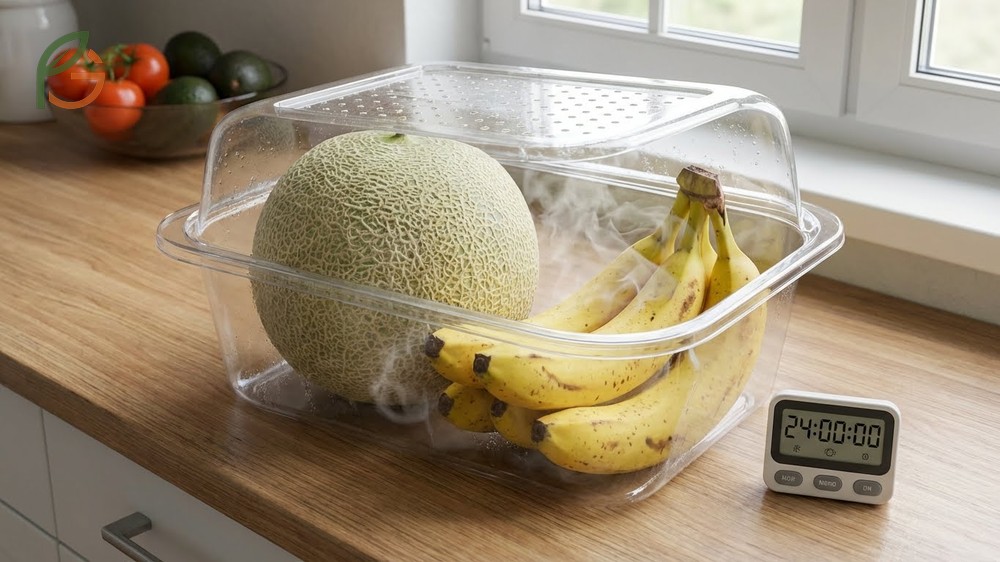
The fastest natural method involves concentrating ethylene gas around your honeydew melon. Ethylene is a plant hormone that triggers ripening in climacteric fruits like honeydew, bananas, and tomatoes. When trapped in an enclosed space, this gas accelerates softening and color development.
Commercial operations apply 100-150 ppm ethylene for 24-48 hours to speed ripening[4]. At home, you can achieve similar results using natural ethylene producers. This cuts ripening time from 4-5 days down to 2-3 days without compromising quality.
The reason this works is simple: honeydew melons produce their own ethylene as they ripen, but the process moves slowly when gas dissipates into the air. Containing that ethylene creates a feedback loop that jumpstarts ripening mechanisms.
Paper Bag Method
Place your honeydew in a large paper grocery bag along with 1-2 ripe bananas or apples. These fruits emit high levels of ethylene gas. Fold the top of the bag twice to seal it loosely—paper allows carbon dioxide to escape while trapping ethylene.
Leave the bag on your counter away from direct sunlight for 2-3 days. Check daily by pressing the blossom end. The melon is ready when it yields slightly to gentle pressure and emits a sweet aroma.
- Choose a bag large enough that the melon isn’t cramped (standard grocery bags work well)
- Add 1 ripe banana or 2-3 apples as ethylene sources
- Fold the top twice to create a loose seal that allows air exchange
- Position the bag in a spot with stable room temperature away from heat sources
- Check progress every 24 hours by smell and touch
- Remove the melon as soon as it reaches desired ripeness to prevent over-softening
- Never use plastic bags—they trap moisture and cause premature spoilage
Ethylene Gas Exposure
Agricultural data shows that exposure to 100-150 ppm ethylene for 18-24 hours at 68°F (20°C) ripens physiologically mature honeydew melons[1]. This commercial technique isn’t common practice anymore for California honeydew but illustrates how powerfully ethylene influences ripening. Home cooks can mimic this effect using ethylene-producing fruits.
Once your honeydew loses most of its greenish tint and develops noticeable aroma, it’s producing enough ethylene on its own and no longer needs external help. At this point, you can remove it from the bag and continue ripening on the counter or refrigerate to hold at current ripeness.
Pro Tip: Riper bananas produce more ethylene than green ones. Use bananas with brown spots for maximum effect. Don’t worry if the banana over-ripens in the bag—you can still use it for smoothies or baking.
Honeydew Ripeness Signs
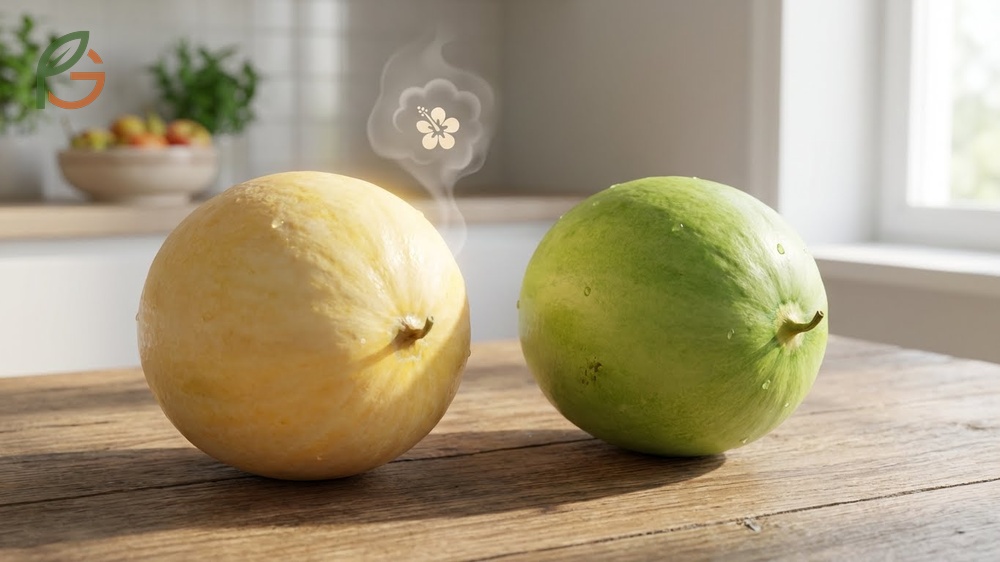
Evidence suggests that color provides the most reliable ripeness indicator for honeydew melons. A ripe honeydew displays a creamy yellow or pale golden hue[3]. Bright green melons were picked too early and won’t reach full sweetness potential, though they’ll still soften. If your melon stays predominantly green after 3-4 days of ripening, it was harvested immature.
The second key indicator is aroma. Ripe honeydew emits a noticeably sweet, honey-like fragrance from the blossom end. You shouldn’t have to press your nose against the melon—the scent should be detectible when held at arm’s length. No aroma means the melon needs more time.
Texture reveals the final stage of ripeness. Press your thumb gently against the blossom end (opposite the stem scar). You’re looking for a slight give, similar to pressing a room-temperature stick of butter[3]. Rock-hard means underripe. Spongy or mushy indicates overripe or internal fermentation.
- Color: Creamy yellow to pale gold with minimal green tinting remaining
- Aroma: Sweet, honey-like fragrance detectible at the blossom end
- Texture: Skin transitions from slightly fuzzy to smooth and waxy
- Weight: Feels heavy for its size, indicating high juice content
- Blossom end: Yields slightly to gentle thumb pressure without feeling mushy
- Sound: Produces a dull thud when tapped, not a hollow ring
- Stem end: Should be clean and slightly sunken, not damp or moldy
This table compares color, texture, aroma, and recommended actions across three honeydew ripeness stages from unripe to overripe
| Stage | Color | Texture | Aroma | Action |
|---|---|---|---|---|
| Unripe | Bright green to greenish-white | Rock-hard, no give when pressed | No detectable scent | Ripen at 68-77°F (20-25°C) for 2-4 days |
| Ripe | Creamy yellow to pale gold[3] | Slight give at blossom end | Sweet, honey-like fragrance | Eat within 2-3 days or refrigerate |
| Overripe | Deep yellow with brown spots | Spongy, mushy when pressed | Fermented or overly strong scent | Use immediately in smoothies |
Room Temperature Ripening
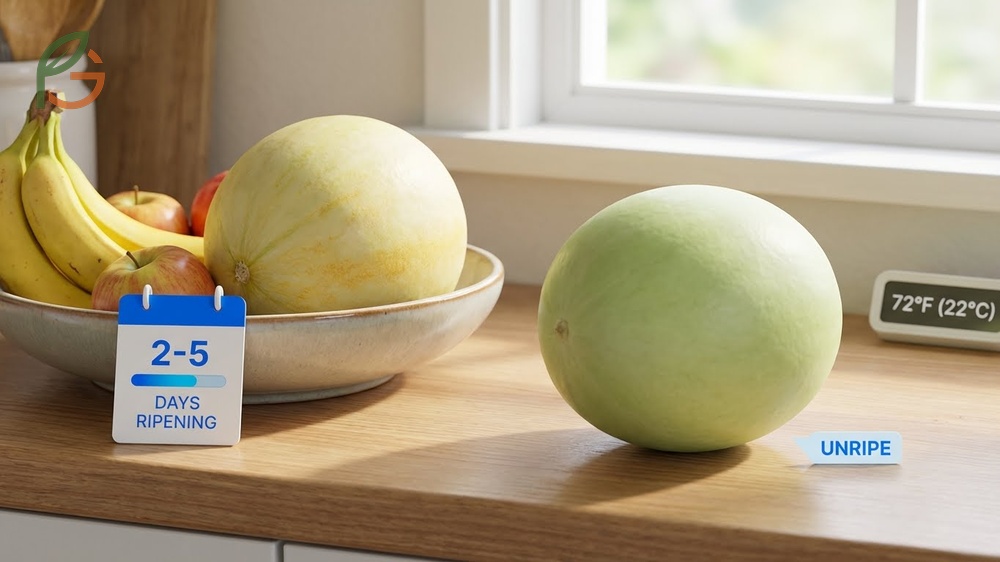
Current guidance emphasizes that room temperature storage is essential for honeydew ripening. Studies from Ohio State University confirm that honeydew melons with creamy yellow coloring at harvest will continue ripening at room temperature, while green melons will never fully ripen regardless of storage conditions[2]. This distinction helps you set realistic expectations for melons purchased out of season.
The typical ripening timeline spans 2-5 days depending on initial maturity and ambient temperature. Melons showing partial yellow coloring ripen faster than predominantly white ones. Consistent temperatures in the 70-75°F (21-24°C) range produce the most predictable results.
Positioning matters more than most people realize. Keep melons away from direct sunlight, which creates hot spots and uneven ripening. Avoid placing them near heat-generating appliances like ovens or dishwashers. A corner of your kitchen counter away from windows provides ideal conditions.
- Maintain steady temperatures between 68-77°F (20-25°C) throughout the ripening period
- Store melons stem-side down to allow any residual moisture to drain away from the blossom end
- Keep melons at least 12 inches away from other ethylene-producing fruits unless using the paper bag method
- Rotate the melon 180 degrees daily to ensure even exposure to ambient air circulation
- Never stack melons—air circulation around the entire surface promotes uniform ripening
- Check progress daily rather than multiple times per day to avoid over-handling
Storage Warning: Don’t refrigerate unripe honeydew hoping it will stay fresh longer. Cold temperatures halt the ripening process completely and can cause chilling injury—internal browning that ruins flavor. Only refrigerate after melons reach desired ripeness.
Counter Ripening Method
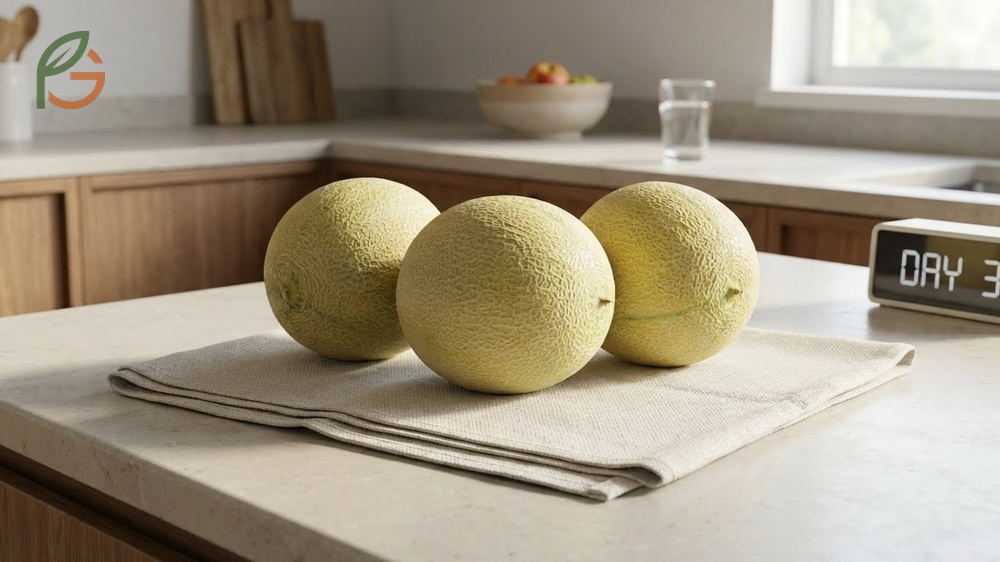
The simplest approach involves leaving your honeydew on a clean kitchen counter for 3-5 days. This passive method works well when you’re not in a hurry and have adequate counter space. Research confirms that mature melons will complete ripening at typical room temperatures without intervention[5].
Place melons in a single layer on a clean towel or cutting board to prevent contact with potentially contaminated surfaces. The slight elevation improves air circulation underneath, which prevents moisture buildup that could lead to soft spots. Check progress every 24 hours using the color, aroma, and texture tests described earlier.
For breakfast preparation, start ripening your honeydew on Monday for a perfect Friday morning fruit salad. This 4-day window accommodates most ripening scenarios. If you’re planning a weekend brunch, buy melons on Wednesday and ripen through Friday evening.
When your honeydew reaches the desired softness and aroma, transfer it immediately to the refrigerator. Properly ripened melons hold quality for 5-7 days when stored at 36-41°F (2.5-5°C)[4]. Wrap cut sections tightly in plastic wrap to minimize moisture loss and flavor transfer to other refrigerated items.
- Day 1: Melon shows greenish-white color, firm texture, no aroma—continue ripening
- Day 2: Slight color shift toward cream, still firm—patience required
- Day 3: Creamy yellow developing, faint aroma emerging—check blossom end daily
- Day 4: Pale golden color, noticeable sweet scent, slight softness—likely ready
- Day 5: If still hard after 5 days, melon was picked too early and won’t fully ripen
- Troubleshooting: Brown spots or dampness indicate overripeness—use immediately in smoothies
Conclusion
The evidence is clear: how to ripen honeydew melon successfully depends on starting with a mature melon and providing the right temperature conditions. Melons showing at least some creamy yellow coloring will ripen beautifully at room temperature in 2-3 days, especially when you use the paper bag method with ethylene-producing fruits. Remember that sugar content is set at harvest—you can’t make an immature melon sweeter, but you can optimize texture and aroma development.
Current agricultural guidance emphasizes proper selection over ripening tricks. Choose heavy melons with creamy coloring and a slightly waxy texture for the best results. FruitGarden continues to synthesize the latest postharvest research to help home cooks maximize fruit quality through evidence-based storage and ripening techniques.
Frequently Asked Questions
Can you ripen honeydew melon in the refrigerator?
No, refrigeration halts the honeydew ripening process entirely. Temperatures below 50°F (10°C) prevent the enzymatic activity needed for softening and aroma development. Always ripen honeydew at room temperature (68-77°F/20-25°C) first, then refrigerate only after it reaches desired ripeness to maintain quality for 5-7 days.
How long does it take to ripen honeydew on the counter?
Most honeydew melons ripen in 2-5 days on the counter at room temperature. Melons showing partial yellow coloring ripen faster (2-3 days) than predominantly white ones (4-5 days). Using the paper bag method with ripe bananas can reduce this to 2-3 days regardless of initial color stage.
What if my honeydew never ripens?
Honeydew melons that remain bright green and hard after 5-7 days at room temperature were harvested too early and won’t ripen properly. Ohio State research confirms that green honeydew will never develop full sweetness no matter how long you wait. Cut these melons into chunks for smoothies or agua fresca where added sweeteners compensate for low sugar content.
Does honeydew ripen after you cut it?
No, once cut, honeydew stops ripening completely. The fruit’s connection to its internal ethylene production system is disrupted. This is why it’s crucial to wait until honeydew shows full ripeness signs before cutting. Store cut honeydew pieces in airtight containers in the refrigerator and consume within 3-4 days.
Can you speed up honeydew ripening with a banana?
Yes, placing honeydew in a paper bag with 1-2 ripe bananas speeds ripening by 1-2 days. Bananas emit ethylene gas that triggers ripening hormones in honeydew. Use bananas with brown spots for maximum ethylene production. Check the melon daily and remove it from the bag once it develops a sweet aroma and yields slightly at the blossom end.
Should honeydew be hard or soft when you buy it?
Buy honeydew that’s mostly firm with slight give at the blossom end. Rock-hard melons need 4-5 days of ripening at home. Melons with noticeable softness are closer to ripe and need only 1-2 days. Avoid spongy or overly soft specimens, which indicate overripeness. Always prioritize creamy yellow color over firmness—green melons won’t fully ripen regardless of texture changes.
What temperature is best for ripening honeydew melon?
Research from UC Davis identifies 68-77°F (20-25°C) as the optimal temperature range for honeydew ripening. This range activates ethylene production while preventing chilling injury. Most kitchen counters naturally fall within this zone. Temperatures below 50°F (10°C) halt ripening, while temperatures above 85°F (29°C) can cause uneven softening and off-flavors.





