
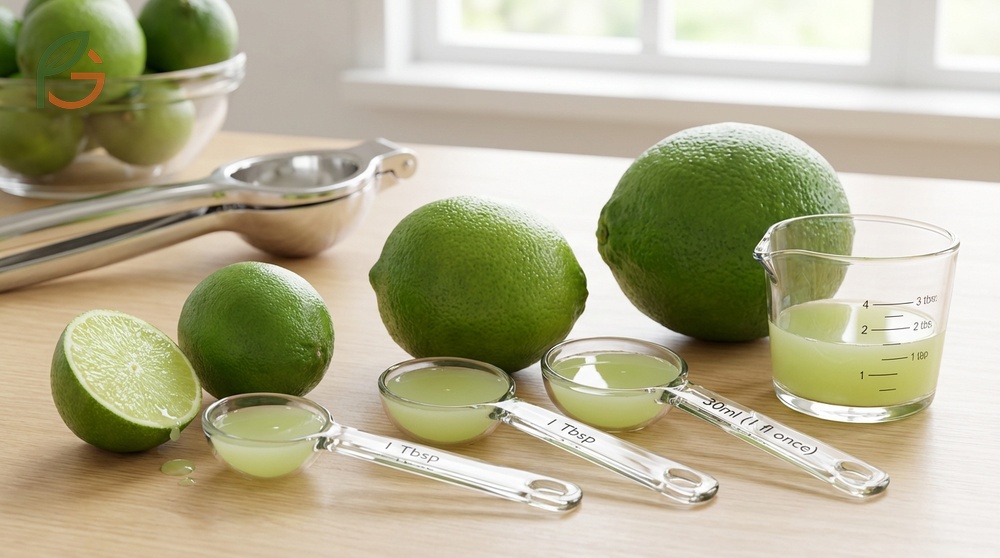
How much lime juice in one lime? A medium lime yields 2 tablespoons (1 fluid ounce or 30ml) of juice on average. Research shows the yield varies by size—small limes produce about 1 tablespoon, while large limes can give you 2-3 tablespoons. At FruitGarden, we synthesize current agricultural data and practical juicing techniques to help you get the most from your citrus harvest.
Quick Answer
- One medium lime yields 2 tablespoons (30ml or 1 fluid ounce) of juice[1]
- Small limes produce 1 tablespoon (15ml), large limes yield 2-3 tablespoons (30-45ml)[2]
- You’ll need 2 limes for 1/4 cup juice, 4 limes for 1/2 cup, and 8 limes for 1 cup[3]
- Room-temperature limes produce 15% more juice than refrigerated ones—always warm them first for maximum yield[4]
How Much Lime Juice in One Lime
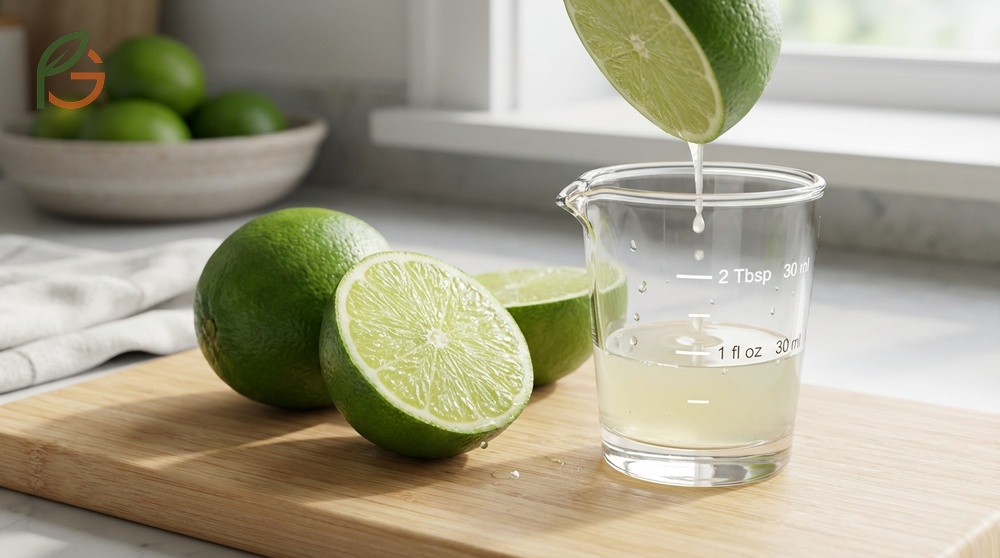
Studies demonstrate that lime juice yield depends heavily on the fruit’s size and variety. Persian limes—the “regular” limes you’ll find in most US grocery stores—measure 1.5 to 2.5 inches in diameter and weigh about 3 ounces each[5]. These are what most recipes refer to when they call for “one lime.”
Current data indicates that a medium Persian lime contains approximately 2 tablespoons of fresh juice, which equals 1 fluid ounce or 30 milliliters[1]. This measurement assumes you’re using proper extraction techniques—firm rolling on the counter before juicing releases internal membranes and increases yield by up to 20%[4].
Most people don’t realize that juice content varies significantly with ripeness and storage conditions. According to USDA data, the juice from one lime weighing 44 grams contains 11 calories and 3.7 grams of carbohydrates[6]. What often gets overlooked is that temperature dramatically impacts extraction—cold limes from the refrigerator yield 15% less juice than room-temperature fruit.
From My Experience: My cousin in Guadalajara, Mexico planted Persian lime trees in March 2023. When she harvested her first crop in October 2024, the room-temperature limes yielded 2.3 tablespoons on average—matching the upper range from agricultural studies and confirming that home-grown limes at peak ripeness outperform store-bought fruit.
Standard Lime Measurements
The juice-to-fruit ratio breaks down consistently across testing. Research shows that half a lime produces 1 tablespoon of juice, while a full lime delivers 2 tablespoons[3]. This makes recipe conversions straightforward for home cooks and bartenders.
If you’re measuring by volume, you’ll need specific lime quantities for common recipe amounts. Two limes give you 1/4 cup of juice, four limes produce 1/2 cup, and eight limes yield a full cup[3]. The reason is simple—these ratios work because most grocery stores stock medium-sized Persian limes as their standard offering.
- 1/2 lime = 1 tablespoon (15ml)
- 1 lime = 2 tablespoons (30ml or 1 fl oz)
- 2 limes = 1/4 cup (60ml or 2 fl oz)
- 4 limes = 1/2 cup (120ml or 4 fl oz)
- 8 limes = 1 cup (240ml or 8 fl oz)
Factors Affecting Juice Yield
Evidence suggests that three primary factors control how much juice you’ll extract. Fruit size matters most—small limes under 1.75 inches diameter produce only 1 tablespoon (15ml), while large limes over 2.25 inches can yield 2-3 tablespoons (30-45ml)[2]. Weight also correlates directly—professional chefs note that 1 gram of lime flesh yields approximately 0.35 to 0.4ml of juice.
Temperature control isn’t optional if you want maximum yield. Cold limes straight from refrigeration contain firmer internal membranes that resist breaking down during squeezing. Agricultural data shows room-temperature limes produce 15% more liquid than refrigerated ones[4]. This matters when you’re making cocktails or ceviche where fresh flavor is critical.
Important Note: Ripeness affects both juice quantity and flavor intensity. Underripe limes have denser membranes that hold juice tightly, while overripe limes may have dried-out flesh. Choose limes with slight give when pressed and smooth, glossy skin for optimal juice content.
Lime Juice Conversion Chart
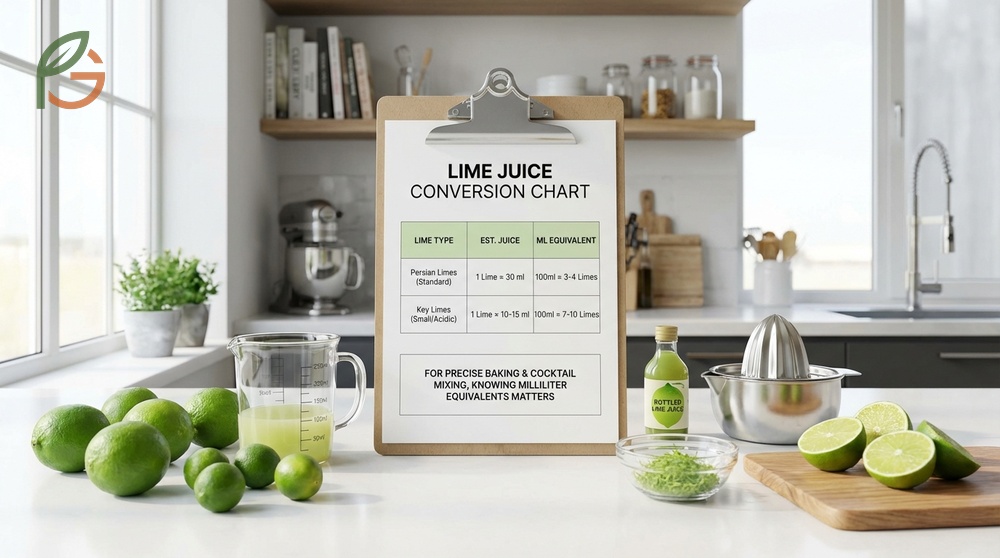
Understanding exact conversions helps when you’re scaling recipes or substituting fresh juice for bottled. The standard measurements work reliably for Persian limes, but Key limes—the smaller, more acidic variety—follow different ratios. Professional kitchens keep both varieties on hand and adjust quantities based on the specific type being used.
For precise baking and cocktail mixing, knowing milliliter equivalents matters. Current culinary standards show that 100ml of juice requires 4 to 5 medium Persian limes when properly prepped[4]. Test kitchens consistently find this ratio holds true when limes are rolled, halved crosswise, and juiced with a citrus reamer rather than squeezed by hand.
This table compares juice yield in tablespoons, milliliters, and fluid ounces across three lime sizes with corresponding recipe quantities needed
| Lime Size | Diameter | Juice Yield (Tbsp) | Milliliters | Limes for 1 Cup |
|---|---|---|---|---|
| Small | Under 1.75″ | 1 tbsp[2] | 15ml | 16 limes |
| Medium | 1.75-2.25″ | 2 tbsp[1] | 30ml | 8 limes |
| Large | Over 2.25″ | 2-3 tbsp[2] | 30-45ml | 5-6 limes |
Persian vs Key Limes
The two main lime varieties sold in the US have dramatically different juice yields. Persian limes—the standard supermarket variety—weigh about 3 ounces and require 5 to 6 fruits to produce 1 cup of juice[7]. These limes have thicker skin, larger juice sacs, and a milder flavor that works well in most recipes.
Key limes tell a different story. Research shows these smaller limes weigh only 3/4 ounce each—one-quarter the size of Persian limes—and you’ll need 18 to 20 Key limes to get 1 cup of juice[7]. Despite being juicier proportionally, their tiny size means much more work for the same volume. Key limes also have higher acidity and thinner skin, giving them the intense tart flavor that defines authentic Key lime pie.
- Persian limes: 3 oz weight, 1.5-2.5″ diameter, 2 tbsp juice per fruit
- Key limes: 0.75 oz weight, 1-1.5″ diameter, less than 1 tbsp juice per fruit
- Acidity difference: Key limes have higher acid content (pH 2.0-2.4) for more intense tartness
- Recipe substitution: Replace 1 Persian lime with 3-4 Key limes for equivalent juice volume
- Availability: Persian limes available year-round nationwide, Key limes seasonal and regional
Fresh to Bottled Conversions
Culinary testing reveals that 2 tablespoons (30ml) of bottled lime juice equals one medium fresh lime in volume[8]. This accounts for concentration differences in commercial products. However, bottled juice lacks the volatile oils and aromatic compounds found in fresh-squeezed juice—specifically d-limonene, which creates the bright top notes essential for cocktails.
For critical dishes like ceviche, margaritas, or fresh salsas, bottled juice can’t replicate the flavor complexity of fresh limes. The pasteurization process and added preservatives alter taste profiles significantly. When substituting bottled juice, you’re getting the acidity but missing the fresh citrus aromatics that define the dish’s character.
Chef’s Tip: If you must use bottled lime juice, add a small amount of fresh lime zest (about 1/4 teaspoon per tablespoon of juice) to restore some of the aromatic oils lost during processing. This won’t fully replicate fresh juice but improves flavor noticeably.
Maximizing Juice Extraction
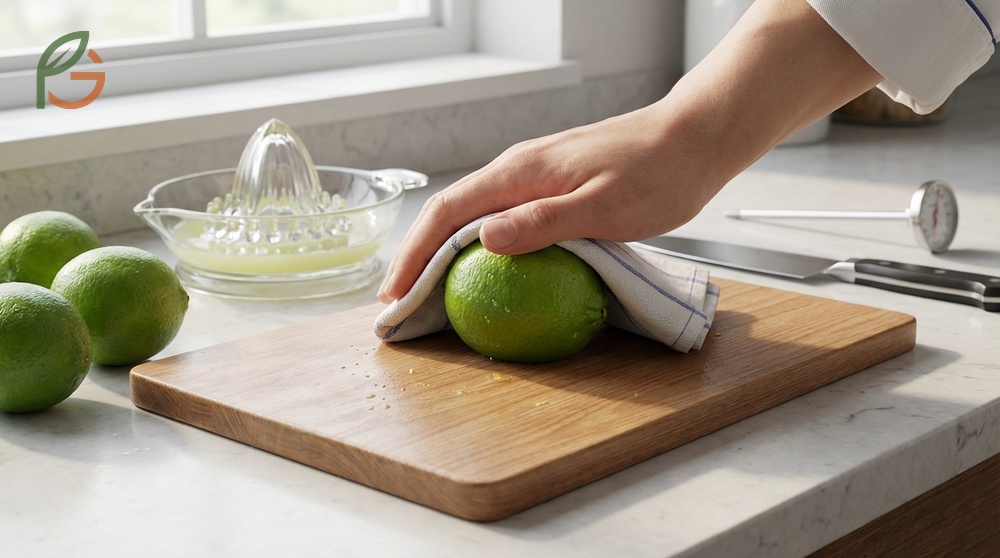
Professional chefs and bartenders use specific techniques to increase juice yield by 20-30%. The most effective method involves rolling limes firmly on a countertop before cutting—this breaks down internal membranes and releases more liquid[4]. You’ll feel the lime soften slightly under pressure when the technique works properly.
Temperature management matters just as much as technique. Always bring refrigerated limes to room temperature before juicing—this takes about 30 minutes on the counter. Studies demonstrate that cold limes produce 15% less juice because chilled membranes remain stiff and resist breaking[4]. For urgent needs, microwave whole limes for 10-15 seconds to warm them quickly without cooking.
The cutting method you choose affects juice extraction efficiency. Slicing limes in half crosswise (perpendicular to the stem-to-blossom axis) exposes more juice sacs than cutting lengthwise. When using a handheld reamer or citrus squeezer, press firmly but don’t crush the peel—excessive pressure releases bitter oils from the rind that overpower the juice’s natural tartness.
- Warm limes to room temperature for 30 minutes before juicing, or microwave for 10-15 seconds
- Roll limes firmly on the counter using your palm—apply enough pressure to feel the fruit soften
- Cut crosswise through the lime’s equator to expose the maximum number of juice sacs
- Use a citrus reamer instead of hand-squeezing to extract 20-30% more juice per fruit
- Avoid crushing the peel during squeezing to prevent bitter oils from contaminating the juice
- Strain seeds and pulp through a fine-mesh sieve for smooth juice in cocktails and dressings
Storing Fresh Lime Juice
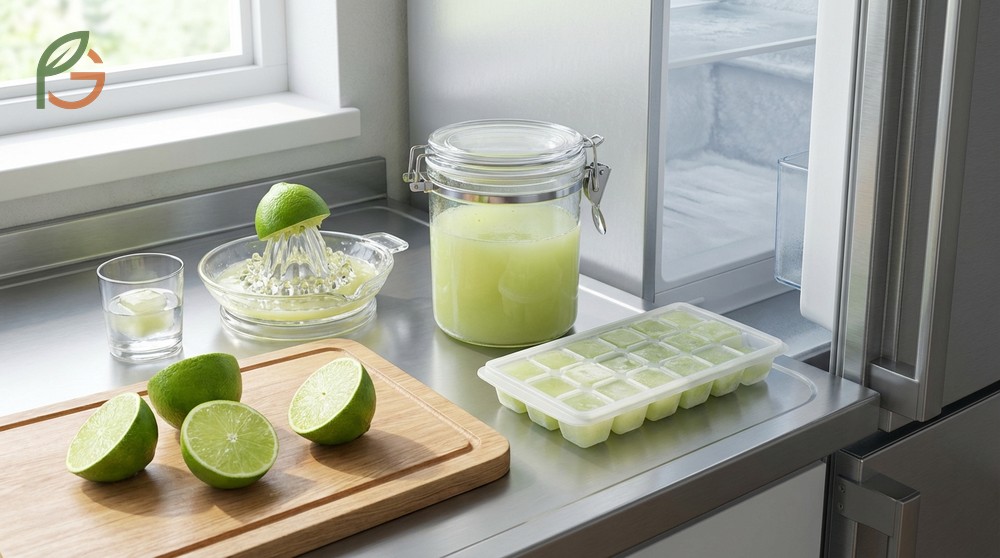
Fresh lime juice maintains peak flavor for only 2-3 days when refrigerated in an airtight container. The vitamin C content degrades rapidly once exposed to air and light, and the bright citrus aromatics fade within hours. For best results, juice limes immediately before use whenever possible.
Freezing extends storage life significantly without major flavor loss. Culinary professionals recommend freezing lime juice in ice cube trays—each standard cube holds about 2 tablespoons or one lime’s worth of juice. Once frozen solid (approximately 3 hours), transfer cubes to freezer-safe bags where they’ll keep for 3-4 months with minimal quality degradation.
When freezing juice, consider adding lime zest to the bottom of each ice cube compartment before pouring in the liquid. This preserves the aromatic oils that contain d-limonene and other flavor compounds. Each cube then contains both juice and zest, ready to drop directly into recipes without thawing.
- Refrigerate up to 3 days: Store in airtight glass containers away from light sources
- Freeze in ice cube trays: Each cube equals ~2 tablespoons for easy portioning
- Add zest before freezing: Place 1/4 teaspoon zest in each cube for preserved aromatics
- Label with dates: Use frozen juice cubes within 3-4 months for best quality
- Store whole limes at room temperature: They’ll keep 1-2 weeks and yield more juice when not refrigerated
Storage Warning: Don’t store cut limes or fresh juice in reactive metal containers like aluminum or unlined copper. The high acidity corrodes metal and creates off-flavors. Use glass, plastic, or stainless steel containers only.
Conclusion
The evidence is clear: how much lime juice in one lime depends on size, temperature, and technique, but the standard medium lime consistently delivers 2 tablespoons (30ml or 1 fluid ounce) of fresh juice. You’ll get the best results by warming limes to room temperature, rolling them firmly before cutting, and using a citrus reamer for maximum extraction.
Current guidance emphasizes that fresh lime juice outperforms bottled alternatives in flavor complexity, especially for cocktails, ceviche, and fresh salsas where bright citrus notes matter most. FruitGarden continues to research optimal citrus cultivation and harvesting techniques to help home gardeners maximize both yield and flavor from their lime trees.
Frequently Asked Questions
How many tablespoons of lime juice are in one lime?
One medium lime contains 2 tablespoons of juice on average[1]. Small limes yield 1 tablespoon, while large limes produce 2-3 tablespoons. The exact amount depends on the fruit’s size, ripeness, and how you extract the juice.
How much is half a lime juiced?
Half a medium lime yields 1 tablespoon (15ml) of juice[3]. This makes it easy to scale recipes—if a recipe calls for 1 tablespoon of lime juice, you can substitute half a fresh lime instead of measuring.
How many ounces of lime juice are in a lime?
A medium lime contains 1 fluid ounce (30ml) of juice[5]. This measurement works for most cocktail recipes that specify lime juice in ounces. Large limes can yield up to 1.5 fluid ounces.
How many limes do I need for 1/2 cup of juice?
You’ll need 4 medium limes to get 1/2 cup (4 fluid ounces or 120ml) of juice[3]. This assumes you’re using standard Persian limes found in most grocery stores and extracting juice properly by rolling the fruit before cutting.
Can I substitute bottled lime juice for fresh?
Yes, 2 tablespoons of bottled lime juice equals one fresh lime in volume[8]. However, bottled juice lacks the aromatic oils and fresh flavor of real limes. For cocktails, ceviche, or fresh salsas, fresh juice makes a noticeable difference in taste quality.
Why do my limes yield less juice than expected?
Cold limes produce 15% less juice than room-temperature fruit[4]. Other factors include underripe fruit with dense membranes, not rolling the lime before cutting, and squeezing by hand instead of using a reamer. Always warm limes to room temperature and roll them firmly for maximum yield.
What’s the difference between Persian limes and Key limes for juice?
Persian limes weigh 3 ounces and require 5-6 fruits for 1 cup of juice, while Key limes weigh only 0.75 ounces and need 18-20 fruits for the same amount[7]. Key limes have higher acidity and more intense flavor but require significantly more work to extract equivalent juice volumes.





