
How long does it take to grow a lemon tree? Grafted lemon trees typically produce fruit within 3-5 years after planting, while seed-grown trees require 7-15 years to bear fruit.[1] Studies from agricultural research show that grafted trees reach full maturity and optimal production around year 5-6, making them the preferred choice for home gardeners and commercial growers.[2] FruitGarden compiles current horticultural data to help you understand the complete lemon tree lifecycle from planting to harvest.
Quick Answer
- Grafted lemon trees produce fruit in 3-5 years, reaching peak production by year 5-6[1]
- Seed-grown trees take 7-15 years to fruit, making them impractical for most growers[2]
- Trees grow 13-24 inches per year until maturity at optimal temperatures of 77-86°F (25-30°C)[3]
- Mature trees can live and produce for 50+ years with proper care[4]
How Long Does It Take to Grow a Lemon Tree
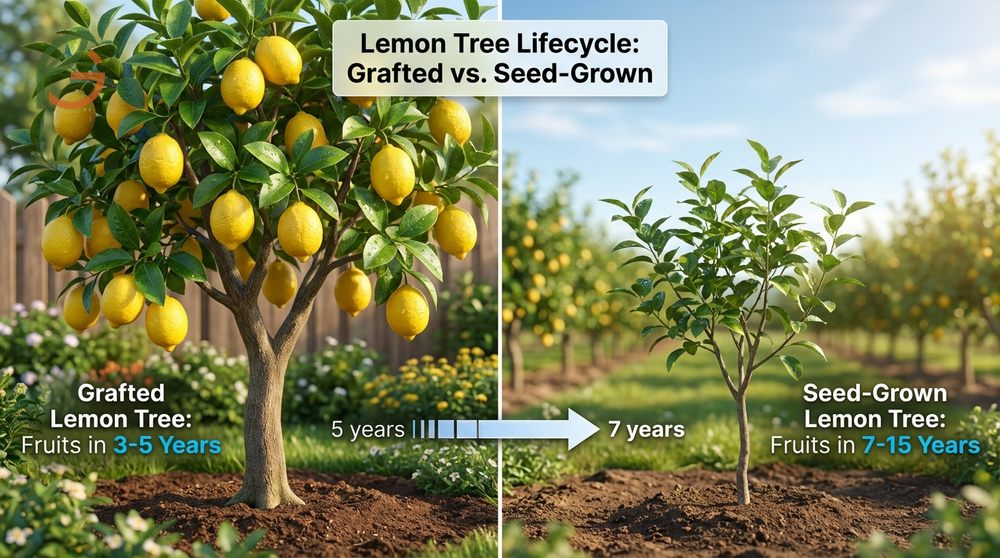
The timeline for growing a productive lemon tree depends primarily on your starting point. Grafted nursery trees begin bearing fruit within 3-5 years, with most producing their first significant harvest around year 4.[1] These trees reach full maturity and peak production by years 6-8.[4]
Research shows that lemon trees add 13-24 inches in height annually during their growth phase, establishing the framework needed for future fruit production. The first two years after planting focus on root and branch structure development rather than fruiting. Agricultural guidance recommends removing any early fruit during this period to redirect energy into building a stronger, more productive tree.
Current horticultural data indicates that most home gardeners can expect to harvest their first lemons in year 3-4 from grafted trees planted as 1-2 year old nursery stock. By year 5, production increases substantially, with mature trees capable of producing lemons year-round in suitable climates.
Grafted Trees Versus Seed-Grown
Grafted trees deliver fruit 4-10 years faster than seed-grown alternatives. The USDA Agricultural Research Service confirms seed-grown lemon trees require 7-15 years to produce fruit, compared to 2-5 years for grafted specimens.[2]
Grafting combines disease-resistant rootstock with productive fruiting varieties, creating trees that mature faster and produce more reliable crops. Seed-grown trees often revert to wild characteristics, yielding smaller, less flavorful fruit. Studies demonstrate that grafted Meyer Lemon varieties can fruit within 2 years under optimal conditions, while seed-grown specimens from the same variety take 5-15 years.
From My Experience: My cousin in Guadalajara, Mexico planted a grafted Eureka lemon tree in March 2022. The tree produced its first 8 lemons by summer 2024, matching the 3-year timeline that research predicts for grafted varieties.
Factors Affecting Timeline
Temperature, sunlight, and variety selection directly impact how quickly your lemon tree reaches fruiting age. Trees grown in USDA zones 9-11 with consistent temperatures of 77-86°F (25-30°C) mature faster than those in marginal climates.[3] Meyer Lemon varieties typically fruit 6-12 months earlier than Eureka or Lisbon types.
Container-grown trees can produce fruit up to one year earlier than ground-planted specimens, as containers create warmer root zones and allow for precise climate control. A 3-foot tall indoor lemon tree can bear approximately 20 lemons around year 3, compared to year 4 for outdoor trees of similar age.
- Tree variety: Meyer lemons fruit earliest (2-3 years), followed by Eureka and Lisbon (3-5 years)
- Starting age: Older nursery stock (3-4 years) produces fruit within 1-2 seasons after planting
- Climate zone: USDA zones 9-11 support faster maturation than zones 8 or cooler
- Sunlight exposure: Trees receiving 6-8 hours of direct sun daily fruit 1-2 years faster[3]
- Soil quality and drainage: Well-draining, slightly acidic soil (pH 5.5-6.5) accelerates root development
Lemon Tree Growth Stages
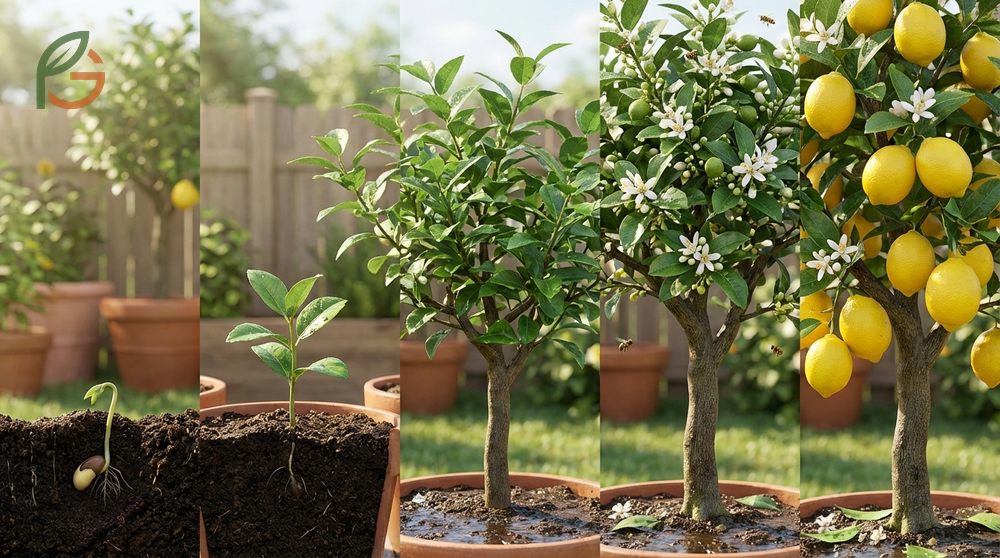
Lemon trees progress through five distinct developmental phases: germination, seedling, vegetative growth, flowering, and fruit production. Each stage requires specific care and attention to support healthy development. Understanding these phases helps you provide appropriate nutrients, water, and pruning at the right times.
The transition between stages isn’t always linear—mature trees continue vegetative growth while simultaneously flowering and fruiting. This overlap allows established trees to produce lemons year-round in warm climates. The first three stages focus on building the tree’s structure, while later stages balance growth with fruit production.
Germination and Seedling
Germination takes 2-4 weeks for lemon seeds planted in warm, moist conditions.[4] Meyer Lemon seeds specifically germinate in 5-7 days when soil temperatures reach 75-77°F (24-25°C). During this phase, the emerging seedling focuses entirely on root system formation.
The seedling stage lasts 4-6 weeks, during which the young plant develops its first true leaves and establishes primary roots. Meyer Lemon seedlings require up to 3 months before they’re sturdy enough for transplanting. Light requirements remain minimal until the seed coat breaks and cotyledons emerge.
Important Note: Seedlings are extremely vulnerable to overwatering during the first 8 weeks. Soil should remain consistently moist but never waterlogged, as excess moisture causes root rot that kills young plants within days.
Vegetative Growth
During years 1-3, lemon trees prioritize stem, leaf, and branch development over fruiting. This vegetative phase builds the structural framework that will support decades of fruit production. Trees can grow 3-5 feet tall during the first two years under ideal conditions.[4]
Light, temperature, and soil moisture directly affect growth rate during this phase. Trees receiving full sun and regular fertilization develop denser canopies with more fruiting sites. Research demonstrates that pruning during vegetative growth should focus only on removing suckers below the graft union and eliminating competing water sprouts.[3]
Flowering and Fruiting
Lemon trees begin flowering 12-18 months after planting grafted nursery stock. The primary bloom occurs in spring (March-May), triggered by warmer temperatures and increasing daylight hours. In subtropical climates, trees can produce multiple flowering flushes throughout the year—spring, summer, and autumn—with spring generating the largest crop.
Once flowering begins, the tree transitions to its mature production phase. Mature lemon trees can live and produce fruit for 50+ years with proper care, spending their energy on flower and fruit development rather than rapid vegetative growth.[4] Production peaks between years 6-15, after which yields gradually stabilize.
This table compares timeline, height growth, and care priorities across five lemon tree development stages from germination through maturity
| Stage | Timeline | Height/Growth | Care Priority |
|---|---|---|---|
| Germination | 2-4 weeks[4] | Root development only | Consistent moisture, 75-77°F (24-25°C) soil |
| Seedling | 4-12 weeks | 4-8 inches | Light exposure, prevent overwatering |
| Vegetative Growth | Years 1-3 | 3-5 feet annually[4] | Fertilization, structural pruning |
| First Flowering | 12-18 months | 3-6 feet total height | Remove early fruit, support structure |
| Mature Production | Years 5-50+[4] | 10-20 feet at maturity | Pest control, harvest management |
Where Do Lemon Trees Grow
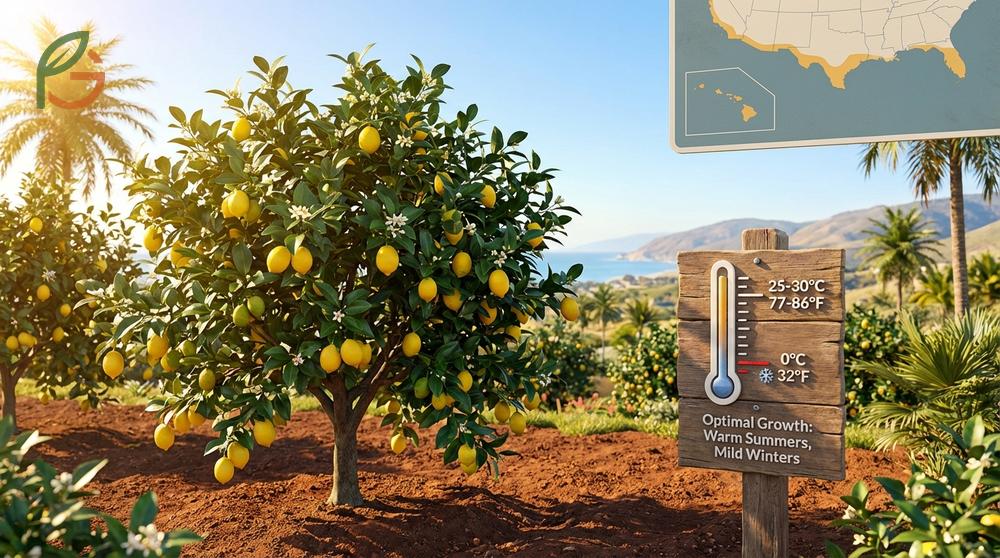
Lemon trees thrive in USDA plant hardiness zones 9-11, characterized by mild winters and warm summers that support year-round growth.[5] These zones include coastal California, southern Texas, Florida, Hawaii, and parts of Arizona. Trees can tolerate brief temperature dips to 25°F (-4°C), but prolonged freezes below this threshold damage young plants and reduce fruit production.
Ideal growing conditions include daytime temperatures of 77-86°F (25-30°C) and nighttime temperatures of 55-65°F (13-18°C).[3] Lemon trees require 6-8 hours of direct sunlight daily for maximum fruit production. In tropical and subtropical climates with mild winters, trees can flower and produce fruit throughout the year, while temperate regions typically see one major spring bloom.
Beyond the United States, commercial lemon production concentrates in Mediterranean climates including Spain, Italy, Turkey, Argentina, and South Africa. These regions share similar temperature patterns, moderate rainfall (30-100 inches annually), and humidity levels around 50%. Trees grow best between sea level and 2,450 feet elevation in subtropical zones, or up to 5,250 feet in truly tropical areas.[6]
- Southern California: Coastal zones 9-10 with consistent sun and moderate temperatures year-round
- Florida: Central and southern regions (zones 9-11) supporting continuous production cycles
- Southern Texas: Rio Grande Valley (zone 9-10) with hot summers and mild winters
- Arizona: Low desert areas (zone 9-10) requiring supplemental irrigation
- Hawaii: All islands (zones 10-11) offering ideal tropical conditions for evergreen fruiting
Container Growing Tip: If you’re outside zones 9-11, container-grown lemon trees let you move plants indoors when temperatures drop below 50°F (10°C). Dwarf varieties like Improved Meyer work best for containers and can produce 15-20 lemons annually in pots.
Time From Flower to Fruit Lemon
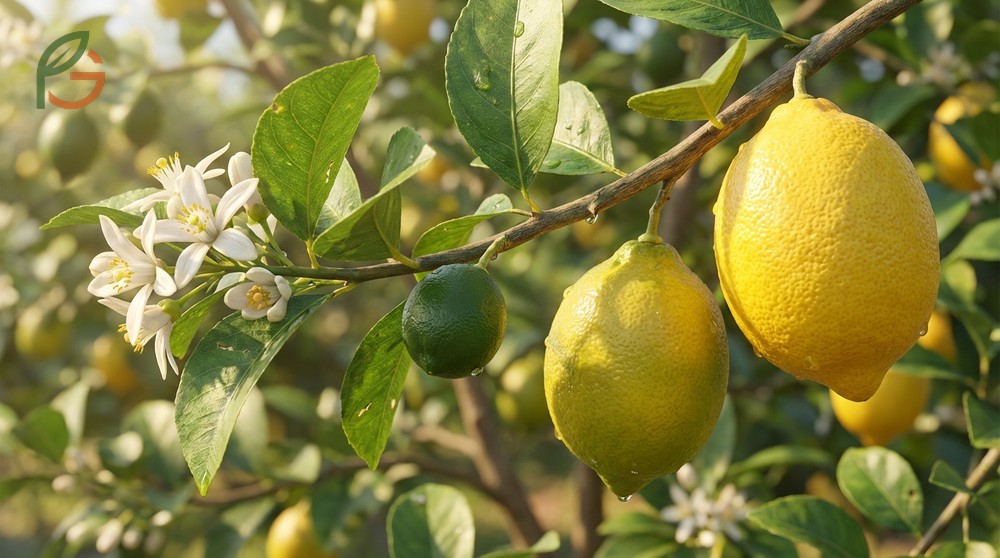
Lemons require 6-9 months to develop from flower to harvestable fruit, with most varieties averaging around 165-180 days after full bloom. The small green fruit that forms immediately after pollination undergoes a gradual ripening process, transitioning from deep green to yellowish-green, then finally to bright yellow when fully mature.
Temperature and sunlight exposure significantly affect ripening speed. Fruit developing during warmer months (spring and summer blooms) typically ripen faster than those from autumn flowers. Research shows that cooler weather accelerates the color change from green to yellow, which explains why late-season fruit often doesn’t turn completely yellow until the following winter.
The fruit growth timeline breaks into three distinct phases: rapid cell division (first 2 months), steady enlargement (months 3-5), and final maturation with color change (months 6-9). During the enlargement phase, lemons reach full size but remain green and highly acidic. The final maturation phase reduces acidity while increasing sugar content and developing the characteristic yellow color.
Unlike many fruits that must be picked at peak ripeness, lemons can remain on the tree for several weeks after turning yellow without significant quality loss. This extended harvest window gives growers flexibility, allowing them to pick fruit as needed rather than rushing to harvest an entire crop at once. Commercial operations often harvest lemons at the yellow-green stage for longer storage potential.
- Bloom timing: Spring flowers ripen by late summer/fall, while autumn blooms mature the following spring
- Variety differences: Meyer lemons mature faster (4-6 months) than Eureka or Lisbon types (7-9 months)
- Temperature consistency: Temperatures above 55°F (13°C) support steady fruit development
- Water availability: Consistent soil moisture prevents fruit drop during the critical 3-5 month growth phase
- Tree age and health: Mature trees (5+ years) ripen fruit more reliably than young specimens
- Nutrient balance: Adequate nitrogen, phosphorus, and potassium support faster, higher-quality fruit development
Speed Up Lemon Tree Growth
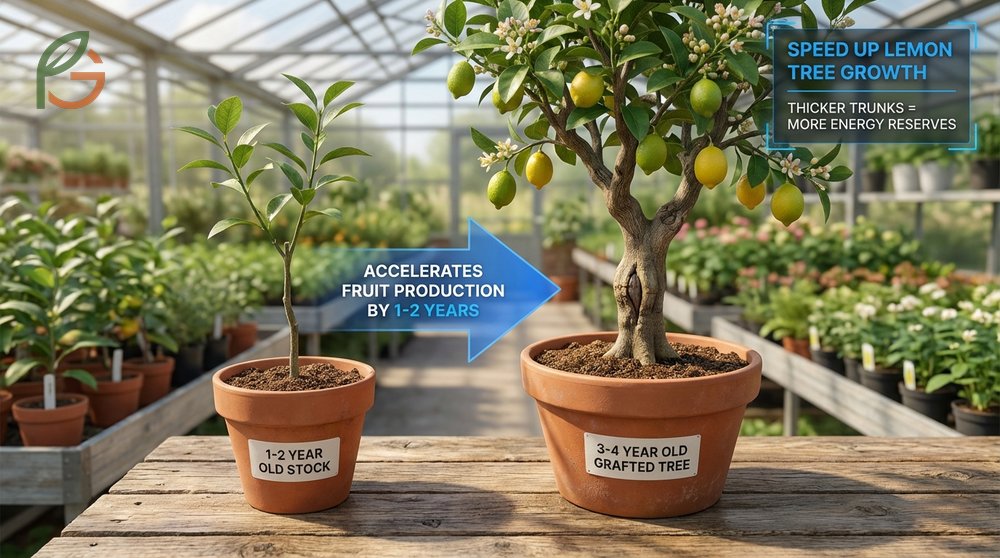
Research shows that selecting grafted trees with thicker trunks at purchase accelerates fruit production by 1-2 years compared to thin-stemmed nursery stock. Trunk diameter indicates stored energy reserves—trees with more reserves flower earlier and support larger initial crops. Agricultural studies demonstrate that purchasing 3-4 year old grafted specimens rather than 1-2 year old stock reduces your wait time to first harvest.
Proper fertilization during the first three years significantly impacts growth rate and fruiting timeline. Current guidance recommends applying citrus-specific fertilizer monthly from early spring through early fall, then reducing frequency during winter dormancy. Trees receiving consistent nutrients develop 30-40% more fruiting sites than unfertilized specimens. Organic options like composted lentils, rice, and wood ash provide slow-release nutrition that supports steady growth.
Sunlight exposure directly correlates with growth speed—trees receiving full sun (6-8 hours daily) mature faster and flower earlier than those in partial shade. Once flowering begins, maintaining consistent soil moisture becomes critical. The soil should dry slightly between waterings but never become bone-dry, as water stress during bloom causes flower drop and delays fruit development by weeks or months.
Strategic pruning accelerates maturation by directing energy toward productive growth rather than excessive vegetation. During the first two years, remove all fruit that forms to focus the tree’s resources on building a strong root system and branch structure. This counterintuitive approach delays your first harvest by 6-12 months but results in 2-3 times higher production in subsequent years.
- Choose older nursery stock: 3-4 year grafted trees with 1-2 inch trunk diameter fruit within 1-2 seasons
- Maximize sun exposure: Plant in south-facing locations receiving 8+ hours direct sunlight daily[3]
- Use citrus-specific fertilizer: Apply monthly spring through fall with NPK ratios around 2-1-1
- Maintain optimal temperature: Protect trees when temperatures drop below 50°F (10°C) to prevent growth stalls
- Remove early fruit: Eliminate all flowers and fruit during years 1-2 to strengthen tree structure
- Ensure proper drainage: Amend heavy soils with sand or perlite to prevent root rot that delays maturation
- Container advantages: Pot-grown trees in controlled environments can produce fruit 12 months earlier than ground-planted specimens
Conclusion
The evidence is clear: how long does it take to grow a lemon tree depends primarily on whether you start with grafted nursery stock (3-5 years to fruit) or seeds (7-15 years). Research across multiple agricultural sources confirms that grafted trees reach productive maturity faster, produce more reliable crops, and offer better disease resistance than seed-grown alternatives.
Current horticultural guidance emphasizes three key factors for optimal results: selecting appropriate varieties for your climate zone, providing 6-8 hours of daily sunlight, and maintaining consistent care during the critical first five years. FruitGarden synthesizes agricultural research to help home gardeners make informed decisions about lemon tree cultivation, from initial planting through decades of productive harvest.
Frequently Asked Questions
How long does it take a lemon tree to grow from seed?
Seed-grown lemon trees require 7-15 years to produce their first fruit, with most taking 10+ years to reach productive maturity. Seeds germinate in 2-4 weeks, but the resulting trees spend years building root and branch structure before flowering. Grafted trees fruit 4-10 years faster, making seed propagation impractical for most home gardeners seeking timely harvests.
How long does a lemon tree take to grow full size?
Lemon trees reach full size in 6-8 years, growing 13-24 inches annually during their vegetative phase. Standard varieties mature at 10-20 feet tall, while dwarf cultivars stop at 4-10 feet. Trees achieve maximum canopy spread and fruiting potential by year 8-10, after which growth slows significantly as energy shifts toward fruit production rather than size increase.
Where do lemons grow best in the United States?
Lemons grow best in USDA zones 9-11, including coastal California, Florida, southern Texas, Arizona, and Hawaii. These regions provide the 77-86°F (25-30°C) daytime temperatures and mild winters that lemon trees require. California and Florida produce over 90% of U.S. commercial lemons due to their ideal Mediterranean and subtropical climates with consistent sun and moderate rainfall.
How long does it take for lemons to grow after flowering?
Lemons take 6-9 months (165-180 days) to grow from flower to harvest-ready fruit. The timeline varies by variety—Meyer lemons mature in 4-6 months, while Eureka and Lisbon types require 7-9 months. Fruit remains green for the first 4-5 months, then transitions to yellow during the final 2-4 months as sugars develop and acidity decreases.
Can lemon trees produce fruit year-round?
Yes, lemon trees in subtropical and tropical climates (zones 10-11) can produce fruit year-round due to multiple flowering flushes in spring, summer, and autumn. Trees in these regions often hold three stages simultaneously—flower buds, developing green fruit, and ripe yellow lemons. Temperate zones typically see one major spring bloom, resulting in a single annual harvest season rather than continuous production.
What is the fastest way to grow a lemon tree?
The fastest approach combines purchasing older grafted nursery stock (3-4 years old), planting in full sun locations with 8+ hours daily exposure, and applying citrus-specific fertilizer monthly during the growing season. Container cultivation accelerates fruiting by 6-12 months compared to ground planting, as pots create warmer root zones. Removing all fruit during the first two years redirects energy into structural growth, resulting in 2-3 times higher production in year 3-4.
When is the best time to plant a lemon tree?
Spring (March-May) is the optimal planting time for lemon trees in most climates, as warming soil temperatures encourage rapid root establishment before summer heat. In warm regions like southern California and Florida, fall planting (September-November) also works well, giving trees several mild months to acclimate before the following spring’s growth flush. Avoid planting during temperature extremes—winter freezes or midsummer heat stress newly planted trees and delay their first fruiting season by 6-12 months.





