
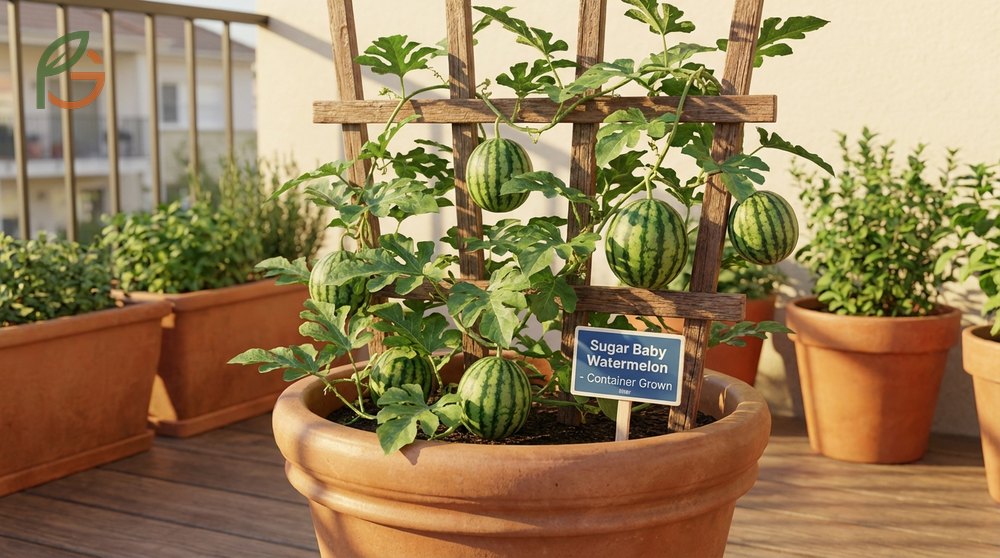
Growing Watermelon In Pots is entirely possible with the right container size, compact varieties, and vertical support systems. Research shows that dwarf watermelon varieties like Sugar Baby and Sugar Pot thrive in containers holding 5-10 gallons of soil, producing 8-10 pound fruits on compact vines just 18-20 inches long[1]. Container gardening allows you to grow watermelons even in small spaces like patios and balconies, while vertical trellising saves space and improves air circulation. FruitGarden provides practical guidance based on current horticultural research to help you successfully grow watermelons in containers from seed to harvest.
Quick Answer
- Use containers that hold 5-10 gallons of soil minimum, with at least 18-24 inches depth[2]
- Choose compact varieties that produce 7-10 pound fruits on short vines[1]
- Plant when soil temperatures reach 70-90°F (21-32°C) for optimal germination[3]
- Install sturdy trellises at planting time to support 1-2 feet weekly vine growth and heavy fruits[4]
Growing Watermelon In Pots
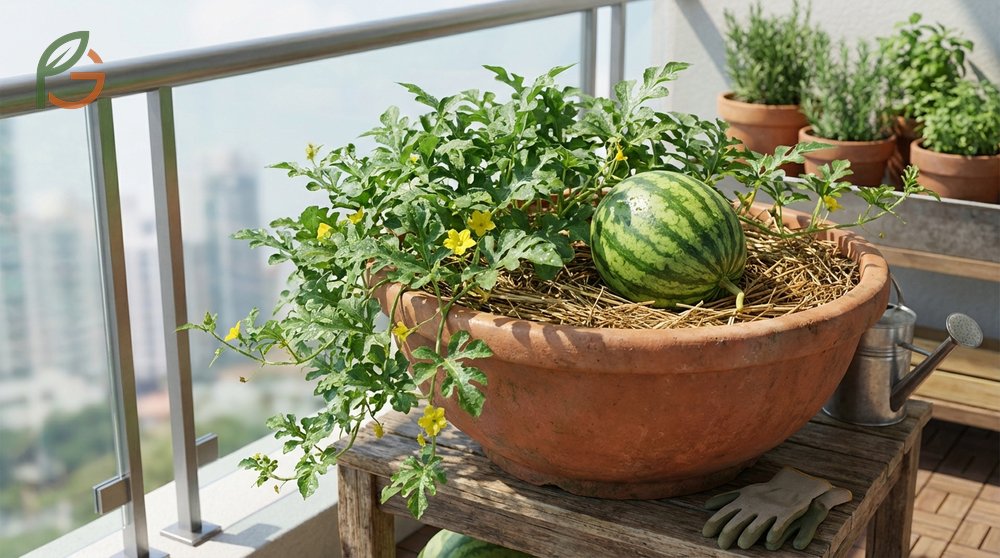
Container watermelon cultivation has become increasingly popular as compact varieties eliminate the need for sprawling garden beds. Traditional watermelon vines can spread up to 10 feet, making them impractical for small spaces[1]. Modern dwarf varieties solve this problem by producing full-sized fruits on vines that stay compact and manageable.
Studies show that watermelons grown in containers benefit from faster soil warming in spring, which accelerates germination and growth rates. Dark-colored pots and black grow bags absorb solar radiation, raising soil temperatures 5-10°F above ground soil levels[5]. This allows you to plant 2-3 weeks earlier than in-ground gardens.
The key to success lies in selecting appropriate varieties, providing adequate container volume, and maintaining consistent moisture levels. Container watermelons require more frequent watering than ground-planted ones but produce comparable yields when properly managed.
Benefits of Container Watermelon Growing
Growing watermelons in pots offers several advantages over traditional ground planting. Containers provide superior control over soil quality, drainage, and growing conditions.
Mobile containers let you position plants in the sunniest spots and move them to protected areas during severe weather. This flexibility is especially valuable for renters or gardeners with limited yard access.
- Faster soil warming in spring enables earlier planting by 2-3 weeks compared to ground gardens
- Complete control over soil composition eliminates issues with poor native soil or contamination
- Reduced pest pressure as containers can be elevated away from ground-dwelling insects and slugs
- Portability allows optimal sun exposure and protection from unexpected frost or storms
- Space efficiency through vertical growing makes watermelon cultivation possible on patios, balconies, and small yards
From My Experience: My cousin in Guadalajara, Mexico grew Sugar Baby watermelons in 10-gallon fabric pots last summer. Seeds germinated in 7 days versus the typical 10-14 day range, achieving 100% success rate with the warm container soil.
Space Requirements
Each container watermelon plant needs adequate space for both root development and vine spread. Compact varieties require minimum 18-24 inches of container diameter and 20-24 inches of depth[5].
When planning vertical growth, allocate 5-6 feet of trellis height to accommodate vine spread. Most watermelon fruits develop within 4 feet of soil level, even when vines climb higher[4].
Important Note: Don’t overcrowd containers—plant only one watermelon per 5-gallon container or two per 10-15 gallon container. Overcrowding reduces fruit size and increases disease risk from poor air circulation.
Growing Watermelon in Containers
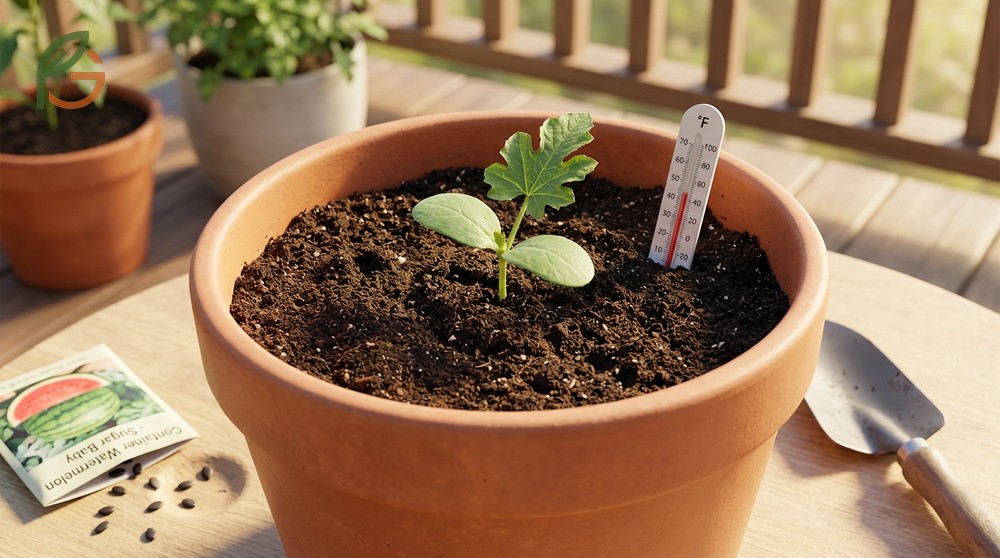
Successful container watermelon cultivation starts with proper variety selection and timing. Plant seeds or transplants 1-2 weeks after the last spring frost when nighttime temperatures stay consistently above 60°F (16°C)[3]. Cold nights below this threshold slow growth and can prevent flowering.
Direct sowing into containers works better than transplanting since watermelon roots are sensitive to disturbance. Sow 2-3 seeds per container at ½ inch depth, then thin to the strongest seedling when three true leaves appear[3]. Germination typically occurs within 7-10 days under optimal conditions.
Container watermelons need full sun exposure—at least 8 hours daily—to produce sweet, flavorful fruits. Position containers in south-facing locations or the sunniest area of your patio for best results.
Best Watermelon Varieties for Pots
Compact and dwarf watermelon varieties are specifically bred for container growing and small spaces. These varieties produce full-flavored fruits up to 10 pounds on vines that stay under 3 feet long.
The most popular container-friendly varieties include Sugar Baby, Bush Sugar Baby, Sugar Pot, Blacktail Mountain, and Golden Midget. Each offers unique characteristics suited to different growing conditions and preferences.
This table compares five popular container watermelon varieties by vine length, fruit weight, days to maturity, and key characteristics
| Variety | Vine Length | Fruit Weight | Days to Maturity | Key Features |
|---|---|---|---|---|
| Sugar Baby | 3-4 feet | 8-10 lbs | 75-80 days | Classic red flesh, thin rind, widely available[6] |
| Sugar Pot | 18-20 inches[1] | 8-10 lbs[1] | 80-85 days | Most compact vines, ideal for small pots |
| Bush Sugar Baby | 2-3 feet | 6-8 lbs | 80-85 days | Bush-type growth, no trellising needed[5] |
| Blacktail Mountain | 3-4 feet | 6-12 lbs | 70-75 days | Early maturing, cold-tolerant, dark green rind[6] |
| Golden Midget | 2-3 feet | 3-5 lbs | 65-70 days | Yellow rind when ripe, fastest maturity[6] |
Container Size for Watermelon
Container volume directly impacts watermelon root development and fruit production. Watermelons have extensive root systems that require adequate space to support vigorous growth and heavy fruits.
Research indicates that 5-gallon containers represent the absolute minimum for compact varieties, while 7-10 gallons produces better results[2][5]. Larger containers reduce watering frequency and provide more nutrients for fruit development.
- 5-gallon containers: Minimum size for Sugar Pot or Golden Midget varieties only, requires twice-daily watering in summer
- 7-10 gallon containers: Recommended for Sugar Baby and Bush Sugar Baby, balances root space with portability
- 15-20 gallon containers: Ideal for growing two compact plants per container or larger varieties
- Fabric grow bags: Excellent alternative to rigid pots, provide superior drainage and air pruning of roots
- Drainage holes: Essential—containers must have multiple holes to prevent waterlogged soil and root rot
Pro Tip: Measure container capacity by filling with water using gallon jugs rather than relying on advertised sizes, which often include rim volume above the soil line. Actual soil capacity runs 10-15% less than stated container volume.
Watermelon Plant on Trellis
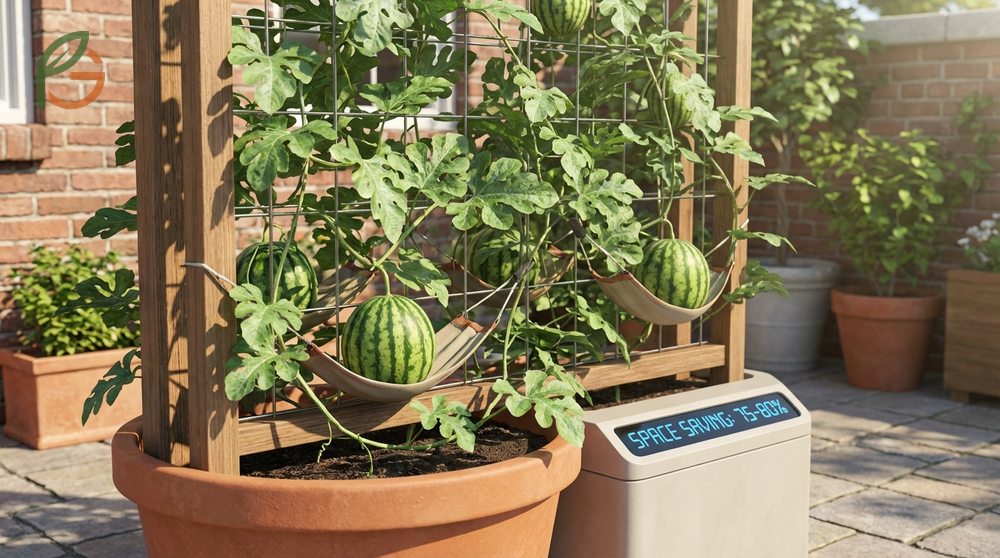
Vertical growing systems transform watermelon cultivation in limited spaces by training vines upward instead of allowing ground sprawl. Trellising container watermelons saves 75-80% of horizontal space while improving air circulation and reducing disease pressure.
Watermelon vines grow rapidly—adding 1-2 feet per week during peak summer growth[4]. This aggressive growth requires sturdy support structures installed at planting time to avoid disturbing established roots.
Fruits developing on trellises need individual support since watermelon tendrils can’t bear the weight of mature melons. Slings made from breathable fabric prevent stem breakage and allow fruits to ripen properly.
Vertical Gardening Support Ideas
Effective trellis systems must support both vigorous vine growth and the weight of developing fruits. Select materials rated to bear 20-30 pounds per plant to accommodate multiple fruits and vine mass.
Heavy-duty structures like cattle panels, welded wire fencing, or commercial tomato cages work better than lightweight netting for watermelons. For containers, tripod designs provide stability without tipping risk[3].
- Cattle panels or field fencing: 16-gauge wire panels rated for 50+ pounds, ideal for multiple fruits, requires secure anchoring
- Wooden tripods: Three 6-8 foot stakes tied at top, offers 360-degree growing space and excellent stability in containers
- Heavy-duty tomato cages: Choose welded steel models at least 5 feet tall, avoid flimsy wire cages that collapse under weight
- A-frame trellises: Two panels joined at top create self-supporting structure, perfect for growing two plants opposite sides
- Wall-mounted trellises: Space-saving option for patio containers placed against walls or fences, use 5.5-6 foot height[4]
Training Watermelon Vines
Watermelons don’t climb naturally like cucumbers or pole beans, requiring manual training throughout the growing season. Loosely tie vines to trellis supports using soft plant ties or strips of fabric every 12-18 inches as they grow.
Start training when vines reach 12-15 inches long by gently guiding the main stem toward the trellis base. Secure vines after each foot of growth, checking ties weekly to ensure they haven’t become too tight as stems thicken.
Create fruit slings when melons reach softball size (4-6 inches diameter) to prevent stem breakage. Use mesh produce bags, old t-shirt fabric, or commercial fruit hammocks attached to the trellis above each developing melon[4]. Position slings to cradle fruits without restricting growth.
Soil Mix for Potted Watermelon
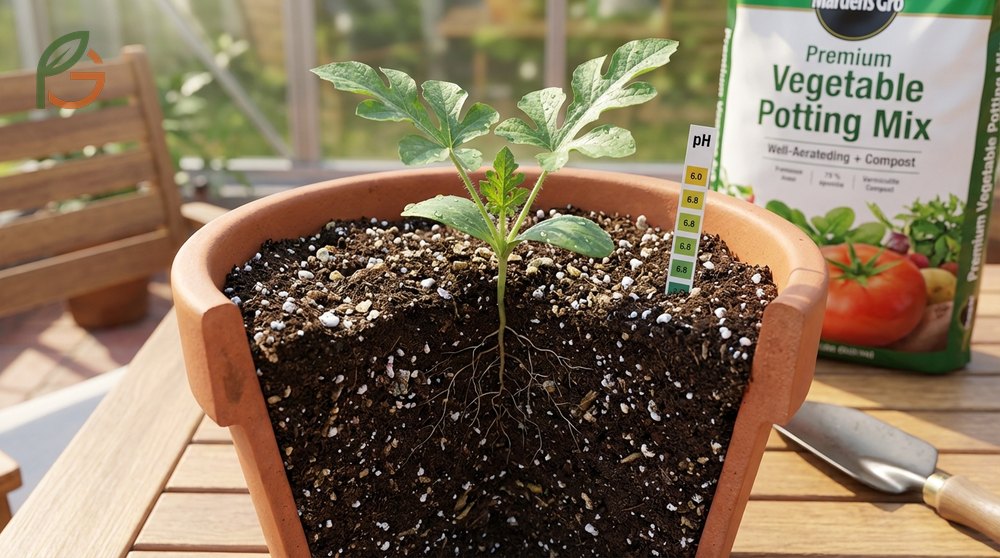
The right soil blend balances water retention with drainage to support watermelon’s dual needs for consistent moisture and oxygen-rich roots. Standard garden soil compacts in containers, creating poor drainage that leads to root rot.
Research shows watermelons thrive in slightly acidic conditions with pH between 6.0-6.8[7]. High-quality potting mixes formulated for vegetables provide the sterile, nutrient-rich foundation watermelons need for container success.
Never use 100% compost or soil from your yard in containers. Pure compost is too nutrient-dense and stays waterlogged, while yard soil harbors diseases and compacts severely when watered.
- High-quality potting soil: Forms the base (50% of mix), provides structure and initial nutrients, must be sterile and pathogen-free
- Finished compost: Adds 25-30% of mix, supplies organic matter and beneficial microorganisms, improves moisture retention[8]
- Perlite or vermiculite: Comprises 15-20% of mix, prevents compaction and improves drainage without sacrificing moisture capacity
- Worm castings: Optional 5-10% addition provides slow-release nutrients and introduces beneficial soil biology
- Coconut coir: Alternative to peat moss (20-30% of mix), sustainable option that improves water retention in hot climates
Mix components thoroughly before filling containers, then moisten the blend until water drains from the bottom. Add a 2-inch layer of straw or shredded bark mulch on top after planting to reduce evaporation and regulate soil temperature fluctuations.
Test soil pH using an inexpensive probe or home test kit before planting. If pH exceeds 7.0, amend with sulfur according to package directions. For pH below 5.5, add dolomitic lime to raise acidity into the optimal range.
Watering Schedule for Containers
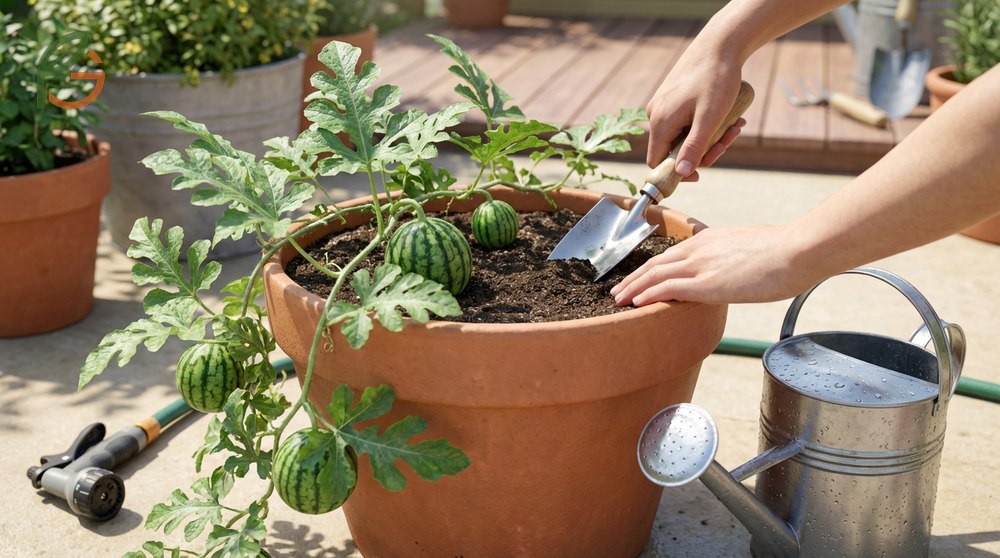
Container watermelons demand more frequent irrigation than ground-planted vines because pots dry out faster through evaporation from all surfaces. Consistent soil moisture is critical from germination through fruit development—irregular watering causes fruit cracking and poor flavor.
During early growth (first 3-4 weeks), water whenever the top 3-4 inches of soil feels dry to the touch[9]. This typically means daily watering in warm weather. Once flowering begins, increase to 1-2 inches of water weekly, which translates to 16-32 gallons per 10 square feet[9].
Hot weather above 85°F (29°C) requires twice-daily watering for container watermelons—once in early morning and again in late afternoon[5]. Check soil moisture by inserting your finger 2-3 inches deep; if it feels dry, water immediately.
- Seedling stage (weeks 1-4): Daily watering to maintain evenly moist soil, never allowing complete dryness that stresses young roots
- Vegetative growth (weeks 5-8): Every 1-2 days depending on temperature, monitoring top 4 inches of soil for dryness
- Flowering and pollination (weeks 8-10): Twice weekly deep watering with 10+ liters per plant, maintaining consistent moisture[10]
- Fruit development (weeks 10-12): Continue twice weekly deep watering until fruits reach full size, never allowing wilting
- Pre-harvest (final 1-2 weeks): Reduce watering by 30-40% to concentrate sugars and improve sweetness, but don’t let plants severely wilt[9]
Critical Warning: Morning leaf wilting indicates severe water stress requiring immediate irrigation. Afternoon wilting is normal heat response and doesn’t necessarily mean plants need water. Check soil moisture rather than relying solely on visual cues.
Fertilizing Potted Watermelons
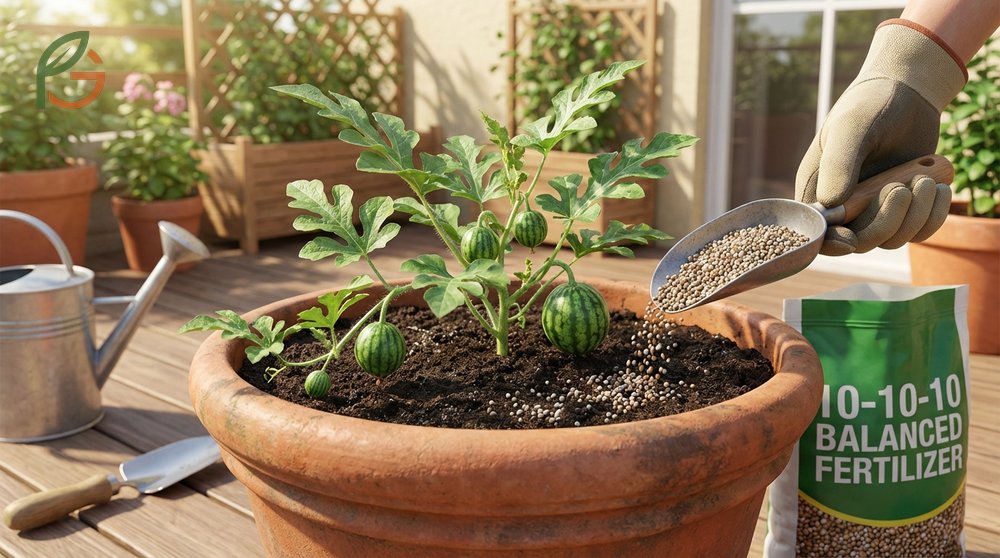
Watermelons are heavy feeders requiring regular fertilization in containers where nutrients leach out with frequent watering. Nutritional needs change as plants progress from vegetative growth to flowering and fruiting stages.
Start with balanced 10-10-10 fertilizer at planting to support overall growth and root development[11]. Apply according to package directions, typically 1-2 tablespoons per gallon of soil mixed into the top 2-3 inches.
Switch to phosphorus-rich formulas (5-10-10) when flowers appear to promote strong blooms and fruit set. Once melons reach baseball size, transition to potassium-heavy fertilizer (3-12-12) to enhance sweetness and support fruit growth to maturity[11].
- Week 1-3 after planting: Balanced 10-10-10 formula every 2 weeks, promotes vigorous vine and leaf development
- Week 4-6 (pre-flowering): Second nitrogen application using 33-0-0 at ½ pound per 50 feet of row or 1 tablespoon per container[12]
- Week 7-9 (flowering): Phosphorus-rich 5-10-10 formula weekly, supports flower production and pollination success
- Week 10-12 (fruit development): Potassium-heavy 3-12-12 or 0-0-12 every 10 days, improves sweetness and water retention in fruits
- Throughout season: Liquid kelp or fish emulsion every 2-3 weeks provides trace minerals and boosts plant immunity
Avoid over-fertilizing, which produces excessive foliage at the expense of fruit production. If leaves turn dark green and vines grow vigorously but produce few flowers, reduce nitrogen and increase phosphorus-potassium ratio.
Water containers thoroughly before and after applying granular fertilizers to prevent root burn. Liquid fertilizers can be applied with regular watering but should be diluted to half-strength for container plants to avoid salt buildup.
Conclusion
The evidence is clear: Growing Watermelon In Pots succeeds when you match compact varieties to appropriately sized containers, provide sturdy vertical support, and maintain consistent watering and fertilization schedules. Container cultivation offers flexibility, faster soil warming, and space efficiency that makes watermelon growing accessible to gardeners with limited space.
Current horticultural guidance emphasizes selecting 7-10 gallon containers minimum, using well-draining potting mixes enriched with compost, and installing trellises at planting time to support rapid vine growth. With attention to these fundamentals and variety selection suited to your climate, you’ll harvest sweet, homegrown watermelons from your patio or balcony. FruitGarden synthesizes research-backed methods to help you achieve container watermelon success from seed to harvest.
Frequently Asked Questions
Can You Grow Watermelon in a Pot?
Yes, you can grow watermelon successfully in pots using compact varieties like Sugar Baby, Sugar Pot, or Bush Sugar Baby. These varieties produce 6-10 pound fruits on vines that stay under 3 feet long, making them ideal for containers holding 5-10 gallons of soil. Choose pots with excellent drainage, use quality potting mix, and provide full sun exposure for best results.
How Do You Grow a Square Watermelon?
Square watermelons are created by placing young fruits into cube-shaped glass or acrylic molds when they reach softball size (4-6 inches diameter). The transparent boxes allow sunlight to reach all sides while constraining growth into a square shape. You’ll need to rotate the box every few days to ensure even green coloring and remove the watermelon when it fills about 80% of the mold volume to prevent growth restrictions that affect flavor.
Can You Grow Watermelon Indoors?
Growing watermelon indoors is challenging but possible with adequate lighting and space. You’ll need high-intensity grow lights providing 12-14 hours of full-spectrum light daily, temperatures maintained between 70-85°F (21-29°C), and hand-pollination since indoor environments lack pollinating insects. Choose the smallest varieties like Golden Midget for better indoor success, and expect reduced yields compared to outdoor growing.
Growing Watermelon Vertically in Pots: What Support Do I Need?
Growing watermelon vertically in pots requires sturdy trellises at least 5-6 feet tall made from cattle panels, welded wire fencing, or heavy-duty tomato cages. Install supports at planting time before roots establish to avoid damage. You’ll also need soft plant ties to train vines as they grow and fabric slings (mesh bags or t-shirt strips) to cradle individual fruits when they reach 4-6 inches diameter, preventing stem breakage from the weight of developing melons.
What’s the Best Container Size for Growing Watermelon?
The best container size for watermelon is 7-10 gallons minimum, with dimensions of at least 18-24 inches across and 20-24 inches deep. While compact varieties can survive in 5-gallon containers, larger pots reduce watering frequency and provide more nutrients for better fruit development. Fabric grow bags work excellently by providing superior drainage and air pruning of roots that prevents root binding.
How Often Should I Water Container Watermelons?
Water container watermelons daily during establishment and vegetative growth, checking that the top 3-4 inches of soil stay moist. During hot weather above 85°F (29°C), water twice daily—morning and late afternoon—to prevent stress. Once fruits develop, maintain consistent moisture with deep watering 2-3 times weekly, providing 1-2 inches of water per application. Reduce watering by 30-40% during the final 1-2 weeks before harvest to concentrate sugars.
When Should I Fertilize Potted Watermelons?
Fertilize potted watermelons every 2 weeks with balanced 10-10-10 formula during the first 6 weeks after planting. Switch to phosphorus-rich 5-10-10 fertilizer weekly when flowers appear to promote blooming and fruit set. Once melons reach baseball size, transition to potassium-heavy formulas (3-12-12 or 0-0-12) every 10 days to enhance sweetness and support fruit growth. Always water thoroughly before and after applying fertilizers to prevent root burn.





