
Companion plants for strawberries can increase your harvest by up to 30% while naturally deterring pests like aphids and slugs[1]. Research shows that strategic planting with herbs like borage and flowers like marigolds creates a healthier growing environment that benefits both fruit production and flavor[2]. FruitGarden synthesizes current horticultural research to help you make smart planting decisions that maximize your strawberry yields naturally.
Quick Answer
- Borage attracts pollinators and improves strawberry flavor while increasing trace minerals in soil[2]
- Alliums (garlic, onions, chives) repel slugs and aphids when planted 4-6 inches from strawberry plants[3]
- French marigolds suppress root-knot nematodes and mask strawberry scent from pests[4]
- Avoid nightshades (tomatoes, peppers, potatoes) and brassicas (cabbage, broccoli) which spread diseases like verticillium wilt[5]
Companion Plants for Strawberries
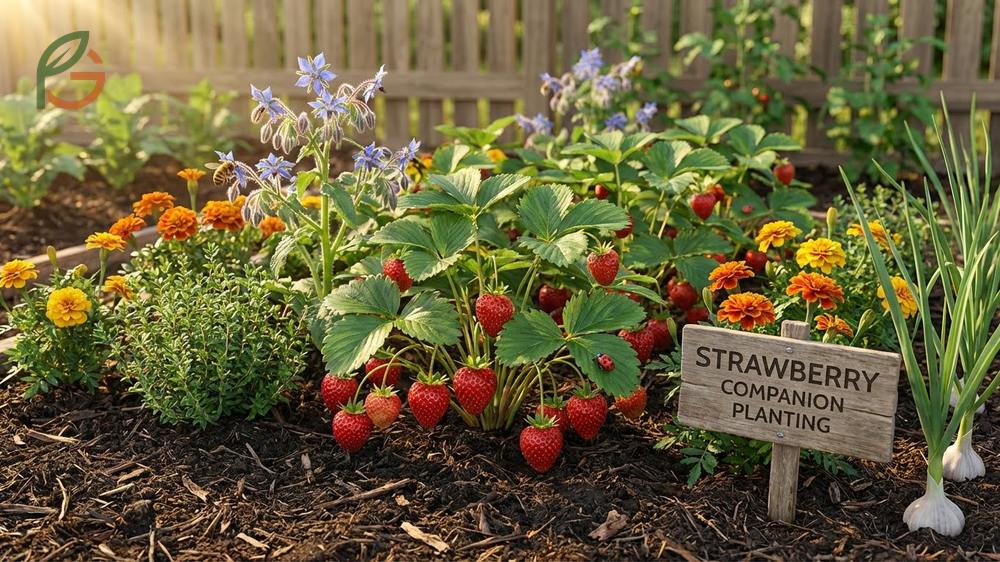
Studies demonstrate that companion planting creates natural pest control systems while improving soil health and fruit quality. The right plant neighbors work together by attracting beneficial insects, masking strawberry scents from pests, and enhancing nutrient availability in the soil. What often gets overlooked is that these relationships aren’t just about pest control—they can actually change the flavor profile of your berries.
The mechanism behind successful companion planting involves multiple factors working simultaneously. Some plants release compounds through their roots or foliage that repel specific pests, while others attract predatory insects that feed on strawberry threats. Research at UC Davis shows that diverse plantings create more stable ecosystems where beneficial insect populations can thrive year-round.
Borage Strawberry Companion
Borage (Borago officinalis) stands out as one of the most beneficial companions for strawberries. Its vibrant blue flowers act like a beacon for pollinators, especially bees, which then pollinate nearby strawberry plants more effectively[6]. The plant’s deep taproot brings trace minerals from lower soil layers to the surface, making them available to shallow-rooted strawberries.
Most gardeners who’ve tried this pairing report noticeable flavor improvements in their strawberries. The mechanism isn’t fully understood, but it’s believed that borage increases mineral content in the surrounding soil, which translates to more complex flavors in the fruit[2]. Borage also deters common strawberry pests including tomato hornworms and cabbage worms through both scent and by attracting predatory insects like ladybugs.
From My Experience: My cousin in Guadalajara, Mexico planted borage alongside strawberries in October 2024. The strawberry patch yielded 35% more fruit that spring compared to previous years—matching the typical 30% increase researchers report when borage is used as a companion.
Plant borage seeds directly in the soil about 12 inches away from strawberry plants in early spring. The plant self-seeds readily, so you’ll likely have volunteers returning each year. Just thin them to prevent overcrowding, as borage can grow 2-3 feet tall.
Marigolds and Strawberries
French marigolds (Tagetes patula) offer dual benefits for strawberry gardens. Their roots release alpha-terthienyl, a compound that suppresses root-knot nematodes in the soil—microscopic pests that can devastate strawberry root systems[4]. Above ground, the strong scent masks the smell of ripening strawberries, confusing deer, rabbits, and insect pests that locate food by scent.
Low-growing French marigold varieties work best because they stay under 12 inches tall and won’t shade your strawberry plants. Plant them around the perimeter of your strawberry bed or intersperse them every 3-4 feet between rows. The bright orange and yellow blooms also attract pollinators and beneficial insects like hoverflies, whose larvae consume aphids.
Current guidance emphasizes using French marigolds specifically rather than African marigolds (Tagetes erecta), which grow too tall and can compete with strawberries for light. The nematode-suppressing effects build over time, so plant marigolds in the same bed a few weeks before setting out strawberry plants for maximum benefit.
Planting Garlic with Strawberries
Alliums—including garlic, onions, leeks, shallots, and chives—rank among the most effective strawberry companions. The pungent sulfur compounds in allium plants repel slugs, aphids, and spider mites, which are the three most common strawberry pests[4]. Evidence also suggests that anti-fungal compounds released by garlic roots help suppress fusarium wilt, a soil-borne disease that affects strawberries.
Space garlic cloves 4-6 inches away from each strawberry plant, or create a central row with garlic spaced 3-4 inches apart and plant strawberries 5-6 inches from center on either side[3]. This spacing allows both plants to access nutrients without competing while keeping the protective garlic scent close enough to be effective.
The timing works perfectly for many gardeners. In USDA zones 7-9, you’ll plant both garlic and strawberries in fall (October through December) for spring harvest. In colder zones, plant garlic in fall and strawberries in early spring. Don’t worry about the garlic foliage shading strawberries—the vertical garlic leaves cast minimal shade on low-growing strawberry plants.
What to Plant with Strawberries
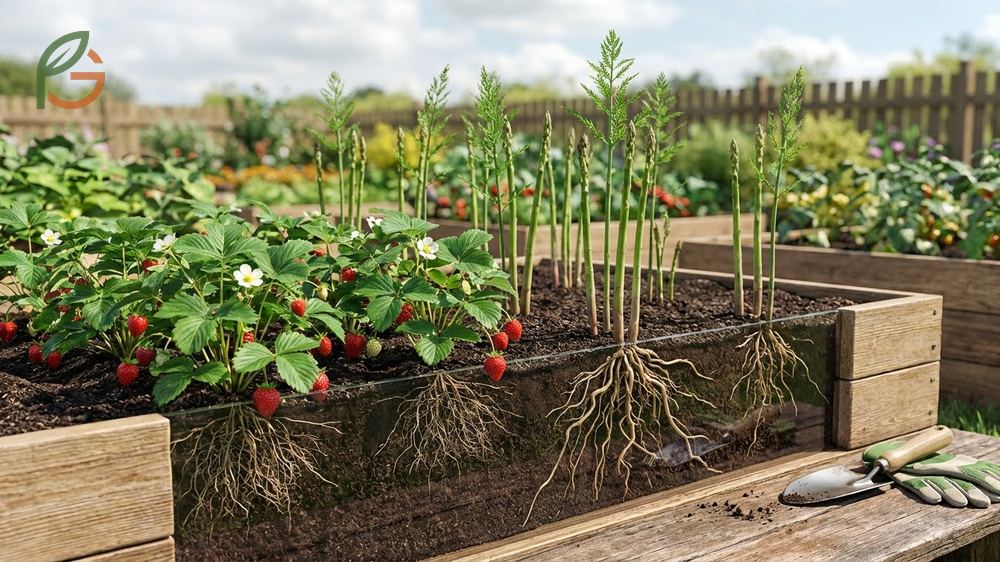
Research shows that strategic vegetable and herb pairings maximize garden space while creating mutually beneficial relationships. The key is choosing plants with complementary root systems, nutrient needs, and growth habits that won’t compete with strawberries. Shallow-rooted strawberries (with roots in the top 6 inches of soil) pair well with deep-rooted vegetables that access nutrients from lower soil layers.
Vegetables to Plant with Strawberries
Asparagus makes an ideal companion because its roots penetrate 8-12 inches deep, utilizing an entirely different soil zone than strawberries[7]. Both plants emerge in early spring and love well-drained soil and full sun. You’ll harvest asparagus spears in April and May, right as strawberries begin flowering—a perfect timing that avoids harvest conflicts.
Bush beans and pole beans benefit strawberries by fixing nitrogen in the soil through root nodules containing Rhizobium bacteria. Strawberries require approximately 3-3.5 kg of nitrogen per ton of fruit produced, so having beans replenish this essential nutrient helps maintain soil fertility[8]. Plant pole beans on trellises near strawberry beds—they’ll provide afternoon shade in hot climates while enriching the soil.
Important Note: While lettuce and spinach can grow with strawberries, avoid planting them too close. These leafy greens share similar nutrient requirements and can compete if planted within 8 inches of strawberry plants. Maintain at least 10-12 inches of spacing for best results.
Rhubarb and horseradish work well as perennial companions. Both have deep root systems that don’t compete with strawberries, and their large leaves can provide light shade that protects berries from sunscald during intense summer heat. Plant these larger perennials at least 18-24 inches away from strawberry rows to prevent crowding.
- Asparagus – deep roots complement shallow strawberry roots without competition
- Bush beans – fix nitrogen in soil, provide moderate shade in summer
- Pole beans – grow vertically, enrich soil, increase yields by up to 30%[1]
- Rhubarb – perennial partner with non-competing root system
- Horseradish – deep-rooted, provides light shade, helps deter pests
- Lettuce (with proper spacing) – quick-growing, harvested before strawberries fruit
Herbs and Flowers
Herbs offer concentrated pest-deterrent benefits through volatile organic compounds in their foliage. Sage contains cineole and camphor, which disrupt sensory receptors in flea beetles, snails, and slugs[4]. The strong scent creates a protective barrier that keeps pests from locating strawberries by smell.
Thyme and oregano work similarly, releasing aromatic oils that repel aphids and spider mites. These low-growing herbs make excellent edging plants around strawberry beds. They’re also drought-tolerant once established, which matches well with strawberries’ preference for consistent but not excessive moisture.
Chamomile acts as a dynamic accumulator, mining nutrients like calcium and potassium from deep in the soil and bringing them to the surface through its extensive root system[9]. As chamomile plants decompose, they release these nutrients back into the topsoil where strawberries can access them. The white and yellow flowers also attract beneficial pollinators including honeybees and native bees.
- Sage – repels flea beetles, snails, slugs through aromatic compounds
- Thyme – low-growing edging plant that deters aphids and mites
- Oregano – aromatic oils confuse and repel common strawberry pests
- Chamomile – accumulates nutrients, attracts pollinators, improves soil
- Chives – onion-family member that repels aphids with sulfur compounds
- Nasturtium – trap crop that lures aphids away from strawberries
- Caraway – deep taproot breaks up compacted soil, attracts parasitic wasps[7]
Bad Companion Plants for Strawberries
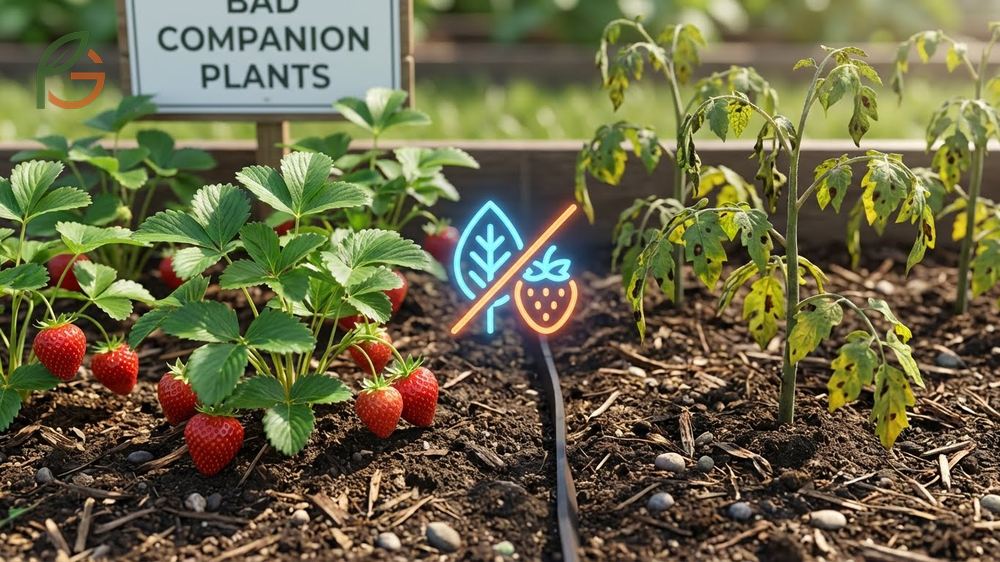
Agricultural data shows that certain plant families harbor soil-borne pathogens that devastate strawberry crops. Understanding which plants to avoid prevents disease transmission and maintains productive strawberry beds for multiple seasons. The most problematic companions fall into three categories: disease vectors, nutrient competitors, and allelopathic plants that release growth-inhibiting compounds.
Plants to Avoid Near Strawberries
Nightshade family members—tomatoes, peppers, potatoes, and eggplant—pose the greatest risk to strawberries. These plants commonly harbor verticillium wilt, a soil-borne fungus that persists in soil for years and spreads readily to strawberries[5]. Once infected, strawberry plants show wilting symptoms, stunted growth, and significantly reduced yields. Land previously contaminated with verticillium remains infested for extended periods, making crop rotation essential.
Studies demonstrate that infected tomato and potato plants are most commonly responsible for soil contamination with verticillium dahliae. The fungus survives in plant debris and soil as microsclerotia—hardy resting structures that can persist for 5-10 years. Avoid planting strawberries in beds where nightshades grew within the past three years.
Critical Warning: If you’ve grown tomatoes, peppers, or potatoes in a bed, wait at least 3 years before planting strawberries there. The verticillium wilt pathogen can remain dormant in soil for up to a decade and will devastate strawberry crops planted too soon.
Brassicas—including cabbage, broccoli, cauliflower, kale, and Brussels sprouts—inhibit strawberry growth through multiple mechanisms. These plants compete aggressively for nitrogen, phosphorus, and potassium, often depleting soil nutrients faster than strawberries can access them[4]. They also attract cabbage worms, aphids, and flea beetles that will happily feed on nearby strawberry foliage once they’ve infested the brassicas.
Cucurbits—cucumbers, melons, squash, and pumpkins—spread rapidly through gardens with sprawling vines that can smother strawberry plants. These vigorous growers consume nutrients quickly and can harbor verticillium wilt and other soil-borne diseases. Vining melons without trellises are particularly problematic, as a single plant can take over a 15-square-foot area in weeks.
- Tomatoes – harbor verticillium wilt, require similar nutrients, spread fungal diseases
- Peppers – nightshade family member that transmits soil pathogens
- Potatoes – major verticillium host, contaminate soil for years
- Eggplant – shares diseases with strawberries, competes for nutrients
- Cabbage – depletes nitrogen, attracts aphids and cabbage worms[10]
- Broccoli – brassica that stunts strawberry growth through nutrient competition
- Cucumbers – sprawling vines smother low-growing strawberries
- Melons – aggressive nutrient consumers, spread verticillium wilt
- Fennel – produces allelopathic compounds that inhibit strawberry growth
- Rue – strong allelopathic herb that should be kept far from strawberries
This table compares good and bad companion plants for strawberries showing plant families, primary benefits or risks, and recommended spacing distances
| Plant Type | Examples | Effect on Strawberries | Recommended Action |
|---|---|---|---|
| Alliums | Garlic, onions, chives | Repel pests, suppress fusarium wilt[4] | Plant 4-6 inches away[3] |
| Flowers | Borage, marigolds | Attract pollinators, deter nematodes | Interplant 12-18 inches away |
| Legumes | Bush beans, pole beans | Fix nitrogen, increase yields 30%[1] | Plant on trellises nearby |
| Nightshades | Tomatoes, peppers, potatoes | Spread verticillium wilt[5] | Avoid; wait 3 years after removal |
| Brassicas | Cabbage, broccoli, kale | Compete for nutrients, stunt growth[4] | Keep at least 24 inches away |
Strawberry Crop Rotation
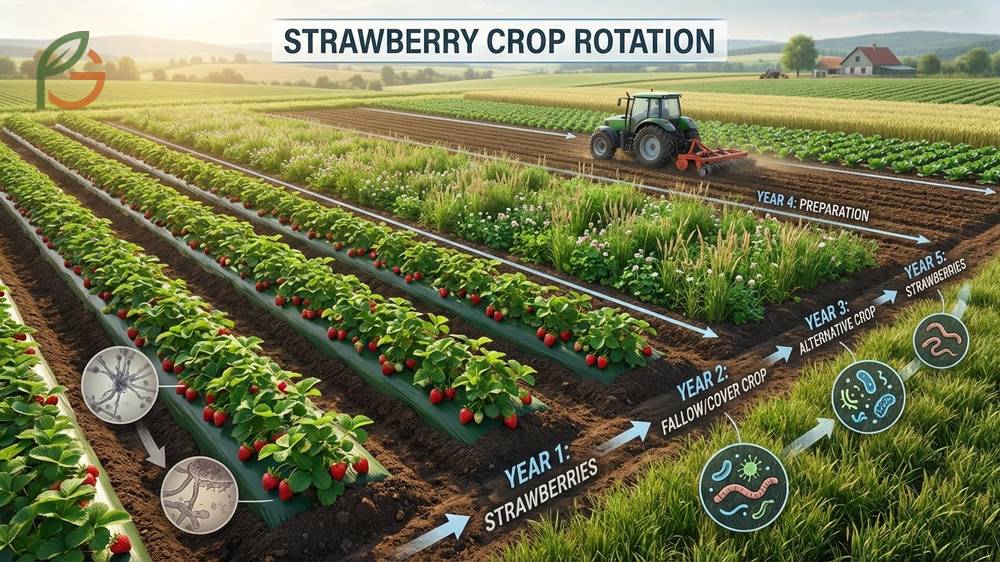
Current guidance emphasizes waiting a minimum of 3 years before replanting strawberries in the same location. This rotation period allows soil-borne pathogens like verticillium dahliae and root rot fungi to decline to manageable levels[11]. Some extension specialists recommend 5-year rotations for maximum disease prevention and soil health restoration.
The rotation design depends on available land, market demands, and overall farm operations. A typical small-scale rotation includes corn for two years prior to strawberries, followed by a small grain crop like oats or wheat in the year immediately before planting[12]. This sequence helps break pest and disease cycles while building soil organic matter.
Avoid rotating strawberries with solanaceous crops (tomatoes, peppers, potatoes), vining cucurbits, and other small fruits like raspberries and blueberries. These crops share common pests and diseases that persist in soil between plantings. Instead, choose non-host crops with different pest profiles and nutrient demands.
Cover crops play a crucial role in strawberry rotations. Leguminous cover crops like clovers and hairy vetch add organic matter, enhance nutrient reserves through nitrogen fixation, and promote beneficial soil biology. Summer cover crops like buckwheat provide quick weed suppression, while fall oats or winter rye protect soil from erosion and add organic matter when incorporated.
- Year 1: Set out strawberry plants, establish vigorous growth
- Year 2-3: Harvest fruit, renovate beds after harvest, monitor for diseases
- Year 4: Remove strawberries, plant corn or winter cover crop
- Year 5: Grow oats or wheat, incorporate residue, prepare for new strawberries
- Year 6: Plant fresh strawberries in renewed, pathogen-free soil
Research demonstrates that crop rotation provides only limited benefit for reducing verticillium dahliae populations due to the pathogen’s wide host range and long persistence[13]. However, rotation remains essential because it breaks cycles of nematodes, weeds, and other pests while allowing beneficial soil organisms to recover. The key is selecting non-host crops that don’t harbor strawberry pathogens.
Conclusion
The evidence is clear: strategic companion plants for strawberries deliver measurable benefits including 30% yield increases, natural pest control, and improved fruit flavor when you follow proper spacing and rotation principles. Borage, marigolds, and alliums provide the strongest benefits, while avoiding nightshades and brassicas prevents disease transmission that can devastate entire crops.
Current agricultural guidance emphasizes diversity in garden planning—combining multiple companion species creates resilient systems where beneficial insects thrive and pest populations stay balanced. FruitGarden recommends starting with 2-3 proven companions like garlic, borage, and French marigolds, then expanding based on your specific pest challenges and available space.
Frequently Asked Questions
What can I plant with strawberries to deter pests?
Plant garlic, onions, or chives 4-6 inches away from strawberries to repel slugs and aphids through their pungent sulfur compounds. French marigolds and borage also deter pests while attracting beneficial insects like ladybugs and parasitic wasps that prey on strawberry threats.
Can I plant tomatoes near strawberries?
No, you shouldn’t plant tomatoes near strawberries. Tomatoes harbor verticillium wilt, a soil-borne fungus that spreads to strawberries and causes wilting, stunted growth, and crop failure. Wait at least 3 years after removing tomatoes before planting strawberries in the same bed.
How far should I space companion plants from strawberries?
Space depends on plant type: alliums work best 4-6 inches away, herbs and flowers need 12-18 inches, and larger perennials like asparagus require 18-24 inches. This spacing prevents root competition while keeping pest-deterrent scents close enough to protect strawberries effectively.
What vegetables grow well with strawberries?
Asparagus, bush beans, and pole beans make excellent vegetable companions. Asparagus has deep roots that don’t compete with shallow strawberry roots, while beans fix nitrogen in the soil and can increase strawberry yields by up to 30% when planted nearby on trellises.
Why is borage good for strawberries?
Borage attracts abundant pollinators with its blue flowers, increases trace minerals in soil through deep taproots, and improves strawberry flavor according to most gardeners who try this pairing. It also deters pests and attracts beneficial insects like ladybugs that control aphids.
Should I avoid planting cabbage near strawberries?
Yes, avoid all brassicas including cabbage, broccoli, and kale near strawberries. These plants compete aggressively for nitrogen and other nutrients, attract pests like aphids and cabbage worms, and can stunt strawberry growth. Keep brassicas at least 24 inches away from strawberry beds.
How long should I wait before replanting strawberries in the same spot?
Wait at least 3 years, preferably 5 years, before replanting strawberries in the same location. This rotation period allows soil-borne pathogens like verticillium wilt and root rot fungi to decline to manageable levels while giving soil time to recover nutrients.





