
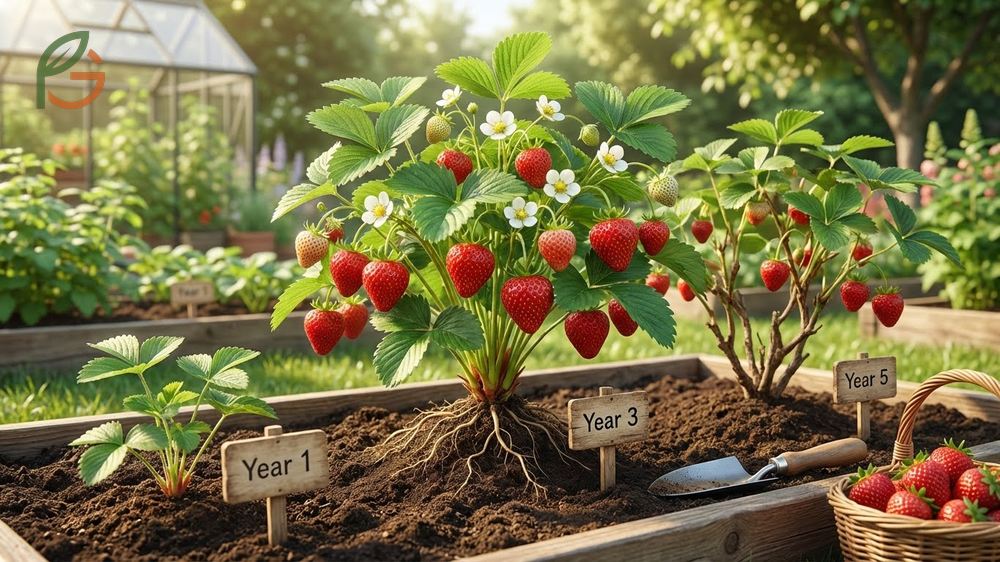
Are strawberry plants perennials? Yes, strawberry plants are perennials that live for more than two years and can produce fruit annually when properly cared for. Studies from multiple university extension programs show that well-maintained strawberry beds typically remain productive for 3-5 years[1]. FruitGarden synthesizes current horticultural research to help you maximize your strawberry harvest year after year.
Quick Answer
- Strawberry plants are true perennials that regrow from the same root system each spring
- A properly maintained bed produces fruit for 3-5 seasons[2]
- June-bearing varieties produce one large crop annually, while everbearing types yield 2-3 harvests per year
- Plants need renovation after each harvest and winter mulch protection in cold zones
Are Strawberry Plants Perennials
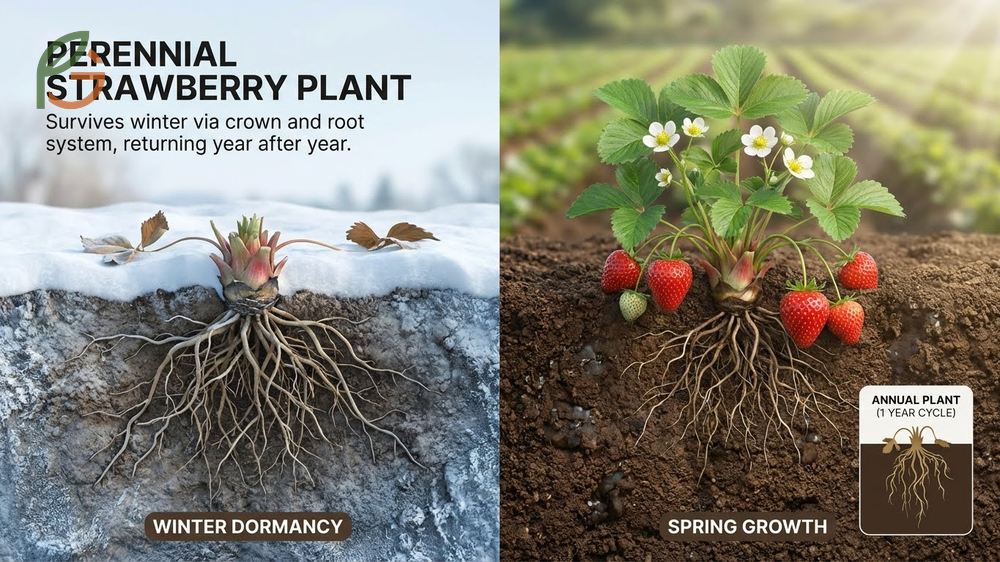
Research from USDA agricultural studies confirms that strawberries are perennial plants, meaning they live for more than two years and return each growing season. Unlike annuals that complete their life cycle in one year, perennial strawberries develop a crown and root system that survives winter dormancy.
The perennial nature of strawberries allows them to produce fruit year after year from the same planting. However, commercial growers sometimes treat them as annuals, destroying plants after one harvest season to maximize yield consistency[3]. Home gardeners typically maintain perennial beds for multiple seasons.
What distinguishes strawberries from true annuals is their ability to go dormant during winter and resume growth in spring. The crown—where leaves emerge from the root system—stays alive below the soil surface, sending up new foliage when temperatures warm.
From My Experience: My cousin in Guadalajara, Mexico planted Albion strawberries in March 2024. The plants survived a mild winter with minimal mulching and started flowering again in February 2025—about 11 months later—producing runners that filled the bed exactly as university extension guides predicted.
- Develop a permanent crown structure that survives winter
- Enter dormancy when temperatures drop below 50°F (10°C)
- Resume active growth in spring when soil warms
- Produce vegetative runners throughout the growing season
- Can be maintained productively for 3-5 years with proper care[1]
Do Strawberry Plants Come Back Each Year
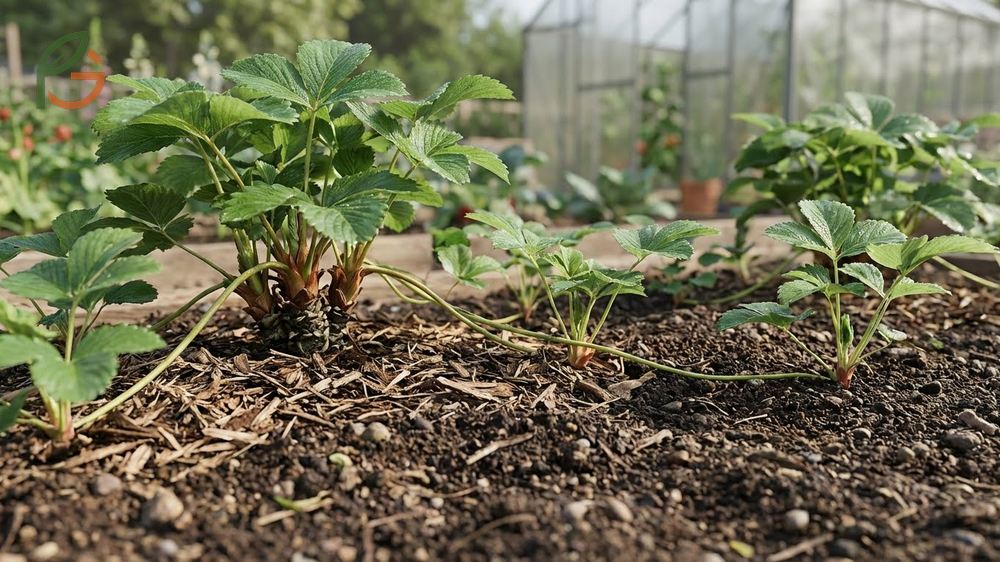
Strawberry plants do come back each year when they’re properly winterized and maintained. The original mother plant can survive multiple seasons, while new daughter plants develop from runners to expand and renew the bed.
Studies from university extension programs demonstrate that strawberries reliably return year after year in USDA hardiness zones 3-10 with appropriate care. The key to successful regrowth lies in protecting the crown during winter and providing adequate nutrients during the growing season.
How Strawberries Regrow
Strawberry plants regrow through their crown, which stays dormant underground during winter. When spring temperatures reach 50-60°F (10-15°C), the crown activates and sends up new leaves, flower buds, and eventually fruit.
During the previous growing season, plants store carbohydrates in their roots and crown. These energy reserves fuel early spring growth before photosynthesis kicks in fully. Most gardeners see new leaf emergence 2-3 weeks after consistent warm weather arrives.
Factors Affecting Return
Several factors determine whether your strawberries come back strong each year. Winter protection is critical—exposed crowns can die when temperatures drop into the low twenties[4].
Disease pressure and soil fertility also impact regrowth. Older beds accumulate pathogens and deplete nutrients, which is why productivity typically declines after 3-4 years even with proper care[5].
Important Note: If your strawberries don’t return in spring, the crown likely froze or rotted due to poor drainage. Check plants in early spring by gently scraping the crown—living tissue appears white or light green, while dead crowns turn brown or black.
How Long Do Strawberry Plants Live
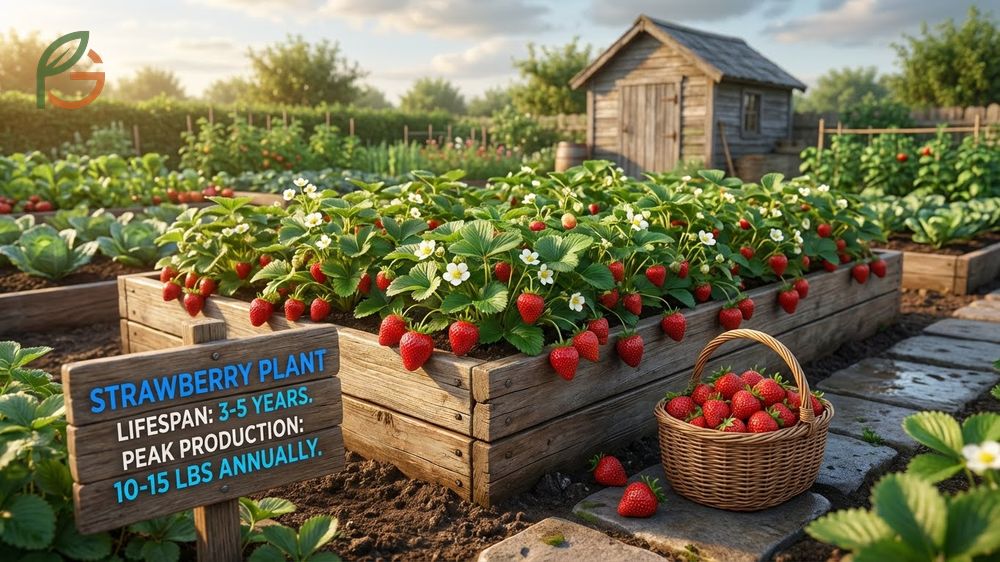
Individual strawberry plants typically live 3-5 years under optimal conditions. A properly maintained 4×8 foot bed produces 10-15 pounds of berries annually for three to five seasons before requiring replacement[1].
The lifespan varies based on variety, climate, disease pressure, and maintenance practices. June-bearing strawberries grown in matted rows often last longer than everbearing types because they channel energy into one concentrated fruiting period. Some growers report productive beds lasting up to 7 years with intensive renovation.
Most experts recommend replacing strawberry plantings every 3-4 years to maintain peak production and minimize disease buildup. Yields naturally decline as plants age and soil becomes depleted.
Strawberry Plant Life Cycle
The strawberry plant life cycle begins with either a seed or runner plant establishing roots. Runner plants have a distinct advantage—they start larger and develop faster than seed-grown plants. By late summer, both types reach maturity and prepare for their first fruiting season.
During the first growing season, plants focus on vegetative growth and runner production. Year one is typically a establishment year—you’ll remove flowers to strengthen the plant. Year two brings the first full harvest, with peak production occurring in years 2-3.
After fruiting each year, plants shift energy toward producing runners. Long days trigger gibberellin hormone production, causing stems to elongate into runners that develop daughter plants 8-18 inches away from the mother plant. This natural multiplication extends the bed’s lifespan.
Replacing Strawberry Plants
You’ll know it’s time to replace your strawberry plants when yields drop significantly from one year to the next. Other signs include excessive disease, weak plant vigor, or overcrowding that can’t be fixed with renovation.
Plan your replacement strategy before productivity crashes completely. Some gardeners stagger plantings, establishing a new bed every 2-3 years so they always have mature, productive plants. This ensures continuous harvests without gaps.
- Berry yields drop by 30% or more compared to previous season
- Fruit size decreases noticeably despite adequate fertilization
- Plants show persistent disease symptoms like leaf spot or crown rot
- Renovation efforts fail to improve plant vigor or density
- Beds become overrun with weeds despite regular maintenance
June Bearing vs Everbearing

The choice between June-bearing and everbearing strawberries significantly affects your harvest timing and maintenance requirements. June-bearing varieties produce one large crop lasting 2-4 weeks in late spring or early summer, channeling all their energy into a concentrated harvest period.
Everbearing (also called day-neutral) strawberries offer 2-3 smaller harvests per year—typically in June, late summer, and early fall. While their total yield is often less than June-bearers’ single flush, the extended harvest window appeals to home gardeners who want fresh berries throughout the season.
June-bearing strawberries tend to produce larger, more intensely flavored berries because they focus energy on one major fruiting. They also generate abundant runners, which requires more management but makes bed expansion easier. These varieties need a cold period for optimal fruit set, making them ideal for northern climates.
This table compares production timing, harvest frequency, berry characteristics, runner production, and best climate zones for June-bearing versus everbearing strawberry varieties
| Characteristic | June-Bearing | Everbearing |
|---|---|---|
| Harvest Period | One large crop, 2-4 weeks in late spring | 2-3 harvests from June through fall |
| Berry Size | Larger berries, intense flavor | Smaller to medium berries |
| Runner Production | Abundant runners, aggressive spread | Fewer runners, easier management |
| Cold Requirement | Needs winter chill for optimal fruiting | Less dependent on cold exposure |
| Best Climate | Zones 3-8, colder regions | Zones 4-9, milder climates |
| Space Needs | Matted row system, 3-4 ft row spacing | Works in containers, raised beds |
Everbearing varieties produce fewer runners, making them suitable for containers and small spaces. They don’t require the same extensive renovation as June-bearers and can handle closer spacing. However, they need more frequent fertilization—every 3-4 weeks during the growing season—to support continuous fruiting.
Variety Selection Tip: Choose June-bearing if you want berries for freezing or preserving—the large single harvest makes processing efficient. Pick everbearing varieties if you prefer fresh eating throughout summer and have limited space.
Overwintering Strawberry Plants
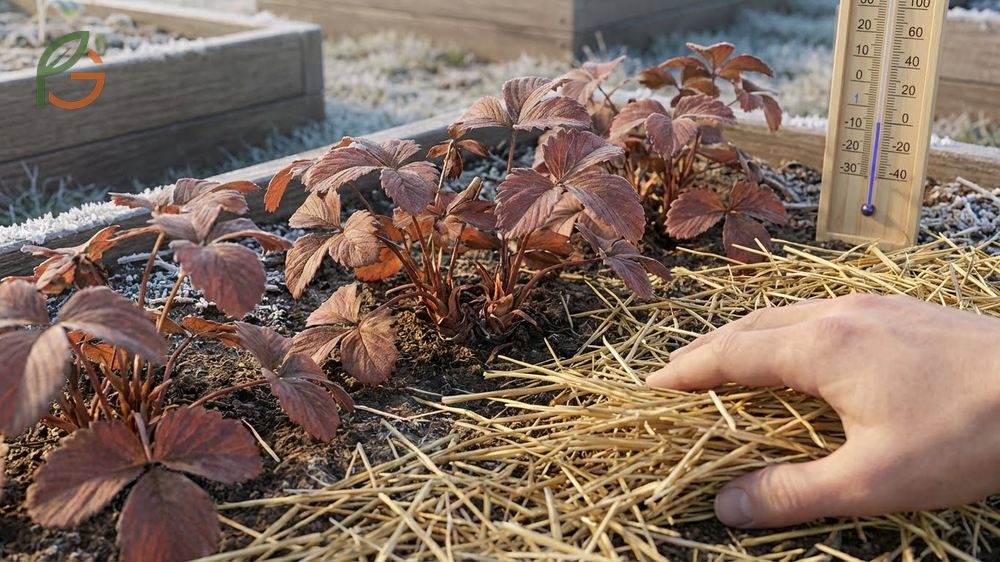
Successfully overwintering strawberry plants ensures they return vigorously each spring. Strawberries are relatively cold-hardy but need protection when temperatures drop into the low twenties. The crown—where leaves meet roots—is the most vulnerable part and must stay insulated through winter.
The key to overwintering is timing your mulch application correctly. Plants must enter full dormancy before you cover them, which happens after 2-3 days of consistent freezing temperatures[4]. Mulching too early keeps plants active and vulnerable to frost damage.
Mulching Techniques
Apply 2-3 inches of straw or pine needle mulch once plants are fully dormant, typically in December for most regions. The mulch insulates crowns and prevents freeze-thaw cycles that can heave plants out of the ground. In colder zones (3-4), increase mulch depth to 4-5 inches.
Remove mulch gradually in spring when new growth begins—don’t wait until all danger of frost passes. Pull mulch away from crowns but leave it between rows to suppress weeds and retain moisture. Strawberries can handle light frosts once they’re actively growing.
- Wait for consistent freezing temperatures and plant dormancy before mulching
- Use clean straw, pine needles, or shredded leaves free from weed seeds
- Apply evenly to 2-3 inch depth, covering entire planting area
- Check periodically during winter—add more mulch if it compacts or blows away
- Remove gradually in spring when you see green growth pushing through
- Keep removed mulch nearby to cover plants if hard freeze threatens
Cold Hardiness Zones
Strawberries grow successfully in USDA zones 3-10, but winter care varies dramatically by region. In zones 7-10, plants may not go fully dormant and might produce fruit sporadically through winter. These warm-climate gardeners focus more on summer heat protection than winter mulching.
Zones 3-5 require heavy mulching and possibly row covers for extreme cold snaps. Container-grown strawberries in these cold zones should move to an unheated garage or shed, as exposed pots freeze solid and kill roots. Water containers occasionally through winter to prevent complete drying.
Renovating Strawberry Bed
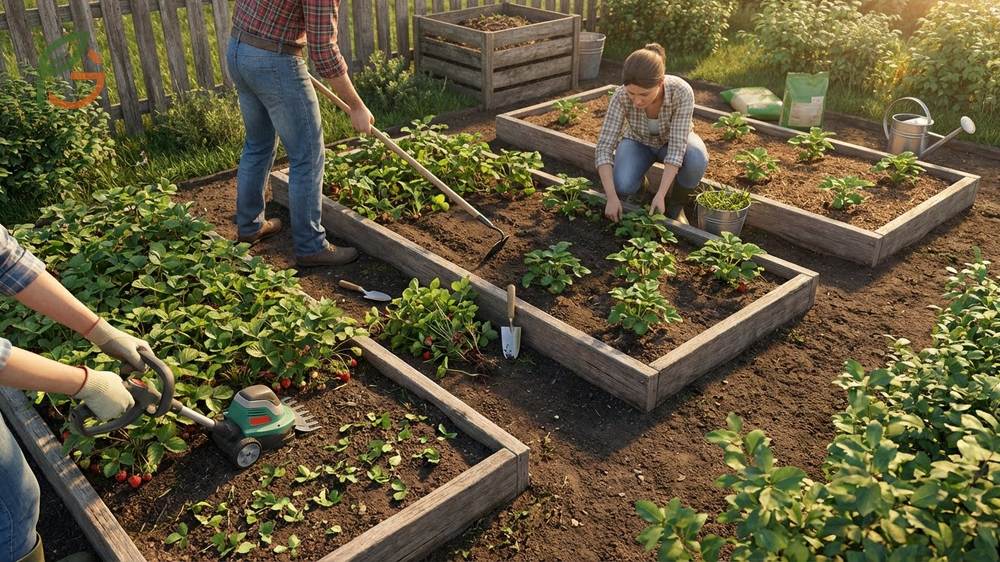
Renovating your strawberry bed after each harvest is essential for maintaining productivity beyond the first year. Michigan State University Extension identifies four main renovation steps: mowing, narrowing, weeding, and maintenance[6]. Start renovation as soon as harvest ends to give plants maximum recovery time.
The renovation process thins overcrowded beds, removes old diseased foliage, and stimulates new growth. Without annual renovation, June-bearing strawberries become dense mats of weak plants that produce small berries and harbor diseases. Early renovation allows runner plants to develop fully before winter, ensuring better yields next season.
Begin by mowing or cutting back foliage to 1-2 inches above the crown—don’t cut into the crown itself. This removes old leaves that may carry disease spores. Next, narrow matted rows to 12-18 inches wide by tilling or cultivating the outer edges, leaving a strip of the healthiest plants down the center.
Apply fertilizer after renovation to fuel new growth, then water thoroughly. Remove weeds aggressively during the 4-6 weeks following renovation, as this is when strawberries are most vulnerable to weed competition. Some growers apply herbicides at this stage, following label directions carefully.
Strawberry Runners Management
Managing runners is crucial for maintaining optimal plant density and berry size. June-bearing strawberries can send out runners equivalent to “50-yard dash” speed, quickly filling spaces with daughter plants. While this natural multiplication is beneficial, unchecked runner production leads to overcrowding that reduces yields.
For matted row systems, allow runners to fill in during the first year until plants are spaced 4-6 inches apart. Once this density is reached, remove or redirect additional runners. The goal is maintaining 4-5 productive plants per square foot—more than this and berry size drops significantly.
- Allow runners to establish until beds reach optimal 4-6 inch plant spacing
- Remove excess runners during summer to direct energy toward fruit production
- Save vigorous runner plants to start new beds or replace old sections
- Cut runners completely from everbearing varieties to maximize berry size
- Pin down runners in bare spots to fill gaps in matted rows naturally
Everbearing strawberries produce fewer runners and often benefit from complete runner removal. This channels energy into continuous fruit production rather than plant multiplication. If you’re growing everbearers in containers or raised beds, snip off runners as they appear to maintain neat, compact plants.
Renovation Timing: Don’t delay renovation—early runner plants that develop in July yield significantly more than those established in August or September. Each week you wait after harvest reduces next year’s crop potential.
Conclusion
The evidence is clear: strawberry plants are perennials that return reliably for 3-5 years with proper care, including renovation, winter protection, and runner management. Your success depends on choosing the right variety for your climate and committing to annual maintenance that keeps beds productive.
Current horticultural guidance emphasizes early renovation and strategic runner management as keys to extending bed lifespan. FruitGarden provides research-based growing strategies to help you maintain thriving strawberry plantings that deliver abundant harvests season after season.
Frequently Asked Questions
What’s the difference between perennial and annual strawberries?
Perennial strawberries develop a crown that survives winter and returns each spring for multiple years, while annuals complete their life cycle in one season. Most strawberry varieties are naturally perennial, but commercial growers sometimes treat them as annuals by replanting after each harvest.
Can strawberry plants survive winter without mulch?
Strawberry plants can survive mild winters (zones 7-10) without mulch, but zones 3-6 require 2-3 inches of straw or pine needle protection. Without mulch in cold regions, crowns freeze when temperatures drop into the low twenties, killing the plants. Container strawberries need extra protection even in mild zones.
How many years will a strawberry plant produce fruit?
A well-maintained strawberry plant produces fruit for 3-5 years, with peak yields in years 2-3. Some plantings last up to 7 years with intensive care, but most experts recommend replacement every 3-4 years to prevent disease buildup and maintain berry size and quality.
Should I remove runners from my strawberry plants?
Remove runners once your matted row reaches 4-6 inch plant spacing to prevent overcrowding. For everbearing varieties, remove all runners to maximize continuous fruit production. Save vigorous runners to propagate new plants or fill bare spots, but don’t let beds become too dense or berry quality suffers.
When should I renovate my strawberry bed?
Renovate June-bearing strawberries immediately after harvest ends, typically late June or early July. This timing gives runner plants maximum time to establish before winter. Delaying renovation by even 2-3 weeks reduces next year’s yields because later-formed runners produce fewer berries.
Do everbearing strawberries need different care than June-bearing?
Everbearing strawberries need more frequent fertilization (every 3-4 weeks) to support continuous fruiting, while June-bearers need 2-3 applications per season. Everbearers produce fewer runners and work well in containers, whereas June-bearers spread aggressively and require annual renovation to control density.
What causes strawberry plants to die over winter?
Crown freeze damage from temperatures in the low twenties kills strawberries that lack mulch protection. Poor drainage causes crown rot when waterlogged soil freezes and thaws repeatedly. Premature mulching before plants enter dormancy can also weaken them, making crowns vulnerable to cold injury.





