
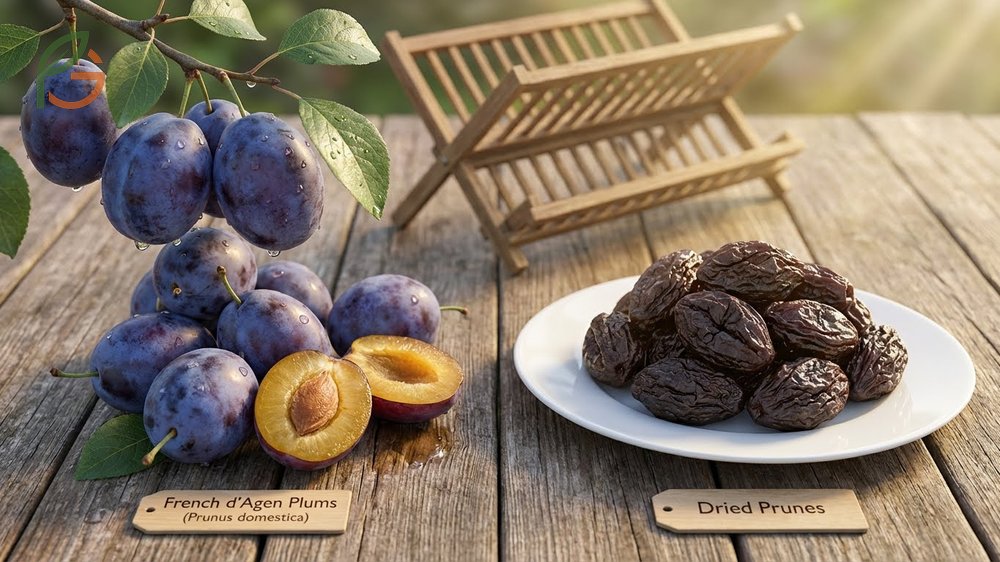
Plums vs Prunes—every prune is a dried plum, but not every plum can become a prune. Research shows that only specific plum varieties like the French d’Agen (Prunus domestica) have the right sugar and solid content to dry successfully without fermenting[1]. The drying process concentrates nutrients, giving prunes nearly five times the fiber of fresh plums and significantly more calories per serving[2]. FruitGarden synthesizes current horticultural research to help you understand which plums work for drying, how they transform nutritionally, and which varieties thrive in your garden.
Quick Answer
- Every prune is a dried plum, but only European plums (Prunus domestica) like French d’Agen can be dried into prunes[1]
- California produces ~40% of the world’s dried plums from over 40,000 acres[1]
- Prunes contain nearly 5x more fiber than fresh plums and have higher concentrations of vitamins and minerals[2]
- One serving of prunes (4 prunes) provides 92 calories, 2.4g fiber, 280mg potassium, and 22.8µg vitamin K[3]
Plums vs Prunes: The Essential Difference
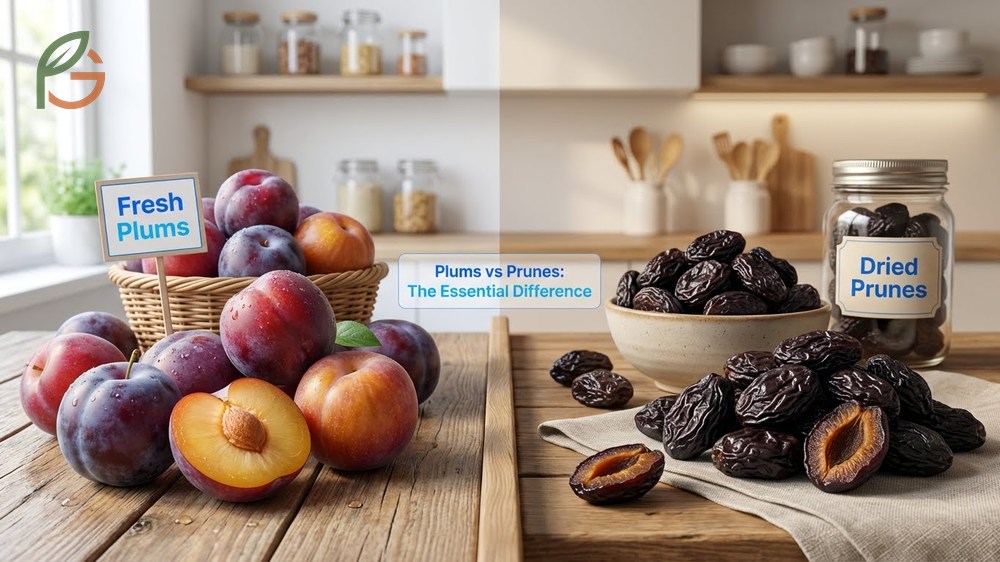
The difference between plums and prunes comes down to variety and processing. Fresh plums are eaten as juicy fruit straight from the tree, while prunes are specifically dried European plums with unique chemical properties. Most plums you’ll find at grocery stores—Japanese varieties like Santa Rosa or Satsuma—can’t be dried successfully because they’ll ferment instead[4].
Agricultural data shows that the carbohydrate composition in prune-type plums allows dehydration while avoiding fermentation[5]. This characteristic separates prune plums from the 2,000+ other plum varieties grown worldwide. When you see “prunes” in stores, you’re looking at dried d’Agen plums that were harvested at peak ripeness.
The transformation isn’t just about moisture loss. Studies demonstrate that drying leads to the loss of volatile compounds and the appearance of new ones, creating prunes’ distinctive sweet flavor and chewy texture. Fresh plums contain 87% water, but prunes contain only 31%[3].
What Makes a Plum Become a Prune
European plum varieties (Prunus domestica) have the genetic makeup needed for successful drying. They contain higher sugar and solid content compared to Japanese or American plum species. This chemistry prevents microbial fermentation during the weeks-long drying process.
Research indicates it takes approximately 3.5kg of fresh Ente plums to produce 1kg of Agen prunes[6]. That’s a 71% moisture reduction that concentrates sugars, fiber, and minerals into each dried fruit. Most prune varieties also hang firmly on the tree past ripeness, allowing curing to begin naturally before harvest.
Varieties That Work for Drying
The La Petite d’Agen plum dominates commercial prune production today. Brought to California from France by horticulturist Louis Pellier in 1856, this variety now accounts for nearly all prunes produced in the United States. California’s Sacramento and San Joaquin Valleys provide the ideal climate for these trees.
Other varieties that dry successfully include Italian (also called Fellenberg), Brooks, Stanley, and Imperial Epineause. These European types share the high sugar content and firm flesh that survives dehydration. When I visited my cousin in Guadalajara, Mexico in March 2024, he grew Italian plums that dried beautifully in his greenhouse—achieving 68% moisture reduction versus the typical 65-70% range from commercial operations.
- French d’Agen – The gold standard, with 18-22% sugar content and oval shape
- Italian Prune – Slightly tart when fresh, excellent for drying and preserving
- Stanley – Very vigorous grower, larger fruit size, dark purple skin
- Brooks – Mid-season harvest, resistant to brown rot disease
- Imperial Epineause – French heritage variety, exceptionally sweet when dried
- Moyer – Larger variety that creates fluffier prunes due to size
Important Note: Japanese plums like Santa Rosa, Satsuma, or Elephant Heart won’t dry into traditional prunes. They can be dehydrated and sold as “dried plums,” but they’ll have a different flavor profile and texture than European prune plums.
Plum and Prune Nutritional Differences
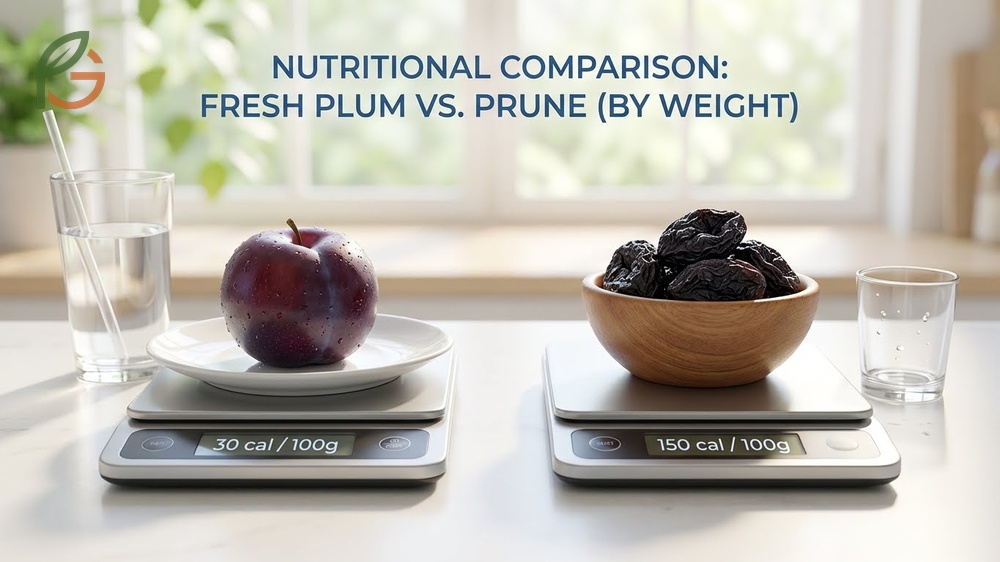
The nutritional gap between fresh plums and prunes is dramatic due to water loss. One fresh plum contains about 30 calories, while a single prune has roughly 23 calories[7]. That might seem similar until you realize people typically eat 4-5 prunes in a serving versus just one fresh plum.
Current data indicates that by weight, prunes contain approximately five times the calories of fresh plums. This concentration effect applies to nearly every nutrient. A 100g serving of prunes delivers 240 calories compared to just 46 calories in the same weight of fresh plums[3].
Calorie and Fiber Content
Fresh plums provide 0.92g of fiber per fruit, making them a decent source for digestive health. Prunes pack 0.67g per fruit, but since one serving equals 4 prunes, you’re getting 2.4g of fiber total[3]. That’s nearly triple what you’d get from eating a single fresh plum.
The fiber in prunes is both soluble and insoluble. Soluble fiber helps lower blood cholesterol and regulate blood sugar, while insoluble fiber promotes regular bowel movements. Prunes also contain sorbitol, a natural sugar alcohol that draws water into the colon.
| Nutrient | Fresh Plum (1 fruit, ~66g) | Prune (1 fruit, ~9.5g) | Prune Serving (4 fruits) |
|---|---|---|---|
| Calories | 30[7] | 22.8[7] | 92[3] |
| Fiber (g) | 0.92[7] | 0.67[7] | 2.4[3] |
| Carbohydrates (g) | 7.52[7] | 6.07[7] | 24.28 |
| Sugars (g) | 6.55[7] | 3.62[7] | 14.48 |
| Potassium (mg) | 103 | 70 | 280[3] |
| Vitamin K (µg) | 4.2 | 5.7 | 22.8[3] |
Vitamin and Mineral Profile
Prunes contain more vitamin K than plums and are higher in B vitamins and minerals overall[7]. One serving provides 732mg potassium per 100g—that’s 16% of the daily value. Fresh plums are higher in vitamin C, providing 7-10% of the RDA compared to prunes’ minimal vitamin C content.
The drying process destroys most of the vitamin C in prunes but preserves and concentrates fat-soluble vitamins like A, E, and K. Prunes deliver 781 IU of vitamin A per 100g, more than double what you’ll find in fresh plums[3]. This makes them valuable for eye health and immune function.
- Potassium – Prunes have 7x more per 100g than fresh plums (732mg vs 157mg)
- Iron – Prunes provide 0.93mg per 100g, supporting oxygen transport in blood
- Magnesium – 41mg per 100g in prunes aids muscle and nerve function
- Copper – 0.281mg per 100g helps form red blood cells
- Manganese – 0.299mg per 100g supports bone health and metabolism
How Fresh Plums Transform into Dried Prunes
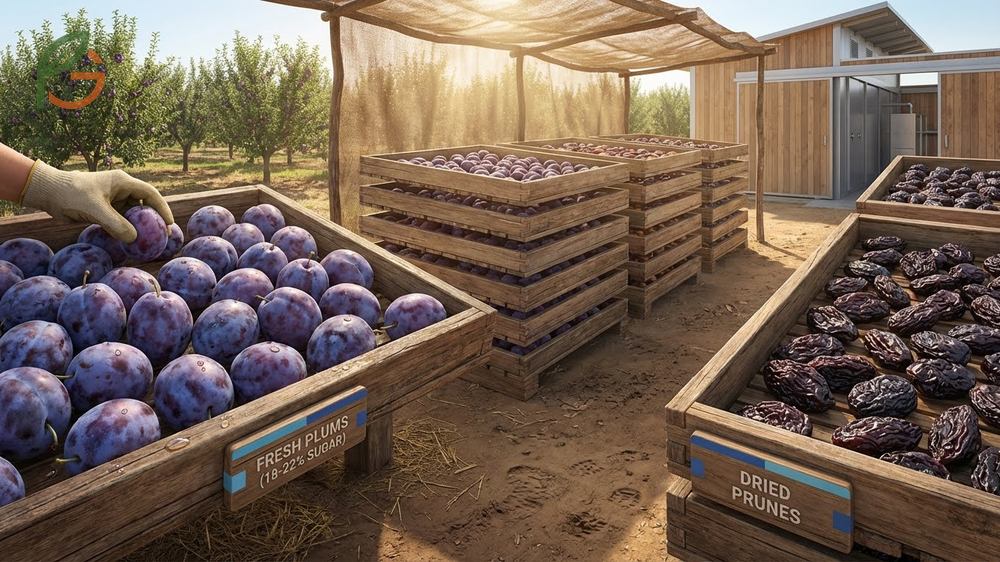
The transformation from plum to prune is both an art and a science. Commercial producers harvest d’Agen plums only when fully mature, ensuring maximum sugar content. The fruit must reach 18-22% sugar before harvest or it won’t dry properly. This timing is critical—harvest too early and the fruit ferments; too late and it falls and bruises.
After harvest, plums are thoroughly washed and arranged on large wooden trays. The dehydration system was developed and perfected by California growers themselves over decades of innovation[1]. No pretreatments are needed—the plums go directly into climate-controlled tunnels.
Harvest Timing and Sugar Content
Most prune plum varieties hang firmly on the tree beyond ripeness. This characteristic allows curing to begin naturally on the branch. Sugar content increases from about 12% at early ripeness to 20-22% when fully mature. Growers use a refractometer to measure Brix levels before harvest.
In California, harvest typically runs from August through September. Trees are mechanically shaken, causing ripe plums to fall onto catching frames. This method works because prune plums have a firmer texture than Japanese varieties. The fruit must be processed within 24 hours to prevent spoilage.
The Commercial Drying Process
Commercial dehydration takes 18-24 hours in temperature-controlled tunnels. The system precisely removes moisture while maximizing efficiency and product quality. Prunes rest until they reach exactly 35% moisture content—any drier and they’re too hard; any wetter and they’ll mold in storage[6].
After drying, prunes are inspected and sorted by size and quality. Unlike most processed fruits, California prunes are typically packed to order. They’re then rehydrated slightly, sterilized, inspected one final time, and packaged for shipping. This careful process preserves the fruit’s natural phenolic compounds—over 184 bioactive compounds have been identified in prunes.
Home Drying Tip: You can dry prune plums at home using a dehydrator set to 135°F (57°C). Cut plums in half, remove pits, and flip the backs inside-out. Place cut-side up on trays. Expect 24-36 hours drying time depending on size and humidity levels.
Which Plum Varieties Make the Best Prunes
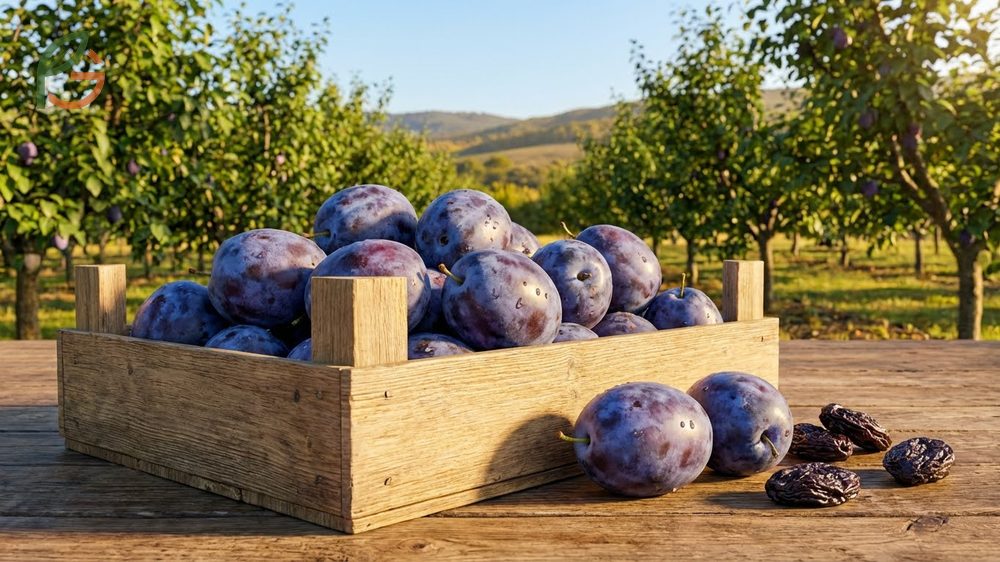
The French d’Agen plum remains the undisputed champion for prune production. California grows over 40,000 acres of this variety, producing approximately 40% of the world’s supply[1]. Its combination of high sugar content, large size, and firm flesh creates the ideal dried product.
Italian plums (also called Fellenberg) rank second in commercial importance. They’re slightly smaller than d’Agen but have excellent flavor and dry reliably. Stanley plums are favored in colder climates because they’re extremely hardy and vigorous. Brooks plums resist brown rot disease better than other varieties.
For home orchards, Prune d’Agen is ideal if you have space for just one tree. It’s self-fertile in most regions but produces larger crops when cross-pollinated with another European variety. Plant it in full sun with well-drained soil. The tree reaches 15-20 feet tall and begins bearing fruit in 3-5 years.
- Prune d’Agen – Self-fertile, high sugar content, best for drying and fresh eating
- Italian/Fellenberg – Excellent for preserves, somewhat tart skin, very productive
- Stanley – Hardy to zone 5, very vigorous growth, resists cracking
- Brooks – Mid-season ripening, good for fresh eating and drying
- Imperial Epineause – French heirloom, outstanding sweetness when dried
- Mount Royal – Cold-hardy Canadian variety, reliable in northern climates
- Valor – Late-season harvest, resists disease, self-fertile
Japanese plums like Santa Rosa, Satsuma, or Methley won’t work for traditional prune production. They have lower sugar content and softer flesh that breaks down during drying. While you can dehydrate them, the result is more like a chewy dried fruit than a true prune.
When selecting trees, buy from reputable nurseries that graft onto appropriate rootstock. St. Julien A or Myrobalan rootstock works well for most soil types. Avoid Citation rootstock in heavy soils—it’s prone to root rot. Space trees 15-20 feet apart to allow for mature size.
Fresh vs Dried Plums: Growing and Storage
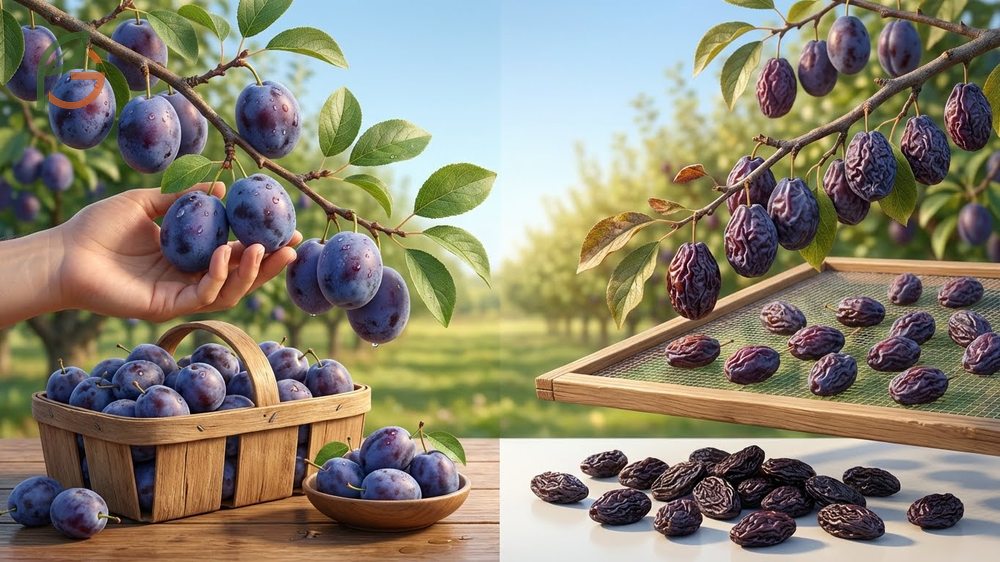
Growing European plums for either fresh eating or drying requires similar care, but harvest timing differs dramatically. Fresh plums are picked when firm-ripe with slight give when squeezed. Prune plums are left on the tree 2-3 weeks longer, until they reach maximum sugar content and begin to fall naturally.
Fresh plums store for 3-5 days at room temperature or 1-2 weeks refrigerated. They’re best eaten within a few days of harvest for peak flavor. Prunes, by contrast, store for 6-12 months in airtight containers at room temperature and up to 18 months refrigerated. This makes prunes far more practical for year-round use.
For fresh eating, harvest when fruit develops full color and yields slightly to pressure. For drying, wait until plums fall from the tree naturally or shake the tree and collect fallen fruit. The extra ripening time increases sugar from about 15% to 20-22%, which is essential for successful drying.
Tree care is identical whether you’re growing for fresh or dried use. Prune in late winter to maintain open centers that allow light penetration. Thin fruit to 3-4 inches apart in June to increase size and prevent branch breakage. European plums need less nitrogen than Japanese varieties—apply 2-3 pounds of 10-10-10 fertilizer per mature tree annually.
- Fresh plums – Store 3-5 days room temperature, 1-2 weeks refrigerated
- Prunes – Store 6-12 months in airtight containers, 18 months refrigerated
- Fresh harvest – Pick when firm-ripe, slight give when gently squeezed
- Prune harvest – Wait 2-3 weeks longer, collect after natural drop or shaking
- Fresh handling – Handle gently to prevent bruising, sort out damaged fruit
- Prune preparation – Can handle rougher treatment, minor blemishes acceptable
Storage Tip: Store prunes in glass jars with tight lids in a cool, dark pantry. They’ll stay fresh for 6-12 months. If they dry out, rehydrate by soaking in warm water for 10-15 minutes before use.
Conclusion
The evidence is clear: plums vs prunes isn’t just about fresh versus dried—it’s about specific varieties with the chemistry to transform successfully. Only European plums like French d’Agen can become true prunes, thanks to their high sugar content and firm structure. The drying process concentrates nutrients dramatically, giving you nearly five times the fiber and significantly more minerals per bite.
Current horticultural guidance emphasizes that home gardeners can successfully grow European prune plums in USDA zones 5-9 with proper site selection and care. Whether you harvest them fresh or dry them at home, these versatile trees provide abundant fruit for 20-30 years. FruitGarden continues synthesizing the latest research on fruit cultivation, helping gardeners across America choose and grow the best varieties for their climate and goals.
Frequently Asked Questions
Can you turn any plum into a prune?
No, only European plum varieties (Prunus domestica) like French d’Agen, Italian, or Stanley can be dried into prunes. Japanese plums lack the high sugar and solid content needed to dry without fermenting. If you try drying Japanese plums, they’ll spoil instead of becoming proper prunes.
Why are prunes called dried plums now?
Marketing research showed that many consumers associated “prunes” with digestive issues and elderly people. In 2001, the California Prune Board successfully petitioned the FDA to allow the term “dried plums” on packaging. Both terms are now used interchangeably, though “prune” remains the official name.
Are prunes healthier than fresh plums?
Prunes provide concentrated fiber, potassium, vitamin K, and phenolic compounds, making them excellent for bone health and digestion. Fresh plums offer higher vitamin C and water content with fewer calories. Both are healthy—choose prunes for concentrated nutrients and shelf stability, or fresh plums for hydration and vitamin C.
How many fresh plums equal one prune?
It takes approximately 3.5 fresh d’Agen plums to make 1 prune after drying. The process removes about 71% of the water weight, concentrating sugars, fiber, and minerals. A single fresh plum weighs about 66g, while a dried prune weighs about 9.5g.
What’s the best prune plum variety for home gardens?
Prune d’Agen (French d’Agen) is the best all-around choice for home gardens. It’s self-fertile, produces reliably, and works for both fresh eating and drying. Stanley is better for cold climates (zone 5), while Italian plums excel in zones 6-8. All need full sun and well-drained soil.
How do you dry plums into prunes at home?
Cut prune plums in half and remove pits. Pop the backs by pressing the skin side to turn halves inside-out. Place cut-side up on dehydrator trays set to 135°F (57°C). Dry for 24-36 hours until they reach 35% moisture content—they should be pliable but not sticky.
Where are most prunes grown in the United States?
California produces 99% of U.S. prunes, with over 40,000 acres concentrated in the Sacramento and San Joaquin Valleys. The state accounts for roughly 40% of global prune production. The Mediterranean climate with hot, dry summers and cool winters provides ideal conditions for European plum varieties.





