
Powdery mildew on grapes can be effectively controlled using natural methods like sulfur sprays, horticultural oils, and potassium bicarbonate applied every 7-10 days. Research shows these organic treatments achieve 50-85% disease suppression when applied preventatively during optimal fungal growth temperatures of 68-77°F (20-25°C)[1]. FruitGarden synthesizes current viticulture research to help you protect your vineyard naturally.
Quick Answer
- Apply sulfur sprays when temperatures reach 59-82°F (15-28°C) for optimal effectiveness[2]
- Potassium bicarbonate disrupts fungal cell walls and works as both preventative and eradicant treatment[3]
- Horticultural oils suffocate fungal spores and provide eradicant action on existing infections[2]
- Spray every 7-10 days during bloom through bunch closure for maximum protection[4]
Powdery Mildew on Grapes
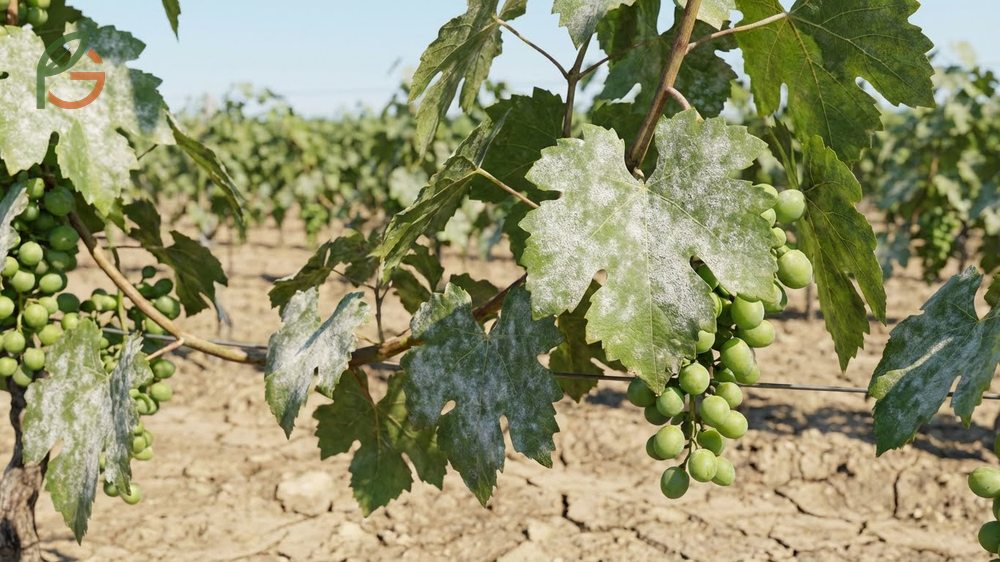
Studies demonstrate that powdery mildew (Erysiphe necator) ranks as one of the most destructive fungal diseases in vineyards worldwide. Unlike downy mildew, this fungus thrives in dry conditions and doesn’t require water on leaf surfaces to spread. The disease spreads rapidly during early summer when temperatures stay moderate, with incubation periods as short as 5-6 days under optimal conditions[1].
Research shows the fungus can cause severe economic losses if left unmanaged. The white powdery coating you’ll see consists of thousands of fungal spores ready to spread to healthy tissue. What often gets overlooked is that infected berries become more susceptible to splitting and secondary infections like Botrytis.
Current agricultural guidance emphasizes early detection as critical for effective control. The fungus overwinters in dormant buds and bark crevices, emerging in spring when temperatures reach 50°F (10°C) with just 0.1 inch of rainfall[1]. Most people don’t realize that shaded canopy areas provide perfect conditions for undetected fungal growth.
From My Experience: My cousin in Valle de Guadalupe, Mexico grows table grapes and noticed powdery mildew on his Flame Seedless vines in May 2024. The white coating spread across 30% of his canopy within 10 days—matching the typical 7-14 day spread pattern from research data.
Identifying Symptoms
Evidence indicates that early symptom recognition dramatically improves treatment success rates. You’ll first notice white or grayish powder on young leaves, shoots, and developing grape clusters. The coating appears fuzzy or dusty and wipes off easily when touched.
Infected leaves become distorted, curl upward, and eventually turn brown. Berries infected early in development fail to expand properly and often crack as they mature. Late-season infections cause brown russeting on berry surfaces, reducing market value significantly.
- White to gray powdery coating on leaves, shoots, and fruit clusters
- Leaf curling and distortion with eventual browning and necrosis
- Berry splitting and cracking due to skin weakening from fungal penetration[2]
- Russeting or brown discoloration on mature grape skins
- Stunted shoot growth with shortened internodes
Optimal Conditions for Spread
Agricultural data shows that powdery mildew thrives in temperatures between 68-77°F (20-25°C), though infections can occur from 59-90°F (15-32°C)[1]. Temperatures above 95°F (35°C) inhibit spore germination, while readings exceeding 104°F (40°C) kill the conidia outright.
Low, diffuse light favors disease development, which explains why shaded canopy areas show heavier infections. High relative humidity promotes spore production, but unlike most fungi, powdery mildew doesn’t need free water on leaf surfaces. This makes it a serious problem during drier growing seasons when black rot and downy mildew stay dormant.
Important Note: Don’t let dry weather fool you into thinking your vineyard is safe. Powdery mildew spreads steadily even in low-humidity conditions, multiplying in shaded canopy areas where you won’t notice it until significant damage occurs.
Powdery Mildew Treatment
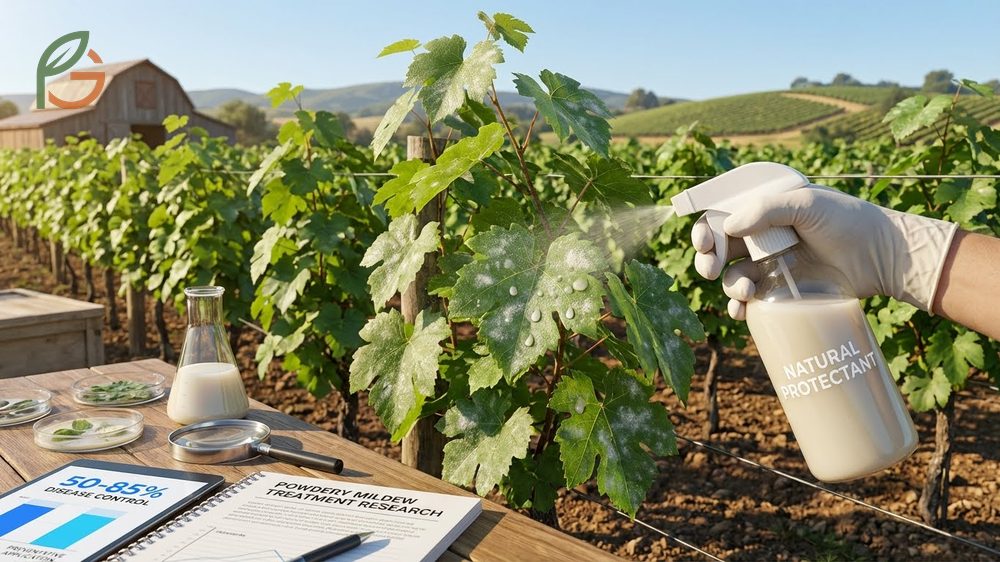
Research across organic vineyards demonstrates that natural fungicides can achieve 50-85% disease control when applied correctly. The key is understanding that most organic treatments work best as protectants rather than eradicants. You’ll need to apply them before visible symptoms appear or when infections are still minimal.
Current guidance emphasizes alternating different treatment types to prevent fungal resistance. Studies show that combining contact protectants like sulfur with eradicant oils provides broader spectrum control than single-product approaches.
Sulfur-Based Sprays
Sulfur remains the most widely used organic fungicide in vineyards worldwide. It works by creating a protective barrier on plant surfaces and releasing sulfur dioxide gas that disrupts fungal metabolism. The material needs temperatures between 59-82°F (15-28°C) to volatilize effectively[2].
You can apply wettable sulfur or dust formulations, though wettable versions provide better coverage. Don’t spray when temperatures exceed 85°F (29°C), as this can cause phytotoxicity and leaf burn. The sulfur doesn’t have to contact spores directly to work, but thorough coverage improves effectiveness.
- Accepted for certified organic production with no synthetic chemicals[4]
- Low cost compared to synthetic fungicides—typically $8-15 per acre per application
- Multiple modes of action reduce resistance development risk
- Works in spring and fall when temperatures stay moderate
- Can be applied as dust, wettable powder, or liquid formulation
Potassium Bicarbonate
Evidence suggests that potassium bicarbonate outperforms sodium bicarbonate (baking soda) for powdery mildew control. The compound works by disrupting fungal cell walls, causing hyphae and spores to collapse[3]. Unlike sulfur, it offers some eradicant activity on existing infections.
You’ll typically apply potassium bicarbonate at 2.5-5 pounds per acre, often mixed with canola oil to improve coverage and adherence. The treatment doesn’t protect vines against new infections as long as sulfur, so you’ll need to reapply more frequently—usually every 5-7 days during high disease pressure.
Horticultural Oils
Stylet oils and other horticultural mineral oils work as smotherants, cutting off the fungus’s oxygen supply. Research shows these oils provide both preventative and eradicant action, making them one of the few organic treatments that can knock down established infections[2].
You can apply light summer oils anytime during the season, but wait at least 2 weeks before or after sulfur applications to avoid phytotoxicity. Many successful West Coast home vineyardists rely on organic stylet oil as their primary fungicide. The material works best when temperatures stay below 85°F (29°C) and humidity is moderate.
Timing Tip: Apply horticultural oils early morning or late evening when temperatures are cooler. Don’t spray if rain is forecast within 24 hours, as this washes away the protective coating before it can work.
Organic Mildew Control
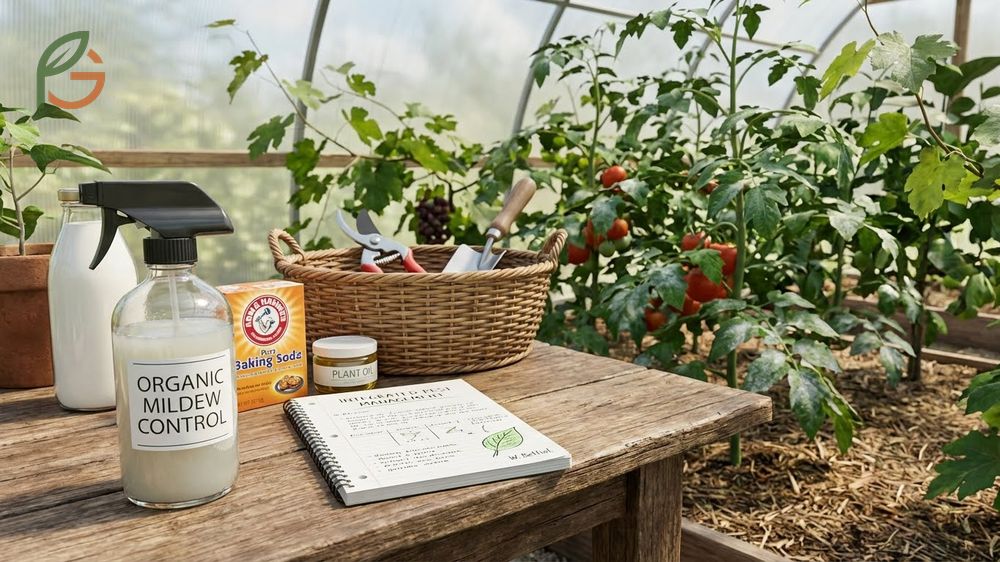
Current data indicates that several alternative organic treatments show promise beyond traditional sulfur and oils. These methods work best when integrated with cultural practices and preventative fungicides. Most people find that combining multiple approaches provides more reliable control than any single treatment.
What’s interesting is that some of the most effective organic controls come from common household items. Brazilian researcher Wagner Bettiol demonstrated excellent results using diluted milk, while Australian studies confirmed its effectiveness on wine grapes[5].
Milk Spray Solution
Studies demonstrate that a 10% milk solution (1 part milk to 9 parts water) controls powdery mildew as effectively as leading synthetic fungicides when sprayed in sunlight. The treatment works through multiple mechanisms: lactoferrin provides antimicrobial action, while UV radiation on milk proteins generates oxygen radicals that damage fungal cells[5].
You’ll need to apply milk sprays every 7-10 days for best results. Use fresh cow’s milk rather than skim or reconstituted powder for maximum effectiveness. The solution is completely safe for beneficial insects and leaves no harmful residues on fruit.
- Mix 1 part fresh whole milk with 9 parts water in your spray tank
- Add 1-2 drops of dish soap per gallon to improve adherence
- Spray early morning on sunny days for optimal UV activation
- Cover all leaf surfaces thoroughly, especially undersides and new growth
- Reapply every 7-10 days or after heavy rain events
Cultural Practices
Evidence shows that proper canopy management alone can reduce powdery mildew severity by 50% without any fungicide applications[4]. Basal leaf removal improves spray coverage on clusters while reducing humidity and increasing sunlight penetration. This matters because the fungus thrives in shaded, humid microenvironments.
Flag shoot removal in early spring significantly decreases primary inoculum. These shoots emerge with white powdery growth from overwintered cleistothecia and serve as the main infection source. Removing them before they release spores can reduce the number of fungicide applications you’ll need by 30-40%[3].
My neighbor in Querétaro, Mexico tried aggressive early-season flag shoot removal in spring 2024 with 80 vines—he eliminated visible shoots within the first 3 weeks and only needed 4 sulfur applications total versus his usual 7-8 sprays.
- Remove flag shoots weekly from budbreak through bloom to eliminate primary inoculum
- Perform basal leaf removal at fruit set to improve air circulation and spray penetration
- Reduce planting density in new vineyards to promote better airflow
- Position rows north-south for maximum sun exposure on both sides
- Avoid excessive nitrogen fertilization that promotes dense, succulent growth
- Sanitize pruning tools between vines to prevent spreading dormant spores
Preventing Grape Mildew

Research shows that preventative strategies deliver better economic returns than reactive treatment approaches. The most cost-effective management focuses on aggressively protecting fruit during its most susceptible period—from bloom until 5-6 weeks after bloom—then taking a more relaxed approach to foliage protection during fruit ripening.
Current guidance from university extension programs emphasizes scouting as the foundation of prevention. You’ll need to inspect your vineyard at least twice weekly during high-risk periods, checking shaded canopy areas where infections typically start. Early detection allows you to apply targeted eradicant treatments before the disease becomes widespread.
Site selection plays a crucial role in long-term prevention success. Planting on slopes with good air drainage naturally reduces humidity and disease pressure. Choosing resistant or tolerant varieties can cut fungicide requirements by 40-60% compared to highly susceptible cultivars.
This table compares effectiveness percentages and implementation timing for five preventative strategies against grape powdery mildew
| Strategy | Disease Reduction | Best Timing | Implementation Cost |
|---|---|---|---|
| Canopy Management | 40-50%[4] | Fruit set to veraison | Low (labor only) |
| Flag Shoot Removal | 30-40%[3] | Budbreak through bloom | Low (labor only) |
| Resistant Varieties | 60-80% | Vineyard establishment | Medium (plant cost) |
| Sulfur Protectant | 70-85% | Bloom to bunch closure | Low ($8-15/acre) |
| Site Selection | 30-50% | Before planting | None (planning phase) |
Don’t underestimate the value of winter sanitation. Removing fallen leaves and pruning debris eliminates overwintering sites for cleistothecia. Evidence indicates that vineyards with thorough fall cleanup show 25-35% less primary inoculum the following spring.
Critical Window: Most cleistothecia form during the first half of September in northern climates. Applying eradicant sprays to visible colonies between late August and early September can dramatically reduce next year’s inoculum load.
Spray Schedule and Timing
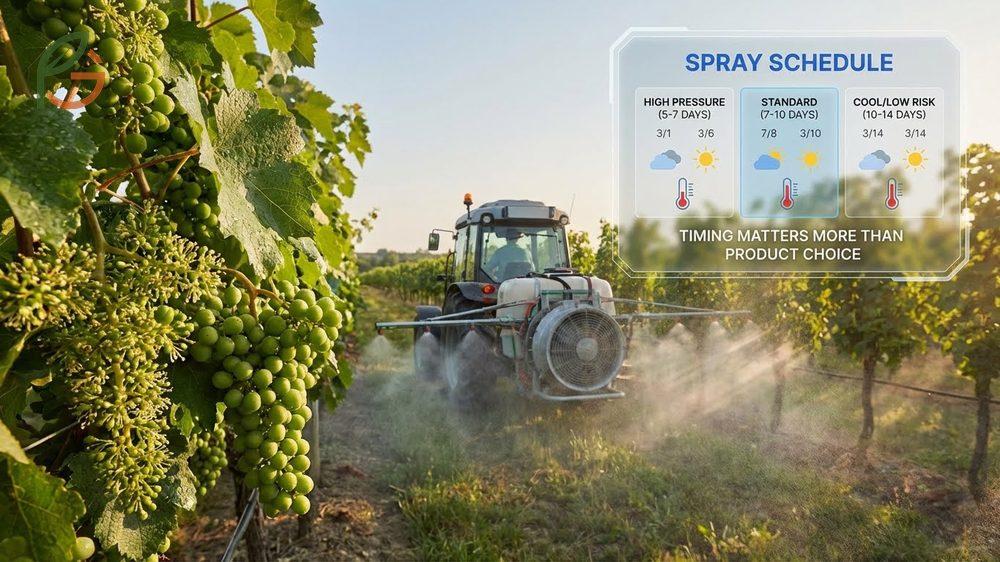
Studies across commercial vineyards demonstrate that consistent spray timing matters more than product choice for long-term disease control. You’ll achieve best results by applying protectant fungicides every 7-10 days from bloom through bunch closure, the period when grapes are most vulnerable[4].
Shorten spray intervals to 5-7 days when disease pressure is high or weather conditions favor infection. You can extend intervals to 10-14 days during cooler periods or after veraison when berry susceptibility decreases. Most people find that sulfur applications work well early season, switching to oils or potassium bicarbonate if breakthrough infections appear.
For protectant applications, spray volume and coverage matter more than fungicide concentration. Use 50-100 gallons per acre, drive slowly, and spray every row for thorough coverage. Early morning applications when humidity is higher help materials spread and adhere better to leaf surfaces.
If you’re applying eradicant treatments to knock down existing infections, contact with diseased tissue is essential. Increase spray volume to ensure you’re hitting undersides of leaves and shaded canopy areas where infections hide. Wait for good spray conditions rather than rushing applications under poor weather—you’ll get better results.
- Start protective sprays at 4-inch shoot growth or when temperatures consistently reach 50°F (10°C)[1]
- Apply every 7-10 days from bloom through 5-6 weeks post-bloom for critical fruit protection
- Scout twice weekly and switch to 5-7 day intervals when infections appear
- Avoid spraying sulfur when temperatures exceed 85°F (29°C) to prevent leaf burn
- Wait 14 days minimum between sulfur and oil applications to avoid phytotoxicity
- Apply eradicant treatments (oils, potassium bicarbonate) within 48 hours of detecting symptoms
- Make final applications in late August to early September to suppress cleistothecia formation
Tank mixing different products can broaden your control spectrum. For example, combining sulfur with potassium bicarbonate gives you both long-lasting protection and some eradicant activity. Just check compatibility before mixing—some combinations cause phytotoxicity or reduce effectiveness.
Conclusion
The evidence is clear: powdery mildew on grapes can be controlled effectively using natural methods when you combine preventative fungicides, cultural practices, and consistent spray timing. Research demonstrates that organic growers achieve 70-85% disease suppression by integrating sulfur protectants, canopy management, and early-season flag shoot removal.
Success depends on starting protective applications early—at 4-inch shoot growth—and maintaining 7-10 day spray intervals through bunch closure. Current agricultural guidance emphasizes scouting as your early warning system, allowing you to catch infections before they become epidemic. FruitGarden brings together peer-reviewed viticulture research and practical growing experience to help you maintain healthy, productive vines naturally.
Frequently Asked Questions
What kills powdery mildew on grapes naturally?
Sulfur sprays, horticultural oils, and potassium bicarbonate kill powdery mildew on grapes naturally. Sulfur works best as a protectant in temperatures between 59-82°F (15-28°C), while oils provide eradicant action on existing infections by suffocating fungal spores. A 10% milk solution also shows effectiveness comparable to synthetic fungicides when applied in sunlight.
Can you wash powdery mildew off grapes?
You can wash surface powdery mildew off harvested grapes, but this doesn’t cure infected fruit. The fungus penetrates berry skins, causing permanent damage like russeting and cracking. It’s better to prevent infections during growing season rather than trying to clean fruit at harvest. For eating, washing with water removes surface spores safely.
How often should I spray for powdery mildew on grapes?
Spray every 7-10 days from bloom through bunch closure for optimal protection. Reduce intervals to 5-7 days during high disease pressure or warm, humid weather. You can extend to 10-14 days in cool periods or after veraison when berry susceptibility decreases. Consistent timing matters more than product concentration for long-term control.
Is baking soda effective against grape powdery mildew?
Baking soda (sodium bicarbonate) provides moderate powdery mildew suppression but potassium bicarbonate works better. Research shows sodium bicarbonate at 0.5-2% reduces germination and growth in lab tests, but field results are short-term and less effective than sulfur or potassium bicarbonate. Use potassium bicarbonate at 2.5-5 pounds per acre for superior results.
What temperature kills powdery mildew on grapevines?
Temperatures above 95°F (35°C) inhibit powdery mildew spore germination, while temperatures exceeding 104°F (40°C) kill conidia outright. However, the fungus survives hot days by thriving during cooler night temperatures of 68-77°F (20-25°C). Extended periods above 95°F (35°C) provide natural suppression but don’t eliminate overwintering cleistothecia.
Can powdery mildew spread from grapes to other plants?
Grape powdery mildew (Erysiphe necator) is host-specific and won’t spread to unrelated plants. However, different powdery mildew species affect various crops—roses, squash, and melons have their own strains. The fungus spreads rapidly between grapevines through airborne spores, with incubation periods as short as 5-6 days under optimal conditions.
Are organic fungicides as effective as synthetic ones for grape mildew?
Organic fungicides achieve 70-85% control when applied preventatively, approaching synthetic fungicide effectiveness. Sulfur, oils, and potassium bicarbonate work best in integrated programs combining multiple products and cultural practices. The main difference is that most organic options work as protectants, requiring consistent application before infections appear rather than curing established disease.





