
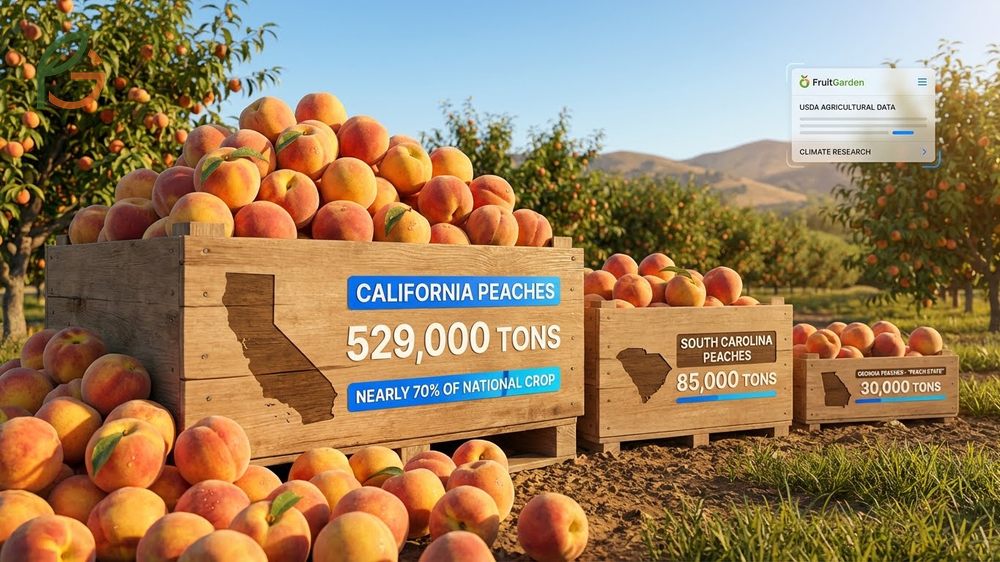
Which state grows the most peaches? California dominates U.S. peach production with 529,000 tons harvested in 2024, representing nearly 70% of the national crop.[1] South Carolina ranks second at 85,000 tons, while Georgia—despite its “Peach State” nickname—produces only 30,000 tons annually.[2] FruitGarden analyzes current USDA agricultural data and climate research to help you understand where America’s peaches really come from.
Quick Answer
Which State Grows the Most Peaches
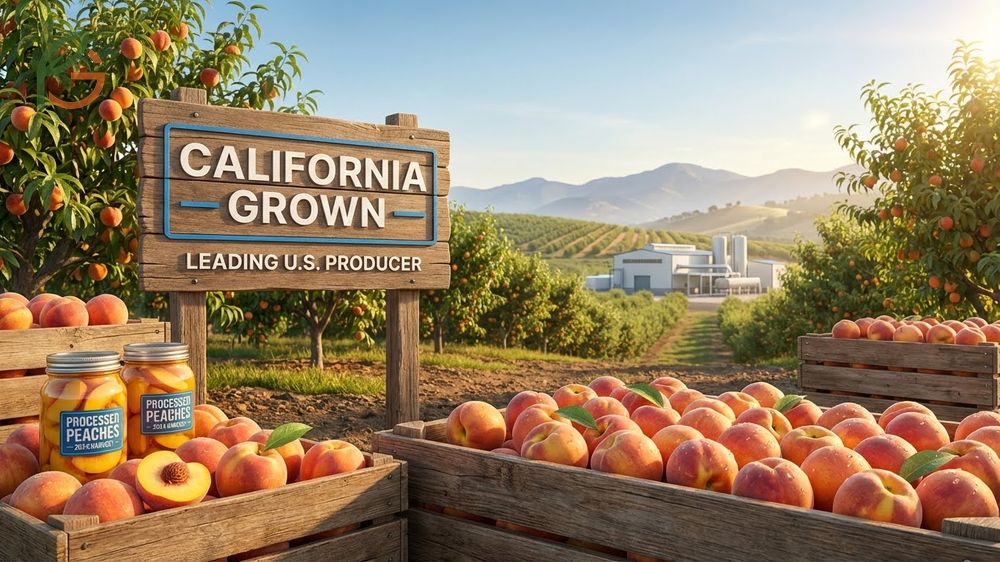
California produces more peaches than any other U.S. state by a significant margin. The 2024 harvest yielded 529,000 tons, which accounts for roughly 70% of America’s total peach production.[1] This dominance has remained consistent for decades, with California supplying both fresh market peaches and over 96% of processed peaches nationwide.[4]
Research shows California’s extended growing season runs from May through September, giving growers multiple harvest windows. The state’s diverse microclimates support both Freestone varieties for fresh consumption and Clingstone types for canning.[5] Most people don’t realize California’s 2025 forecast projects another increase to 550,000 tons, demonstrating the state’s agricultural resilience.[6]
California Dominates Production
California’s peach orchards benefit from Mediterranean climate conditions with hot, dry summers and mild winters. These conditions minimize fungal diseases that plague southeastern growers and allow for consistent year-over-year production.[7] Central Valley regions like Fresno and Tulare counties produce the bulk of the crop with advanced irrigation systems compensating for low rainfall.
The state’s peach acreage has declined slightly since 2014 when production peaked at 620,000 tons. However, California still harvests seven times more peaches than any competitor state.[7] Freestone production for 2025 is forecasted at 320,000 tons, up 7% from 2024, while Clingstone production remains steady at 230,000 tons.[6]
South Carolina Takes Second Place
South Carolina claims the second position in U.S. peach production with approximately 85,000 tons harvested from 18,000 acres of orchards.[8] The state’s Ridge region and Upper State areas provide ideal growing conditions with well-drained soils and strategic elevation that protects against late spring frosts. South Carolina focuses almost entirely on fresh market peaches known for superior flavor and texture.
What often gets overlooked is that South Carolina produces more than double Georgia’s annual harvest despite Georgia’s marketing as “The Peach State.” The Palmetto State ships over 200 million pounds of peaches each year, with Spartanburg County alone accounting for a significant portion of production.[9]
Georgia: Iconic But Small
Georgia produces only 30,000 tons of peaches annually, ranking third nationally but holding enormous cultural significance.[2] The state’s Fort Valley plateau serves as the epicenter of Georgia peach production, though total acreage has declined substantially over recent decades. Climate volatility has become the primary challenge—in 2023, Georgia lost over 90% of its crop due to abnormally warm winter temperatures followed by late March freezes.[10]
Georgia peaches remain culturally iconic despite representing less than 1% of the state’s agricultural economy. The combination of sandy loam soils, consistent rainfall, and hot days traditionally produced exceptionally sweet fruit. However, warming winters now threaten the chill hour requirements peach trees need for proper dormancy and spring bloom timing.[11]
Top Peach Producing States
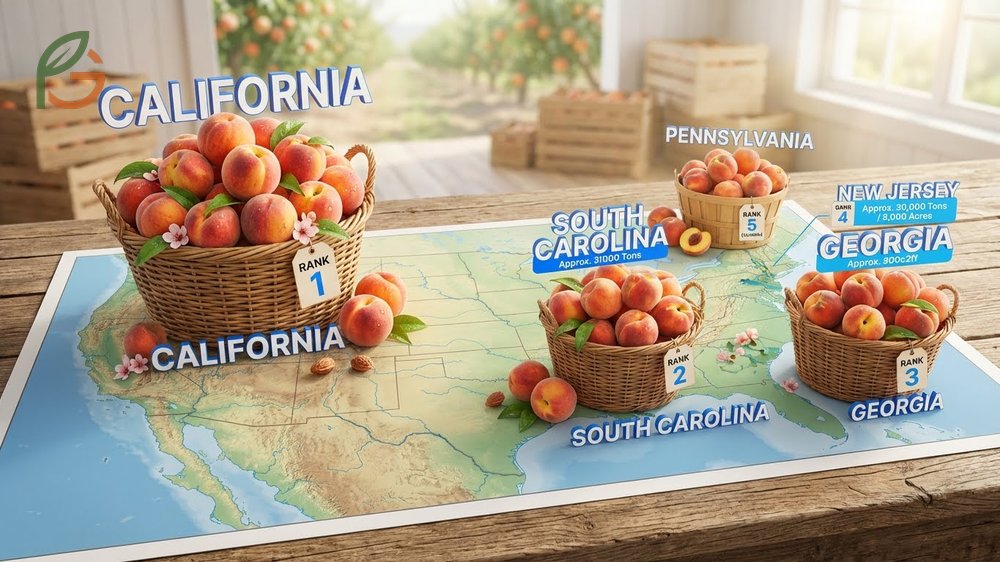
The U.S. peach industry operates across 20 states commercially, though the top four states account for over 85% of national production. After California, South Carolina, and Georgia, New Jersey ranks fourth with approximately 30,000 tons harvested from 8,000 acres.[12] Pennsylvania follows as the fifth-largest producer, though production statistics vary year to year based on weather conditions.
Current data indicates total U.S. peach production reached approximately 719,000 tons in 2024, marking a 22% increase from the previous year primarily driven by California’s strong harvest.[5] This represents a recovery from recent years when adverse weather in southeastern states significantly impacted national totals.
Production Comparison by State
This table compares annual peach production volumes across the top five U.S. producing states, showing California’s dominant market position
| State | Annual Production (Tons) | Percentage of U.S. Total | Primary Use |
|---|---|---|---|
| California | 529,000[1] | ~70% | Fresh & Processed |
| South Carolina | 85,000[8] | ~12% | Fresh Market |
| Georgia | 30,000[2] | ~4% | Fresh Market |
| New Jersey | 30,000[12] | ~4% | Fresh Market |
| Pennsylvania | 15,000-20,000 | ~2-3% | Fresh Market |
Important Note: Production volumes fluctuate significantly based on spring weather patterns. Late frosts can reduce southeastern state harvests by 50-90% in a single season, while California’s more stable climate maintains consistent output year to year.
Fresh Market vs Processed Peaches
California supplies over 96% of America’s processed peaches (canned, frozen, dried), while southeastern states focus entirely on fresh fruit sales.[4] Clingstone varieties dominate processing operations because their flesh adheres firmly to the pit, making mechanical pitting efficient. Freestone peaches separate easily from the pit and command premium prices in fresh markets.
New Jersey exemplifies fresh market specialization—100% of its 60-66 million pounds of annual production goes to supermarkets, farm stands, and U-pick operations throughout the eastern U.S. and Canada.[12] All New Jersey peaches are hand-picked, a labor-intensive process that ensures quality but limits scale compared to California’s partially mechanized harvesting for processing fruit.
Peach Growing Climate
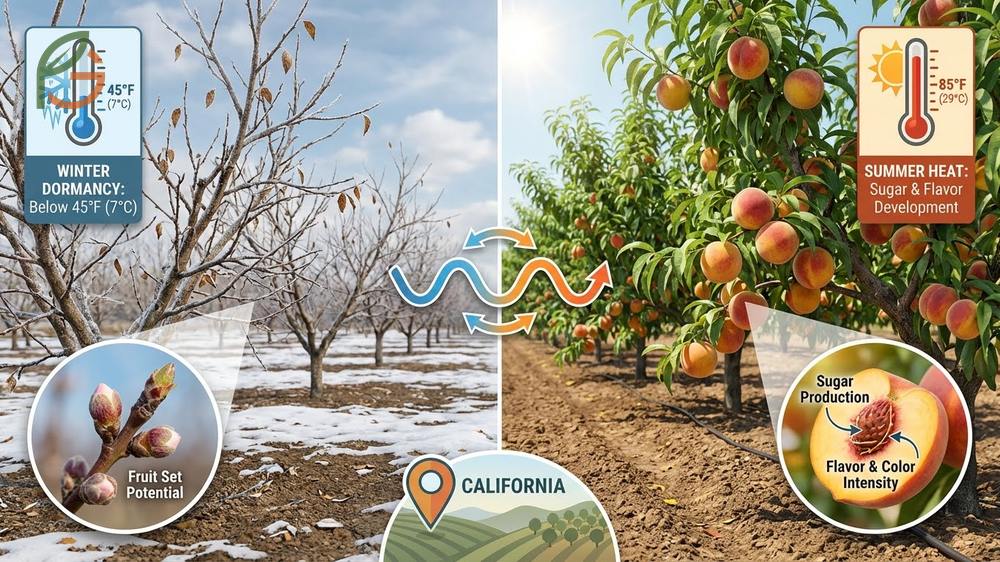
Peaches require specific climate conditions that balance winter cold with summer heat. The trees need exposure to temperatures below 45°F (7°C) during winter dormancy to properly set fruit the following spring. Hot summer days then drive sugar production in developing fruit, while cool nights enhance flavor development and color intensity.
Studies demonstrate that successful peach cultivation depends on matching variety chill requirements to local winter patterns. California’s Central Valley provides 400-800 chill hours annually, adequate for low to medium-chill varieties. In contrast, Michigan and Pennsylvania regularly exceed 1,200 chill hours, supporting high-chill traditional varieties like Elberta.[13]
USDA Hardiness Zones
Peach trees thrive in USDA hardiness zones 5 through 8, with some low-chill varieties extending into zone 9.[3] Zone 5 experiences minimum winter temperatures of -10°F to -20°F (-23°C to -29°C), suitable for cold-hardy varieties in states like Pennsylvania and Ohio. Zone 8, with minimums of 10°F to 20°F (-7°C to -12°C), accommodates most commercial peach production in California, Georgia, and South Carolina.
The hardiness zone system helps growers select appropriate varieties but doesn’t tell the complete story. Late spring frost risk matters more than absolute minimum temperatures for commercial success. Georgia sits primarily in zones 7b-8a, yet faces greater production challenges than Michigan (zones 5-6) due to unpredictable spring freezes after warm winter periods trigger early blooming.
- Winter chill hours: 400-1,000 hours below 45°F depending on variety
- Summer heat: 85-95°F (29-35°C) daytime temperatures for optimal sugar development
- Rainfall: 20-30 inches annually, evenly distributed or supplemented with irrigation
- Soil drainage: Deep, well-drained sandy loam with pH 6.0-7.0
- Frost-free growing season: Minimum 150-180 days from last spring frost to first fall frost
Chill Hours Requirement
Chill hours represent the cumulative time peach trees spend below 45°F (7°C) during winter dormancy. Georgia peach varieties typically require 650-850 chill hours, with the popular Elberta demanding at least 800 hours.[13] When trees don’t accumulate sufficient chill hours, they fail to exit dormancy properly, leading to poor bloom and reduced fruit set.
Central Georgia averaged 1,100 chill hours annually from 1980-2010, but this dropped dramatically to around 600 hours in 2016 and below 400 hours at some farms in 2017.[13] This decline explains Georgia’s increasingly erratic production and drives research into low-chill varieties requiring only 350-500 hours. California benefits from selecting varieties matched to each microclimate’s chill hour profile, avoiding the mismatch problems plaguing southeastern growers.
Climate Challenge: Warmer winters reduce chill hour accumulation, causing trees to bloom early when exposed to brief warm spells. Subsequent late frosts then damage or destroy flowers and developing fruitlets, leading to crop failures even when total winter cold seems adequate.
Peach Season by State
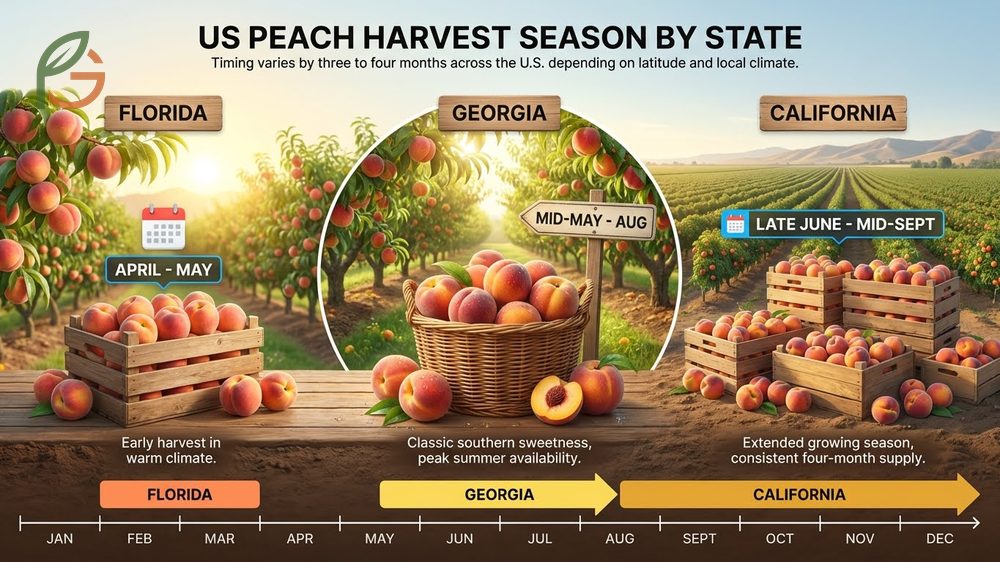
Peach harvest timing varies by three to four months across the U.S. depending on latitude and local climate. Florida’s warm climate produces the earliest peaches, with harvest running from April through May. Georgia follows with mid-May through mid-August availability, delivering classic southern sweetness during peak summer months.[14]
California’s extended growing season spans late June through mid-September, providing consistent supply for four months. This long window results from the state’s diverse microclimates—coastal valleys harvest earlier while interior regions continue producing into fall. South Carolina’s season runs mid-June through late August, overlapping with Georgia but maintaining production after many southeastern orchards finish.[14]
- Florida: April to May (earliest U.S. production)
- Georgia: Mid-May to mid-August (peak southern season)
- South Carolina: Mid-June to late August (extended southern harvest)
- California: Late June to mid-September (longest season nationally)
- New Jersey: July to August (mid-Atlantic peak)
- Pennsylvania: July to late August (northern region harvest)
- Idaho: Late June to late August (western mountain region)
The staggered harvest timing across regions ensures American consumers can access domestically grown peaches from April through September. Fresh market peaches must be picked at optimal ripeness and shipped quickly, as they don’t improve in sweetness after harvest unlike some fruits. This requirement explains why each region serves specific market territories based on transportation distance and timing.
Weather patterns during the critical March-April bloom period determine actual harvest dates and volumes each year. An unusually late spring frost can delay harvest by 7-10 days or eliminate the crop entirely in affected areas. California’s more predictable Mediterranean climate provides the market stability that makes it America’s dominant producer despite higher land and water costs.
Why Georgia Production Declined
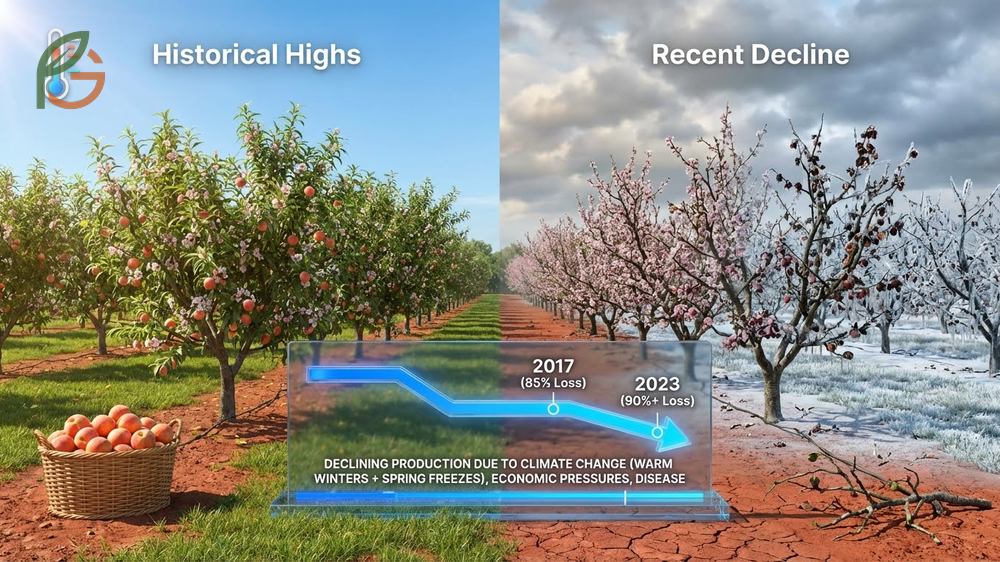
Georgia’s peach production has declined from historical highs due to a combination of climate change, economic pressures, and crop disease challenges. The state lost 85% of its crop in 2017 and over 90% in 2023, both years characterized by abnormally warm winters followed by devastating spring freezes.[10] These aren’t isolated incidents—winter is the fastest-warming season in Georgia, fundamentally altering the chill hour patterns peach trees depend on.
Agricultural climatologists observe that Georgia now experiences warmer winters with insufficient chill hours, followed by erratic temperature swings that trick trees into blooming early. When late March or early April cold snaps arrive, they destroy flowers and tiny fruitlets that have already begun developing. This creates a devastating scenario where trees have exited dormancy but fruit development gets wiped out before harvest can occur.[11]
- Warming winters reducing chill hour accumulation below the 650-850 hours most varieties require
- Increased frequency of late spring frosts after early bloom triggered by warm February/March periods
- Peach tree short life syndrome in the 1960s-1980s that decimated orchards and reduced acreage permanently
- Rising labor costs with hand-harvesting remaining the only viable option for fresh market fruit
- Competition from California’s stable production and South Carolina’s expanding acreage
- Increased humidity promoting fungal diseases like brown rot that damage fruit quality
Historically, Georgia’s Fort Valley region produced exceptional peaches due to sandy loam soils, consistent rainfall, and hot days combined with warm nights that boosted sugar production. The overnight temperatures in Georgia don’t cool as dramatically as northern regions, allowing trees to produce sugars continuously during the growing season.[15] However, these same warm conditions now contribute to insufficient winter chilling.
Researchers are working to develop low-chill peach varieties requiring only 350-500 chill hours that can withstand spring frosts better. Some experimental varieties need their chill hours but then require more warm days before blooming, creating a buffer against late frost damage. Whether these breeding efforts can restore Georgia’s peach industry remains uncertain, but current trends suggest production will continue declining without significant adaptation.[13]
Economic Reality: Despite cultural significance, peaches represent less than 1% of Georgia’s agricultural economy today. The state has shifted toward more reliable crops like peanuts and pecans that tolerate climate variability better and require less intensive hand labor for harvest.
Conclusion
The evidence is clear: which state grows the most peaches has a definitive answer—California produces 529,000 tons annually, dwarfing all competitors and supplying nearly three-quarters of America’s peach crop. South Carolina earns second place with 85,000 tons, while Georgia’s iconic status masks its modest 30,000-ton production that continues declining due to climate challenges.
Current agricultural data shows California’s dominance stems from diverse microclimates, extended growing seasons, and stable weather patterns that ensure consistent harvests year after year. For gardeners and fruit enthusiasts, understanding these production facts helps explain market availability, price fluctuations, and why FruitGarden emphasizes matching peach varieties to local climate conditions rather than relying on traditional growing regions.
Frequently Asked Questions
What state grows the most peaches in the US?
California grows the most peaches in the U.S. with 529,000 tons produced in 2024, representing approximately 70% of the nation’s total peach crop. South Carolina ranks second at 85,000 tons, followed by Georgia at 30,000 tons despite its “Peach State” nickname.
Where do peaches grow best in the United States?
Peaches grow best in USDA hardiness zones 5-8 with specific climate requirements. California’s Central Valley, South Carolina’s Ridge region, and Georgia’s Fort Valley plateau historically provided ideal conditions combining 650-850 winter chill hours, hot summer days, well-drained soils, and minimal late spring frost risk.
What region are the most peaches grown in Georgia?
The Fort Valley plateau in middle Georgia serves as the epicenter of the state’s peach production, offering sandy loam soils and elevation that traditionally protected against spring frosts. Peach County surrounding Fort Valley remains the symbolic heart of Georgia’s peach industry despite declining overall state production.
How many peaches are grown in Georgia each year?
Georgia currently produces approximately 30,000 tons of peaches annually in typical years, though production fluctuates dramatically based on spring weather. In 2023, the state lost over 90% of its crop due to late frosts, while 2017 saw an 85% loss from similar climate challenges.
Why does Georgia grow fewer peaches now?
Georgia’s peach production has declined due to warming winters that reduce chill hour accumulation below the 650-850 hours trees require, followed by erratic spring freezes that destroy early blooms. Climate change, increased labor costs, disease pressures, and competition from California’s stable production have all contributed to the decline.
Where are peaches grown commercially in the US?
Peaches are commercially grown in 20 U.S. states, with the top producers being California, South Carolina, Georgia, New Jersey, and Pennsylvania. Other significant production occurs in North Carolina, Colorado, Idaho, Michigan, Arkansas, and Washington, though volumes vary considerably by state and growing season conditions.
When is peach season by state?
Peach season varies by state from April through September. Florida harvests April-May, Georgia runs mid-May through mid-August, California produces late June through mid-September, South Carolina harvests mid-June through late August, and northern states like New Jersey and Pennsylvania harvest during July and August.





