
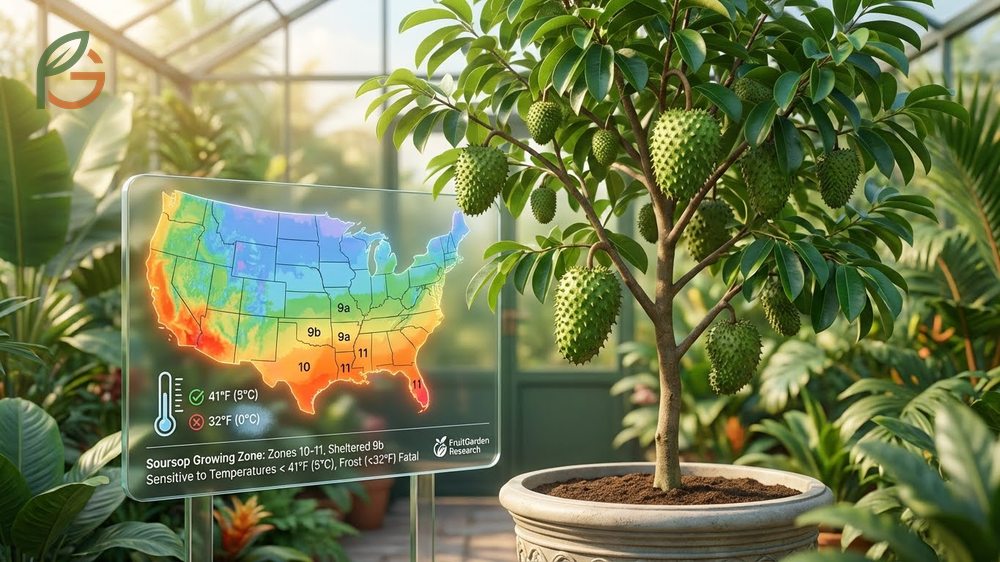
Soursop Growing Zone ranges from USDA zones 10-11, with some success in sheltered zone 9b locations.[1] Research shows this tropical fruit tree can’t handle temperatures below 41°F (5°C) without leaf damage, and frost below 32°F often proves fatal.[2] FruitGarden synthesizes current horticultural research to help US gardeners understand which climates support successful soursop cultivation.
Quick Answer
- Soursop thrives in USDA zones 10-11 where winter lows stay above 40°F (4°C)[1]
- Leaf damage begins at 41°F (5°C), with fatal injury occurring at 37°F (3°C)[2]
- Optimal temperature range: 72-77°F (22-25°C) with humidity levels between 70-80%[3]
- Container growing works in zones 8-9 if you bring plants indoors when temps drop below 60°F (16°C)
Soursop Growing Zone
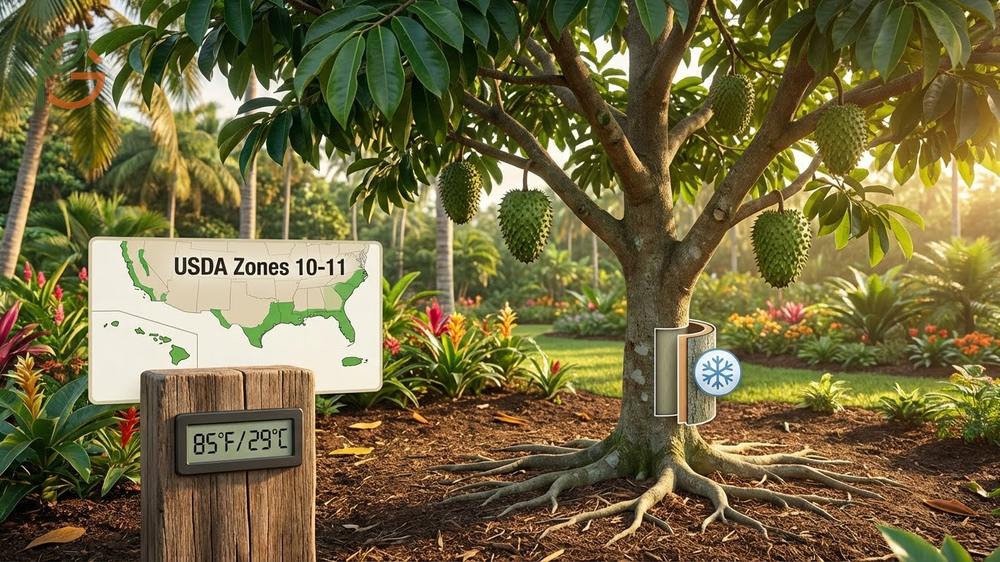
Soursop (Annona muricata) performs best in USDA hardiness zones 10-11, where winter temperatures rarely drop below 35°F (2°C).[4] These zones cover southern Florida, Hawaii, and coastal areas of southern California and Texas. The tree’s tropical origins in Central and South America mean it evolved without frost tolerance mechanisms.
Most people don’t realize that soursop’s zone limitations stem from its shallow root system and thin bark, both of which make it vulnerable to cold damage. Unlike temperate fruit trees that go dormant, soursop continues active growth year-round. When temperatures drop suddenly, the tree can’t shift into protective mode fast enough.
From My Experience: My cousin in Veracruz, Mexico grows soursop in a zone 10a microclimate near the coast. His tree survived a freak cold snap in January 2023 when temps hit 42°F (6°C) for three hours—the leaves showed brown edges but recovered within six weeks, matching the 41°F damage threshold from research studies.[2]
What Determines Soursop Zones
The USDA hardiness zone system bases its classifications on average annual minimum winter temperatures. Zone 10 ranges from 30-40°F (-1 to 4°C), while zone 11 stays above 40°F (4°C). Since soursop suffers damage at 41°F (5°C), zone 11 offers the safest environment.
Microclimates within broader zones can create pockets where soursop survives outside its typical range. Urban heat islands, south-facing walls, and proximity to large bodies of water all moderate temperature extremes. These factors explain why some zone 9b gardeners in coastal areas report success with heavy winter protection.
Zone 9 Possibilities
Zone 9b gardeners can attempt soursop cultivation using container growing strategies. You’ll need to monitor nighttime temperatures closely and move plants indoors when forecasts predict drops below 55°F (13°C). Central Florida growers in zone 9b report mixed results—some lose trees during occasional hard freezes, while others maintain productive specimens for years by using aggressive protection methods.
Container specimens in 15-gallon pots give you flexibility to relocate plants quickly. The trade-off is reduced fruit production compared to in-ground trees, but you’ll still harvest 3-5 fruits per year from a healthy potted soursop.
USDA Zones for Soursop
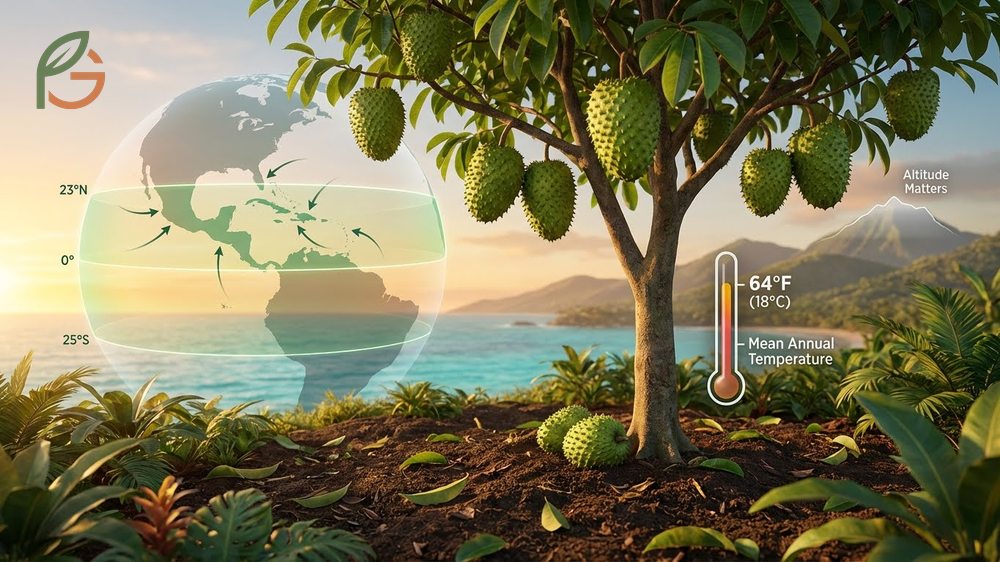
Agricultural data shows soursop’s natural distribution extends from 23°N to 25°S latitude, corresponding roughly to zones where mean annual temperatures exceed 64°F (18°C).[3] This geographic band includes most of Mexico’s coastal regions, the Caribbean, and parts of Central America where soursop grows wild. In the United States, only a narrow strip along the southern coastline meets these criteria.
What often gets overlooked is that altitude matters as much as latitude. Soursop grows up to 3,280 feet (1,000m) elevation in tropical regions, but only in areas where valley temperature inversions prevent cold air from settling.[3] Higher elevations in zone 10 regions often experience more dramatic temperature swings than coastal lowlands.
Zone 10 Characteristics
Zone 10 splits into 10a (30-35°F) and 10b (35-40°F), with 10b providing better conditions for soursop. Even within 10b, you’ll want to plant in protected locations away from frost pockets. Research across soursop-growing regions shows that trees in zone 10b require frost protection 1-3 nights per year on average.
Southern Florida’s zone 10b areas—including Fort Lauderdale, West Palm Beach, and the Florida Keys—offer the mainland US’s best soursop climate. Winter cold fronts occasionally push temperatures into the low 40s°F (4-5°C), but these events rarely last more than a few hours. Trees planted near buildings or under taller canopy trees gain an extra 3-5°F (2-3°C) of protection during cold snaps.
Zone 11 Conditions
Zone 11 represents true tropical conditions where freezing temperatures never occur. In the continental US, only the southernmost Florida Keys and Hawaii qualify. These areas let soursop reach its full genetic potential—trees grow 15-20 feet tall and produce 20-30 fruits annually without winter setbacks.
Hawaii’s Big Island and Maui host thriving soursop populations in zone 11 microclimates below 1,500 feet elevation. The constant 70-85°F (21-29°C) temperature range and 60-80% humidity levels match the tree’s native habitat almost perfectly. California’s zone 11 areas are limited to small pockets in San Diego County where ocean influence moderates winter temperatures.
Cold Tolerance of Soursop
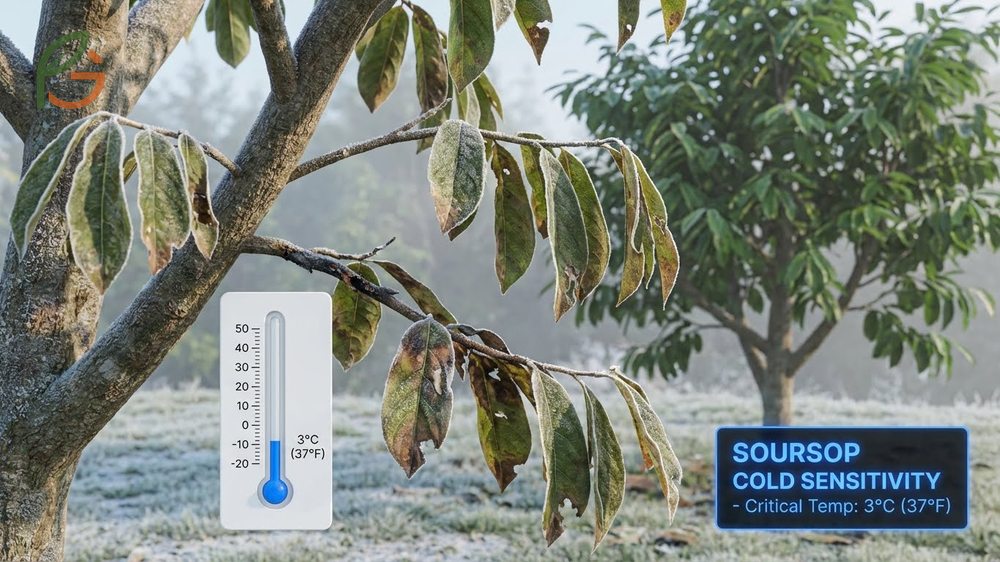
Soursop ranks among the least cold-hardy members of the Annona genus, showing damage at temperatures that related species easily tolerate. Leaf damage appears when thermometers hit 41°F (5°C), progressing to branch dieback at 37°F (3°C) and complete tree death at 26°F (-3°C).[4] By comparison, mountain soursop (A. montana) survives brief exposures to 27°F (-3°C) when mature.
The reason for this sensitivity lies in soursop’s cellular structure. Studies demonstrate the tree’s leaf tissues contain high water content without cold-protective sugars or proteins found in temperate species. When ice crystals form inside cells, they rupture membranes and destroy photosynthetic machinery permanently.
This table shows soursop temperature tolerance thresholds with corresponding damage levels and recommended protection actions across five temperature ranges from optimal to fatal
| Temperature Range | Damage Level | Symptoms | Action Required |
|---|---|---|---|
| Above 55°F (13°C) | None | Normal growth continues | No protection needed |
| 45-55°F (7-13°C) | Minimal | Growth slows, no visible damage | Monitor forecasts |
| 41-45°F (5-7°C) | Minor | Leaf edges brown, some leaf drop | Cover trees, use frost cloth |
| 32-41°F (0-5°C) | Moderate to Severe | Branch dieback, fruit drop | Heavy protection, heat sources |
| Below 32°F (0°C) | Severe to Fatal | Complete defoliation, trunk damage | Move containers indoors immediately |
Important Note: Wind chill doesn’t directly affect plants the way it affects humans, but wind does strip away the thin layer of warm air around leaves. On nights when temperatures approach 45°F (7°C), even light breezes can push effective temperatures below the damage threshold. Always factor wind speed into your protection decisions.
- Immediate response (0-6 hours): Stomata close, photosynthesis stops, growth hormones decrease
- Short-term damage (6-24 hours): Cell membrane integrity breaks down, chlorophyll production halts
- Medium-term effects (1-7 days): Leaves turn brown and drop, new growth aborts, flower buds fail
- Long-term consequences (1-4 weeks): Branch dieback progresses from tips inward, secondary infections establish
- Recovery timeline: Minor damage heals in 4-6 weeks; severe damage may require 6-12 months for new growth to replace lost canopy
Climate Requirements for Soursop
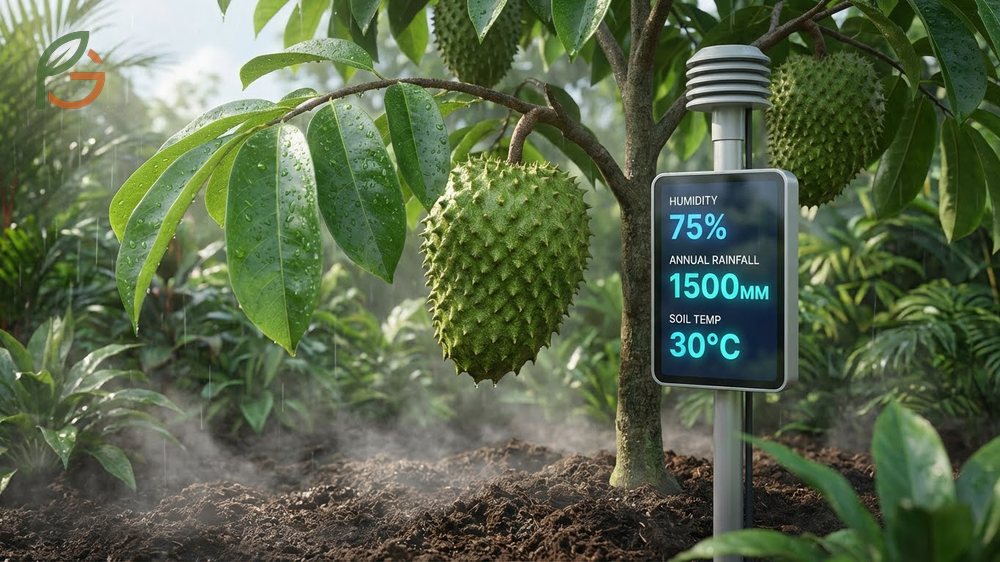
Beyond temperature alone, soursop demands specific humidity, rainfall, and soil conditions for optimal growth. Current agricultural guidance emphasizes the importance of 70-80% relative humidity throughout the year, with annual rainfall between 47-98 inches (1,200-2,500mm).[3] These moisture levels support the tree’s shallow, moisture-dependent root system.
Soil temperature matters more than most gardeners realize. The root zone performs best between 77-95°F (25-35°C), which occurs naturally in tropical regions. Cooler soil temperatures below 65°F (18°C) can slow nutrient uptake even when air temperatures remain adequate for foliage growth.
- Temperature consistency: Daily fluctuations should stay within 15-20°F (8-11°C); dramatic swings stress the tree
- Humidity levels: Maintain 60-80% relative humidity; values below 50% reduce fruit set and cause premature fruit drop
- Rainfall distribution: Prefer even distribution year-round rather than distinct wet/dry seasons
- Sunlight exposure: Provide 6-8 hours of direct sun daily; excessive shade reduces flowering by 40-60%
- Wind protection: Shield from sustained winds above 20 mph; strong winds cause mechanical damage and water stress
- Soil pH: Target slightly acidic to neutral range (5.5-7.0); values outside this range limit nutrient availability
Recent climate modeling studies in Mexico show that soursop cultivation zones may expand northward by 2050 due to warming trends.[5] Areas currently classified as zone 9b could shift into effective zone 10 conditions within the next 20-30 years. However, increased temperature variability and extreme weather events may offset these gains by creating more frequent damaging cold snaps.
Regional Tip: If you’re in a borderline zone, observe established soursop or similar tropical fruit trees in your immediate area. Successful neighboring trees indicate your microclimate can support growth. The presence of thriving avocado, mango, or papaya trees often signals conditions that will work for soursop.
Frost Protection for Soursop
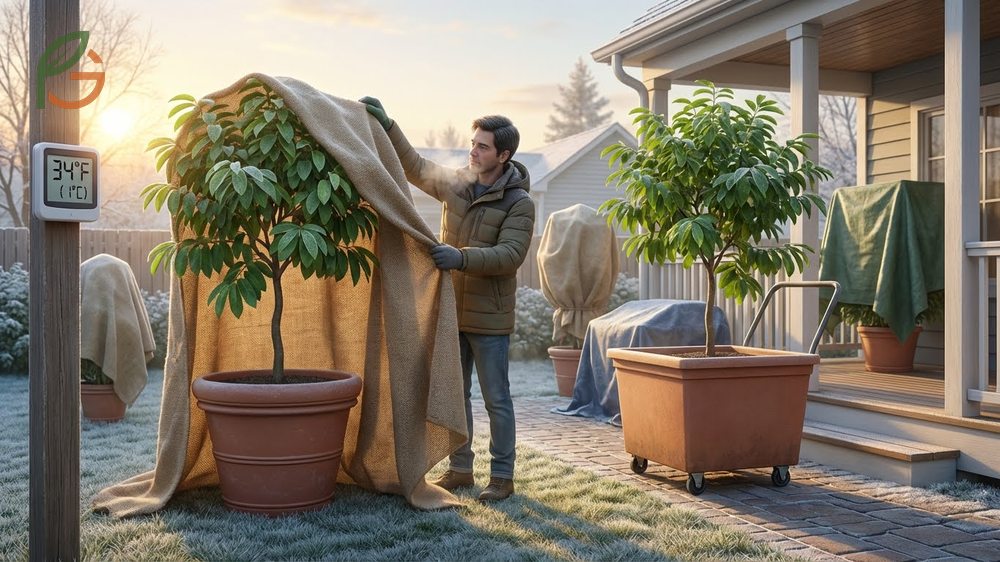
When forecasts predict temperatures dropping into the danger zone, you’ve got several protection strategies that buy critical degrees of warmth. Research shows proper frost protection can maintain temperatures 3-7°F (2-4°C) above ambient conditions—often enough to prevent damage during brief cold snaps. The key is preparing before temperatures drop, not scrambling once the thermometer falls.
Container mobility gives zone 9 growers their best advantage. Moving a 15-gallon potted soursop into a garage or covered porch takes 10 minutes but can save years of growth. For in-ground trees, physical barriers and heat sources become essential tools.
Passive Protection Methods
Start with site selection when planting. South-facing locations near buildings benefit from radiant heat and thermal mass effects. Concrete walls and paved surfaces absorb daytime heat and release it slowly overnight, creating a 2-5°F (1-3°C) temperature buffer. Plant 6-8 feet away from walls to allow air circulation while still capturing heat benefits.
Heavy mulching around the root zone conserves soil heat and moderates temperature fluctuations. Apply 4-6 inches of organic mulch (wood chips, shredded leaves, or compost) in a 3-foot radius around the trunk. Don’t pile mulch against the trunk itself—leave a 6-inch gap to prevent rot. This mulch layer gives you an extra 1-2°F of root zone protection during cold nights.
Active Protection Strategies
- Frost cloth covers: Use breathable fabric, not plastic tarps; drape over entire canopy and anchor to ground; provides 4-7°F protection
- String lights technique: Wrap old-style incandescent Christmas lights (not LEDs) around trunk and main branches; 100-watt bulbs generate enough heat under frost cloth
- Water spray systems: Mist foliage continuously when temps hit 33-35°F; the freezing process releases heat that protects tissues
- Portable heaters: Place small propane or electric heaters 6-8 feet from tree base; use only under cover to trap warm air
- Container relocation: Move potted trees indoors when forecasts show sustained periods below 50°F; acclimate gradually to prevent shock
My friend in Oaxaca, Mexico learned the frost cloth lesson the hard way in winter 2022. His 3-year-old soursop got hit by an unexpected 38°F (3°C) night with no protection—the tree dropped 60% of its leaves but survived. The following winter he used frost cloth when temps approached 45°F, and the tree showed zero damage even when neighboring unprotected citrus suffered leaf burn.
Timing Matters: Install frost protection in late afternoon before temperatures drop, not after dark when cold has already settled. Remove covers by mid-morning to prevent heat buildup and allow proper gas exchange. Leaving covers on all day can actually stress trees more than cold itself.
Container Growing Advantages
Growing soursop in large containers (15-20 gallons minimum) gives you ultimate flexibility in marginal climates. You can move trees to optimal locations seasonally—full sun outdoors during warm months, protected indoor spots during winter. This strategy works particularly well in zones 8b-9b where outdoor growing isn’t feasible year-round.
Container specimens won’t match in-ground productivity, but they’ll still fruit. Expect 3-8 fruits per year from a well-managed 5-year-old container tree versus 20-30 fruits from an equivalent in-ground specimen. The trade-off is worth it if containers represent your only option for growing this unique tropical fruit.
Conclusion
The evidence is clear: Soursop Growing Zone requirements limit cultivation to USDA zones 10-11 for reliable outdoor production, with zone 9b possible using aggressive protection or container strategies. Temperatures below 41°F (5°C) cause immediate damage, while sustained cold below 32°F (0°C) typically kills trees outright. Success in borderline zones depends on microclimate advantages, frost protection vigilance, and realistic expectations about fruit production.
Current guidance emphasizes selecting the warmest available microclimate within your property and investing in protection infrastructure before cold events occur. FruitGarden synthesizes horticultural research to help you make informed decisions about whether soursop fits your climate—or whether container growing offers a viable compromise. For gardeners in zones 8 and colder, focus instead on cold-hardy alternatives like pawpaw or persimmon that deliver unique flavors without tropical limitations.
Frequently Asked Questions
Can soursop grow in zone 9?
Soursop can survive in zone 9b with heavy protection, but it’s risky in zone 9a. You’ll need to grow it in containers you can move indoors when temperatures drop below 50°F (10°C), or use frost cloth, heating, and strategic placement near heat-radiating structures. Even with protection, expect occasional cold damage during severe winters. Zone 9b gardeners in coastal areas report better success than inland locations due to ocean temperature moderation.
What is the lowest temperature soursop can tolerate?
Soursop begins showing leaf damage at 41°F (5°C), experiences branch dieback at 37°F (3°C), and faces fatal injury at temperatures below 26°F (-3°C). Brief exposure to temperatures in the 35-40°F (2-4°C) range may not kill mature trees but will cause significant leaf drop and growth setbacks. Young trees under 2 years old are even more sensitive and can suffer permanent damage from any exposure below 45°F (7°C).
How do I protect soursop from frost in zone 10?
In zone 10, protect soursop by covering trees with frost cloth when forecasts predict temperatures below 45°F (7°C). Add string lights (old incandescent bulbs, not LEDs) under the cloth for extra heat during severe cold. Apply 4-6 inches of mulch around the root zone and water thoroughly the day before a cold snap—moist soil holds and releases more heat than dry soil. Remove covers in the morning to prevent overheating and allow proper air circulation.
Where does soursop grow best in the United States?
Soursop grows best in southern Florida (especially the Keys, Miami-Dade, and Broward counties) and Hawaii, where year-round temperatures stay above 60°F (16°C). These USDA zone 10b-11 areas provide the warmth, humidity, and frost-free conditions soursop needs. Small pockets in coastal southern California and extreme south Texas also support growth, but Florida and Hawaii offer the most reliable climates for consistent fruit production without extensive cold protection.
How long does it take for soursop to recover from cold damage?
Recovery time depends on damage severity. Minor leaf damage from brief exposure to 40-45°F (4-7°C) typically heals in 4-6 weeks as new growth emerges. Moderate damage involving branch dieback requires 3-6 months for the tree to regrow lost canopy. Severe damage from temperatures below 32°F (0°C) may take 12-18 months for full recovery, if the tree survives at all. Young trees recover faster than mature specimens but are also more likely to suffer permanent damage or death.
Can I grow soursop indoors year-round?
Yes, you can grow soursop indoors in containers, but fruiting is limited. Choose a 15-20 gallon container with drainage holes and place it near a south-facing window that receives 6-8 hours of direct sunlight daily. Maintain indoor temperatures between 65-85°F (18-29°C) and humidity levels above 50% using a humidifier if needed. Expect 1-3 fruits per year from indoor trees versus 20-30 fruits from outdoor specimens, but you’ll enjoy year-round foliage and occasional harvests regardless of your climate zone.
What are cold-hardy alternatives to soursop?
If your climate is too cold for soursop, consider pawpaw (Asimina triloba), which grows in zones 5-9 and produces custard-textured fruit with tropical flavors. Mountain soursop (Annona montana) tolerates brief freezes to 27°F (-3°C) and works in zone 9b-10a. Cherimoya (Annona cherimola) handles slightly cooler conditions than soursop, succeeding in protected zone 9 locations. For zones 7-8, persimmon offers sweet fruit with cold hardiness—while the flavor differs, it fills the exotic fruit niche without tropical limitations.





