
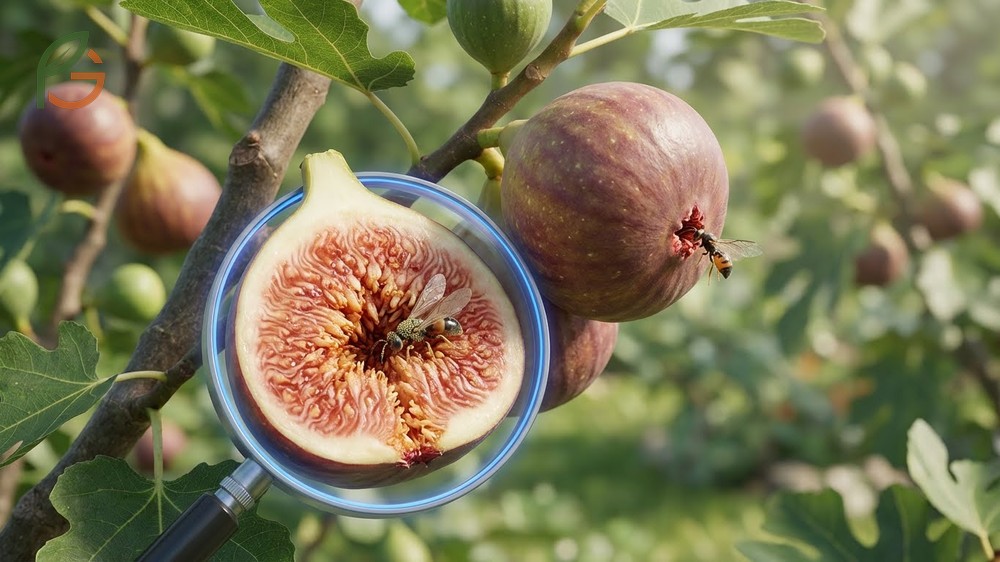
Fig trees and wasps share one of nature’s most remarkable partnerships—an obligate mutualism spanning 60 million years[1] where approximately 750 Ficus species[1] each depend on a specific wasp species for reproduction. Research shows that many cultivated varieties don’t actually need wasps, producing fruit through parthenocarpy instead. FruitGarden synthesizes current botanical research to help you understand this fascinating symbiosis and what it means for your backyard fig trees.
Quick Answer
- Female fig wasps enter unripe figs, pollinate flowers, and lay eggs—all within a 1-2 day lifespan[2]
- Most commercial figs are parthenocarpic (no pollination needed), while Smyrna varieties require wasp pollination to develop fruit
- Those crunchy bits you’re tasting? They’re seeds, not wasp parts—an enzyme called ficin breaks down any dead wasps[3]
- Fig trees bloom inside a hidden structure called a syconium, which later becomes the fruit you eat
Fig Trees and Wasps
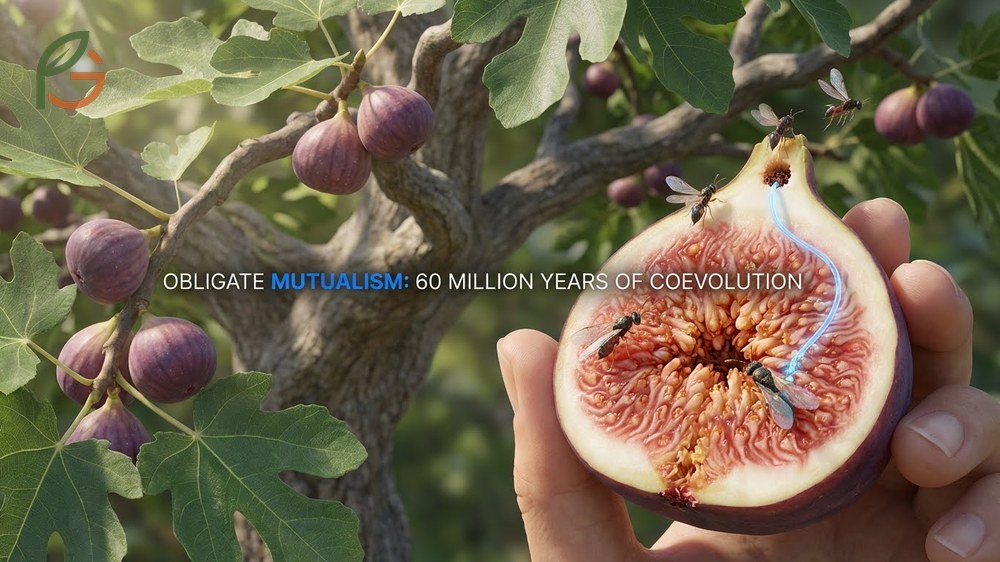
The relationship between fig trees and fig wasps represents what biologists call obligate mutualism—neither species can complete its life cycle without the other. Studies demonstrate that this partnership evolved over 60 million years[1], creating one of evolution’s most precisely synchronized systems. Each of the approximately 750 Ficus species[1] worldwide typically depends on a single, species-specific wasp for pollination.
Female wasps detect receptive figs by chemical signals the tree releases when flowers inside are ready for pollination[4]. They can travel over 100 miles carried by wind currents to find the right target. Once inside the fig, the wasp pollinates female flowers while simultaneously laying eggs in some of them—the tree sacrifices potential seeds to provide nursery space for the next generation of pollinators.
Most people don’t realize that fig cultivation in home gardens typically bypasses this entire process. Commercial varieties like Brown Turkey, Celeste, and Black Mission are parthenocarpic, meaning they develop fruit without any pollination at all. You won’t find fig wasps in most American backyards because they’re simply not needed.
From My Experience: My cousin in Guadalajara, Mexico grows three Black Mission fig trees that produce abundantly each summer. No fig wasps exist in his area, yet he harvests 40-50 ripe figs per tree from July through September—proving parthenocarpy works perfectly for home cultivation.
Obligate Mutualism Explained
In obligate mutualism, both organisms can’t survive or reproduce without their partner. Fig wasps can only complete their life cycle inside figs, using them as the sole site for egg-laying and larval development. Meanwhile, wild fig species that require pollination can’t produce viable seeds without their specific wasp partner entering and pollinating the flowers inside.
Research shows this isn’t a casual partnership that developed recently. Molecular dating techniques reveal that fig and wasp lineages co-diverged for at least 60 million years[1], with both groups speciating in parallel. When a fig species evolved, its wasp partner evolved alongside it, maintaining the precise chemical and physical adaptations needed to continue the relationship.
Species Specificity
The specificity of this relationship is remarkable—a wasp species that pollinates one type of fig typically can’t pollinate any other. Current data indicates that each Ficus species releases unique volatile compounds that attract only its matching pollinator. The wasp’s sensory organs evolved to detect these exact chemical signatures, ensuring she doesn’t waste her short life entering the wrong fig species.
This precision extends to physical adaptations too. Female fig wasps have specialized head appendages that help them squeeze through the tiny opening (called an ostiole) at the top of their specific fig variety. Some species even evolved extremely long ovipositors to lay eggs from outside the fig without entering at all—a strategy that lets them avoid getting trapped inside.
- Chemical signaling systems that match specific wasp species to their fig partners
- Head appendages shaped precisely to fit through their fig’s ostiole opening
- Sensory organs tuned to detect unique volatile compounds released by receptive figs
- Synchronized reproductive timing where fig flowers mature exactly when wasps emerge
- Body size evolution—wasps measure just 1-2 millimeters long to navigate inside figs
Important Note: In North America, only Blastophaga psenes wasps pollinate cultivated Smyrna figs, and they’re primarily found in California. If you’re growing common figs elsewhere, you won’t encounter these wasps at all.
How Fig Trees Are Pollinated
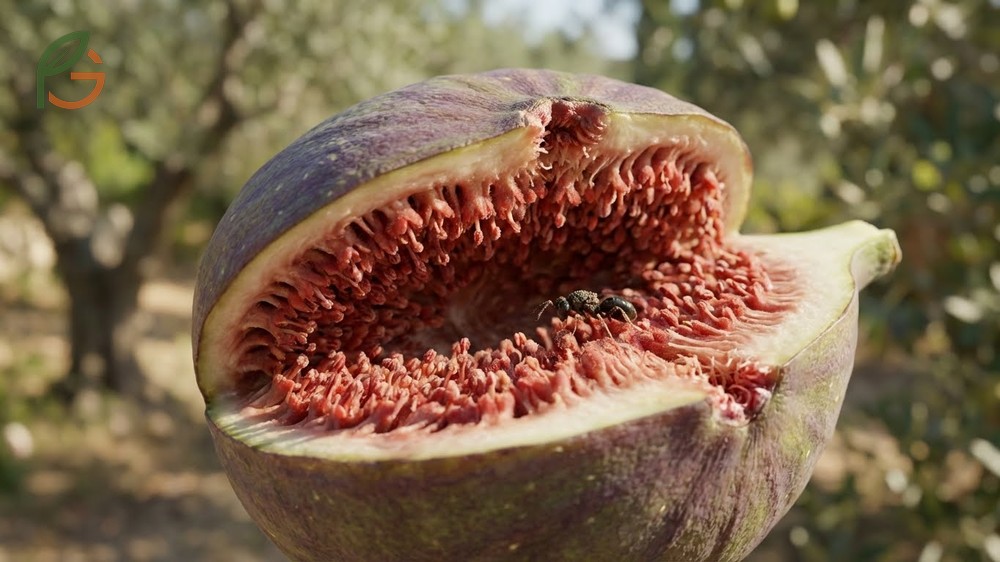
Fig pollination happens entirely inside what looks like a fruit but is actually an inverted flower structure called a syconium. When the female flowers inside reach maturity, the fig releases chemical signals that guide female wasps to enter through a tiny opening. The wasp struggles through this narrow passage, often losing her wings and antennae in the process[5].
Once inside, she crawls across the hundreds of tiny flowers lining the syconium’s interior, depositing pollen she carried from her birth fig. She then lays eggs in some of the short-styled flowers—those with stigmas positioned where her ovipositor can reach. The long-styled flowers remain inaccessible to egg-laying, so they get pollinated without sacrificing seed development to wasp larvae.
The whole process takes just hours, and the exhausted wasp typically dies inside the fig she just pollinated. Over the next few weeks, her eggs develop into larvae, which feed on gall tissue that forms around them. Male wasps emerge first, mate with developing females still inside their galls, then use their powerful mandibles to chew exit tunnels through the fig wall before dying.
Fig Wasp Life Cycle
Adult female fig wasps live an incredibly short life—just 1-2 days[2] once they emerge from their birth fig. During this brief window, they must find a receptive fig, enter it, pollinate flowers, and lay eggs—or their genetic line ends. This time pressure means fig trees need to maintain a continuous supply of receptive figs to keep their pollinator population alive.
The wasp’s life cycle can be broken into distinct stages that span several weeks. After eggs hatch inside a fig, larvae spend about 2-3 weeks developing while feeding on gall tissue. Males emerge first and search for females still developing inside their galls, fertilizing them before the females even leave their chambers.
- Egg stage: Female wasp lays eggs inside short-styled flowers within the syconium
- Larval stage: Developing wasps feed on gall tissue for 2-3 weeks inside the fig
- Male emergence: Wingless males hatch first, mate with developing females, then die after chewing exit holes
- Female emergence: Fertilized females exit through tunnels, collecting pollen from male flowers near the ostiole
- Adult dispersal: Females fly up to 100 miles to find receptive figs, living just 1-2 days total[2]
Caprifig vs Edible Fig
Caprifigs are “male” trees that produce inedible fruit packed with pollen-producing flowers and short-styled female flowers where wasps can lay eggs. Edible fig trees are “female” trees that produce only long-styled flowers—these get pollinated but don’t support wasp reproduction. This separation creates what botanists call a gynodioecious system where both tree types are needed for sexual reproduction in wild populations.
The reason this matters for cultivation is that Smyrna-type figs won’t mature without pollination—a process called caprification where growers deliberately introduce caprifigs containing wasps near their edible fig orchards. San Pedro varieties produce a small first crop without pollination but need caprification for their main crop. Common figs ignore the whole system, producing two full crops annually without any pollination at all.
This table compares four fig tree types by their pollination requirements, commercial viability, and common varieties grown in the United States
| Fig Type | Pollination Needed | Common Varieties | Commercial Use |
|---|---|---|---|
| Common Fig | None (parthenocarpic) | Brown Turkey, Black Mission, Celeste | Most popular for fresh eating and home gardens |
| Caprifig | Self-pollinating via wasps | Croisic, Roeding #3 | Provides pollen for Smyrna varieties |
| Smyrna | Required (caprification) | Calimyrna, Marabout | Preferred for drying due to nutty flavor |
| San Pedro | First crop: no; Main crop: yes | King, Lampeira | Limited commercial production |
When Do Fig Trees Bloom
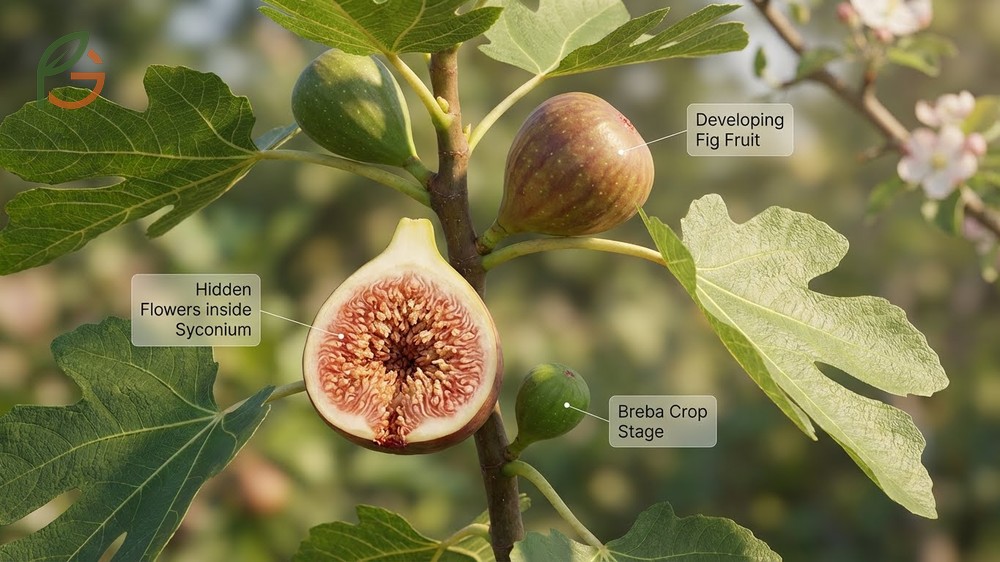
Fig trees don’t bloom like apple or cherry trees with visible flowers covering their branches. Instead, their flowers develop inside the syconium—that bulbous structure that eventually becomes the fig fruit. You can’t see these blooms from the outside, which leads many gardeners to wonder if fig trees flower at all. The answer is yes, but the blooming happens entirely within the developing fruit.
Most fig varieties follow a two-crop pattern. The first crop, called breba, forms on last year’s wood and appears in late spring to early summer. These figs started as tiny buds the previous growing season, overwintered on the tree, then resumed development when warm weather returned. The main crop develops on new growth produced during the current season and ripens from late summer through early fall.
Timing varies significantly by climate zone and variety. In warm regions like southern California or Florida, fig trees might break dormancy as early as March, with breba figs appearing by May or June. In cooler areas like the Pacific Northwest or mid-Atlantic states, dormancy might extend into April, pushing the breba harvest to July. The main crop typically follows 30-45 days after the breba harvest concludes.
Breba Crop Timing
The breba crop emerges from buds positioned in the top 4-6 nodes of branches that grew the previous year. These buds develop during the prior summer, enter dormancy in fall, then activate when spring temperatures consistently reach 60-65°F (15-18°C). Not all fig varieties produce brebas—only bifara types like Brown Turkey, Desert King, and Violette de Bordeaux reliably yield this early harvest.
Breba figs take approximately 90-120 days from bud break to ripeness. They’re generally larger than main crop figs but often less flavorful since they developed during cooler conditions. The ripening window for brebas is remarkably short—just 5-15 days—so you’ll need to monitor them closely once they start sizing up. Miss that window and they’ll split, sour, or attract pests.
Main Crop Development
The main crop forms on new wood produced during the current growing season, with tiny figs appearing as branch tips extend in late spring and early summer. These figs grow alongside leaves on fresh stems, unlike brebas which emerge from bare branches before foliage fully develops. All fig varieties produce a main crop, making it the more reliable harvest for gardeners in areas where winter damage prevents breba production.
Main crop figs typically ripen 70-90 days after formation, depending on variety classification. Early varieties like Olympian or Lattarula might be ready by mid-July, while midseason types like Black Mission peak in August, and late varieties such as Marseilles can extend into October. The ripening window is longer than breba—about 30-60 days—giving you a more extended harvest period.
- Climate zone: USDA zones 7-9 experience typical two-crop patterns; zone 6 often loses brebas to frost
- Variety selection: Bifara types produce two crops; unifera varieties yield only main crop figs
- Winter protection: Trees with protected roots and branches maintain more breba-producing wood
- Spring temperatures: Consistent warmth above 60°F (15°C) triggers bud break and flowering initiation
- Pruning timing: Heavy winter pruning removes breba buds, reducing or eliminating the first crop
Timing Tip: Fig flowers inside the syconium mature over 2-3 weeks before the fruit is ready for wasp entry. If you’re growing Smyrna varieties that need caprification, hang caprifig branches near your trees when receptive figs show their first signs of softening.
Parthenocarpic Figs
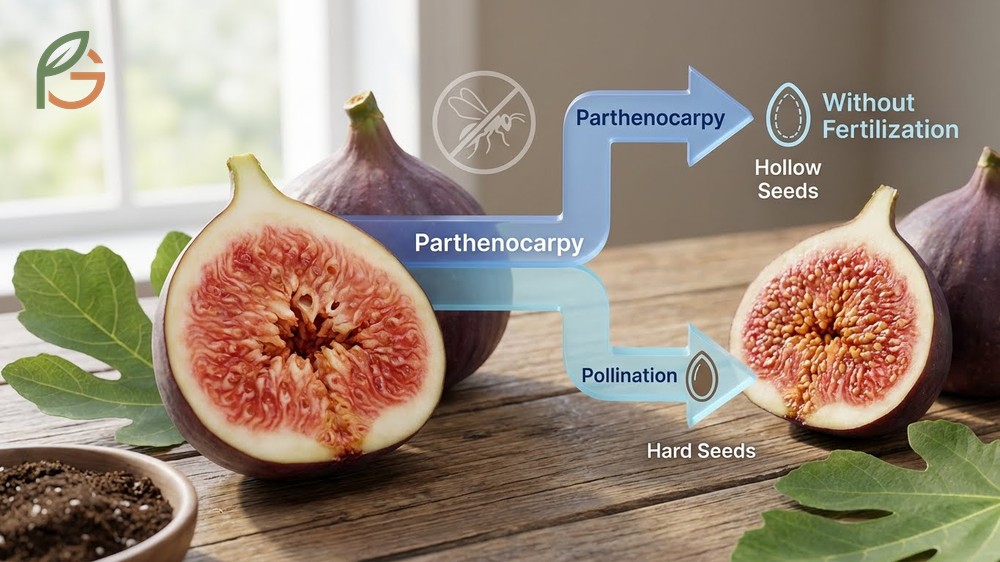
Parthenocarpy refers to fruit development without fertilization—the plant produces fruit tissue that ripens normally even though no seeds were pollinated. Common figs evolved this trait, allowing them to develop fully ripe figs containing hollow seeds rather than the hard, crunchy seeds that result from pollination. This adaptation freed them from dependence on fig wasps, enabling cultivation in regions where pollinators don’t exist.
Research shows that parthenocarpic figs still contain hundreds of unfertilized ovules that look like seeds but remain soft and nearly imperceptible when you bite into the fruit. These hollow seeds contribute minimal texture compared to the crunchy, fertilized seeds found in pollinated Smyrna figs. That’s why Brown Turkey and Black Mission figs taste smooth and jammy, while Calimyrna figs offer a distinct nutty crunch from their fully developed seeds.
The practical advantage for home gardeners is significant—you can plant a single common fig tree and expect reliable harvests without worrying about pollination partners, fig wasps, or caprifigs. Varieties like Brown Turkey, Celeste, Chicago Hardy, and LSU Purple all exhibit strong parthenocarpic characteristics, making them perfect choices for backyard cultivation across diverse climate zones.
- Brown Turkey: Adaptable to zones 7-10, produces sweet figs with purple-brown skin and pink flesh
- Black Mission: Thrives in zones 8-10, known for rich flavor and excellent fresh eating quality
- Celeste: Cold-hardy to zone 6, small figs with intense sweetness and honey notes
- Chicago Hardy: Survives zone 5 with protection, reliable producer in challenging climates
- LSU Purple: Heat-tolerant for zones 7-10, resistant to splitting in humid conditions
- Violette de Bordeaux: Produces in zones 7-9, prized for complex berry-like flavor profile
Gardener’s Note: Even common figs labeled as “self-pollinating” aren’t actually pollinating themselves—they’re producing parthenocarpic fruit. That terminology confuses many beginners who then search for pollination partners they don’t need.
Dead Wasps in Figs
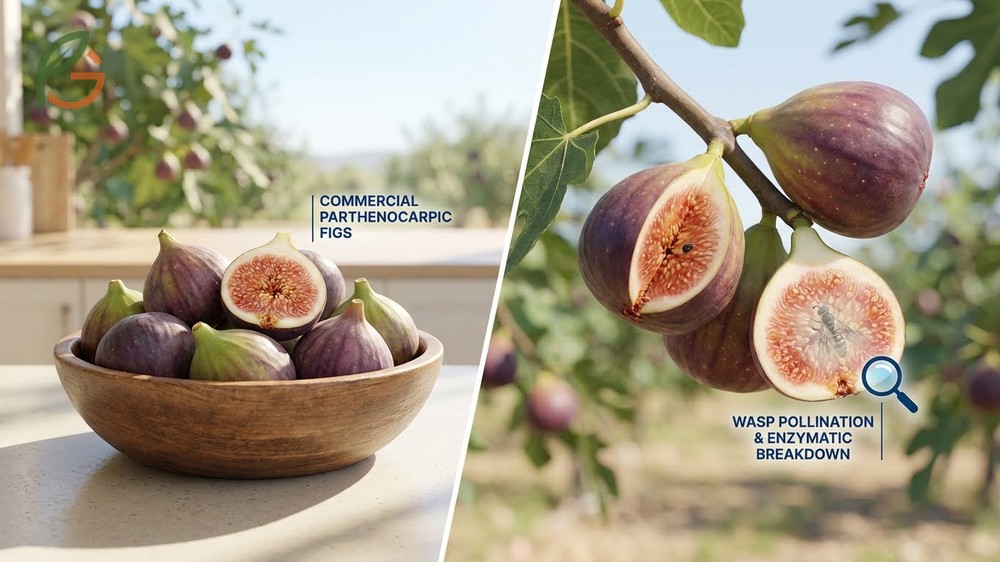
The question “are there dead wasps in my figs?” comes up constantly, and the answer depends on which figs you’re eating. Commercial figs grown in the United States—the ones you buy fresh or dried at grocery stores—almost never contain wasps because they’re parthenocarpic varieties that don’t attract pollinators. Even imported Smyrna figs that required pollination don’t contain recognizable wasp parts by the time they reach consumers.
When wasps do die inside figs, an enzyme called ficin (also spelled ficain) breaks down their proteins completely[3]. This proteolytic enzyme functions similarly to the papain in papayas or bromelain in pineapples, digesting the wasp’s body into amino acids that the fig absorbs as nutrients. The process takes several days, occurring as the fig continues ripening after the wasp’s death.
Those crunchy bits you feel when eating dried figs aren’t wasp fragments—they’re seeds. In parthenocarpic figs, the “seeds” are hollow, unfertilized ovules that stay soft. In pollinated figs like Calimyrna, the crunchy texture comes from hard seed coats surrounding actual embryos that developed after fertilization. Studies confirm that the distinctive nutty flavor and crunchy texture of dried Smyrna figs result from their mature seeds, not from insect content.
- Ficin enzyme breaks down wasp proteins into amino acids within days of the wasp’s death[3]
- Common figs (Brown Turkey, Black Mission, Celeste) never attract wasps because they’re parthenocarpic
- Male fig wasps die inside caprifigs, not in the edible figs you’d harvest or purchase
- Female wasps that enter edible Smyrna figs typically die there, but ficin digests them completely
- FDA standards for fig paste allow minimal insect fragments, but these come from field contamination, not from the pollination process
- The crunchy texture in dried figs comes from hard seed coats formed after successful pollination, not from wasp chitin
Food Safety Note: Even in pollinated fig varieties, you’re not consuming wasp parts. The ficin enzyme completely digests any wasps that died inside, converting them to amino acids the plant absorbs. What remains is 100% plant material—fig flesh and seeds.
Conclusion
The evidence is clear: fig trees and wasps evolved together over 60 million years[1], creating a pollination system so specialized that each of approximately 750 Ficus species depends on a unique wasp partner. Yet human cultivation broke that dependence for most varieties, selecting parthenocarpic types that produce abundant fruit without any pollination at all. Current guidance emphasizes growing common fig varieties for home gardens, as they’ll thrive and produce reliably without the complexity of maintaining caprifigs or attracting pollinators.
Whether you’re planting your first fig tree or expanding an existing orchard, understanding this biology helps you choose the right variety for your situation. FruitGarden brings together botanical research and practical cultivation experience to help gardeners make informed decisions about which figs work best in their specific climate zones and growing conditions.
Frequently Asked Questions
Does a fig tree flower?
Yes, fig trees flower, but their blooms develop inside the syconium—the structure that becomes the fruit. You can’t see these flowers from the outside because they’re completely enclosed within the bulbous fig itself. The syconium contains hundreds of tiny unisexual flowers that bloom internally before the fig ripens.
Are fig trees self-pollinating?
Common figs aren’t self-pollinating—they’re parthenocarpic, meaning they develop fruit without any pollination at all. Smyrna figs require cross-pollination from caprifigs via fig wasps. San Pedro varieties produce a first crop without pollination but need wasp pollination for their main crop. Only common fig varieties truly bypass the pollination requirement entirely.
How long do fig wasps live?
Adult female fig wasps live just 1-2 days once they emerge from their birth fig[2]. During this brief window, they must locate a receptive fig, enter it, pollinate flowers, and lay eggs. The entire development from egg to adult takes about 2-3 weeks inside the fig syconium.
What happens to wasps that die inside figs?
An enzyme called ficin breaks down any wasps that die inside figs, digesting their proteins into amino acids that the fig absorbs[3]. This process completes within days as the fig ripens. You won’t find wasp remains in ripe figs—the enzyme converts them entirely into plant-usable nutrients.
When do fig trees bud in spring?
Fig trees break dormancy and begin budding when spring temperatures consistently reach 60-65°F (15-18°C). In warm regions like southern California or Florida, this can happen as early as March. In cooler zones like the mid-Atlantic or Pacific Northwest, bud break might not occur until late April or early May. Breba figs from overwintered buds appear first, followed by new growth that will produce the main crop.
What’s the difference between a caprifig and an edible fig?
Caprifigs are functionally “male” trees that produce inedible fruit containing both male pollen-producing flowers and short-styled female flowers where wasps lay eggs. Edible figs are “female” trees with only long-styled flowers that get pollinated but can’t support wasp reproduction. Caprifigs serve as pollen sources for Smyrna-type edible figs that require pollination to develop properly.
How many fig species exist worldwide?
Approximately 750 Ficus species exist worldwide[1], distributed primarily in tropical and subtropical regions. Each species typically depends on a unique fig wasp species for pollination, creating 750+ specialized pollination partnerships. The cultivated edible fig, Ficus carica, represents just one of these many species.





