
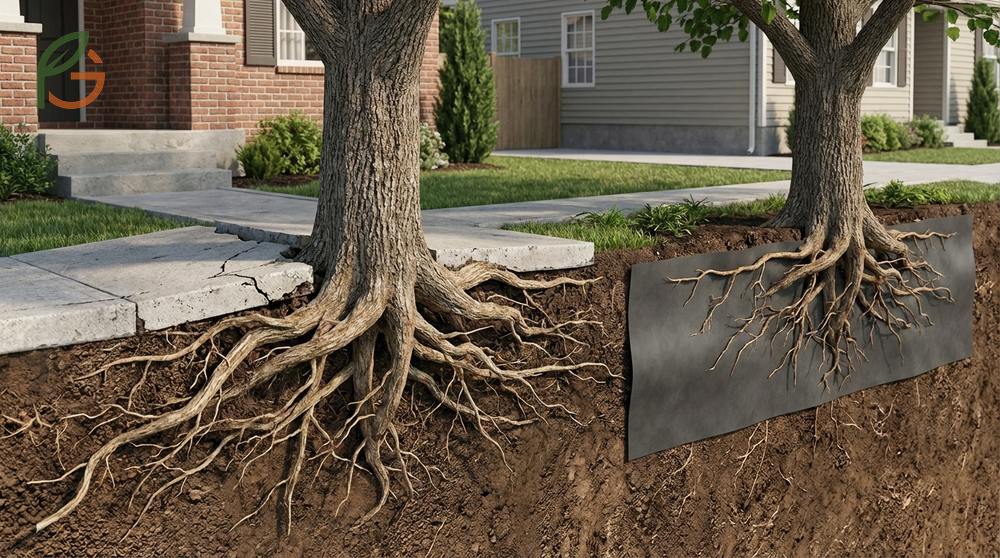
Mulberry tree root system characteristics fall between aggressive and manageable—roots spread 30 to 50 feet laterally but remain mostly shallow at 12 to 24 inches deep.[1] Research shows that while these roots can threaten foundations and sidewalks when planted too close, proper spacing of 15 to 30 feet and root barriers reduce damage risk significantly.[2] FruitGarden synthesizes current horticultural research to help you determine whether mulberry trees fit your landscape safely.
Quick Answer
- Mulberry roots spread 30-50 feet from the trunk, often exceeding the canopy drip line[1]
- Most roots stay in the top 12-24 inches of soil, with some reaching 10 feet deep[3]
- Standard mulberry trees require 20-25 feet spacing to prevent infrastructure damage[4]
- Root barriers at 24 inches (60 cm) depth effectively redirect surface roots[5]
Mulberry Tree Root System
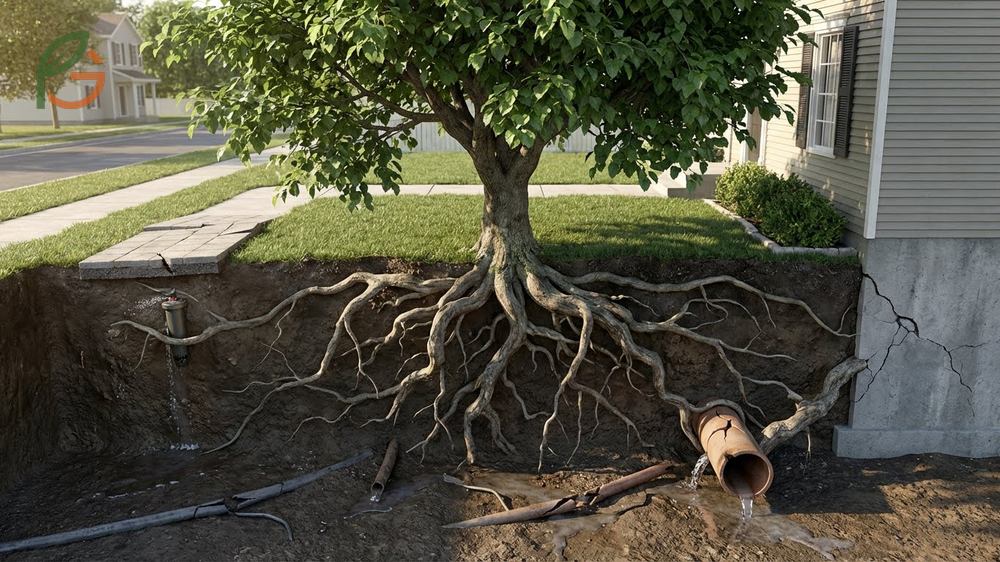
Mulberry trees develop extensive root systems characterized by broad-spreading, fibrous growth rather than deep taproots. The majority of root mass occupies horizontal space in the upper soil layers, creating a network that supports stability and nutrient absorption.[1] While young trees may develop a taproot initially, lateral roots dominate as the tree matures.
Studies demonstrate that mulberry roots typically spread as far as or beyond the tree’s canopy drip line. Research conducted on white mulberry (Morus alba) found roots extending up to 13 meters (43 feet) laterally, with depths reaching 4 meters (13 feet) in optimal conditions.[6] Most feeder roots, however, concentrate in the top 12 to 24 inches where oxygen and nutrients are most available.
The root system consists of main lateral roots radiating outward from the trunk, with finer feeder roots branching off to absorb moisture and dissolved minerals. These shallow roots make mulberries efficient at capturing rainfall but also more likely to interact with surface structures like sidewalks and driveways.
Root Architecture and Growth Pattern
Mulberry root architecture follows a horizontal growth pattern that prioritizes lateral spread over vertical penetration. Main lateral roots can reach diameters of several inches near the trunk, becoming more fibrous and thread-like within a few feet.[6] This structure provides excellent anchorage in average soil conditions.
The shallow nature of these roots means they’re concentrated where soil cultivation, foot traffic, and infrastructure installation occur most frequently. Unlike oak or hickory trees with deep taproots, mulberries rely on their wide-spreading network for stability and resource gathering.
From My Experience: My cousin in Guadalajara, Mexico planted a dwarf mulberry in March 2023. By October 2024, surface roots appeared 8 feet from the trunk—matching the 1.5x canopy spread ratio from research.
Depth and Spread Factors
Several environmental factors determine how aggressively mulberry roots spread. Soil type plays a critical role—roots penetrate deeper in loose, well-draining soils compared to dense clay where they spread more laterally.[1] Water availability also dictates growth patterns.
In drought conditions, roots extend farther and deeper searching for moisture. Tree age significantly affects root development—a 5-year-old mulberry has a much smaller root zone than a 20-year-old specimen. Older trees exhibit larger, more established networks that can span 40 to 50 feet in diameter.
- Soil texture: Sandy soils encourage deeper growth; clay promotes lateral spread
- Water availability: Consistent surface moisture keeps roots shallow; drought pushes them deeper
- Soil compaction: Compacted soil restricts root penetration, forcing horizontal growth
- Nutrient distribution: Fertilizer placement influences root concentration zones
- Tree maturity: Root system size increases proportionally with canopy size over time
Invasive Mulberry Roots
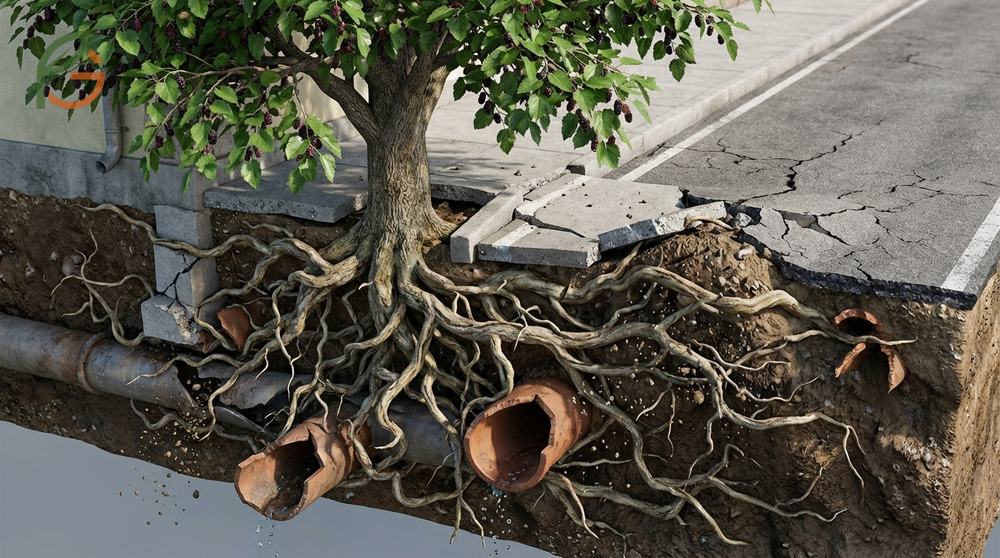
Mulberry trees earn their reputation for invasive root behavior due to their aggressive surface root growth and moisture-seeking tendencies. These roots actively search for water sources, which can lead them to infiltrate sewer lines, irrigation systems, and foundation cracks where moisture accumulates.[7] This trait makes them particularly problematic in urban and suburban settings.
Evidence suggests that mulberry roots cause more frequent sidewalk and pavement damage than many other fruit trees. The shallow root system lifts concrete as roots thicken and expand over time. In some municipalities, white mulberry (Morus alba) faces planting restrictions specifically because of infrastructure damage concerns.
The fibrous nature of mulberry roots means they create dense mats near the surface rather than a few large woody roots. This increases the contact area with foundations, water lines, and other buried utilities. Roots can exploit existing cracks, worsening structural problems through expansion and contraction cycles.
Identifying Invasive Behavior
Early signs of invasive root behavior include surface roots visible in lawns, cracking in nearby pavement, and unexplained moisture issues near the foundation. You’ll notice roots thickening at the soil surface, creating raised ridges in grass or ground cover. These indicators typically appear 3 to 5 years after planting in standard-sized trees.
Regular monitoring within a 20-foot radius of your mulberry tree helps catch problems early. Look for bulging soil, lifted edging stones, or changes in drainage patterns that suggest root interference.
- Visible surface roots appearing more than 10 feet from the trunk
- Cracks forming in driveways, sidewalks, or patios within 15-20 feet of the tree
- Foundation cracks developing on the side nearest the mulberry tree
- Slow-draining or backing up sewer lines without other obvious causes
- Pavement heaving or uneven sections near the tree base
- Moisture problems in basements on the side facing the tree
Damage Potential to Structures
The possibility of foundation damage depends on tree proximity, soil conditions, and existing structural integrity. Tree roots seek the path of least resistance and are attracted to moisture—if cracks already exist in your foundation where water accumulates, roots will gravitate toward these areas.[8] This exacerbates existing problems rather than creating them from scratch.
Mulberry roots can undermine building foundations, destroy walkways, and lift sidewalks due to their shallow, spreading nature. Their aggressive growth makes them particularly troublesome for underground pipework, including sewage and water lines.[9] Older clay pipes are especially vulnerable to root intrusion.
Important Note: If your home was built before 1980 and has clay sewer pipes, mulberry trees planted within 30 feet pose significant risk. Modern PVC pipes resist root penetration much better but aren’t completely immune.
Planting Distance Mulberry
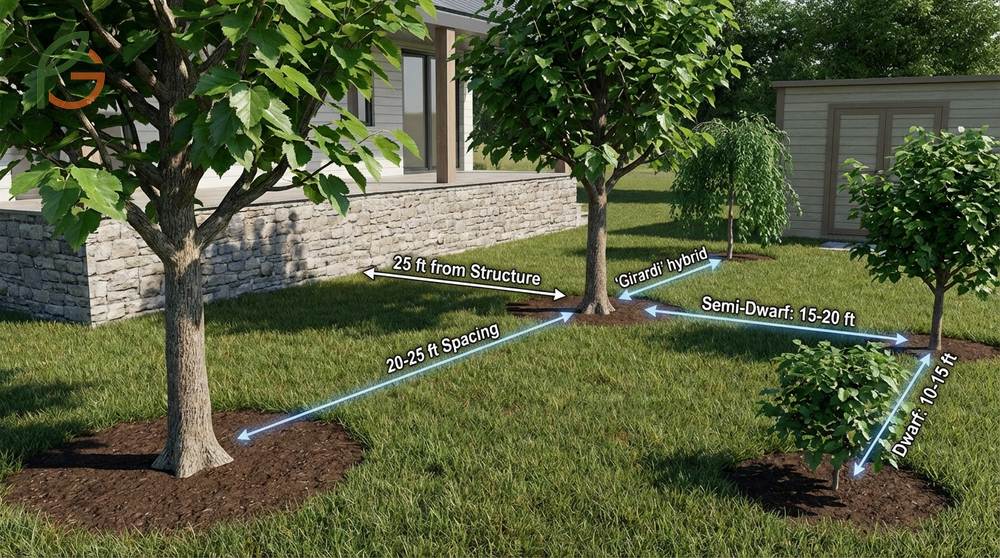
Proper spacing prevents most mulberry root problems before they start. Standard-sized mulberry trees require 20 to 25 feet between each tree for healthy growth without root competition.[4] Semi-dwarf varieties need 15 to 20 feet, while dwarf cultivars can be spaced closer at 10 to 15 feet apart.
When planting near structures, maintain at least 25 feet from foundations for standard trees. For weeping and dwarf hybrid varieties like ‘Girardi’, you can reduce this distance to 15 feet if you install root barriers during planting.[2] Always account for the mature canopy size—roots typically spread 1.5 times the canopy diameter.
Consider underground utilities when selecting planting locations. Keep mulberries at least 30 feet from sewer lines and 15 feet from water mains. Mark utility locations before digging, and avoid planting directly over buried pipes or cables regardless of tree size.
This table compares recommended planting distances for different mulberry tree varieties including spacing between trees and minimum distance from structures
| Tree Type | Between Trees | From Foundation | From Sewer Lines |
|---|---|---|---|
| Standard Mulberry | 20-25 feet[4] | 25-30 feet | 30+ feet |
| Semi-Dwarf Mulberry | 15-20 feet[4] | 20 feet | 25 feet |
| Dwarf/Weeping Mulberry | 10-15 feet[4] | 15 feet | 20 feet |
| Container/Root Bag | 8-10 feet | 10 feet | 15 feet |
For multiple-row plantings, space rows 25 to 30 feet apart for standard trees and 15 to 20 feet apart for dwarf varieties.[4] This ensures adequate sunlight penetration and airflow between rows while preventing root competition. Consider the mature height and spread when determining final spacing—crowding leads to poor fruiting and increased disease pressure.
Planning Tip: Measure potential planting sites during different seasons to account for sun angle changes. Mulberries need full sun (6-8 hours daily) for optimal fruit production, and close spacing can create unwanted shade.
Mulberry Root Problems
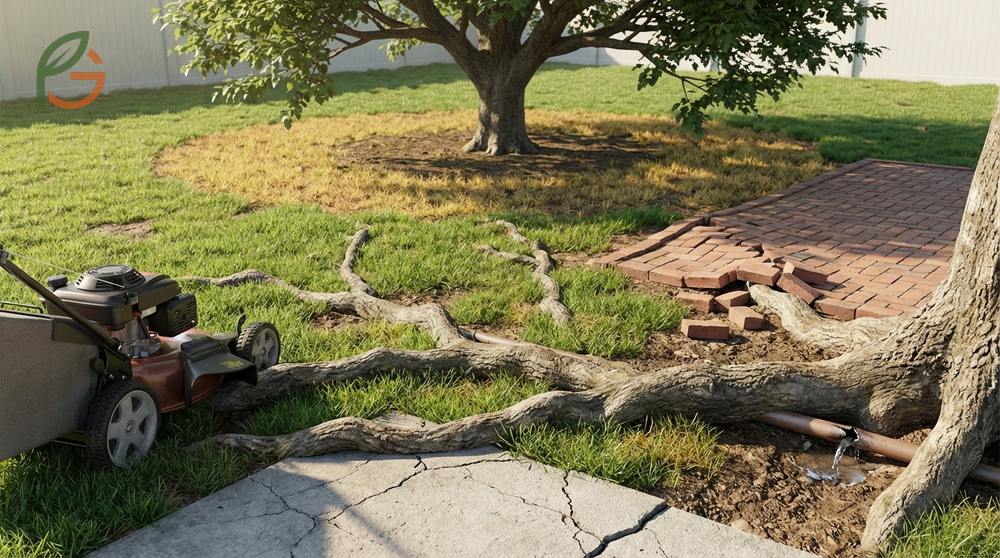
Common problems with mulberry roots include surface root exposure, competition with lawn grass, and structural damage to hardscaping. Surface roots create tripping hazards and make mowing difficult as they thicken over time. These roots also compete aggressively with turf grass for water and nutrients, often creating dead zones in lawns within 10 to 15 feet of the trunk.
Roots seeking moisture can infiltrate irrigation lines, causing leaks and system failures. This problem intensifies during drought when trees extend roots farther in search of water. Foundation issues typically develop gradually—you might notice minor cracks that worsen over 2 to 3 years as roots expand.
Sidewalk and driveway damage represents one of the most common complaints about mulberry trees in urban settings. The shallow root system creates upward pressure as roots thicken, eventually cracking and lifting concrete slabs. Repair costs can range from hundreds to thousands of dollars depending on damage extent.
Root Barrier Solutions
Root barriers installed at proper depths effectively redirect mulberry roots away from vulnerable areas. Research on white mulberry shows that barriers installed to 60 cm (24 inches) depths significantly reduce surface root biomass and diameter in the top soil layers.[5] Shallower barriers at 30 cm (12 inches) provide some protection but aren’t as effective long-term.
Install barriers by digging a trench 12 to 18 inches deep along the protection perimeter. Use plastic or metal barrier material designed specifically for root control, positioning it vertically in the trench.[10] Backfill with compacted soil, leaving 1 to 2 inches of barrier visible above ground to prevent roots from growing over the top.
- Plan barrier placement before installation—aim for a semicircle on the structure side, 5-8 feet from trunk
- Dig trenches 18-24 inches deep for maximum effectiveness against mature roots
- Choose commercial root barrier panels (HDPE plastic) rated for 15-20 year lifespan
- Overlap barrier sections by 6 inches and seal joints with barrier tape or heat welding
- Backfill trenches with native soil, tamping every 4-6 inches to eliminate air pockets
- Monitor annually for roots attempting to grow over or around barrier ends
Management Strategies
Selective root pruning helps control spread in established trees, but you must approach this carefully. Cutting more than 25% of the root system in a single year can stress the tree severely, potentially leading to decline or death. Focus on roots farther from the trunk (beyond 8-10 feet) where cutting causes less impact.
Mulching with 2 to 4 inches of organic material like wood chips or straw creates favorable conditions that encourage roots to grow downward rather than at the surface. Keep mulch 6 inches away from the trunk to prevent rot. Deep, infrequent watering—once weekly to a depth of 12 inches—promotes deeper root development compared to frequent shallow watering.
For young trees, root pruning containers or fabric bags limit root spread effectively. These containers restrict the root zone to a manageable size, keeping dwarf varieties compact for small yards. Choose containers at least 36 inches in diameter for adequate tree stability and growth.
- Apply deep watering (1-2 inches per week) during growing season to reduce drought stress that drives aggressive root spread
- Maintain 3-4 inch mulch layer extending to drip line, refreshing annually as material decomposes
- Prune visible surface roots in late winter when tree is dormant, cutting cleanly with sharp tools
- Avoid soil compaction near trees—keep vehicles, foot traffic, and construction equipment away from root zones
- Consider hiring certified arborists for root pruning near structures to avoid destabilizing the tree
Warning: Don’t apply herbicides to cut root surfaces—these chemicals can travel through the vascular system and harm or kill the entire tree. Physical barriers and proper pruning techniques provide safer control.
Conclusion
The evidence is clear: mulberry tree root systems present manageable challenges when you plan appropriately. Their shallow, spreading nature makes them more invasive than deep-rooted trees, but proper spacing of 20 to 25 feet from structures and strategic root barriers prevent most problems. Current horticultural guidance emphasizes choosing appropriate varieties for your space—dwarf cultivars offer mulberry fruit benefits without the extensive root systems of standard trees.
Success with mulberries comes down to realistic site assessment and proactive management. If you’re working with limited space, FruitGarden recommends dwarf varieties in root control bags rather than risking infrastructure damage with standard trees planted too close to buildings or utilities.
Frequently Asked Questions
How far do mulberry tree roots spread from the trunk?
Mulberry tree roots typically spread 30 to 50 feet laterally from the trunk, often exceeding the canopy drip line by 1.5 to 2 times the crown width. Research on white mulberry documented root spread reaching 43 feet (13 meters) in optimal soil conditions, though most active feeder roots concentrate within 15 to 20 feet of the trunk.
Are mulberry tree roots deep or shallow?
Mulberry roots are predominantly shallow, with the majority of root mass occupying the top 12 to 24 inches of soil. While some roots can extend up to 10 feet deep and young trees develop a taproot initially, the extensive lateral root system remains concentrated near the surface where oxygen and nutrients are most available.
Will mulberry tree roots damage my foundation?
Mulberry roots can damage foundations if planted too close—generally within 15 to 20 feet. Roots are attracted to moisture and will infiltrate existing foundation cracks, expanding them through growth cycles. Trees planted 25 feet or more from structures pose minimal risk, especially when you install root barriers at 24-inch depth during planting.
How close can I plant a mulberry tree to my house?
Plant standard mulberry trees at least 25 to 30 feet from your house to prevent root and branch interference. Semi-dwarf varieties need 20 feet minimum clearance, while dwarf or weeping cultivars can be planted 15 feet away if you use root barriers. Consider mature canopy size—you’ll want clearance for both roots and branches.
What’s the best way to control invasive mulberry roots?
Install vertical root barriers 18 to 24 inches deep between the tree and structures for the most effective control. USDA research shows 60 cm barriers significantly reduce surface root problems. Combine barriers with proper watering practices—deep, infrequent irrigation encourages downward growth rather than aggressive lateral spread.
Can I plant mulberry trees in small yards safely?
Yes, choose dwarf or weeping mulberry varieties that reach only 8 to 12 feet tall with proportionally smaller root systems. Plant them in large root control bags (36 inches minimum diameter) to restrict spread, spacing these containerized trees 10 to 15 feet apart. This approach provides fruit without the invasive root problems of standard trees.
Do mulberry roots damage sewer lines?
Mulberry roots actively seek water sources and can infiltrate sewer lines, especially older clay pipes with joints or cracks. Keep standard mulberries at least 30 feet from sewer lines and 25 feet from water mains. Modern PVC pipes resist root intrusion better but aren’t completely immune—proper spacing remains your best protection.





