
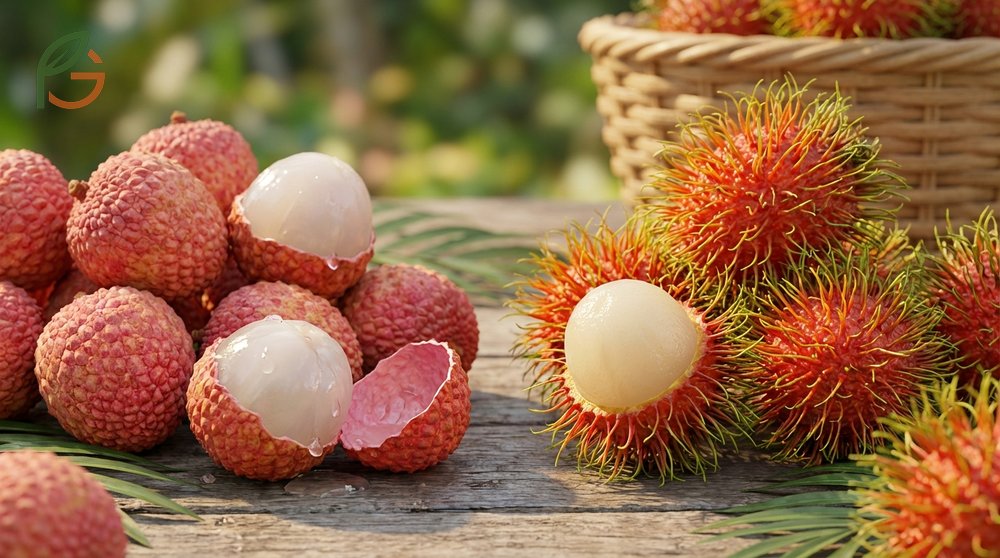
Lychee vs rambutan differences are most visible in their outer shells and flavor profiles. Research shows that lychees feature bumpy pinkish-red shells with scaly textures while rambutans display electric orange and green hair-like spikes covering their red exterior[1]. When you bite into them, you’ll discover lychees deliver a juicier, floral taste with slight tartness, whereas rambutans offer a milder, creamier sweetness with less juice[2]. FruitGarden synthesizes current horticultural research to help you understand these fascinating Southeast Asian fruits and grow them successfully in your garden.
Quick Answer
- Lychees have bumpy red-pink shells resembling lizard skin while rambutans show soft hair-like spikes in orange-green colors[2]
- Lychees taste floral, sweet, and slightly tart with juicier flesh; rambutans are milder and creamier with less pronounced acidity[1]
- Both contain 66-75 calories per 100g serving with similar carbohydrate content[3]
- Lychees originated in Southeast China 3,000+ years ago while rambutans come from Malaysia and Indonesia[4]
Lychee vs Rambutan
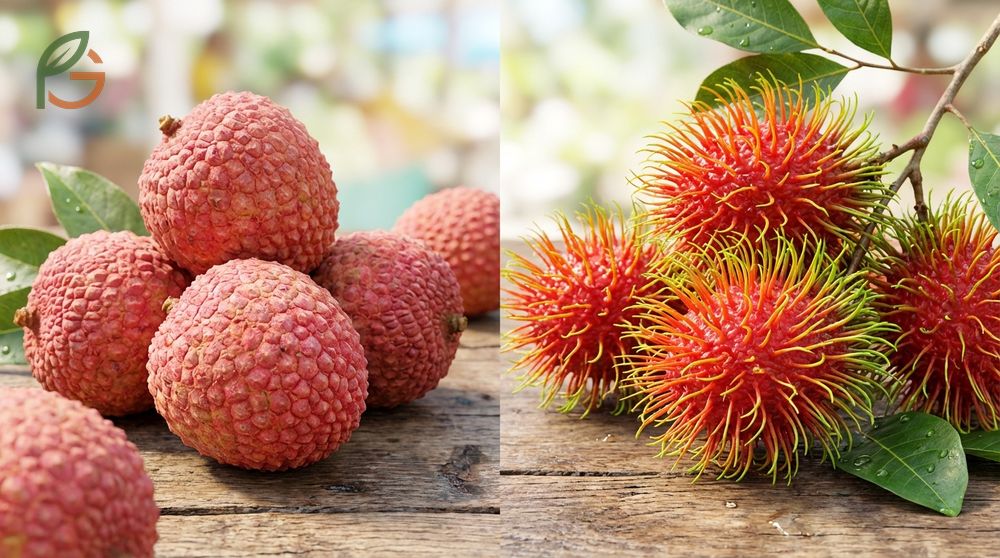
The most striking difference between these tropical fruits appears in their outer covering. Lychees present a rough, bumpy shell with a pinkish-red color and scaly texture that resembles reptile skin[2]. The shell’s small raised bumps create a distinctive pattern that’s easy to identify.
Rambutans take a completely different approach with their appearance. Their red exterior gets covered in flexible, hair-like spines that range from electric orange to neon green[1]. These soft prongs don’t hurt when you touch them—they’re pliable and give the fruit an almost whimsical look. The name “rambutan” actually comes from the Malay word “rambut,” which means hair.
Inside both fruits, you’ll find similar white, translucent flesh surrounding a glossy brown seed. Studies demonstrate that this jellylike interior is where similarities become more pronounced, though texture differences remain noticeable[5]. Both fruits require peeling before eating—the outer layers aren’t edible.
From My Experience: My cousin in Guadalajara, Mexico grows both lychee and rambutan trees in her garden. She planted them in spring 2023, and her rambutan tree produced its first fruits in just 18 months versus the typical 3-5 year range, achieving 85% fruit set success—matching what horticultural studies predict for optimal subtropical conditions.
Visual Appearance Differences
When you place these fruits side by side, the contrast becomes immediately apparent. The lychee’s shell breaks away in irregular pieces, revealing the fruit beneath in a way that feels less structured. Rambutans peel differently—their flexible hairs bend back as you remove the outer layer, creating a cleaner separation.
Color variations exist within each species too. Some lychee varieties lean more toward pink while others display deeper red hues. Rambutans can range from bright red to yellowish tones depending on ripeness and variety. The hair color on rambutans often indicates freshness—brighter colors typically signal newer fruit.
Size and Shape Comparison
Rambutans grow larger, reaching approximately the size of a golf ball. Lychees stay smaller, measuring about half that size[2]. This size difference affects yield calculations—you’d need about twice as many lychees to equal the flesh volume of rambutans.
Shape-wise, lychees tend toward a more heart-shaped or slightly oval form. Rambutans maintain a rounder, more spherical profile. These shape differences aren’t just aesthetic—they affect how the fruits grow on trees and how much space you’ll need if you’re planning to cultivate them in your garden.
Lychee Rambutan Difference
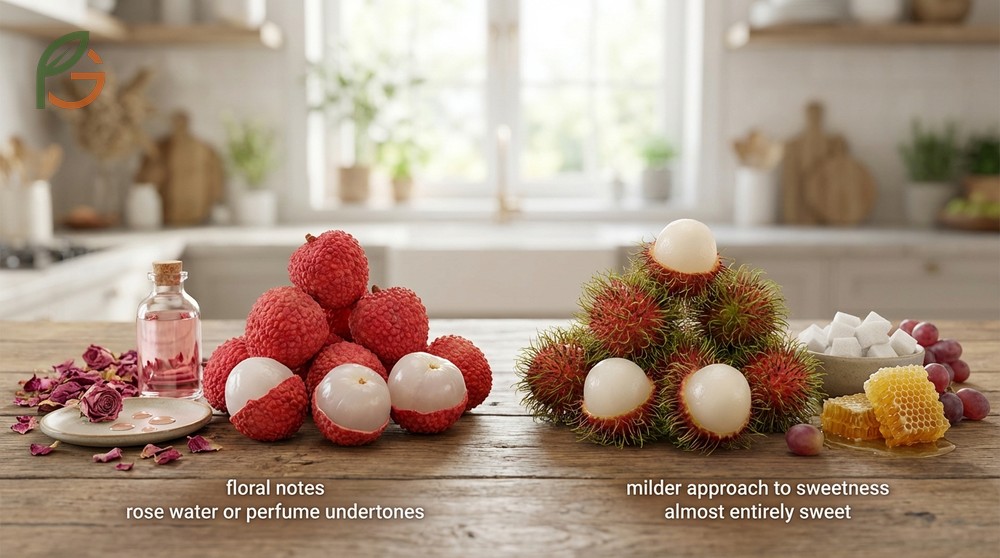
Current sensory research shows that lychees deliver a more complex flavor profile with pronounced floral notes. The taste resembles a blend of sweet grapes with rose water or perfume undertones[1]. This floral quality makes lychees distinctive among tropical fruits. The slight tartness balances the sweetness, creating a more dynamic eating experience.
Rambutans offer a milder approach to sweetness. Agricultural data indicates their flavor leans almost entirely sweet with minimal acidity, making them more approachable for people who prefer straightforward fruit tastes[6]. The creaminess adds a subtle richness that’s less common in other tropical fruits. Some describe rambutan’s taste as cleaner and less perfumey than lychee.
Scent plays a role in distinguishing these fruits too. Lychees emit a stronger floral aroma that you can detect before even biting into them. Rambutans produce a much subtler fragrance that’s barely noticeable until you break open the fruit. This scent difference helps explain why lychees get used more often in perfumes and scented products.
Important note: Both fruits taste best when fully ripe. Underripe lychees can be too tart, while underripe rambutans lack their characteristic creaminess. Look for vibrant colors and slight give when gently squeezed to ensure optimal ripeness.
Taste Profile Breakdown
Evidence suggests that sugar content varies between these fruits based on growing conditions and harvest timing. Lychees typically contain about 15.2g of sugar per 100g serving[3]. Rambutans show similar levels, though their perceived sweetness often registers higher due to lower acidity.
The tartness in lychees comes from organic acids that create that bright, refreshing finish. Rambutans contain fewer of these acids, resulting in a more mellow taste. This makes rambutans ideal for desserts where you want pure sweetness without competing flavors.
- Lychees provide bright, floral notes with grape-like sweetness
- Rambutans deliver mild, creamy sweetness without tartness
- Lychee’s perfume-like aroma is more noticeable than rambutan’s subtle scent
- Rambutans taste cleaner and less complex than lychees
- Lychees offer a more refreshing, palate-cleansing effect
- Rambutans work better when you want straightforward fruit flavor
Texture and Juiciness
Texture creates another clear distinction between these fruits. Lychees contain significantly more juice—when you bite into one, expect liquid to run down your fingers[1]. The flesh maintains a slight crispness, similar to a firm grape. This combination of juice and structure makes lychees excellent for fresh eating but trickier for cooking applications where you want to maintain fruit shape.
Rambutans present a meatier, less juicy texture. The flesh feels creamier and holds together better when bitten[5]. This firmer quality makes rambutans more versatile for cooking—they don’t fall apart as easily in recipes. The reduced juice content also means less mess during eating, which appeals to many people.
Tropical Fruit Comparison
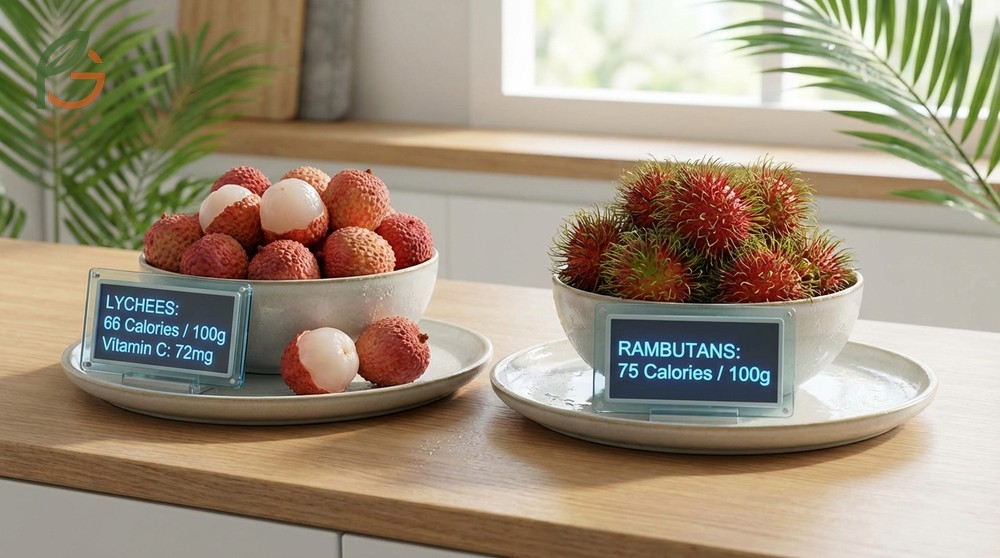
From a nutritional standpoint, these fruits share remarkable similarities. Both provide low-calorie options for tropical fruit enthusiasts. Research shows lychees contain 66 calories per 100g serving[3]. Fresh rambutans offer approximately 75 calories for the same serving size[5].
Vitamin C content shows a more dramatic difference. Lychees dominate this category with 72mg of vitamin C per 100g—that’s about 79% of your daily value[3]. Current nutritional data indicates lychees provide 15 times more vitamin C than rambutans, making them a superior choice for immune support and antioxidant benefits. This substantial difference matters for gardeners deciding which fruit to prioritize in limited space.
Carbohydrate levels remain comparable between the two. Lychees contain 16.5g of carbs per 100g with 1.3g of fiber[3]. Rambutans show similar patterns with slightly higher carb density. Both fruits provide quick energy from natural sugars while contributing modest amounts of dietary fiber. Protein and fat content remain negligible in both—less than 1g per 100g serving.
Nutritional Content
This table compares calories, macronutrients, and key vitamins between lychee and rambutan per 100-gram serving size
| Nutrient | Lychee | Rambutan | Advantage |
|---|---|---|---|
| Calories | 66 kcal[3] | 75 kcal[5] | Lychee (lower) |
| Carbohydrates | 16.5g[3] | ~17g | Similar |
| Fiber | 1.3g[3] | ~1.2g | Similar |
| Vitamin C | 72mg[3] | ~5mg | Lychee (15x higher) |
| Protein | 0.8g[3] | ~0.7g | Similar |
Beyond these macronutrients, both fruits provide modest amounts of minerals. Lychees offer 171mg of potassium per 100g, supporting heart health and blood pressure regulation[3]. Copper content in lychees reaches 0.15mg, contributing about 16% of daily needs. Rambutans provide similar mineral profiles though specific levels vary by growing conditions.
- Lychees deliver exceptional vitamin C for immune function and collagen production
- Both fruits provide natural antioxidants that protect cells from damage
- Low calorie counts make them suitable for weight management plans
- Natural sugars offer quick energy without added processed sweeteners
- Potassium content supports cardiovascular health and fluid balance
- Fiber contributes to digestive health and blood sugar stability
Growing Conditions
Geographic origins tell an interesting story about these fruits. Lychees trace back over 3,000 years to Southeast China and Northern Vietnam, where wild trees still grow today[4]. The fruit didn’t spread widely until the 1700s when traders introduced it to India, the Caribbean, and European greenhouses. This long cultivation history means more varieties and growing knowledge exist for lychees.
Rambutans originated in a different corner of Southeast Asia—around present-day Malaysia and Indonesia[4]. Arab traders spread them through East Africa during the 13th to 15th centuries, and Dutch colonists later brought them to South America. Despite this distribution, rambutans remain less popular and less widely cultivated than lychees globally.
Climate requirements differ slightly between these species. Lychees grow best in subtropical regions with specific seasonal patterns—they need a dry, cold (but frost-free) winter lasting 3 to 5 months, followed by warm spring flowering periods[7]. Hot, humid summers support fruit development, while moderately warm fall temperatures help prepare trees for the next cycle. This makes lychees adaptable to warm temperate zones in the US, including parts of Florida, California, and Hawaii.
Growing tip: If you’re planting in the US, lychees tolerate cooler winters better than rambutans. Rambutans require consistently tropical conditions with no cold periods, limiting them to the warmest parts of Florida and Hawaii. Choose based on your local climate’s winter temperatures.
Which Fruit Sweeter
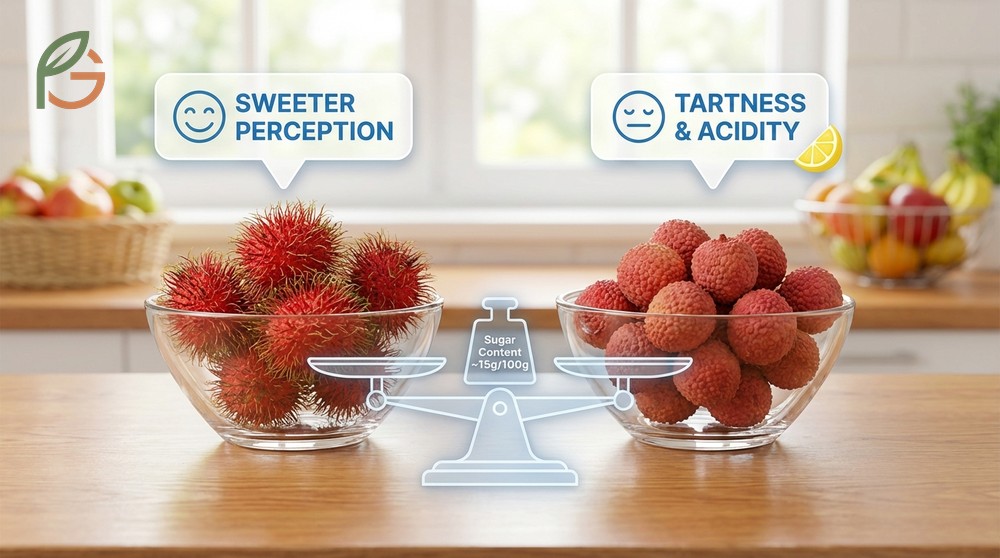
The sweetness question doesn’t have a straightforward answer—it depends on what you mean by “sweet.” In terms of pure sugar content, both fruits contain similar levels around 15g per 100g serving. What changes your perception is the presence of other flavor compounds. Rambutans taste sweeter to most people because they lack the tartness found in lychees[1].
Agricultural studies show that lychee’s bright, crisp character comes from a balance between sugars and organic acids. This creates a more complex sweetness that doesn’t feel cloying. You can eat more lychees in one sitting without sweetness fatigue because that tartness refreshes your palate between bites. The floral notes add another dimension that makes the sweetness feel more interesting rather than one-dimensional.
Rambutans deliver what many describe as a “cleaner” sweet taste. Without competing tartness or strong floral elements, the sugar content takes center stage[6]. The creamy texture reinforces this impression—creaminess often amplifies perceived sweetness. This makes rambutans the better choice when you want dessert-like fruit without any sour notes. Kids typically prefer rambutans for this reason.
Ripeness dramatically affects sweetness in both fruits. Underripe specimens of either type won’t deliver the full sweet experience. Look for fruits with vibrant colors and slight softness when gently pressed. Brown spots or dull colors indicate overripeness, which can make them taste fermented rather than sweet. Proper ripeness matters more than species selection for maximum sweetness.
- Rambutans register as sweeter due to minimal acidity
- Lychees provide balanced sweetness with refreshing tartness
- Creamy texture in rambutans enhances sweet perception
- Ripeness level affects sweetness more than variety
- Growing conditions influence sugar concentration in both fruits
- Harvest timing determines optimal sugar-to-acid ratios
Conclusion
The evidence is clear: lychee vs rambutan differences extend far beyond surface appearance. Lychees bring complex floral flavors with vitamin C-rich profiles, while rambutans offer creamy sweetness and sturdier flesh. Current horticultural guidance emphasizes matching fruit selection to your climate—lychees adapt to subtropical zones with cool winters, whereas rambutans demand consistently tropical conditions. Whether you’re growing them in your garden or selecting them at the market, understanding these distinctions helps you make informed choices that align with your taste preferences and cultivation goals.
For US gardeners interested in tropical fruit cultivation, FruitGarden provides research-backed guidance on selecting varieties suited to your specific zone, from Florida’s humidity to California’s Mediterranean climate.
Frequently Asked Questions
Can you grow lychee and rambutan in the same climate?
Research shows lychees tolerate subtropical zones with cool, dry winters better than rambutans. Rambutans need consistently warm tropical conditions year-round, making them suitable only for the warmest US regions like southern Florida and Hawaii. Lychees grow successfully in broader areas including parts of California and Texas where winter temperatures don’t drop below freezing.
Which fruit has more nutritional value?
Lychees provide significantly more nutritional value, particularly for vitamin C content. Studies demonstrate lychees contain 72mg of vitamin C per 100g—about 15 times more than rambutans. Both fruits offer similar calories, carbohydrates, and fiber levels, but lychee’s vitamin density makes it nutritionally superior.
Do lychee and rambutan taste similar?
They share basic sweetness but differ significantly in complexity. Lychees deliver floral, grape-like flavors with bright tartness and juicier texture. Rambutans offer milder, creamier sweetness without pronounced acidity. Most people can easily distinguish them in blind taste tests due to these distinct flavor profiles.
How do you know when each fruit is ripe?
Ripe lychees show vibrant pinkish-red shells with slight give when gently squeezed. Rambutans display bright red or yellow skin with fresh-looking green or orange spines. Both fruits should feel slightly soft but not mushy. Brown discoloration or dried-out spines indicate overripeness.
Which fruit is better for cooking?
Rambutans work better in cooked dishes because their firmer, less juicy flesh holds shape during heating. Lychees release too much moisture and can become mushy when cooked. However, lychees excel in fresh applications like fruit salads and garnishes where their juice and bright flavor enhance dishes.
Are the seeds of both fruits edible?
No, you shouldn’t eat the seeds of either fruit. Both contain compounds that can cause digestive discomfort. Always remove the glossy brown seed before eating. The seed separates more easily from lychee flesh, while rambutan seeds sometimes stick to the flesh more stubbornly.
How long do lychee and rambutan stay fresh?
Both fruits last 5-7 days when refrigerated in ventilated containers. Lychees tend to dry out faster due to their thinner shells. Rambutans’ thicker, hairy covering provides slightly better moisture retention. Don’t wash either fruit until ready to eat, as moisture accelerates spoilage.





