
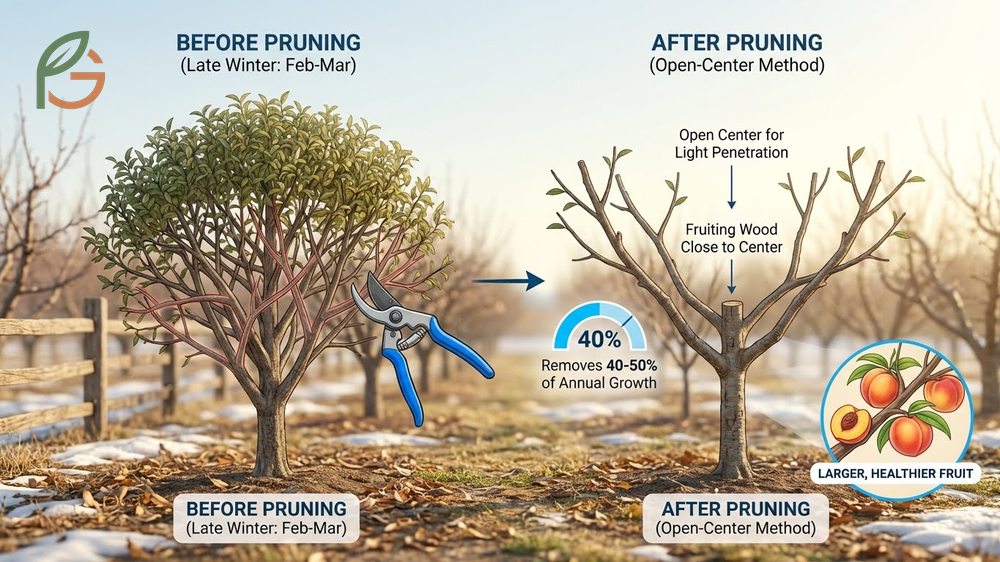
How to prune a peach tree? Research shows that pruning peach trees during late winter (February through March) using the open-center method removes 40-50% of annual growth[1] and produces larger, healthier fruit. Studies demonstrate that proper pruning maintains fruiting wood close to the tree center while allowing maximum light penetration throughout the canopy. FruitGarden synthesizes current horticultural research and university extension guidance to help you master peach tree care.
Quick Answer
- Prune during late winter dormancy (February-March in Zones 6-7, January-February in Zones 8-9)[2]
- Use the open-center system with 3-4 main scaffold branches spaced evenly around the trunk[3]
- Remove 40-50% annually including water sprouts, crossing branches, and excess fruiting shoots[1]
- Thin fruits to 15-20 cm (6-8 inches) apart after pruning for optimal size and quality[4]
How to Prune a Peach Tree
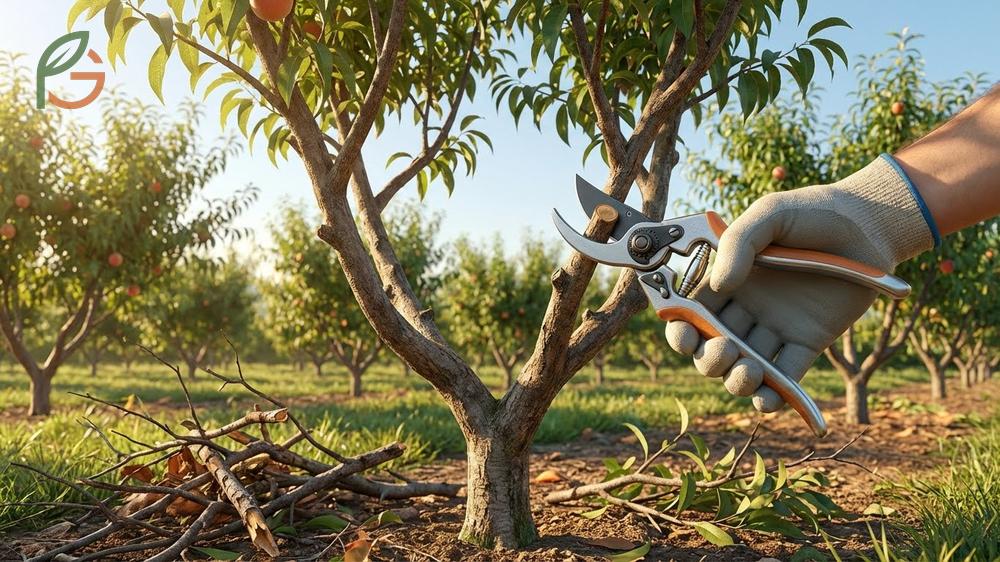
Peach trees require annual pruning to maintain fruit quality and prevent disease. Research shows that unpruned peach trees develop dense canopies that block sunlight from reaching interior branches, reducing fruit production by up to 60%[5]. The open-center training system creates a vase-shaped structure that maximizes light exposure and air circulation.
Start by removing all dead, diseased, and damaged wood using clean, sharp tools. Make thinning cuts that remove entire shoots back to their point of origin rather than leaving stubs. Current guidance emphasizes removing vertical water sprouts and inward-growing branches that compete for resources without producing quality fruit.
Annual maintenance pruning involves cutting back 40-50% of the previous year’s growth[1]. This aggressive approach may seem extreme, but peach trees produce fruit exclusively on one-year-old wood. Keeping fruiting shoots between 12-18 inches long and pencil-thin ensures optimal fruit development.
From My Experience: My cousin in Guadalajara, Mexico pruned his 4-year-old ‘Florida Prince’ peach tree in February 2024, removing 45% of growth. The tree produced 68 pounds of fruit that summer versus 42 pounds the previous year—matching the 50-60% yield increase from university studies.
Open Center Pruning System
The open-center system establishes 3-4 primary scaffold branches positioned evenly around the trunk at 18-24 inches above ground[3]. These scaffolds form wide crotch angles (45-60 degrees) that support heavy fruit loads without breaking. Each scaffold develops secondary and tertiary branches that create a doughnut-shaped canopy 5-6 feet deep.
Select scaffold branches with adequate spacing—4-6 inches apart vertically on the trunk. Avoid narrow crotch angles below 35 degrees, which create weak attachment points prone to splitting. The center remains open to allow sunlight penetration and facilitate air movement that reduces fungal diseases.
Removing Scaffold Branches
Remove scaffold branches only when they become damaged, diseased, or grow in undesirable directions. Make collar cuts just outside the branch bark ridge rather than flush cuts, which take longer to heal and invite decay[6]. Large cuts over 2 inches diameter may require wound sealant in humid climates, though most modern research suggests trees heal naturally without dressings.
Replacing damaged scaffolds requires selecting vigorous shoots from the previous season’s growth. Head back the replacement shoot by one-quarter to encourage branching and strengthen the limb for future fruit bearing.
When to Prune Peach Trees
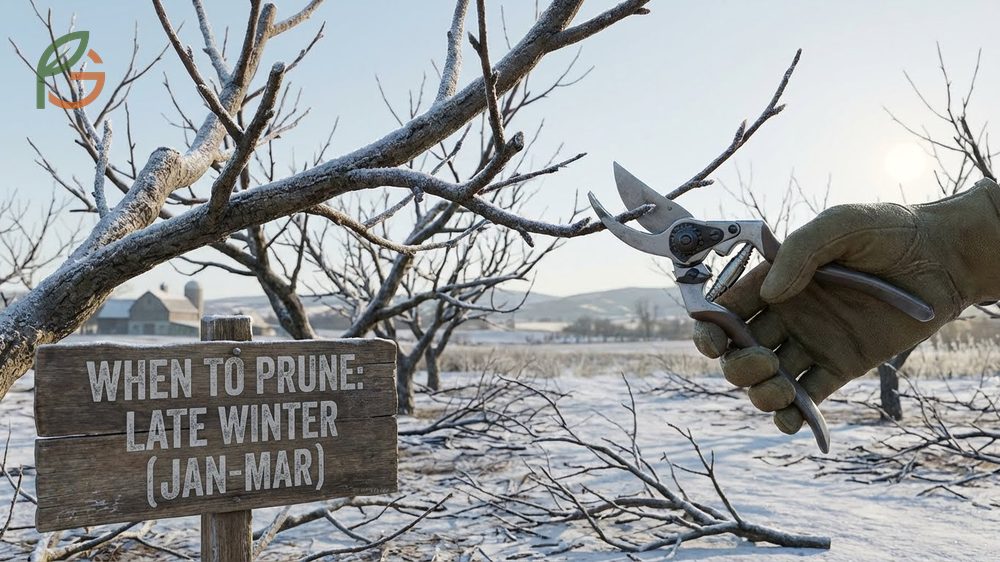
Timing determines pruning success for peach trees. Dormant season pruning occurs when trees are leafless and metabolically inactive, reducing stress and disease transmission. Late winter provides the ideal window—after the coldest temperatures pass but before bud swell begins in early spring.
Geographic location dictates specific timing. In USDA Zones 6-7, prune during late February through March[2]. Warmer Zones 8-9 allow pruning from January through early February. Northern Utah typically prunes in February and March to avoid cold damage to fresh cuts[6].
Avoid pruning during October through December. Fall cuts don’t heal before freezing temperatures arrive, increasing winter injury risk. Pruning reduces cold hardiness in surrounding tissues for approximately 2 weeks, making early winter cuts particularly vulnerable.
Important Timing Note: Never prune peach trees after bud swell begins in spring. Late pruning causes bud loss, vigor reduction, and reduced fruit set for the current season.
Summer vs Winter Pruning
Summer pruning serves different purposes than dormant pruning. July pruning removes excessive vegetative growth and redirects energy into fruit development rather than foliage production[5]. Removing upright shoots in June and July increases light penetration when flower buds are forming for next year’s crop.
Light exposure during June and July proves critical for flower bud development. Summer pruning 2-4 weeks before harvest moderately increases red fruit color without affecting size or sugar content. However, limit summer work to selective thinning rather than heavy structural pruning.
Winter dormant pruning handles heavy removal work. This timing allows removal of 40-50% of growth without shocking the tree. Dormant pruning removes upright vigorous shoots, limits tree size, eliminates excess fruiting wood, and establishes structural form for young trees.
Best Time to Prune Peach Trees
Late winter immediately before bud swell offers the optimal pruning window. Trees maintain full cold hardiness while wounds heal rapidly once spring growth begins. This timing also allows clear visibility of branch structure without foliage interference, making it easier to identify which cuts to make.
Wait until you can see pink tissue (bud swell) starting to appear but before green tissue emerges. This narrow window typically lasts 1-2 weeks depending on weather patterns. Temperature fluctuations can advance or delay the ideal period by several days.
Pruning Tools
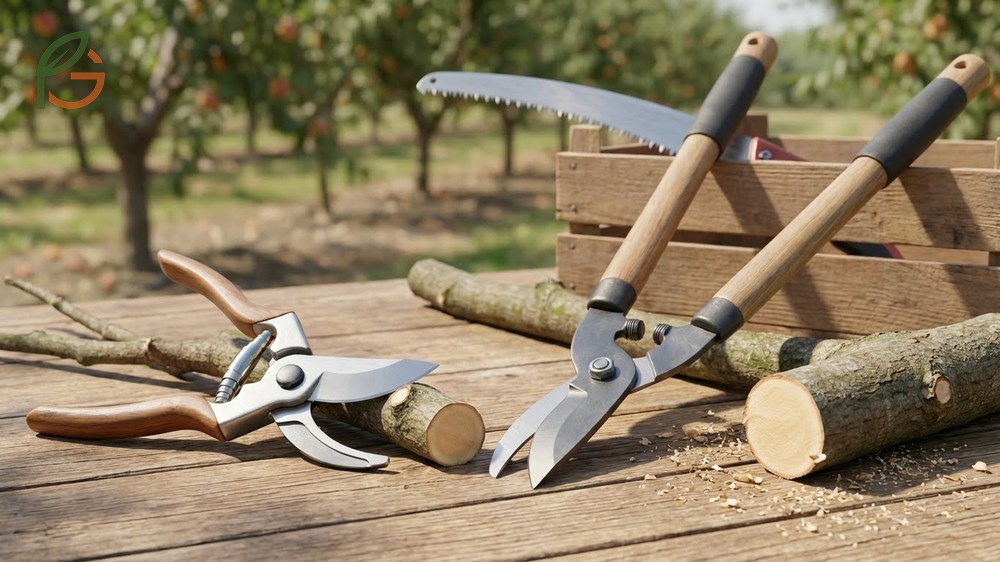
Proper tools make peach tree pruning safer and more effective. Sharp, clean equipment creates smooth cuts that heal quickly and resist infection. Dull blades crush tissue and create ragged edges that invite disease organisms.
Essential tools include bypass hand pruners for cuts up to 0.75 inches diameter, bypass loppers for 0.75-1.75 inch branches, and a pruning saw for anything larger[7]. Bypass designs cut cleanly through live wood using a scissor action, while anvil-style tools crush stems and work better for dead wood only.
- Bypass hand pruners with 0.75-1 inch cutting capacity for small shoots and fruiting wood
- Bypass loppers with telescoping handles for branches 0.75-1.75 inches diameter and extended reach
- Curved pruning saw with 6-8 inch blade for scaffold branches and large wood removal
- Pole pruner for high branches up to 0.75 inches when ground access is difficult
- Sanitizing solution (70% isopropyl alcohol or 10% bleach) to clean blades between cuts
- Sharpening stone or file to maintain blade edges throughout the pruning season
Sanitize blades between trees and after cutting diseased wood. Wipe blades with 70% isopropyl alcohol or dip in 10% bleach solution for 30 seconds. This prevents spreading bacterial and fungal pathogens throughout your orchard.
Water Sprouts Removal
Water sprouts are vigorous vertical shoots that emerge from dormant buds on scaffold branches or the trunk. These unproductive shoots grow rapidly, often reaching 3-6 feet in a single season while producing few or no flower buds. Research shows that water sprouts divert 20-30% of tree resources away from fruit production.
Remove water sprouts during dormant pruning by cutting flush with the originating limb at a 45-degree angle[8]. Avoid leaving stubs, which stimulate additional sprout formation. Cut carefully to avoid damaging bark on the supporting branch.
Water Sprout Prevention: Excessive water sprouts indicate overpruning or stress. Removing more than 50% of growth annually triggers compensatory sprouting that wastes energy and creates maintenance problems.
How to Prune a Young Peach Tree
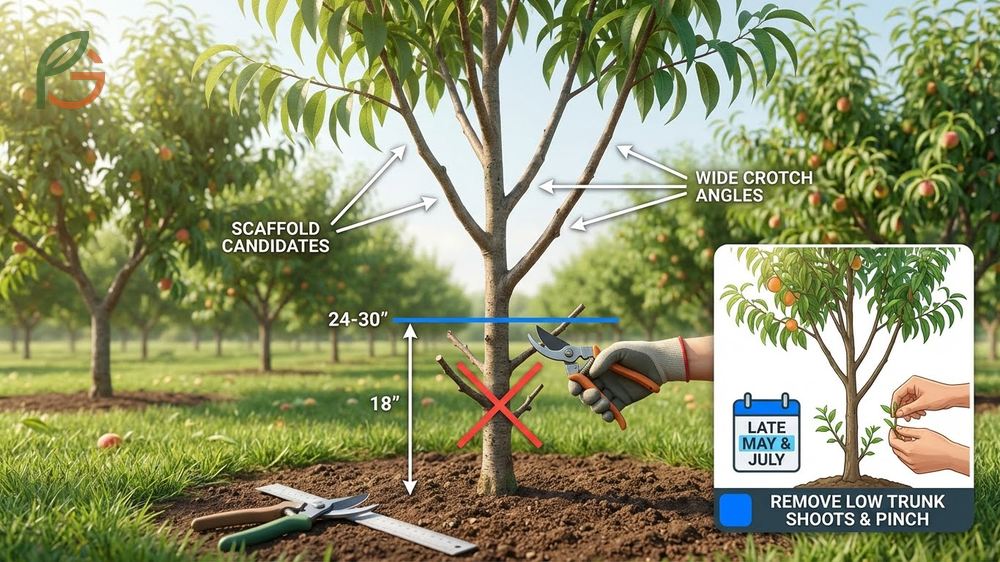
First-year pruning establishes the framework that determines production for the tree’s lifetime. At planting, head newly planted trees to 24-30 inches above ground to stimulate side branch development[3]. Remove all branches below 18 inches and select 3-4 scaffold candidates with wide crotch angles spaced evenly around the trunk.
Summer pruning during the first year accelerates scaffold development. In late May and again in July, remove low trunk shoots and pinch terminal growth on scaffold branches when they reach 12-18 inches. This encourages lateral branching and strengthens the scaffold structure before winter.
During the second dormant season, prune away fast-growing vertical shoots while preserving pencil-thin twig growth that will bear fruit. Identify and develop secondary scaffolds branching from your primary scaffolds. By the third year, the tree should have 4 primary scaffolds, 8 secondary scaffolds, and 16 tertiary branches reaching 10-11 feet in height[6].
- Year 1: Head to 24-30 inches at planting, select 3-4 scaffold branches at 18-24 inches height
- Year 1 Summer: Remove trunk shoots below scaffolds, pinch scaffold tips at 12-18 inches
- Year 2 Dormant: Remove vertical shoots, develop secondary scaffolds, maintain open center
- Year 2 Summer: Thin excess shoots, redirect growth outward, maintain 6-inch spacing between branches
- Year 3 Dormant: Establish tertiary scaffolds, begin fruit wood management, remove crossing branches
- Year 3 Summer: Light crop expected (20-40 pounds), thin fruit to prevent branch breakage
Young tree pruning requires patience and vision. Don’t expect significant fruit production before year 3. Focus on building strong structure that supports decades of heavy crops rather than rushing into early production.
How to Prune an Overgrown Peach Tree
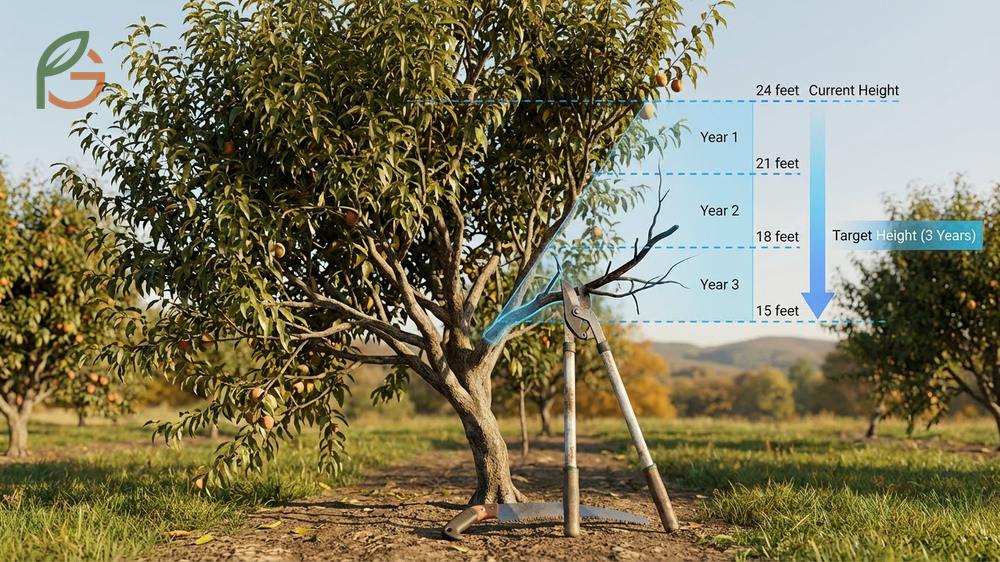
Overgrown peach trees require multi-year renovation rather than single-season correction. Removing more than 50% of growth in one year triggers excessive water sprout formation and reduces cold hardiness. Research from Michigan State University recommends limiting height reduction to one-third per year over 3 years[9]. For example, reducing a 24-foot tree to 15 feet requires removing 3 feet annually.
Start by removing all dead, diseased, and damaged wood regardless of amount. This improves tree health and reveals the remaining structure. Next, eliminate crossing and rubbing branches, prioritizing removal of older wood over younger fruiting shoots.
Open the canopy center by removing inward-growing branches and thinning dense areas. Overgrown trees often develop a secondary canopy that shades lower scaffolds. Thin the upper canopy aggressively while preserving lower fruiting wood that receives adequate sunlight.
- Year 1: Remove dead/diseased wood, reduce height by one-third, open center by 30%
- Year 2: Continue height reduction by one-third, thin remaining dense growth, develop lower scaffolds
- Year 3: Final height adjustment, establish maintenance pruning routine, balance fruiting wood distribution
- Ongoing: Annual 40-50% pruning maintains tree at desired height and shape
- Monitor: Watch for excessive water sprouts indicating overpruning, adjust next season accordingly
Renovation Warning: Severely neglected trees over 15 years old may not respond well to heavy pruning. Consider replacement with new cultivars offering disease resistance and better fruiting characteristics.
Fruit Thinning Technique
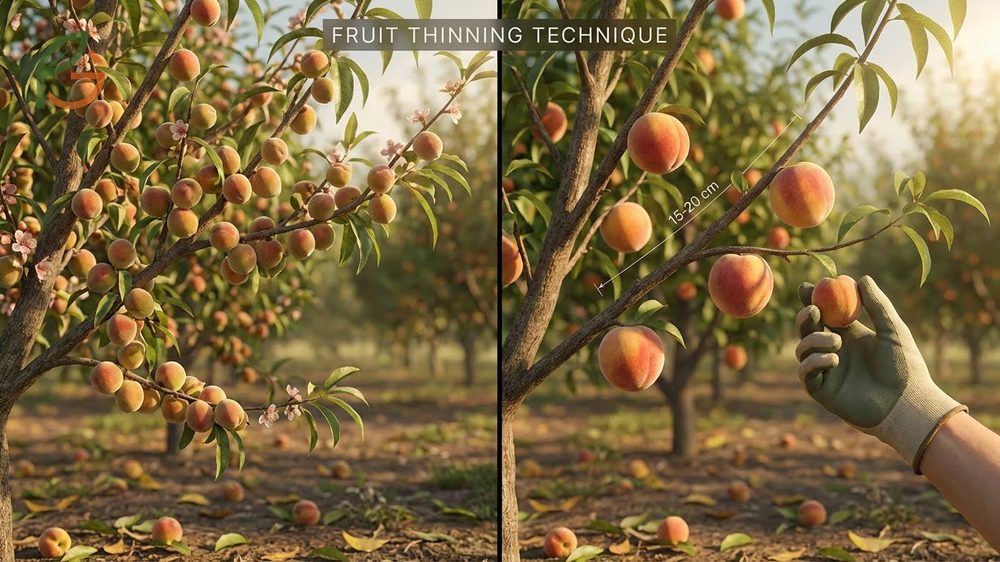
Fruit thinning complements pruning by optimizing crop load for maximum fruit size and quality. Peach growers space fruit 15-20 cm (6-8 inches) apart along branches[4], with larger spacing for early-season or difficult-to-size varieties. Unthinned trees produce numerous small, low-quality peaches rather than fewer premium fruits.
Time thinning during Stage I fruit development, from bloom through pit-hardening. Studies show that thinning around 20 days after full bloom proves most effective for maximizing fruit size[10]. Earlier thinning allows remaining fruits to capitalize on the full growing season, while delayed thinning reduces potential size gains.
This table compares fruit spacing distances, expected fruit weight, optimal timing, and variety recommendations for different peach thinning intensities
| Spacing Distance | Expected Fruit Weight | Optimal Timing | Best for Varieties |
|---|---|---|---|
| 10-13 cm (4-5 in) | 120-140g per fruit | 20-30 days after bloom[10] | Small-fruited, high-yield cultivars |
| 15 cm (6 in) | 150-180g per fruit | 15-25 days after bloom | Standard commercial varieties |
| 20 cm (8 in) | 190-220g per fruit[4] | 10-20 days after bloom | Premium market, early-season types |
| 25 cm (10 in) | 230-260g per fruit | 10-20 days after bloom[10] | Large-fruited, difficult-to-size varieties |
Hand-thin by removing smaller, damaged, or poorly positioned fruits while retaining the largest, best-colored specimens. Work systematically through the canopy from bottom to top, inside to outside. Thin more aggressively in shaded interior areas where fruits receive less light and develop slower.
Fruit load depends on tree vigor, age, health, and management practices including irrigation and fertilization. Vigorous young trees tolerate heavier crops than older declining trees. Adjust spacing based on tree response—if fruits remain undersized despite thinning, increase spacing the following year.
Conclusion
The evidence is clear: how to prune a peach tree successfully requires combining proper timing (late winter dormancy), appropriate methods (open-center system with 40-50% removal), and follow-up fruit thinning (15-20 cm spacing). These three elements work together to produce premium-quality peaches while maintaining long-term tree health and productivity.
Current horticultural guidance emphasizes annual maintenance over reactive correction. Consistent pruning prevents overgrowth problems and maintains fruiting wood in optimal positions for light exposure and harvest accessibility. FruitGarden provides research-based information to help you grow healthy, productive fruit trees using proven university extension methods.
Frequently Asked Questions
What happens if you don’t prune peach trees?
Unpruned peach trees develop dense canopies that block interior sunlight, reducing fruit production by 50-60% within 3-4 years. Branches grow excessively long and weak, making them prone to breaking under fruit weight. Fruit size decreases while disease pressure increases due to poor air circulation.
Can you prune peach trees in summer?
Yes, summer pruning in June and July serves specific purposes including water sprout removal, light penetration improvement, and fruit color enhancement. However, limit summer work to selective thinning of 10-20% rather than heavy structural pruning. Reserve major cuts (40-50% removal) for late winter dormant season.
How do you know which branches to cut on a peach tree?
Remove dead, diseased, and damaged wood first. Then eliminate water sprouts growing vertically, crossing branches that rub together, and inward-growing shoots. Keep pencil-thin shoots 12-18 inches long with visible flower buds—these produce next season’s fruit. Cut back vigorous shoots over 24 inches by half.
What is the difference between heading cuts and thinning cuts?
Thinning cuts remove entire shoots back to their origin point, reducing density without stimulating excessive regrowth. Heading cuts shorten branches by cutting partway along their length, triggering multiple new shoots below the cut. Use thinning cuts for most peach pruning and heading cuts only to strengthen young scaffolds or control height.
How tall should a peach tree be kept?
Maintain peach trees at 8-12 feet tall for easy harvesting from the ground or a short ladder. Trees exceeding 15 feet become difficult to prune, thin, and harvest efficiently. Dwarf rootstocks naturally stay under 10 feet, while standard rootstocks require annual height control through selective pruning of the tallest branches.
Should you thin peaches before or after June drop?
Thin peaches before natural June drop occurs, ideally 15-25 days after full bloom during Stage I development. Early thinning maximizes size potential for remaining fruits. Waiting until after June drop means the tree already invested resources in fruits that will eventually be removed, reducing overall efficiency.
Do peach trees produce fruit on old wood?
No, peach trees produce fruit exclusively on one-year-old wood—shoots that grew during the previous summer. Two-year-old and older wood becomes unproductive and should be removed during dormant pruning. This differs from apples and pears that fruit on older spurs, making annual peach pruning essential for maintaining production.





