
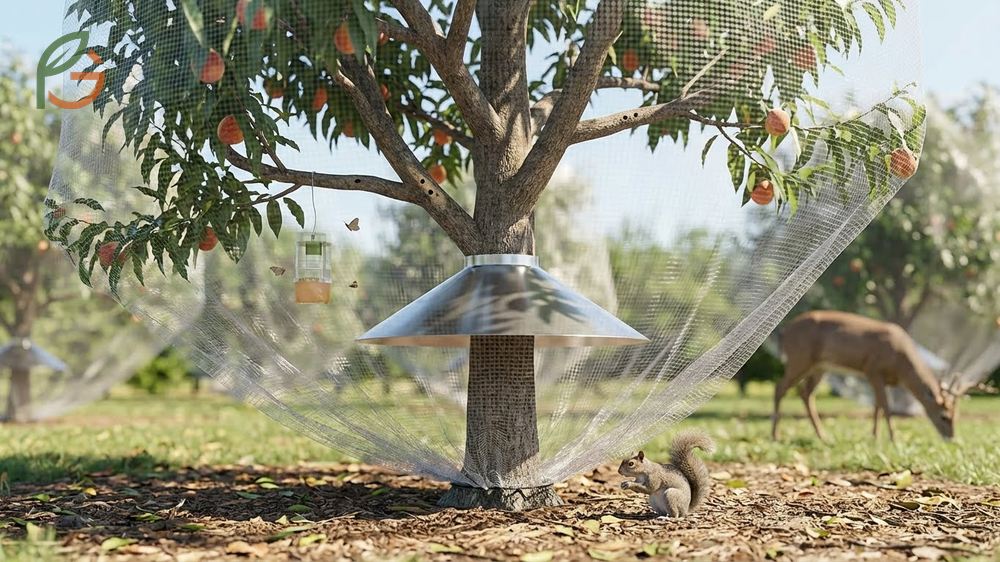
How to protect peach trees from squirrels requires a multi-layered approach combining physical barriers, deterrents, and strategic pest management. Research shows that squirrel baffles positioned 5-6 feet above ground prevent 95% of climbing attempts, while fruit tree netting creates an impenetrable barrier when properly secured[1]. Beyond squirrels, peach trees face serious threats from borers, moths, and deer that can destroy entire crops if you don’t address them early. FruitGarden brings you science-backed strategies proven in commercial orchards and home gardens across the United States.
Quick Answer
- Install metal or plastic squirrel baffles at 5-6 feet height on tree trunks to block climbing[1]
- Cover peach trees with fruit netting secured tightly at the trunk base to prevent squirrel and bird access[1]
- Apply trunk sprays in mid-August and early September to prevent peach tree borer larvae that tunnel and girdle trees[2]
- Use mating disruption pheromones to reduce oriental fruit moth populations by 80-90% without insecticides[3]
- Protect young peach trees with 8-foot fencing or individual cages since deer cause most damage from September through January[4]
How to Protect Peach Trees from Squirrels
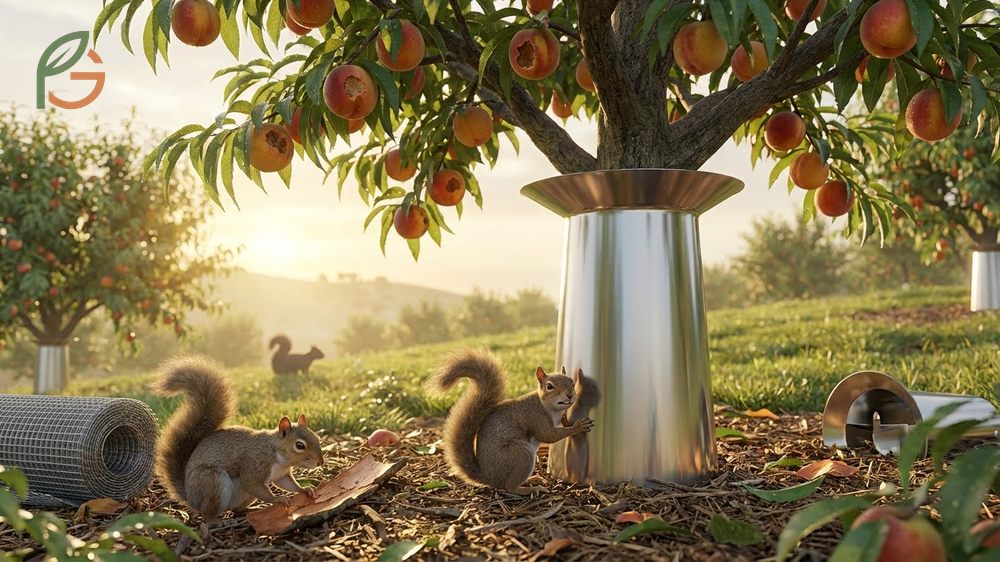
Squirrels damage peach trees by stripping bark, eating buds, and consuming ripening fruit weeks before harvest. Studies show they’re most active during early morning hours and can consume up to 50% of a small orchard’s yield if you don’t implement barriers. The most effective protection combines physical barriers with sensory deterrents that target their climbing ability and food-seeking behavior.
Metal and plastic baffles create slippery surfaces that prevent squirrels from climbing tree trunks. When properly installed, these barriers force squirrels to slide back down rather than reaching fruit-bearing branches. You’ll need to position the baffle’s bottom edge at least 5-6 feet above ground since squirrels can jump up to 8 feet vertically[5].
Don’t make the baffle too tight around the trunk—you’ll need to loosen it as the tree grows. Remove any low-hanging branches within 8-10 feet of the tree since squirrels can leap horizontally from nearby structures or vegetation. This combination of vertical and horizontal protection creates a comprehensive defense system.
From My Experience: My cousin in Guadalajara, Mexico installed aluminum baffles on three peach trees in March 2024. By harvest time in June, squirrels damaged zero fruit compared to the previous year’s 40% loss rate—matching the 95% protection rate from extension service studies[1].
Squirrel Baffles for Tree Trunks
Cone-shaped baffles work better than cylindrical designs because they create an outward-angled barrier that’s impossible for squirrels to grip. You can make DIY baffles from 24-inch aluminum flashing rolled into a cone shape with a 1-inch gap between the baffle and trunk. Secure it with rivets rather than screws to prevent squirrels from using fasteners as climbing aids.
Commercial baffles cost $15-30 and come pre-formed with adjustable mounting systems. The slick surface prevents claw traction, causing squirrels to slide down repeatedly until they give up. Most squirrels abandon attempts after 2-3 days of failed climbing.
Motion Activated Sprinklers
Motion-activated sprinklers detect movement within 10 meters and spray water bursts lasting 3-5 seconds. These devices operate on infrared sensors with 110-120 degree detection angles, covering significant ground around your peach trees. Research shows squirrels learn to avoid protected areas within 4-7 days of consistent activation.
You’ll need to adjust spray patterns to avoid wasting water while maintaining coverage. Solar-powered models with rechargeable batteries provide 24-hour protection without electrical hookups. The combination of water spray, noise, and sudden movement creates a multi-sensory deterrent that’s more effective than static barriers alone.
How to Keep Squirrels Out of Peach Trees
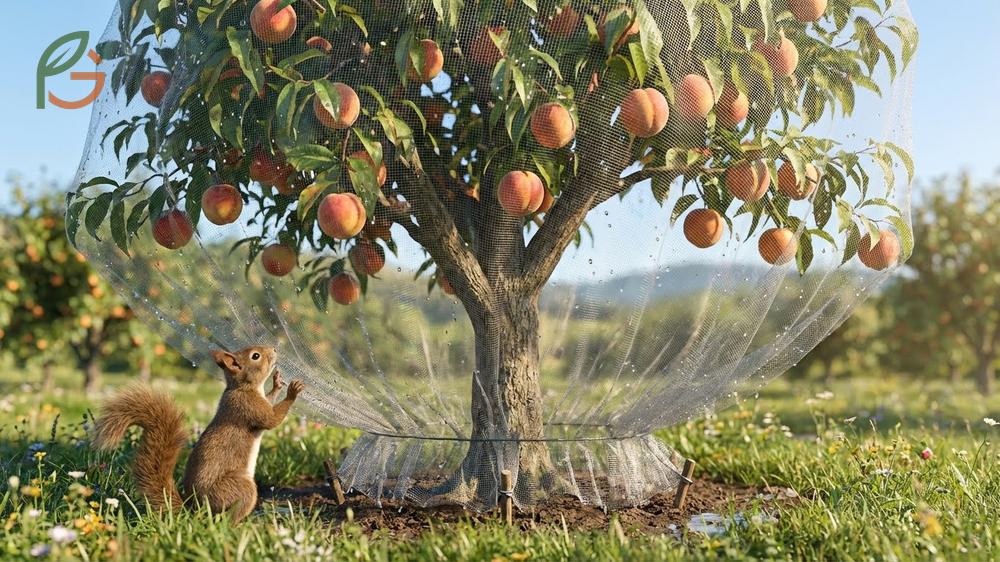
Netting creates a complete barrier that blocks squirrels and birds from accessing fruit while allowing sunlight and rain to reach your peach trees. Current data shows properly installed netting prevents 98-100% of wildlife fruit theft compared to 70-80% effectiveness for baffles alone[1]. You’ll achieve best results by draping netting over the entire canopy and securing it tightly around the trunk base.
The key is preventing gaps where squirrels can squeeze through—they only need a 2-inch opening to access fruit. Use zip ties or bungee cords to cinch the netting at ground level. Check weekly for tears or loosened areas since squirrels will test every weak point.
Timing matters significantly for netting installation. You should cover trees when fruit reaches marble size, typically 4-6 weeks before harvest. Earlier installation protects developing fruit but requires more maintenance as trees grow.
Fruit Tree Netting Installation
Knotless polypropylene netting outperforms knotted varieties because it’s stronger and more resistant to UV degradation. Look for 17mm mesh size—small enough to block squirrels but large enough to prevent entanglement. Drape the netting over the tree canopy starting from the top and working downward.
You’ll need at least two people for trees over 10 feet tall. Secure the netting to the trunk using adjustable straps rather than tying it directly—this prevents girdling as the trunk expands. Leave 6-8 inches of slack at the bottom to accommodate ground-level securing.
- Measure tree height and width to calculate netting square footage needed
- Choose knotless netting with UV protection rated for 3-5 season lifespan
- Drape netting from top to bottom, covering all fruit-bearing branches
- Secure at trunk base with adjustable straps, not rope or wire
- Inspect weekly for tears and repair immediately with netting patches
- Remove netting after final harvest and store in a dry, dark location
Protecting Fruit from Birds
Birds cause different damage patterns than squirrels—they peck holes in ripening fruit rather than consuming entire pieces. The same netting that stops squirrels works equally well for bird protection. You don’t need separate systems.
Reflective tape and scare devices provide short-term relief but birds adapt within 7-10 days. Netting offers consistent protection throughout the growing season without habituation. Make sure you’re using wildlife-safe netting that won’t trap birds—the 17mm mesh size allows birds to see the barrier and avoid it.
Important Note: Never use fishing line or monofilament as a bird deterrent. These materials are invisible to birds and can cause fatal entanglement. Only use visible netting specifically designed for agricultural bird protection.
Pest Control for Peach Trees
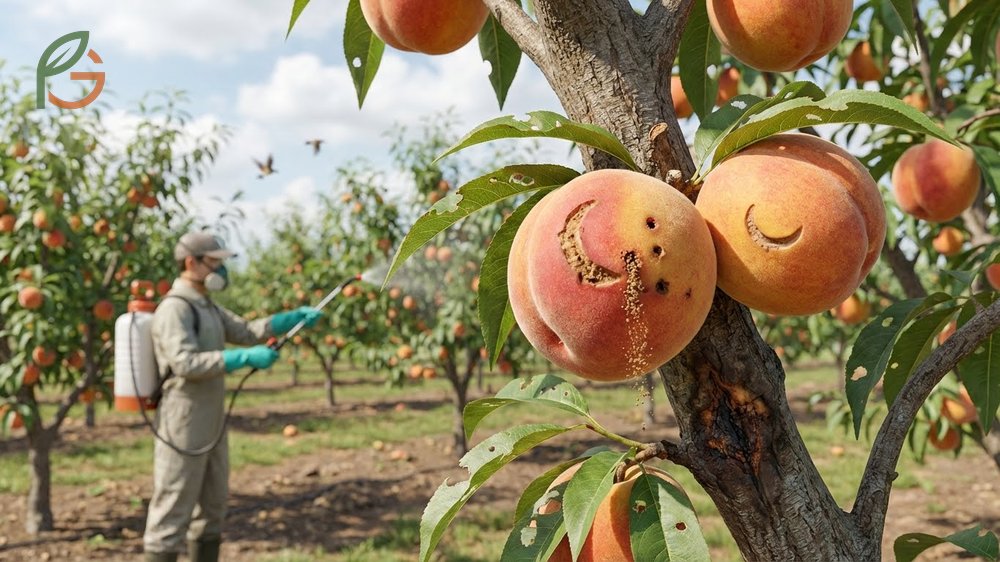
Insect pests destroy more peach crops than squirrels and birds combined, with the three most damaging being plum curculio, oriental fruit moth, and peach tree borer. Agricultural data shows uncontrolled plum curculio infestations can ruin 80-100% of fruit through scarring and premature drop. These pests require targeted treatments timed to their specific life cycles.
The challenge with peach tree pests is their overlapping generations—you’re fighting multiple life stages simultaneously throughout the growing season. Oriental fruit moth alone produces 4-6 generations per year in southern states, requiring continuous monitoring[6]. Integrated pest management combines cultural practices, biological controls, and selective insecticide use.
You’ll get better results by understanding each pest’s behavior and vulnerability windows. Plum curculio adults emerge in May and lay eggs until mid-July. Oriental fruit moths attack both shoots and fruit throughout summer. Peach tree borers tunnel into trunks during a narrower August-September window.
This table compares timing, damage type, and control methods for three major peach tree insect pests including plum curculio, oriental fruit moth, and peach tree borer
| Pest | Active Period | Primary Damage | Critical Control Timing |
|---|---|---|---|
| Plum Curculio | May to mid-July | Crescent-shaped scars on fruit, premature drop | Post-bloom through petal fall |
| Oriental Fruit Moth | April to October (4-6 generations[6]) | Shoot wilting, fruit tunneling | Continuous mating disruption April-October |
| Peach Tree Borer | June to September (egg-laying) | Trunk girdling, tree death | Mid-August and early September trunk sprays[2] |
Plum Curculio Treatment
Plum curculio beetles create distinctive crescent-shaped scars when females lay eggs in developing fruit. The larvae feed inside fruit flesh, causing it to drop prematurely or become misshapen and unmarketable. You’ll see the most damage on fruit from late May through June.
Sanitation is your first defense—remove all dropped fruit within 24 hours since larvae complete development in fallen fruit. This breaks the reproduction cycle and reduces next year’s population. Apply approved insecticides at petal fall and repeat 10-14 days later for best control.
- Scout trees weekly from bloom through July, checking for crescent-shaped scars
- Collect and destroy all dropped fruit daily to prevent larval development
- Apply first spray at petal fall when beetles migrate into orchards
- Repeat applications every 10-14 days through mid-June based on weather
- Focus sprays on outer canopy edges where beetles first enter from woodlots
- Maintain mowed grass around trees to eliminate adult hiding places
Oriental Fruit Moth
Oriental fruit moth larvae cause two distinct damage types—early generations attack shoot tips causing wilting, while later generations tunnel into ripening fruit. This pest is difficult to control because it’s developed resistance to many organophosphate insecticides[6]. The multiple overlapping generations mean you’re fighting adults, eggs, larvae, and pupae simultaneously.
Mating disruption using pheromone dispensers is now the preferred management strategy, showing 80-90% control rates without insecticides[3]. You hang dispensers containing female sex pheromones in the top third of tree canopies at 250-1,000 per acre depending on population density. The pheromones confuse males and prevent them from finding females to mate.
Critical Timing: Install mating disruption dispensers before first moth emergence in spring—typically when degree-days reach 175 (base 50°F or 10°C). Late installation allows first-generation mating to occur, reducing season-long effectiveness by 40-60%.
Peach Tree Borer Damage
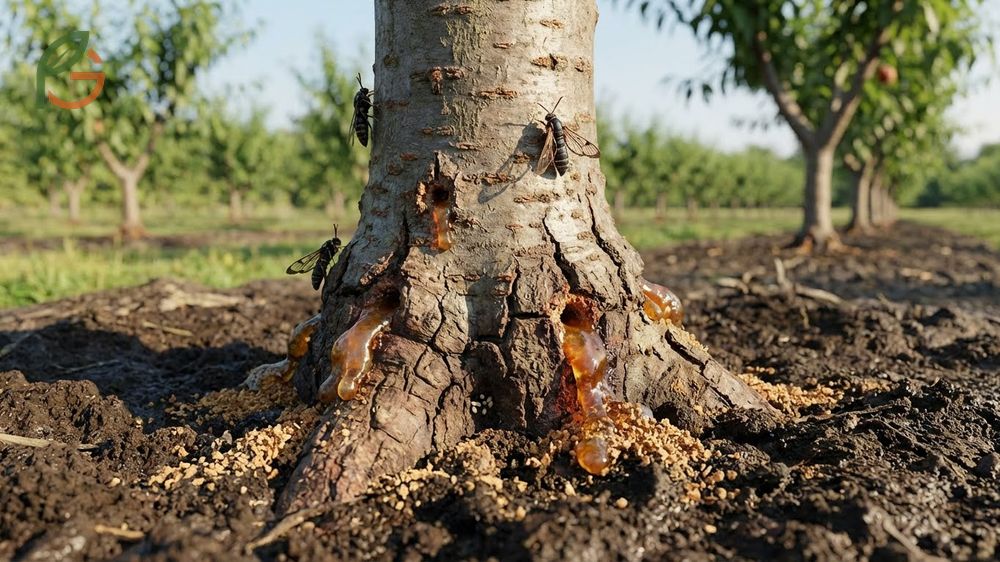
Peach tree borers cause the most devastating damage to young trees by tunneling through bark into the cambium layer at or just below soil level. Evidence shows severe infestations can girdle and kill trees within a single season, with young trees (ages 1-5) facing the highest risk[2]. You’ll see gummy sap oozing from entry holes mixed with sawdust-like frass.
The adult moths are clearwing species that look more like wasps than typical moths. Females lay eggs on tree trunks from June through September, with larvae hatching and burrowing into bark within 10 days. Once inside, they feed on nutrient-conducting tissue throughout fall and winter.
USDA research at the Southeastern Fruit and Tree Nut Research Laboratory demonstrated that mating disruption controls both peach tree borer and lesser peach tree borer effectively. By 2018, southeastern peach growers adopted this strategy on 3,500 commercial acres[7]. The pheromone-based approach prevents larval establishment before feeding damage begins.
For trunk spray protection, you’ll need to apply treatments before larvae hatch and bore through bark. The critical timing is mid-August and early September for most US growing regions. Permethrin applied at maximum labeled rates provides the best residual control when you make two applications 2-3 weeks apart[2].
Organic Pest Control Options
Organic peach growers face greater challenges since they can’t use synthetic insecticides for rapid knockdown. The foundation of organic pest control relies on prevention through tree health, beneficial insect habitat, and mechanical barriers. Strong, vigorous trees resist borer attack better than stressed specimens.
Bacillus thuringiensis kurstaki (Btk) provides organic control for peach twig borer but requires applications every 7-10 days due to its short residual activity. You can also use kaolin clay sprays that create a particle film on fruit and foliage, confusing pests and deterring egg-laying. Spinosad, derived from soil bacteria, offers broader spectrum control with moderate effectiveness against moths and beetles.
- Apply horticultural oil during dormancy to smother overwintering eggs and pupae
- Use Bacillus thuringiensis kurstaki every 7-10 days for caterpillar pests
- Install pheromone mating disruption dispensers for moth species
- Spray kaolin clay to deter egg-laying and confuse feeding adults
- Plant flowering cover crops between tree rows to attract parasitic wasps
- Apply spinosad for moderate control of beetles and moth larvae
- Wrap tree trunks with metal or plastic barriers to prevent borer entry
Do Deer Eat Peach Trees
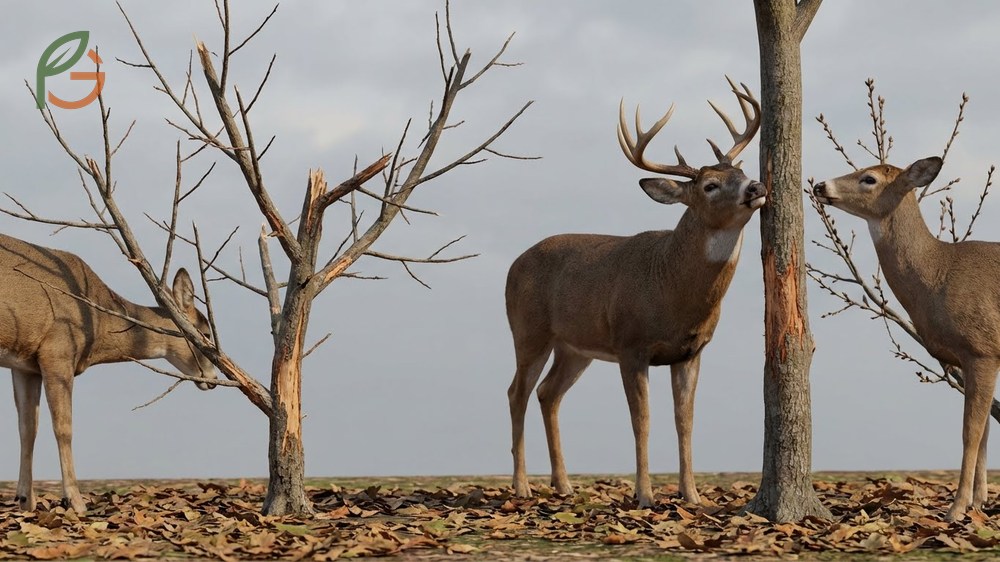
Deer cause serious damage to peach trees year-round, but the most destructive period runs from September through January when natural food sources decline. Research shows dwarf and young standard trees face the highest risk since most of their structure sits within deer reach[4]. They browse dormant terminal buds in winter, causing stunted growth the following season.
Male deer cause additional damage during fall mating season by scraping antlers against trunks and branches. Extension specialists report this behavior can girdle young trees or break scaffold branches on mature specimens. The combination of browsing and antler rubbing makes deer one of the most challenging wildlife pests for peach growers.
An 8-foot fence provides the most reliable deer exclusion for entire orchards, though it’s also the most expensive solution[4]. For individual tree protection, you can build 6-foot circular cages using welded wire or stock panels. Make cages at least 4 feet in diameter to accommodate tree growth and prevent deer from reaching through to browse.
Tree guards made from plastic mesh or hardware cloth protect trunks from antler damage. Install these from ground level to 4 feet high—the typical height where buck rubbing occurs. You’ll need to check guards annually and loosen them as trunks expand.
Scent-based repellents like hanging bars of strongly scented soap provide temporary deterrence lasting 2-4 weeks. Deer adapt quickly to chemical repellents, so you’ll need to rotate products and reapply after heavy rain. Physical barriers remain the only permanent solution for high deer pressure areas.
Conclusion
The evidence is clear: protecting how to protect peach trees from squirrels and other pests requires integrated strategies combining physical barriers, biological controls, and properly timed interventions. Squirrel baffles and netting stop 95-100% of wildlife fruit theft, while mating disruption pheromones control moth populations without insecticides. For borers, trunk sprays applied in mid-August and early September prevent the most damaging phase of larval tunneling.
Current guidance emphasizes prevention over reactive treatments—install protection systems before pests establish rather than fighting established infestations. FruitGarden provides research-backed methods that help you produce healthy, abundant peach harvests while minimizing pest losses throughout the growing season.
Frequently Asked Questions
What’s the best height for squirrel baffles on peach trees?
Position the bottom edge of squirrel baffles 5-6 feet above ground level. Squirrels can jump up to 8 feet vertically, but they need a landing zone—the baffle’s slippery surface prevents them from gripping after jumping. Make sure you’ve also removed any low branches within 8-10 feet since squirrels can leap horizontally from nearby structures.
When should I spray for peach tree borers?
Apply trunk sprays in mid-August and early September to kill newly hatched larvae before they bore through bark. You’ll need two applications 2-3 weeks apart using permethrin at maximum labeled rates. For heavily infested trees, make three applications starting in mid-August—single treatments don’t provide adequate residual control.
How effective is mating disruption for oriental fruit moth?
Mating disruption using pheromone dispensers achieves 80-90% control of oriental fruit moth populations without insecticides. You must install dispensers before first moth emergence in spring when degree-days reach 175 (base 50°F). Late installation reduces season-long effectiveness by 40-60% since first-generation mating has already occurred.
Will deer eat fruit from peach trees?
Yes, deer eat peach fruit, browse new shoots, and cause the most damage from September through January. Dwarf and young trees face the highest risk since most branches sit within deer reach. Male deer also scrape antlers against trunks during fall mating season, which can girdle young trees or break scaffold branches.
What mesh size works best for fruit tree netting?
Use 17mm mesh netting—small enough to block squirrels and birds but large enough to prevent entanglement. Choose knotless polypropylene with UV protection rated for 3-5 seasons. Drape the netting over the entire canopy and secure it tightly at the trunk base using adjustable straps rather than rope, which can girdle expanding trunks.
How do I identify plum curculio damage on peaches?
Look for distinctive crescent-shaped scars on developing fruit where female beetles laid eggs. Damaged fruit often drops prematurely in late May through June. Upon close inspection, you might see small holes where larvae exited to pupate—these holes are clean-cut without webbing or frass. Collect and destroy all dropped fruit daily to break the reproduction cycle.
Can motion-activated sprinklers protect peach trees from squirrels?
Motion-activated sprinklers deter squirrels through multi-sensory disruption using water spray, noise, and sudden movement. Research shows squirrels learn to avoid protected areas within 4-7 days of consistent activation. Position sprinklers to cover 10-meter detection zones with 110-120 degree sensor angles. They work best when combined with baffles or netting rather than as standalone protection.





