
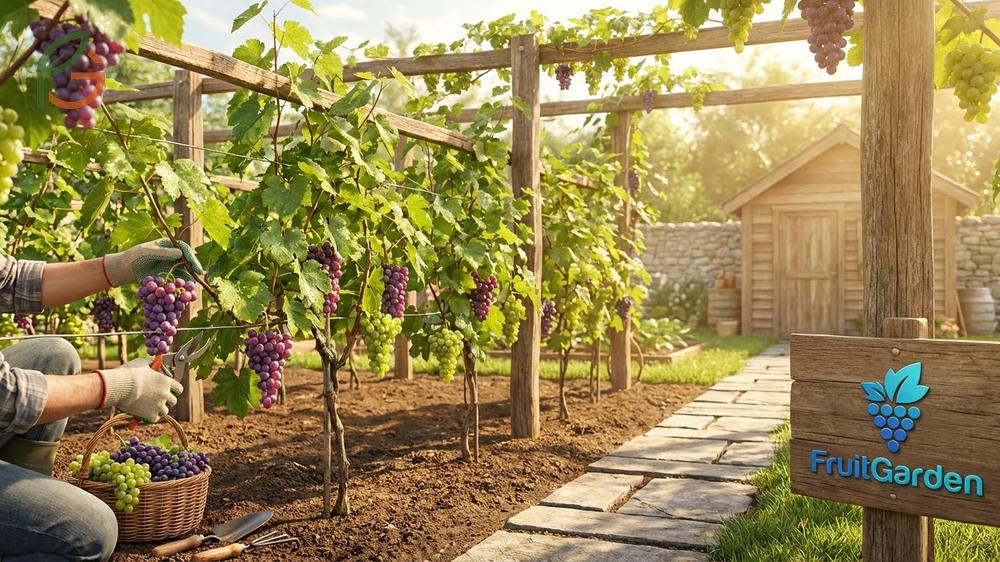
How to grow grapes successfully starts with choosing the right location, preparing well-drained soil, and understanding your climate zone. Research shows that grapevines thrive when planted in full sun with proper trellis support and consistent care throughout the growing season.[1] FruitGarden synthesizes current horticultural research and practical growing techniques to help you establish a productive home vineyard.
Quick Answer
- Plant grapevines in early spring (March-April) in cold climates or late winter in zones 7 and warmer[2]
- Provide full sun exposure (7+ hours daily)[1] and well-drained soil with pH 5.5-7.0[3]
- Install trellis systems before planting to support vines as they grow
- Start with disease-resistant varieties like Concord, Reliance, or Mars Seedless for easier success
How to Grow Grapes
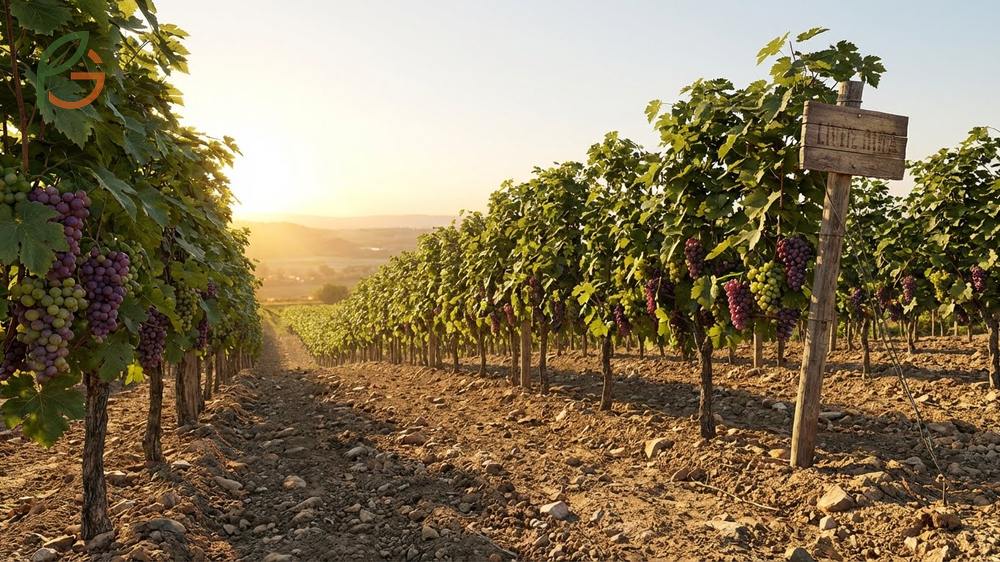
Growing grapes at home requires understanding three fundamental factors: location, soil conditions, and climate compatibility. Most grape varieties need full sun exposure and excellent drainage to prevent root rot and fungal diseases. What often gets overlooked is that grapevines can thrive in surprisingly poor soils as long as drainage is adequate.
Studies demonstrate that proper site selection determines 60-70% of your vineyard’s long-term success. You’ll want south-facing slopes or areas with good air circulation to minimize disease pressure. Cold air drainage is crucial—avoid planting in frost pockets where spring freezes can damage emerging buds.
From My Experience: My cousin in Guadalajara, Mexico planted three Flame Seedless vines in March 2023. The vines produced their first small clusters in the second year—earlier than the typical 3-year wait—because she chose a sunny courtyard wall with perfect southern exposure and excellent heat reflection.
Best Soil for Grapes
Research shows that grapevines grow best in well-drained loamy or sandy soils with pH between 5.5 and 7.0.[3] American grape varieties prefer more acidic conditions with an ideal pH of 5.5, while European wine grapes tolerate slightly higher pH up to 6.5.[3] Heavy clay soils that retain moisture around roots will eventually cause root rot and vine death.
Current guidance emphasizes testing your soil 6-12 months before planting. You can amend pH by adding limestone to raise acidity or sulfur to lower it. Deep soil preparation—loosening the ground to 2-3 feet depth—helps roots establish quickly and access nutrients.
- Well-drained structure that doesn’t puddle after rain
- Minimum 3-4 feet of soil above hardpan or rock layers for root development
- Organic matter content around 2-3% for nutrient availability
- Avoid waterlogged or compacted areas that restrict root growth
- Test drainage by digging a 12-inch hole and filling it with water—it should drain within 4 hours
Sunlight Requirements
Grapevines require a minimum of 7 hours of direct sunlight daily to produce abundant, sweet fruit.[1] Vines grown in partial shade produce lower yields and inferior fruit quality. Limited sun exposure also increases susceptibility to diseases like powdery mildew and fruit rot.
The reason is simple: photosynthesis drives sugar production in grapes. More sunlight means higher sugar levels, better flavor development, and healthier vines overall. South-facing locations in the Northern Hemisphere receive the most consistent sun throughout the growing season.
Important Note: If you’re growing grapes in hot climates with afternoon temperatures exceeding 95°F (35°C), some afternoon shade can prevent sunscald on fruit. In moderate climates, maximize sun exposure for best results.
When to Plant Grapes
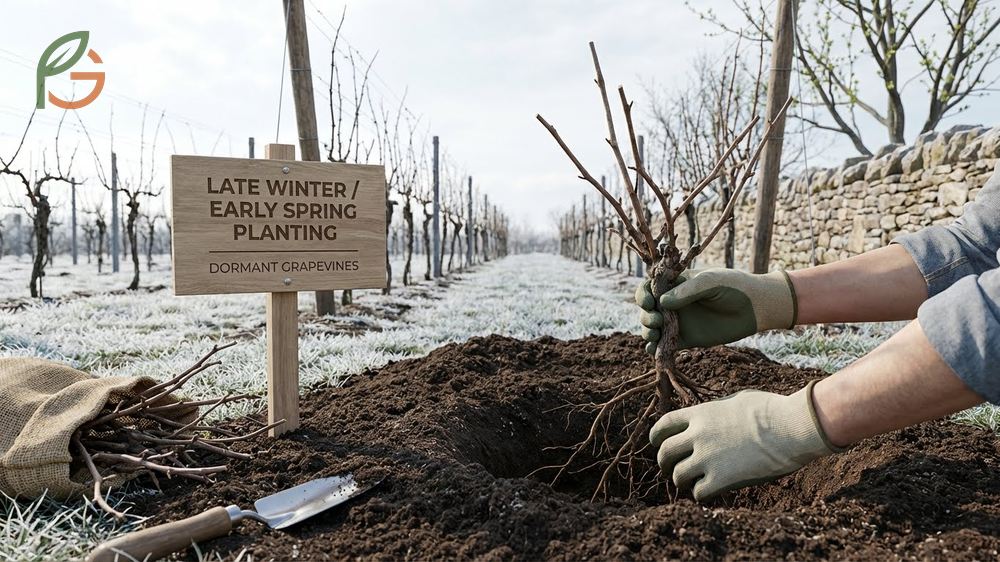
The best time to plant dormant grapevines is during late winter to early spring when temperatures are cool and growth activity is minimal.[2] This timing allows roots to establish before the growing season begins. In mild winter areas (USDA Zone 7 and warmer), you can plant in early winter, while colder regions should wait until early spring after the last frost.[2]
Non-dormant potted grapevines offer more flexibility. You can plant them anytime after all danger of frost has passed, typically from April through June in most US regions. Container-grown plants need a few days to acclimate to outdoor conditions before planting.
Planting Steps
Start by digging a planting hole about 2 feet deep and wide to accommodate the extensive root system that grapevines develop.[2] Grapevines set roots as deep as 15 feet, so initial depth matters for long-term health. Mix compost or aged manure into the native soil to improve structure and provide slow-release nutrients.
Before planting, soak bare-root vines in water for 2-4 hours to rehydrate the roots. Trim any broken or dead roots with clean pruning shears. Position the vine so the graft union (if grafted) sits 2-3 inches above the soil line to prevent rootstock suckering.
- Dig hole 24 inches deep and wide, mixing compost into backfill soil
- Soak bare-root vines for 2-4 hours before planting
- Spread roots naturally in the hole without crowding or circling
- Backfill with amended soil, firming gently to eliminate air pockets
- Water thoroughly with 2-3 gallons to settle soil around roots
- Apply 2-3 inch mulch layer, keeping it 4 inches away from the trunk
Spacing and Depth
Space grapevines 6-10 feet apart within rows depending on the variety’s vigor and your chosen training system. More vigorous European wine grapes need 8-10 feet, while compact American varieties can succeed with 6-8 feet spacing. Rows should be spaced 8-12 feet apart to allow equipment access and adequate air circulation.
Plant depth is critical for establishing a strong root crown. The original soil line on bare-root plants should match your garden’s soil level. Planting too deep encourages rot, while too shallow exposes roots to temperature extremes and drought stress.
How to Care for Grape Plants
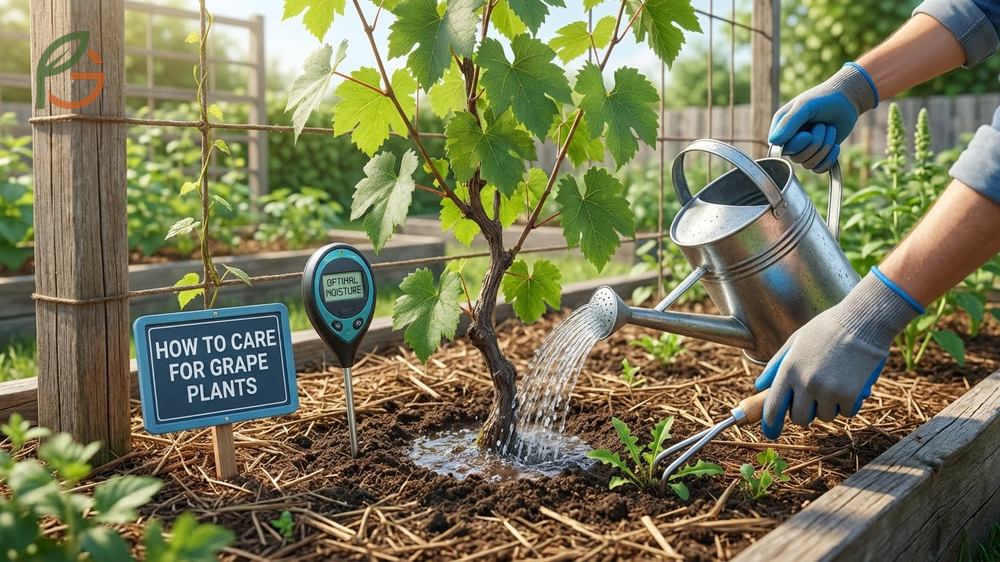
Consistent care during the first three years determines whether your grapevines become productive long-term. Young vines need regular watering, appropriate fertilization, and weed control to establish strong root systems. Most people don’t realize that overwatering causes more vine deaths than underwatering in home gardens.
Watering Grape Vines
Newly planted grapevines need deep watering once or twice weekly during the first growing season to encourage root development. Apply 2-3 gallons per vine each session, adjusting for rainfall and temperature. Established vines are drought-tolerant but produce better with consistent moisture during fruit development.
Current guidance emphasizes irrigating when 40-50% of available soil water remains rather than following fixed schedules. Sandy soils require more frequent watering at the 40% threshold, while clay soils can wait until 50% depletion. Drip irrigation systems deliver water directly to root zones with minimal waste.
During the growing season, grapevines typically need 10-30 inches of water total from rainfall and irrigation combined. Reduce watering as harvest approaches to concentrate sugars in the fruit. Winter dormancy requires little to no supplemental water in most climates.
Watering Tip: Check soil moisture 6-8 inches deep before watering. If soil feels damp at that depth, wait another 2-3 days. Overwatering promotes shallow root growth and increases disease risk.
Fertilizer for Grapes
Young grapevines benefit from light fertilization to support growth without causing excessive vigor. Apply 2 ounces (1/4 cup) of 10-10-10 fertilizer per vine soon after growth begins in spring, then repeat 4 weeks later.[4] Spread the fertilizer evenly over a 4-5 foot diameter circle around each vine.
Established vines require less frequent fertilization than most fruit crops. Many vineyards go years without nitrogen applications if soil organic matter is adequate. Over-fertilizing causes excessive vegetative growth, delayed fruit ripening, and increased disease susceptibility.
- First year: Apply 1/4 cup 10-10-10 fertilizer at bud break, repeat after 4 weeks[4]
- Second year: Increase to 1/2 cup per application using the same timing
- Third year and beyond: Base fertilization on tissue testing and vine vigor
- Apply nitrogen when vines show pale green leaves or weak shoot growth
- Avoid fertilizing after mid-July as it delays dormancy and reduces cold hardiness
Pruning and Training
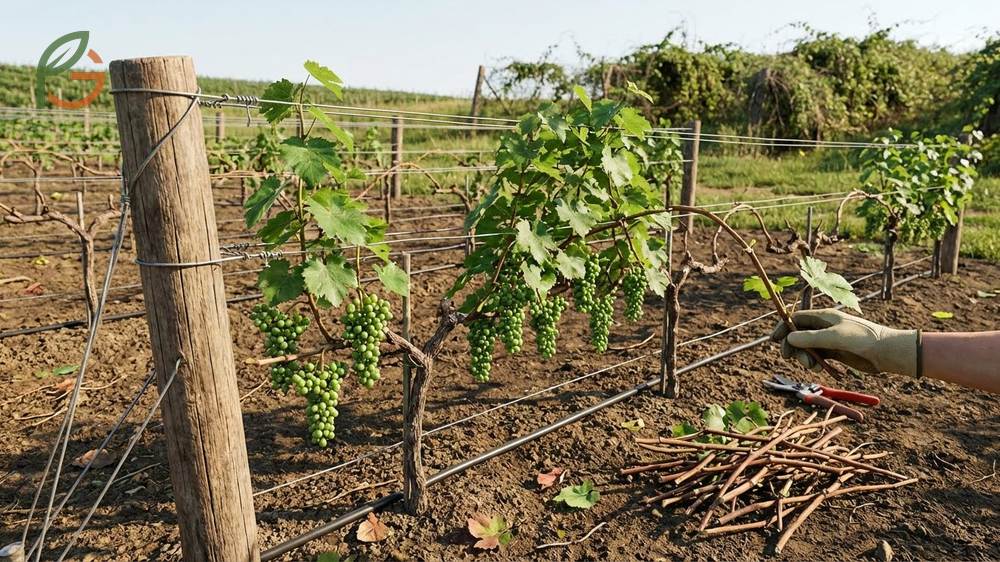
Training positions fruit-bearing wood on a trellis support system, while pruning removes excess growth to balance crop load and vine vigor.[5] These two practices work together to create manageable vines that produce quality fruit year after year. Without proper training, grapevines become tangled masses that are difficult to harvest and prone to disease.
Most home gardeners underestimate how much wood they need to remove during annual pruning. You’ll typically remove 80-90% of the previous year’s growth each dormant season. This seems drastic but prevents overcropping and maintains vine health for decades.
Grape Trellis Ideas
Install your trellis system before or immediately after planting so you don’t disturb roots later. The most common systems for home gardens are the 4-Cane Kniffin (two wires) and the High Cordon (single wire at 5-6 feet). Table grapes can use simple stakes or arbor structures for ornamental appeal.
The 4-Cane Kniffin system uses two strands of wire—one at 36-40 inches and another at 60-72 inches above ground. This design suits most American and hybrid varieties with moderate vigor. High Cordon systems work well for trailing varieties with downward growth habits.
- 4-Cane Kniffin: Two-wire system ideal for American varieties, easy to maintain
- High Cordon: Single wire at 5-6 feet, suited for trailing growth habits
- Vertical Shoot Positioning: Professional system with multiple catch wires for wine grapes
- Arbor/Pergola: Ornamental overhead structure for table grapes in landscapes
- Horizontal T-bar: Supports cordons trained horizontally with shoots hanging down
Pruning Techniques
Dormant pruning occurs in late winter (February-March) before buds swell. The two main methods are cane pruning and spur pruning, chosen based on variety and training system.[5] Cane pruning removes most of the vine except 4 canes with 8-12 buds each, while spur pruning leaves short spurs along permanent cordons with 2-3 buds per spur.
Summer pruning involves removing excessive shoot growth, lateral shoots, and leaves shading fruit clusters. This improves air circulation, reduces disease pressure, and enhances fruit quality. Remove shoots that don’t bear fruit and thin clusters when they’re pea-sized if the vine is overloaded.
Pest Control and Varieties
Pest Control for Grapes
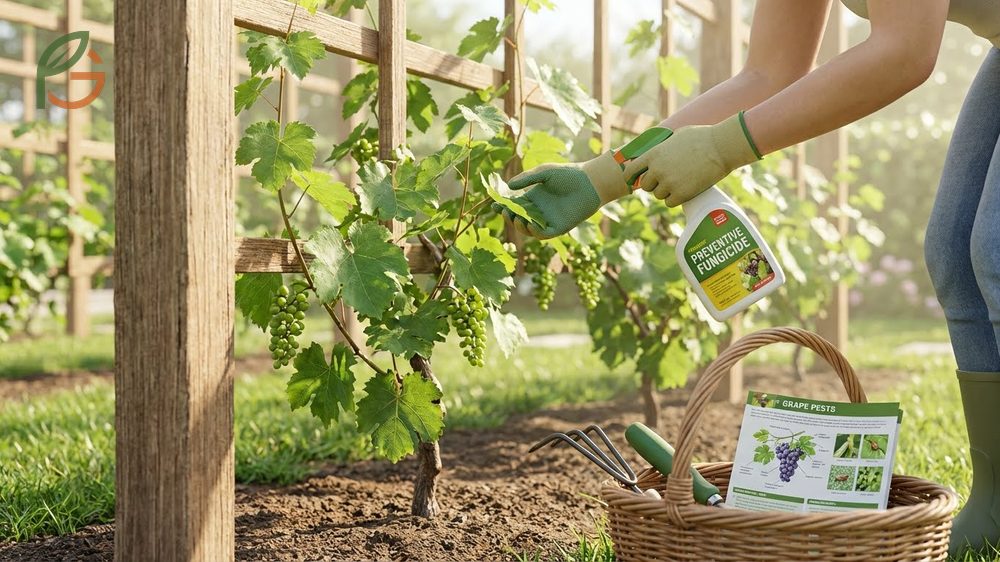
The three most common grape diseases in home gardens are black rot, powdery mildew, and downy mildew. Black rot causes brown spots on leaves and shriveled, mummified fruit. Powdery mildew appears as white powder on leaves and fruit, while downy mildew creates yellow patches on leaf surfaces.
Preventive sprays work better than reactive treatments for grape diseases. Fungicide programs typically begin at bud break and continue through bloom, with applications timed before bloom, immediately after bloom, and at 10-14 day intervals during fruit development.[6] Common materials include Captan, sulfur, and Mancozeb applied according to label directions.
- Choose disease-resistant varieties like Concord or Marquis to reduce spray needs
- Remove and destroy all mummified fruit and diseased leaves in fall
- Prune for good air circulation to keep foliage dry
- Apply dormant oil spray in late winter to reduce overwintering disease spores
- Monitor regularly for Japanese beetles, grape berry moths, and leafhoppers
- Use row covers or netting to protect ripening fruit from birds and wasps
Organic Option: Sulfur dust and copper-based fungicides provide organic disease control when applied preventively. Combine with cultural practices like leaf removal and proper spacing for best results.
Grape Varieties for Beginners
Starting with the right variety significantly increases your chances of success. Concord grapes are the easiest for beginners because they’re cold-hardy, disease-resistant, and productive across most US regions. These blue-black table grapes tolerate a wide range of growing conditions and require minimal care once established.
Seedless varieties like Thompson Seedless, Mars Seedless, and Somerset Seedless appeal to gardeners who want fresh eating grapes. Wine grape enthusiasts should match varieties to their climate—Chardonnay and Merlot for temperate zones, Zinfandel for warmer regions. Always verify that your chosen variety is cold-hardy to your USDA zone.
This table compares five popular grape varieties across hardiness zones, fruit characteristics, disease resistance, and best uses to help beginners select appropriate cultivars
| Variety | Hardiness Zones | Fruit Type | Disease Resistance | Best Use |
|---|---|---|---|---|
| Concord | 4-8 | Blue-black, seeded | Excellent | Table, juice, jelly |
| Mars Seedless | 5-9 | Purple, seedless | Good | Fresh eating |
| Thompson Seedless | 7-9 | Green, seedless | Moderate | Table, raisins |
| Reliance | 4-8 | Pink-red, seedless | Very good | Fresh eating |
| Niagara | 5-8 | White, seeded | Good | Table, wine |
Conclusion
The evidence is clear: how to grow grapes successfully depends on matching varieties to your climate, providing excellent drainage and full sun, and committing to consistent pruning and training. Most home gardeners can produce their first harvest within 2-3 years by starting with disease-resistant varieties like Concord or Reliance.
Current horticultural guidance emphasizes prevention over reaction—proper site selection, soil preparation, and trellis installation before planting prevent most problems you’ll encounter. FruitGarden recommends starting small with 2-3 vines to learn the basics before expanding your backyard vineyard.
Frequently Asked Questions
How long does it take for grapevines to produce fruit?
Grapevines typically produce their first small crop in the third year after planting, with full production beginning in years 4-5. The first two years focus on establishing strong root systems and framework structure. Some vigorous varieties may set a few clusters in year two, but you should remove these to maintain vine strength.
Can I grow grapes in containers?
Yes, grapevines adapt well to container growing when you use pots holding at least 20 liters (5 gallons) of soil. Choose compact varieties like Somerset Seedless or Mars Seedless that don’t require extensive space. Container grapes need more frequent watering and annual fertilization but can produce 10-15 pounds of fruit per vine when properly managed.
What’s the difference between table grapes and wine grapes?
Table grapes have larger berries, thinner skins, and milder flavors optimized for fresh eating. Wine grapes produce smaller, more concentrated berries with thicker skins and higher sugar content for fermentation. Most table grape varieties are seedless for convenience, while wine grapes are typically seeded.
How much water do grape vines need?
Newly planted vines need 2-3 gallons per week during the first growing season. Established grapevines require 10-30 inches of total water annually from rainfall and irrigation combined, with peak demand during fruit development. Reduce watering as grapes approach harvest to concentrate sugars and improve flavor.
When should I prune my grapevines?
Dormant pruning occurs in late winter (February-March) before buds begin swelling. This timing allows you to see the vine structure clearly and minimizes sap bleeding. Summer pruning happens during the growing season to remove excessive shoots, thin clusters, and improve air circulation around developing fruit.
Do I need two grapevines for pollination?
No, most grapevines are self-fertile and don’t require cross-pollination from another variety. A single vine can produce full crops on its own. However, planting multiple vines extends your harvest season and provides variety in fruit types and flavors.
What are the most common mistakes when growing grapes?
The three biggest mistakes are planting in poorly drained soil, under-pruning during the dormant season, and choosing varieties not suited to your climate zone. Many beginners also overfertilize young vines, causing excessive leaf growth at the expense of fruit production. Starting with disease-resistant varieties prevents most pathogen problems.





