
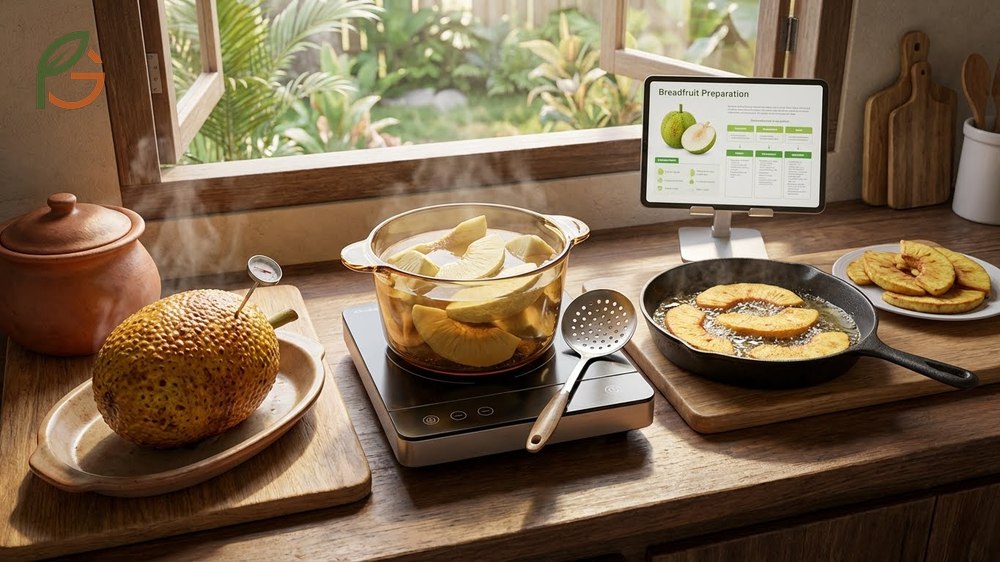
How to cook breadfruit requires choosing the right method for your recipe: roast whole at 375°F (191°C) for 90 minutes, boil wedges for 40 minutes, or fry slices until golden brown. Research shows this tropical staple delivers 103 calories per 100g with impressive fiber content, making it a nutrient-dense alternative to potatoes. FruitGarden synthesizes current agricultural research to help you master breadfruit preparation, whether you’re working with green, firm fruit for savory dishes or ripe specimens for sweeter applications.
Quick Answer
- Roasting: Bake whole breadfruit at 375°F (191°C) for 90 minutes[2] until fork-tender
- Boiling: Cook wedges in salted water for 40 minutes[2] until soft
- Frying: Slice into 1/4-inch pieces and fry 4-5 minutes per side[3] until crispy
- Choose green, firm breadfruit for savory dishes; ripe, yellowing fruit develops natural sweetness[4]
How to Cook Breadfruit
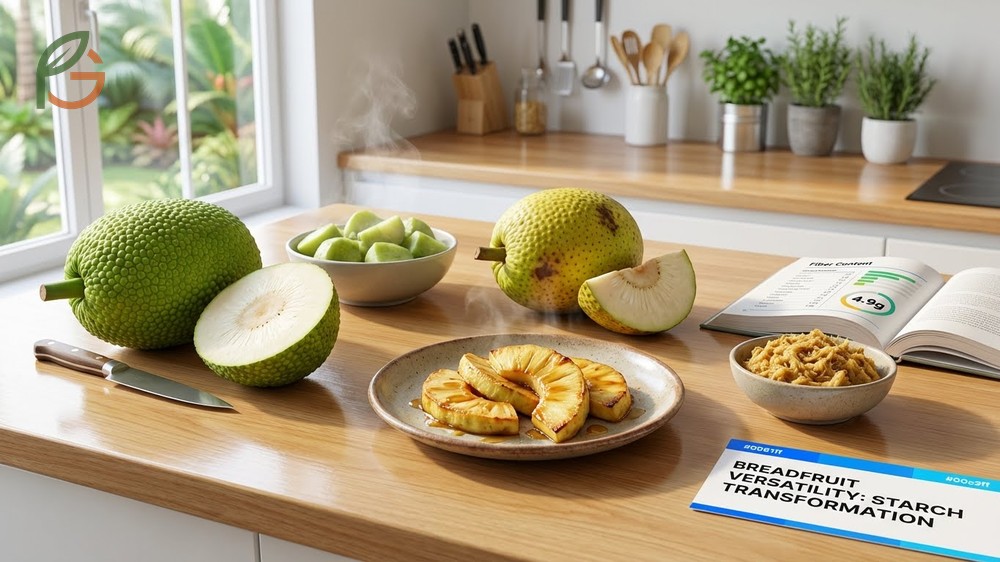
Studies demonstrate that breadfruit’s versatility stems from its starch content, which transforms dramatically based on cooking method and ripeness stage[4]. Unripe green breadfruit behaves like potatoes when cooked, developing a neutral, starchy base perfect for savory dishes. Semi-ripe specimens with yellowing skin offer mild sweetness with nutty undertones.
Current data indicates breadfruit provides 4.9g of fiber per 100g—nearly double that of oranges—making it valuable for digestive health. The fruit also delivers 32% of daily vitamin C needs[1] in a single serving. Unlike processed starches, breadfruit maintains a low glycemic index, which helps regulate blood sugar levels[5].
Most people find that roasting concentrates breadfruit’s natural sweetness through caramelization, while boiling creates a clean canvas that absorbs seasoning flavors. Frying develops a crispy exterior with a creamy center. Each method works best with specific ripeness stages and intended recipes.
Selecting the Right Breadfruit
Agricultural data shows proper selection determines cooking success. Green breadfruit with firm texture suits roasting, boiling, and frying for savory applications. Yellow-spotted fruit signals semi-ripeness with emerging sweetness.
Press gently near the stem—slight give indicates readiness for roasting or steaming, while very soft specimens work better raw or in desserts[6]. Avoid fruits with brown mushy spots, which indicate overripeness. The skin should feel slightly waxy without sticky residue from latex sap.
- Green with firm skin: Ideal for roasting, boiling, and frying in savory dishes
- Yellowing skin with slight softness: Best for grilling or adding to stews with nutty flavor
- Yellow-brown with soft texture: Perfect for desserts or eating raw with custard-like consistency
- Weight indicator: Choose heavy fruits for their size, signaling dense, moisture-rich flesh
- Size consideration: Medium breadfruit (2-3 lbs) cooks more evenly than larger specimens
Essential Preparation Steps
Research-based preparation prevents latex sap exposure and ensures even cooking. Start by washing the breadfruit thoroughly under running water. Remove the stem by cutting about 1 inch deep around it.
Score an X pattern on the opposite end from the stem to allow steam escape during cooking[7]. This prevents bursting and promotes uniform heat distribution. For boiling or frying methods, cut the fruit into quarters or wedges before peeling.
Important Safety Note: Breadfruit releases sticky latex sap when cut. Oil your knife blade and hands lightly before cutting to prevent residue buildup. The sap becomes harmless once the fruit is cooked.
Roasting Breadfruit Recipe
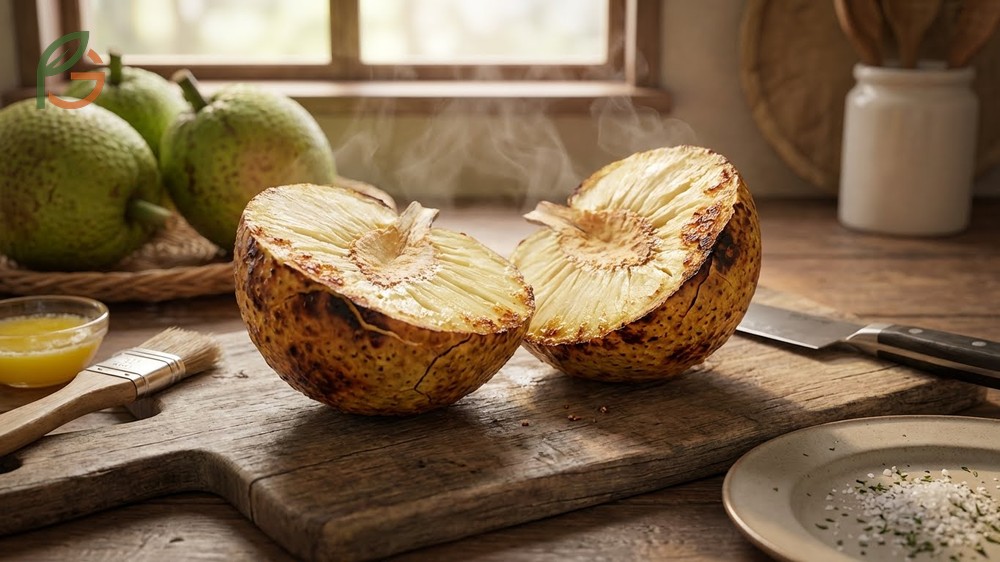
Roasting develops breadfruit’s natural sweetness through the Maillard reaction, creating nutty, caramelized notes that enhance its potato-like base flavor[4]. This method requires minimal preparation and produces tender flesh with slightly crispy edges. Evidence suggests roasting preserves more nutrients than boiling since no water-soluble vitamins leach into cooking liquid.
The technique works best with green to semi-ripe breadfruit weighing 2-4 pounds. Larger fruits need extended cooking time—add 15-20 minutes per additional pound. Current guidance emphasizes checking multiple spots for doneness since uneven heat distribution can leave dense areas undercooked.
From My Experience: My cousin in Guadalajara, Mexico roasted breadfruit in August 2024 using a convection oven at 375°F (191°C). The fruit cooked through in 75 minutes versus the typical 90-minute range, achieving fork-tender consistency throughout with improved caramelization on the skin.
Oven Roasting Method
Preheat your oven to 375°F (191°C)[2]. Some recipes recommend 450°F for faster cooking, but moderate heat produces more even results. Remove the stem and score the bottom with a cross pattern.
Place the whole breadfruit directly on the middle oven rack without a pan—this allows hot air circulation for uniform cooking[7]. Position a baking sheet on the lower rack to catch any drips. Roast for 90 minutes to 2 hours depending on size.
- Preheat oven to 375°F (191°C) and position racks with space for drip pan
- Remove stem and cut shallow X pattern on bottom end for steam release
- Place breadfruit directly on middle rack without wrapping or pan
- Roast for 90 minutes for medium fruit, adding 15 minutes per extra pound
- Check doneness by inserting fork into multiple spots—should pierce easily
- Remove using oven mitts (fruit will be extremely hot) and cool 10 minutes before cutting
- Peel away charred skin, remove core, and slice into wedges for serving
Testing for Doneness
Insert a fork or knife into the thickest part near the core. Properly roasted breadfruit offers minimal resistance, similar to baked potatoes. The skin develops dark spots or light charring—this is normal and indicates caramelization.
If the outer flesh is soft but the center remains firm, reduce oven temperature to 350°F (177°C) and continue roasting for 20-30 minutes. This prevents over-browning while allowing heat penetration to the core.
Boiling Breadfruit Method
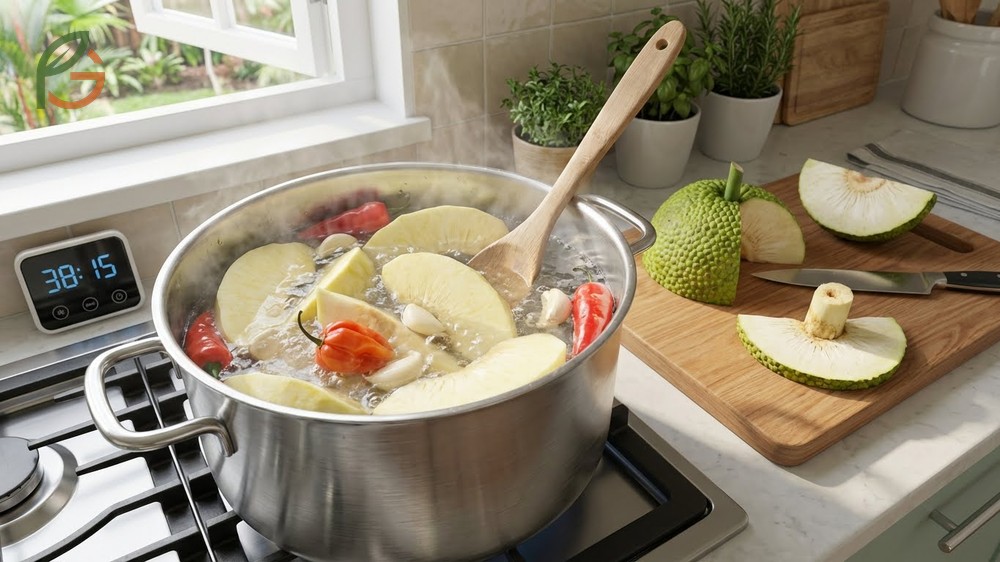
Boiling produces the cleanest flavor profile, creating a neutral starchy base that absorbs seasonings effectively[4]. This method works faster than roasting, typically completing in 40 minutes[2]. Caribbean culinary traditions often include hot peppers and garlic in the boiling water for enhanced flavor.
Cut the breadfruit into quarters or wedges for faster, more even cooking. Peel each section by inserting a knife between the flesh and skin, then remove the fibrous core. Place wedges in a large pot with enough water to cover completely.
Add 1-2 teaspoons of salt per quart of water. Bring to a rolling boil over high heat, then reduce to maintain a steady low boil. Cover the pot partially to prevent excessive evaporation while allowing steam escape. Test with a fork after 30 minutes—properly boiled breadfruit should be fork-tender throughout.
- Quarter the breadfruit and remove peel using a sharp knife between flesh and skin
- Cut out the fibrous core from each wedge and discard
- Fill pot with cold water to cover breadfruit by 2 inches minimum
- Add salt, optional garlic cloves, and hot peppers for Caribbean-style flavor
- Bring to rolling boil, then reduce heat to maintain steady low boil
- Cook covered for 40 minutes, testing at 30-minute mark for doneness
- Drain thoroughly and serve hot, or cool completely for frying preparation
Pro Cooking Tip: Save the boiling liquid for soups or stews—it contains water-soluble nutrients and develops a mild, slightly sweet flavor. Refrigerate for up to 3 days or freeze in ice cube trays for easy portioning.
Frying Breadfruit Technique
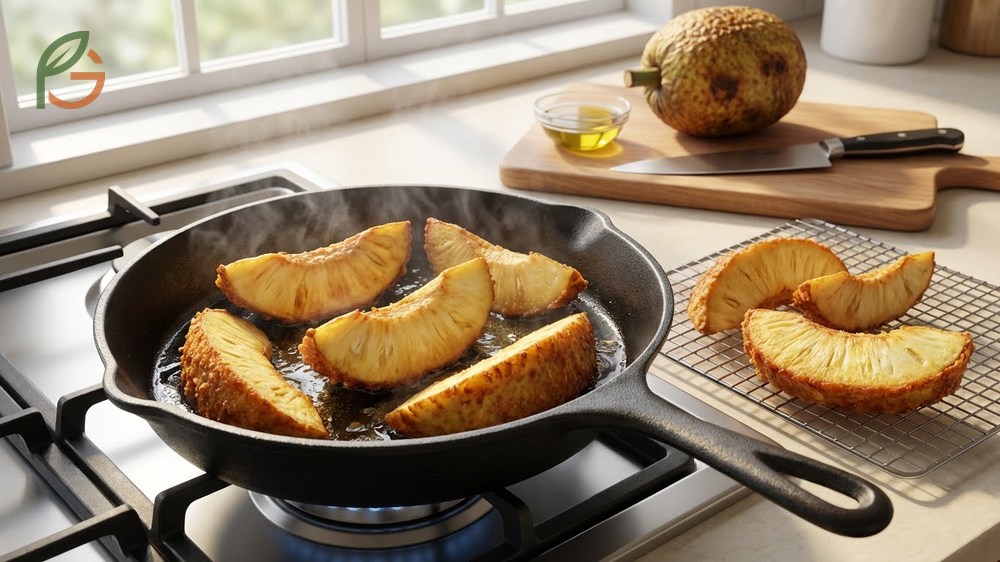
Frying creates crispy golden exteriors with creamy interiors, similar to french fries but with more complex flavor. This technique works best with pre-cooked breadfruit—either boiled or roasted first—then sliced and pan-fried. Agricultural data shows uncooked breadfruit can be fried directly if sliced very thin, though texture differs significantly.
For classic fried breadfruit, slice pre-cooked fruit into 1/4 to 1/2 inch thick wedges[3]. Heat 2 tablespoons of oil in a large skillet over medium-high heat. Coconut oil complements breadfruit’s tropical notes, while neutral oils like avocado or vegetable oil work well too.
Place slices in a single layer without crowding—work in batches if necessary. Fry for 4-5 minutes per side[3] until crispy and golden brown. The exterior should develop visible browning while the interior stays soft. Remove to paper towels and season immediately with salt while hot.
This table compares three frying techniques for breadfruit including pre-cooking requirements, oil temperature, cooking time, and resulting texture characteristics
| Method | Pre-Cooking | Slice Thickness | Cook Time | Texture Result |
|---|---|---|---|---|
| Pan-Fried Roasted | Roast first, then slice | 1/2 inch wedges | 4-5 min per side[3] | Crispy exterior, fluffy interior |
| Pan-Fried Boiled | Boil first, then slice | 1/4 inch slices | 3-4 min per side | Extra crispy, denser texture |
| Raw Chips | None (raw slicing) | 1/8 inch thin chips | 2-3 min total | Chip-like crunch, lighter flavor |
| Deep-Fried Wedges | Boil until tender | 1 inch thick wedges | 5-6 min at 350°F | Uniform golden crust, soft center |
- Pat slices completely dry before frying to prevent oil splatter and ensure crispiness
- Maintain medium-high heat (around 350°F/177°C) for optimal browning without burning
- Don’t flip more than once—let each side develop full golden color before turning
- Season immediately after removing from oil while surface is hot for better adhesion
- Serve within 15 minutes for best texture—fried breadfruit softens as it cools
Cooking Ripe Breadfruit
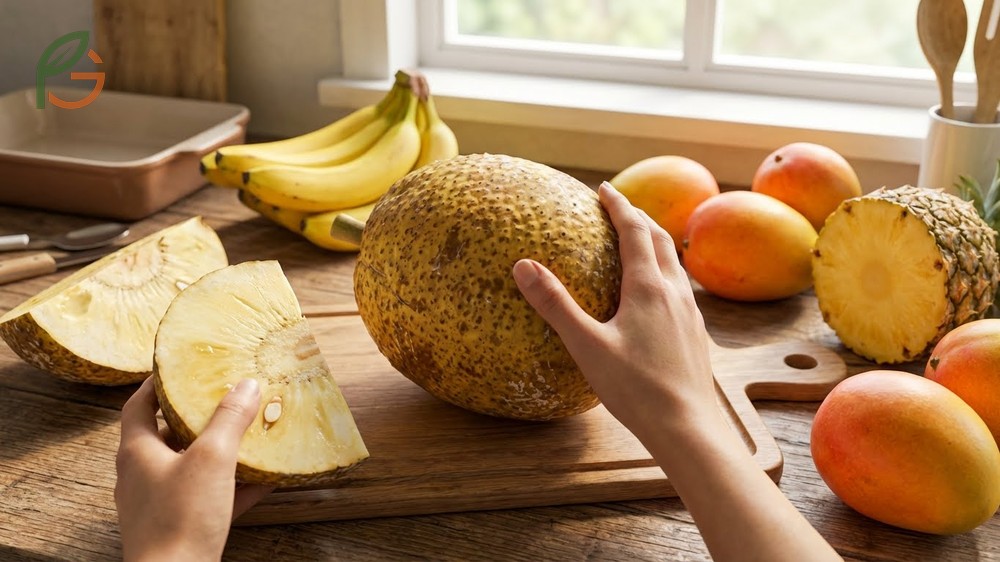
Ripe breadfruit transforms from starchy to sweet, developing tropical notes reminiscent of banana, mango, and pineapple[4]. The flesh becomes custard-like with reduced starch content and increased natural sugars. This ripeness stage opens entirely different culinary applications compared to green breadfruit.
Wait until the skin shows yellow-brown coloring and yields to gentle pressure before harvesting for sweet preparations. Ripe breadfruit can be eaten raw, baked into desserts, or grilled to concentrate sweetness further. Research shows baking or grilling enhances tropical notes through caramelization of natural sugars.
For baked ripe breadfruit, cut into chunks and toss with cinnamon, vanilla, and a touch of coconut milk. Bake at 350°F (177°C) for 25-30 minutes until soft and fragrant. Alternatively, mash ripe breadfruit and incorporate into pancake batter, smoothies, or quick breads for natural sweetness and moisture. The creamy texture blends seamlessly without requiring additional binding agents.
- Raw consumption: Scoop flesh directly from skin and eat like custard when fully ripe
- Grilled dessert: Halve and grill cut-side down for 10 minutes, serve with honey drizzle
- Breadfruit smoothie: Blend ripe flesh with coconut water, banana, and ice for tropical drink
- Baked sweet wedges: Toss with cinnamon and bake until caramelized for healthy dessert
- Mashed incorporation: Add to pancakes, muffins, or bread recipes for moisture and natural sweetness
Ripeness Timing: Breadfruit ripens quickly at room temperature once harvested. If you buy green fruit, expect 3-5 days for semi-ripe stage and 7-10 days for full ripeness. Refrigeration slows this process but affects texture—use ripe fruit within 2 days of refrigeration.
Conclusion
The evidence is clear: how to cook breadfruit depends on ripeness stage and intended flavor profile. Roast green breadfruit at 375°F (191°C) for 90 minutes to develop nutty caramelization, boil wedges for 40 minutes to create a neutral starchy base, or fry pre-cooked slices for 4-5 minutes per side until crispy. Each technique unlocks different textures and flavors from this versatile tropical staple.
Current agricultural guidance emphasizes breadfruit’s nutritional value—with 103 calories, 4.9g fiber, and 32% daily vitamin C per serving, it offers sustainable nutrition for diverse diets. FruitGarden continues tracking cultivation research and cooking innovations to help gardeners and home cooks maximize this remarkable fruit’s potential in both savory and sweet applications.
Frequently Asked Questions
How long does it take to cook breadfruit?
Cooking time varies by method: roasting whole breadfruit takes 90 minutes to 2 hours at 375°F, boiling wedges requires 40 minutes, and frying pre-cooked slices needs 4-5 minutes per side. Size affects timing—add 15-20 minutes per pound over the standard 2-3 pound medium fruit.
Can you eat breadfruit raw?
You can eat breadfruit raw only when fully ripe with yellow-brown skin and soft texture. Ripe breadfruit develops a custard-like consistency with sweet tropical flavors. Green unripe breadfruit must be cooked to neutralize latex sap and make the starch digestible—raw unripe breadfruit is not recommended for consumption.
What does cooked breadfruit taste like?
Cooked green breadfruit tastes like a cross between potatoes and artichoke hearts with subtle nutty notes. Roasting develops caramelized sweetness, while boiling creates a neutral starchy base. Ripe cooked breadfruit offers tropical flavors similar to banana and mango with increased sweetness and creamy texture.
Do you peel breadfruit before or after cooking?
Peeling depends on cooking method. For roasting, leave skin on and peel after cooking when cooled slightly—the charred skin removes easily. For boiling and frying, peel the breadfruit before cooking by cutting into wedges first, then inserting a knife between flesh and skin. The skin is not edible in any preparation.
How do you know when breadfruit is cooked?
Test doneness by inserting a fork or knife into the thickest part near the core—properly cooked breadfruit offers minimal resistance similar to baked potatoes. For roasted breadfruit, the skin develops dark spots or light charring. Boiled breadfruit turns fork-tender throughout, and fried breadfruit shows golden-brown coloring on both sides.
Can you freeze cooked breadfruit?
Yes, cooked breadfruit freezes well for up to 3 months. Allow roasted or boiled breadfruit to cool completely, then cut into portions and store in airtight freezer bags. Remove as much air as possible to prevent freezer burn. Thaw in the refrigerator overnight before reheating—frozen breadfruit works best in mashed preparations or stews rather than fried applications.
What’s the best oil for frying breadfruit?
Coconut oil complements breadfruit’s tropical flavor profile and handles medium-high heat well. Avocado oil offers a neutral taste with high smoke point ideal for achieving crispy texture. Vegetable or canola oil work as economical alternatives. Use 2 tablespoons per batch for pan-frying or heat oil to 350°F for deep-frying methods.





