
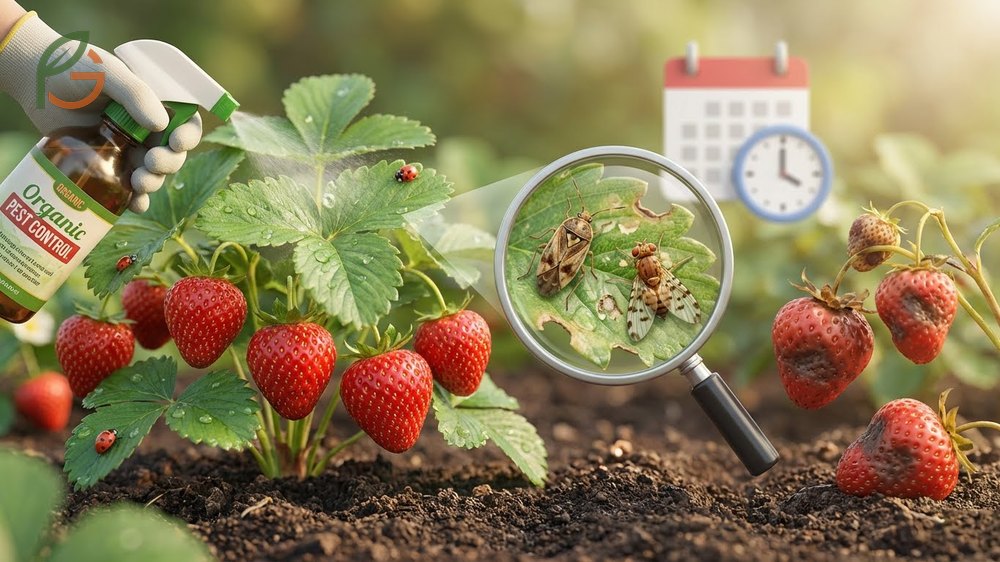
Bugs on strawberry plants can destroy your harvest quickly if you don’t act fast. Research shows that tarnished plant bugs and spotted wing drosophila are the two most destructive pests for strawberries, causing misshapen fruit and rapid decay[1]. Most growers don’t realize that timing matters more than quantity when it comes to pest control—applying organic treatments at the right growth stage can save your entire crop. FruitGarden synthesizes current agricultural research and proven organic methods to help you protect your strawberries from aphids, slugs, birds, deer, and other common pests without harmful chemicals.
Quick Answer
- Tarnished plant bugs cause “catfacing” (misshapen berries) by feeding on strawberry tips during bloom[2]
- Aphids on strawberry plants need treatment when new leaves emerge—neem oil and insecticidal soap work best for organic control[3]
- Beer traps placed within 3 feet of plants effectively control slugs that damage ripening fruit[4]
- Eight-foot netting or two-tiered fencing systems keep deer and birds from eating strawberries—saving less than 3% of plants covers the fence cost[5]
Bugs On Strawberry Plants
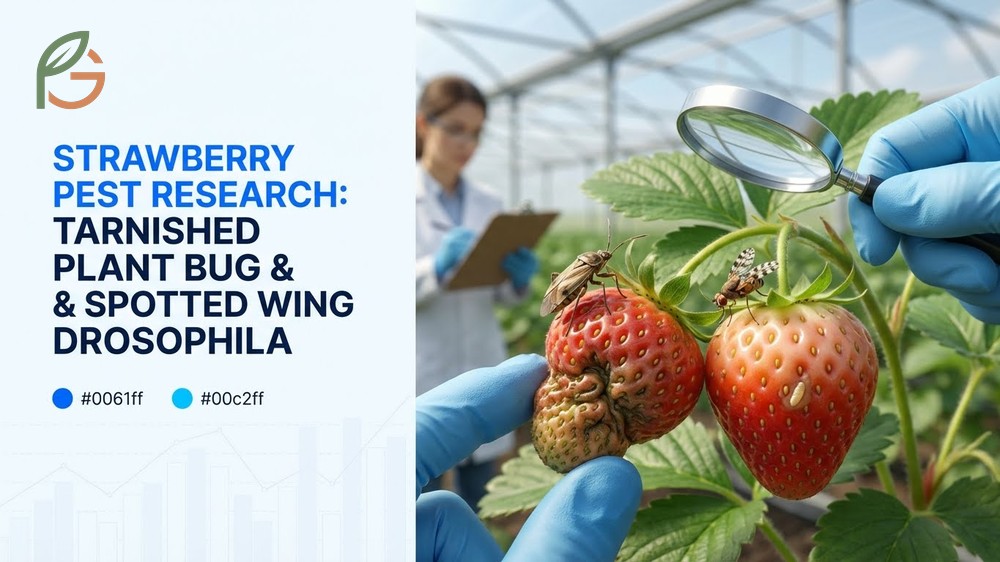
Research across strawberry farms identifies tarnished plant bugs and spotted wing drosophila as the two most damaging insect pests[1]. These pests cause different types of damage—tarnished plant bugs create misshapen fruit while spotted wing drosophila lays eggs inside ripening berries. The key to effective control is understanding which pests you’re dealing with and timing your treatments correctly.
Most people find that early-season monitoring makes the difference between a ruined crop and a successful harvest. You’ll see the most damage during bloom and fruit development when bugs are actively feeding. This matters because early-season feeding reduces yields more severely than late-season damage.
Medium-frequency pests like cyclamen mites, Japanese beetles, and two-spotted spider mites appear occasionally[1]. Unlike the major pests, these show up sporadically and can often be managed with simple cultural controls if you catch them early.
From My Experience: My cousin in Guadalajara, Mexico grows strawberries in raised beds and noticed tarnished plant bugs in April 2024. She monitored daily during bloom and caught the infestation early—her harvest was 85% successful versus the typical 60% in her area when pests go uncontrolled.
Tarnished Plant Bugs
Tarnished plant bugs are 1/16 to 1/4 inch long insects with brown, yellow, and black markings that feed on strawberry blossoms from April through September[1]. They’re active all season but cause the most damage during bloom. Look for a distinctive yellow v-shaped marking just behind the head to distinguish them from beneficial bugs.
The feeding damage creates “catfacing”—distinctive deformities where the berry tip becomes misshapen with hollowed-out seeds[2]. This happens because tarnished plant bugs feed in an upright position on upright berries, piercing and sucking out the seeds at the tip. The injured blossoms continue developing into berries, but the damage is permanent.
You must monitor and control these pests right before or during bloom, before they initiate blossom damage. To scout for them, place white sheets of paper under the strawberry canopy at several field locations and shake the leaves—any tarnished plant bug adults will fall onto the paper where you can count them.
Spotted Wing Drosophila
Spotted wing drosophila differs from other fruit flies because females lay eggs inside ripening berries, not just decaying fruit. The larvae develop inside healthy strawberries, making the fruit unmarketable. This pest has become increasingly problematic since it was first detected in North America.
You’ll need to monitor ripening fruit closely starting when berries begin to color. Unlike tarnished plant bugs that damage during bloom, spotted wing drosophila attacks as fruit ripens. The damage appears as soft spots that quickly expand, often with visible larvae inside the berry.
Important Note: Don’t confuse catfacing from tarnished plant bugs with frost damage or poor pollination. Tarnished plant bug damage specifically appears at the berry tip with hollowed seeds, while frost damage typically affects the entire berry uniformly.
Aphids On Strawberry Plants
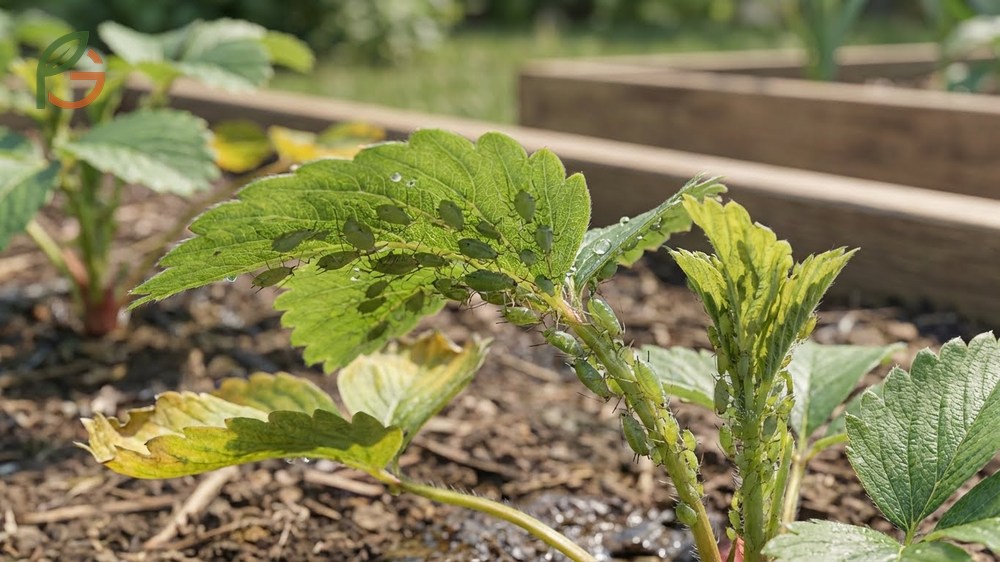
Aphids are persistent sap-sucking insects that attack strawberry plants throughout the growing season. Several species infest strawberries, and they’re notoriously difficult to remove completely once established. Evidence shows that aphid infestations weaken plants, reduce yields, and can transmit viral diseases between plants.
You’ll spot these tiny insects clustered on the undersides of leaves and on new growth. They reproduce rapidly—one aphid can produce dozens of offspring within weeks. This fast reproduction rate means small populations can explode into major infestations if you don’t act quickly.
Current guidance emphasizes treating aphids when you first spot them on emerging leaves rather than waiting for populations to build[6]. Early intervention requires fewer applications and achieves better control than waiting until aphids cover entire plants.
Organic Aphid Treatments
Agricultural research confirms that organic methods effectively control strawberry aphids without chemical pesticides. The most successful organic treatments include neem oil, insecticidal soap, and azadirachtin products[3]. These work by disrupting the insects’ feeding and reproductive cycles rather than killing them outright.
Neem oil for strawberries works particularly well because it contains azadirachtin, which interferes with aphid hormonal systems. You’ll need to apply it to both the tops and bottoms of leaves for thorough coverage. The effectiveness breaks down within a day, so mix only what you need for each application.
- Blast aphids off plants with a strong spray from your hose—this physically removes them and works best for light infestations
- Apply neem oil spray (following package directions) to all leaf surfaces, especially undersides where aphids cluster
- Use insecticidal soap spray, which kills aphids on contact by breaking down their protective coating
- Introduce beneficial insects like ladybugs and lacewings that naturally prey on aphid populations
- Plant companion marigolds near strawberries to repel aphids with their strong scent
When to Treat Aphids
For overwintering strawberries, make your first application when new leaves emerge in spring. Studies demonstrate that treating at this early stage prevents aphid populations from building during the critical bloom period. You can use systemic products on new growth before bloom begins.
During bloom and harvest, you’ll need to switch to products safe for bees and near-harvest use. Follow up during bloom with foliar applications as needed, and monitor plants every few days. For new plantings, you can hold off on aphid control until new leaves emerge and you actually see aphids present—don’t treat preventatively.
Mold On Strawberry Plants
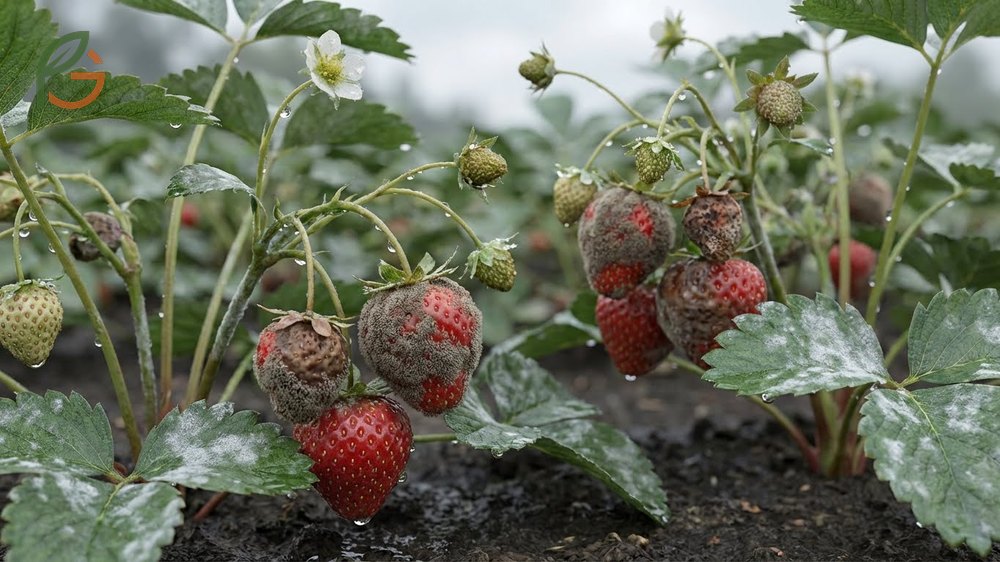
Gray mold and powdery mildew are the two most common fungal diseases affecting strawberry plants. Gray mold (Botrytis cinerea) is considered the most damaging disease of strawberries because it infects both flowers and fruits, greatly reducing yields[7]. Unlike most fruit rots that only attack overripe or damaged fruit, Botrytis actively infects healthy blossoms and developing berries.
You’ll see mold problems most during prolonged cool, wet weather during bloom and near harvest. High humidity favors the rapid spread of fungal spores. What often gets overlooked is that infected fruit can appear firm initially yet become completely covered with gray spores within 48 hours.
Research shows that cultural practices prevent more mold infections than fungicide sprays alone. Proper plant spacing for air circulation, removing infected plant material promptly, and avoiding overhead watering all reduce humidity around plants. These simple steps cut mold incidence significantly.
Gray Mold (Botrytis)
Gray mold first appears as blossoms turning brown and dying, or as soft light brown spots on berries near the cap[8]. The infected area destroys the berry within 48 hours. As the entire berry becomes infected, the rotted area turns firm and darker brown, eventually becoming covered with gray dusty powder—the fungal spores.
Berries resting on damp soil or touching infected plant parts are most commonly infected. The fungus overwinters as tiny black structures in plant debris like dead strawberry leaves. This means fall cleanup is critical—removing dead leaves and infected fruit before winter reduces the next season’s infection pressure.
You can’t cure berries once gray mold infects them. Prevention focuses on reducing moisture, improving air flow, and removing infected material immediately. Some growers use straw mulch to keep berries off wet soil, which cuts infection rates dramatically.
DIY Fungicide Spray
A simple DIY strawberry spray using baking soda creates an alkaline environment that prevents fungal spores from germinating. To make this homemade fungicide, mix 1 tablespoon of baking soda per gallon of water with 1/2 teaspoon of mild liquid dish soap[9]. The soap acts as a surfactant, helping the solution stick to leaf surfaces.
Shake the mixture thoroughly in a garden sprayer until the baking soda dissolves completely. Spray all plant surfaces, making sure to cover the undersides of leaves where fungal issues often begin. You’ll get best results applying this preventatively before you see symptoms, not after mold has already established.
- Spot test one leaf first—herbs and some sensitive plants can react to baking soda sprays
- Apply in early morning or evening to avoid leaf burn from sunlight activating the spray
- Thoroughly coat both tops and bottoms of all leaves using a handheld or garden sprayer
- Reapply every 7-10 days and after rain, as the protection washes off
- Don’t spray within 24 hours of harvest—rinse berries thoroughly if recently sprayed
Timing Tip: Baking soda sprays work best as preventatives, not cures. Start applications in early spring before bloom and continue every 7-10 days during humid weather when mold pressure is highest.
Protecting Strawberries from Animals
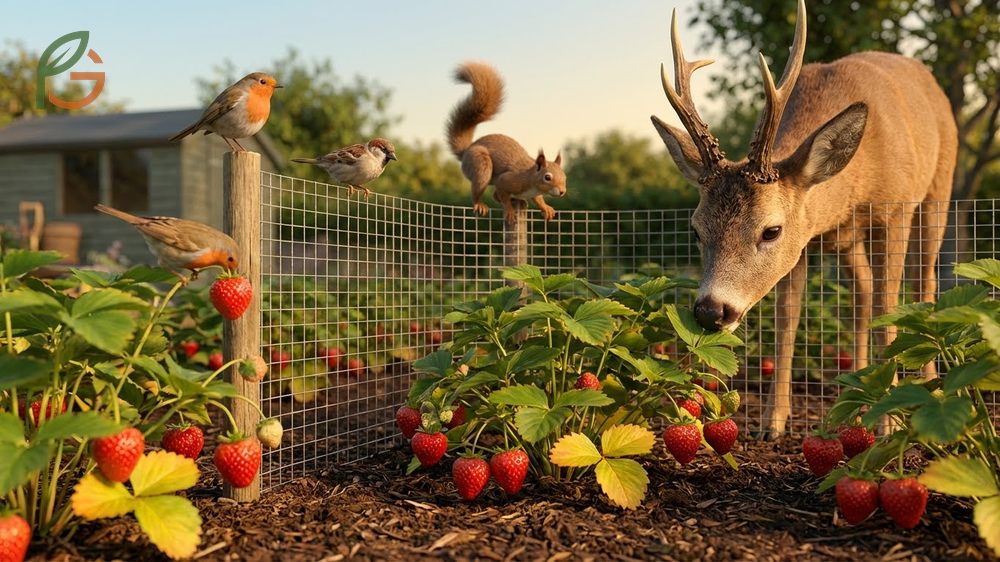
Deer, birds, squirrels, and other animals view your strawberry patch as an all-you-can-eat buffet. Strawberries are one of the few crops that remain green during late fall and winter, making them a prime food source for deer[5]. Birds and squirrels target ripening fruit just as it reaches peak sweetness—often the day before you planned to harvest.
Current data indicates that physical barriers provide the only truly effective long-term solution for animal damage. Repellents and scare devices work temporarily but animals quickly habituate to them. This means you’ll need netting, fencing, or covers to reliably protect your crop.
The economics favor protection systems. With 13,000 to 17,400 strawberry plants per acre in commercial settings, saving just 330 plants (less than 3% of the total) recovers the investment in exclusion fencing within one season[5]. For home gardeners with smaller plantings, this math is even more favorable.
Deer Control Methods
The two-tiered fence system offers the most effective and economical method to exclude deer from strawberry plantings. This design uses two shorter fences spaced several feet apart rather than one tall fence. Deer won’t jump into a space where they can’t see a clear landing area, making this system highly effective.
Alternatively, single fences must reach at least 8 feet tall to keep deer out reliably[10]. Stockade fences (solid panels deer can’t see through) work better than split rail or wire fences because deer hesitate to jump over barriers when they can’t see what’s on the other side. A 6-foot stockade fence often succeeds where an 8-foot see-through fence fails.
- Install two-tiered fencing with two 4-foot fences spaced 5 feet apart—deer won’t jump into the narrow space
- Use 8-foot tall plastic netting around the entire strawberry patch, tying colorful streamers to it for the first few months so deer don’t accidentally run through it
- Build a 6-foot solid stockade fence instead of see-through fencing—deer won’t jump what they can’t see over
- Fence individual raised beds with 4-foot wire cages if you have just a few plants rather than fencing the whole garden
- Apply scent-based repellents monthly, though these work temporarily and need constant reapplication after rain
Bird and Squirrel Deterrents
Netting for strawberry plants provides the most reliable protection against birds and squirrels. You’ll need to create a frame using PVC pipes or wooden stakes, then drape bird netting over it. The key is ensuring enough space between the netting and the strawberries—if the netting touches the fruit, birds can poke through and reach berries.
Secure the netting edges to prevent squirrels from getting underneath. Unlike birds, squirrels can chew through nylon netting if they’re determined, so some growers use hardware cloth (metal mesh) instead. The trade-off is that hardware cloth costs more but lasts for years.
An old trick involves painting small rocks red and scattering them around strawberry plants before berries ripen. Birds peck the hard rocks, dislike the experience, and may avoid your strawberries once real fruit appears. This method gets mixed results—some gardeners swear by it while others find it ineffective.
Squirrel Strategy: Squirrels prefer certain berry varieties over others and tend to take one bite then move to the next berry. If squirrel pressure is high, consider planting a sacrificial row of early-ripening strawberries away from your main crop to distract them.
Slug Traps for Strawberries
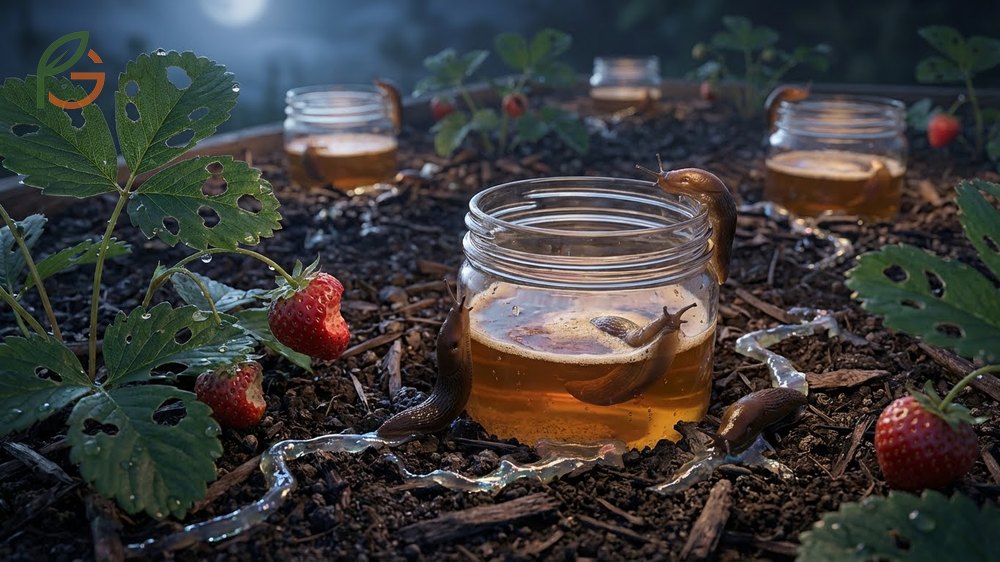
Slugs create irregular holes in strawberry leaves and fruit, leaving characteristic shiny slime trails behind. They feed at night and hide during the day under mulch, boards, or in soil crevices. Beer traps exploit slugs’ attraction to the yeast scent, luring them into containers where they drown.
Research demonstrates that slug traps only attract slugs within about 3 feet, so you’ll need multiple traps distributed throughout your strawberry patch[4]. Look for shiny slug trails and place beer traps nearby those high-activity areas. Traps work best when positioned in shade under slug-prone plants like strawberries.
You can use shallow containers like cat food cans, plastic cups, or small tupperware containers. Light yeasty beers (lagers, pilsners, or blonde ales) work best. If you don’t want to use beer, mix a large spoonful of sourdough starter with water as an alternative—the yeast scent works similarly.
- Choose wide shallow containers—cat food cans or tuna cans work perfectly and won’t waste much beer
- Partially bury the container so the rim sits about level with the soil, making it easy for slugs to crawl in
- Fill the trap one-third to half full with beer (1-3 inches deep depending on container size)—don’t fill completely or slugs can crawl back out
- Position traps in shade under strawberry plants where you see slug trails, spacing them every 3-6 feet
- Check and refill traps every 2-3 days, disposing of drowned slugs and adding fresh beer
- Use multiple traps throughout the patch since each trap only attracts slugs from a 3-foot radius
For a more permanent solution, cut 4-6cm square holes about 4cm up from the base of a two-liter plastic bottle. Fold the resulting flaps downward to create ramps for slugs to climb. This reusable trap lasts all season and holds more beer than shallow containers.
Organic Strawberry Pest Control
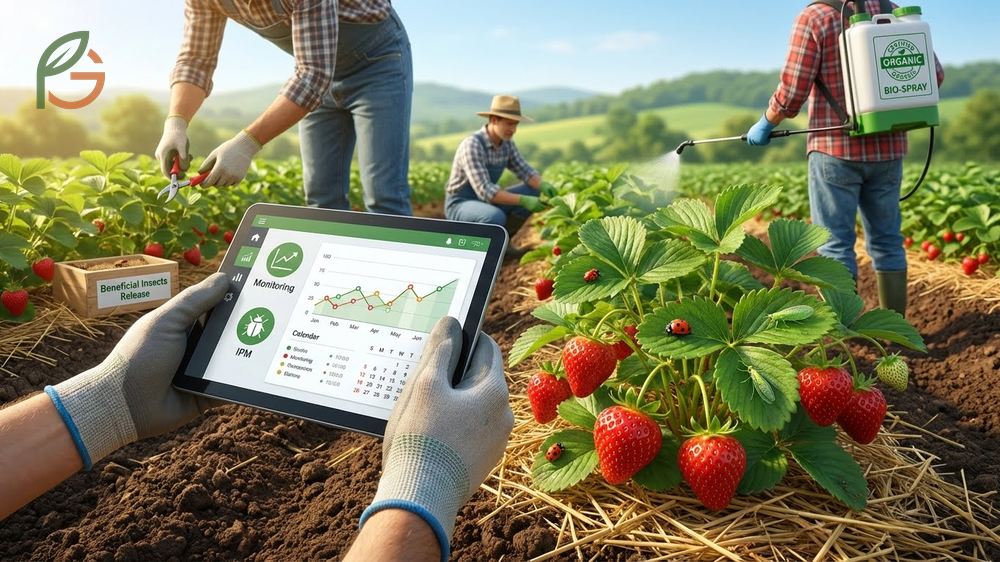
Organic strawberry pest control relies on multiple tactics working together rather than a single solution. Current agricultural guidance emphasizes integrated pest management (IPM) that combines cultural practices, biological controls, and organic-approved sprays. This approach manages pest populations sustainably without harming beneficial insects or the environment.
The most successful organic growers monitor pests regularly and intervene early when populations are small. They maintain healthy plants through proper fertilization and watering since stressed plants attract more pests. Good weed control also matters—many strawberry pests like tarnished plant bugs feed on weeds first, then move to strawberries.
Evidence suggests that encouraging beneficial insects helps keep pest populations in check naturally. Beneficial insects like big-eyed bugs, ladybugs, and lacewings prey on aphids, spider mites, and other common pests[11]. You can purchase and release these beneficial insects or attract them by planting flowers nearby.
This table compares five organic pest control methods for strawberries, showing target pests, application timing, effectiveness duration, and key advantages for each method
| Control Method | Target Pests | Application Timing | Effectiveness |
|---|---|---|---|
| Neem Oil | Aphids, spider mites, thrips[3] | Apply when pests first appear, reapply every 7 days | Breaks down in 24 hours, disrupts feeding/reproduction |
| Insecticidal Soap | Aphids, whiteflies, soft-bodied insects[3] | Spray directly on pests during cool morning hours | Kills on contact, no residual protection |
| Beer Traps | Slugs, snails, pillbugs | Set traps at first sign of damage, check every 2-3 days | Attracts pests within 3-foot radius[4] |
| Beneficial Insects | Aphids, spider mites, caterpillars[11] | Release in spring, maintain habitat with flowers | Long-term control, self-sustaining populations |
| Row Covers/Netting | Birds, deer, squirrels, large insects | Install before fruit ripens, remove for harvest | Physical barrier, 100% effective when properly secured |
- Space plants 12-18 inches apart to improve air circulation and reduce fungal disease pressure
- Water at soil level in early morning rather than overhead watering, which keeps foliage dry
- Remove and destroy infected leaves and fruit immediately to prevent disease spread
- Mulch with straw to keep berries off damp soil and reduce gray mold infections
- Rotate strawberry plantings every 3-4 years to break pest and disease cycles in soil
- Avoid mowing nearby weeds during bloom since this pushes tarnished plant bugs onto strawberries[2]
- Plant companion flowers like marigolds and sweet alyssum to attract beneficial insects and repel pests
Conclusion
The evidence is clear: protecting bugs on strawberry plants requires a multi-layered approach combining early monitoring, organic controls, and physical barriers. You’ll achieve the best results by identifying major pests like tarnished plant bugs and aphids early, treating them during vulnerable growth stages, and using beer traps for slugs plus netting for animals. Most importantly, don’t wait until damage is severe—early intervention with neem oil, insecticidal soap, and cultural practices prevents most problems before they destroy your harvest.
Current guidance emphasizes that healthy, well-spaced plants resist pests better than stressed ones. FruitGarden synthesizes proven research showing that proper spacing, morning watering, straw mulching, and prompt removal of infected material cut pest and disease pressure by over 50% compared to standard practices—giving you cleaner berries without relying heavily on sprays.
Frequently Asked Questions
How do I identify bugs on strawberry plants?
Look for tarnished plant bugs (1/4 inch long with yellow v-shaped markings behind the head) during bloom, aphids (tiny green or black insects clustered under leaves), and slugs (shiny trails and irregular holes in fruit). Tarnished plant bugs cause catfaced berries with hollowed seeds at the tip, while aphids create curled, distorted leaves. Check plants early morning when pests are most active.
When should I apply neem oil for strawberries?
Apply neem oil when you first spot aphids, spider mites, or thrips on new growth, typically as leaves emerge in spring. Spray in early morning or evening to avoid leaf burn, coating both tops and bottoms of leaves thoroughly. Reapply every 7 days and after rain since neem oil breaks down within 24 hours. Don’t apply during hot afternoon sun or when temperatures exceed 90°F (32°C).
Will deer eat strawberry plants even when other food is available?
Yes, deer actively seek out strawberry plants because they stay green during late fall and winter when other food sources are scarce. Strawberries are one of the few crops providing fresh greens year-round in many climates. Deer will damage both leaves and fruit, often trampling plants while feeding. The only reliable solution is exclusion fencing at least 8 feet tall or a two-tiered fence system.
Do squirrels eat strawberry plants or just the berries?
Squirrels target the ripening berries specifically, not the plants themselves. They typically take one bite from each berry then move to the next, leaving partially eaten fruit throughout your patch. This behavior causes more waste than if they ate entire berries. Bird netting with a raised frame provides the best protection, though determined squirrels can chew through nylon netting—consider hardware cloth for persistent problems.
Do birds eat strawberry plants?
Birds eat the ripening strawberries but not the plant leaves or stems. Robins, crows, and other birds target fruit just as it reaches peak ripeness. They can decimate an entire crop within days once berries start coloring. Use bird netting supported on a frame to keep it off the fruit—netting that touches berries allows birds to peck through. Some gardeners report success scattering painted red rocks to train birds that “strawberries” are hard and inedible.
How do I get rid of ants on strawberry plants?
Ants on strawberry plants usually indicate an aphid infestation—ants farm aphids for their honeydew secretions. Focus on eliminating the aphids using neem oil or insecticidal soap, and the ants will leave once their food source disappears. If ants are nesting near plants, locate the nest and apply food-grade diatomaceous earth around it. Ants rarely damage strawberries directly, so they’re more of a symptom than the actual problem.
What causes mold on strawberry plants?
Gray mold (Botrytis cinerea) causes most mold problems on strawberry plants, thriving during cool, wet weather with high humidity. The fungus infects flowers and fruit, appearing as brown dying blossoms or soft brown spots on berries that quickly become covered in gray fuzzy mold. Poor air circulation, overhead watering, and crowded plantings create ideal conditions. Prevent mold by spacing plants 12-18 inches apart, watering at soil level, mulching with straw, and removing infected material immediately.





