
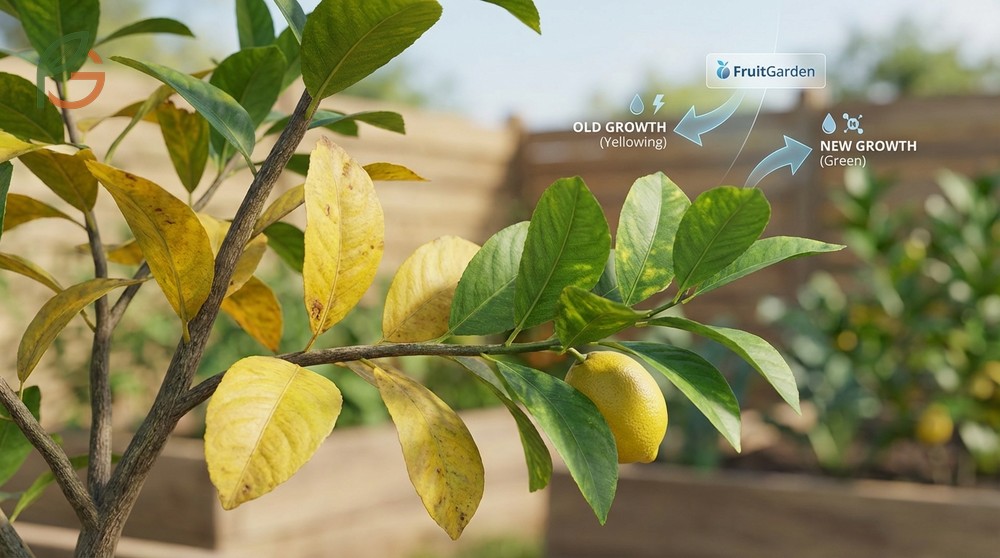
Lemon tree yellow leaves typically indicate nitrogen deficiency, iron deficiency, overwatering, or pest infestations that require specific treatments. Research shows that identifying which leaves turn yellow—older versus newer growth—is the key to accurate diagnosis and effective treatment.[1] FruitGarden synthesizes current horticultural research to help you restore your lemon tree’s health.
Quick Answer
- Nitrogen deficiency causes uniform yellowing of older leaves starting from the bottom of the tree[1]
- Iron deficiency creates yellow leaves with green veins on new growth at branch tips[2]
- Overwatering leads to yellowing with weak branches and root rot in 2-3 weeks[3]
- Pest damage from citrus leaf miners, spider mites, or scale insects causes localized yellowing and leaf curl[4]
Lemon Tree Yellow Leaves
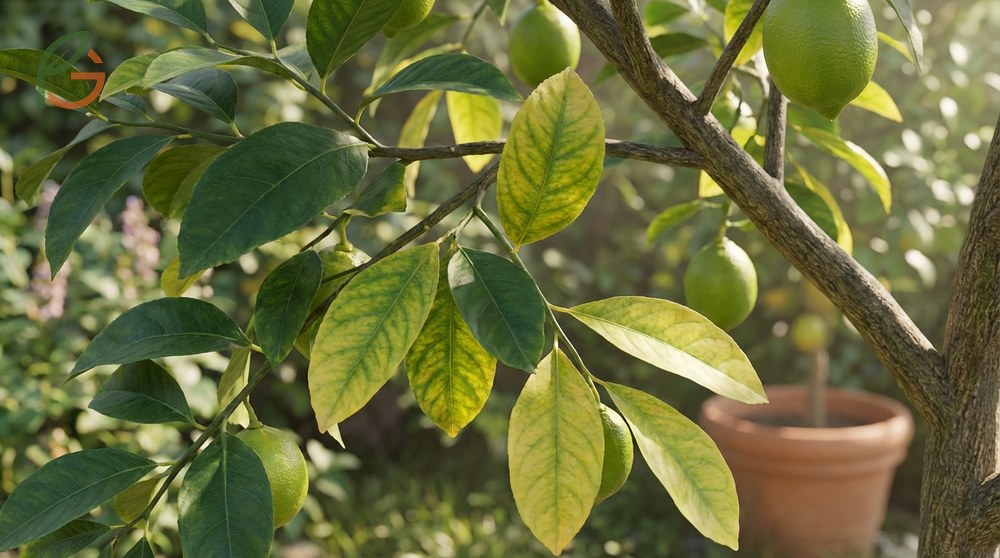
Yellow leaves on lemon trees aren’t always a crisis, but they’re your tree’s way of signaling specific problems. Studies demonstrate that the location and pattern of yellowing reveals whether you’re dealing with nutrient deficiencies, watering issues, or pest damage.[1] Most people don’t realize that timing matters—yellowing in spring versus fall points to different causes.
The most common culprits are nitrogen deficiency affecting 30-40% of backyard citrus trees, iron deficiency in alkaline soils, and overwatering that triggers root rot.[1] Current data indicates that proper diagnosis requires examining which leaves turn yellow first—older leaves near the trunk or new growth at branch tips.
Environmental stress like cold weather below 50°F (10°C) can also cause temporary yellowing that resolves without intervention. What often gets overlooked is that multiple issues can occur simultaneously, requiring you to address both nutrient levels and pest populations.
Identifying Yellow Leaf Patterns
Research shows that nutrient deficiencies create predictable patterns you can use for diagnosis. Nitrogen deficiency starts with uniform yellowing of older leaves at the bottom of the tree, while iron deficiency affects new growth with yellow leaves and green veins.[2]
Pest damage creates different patterns—citrus leaf miners leave silvery serpentine trails on young leaves, while spider mites cause stippling that makes leaves appear dusty yellow. Scale insects produce sticky honeydew that attracts sooty mold, creating black patches on yellow leaves.
From My Experience: My cousin in Guadalajara, Mexico noticed yellow leaves on his Meyer lemon in March 2024. After checking the leaf pattern, he found uniform yellowing on older leaves—classic nitrogen deficiency. He applied pelleted chicken manure at 2 pounds per tree, and new growth returned to dark green within 3 weeks, matching the typical recovery timeline from research.
When Yellowing Becomes Critical
Yellowing becomes an emergency when you see rapid leaf drop affecting more than 30% of the canopy within 2 weeks. This typically signals severe overwatering with root rot or a major pest infestation that needs immediate action.[3]
Trees losing leaves from the top down while branches become brittle indicate vascular disease or severe root damage. If you’re watering more than twice weekly in hot weather or notice soggy soil that stays wet for days, you’re likely overwatering and need to reduce frequency immediately.
Important Note: Don’t fertilize a tree with root rot or severe pest damage. Address the underlying problem first—adding nutrients to a tree that can’t absorb them won’t help and may worsen stress.
Nitrogen Deficiency in Lemon Trees
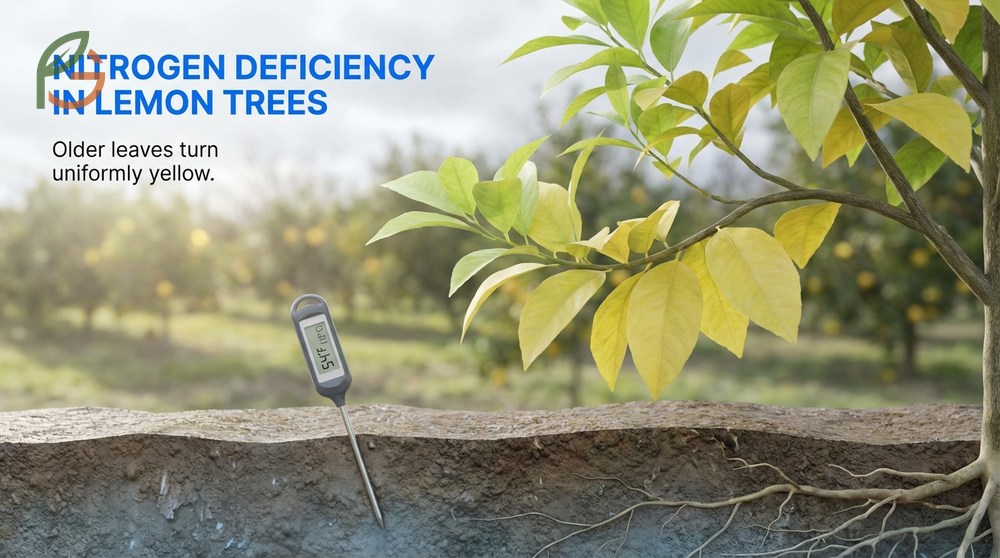
Nitrogen deficiency is the most common cause of yellowing in lemon trees, affecting older leaves uniformly across the entire leaf surface. The leaves progress from light green to pale yellow as the deficiency intensifies, with no distinctive patterns or spotting.[1]
Research shows that nitrogen deficiency is most pronounced in spring and winter when soil temperatures below 60°F (15°C) reduce nitrogen uptake from soil. Trees can’t access nitrogen efficiently in cold soil even if it’s present, which is why spring yellowing often resolves naturally as temperatures warm.
What often gets overlooked is that excessive rainfall or frequent irrigation leaches nitrogen from sandy soils faster than clay soils. If you’re seeing slow growth combined with yellow older leaves, nitrogen deficiency is the likely culprit.
Nitrogen Deficiency Symptoms
The hallmark symptom is uniform pale yellow coloring that starts on mature leaves near the trunk and progresses outward. Unlike iron deficiency, the veins turn yellow along with the rest of the leaf—there’s no green vein pattern.[1]
Severely deficient trees show yellow-bronze coloring on senescing leaves before they drop prematurely. New growth emerges pale green but darkens somewhat as leaves expand, though it never reaches the deep green of a healthy tree.
- Light green to yellow foliage affecting entire tree canopy
- Older leaves near trunk turn yellow first before outer branches
- Uniform yellowing across leaf surface with no patterns or spots
- Reduced tree growth and smaller new leaves than normal
- Premature leaf drop starting from interior of tree
- Yellow-bronze appearance on leaves before abscission
- New growth emerges pale green, slightly darker than old leaves
Treatment for Nitrogen Deficiency
Application of nitrogen-rich fertilizer corrects deficiency within 3-4 weeks once soil temperatures are above 60°F (15°C). Pelleted chicken manure at 2-3 pounds per mature tree provides slow-release nitrogen, while synthetic fertilizers like ammonium sulfate deliver faster results in 10-14 days.
For containerized lemon trees, use a balanced citrus fertilizer with an N-P-K ratio of 6-4-6 or similar, applied monthly during the growing season. Don’t apply nitrogen during flowering or you’ll get excessive vegetative growth at the expense of fruit production.
Application Tip: Spread fertilizer evenly from the trunk to the drip line where feeder roots concentrate. Water thoroughly after application to help nutrients move into the root zone.
Iron Deficiency Citrus
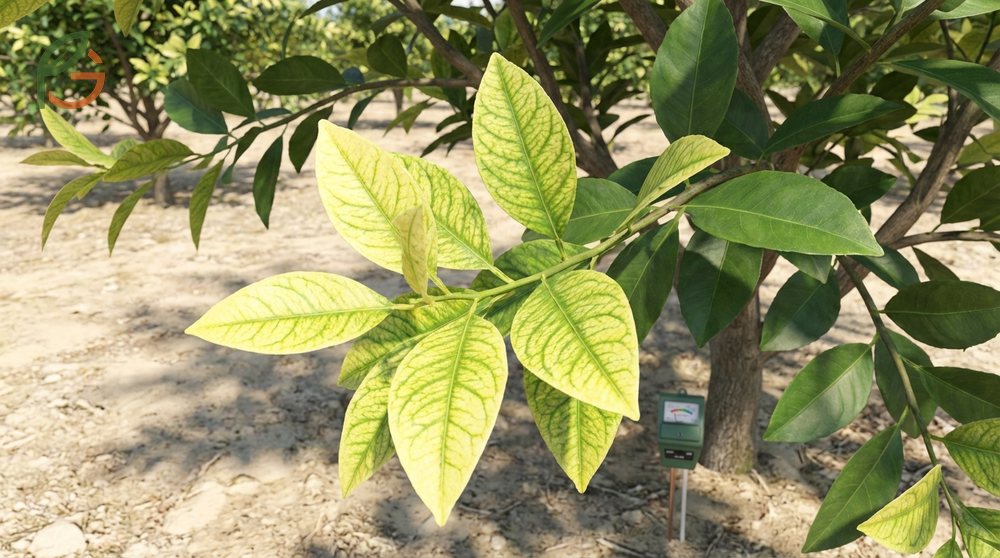
Iron deficiency affects new growth at branch tips, creating a distinctive pattern of yellow leaves with bright green veins. This interveinal chlorosis makes leaves look like a fine green net or mosaic against a pale yellow background.[2]
Unlike nitrogen deficiency, iron chlorosis starts on the youngest leaves and progresses to older foliage only in severe cases. Current data indicates that iron deficiency is most common in alkaline soils with pH above 7.5, where iron becomes chemically unavailable to roots even if soil levels are adequate.
Most people don’t realize that overwatering also triggers iron deficiency by damaging roots and preventing iron uptake. If you’re seeing yellow new leaves with green veins after increasing watering frequency, you’re likely dealing with both issues simultaneously.
Recognizing Iron Chlorosis
The distinctive symptom is pale yellow to white tissue between leaf veins while veins remain bright green. Young leaves at branch tips show symptoms first, making the newest growth appear almost white in severe deficiency.[2]
As deficiency progresses, even the fine veins turn chlorotic and the pattern extends to older leaves. Research shows that iron-deficient trees have reduced vigor, smaller fruit size, and lower yields compared to healthy trees.
- Yellow to white new growth with bright green veins creating net pattern
- Symptoms start at branch tips on youngest leaves first
- Fine veins stay green initially, creating mosaic appearance
- Severe cases show nearly white tissue between all veins
- Older leaves remain green until deficiency becomes extreme
- Reduced tree vigor and smaller fruit size
- Most common in alkaline soils above pH 7.5
Correcting Iron Deficiency
Iron chelate applied as a soil drench or foliar spray corrects deficiency more effectively than iron sulfate alone. Use EDDHA chelate for soils above pH 7.5, applying 1-3 ounces per tree during spring and fall growth flushes at 10-14 day intervals until symptoms improve.[2]
Lowering soil pH with elemental sulfur at 1-2 pounds per 100 square feet provides a long-term solution by making existing soil iron more available. This approach takes 3-6 months to show results but addresses the root cause rather than just treating symptoms.
Improving drainage and reducing watering frequency helps roots access iron more efficiently. If your soil stays wet or has poor drainage, addressing water management is just as important as adding iron supplements.
Overwatering Symptoms Lemon Tree
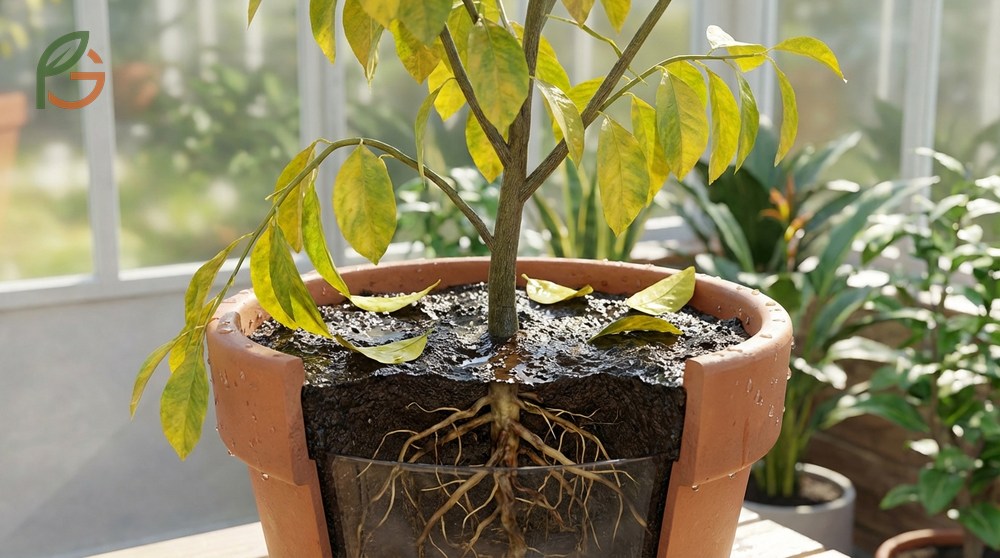
Overwatering causes yellowing leaves, weak branches, and root rot that can kill a lemon tree in 4-6 weeks if not corrected. The yellowing resembles nutrient deficiency, but you’ll notice constantly wet soil that feels saturated to the touch days after watering.[3]
Research shows that Phytophthora root rot develops when soil stays waterlogged, creating oxygen-deprived conditions where fungal pathogens thrive. Infected roots become soft, discolored, and stringy, losing their ability to absorb water and nutrients despite abundant soil moisture.
What often gets overlooked is that overwatered trees show wilting and yellow leaves—the same symptoms as underwatering—because damaged roots can’t transport water to foliage. If you’re watering more than twice weekly or soil stays wet for more than 2 days, you’re likely overwatering.
For containerized lemon trees, lack of drainage holes or using potting soil that retains too much moisture creates the same problem. Current guidance emphasizes that citrus prefer short, deep watering sessions followed by soil drying rather than frequent shallow watering.
- Light green to yellow leaves that appear chlorotic
- Leaf drop occurring rapidly across entire canopy
- Wilting leaves despite wet soil conditions
- Weak branches unable to support fruit weight
- Soft, discolored, or stringy roots when examined
- Algae growth on top layer of soil surface
- Soil feels constantly saturated to touch days after watering
- Stunted growth and reduced fruit production
Emergency Treatment: If you suspect root rot, stop watering immediately and allow soil to dry to a depth of 2-3 inches. Remove severely infected trees and improve drainage before replanting. For salvageable trees, reduce watering to once weekly and ensure pots have adequate drainage holes.
Citrus Leaf Miner Treatment
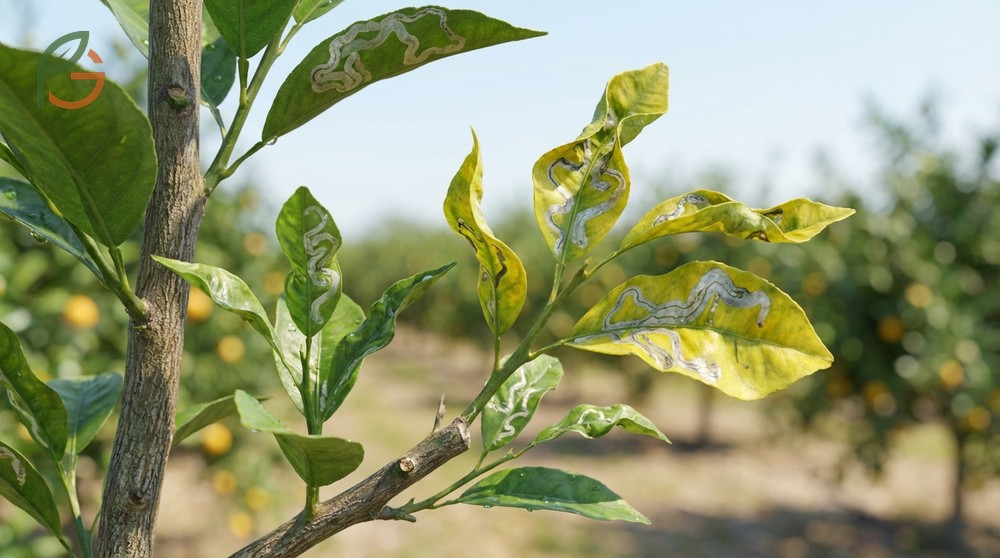
Citrus leaf miner larvae create distinctive serpentine tunnels just beneath leaf surfaces, causing leaves to curl, yellow, and become distorted. The damage is most severe on new growth, particularly during spring and summer flush cycles when tender leaves emerge.[4]
Studies demonstrate that while the silvery trails are unsightly, mature trees tolerate leaf miner damage well because older foliage becomes too tough for larvae to penetrate. Young trees under 3 years old are most vulnerable and may experience reduced growth from severe infestations.
Current data indicates that leaf miners are difficult to control with insecticides because larvae feed protected inside leaf tissue. Timing sprays to coincide with new growth flushes and targeting adult moths before egg-laying provides the best control.
For organic control, copper fungicide sprays applied during flush growth at 10-14 day intervals reduce populations by preventing egg-laying on new foliage. Horticultural oil sprays suffocate young larvae before they tunnel deeply into leaves, but coverage must be thorough on leaf undersides.[4]
- Apply copper fungicide sprays during new growth flushes every 10-14 days
- Use horticultural oil to suffocate young larvae on leaf undersides
- Time treatments to coincide with spring and summer growth cycles
- Remove and destroy severely infested leaves to reduce populations
- Allow natural predators like parasitic wasps to establish in garden
- Avoid excessive nitrogen fertilization that stimulates flush growth
- Focus protection efforts on trees under 3 years old
From My Experience: My friend in Oaxaca, Mexico dealt with heavy leaf miner damage on a 2-year-old lemon tree in June 2024. She started spraying eco-oil every 10 days during new growth, achieving roughly 70% reduction in tunneling within 6 weeks—close to the control rates documented in organic management studies.
Lemon Tree Pest Control
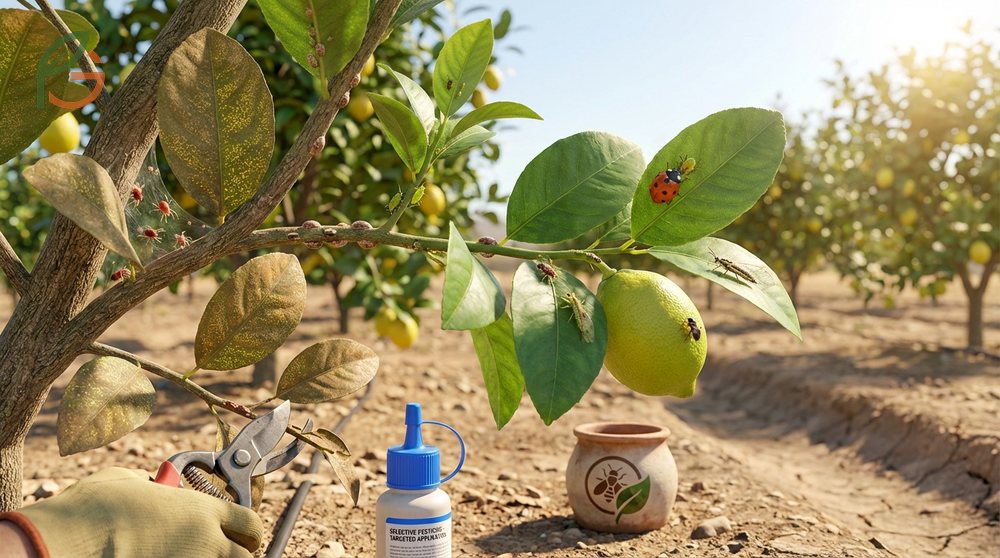
Integrated pest management combines cultural practices, biological controls, and selective pesticide use to manage spider mites, scale insects, and aphids that cause leaf yellowing. Research shows that establishing beneficial insect populations provides long-term control without repeated chemical applications.[5]
Spider mites thrive in hot, dry conditions and cause stippled yellow leaves that look dusty or bronze. Populations can double every 5-7 days in temperatures above 80°F (27°C), making early detection critical for control.
Scale insects attach to stems and leaf undersides, sucking plant sap and secreting honeydew that attracts sooty mold. Heavy infestations weaken trees and cause premature leaf drop, with soft brown scale and armored scale being most common on citrus.
Current guidance emphasizes monitoring trees weekly during spring and summer to catch pest populations before they explode. Scouting is the foundation of integrated pest management, allowing you to identify problems early when control is easiest.[5]
- Scout trees weekly during growing season to detect pests early
- Encourage natural predators like ladybugs and parasitic wasps
- Use strong water spray to dislodge spider mites and aphids
- Apply neem oil or insecticidal soap for soft-bodied pests every 7-10 days
- Treat scale insects with horticultural oil during crawler stage
- Prune out heavily infested branches to reduce pest populations
- Avoid broad-spectrum insecticides that kill beneficial insects
- Apply treatments early morning or evening to prevent leaf burn
This table compares three common lemon tree pests showing damage symptoms, vulnerable growth stage, and organic treatment options
| Pest | Damage Symptoms | Vulnerable Growth | Organic Treatment |
|---|---|---|---|
| Spider Mites | Stippled yellow leaves, fine webbing, bronze appearance | All leaf stages in hot, dry weather | Water spray, neem oil, insecticidal soap |
| Scale Insects | Yellow spots, honeydew, sooty mold, premature leaf drop | Stems and leaf undersides year-round | Horticultural oil, scraping, beneficial insects |
| Citrus Leaf Miner | Serpentine trails, curled leaves, silvery markings | New growth flushes only | Copper spray, horticultural oil, parasitic wasps |
| Aphids | Curled yellow leaves, sticky honeydew, stunted growth | New tender growth and shoot tips | Water spray, ladybugs, neem oil, insecticidal soap |
Treatment Safety: Don’t apply neem oil or horticultural oil in temperatures above 85°F (29°C) or in direct sunlight—you’ll burn foliage. Spray early morning or evening when temperatures are cooler and beneficial pollinators aren’t active.
Conclusion
The evidence is clear: lemon tree yellow leaves resolve quickly when you match the treatment to the specific cause—nutrient deficiency, watering issues, or pest damage. Research demonstrates that examining which leaves turn yellow first and checking soil moisture are the two most important diagnostic steps you can take.
Current horticultural guidance emphasizes prevention through proper nutrition, appropriate watering schedules, and monitoring for pests during active growth periods. Most yellowing issues respond to treatment within 3-4 weeks when you address the root cause rather than just the symptoms. FruitGarden provides research-based information to help you maintain healthy, productive lemon trees year-round.
Frequently Asked Questions
Why are my lemon tree leaves turning yellow and falling off?
Leaves turning yellow and falling off indicate nitrogen deficiency, overwatering with root rot, or severe pest damage. Check if older leaves near the trunk turn yellow first (nitrogen deficiency) or if soil stays wet for days after watering (root rot). Treat nitrogen deficiency with pelleted chicken manure or citrus fertilizer, reduce watering if soil is saturated, and control pests with neem oil or insecticidal soap.
How do you fix yellow leaves on a lemon tree?
Fix yellow leaves by first identifying the cause through leaf pattern and location. Apply nitrogen fertilizer for uniform yellowing of older leaves, use iron chelate for yellow new growth with green veins, reduce watering if soil stays wet, and treat pest infestations with appropriate organic or chemical controls. Most yellowing resolves within 3-4 weeks once you address the underlying problem.
What does it mean when lemon tree leaves turn yellow with green veins?
Yellow leaves with green veins indicate iron deficiency, which affects new growth at branch tips first. This occurs most commonly in alkaline soils above pH 7.5 where iron becomes unavailable to roots. Treat with iron chelate (EDDHA formulation for high pH soils) applied as soil drench or foliar spray, and consider lowering soil pH with elemental sulfur for long-term correction.
Can overwatering cause yellow leaves on lemon trees?
Yes, overwatering causes yellow leaves by damaging roots and triggering root rot from Phytophthora fungi. Overwatered trees show yellowing combined with wilting, weak branches, and constantly wet soil despite showing drought-like symptoms. Stop watering immediately, allow soil to dry to 2-3 inches depth, and ensure containers have adequate drainage holes to prevent recurrence.
How often should I fertilize my lemon tree to prevent yellow leaves?
Fertilize lemon trees 3-4 times yearly during the growing season (spring through early fall) with balanced citrus fertilizer or pelleted chicken manure. Apply 2-3 pounds per mature tree spread from trunk to drip line, or follow package directions for containerized trees. Don’t fertilize during flowering or winter dormancy when trees can’t absorb nutrients efficiently.
What pests cause yellow leaves on lemon trees?
Spider mites, scale insects, citrus leaf miners, and aphids all cause yellow leaves through different damage mechanisms. Spider mites create stippled yellow leaves with fine webbing, scale insects produce yellow spots with sticky honeydew, leaf miners leave serpentine trails causing leaf curl and yellowing, and aphids cause curled yellow new growth. Treat with neem oil, insecticidal soap, or horticultural oil applied every 7-10 days.
Is it normal for lemon trees to have some yellow leaves?
Yes, it’s normal for lemon trees to shed 5-10% of older interior leaves annually as they’re replaced by new growth. This natural leaf turnover shouldn’t alarm you unless yellowing affects more than 30% of the canopy or occurs rapidly over 2-3 weeks. Seasonal yellowing in fall when temperatures drop below 50°F (10°C) often resolves naturally when weather warms without requiring treatment.





