
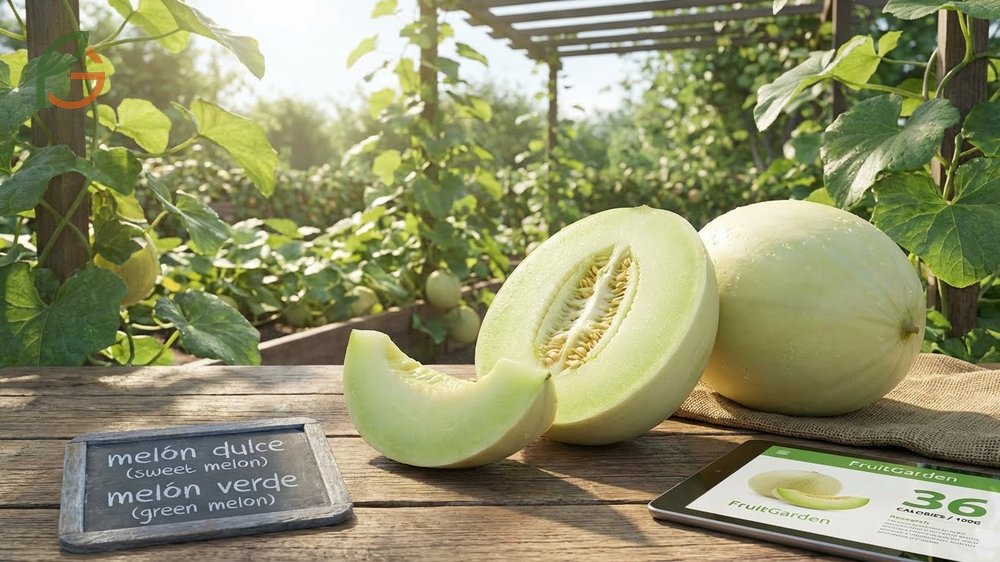
Honeydew melon in Spanish is called “melón dulce” (sweet melon) or “melón verde” (green melon), depending on the region. Research shows this pale-green fruit contains 36 calories per 100 grams and delivers a mild, sweet flavor that’s less musky than cantaloupe[1][2]. FruitGarden synthesizes current agricultural research to help US gardeners understand cultivation and flavor profiles of fruits like honeydew.
Quick Answer
Honeydew Melon in Spanish
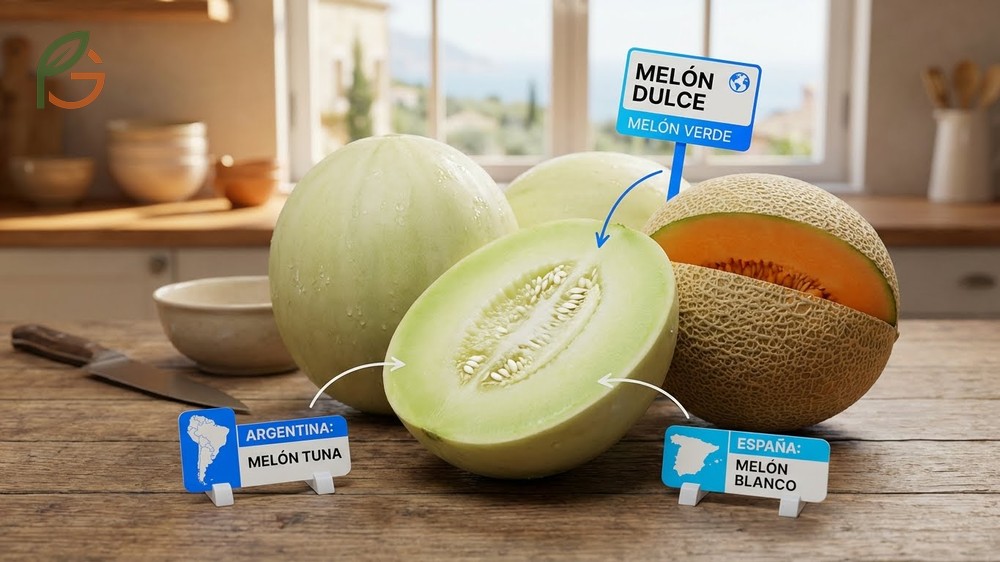
The most common Spanish translation for honeydew melon in Spanish is “melón dulce,” which literally means sweet melon[3]. Spanish speakers also use “melón verde” (green melon) to distinguish it from orange-fleshed cantaloupes. Regional variations exist across Spanish-speaking countries, reflecting local agricultural traditions.
In Argentina and some South American regions, you’ll hear “melón tuna” used for honeydew varieties[3]. Spain typically favors “melón blanco” (white melon), while Mexico often sticks with “melón verde.” The literal translation “melón rocío de miel” exists but isn’t common in everyday conversation.
What’s interesting is how French speakers simply call it “melon” or sometimes “melon jaune” (yellow melon), showing less linguistic specificity than Spanish[6]. This reflects cultural differences in how various societies categorize melon varieties.
Spanish Translation Variations by Region
Understanding regional preferences helps when shopping at international markets or traveling. The translations aren’t random—they’re based on visual characteristics and local cultivation history.
- Spain: Melón blanco (white melon) – references the pale flesh color
- Mexico: Melón verde (green melon) – describes the typical rind color
- Argentina: Melón tuna – traditional term used in markets
- Central America: Melón dulce (sweet melon) – emphasizes flavor profile
- Caribbean: Melón miel (honey melon) – closest to English etymology
Language Tip: When ordering at Spanish-speaking restaurants, “melón dulce” works universally, but asking “¿Tienen melón verde?” (Do you have green melon?) ensures you don’t get cantaloupe instead.
Pronunciation Guide for Spanish Speakers
Pronouncing “melón dulce” correctly requires emphasis on the first syllable: meh-LOHN DOOL-seh. The accent mark on “melón” indicates stress placement, which differs from English stress patterns.
Native speakers pronounce the “d” in “dulce” softly, almost like the “th” in “the.” The final “e” is always pronounced in Spanish, unlike silent English “e” endings. Practice saying it slowly: meh-LOHN DOOL-theh.
What Does Honeydew Melon Taste Like
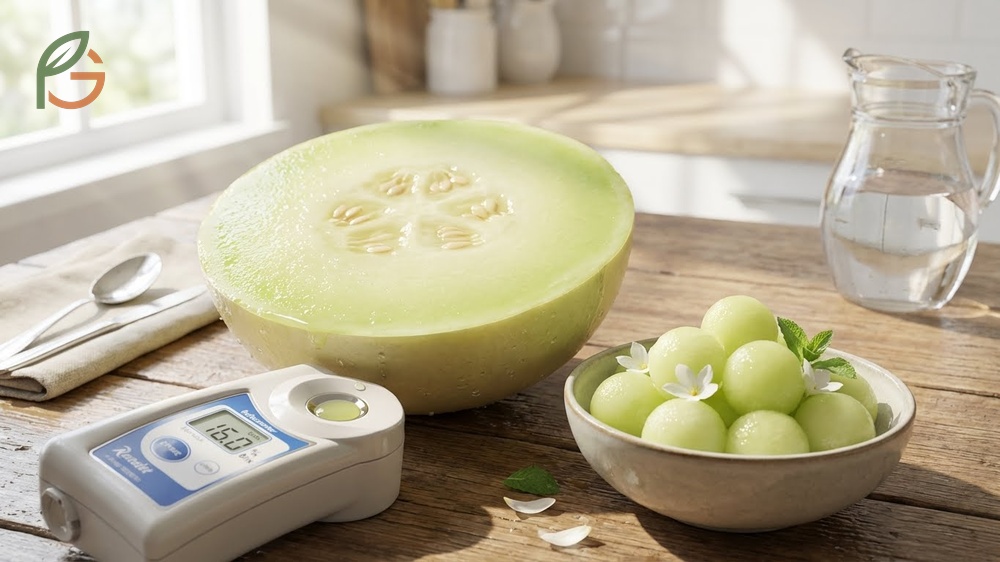
Honeydew delivers a mild, sweet flavor with subtle floral notes and a slightly musky aftertaste[2]. The flesh contains approximately 16 Brix (sugar content measurement), creating a delicate sweetness that doesn’t overpower other ingredients[7]. Most people find it refreshing rather than intensely sweet.
The texture is juicy and smooth when ripe, yielding easily to gentle pressure around the blossom end. Underripe honeydew tastes bland and slightly bitter, while overripe fruit develops fermented, vinegar-like notes. The pale green or white flesh stays crisp longer than cantaloupe.
Unlike watermelon’s pure sweetness, honeydew offers complexity—you’ll detect earthy undertones that pair well with prosciutto in Mediterranean cuisine. The rind emits a faint sweet aroma when the fruit reaches peak ripeness, signaling optimal eating time.
Flavor Profile Characteristics
Breaking down the taste experience helps gardeners and cooks know what to expect. The sugar content varies based on growing conditions, with hot climates producing sweeter fruit.
- Sweetness level: Moderate to high (16 Brix average) compared to 12-14 Brix in watermelon
- Aroma: Faint and delicate when whole, stronger when cut open
- Aftertaste: Slightly musky with floral hints lasting 10-15 seconds
- Texture: Smooth, juicy, less fibrous than cantaloupe
- Acidity: Low, making it suitable for acid-sensitive digestive systems
- Flavor intensity: Mild, works as neutral base in fruit salads
Honeydew vs Cantaloupe Taste
Cantaloupe carries a strong musky aroma that honeydew lacks, making honeydew the preferred choice for those who dislike intense melon flavors[2]. The sweetness differs too—honeydew tastes cleaner and more refined. Cantaloupe’s orange flesh contains more beta-carotene, giving it earthy, almost squash-like notes.
Honeydew’s pale color reflects its milder flavor chemistry. When both are perfectly ripe, honeydew wins in juiciness tests. The water content runs higher, making it more hydrating on hot summer days.
Honeydew Melon Origin

Evidence places honeydew cultivation in West Africa approximately 4,000 years ago, though some researchers point to the Middle East or Western Asia as alternative origin points[5]. The mystery stems from limited archaeological records. Ancient Egyptians revered honeydews as sacred food, with hieroglyphic mentions found in tombs dating to 2400 BCE[5].
Ancient Romans introduced honeydew to Europe, becoming the first to cultivate it outside Africa systematically. Spanish and Portuguese explorers brought melons to the New World during the 15th and 16th centuries[8]. This explains why Spanish-speaking countries developed distinct regional names for the fruit.
Modern honeydew varieties resulted from centuries of selective breeding. Farmers prioritized sweeter flesh, thicker rinds for shipping, and disease resistance. The smooth-skinned inodorus group distinguishes honeydew from netted muskmelons.
Ancient Cultivation History
Archaeological evidence shows honeydew traveled ancient trade routes between Africa and Asia. The warm climate requirements limited cultivation to specific latitudes. Early farmers noticed honeydew tolerated heat better than other melon varieties.
Egyptian tomb paintings depict workers harvesting pale melons resembling modern honeydew. The fruit appeared in royal feasts, suggesting high status. Trade records from 1000 BCE mention melon exports from Egypt to neighboring kingdoms.
Historical Note: Ancient cultivation methods focused on seed saving from the sweetest fruits each season. This practice, continued for millennia, created the distinctly sweet honeydew varieties we know today.
How Honeydew Got Its Name
The English name “honeydew” emerged from a 1911 New York City hotel dinner where the melon appeared on an upscale menu[5]. An impressed diner saved the seeds and sent them to Colorado melon breeder John E. Gauger. The marketing name “honeydew” stuck because it evoked the fruit’s sweet, honey-like flavor.
Before 1911, Americans called it “white antibes” or “winter melon” due to its late-season harvest. The romantic “honeydew” branding helped popularize the fruit across the United States. Marketing genius, really—the name sounds more appealing than technical classifications.
What Is Honeydew Melon
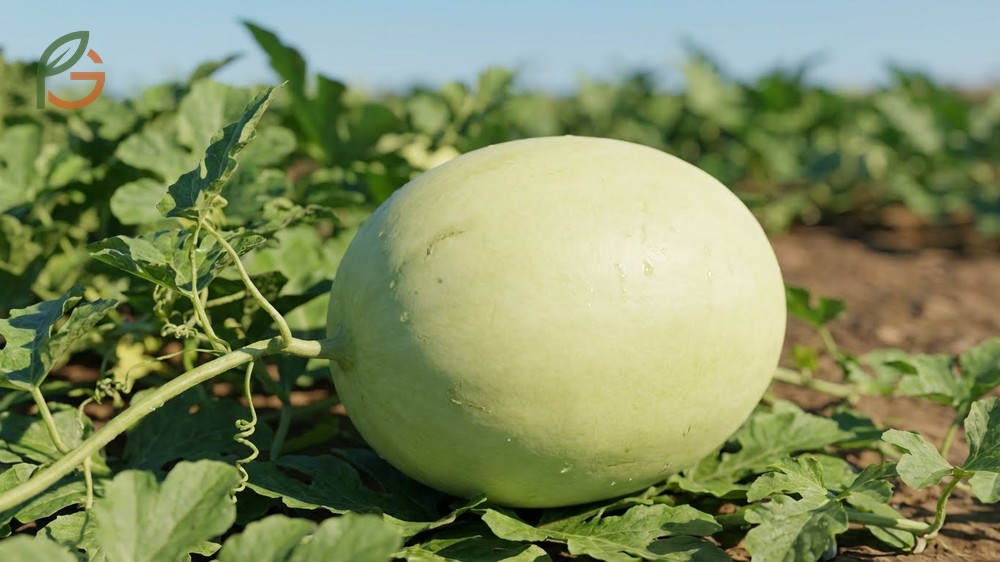
Honeydew is one of two main cultivar types in the Cucumis melo var. inodorus group, characterized by smooth, often green or yellowish rinds[4]. The scientific name breaks down as: Cucumis (cucumber genus), melo (melon species), inodorus (lacking strong scent). This distinguishes it from aromatic muskmelons in the reticulatus group.
The fruit grows on annual climbing vines in the Cucurbitaceae family. Vines can spread 6-8 feet, producing 4-8 pound oval fruits with pale green flesh. The central cavity contains white stringy fibers and tan oval seeds that you remove before eating.
Honeydew requires warm growing conditions—soil temperatures above 70°F (21°C) for germination and daytime temperatures between 75-85°F (24-29°C) for optimal growth. Most varieties mature in 80-110 days from transplanting. The smooth rind turns from greenish-white to creamy yellow when ripe.
Botanical Classification
Understanding the classification helps gardeners choose compatible varieties for cross-pollination. Honeydew belongs to the same species as cantaloupe but different variety groups.
- Kingdom: Plantae (plants)
- Family: Cucurbitaceae (cucurbits – includes cucumbers, squash, pumpkins)
- Genus: Cucumis (melons and cucumbers)
- Species: Cucumis melo (melon species)
- Variety: inodorus (smooth-skinned, non-aromatic melons)
- Common cultivars: Green Flesh, Golden, Orange Flesh varieties
Nutritional Composition
Honeydew’s nutritional profile makes it valuable for hydration and vitamin C intake. The low calorie density supports weight management diets. Per 100g serving, you get substantial nutrients without excess sugar.
The vitamin C content reaches 18mg (20% daily value), supporting immune function[1]. Potassium levels at 228mg help regulate blood pressure and muscle function. The fiber content of 0.8g per 100g is modest compared to apples but still aids digestion.
This table compares key nutritional values per 100 grams of honeydew melon including calories, macronutrients, vitamins, and minerals with their daily value percentages
| Nutrient | Amount | Daily Value % | Notes |
|---|---|---|---|
| Calories | 36 kcal[1] | 2% | Low calorie density |
| Carbohydrates | 9.1g[1] | 3% | Net carbs: 8.3g |
| Sugar | 8.1g[1] | — | Natural fruit sugars |
| Fiber | 0.8g[1] | 3% | Aids digestion |
| Vitamin C | 18mg[1] | 20% | Immune support |
| Potassium | 228mg[1] | 7% | Blood pressure regulation |
Melon Varieties Comparison
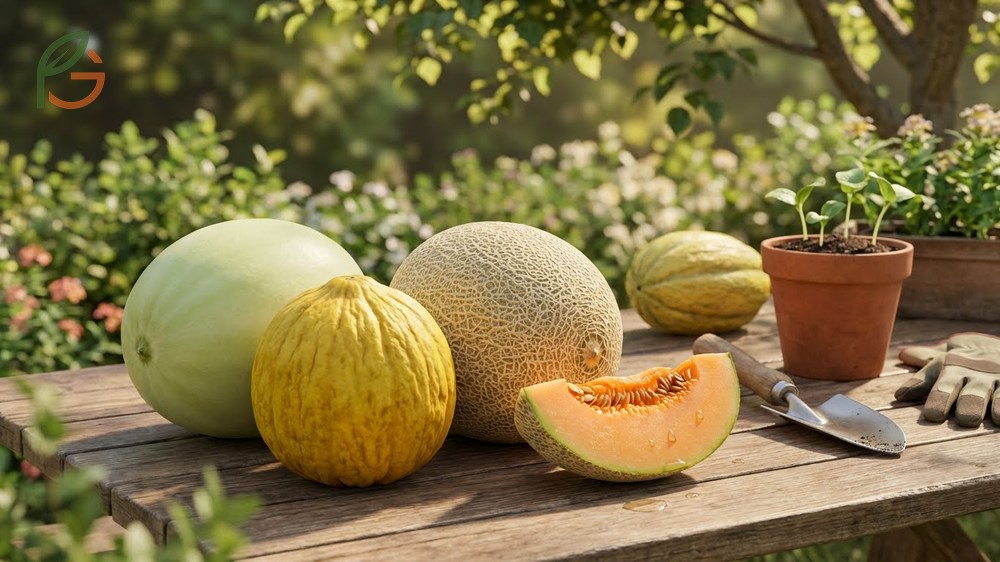
Understanding how honeydew compares to other melon varieties helps gardeners decide what to plant. Each type has distinct growing requirements, flavor profiles, and storage characteristics. The Cucumis melo species includes multiple cultivar groups beyond just honeydew and cantaloupe.
Cantaloupe (Reticulatus group) features netted rinds and orange flesh with strong aroma. Casaba melons (also Inodorus group) share honeydew’s smooth skin but have wrinkled yellow rinds. Crenshaw melons hybridize Casaba and Persian varieties, creating salmon-pink flesh. Each variety evolved in different climate zones, explaining their temperature tolerance differences.
For US gardeners, honeydew works best in USDA zones 4-11 with 80-110 frost-free days. Cantaloupe matures faster (70-90 days), suiting shorter growing seasons. Watermelon, though not Cucumis melo, requires similar heat but more space—vines spread 12-20 feet versus honeydew’s 6-8 feet.
| Variety | Scientific Group | Days to Maturity |
|---|---|---|
| Honeydew | Inodorus | 80-110 days |
| Cantaloupe | Reticulatus | 70-90 days |
| Casaba | Inodorus | 90-120 days |
| Crenshaw | Hybrid | 90-110 days |
What often gets overlooked is that honeydew stores longer than cantaloupe after harvest—up to 3 weeks refrigerated versus 5-7 days for cantaloupe. This makes honeydew valuable for gardeners who can’t eat large harvests immediately. The thicker rind protects against bruising during transport too.
- Rind texture: Honeydew smooth, cantaloupe netted, Casaba wrinkled
- Flesh color: Honeydew pale green/white, cantaloupe orange, Crenshaw salmon
- Aroma intensity: Honeydew faint, cantaloupe strong, Casaba moderate
- Storage life: Honeydew 2-3 weeks, cantaloupe 5-7 days, watermelon 1-2 weeks
- Cold tolerance: All require warm soil, but cantaloupe tolerates cooler nights better
- Vine spread: Honeydew 6-8 ft, cantaloupe 5-7 ft, watermelon 12-20 ft
Conclusion
The evidence is clear: honeydew melon in Spanish goes by several names including “melón dulce” and “melón verde,” each reflecting regional preferences across Spanish-speaking countries. This 4,000-year-old fruit originated in West Africa or the Middle East, spreading globally through ancient trade routes and Spanish explorers. Its mild, sweet taste with 16 Brix sugar content makes it less intense than cantaloupe while delivering 20% daily vitamin C per 100g serving.
Current agricultural guidance emphasizes proper ripeness identification—look for creamy yellow rinds that yield to gentle pressure and emit a faint sweet aroma. FruitGarden provides research-based cultivation tips to help US gardeners successfully grow honeydew in zones 4-11 with adequate heat and 80-110 frost-free days.
Frequently Asked Questions
How do you say honeydew fruit in Spanish?
The most common translations are “melón dulce” (sweet melon) and “melón verde” (green melon). Regional variations include “melón blanco” in Spain, “melón tuna” in Argentina, and “melón miel” in some Caribbean countries. All refer to the same Cucumis melo var. inodorus fruit.
What does honeydew look like when ripe?
Ripe honeydew has a smooth, creamy yellow or pale green rind that yields slightly to gentle pressure at the blossom end. The surface should feel waxy, not fuzzy, and the melon emits a faint sweet aroma. Avoid melons with soft spots, cracks, or strong fermented smells indicating overripeness.
What is a honeydew melon related to?
Honeydew belongs to the Cucurbitaceae family, making it related to cucumbers, squash, pumpkins, and other melons like cantaloupe and watermelon. It shares the species Cucumis melo with cantaloupes but belongs to the different inodorus variety group characterized by smooth rinds and mild aroma.
What is the French word for honeydew melon?
French speakers typically call it “melon” or “melon jaune” (yellow melon) in everyday conversation. Unlike Spanish, French doesn’t have a specific widely-used term distinguishing honeydew from cantaloupe—context determines which melon type is meant. Some markets use “melon vert” (green melon) for clarity.
What is the scientific name of honeydew melon?
The scientific name is Cucumis melo var. inodorus, where “Cucumis” is the genus, “melo” is the species, and “inodorus” indicates the variety group meaning “without strong scent.” This classification distinguishes smooth-skinned honeydew from netted muskmelons in the reticulatus group.
Does honeydew taste like cantaloupe?
Honeydew tastes sweeter and milder than cantaloupe, lacking the strong musky aroma and earthy aftertaste. Both are sweet, but honeydew has a cleaner, more delicate flavor with subtle floral notes. Honeydew’s pale flesh also stays juicier and crisper longer than cantaloupe’s orange flesh.
Where did honeydew melons originate?
Evidence places honeydew origins in West Africa approximately 4,000 years ago, though some researchers suggest the Middle East or Western Asia. Ancient Egyptians cultivated honeydew by 2400 BCE, as shown in tomb hieroglyphics. Spanish and Portuguese explorers introduced the fruit to the Americas during the 15th and 16th centuries.





