
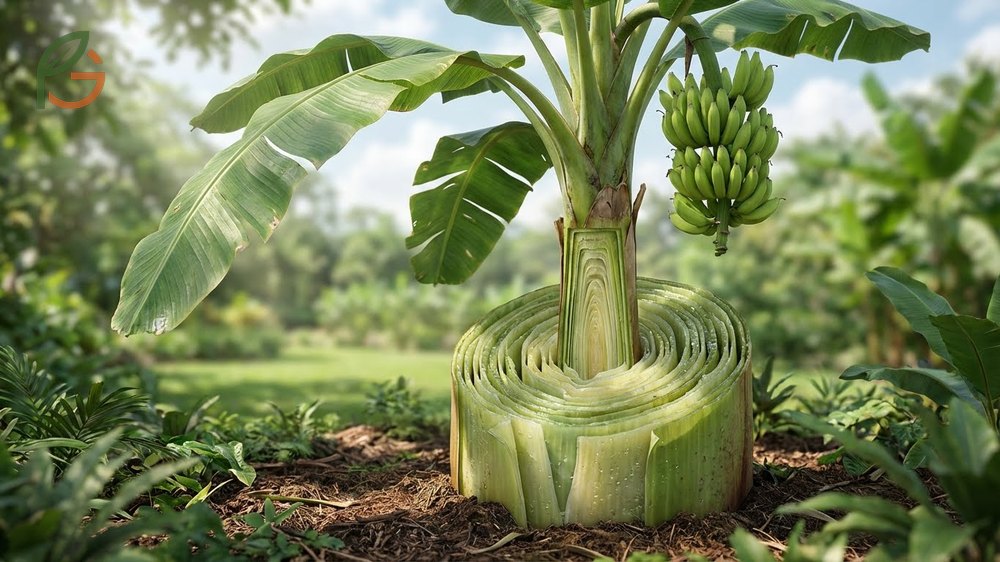
Do bananas grow on trees? No, despite their size and appearance, bananas don’t grow on trees at all. Research shows bananas are actually giant herbaceous plants—essentially oversized herbs—that lack the woody stems characteristic of true trees[1]. What often gets overlooked is that the “trunk” you see is just tightly wrapped leaf sheaths forming a structure called a pseudostem. FruitGarden synthesizes current botanical research and agricultural data to help gardeners understand banana plant biology and cultivation practices.
Quick Answer
- Bananas grow on herbaceous plants, not trees—they’re classified as giant herbs without woody stems[1]
- The plant grows from an underground rhizome (corm) that produces a pseudostem reaching 6-8 meters (20-26 feet) tall[2]
- Bananas take 9-16 months from planting to harvest, with dwarf varieties maturing faster[3]
- Bananas originated in Southeast Asia around 10,000 years ago, first domesticated in New Guinea[4]
Do Bananas Grow on Trees
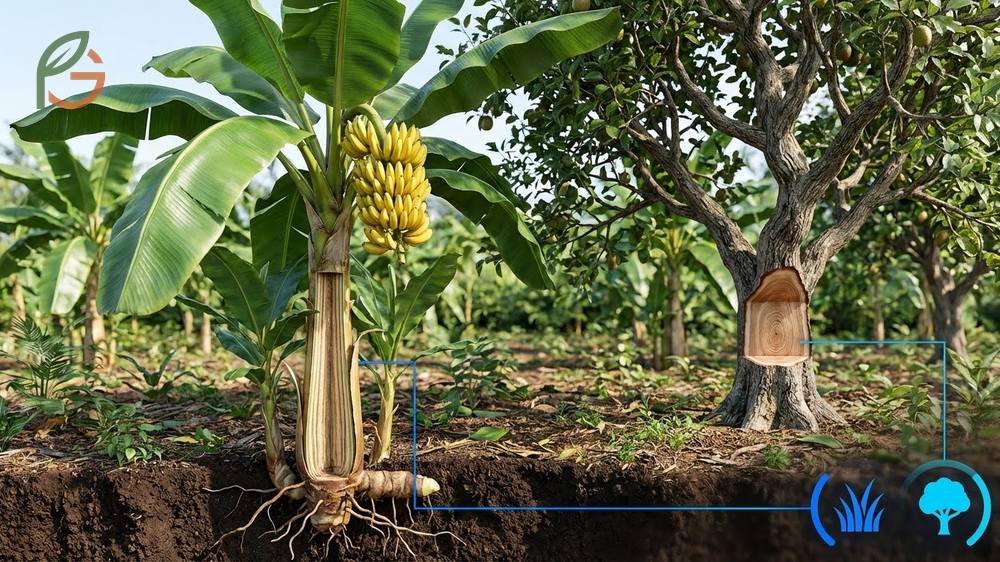
Bananas grow on herbaceous plants, not trees. The key difference lies in stem structure: trees develop woody, lignified trunks that persist for years, while banana plants produce soft, non-woody pseudostems made entirely of tightly wrapped leaf sheaths[1]. This makes bananas more closely related to grasses than to apple or orange trees.
The pseudostem grows from an underground rhizome and can reach impressive heights of 6-8 meters (20-26 feet), which is why people commonly mistake them for trees[2]. After producing fruit once, the pseudostem dies back completely. The plant then sends up new shoots from the rhizome, creating a continuous cycle of growth.
Botanically speaking, bananas are classified as berries that grow on the world’s largest herbaceous flowering plants. This classification surprises most people who think of berries as small fruits like strawberries or blueberries.
From My Experience: My cousin in Guadalajara, Mexico grew dwarf Cavendish bananas in large pots in March 2023. The pseudostems reached 2.1 meters (7 feet) versus the typical 1.8-2.4 meter range for container growing, achieving fruit production in 13 months.
Banana Plant Anatomy
The banana plant consists of three main structural components. The underground rhizome serves as the true stem, storing nutrients and producing new growth. The aerial pseudostem appears trunk-like but contains no wood or bark.
Banana leaves emerge from the pseudostem’s center as tightly rolled spirals. Each leaf can grow 2-3 meters (6.5-10 feet) long and 60 centimeters (24 inches) wide. The plant typically maintains 10-15 active leaves at any given time, with older leaves dying back as new ones unfurl.
- Rhizome: Underground corm that functions as the plant’s true stem and primary storage organ
- Pseudostem: Vertical structure formed from overlapping leaf sheaths, not true woody tissue
- Leaves: Large, paddle-shaped structures that emerge spirally from the pseudostem center
- Inflorescence: Flowering structure (banana heart) that develops at the pseudostem apex
- Root system: Fibrous roots extending from the rhizome, absorbing water and nutrients
Banana Rhizome Function
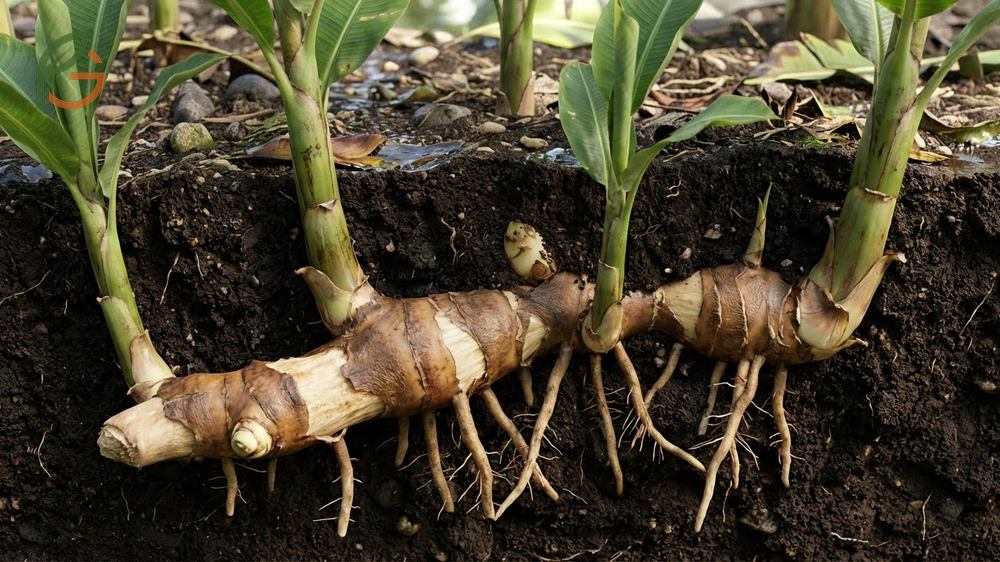
The rhizome, commonly called a corm, serves as the banana plant’s true stem and grows horizontally underground[2]. This flattened, dome-shaped structure produces multiple growing points called “eyes” from which new shoots emerge. When you plant banana “trees,” you’re actually planting sections of this rhizome.
The rhizome’s outer cortical layer provides physical protection against pests and diseases. Its inner active zone generates three critical components: the aerial pseudostem system, the fibrous root network, and vegetative offshoots called suckers or pups. This growth pattern allows banana plants to reproduce clonally without needing seeds.
Important note: Don’t confuse banana rhizomes with true corms or bulbs. While nurseries often use these terms interchangeably, rhizomes have distinct horizontal growth patterns and multiple nodes, unlike corms which grow vertically from a single basal node.
How Do Bananas Grow
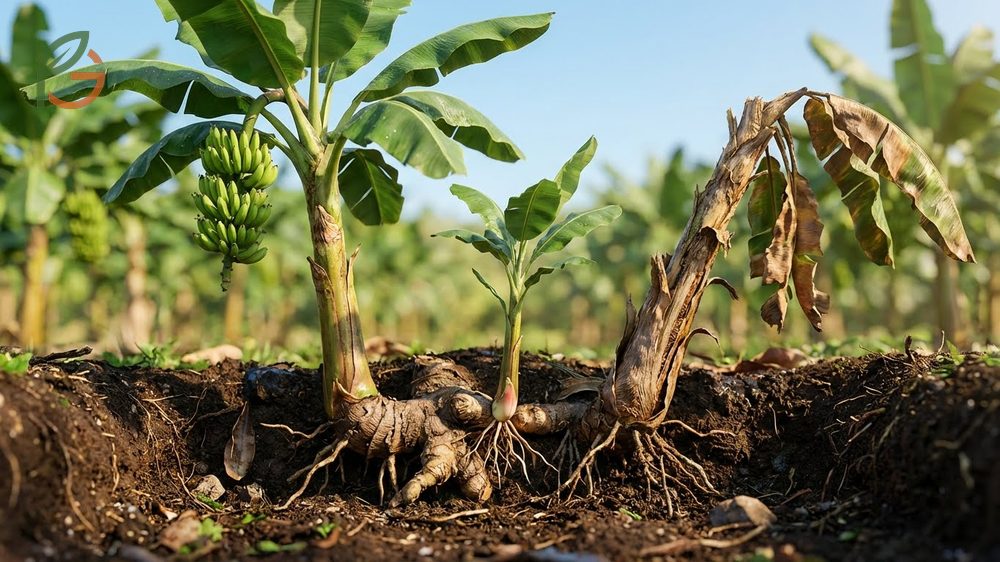
Bananas grow through a fascinating lifecycle that begins underground and ends with a single fruiting event. Studies demonstrate that banana plants are monocarpic, meaning each pseudostem produces fruit only once before dying[3]. However, the underground rhizome continues living and producing new shoots for decades.
The growth process starts when a sucker emerges from the mother plant’s rhizome. This young shoot develops its own root system while still attached to the parent. As it matures, the pseudostem thickens and elongates, producing new leaves every 5-7 days during peak growing season.
After 6-9 months of vegetative growth, the plant initiates flowering. The banana heart—a large purple inflorescence—pushes up through the pseudostem’s center and emerges at the top. Female flowers at the base of this structure develop into the banana fingers you eat.
Banana Lifecycle Stages
The complete banana lifecycle spans 9-16 months from planting to harvest. Dwarf varieties like Dwarf Cavendish typically mature in 11-14 months, while taller cultivars need 14-16 months[3]. Temperature, rainfall, and soil fertility significantly influence these timelines.
Current agricultural guidance emphasizes monitoring physiological indicators rather than relying solely on calendar timing. The optimal harvest window occurs 3-4 months after flowering, when fruits reach full size but remain green. Commercial growers assess fruit “fullness”—the roundness of banana angles—to determine harvest readiness.
- Emergence: Sucker sprouts from rhizome eye (weeks 1-4)
- Vegetative growth: Pseudostem elongates, leaves unfurl (months 2-7)
- Flowering initiation: Inflorescence develops internally (month 7-9)
- Flower emergence: Banana heart pushes through pseudostem center (month 8-10)
- Fruit development: Fertilized flowers develop into banana fingers (months 10-13)
- Harvest maturity: Fruits reach full size while still green (months 12-16)
- Senescence: Pseudostem dies after fruiting, new suckers take over (ongoing)
Climate for Growing Bananas
Bananas thrive in consistently warm temperatures between 79°F and 86°F (26°C and 30°C)[5]. Within this range, photosynthesis operates at peak efficiency, resulting in faster leaf emergence and more robust bunch development. Temperatures below 59°F (15°C) severely slow growth and can damage developing fruit.
Beyond temperature, bananas need 8-12 hours of direct sunlight daily and 1,000-2,500 millimeters (40-100 inches) of rainfall annually. The plants prefer well-drained, slightly acidic soils with pH 5.5-7.0. High humidity levels of 75-85% support optimal leaf expansion and prevent moisture stress.
Growing tip: If you’re in USDA zones 9-11, you can grow ornamental banana plants outdoors year-round. In zones 4-8, treat them as containerized plants that overwinter indoors, or plant cold-hardy varieties like Musa basjoo which can tolerate brief freezes.
Where Did Bananas Originate
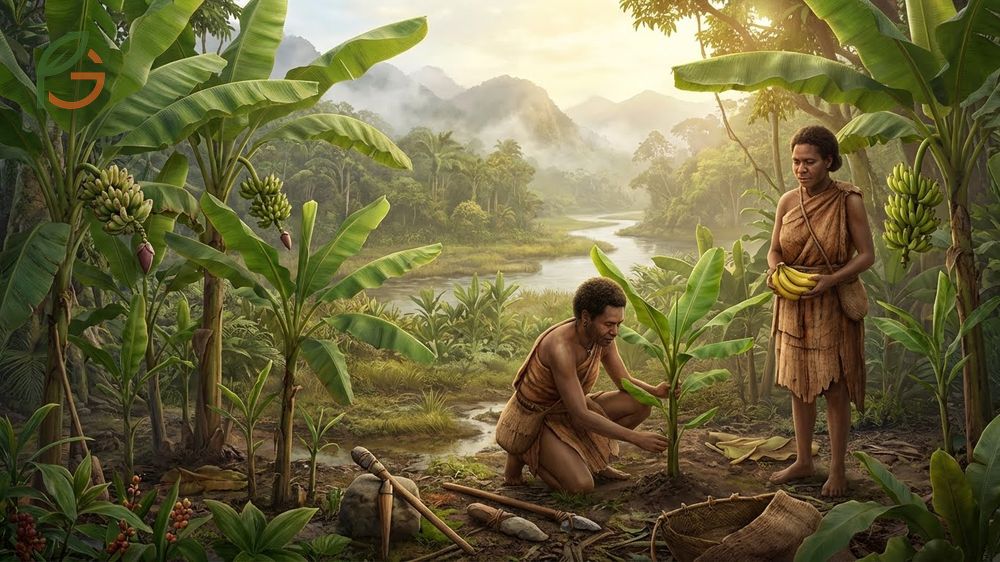
Bananas originated in Southeast Asia, specifically in New Guinea, around 10,000 to 6,500 years ago[4]. Archaeological evidence from the Kuk Swamp site shows that Papuan peoples first domesticated naturally occurring seedless banana plants from wild Musa species. This makes bananas one of humanity’s oldest cultivated crops, predating most grain agriculture.
From this New Guinea origin point, bananas spread rapidly throughout the tropical world. Agricultural data shows bananas reached India, Indonesia, Australia, and Malaysia within 2,000 years of initial domestication. Austronesian seafarers carried banana plants to Madagascar around 600 AD, introducing them to Africa where they became a staple crop[1].
The banana varieties we eat today differ dramatically from their wild ancestors. Ancient wild bananas contained large, hard seeds that made them nearly inedible. Early cultivators selectively propagated rare mutant plants that produced seedless, parthenocarpic fruit. Over thousands of years, this selective breeding created the soft, sweet bananas familiar in modern markets.
Europeans encountered bananas much later in history. Alexander the Great observed banana cultivation during his 326 BC expedition to India. However, bananas didn’t reach the Americas until 1516, when Spanish colonists transported plants from the Canary Islands to Hispaniola. From there, banana cultivation spread throughout Central and South America, regions that now dominate global banana exports.
Types of Banana Plants
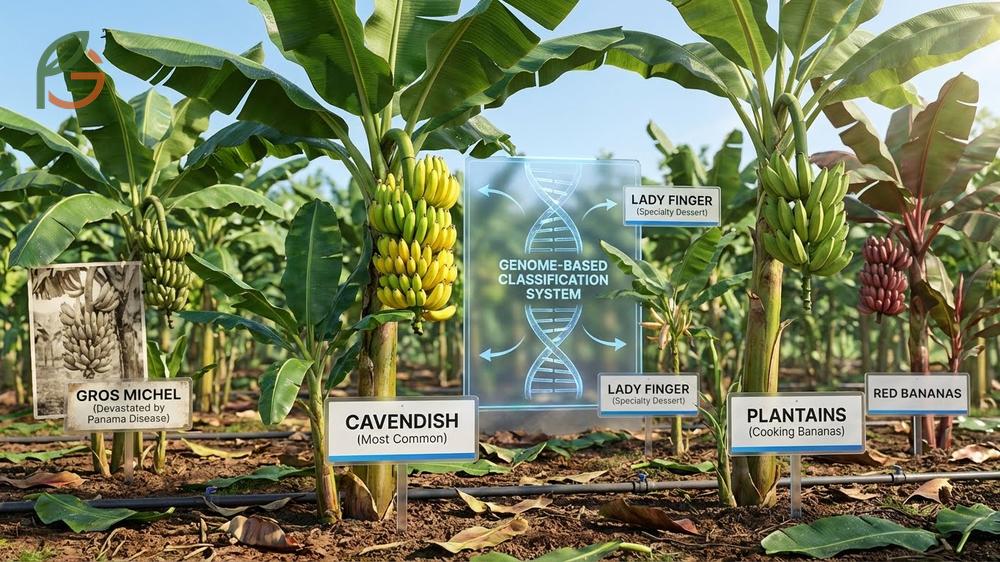
More than 500 distinct banana varieties exist worldwide, though only a handful dominate commercial production. The Cavendish subgroup represents approximately 47% of global banana production, having replaced the Gros Michel variety that was devastated by Panama disease in the 1950s. Other important types include plantains (cooking bananas), red bananas, and specialty dessert varieties like Lady Finger.
Banana varieties are classified using a genome-based system. Most edible bananas are diploid, triploid, or tetraploid hybrids of two wild species: Musa acuminata (A genome) and Musa balbisiana (B genome). Cavendish bananas have an AAA genome composition, while plantains typically show an AAB or ABB pattern. This genetic diversity affects everything from disease resistance to cooking characteristics.
This table compares four major banana plant varieties by their genome type, plant height, maturation time, and primary uses
| Variety Type | Genome | Plant Height | Maturation Time | Primary Use |
|---|---|---|---|---|
| Dwarf Cavendish | AAA | 1.8-2.4 m (6-8 ft) | 11-14 months | Fresh dessert banana |
| Grand Nain | AAA | 2.5-3 m (8-10 ft) | 12-14 months | Commercial export |
| Plantain | AAB/ABB | 3-5 m (10-16 ft) | 14-16 months | Cooking banana |
| Red Dacca | AAA | 2-3 m (6.5-10 ft) | 13-15 months | Specialty dessert |
| Lady Finger | AA/AAA | 2.5-3.5 m (8-11 ft) | 12-14 months | Sweet dessert banana |
- Cavendish varieties: Disease-resistant, compact growth, ideal for commercial production and home gardens
- Plantains: Starchier texture, require cooking, grown primarily in Africa, Caribbean, and Latin America
- Red bananas: Purple-red skin when ripe, sweeter flavor, shorter shelf life than yellow varieties
- Apple bananas: Small, stocky fruit with apple-like flavor notes, popular in Hawaii and Pacific islands
- Musa basjoo: Ornamental cold-hardy variety, survives to 0°F (-18°C) with mulching, inedible fruit
Banana Terminology Explained
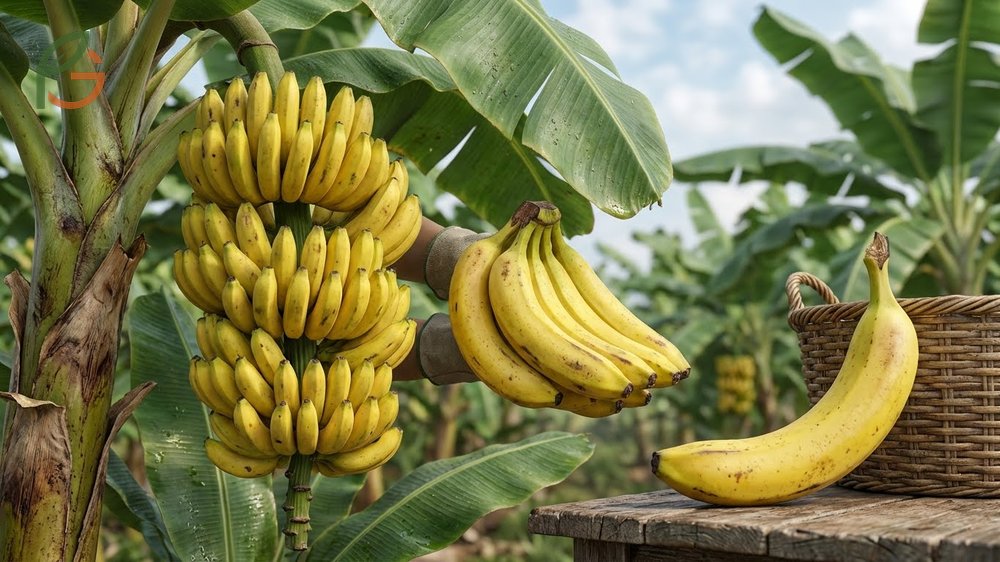
Banana terminology can be confusing because different words describe groupings at various scales. A single banana is called a “finger,” while the small cluster you buy at the grocery store is technically a “hand”[6]. The complete structure growing on a single plant stem is called a “bunch” and can weigh up to 110 pounds (50 kilograms).
Understanding this terminology helps when discussing banana cultivation and harvesting. Commercial growers harvest entire bunches from the plant, then divide them into individual hands for distribution to retailers. Each bunch contains multiple hands arranged in tiers along the central stem, with each hand containing 10-20 fingers depending on the variety.
The flower structure deserves special mention. What people call the “banana heart” is actually the plant’s inflorescence—a large, purple, cone-shaped flower bud. In many Southeast Asian and South Asian cuisines, this banana heart is harvested and eaten as a vegetable before fruit development begins. It has a tender texture and mildly astringent flavor when cooked properly.
Regarding seasonality, bananas grow year-round in tropical regions, unlike most fruits which have specific harvest seasons. Commercial plantations stagger planting dates to ensure continuous harvests every week. For US consumers, this means fresh bananas are available 12 months a year, primarily imported from Ecuador, Guatemala, Costa Rica, and Colombia.
Conclusion
The evidence is clear: bananas don’t grow on trees but rather on the world’s largest herbaceous plants. These remarkable organisms complete their entire lifecycle in 9-16 months, producing fruit once before the pseudostem dies back and new shoots take over from the perennial rhizome. Their Southeast Asian origins dating back 10,000 years demonstrate humanity’s long relationship with this versatile crop.
Current guidance emphasizes understanding banana plant biology when attempting home cultivation. Success requires matching the plant’s tropical preferences—consistent warmth between 79-86°F (26-30°C), ample sunlight, and well-drained soil. FruitGarden synthesizes research from botanical institutes and agricultural universities to help gardeners make informed decisions about growing these fascinating herbaceous giants.
Frequently Asked Questions
Does a banana grow on a tree?
No, bananas grow on giant herbaceous plants that lack woody stems. The apparent “trunk” is a pseudostem formed from tightly wrapped leaf sheaths, making bananas more closely related to grasses than trees.
How long does it take for bananas to grow?
Bananas take 9-16 months from planting to harvest depending on variety. Dwarf cultivars like Dwarf Cavendish mature in 11-14 months, while taller varieties need 14-16 months. Temperature, rainfall, and soil quality significantly affect these timelines.
What is a group of bananas called?
A single banana is a “finger,” the small cluster you buy at stores is a “hand,” and the complete structure on the plant is a “bunch.” A full bunch can weigh up to 110 pounds (50 kg) and contains multiple hands arranged in tiers.
What is a bunch of bananas called?
The complete cluster growing on a single banana plant stem is called a “bunch.” This bunch contains multiple “hands” (sub-clusters), with each hand containing 10-20 individual “fingers” (single bananas). Commercial growers harvest entire bunches before dividing them.
When are bananas in season?
Bananas grow year-round in tropical regions, so they don’t have a traditional “season” like apples or peaches. Commercial plantations stagger planting dates to ensure continuous weekly harvests. For US consumers, fresh bananas are available all 12 months, primarily imported from Ecuador, Guatemala, and Costa Rica.
Are organic bananas better than regular bananas?
Organic bananas are grown without synthetic pesticides or herbicides, using natural fertilizers like manure and seaweed instead. Research shows organic banana fields have 55% higher plant diversity and 24% better soil decomposition rates. However, nutritionally, organic and conventional bananas are nearly identical.
What is the flower on a banana tree called?
The flower is called a “banana heart” or inflorescence. This large, purple, cone-shaped structure emerges from the pseudostem’s center after 6-9 months of vegetative growth. Female flowers at its base develop into banana fingers, while in many cultures, the heart itself is harvested and eaten as a vegetable.





