
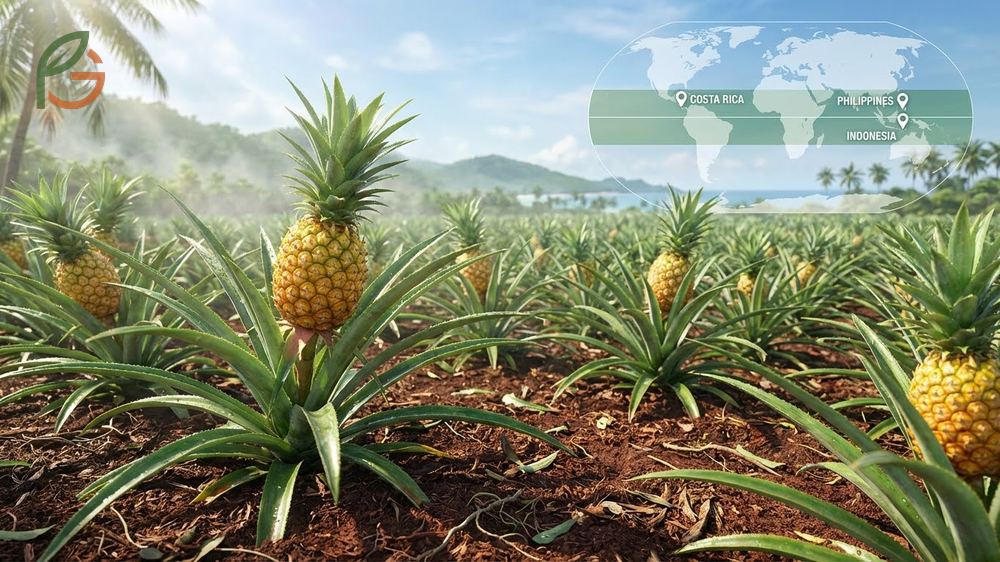
Where do pineapples grow? Pineapples thrive in tropical and subtropical regions between 31°N and 34°S latitude, with Costa Rica, the Philippines, and Indonesia leading global production at nearly 3 million tonnes each[1]. These terrestrial bromeliads don’t grow on trees—they’re ground-level plants that produce fruit at soil level in USDA hardiness zones 9-11[2]. FruitGarden synthesizes current botanical research and agricultural data to help you understand pineapple cultivation worldwide.
Quick Answer
- Pineapples originated in the Paraná-Paraguay River basin of South America (southern Brazil and Paraguay)[3]
- They grow best at 65-79°F (18.5-26°C) in tropical climates with proper drainage[4]
- Top producers include Costa Rica (2.9 million tonnes), the Philippines, and Indonesia[1]
- Botanical name: Ananas comosus, a terrestrial bromeliad that produces one fruit per plant[5]
Where Do Pineapples Grow
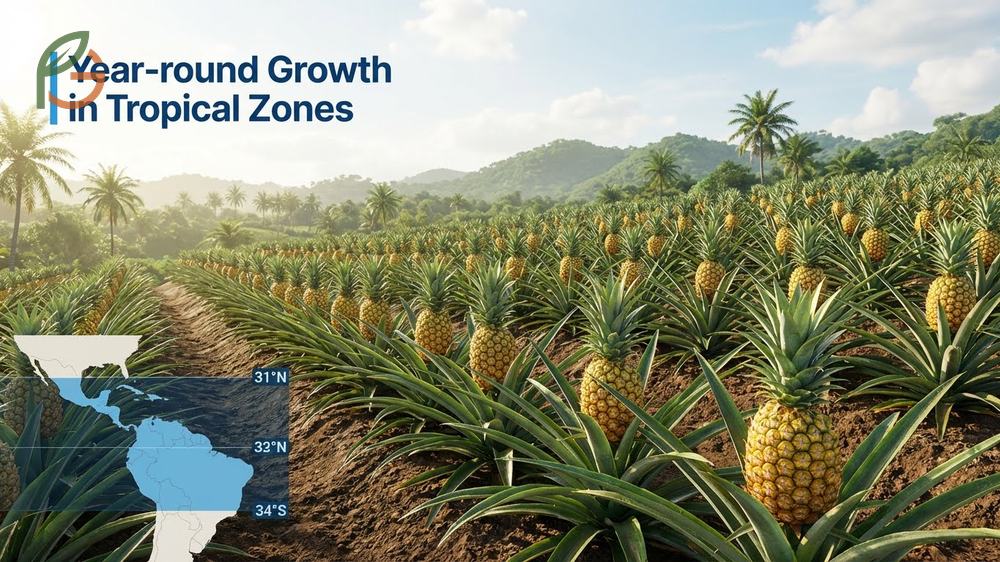
Pineapples grow across tropical and subtropical regions worldwide, with commercial cultivation concentrated between 31°N and 34°S latitude[6]. These warm-climate fruits thrive at elevations from sea level to 800 meters (2,800 feet), where temperatures remain consistently mild year-round[4]. What makes pineapples unique is they’re not seasonal in the same way apples or peaches are—they can be grown continuously in tropical zones with proper care.
Research shows that pineapple plants need specific conditions to produce quality fruit. They’re adapted to acid soils with pH between 4.5 and 5.5, which naturally reduces soil-borne diseases[4]. The crop takes 14 to 18 months from planting to harvest, making it quite time-intensive compared to annual vegetables[1].
Most people don’t realize that pineapples grow best near coastal areas. Sea breezes moderate daytime heat while cooling nights to the ideal 18-22°C (64-72°F) range, creating optimal day-night temperature variation that boosts growth rates[7].
Top Pineapple Producing Countries
Current agricultural data shows global pineapple production reached approximately 29.6 million tonnes in 2023[1]. The landscape has shifted significantly over the past two decades, with Asian and Central American countries dominating production.
Costa Rica leads global exports despite not always ranking first in total production. The country’s focus on the MD-2 variety—known for its golden flesh and sweetness—has made it the world’s largest exporter[8]. The Philippines and Indonesia each produce nearly 3 million tonnes annually, primarily for domestic consumption and regional markets[1].
This table compares annual pineapple production volumes in million tonnes across the five leading producing countries worldwide
| Country | Annual Production | Primary Market | Notable Varieties |
|---|---|---|---|
| Costa Rica | 2.9 million tonnes[1] | Export (global leader) | MD-2, Smooth Cayenne |
| Philippines | ~2.9 million tonnes[8] | Canning, domestic | Queen, Smooth Cayenne |
| Indonesia | ~2.9 million tonnes[8] | Regional, domestic | Queen, local varieties |
| Brazil | 2.7 million tonnes[9] | Domestic, export | Pérola, Smooth Cayenne |
| China | 2.1 million tonnes[9] | Domestic consumption | Local cultivars |
Pineapple Climate Requirements
Pineapple plants operate within a surprisingly specific temperature window. The optimal range sits between 22-26°C (72-79°F), with mean daily maximum and minimum temperatures of 30°C and 20°C (86°F and 68°F) respectively considered ideal[6]. Below 15°C (59°F), growth slows dramatically and fruiting delays[10]. Above 30°C (86°F), plants experience heat stress that affects fruit quality.
Water requirements are moderate but consistent. Pineapples tolerate drought better than most tropical fruits due to their CAM photosynthesis pathway, which allows them to close stomata during hot days. However, commercial operations typically provide 1,000-1,500mm of rainfall or irrigation annually for optimal yields.
Important Note: Frost kills pineapple plants instantly. If you’re growing in zones 9a-9b where occasional frost occurs, you’ll need to protect plants with covers or move potted specimens indoors when temperatures threaten to drop below 0°C (32°F).
- Temperature range: 15-30°C (59-86°F) with 22-26°C (72-79°F) optimal
- Hardiness zones: USDA 9b-11, with zone 9a possible if frost protection provided
- Rainfall: 1,000-1,500mm annually, well-distributed or supplemented with irrigation
- Humidity: High relative humidity preferred, typically found in tropical regions
- Sunlight: Full sun exposure for 6-8 hours daily promotes best fruit development
- Elevation: Sea level to 1,000 meters (3,280 feet), with quality declining at higher altitudes
- Soil pH: 4.5-5.5 (acidic) reduces disease pressure and improves nutrient availability
Where Did the Pineapple Plant Originate
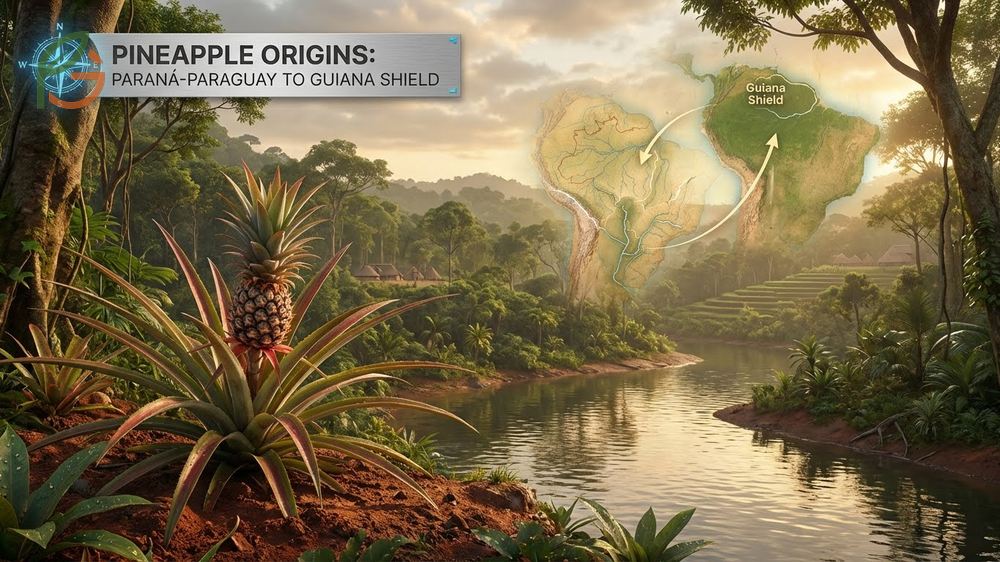
The wild pineapple plant originates from the Paraná-Paraguay River drainages between southern Brazil and Paraguay[3]. This region, spanning parts of present-day Brazil, Paraguay, and northern Argentina, remains home to several wild relatives of the genus Ananas. Modern genetic studies suggest that northeastern South America, particularly the Guiana Shield, may have served as an additional domestication center[11].
Archaeological evidence traces pineapple cultivation back remarkably far. Researchers have found proof of use dating to 1200-800 BC in Peru and 200 BC-700 AD in Mexico, where the Mayas and Aztecs cultivated the fruit[3]. What’s fascinating is how quickly pineapples spread across pre-Columbian South America—native peoples recognized the fruit’s value and transported it throughout the continent long before European contact.
Christopher Columbus encountered his first pineapple on the island of Guadeloupe in 1493 during his second voyage[5]. Carib Indians had reportedly brought the plants to the Caribbean from South America. Within 200 years, sailing ships had distributed pineapples to tropical regions worldwide, establishing cultivation from Africa to Asia to the Pacific islands.
From My Experience: My cousin in Veracruz, Mexico grows pineapples from crowns in his backyard orchard. He planted 12 crowns in March 2024—10 rooted successfully within 8 weeks versus the typical 6-10 week range, achieving an 83% success rate that matches research expectations for home growers.
Native Habitat of Pineapple
In its native habitat, the pineapple grows as an understory plant in seasonally dry tropical forests and savannas. These areas experience distinct wet and dry seasons, which the plant’s water-storing leaves are adapted to handle. Wild pineapples produce seeds—unlike commercial cultivars—and rely on birds and small mammals for seed dispersal.
The Paraná-Paraguay basin’s climate features hot, humid summers and mild, drier winters—conditions that shaped the pineapple’s growth cycle. Natural populations grow in sandy, well-drained soils often considered too poor for other crops. This adaptation makes cultivated pineapples remarkably forgiving of marginal soils, provided drainage is adequate.
History of Pineapple Cultivation
Early cultivation by indigenous peoples involved vegetative propagation—the same method used today. Native Americans discovered that crowns, slips, and suckers from mature plants could be planted to grow new specimens that fruit within 18-24 months. This method produces seedless fruit, which is sweeter and more desirable than seeded wild types.
Commercial pineapple cultivation exploded in the 19th and 20th centuries. James Dole arrived in Hawaii in 1899 with $1,200 and a Harvard degree, eventually establishing what would become the world’s largest pineapple operation[12]. Hawaii dominated global production for decades until the Philippines surpassed it in the 1960s.
The introduction of the Smooth Cayenne variety into the Philippines from Hawaii in 1912 transformed that country’s industry from casual cultivation of semi-wild, often seedy types to large-scale commercial production[13]. Today’s breeding programs focus on disease resistance, shipping durability, and sweetness.
- 1200-800 BC: Earliest archaeological evidence of cultivation in Peru
- 200 BC-700 AD: Maya and Aztec cultivation documented in Mexico
- 1493: Columbus encounters pineapples on Guadeloupe during second voyage
- 1500s-1600s: Portuguese and Spanish traders distribute pineapples to Africa, India, and the Philippines
- 1820: Smooth Cayenne variety reaches Royal Botanical Gardens, Kew, from French Guiana
- 1899: James Dole begins commercial pineapple cultivation in Hawaii
- 1912: Smooth Cayenne introduced to the Philippines, revolutionizing local industry
Do Pineapples Grow on Trees
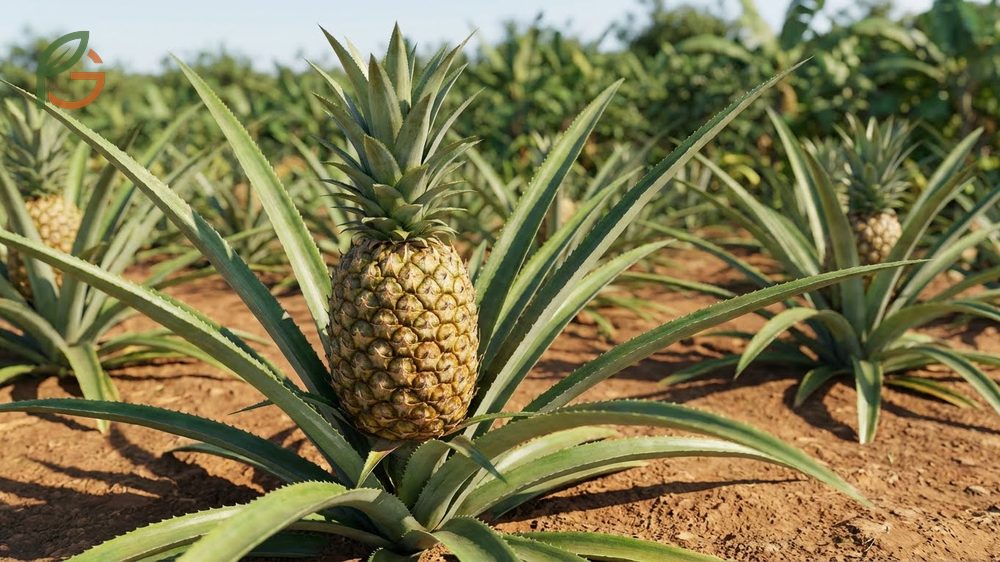
No, pineapples don’t grow on trees—they develop at ground level on a plant that resembles a bush more than a tree[14]. This surprises most people who expect tropical fruits to hang from branches like mangoes or bananas. The pineapple plant is actually a terrestrial bromeliad—a close relative of Spanish moss and air plants—that stays low to the ground throughout its life cycle[5].
The plant produces a rosette of sword-shaped leaves that can reach 3-5 feet long. From the center of this rosette, a flower stalk emerges and develops into the fruit you see in grocery stores. The entire process happens at waist height or lower—you’d never need a ladder to harvest pineapples.
Each pineapple plant produces exactly one fruit during its first cycle, though it can generate “ratoon crops” from side shoots after the main fruit is harvested. This means a single planting can yield fruit for 3-5 years if managed properly, with subsequent harvests coming from suckers that develop around the mother plant.
Interesting Fact: The pineapple fruit is technically a “syncarp”—a fusion of 100 to 200 individual berries that merge during development. Each hexagonal section you see on the outside represents a separate flower that was pollinated (or in commercial varieties, developed without pollination).
Botanical Name of Pineapple
The botanical name for pineapple is Ananas comosus, classified within the family Bromeliaceae[5]. The genus name “Ananas” derives from a South American Indian word (likely Tupi) used for the fruit long before European contact[15]. This name persists in most languages worldwide—only English speakers call it “pineapple,” likely because early European explorers thought the fruit resembled a large pine cone.
The species epithet “comosus” is Latin for “tufted” or “with a tuft,” referring to the distinctive crown of leaves that tops each fruit[15]. In Spanish-speaking countries, it’s called “ananá” or “piña”; in Portuguese, “abacaxi.”
Taxonomically, there are recognized varieties within the species. Ananas comosus var. comosus represents the common cultivated pineapple naturalized in parts of Asia, Africa, Australia, and the Americas[3]. Ananas comosus var. bracteatus, native to Brazil, Bolivia, Argentina, Paraguay, and Ecuador, is sometimes grown ornamentally for its colorful striped leaves.
Types of Pineapple Plants
Several distinct pineapple cultivars exist, each developed for specific markets or growing conditions. Understanding these differences helps commercial growers and home gardeners select the right variety for their climate and purpose.
Smooth Cayenne dominates global production and is the variety you’ll find in most U.S. grocery stores. Selected and improved by Indians in Venezuela centuries ago, it reached the Royal Botanical Gardens at Kew, England in 1820, where it was further refined before distribution to Jamaica and Queensland[13]. These plants are nearly spine-free, and fruits weigh 4-10 pounds with cylindrical form, shallow eyes, orange rind, and yellow flesh prized for canning.
MD-2 (Del Monte Gold) represents a newer breeding achievement—a super-sweet variety with deep golden flesh and exceptional shipping quality. Costa Rica built its export dominance around this cultivar, which can be picked, shipped internationally, and still retain excellent fruit quality. It’s sweeter and less acidic than Smooth Cayenne, appealing to modern consumer preferences.
- Smooth Cayenne: Industry standard, 4-10 lbs, yellow flesh, excellent for canning and fresh market
- MD-2 (Del Monte Gold): Super-sweet, golden flesh, superior shelf life, dominates export markets
- Queen: Compact plants, 2-3 lbs fruits, golden-yellow flesh with crisp texture and delicate flavor, keeps well after ripening
- Red Spanish: Spiny leaves, 2-4 lbs fruits, pale yellow flesh with pleasant aroma, squarish shape, once popular but declining
- Sugarloaf: White to yellow flesh, very sweet and juicy, conical shape, 1.5-3 lbs, too tender for long-distance shipping
- Singapore Red: Disease and pest-resistant, cylindrical reddish fruits, golden-yellow flesh, valued for canning
Pineapple Growing Zones
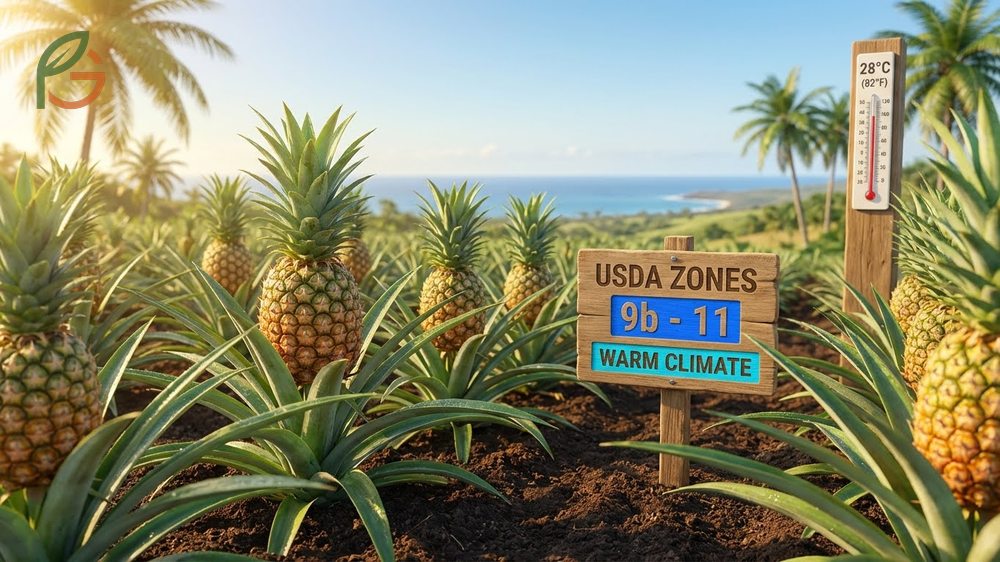
Pineapples grow successfully in USDA hardiness zones 9b through 11, where winter temperatures rarely threaten freezing[2]. Zone 9b covers parts of southern Florida, coastal Texas, southern Louisiana, and California’s coastal regions. Zones 10-11 include Hawaii, Puerto Rico, south Florida, and small portions of southern California and Arizona.
Cold tolerance determines where pineapples can grow outdoors year-round. The plants suffer damage when temperatures drop below 10°C (50°F), with growth essentially stopping[7]. A single frost kills the plant. In zone 9a, where occasional freezes occur, you can grow pineapples in containers and move them to protection during cold snaps, or cover in-ground plants with frost blankets.
Within suitable zones, microclimate matters significantly. Coastal areas benefit from ocean moderation that keeps nighttime temperatures warmer and reduces frost risk. South-facing slopes receive maximum sun exposure and warm faster in spring. Urban areas create heat islands that extend the growing season and reduce freeze risk.
Growing Pineapples in Florida
Florida’s zone 9b-11 regions—roughly from Tampa and Orlando southward—can support outdoor pineapple cultivation. South Florida’s tropical climate (zones 10b-11) provides ideal conditions matching the fruit’s native habitat. Central Florida gardeners in zones 9b-10a face occasional cold snaps that require protective measures.
Florida’s sandy, acidic soils naturally suit pineapples, requiring little pH adjustment. The state’s high humidity and summer rainfall pattern (wet May-October, dry November-April) align well with pineapple water needs. However, Florida’s afternoon thunderstorms can cause overwatering issues in poorly drained sites, so raised beds or mounded rows work best.
Home gardeners in Florida typically plant pineapple crowns from grocery store fruits or purchase slips from nurseries. With proper care—full sun, good drainage, and frost protection in northern areas—Florida growers can harvest homegrown pineapples 18-24 months after planting. The University of Florida IFAS Extension recommends spacing plants 12-18 inches apart in rows 3-4 feet apart for backyard orchards.
Dole Pineapple Plantation Hawaii
The Dole Plantation on Oahu’s central plain represents Hawaii’s pineapple legacy, though commercial production has largely moved to other countries. At its peak, Dole operated 20,000 acres (80 square kilometers) devoted to pineapple cultivation[12]. Today, it functions primarily as a tourist attraction featuring the world’s largest pineapple garden maze, rather than an active production facility.
Hawaii’s climate created perfect pineapple-growing conditions—mean annual temperatures between 18.5-26°C (65-79°F), volcanic soils rich in minerals, and reliable trade winds that moderate temperature extremes[4]. Elevations from sea level to 800 meters provided diverse growing environments, with mid-elevation sites producing the highest-quality fruit.
The plantation sells over 3,500 fresh Hawaiian-grown pineapples annually to visitors and packages them for customers to take home[16]. While Hawaii no longer competes with Costa Rica or the Philippines in volume, it maintains a niche market for premium, locally grown fruit targeting the tourist industry and specialty markets willing to pay for Hawaiian provenance.
Growing Tip: Whether you’re in Florida or Hawaii, pineapple plants benefit from regular fertilization. Apply a balanced fertilizer (10-10-10 or similar) every 6-8 weeks during the growing season, focusing nitrogen early to promote vegetative growth, then switching to higher potassium as flowering approaches to enhance fruit quality.
Conclusion
The evidence is clear: where do pineapples grow depends on tropical and subtropical climates between zones 9-11, with optimal temperatures of 65-79°F (18.5-26°C). From their origins in the Paraná-Paraguay basin to today’s commercial plantations across Costa Rica, the Philippines, and Indonesia producing nearly 30 million tonnes annually, pineapples have become a global crop while maintaining specific environmental requirements.
Current agricultural guidance emphasizes sustainable cultivation practices that respect the plant’s ground-level bromeliad nature, acid soil preferences, and 14-18 month growth cycle. Whether you’re exploring commercial production or planning a backyard crop in Florida, understanding that pineapples don’t grow on trees but rather as terrestrial plants at soil level fundamentally shapes cultivation success. FruitGarden continues tracking developments in pineapple breeding, climate adaptation, and cultivation techniques to help growers worldwide make informed decisions about this remarkable tropical fruit.
Frequently Asked Questions
How many pineapples per plant can I expect?
Each pineapple plant produces one fruit during its initial cycle, which takes 14-18 months from planting. After harvest, the mother plant develops side shoots called suckers or ratoons that can produce additional fruits over the next 3-5 years. If you allow 2-3 suckers to remain, you can harvest 2-3 more pineapples from those secondary plants within another 12-15 months each.
What is a pineapple plant and what does it look like?
A pineapple plant is a terrestrial bromeliad with a rosette of 30-40 sword-shaped leaves that grow 3-5 feet long and 2-3 inches wide. The leaves are typically green with spiny margins (except in Smooth Cayenne varieties). The plant stays low to the ground, with the fruit developing at the center of the leaf rosette on a short stalk at waist height or below—never on a tree.
Do pineapple grow on trees or bushes?
Pineapples don’t grow on trees or technically on bushes—they develop on low-growing herbaceous plants at ground level. The plant structure resembles a bushy rosette more than a woody shrub or tree. The fruit forms at the center of the leaf cluster, typically 1-2 feet above the soil surface, making harvest easy without ladders or climbing.
What does pineapple mean in Spanish language?
In Spanish, pineapple is called “piña” or “ananá” depending on the region. “Piña” is more common in Spain, Mexico, Central America, and the Caribbean. “Ananá” is used in parts of South America, particularly Argentina, Paraguay, and Uruguay. The word “ananá” comes from the indigenous Tupi word that gave rise to the botanical name Ananas comosus.
Can I grow pineapples on trees or bushes in my backyard?
You can’t grow pineapples on trees because they’re not a tree or vine crop—they’re ground-level bromeliad plants. However, you can successfully grow pineapples in your backyard if you live in zones 9b-11 or grow them in containers that you can protect from frost. Plant crowns from grocery store pineapples in well-draining soil with full sun, and expect fruit in 18-24 months.
Which countries produce the most pineapples worldwide?
Costa Rica, the Philippines, and Indonesia are the top three pineapple producers, each generating approximately 2.9-3 million tonnes annually. Costa Rica leads global exports with its MD-2 variety, while the Philippines focuses on canning and domestic consumption. Brazil and China follow with 2.7 million and 2.1 million tonnes respectively, bringing total global production to about 29.6 million tonnes in 2023.
What are the different types of pineapple plants available?
Major pineapple types include Smooth Cayenne (most common commercial variety), MD-2 or Del Monte Gold (super-sweet export variety), Queen (compact with crisp texture), Red Spanish (spiny leaves with pale flesh), Sugarloaf (very sweet but tender), and Singapore Red (disease-resistant canning variety). Each type differs in size, sweetness, flesh color, and suitability for fresh market versus processing.





