
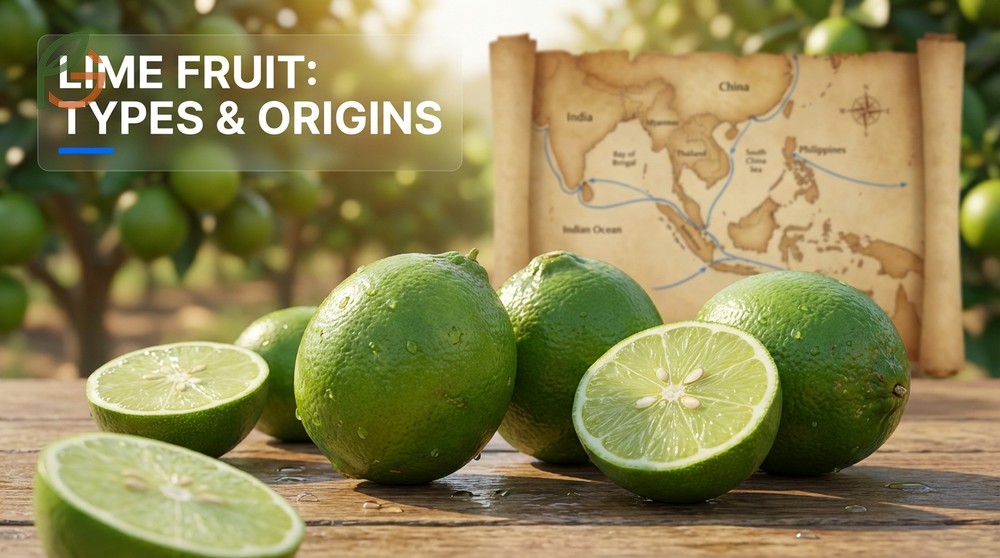
What is lime fruit? It’s a small, round citrus from the Rutaceae family with green skin and acidic juice that’s cultivated across tropical and subtropical regions worldwide[1]. Research shows limes originated in Southeast Asia over 3,000 years ago and spread through ancient trade routes[2]. FruitGarden synthesizes current agricultural research to help you understand citrus cultivation and varieties.
Quick Answer
- Limes belong to the genus Citrus in the Rutaceae family, with scientific name Citrus aurantiifolia for Key limes[1]
- One lime provides 19.5-29 milligrams of vitamin C, meeting 22-32% of your daily needs[3][4]
- India leads global production at 3.79 billion units (16%), followed by Mexico with 3.25 billion (13.76%)[5]
- Persian limes dominate US markets, while Key limes offer more aromatic, acidic juice for cooking[6]
What is Lime Fruit
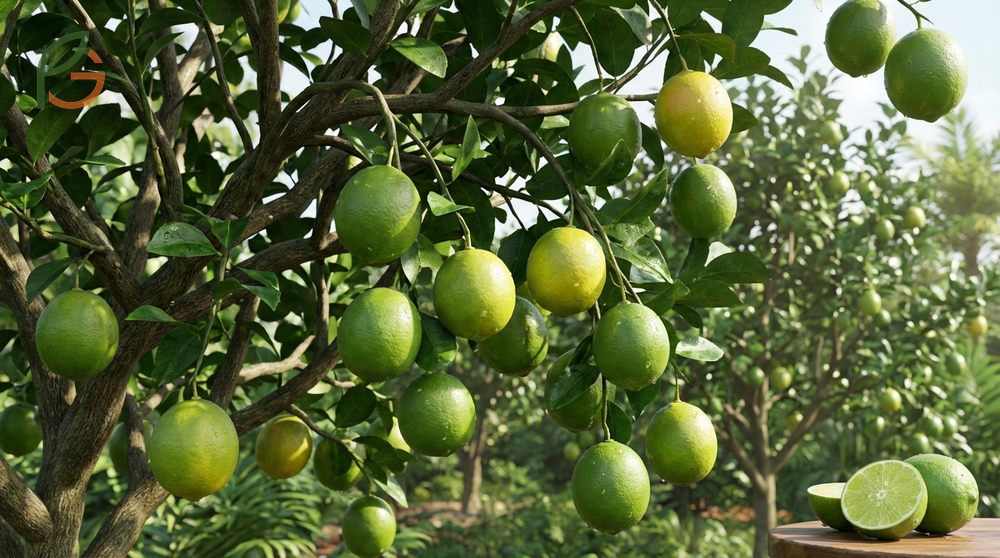
Limes are small citrus fruits with green skin, acidic pulp, and high vitamin C content that thrive in tropical climates. Current agricultural data shows these evergreen trees reach approximately 5 meters in height with dense, irregular branching patterns[7]. The fruits measure 2.5 to 5 centimeters (1 to 2 inches) in diameter and turn yellow when fully ripe.
Unlike other citrus, limes don’t ripen after harvest—they’re non-climacteric fruits that develop maturity on the tree. This matters because picking timing directly affects juice acidity and flavor intensity. The thin peel contains dense glandular segments with yellow-green pulp vesicles packed with fragrant, sour juice.
Studies demonstrate that lime juice rivals lemon in sourness but offers more aromatic compounds. Most people find the juice tastes sharper and more floral than typical lemons. This aromatic quality comes from specific volatile oils in the peel and pulp.
Lime Scientific Name and Classification
The scientific name Citrus aurantiifolia (Christm.) Swingle identifies Key limes, also known as Mexican or West Indian limes. Research from genetic analysis reveals that limes are hybrids rather than pure species. Current evidence indicates Key limes resulted from crossing Citrus micrantha (papeda) with Citrus medica (citron)[8].
Persian limes carry different genetics—they’re hybrids between Key limes and lemons. What often gets overlooked is that only three citrus species are considered “true” biological species: citron (Citrus medica), mandarin (Citrus reticulata), and pummelo (Citrus maxima). Everything else, including limes, represents interspecies crosses.
Lime Family Rutaceae
Limes belong to the Rutaceae family, a large group of flowering plants containing over 150 genera and 1,600 species[9]. This family includes all commercial citrus fruits plus aromatic plants used in cooking. Members share characteristic features: aromatic leaves with oil glands, flowers with four or five petals, and fruits with segmented interiors.
The Rutaceae classification helps explain why lime leaves carry such strong fragrance when crushed. Those same essential oils appear in the peel, making lime zest valuable for cooking. Persian culture traditionally dries limes for use in stews and rice dishes, while the leaves treat headaches and colds.
Important Note: Don’t confuse culinary limes with agricultural lime (calcium carbonate). The name similarity causes confusion, but they’re completely unrelated—one’s a fruit, the other’s a soil amendment.
Types of Limes
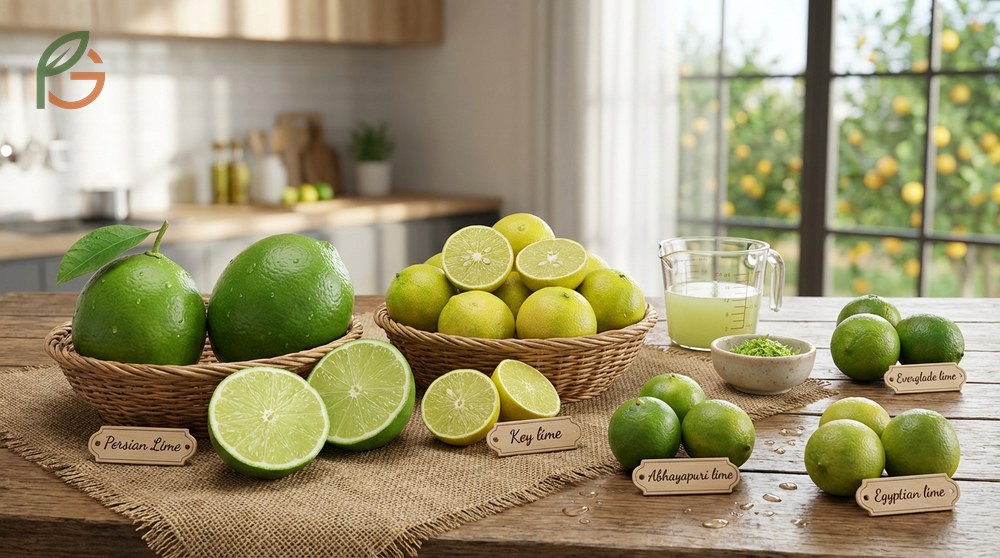
Agricultural data shows five main cultivated lime groups, but two varieties dominate commercial markets: Persian limes and Key limes. Persian types account for roughly 90% of US lime sales, while Key limes serve niche markets and specialty applications[6]. The differences affect everything from harvest timing to shelf life.
Beyond these major types, regional varieties thrive in specific areas. Examples include Abhayapuri limes in India, Everglade limes in Florida, and Egyptian limes in North Africa. Most home gardeners stick with Persian or Key varieties because they’re easier to source and grow.
This table compares Persian and Key lime varieties across size, acidity, seed content, growing zones, and primary markets
| Characteristic | Persian Lime | Key Lime |
|---|---|---|
| Size | Larger, up to 2.5 inches | Smaller, 1-2 inches[1] |
| Acidity | Less acidic and bitter[10] | More acidic, aromatic |
| Seeds | Seedless (Bearss variety) | Contains seeds |
| Growing Zones | USDA zones 9-11[6] | USDA zones 9-11, frost-sensitive |
| Primary Markets | Commercial fresh sales | Specialty cooking, Key lime pie |
Persian Lime Characteristics
Persian limes, also called Tahiti or Bearss limes, are hybrids between Key limes and lemon trees. They can reach 20 feet tall in home gardens and develop thorny branches as they mature. The Bearss variety grown in California stays seedless and turns from dark green to lighter green-yellow when ripe.
These limes dominate commercial production because of superior shelf life and year-round availability. The main harvest begins in winter and continues through late spring. For home growers, this extended season means fresh limes for months without special storage.
Key Lime Features
Key limes got their name from naturalization in the Florida Keys, where they were introduced as early as 1838[11]. These fruits measure 1-2 inches in diameter with thin, smooth skin and aromatic, pale green leaves. The petioles show narrow wings that distinguish them from Persian varieties.
What makes Key limes special is their intense flavor profile. The juice tastes sharper and more complex than Persian limes, which is why bartenders and chefs seek them for specific recipes. They require hot, sunny, humid conditions and can’t tolerate frost, so container growing works best in cooler regions.
- Smaller fruit size with higher juice content per ounce of fruit
- Seeds present in most fruits, typically 5-10 per lime
- More aromatic essential oils in peel and juice
- Traditional choice for authentic Key lime pie
- Less vigorous growth compared to Persian varieties
Origin of Limes

Citrus fruits and their relatives originated in Southeast Asia, New Caledonia, and Australia according to botanical research[8]. Limes specifically trace back to tropical Southeast Asia and South Asia, where wild citrus species naturally hybridized over millennia. Makrut lime was among the earliest citrus introduced outside its native range.
Human migration and trade spread limes across the globe. The Austronesian expansion carried limes to Micronesia and Polynesia between 3000-1500 BCE. By at least 1200 BCE, the spice trade brought limes to the Middle East and Mediterranean regions.
Current production centers far from the origin. India produces 3.79 billion units annually, representing 16.04% of global output[5]. Mexico follows with 3.25 billion units (13.76%), while China contributes 2.38 billion (10.09%). These three countries collectively supply 40% of the world’s limes.
History of Limes
Sour limes were probably one of the first citrus fruits carried westward by crusaders returning from the Holy Land. Arabs transported them to North Africa and surrounding regions, then moved them from Palestine to Mediterranean Europe. By the mid-13th century, small-fruited acid limes were well-established in Italy and France[7].
Spanish and Portuguese explorers brought limes to the Americas during the 16th century. The fruits naturalized throughout the Caribbean, Eastern Mexico, tropical South America, Central America, and the Florida Keys. Florida’s commercial lime industry thrived as a niche market until citrus canker disease, cold weather, and labor issues caused contraction—by 2002, virtually no commercial production remained in the state.
- 3000-1500 BCE: Austronesian peoples spread limes to Pacific islands
- 1200 BCE: Spice trade introduces limes to Middle East and Mediterranean
- 13th century CE: Limes established in Italian and French cultivation
- 16th century: Spanish colonizers bring limes to Americas
- 1838: Key limes introduced to Florida Keys, later naturalized
- 1970s-1990s: Over 51% of Florida lime production targets fresh markets[11]
Historical Note: British sailors earned the nickname “limeys” from their practice of consuming lime juice to prevent scurvy during long voyages. This vitamin C source proved essential for naval health in the age of sail.
Lime Culinary Uses
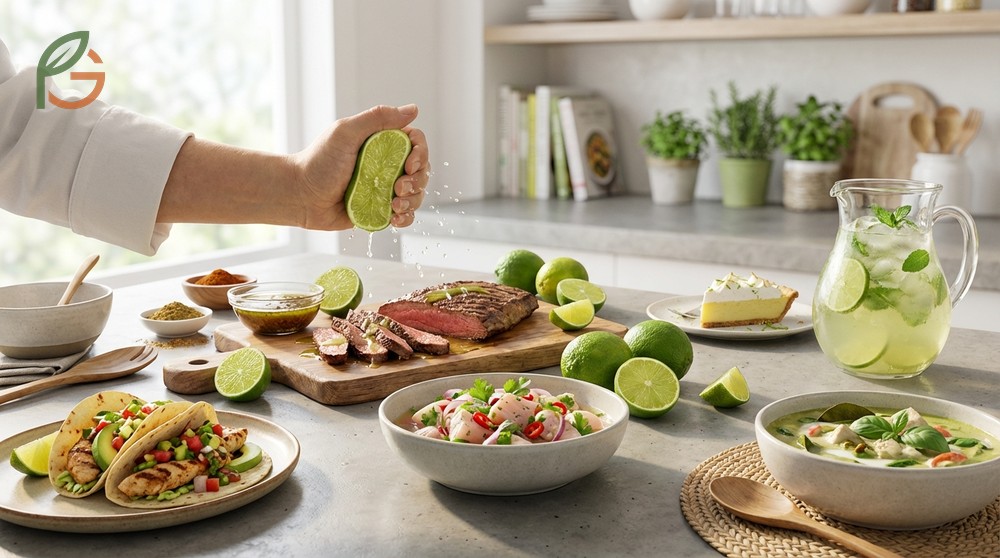
Lime’s tangy acidity balances recipes by adding brightness to everything from tacos to desserts. The juice works as a flavor enhancer in cooking, beverages, and sweet treats. Studies demonstrate that lime’s acidity helps tenderize proteins while infusing them with citrus-forward taste that balances spiciness beautifully[12].
Around the world, lime takes center stage in countless cuisines. It gives Thai green curries their fragrant aroma and adds brightness to Mexican ceviche. You’ll find it in Caribbean jerk marinades, where lime’s acidity tames heat while amplifying spice. In Persian cooking, dried limes flavor stews and rice dishes with concentrated sourness.
Lime zest carries fragrant oils that deliver pure, concentrated flavor. It’s perfect for enhancing savory dishes like whole roasted fish or pan-seared vegetables. Mix lime juice with olive oil, garlic, and herbs for quick, flavorful marinades. The acidity in lime juice helps tenderize chicken, shrimp, and fish while preventing browning in fresh-cut fruits as a natural antioxidant.
For marinades, lime juice transforms everyday proteins into something special. The acidity enhances flavor in chicken, fish, and shrimp, giving meals fresh, zesty brightness. Pair it with herbs, garlic, or honey for balanced taste. These simple combinations turn basic dishes into memorable meals.
- Mexican cuisine: tacos, guacamole, ceviche, elote, and margaritas
- Thai dishes: tom yum soup, pad thai, green curry, and papaya salad
- Caribbean cooking: jerk marinades, rice and peas, rum cocktails
- Vietnamese food: pho garnish, spring roll dipping sauces, banh mi
- Beverage applications: cocktails, limeade, mojitos, caipirinha
- Desserts: Key lime pie, lime bars, sorbets, cheesecakes
- Preserves: lime marmalade, pickled limes, lime curd
From My Experience: My cousin in Guadalajara, Mexico grows Persian limes in her backyard garden. She planted three trees in March 2023, and they produced their first harvest in November 2024—about 18 months versus the typical 15-24 month range for container-grown citrus. She uses fresh lime juice daily in agua fresca and achieves restaurant-quality brightness without any commercial additives.
Conclusion
The evidence is clear: limes are versatile citrus fruits from the Rutaceae family that originated in Southeast Asia and now grow across tropical regions worldwide. With varieties ranging from seedless Persian limes to aromatic Key limes, these fruits deliver high vitamin C content and distinctive acidic flavor that’s essential in global cuisines. Current agricultural guidance emphasizes sustainable cultivation methods and proper variety selection based on your climate zone and intended use.
Whether you’re growing limes in home gardens or using them in cooking, understanding the differences between varieties helps you make informed choices. FruitGarden continues synthesizing the latest horticultural research to help gardeners and fruit enthusiasts succeed with citrus cultivation.
Frequently Asked Questions
What is the difference between Key limes and regular limes?
Key limes are smaller (1-2 inches), more acidic, and contain seeds, while Persian “regular” limes are larger, seedless, and less acidic. Key limes offer more aromatic flavor that’s prized for specialty cooking and desserts, whereas Persian limes dominate commercial markets due to longer shelf life and easier handling.
Are limes and lemons the same species?
No, limes and lemons are different citrus hybrids with distinct genetic backgrounds. Research shows limes (Citrus aurantiifolia) are crosses between papeda and citron, while lemons have different parent species. Persian limes are actually lime-lemon hybrids, which explains their intermediate characteristics.
How much vitamin C is in one lime?
One lime with a 2-inch diameter provides 19.5-29 milligrams of vitamin C, which represents 22-32% of your daily recommended intake. The juice from one lime alone delivers about 22% of daily vitamin C needs, making limes an excellent dietary source of this essential antioxidant.
Which country produces the most limes?
India leads global lime production with 3.79 billion units annually, representing 16.04% of world output. Mexico ranks second with 3.25 billion units (13.76%), followed by China with 2.38 billion units (10.09%). These three countries collectively supply approximately 40% of global lime production.
Can lime trees grow in cold climates?
Lime trees are frost-sensitive and thrive in USDA zones 9-11, requiring warm temperatures year-round. In cooler regions, you can grow them in containers and bring them indoors during winter. Key limes are especially sensitive and need hot, sunny, humid conditions to produce fruit successfully.
What are the main culinary uses for limes?
Limes serve as essential ingredients in global cuisines for marinades, beverages, and flavor enhancement. Their acidic juice tenderizes proteins in Mexican ceviche, adds brightness to Thai curries, balances heat in Caribbean jerk, and provides signature taste in cocktails like margaritas and mojitos. The zest offers concentrated aromatic oils for both savory and sweet dishes.
Do limes ripen after being picked?
No, limes are non-climacteric fruits that don’t ripen after harvest—they must reach maturity on the tree. This means picking timing directly affects juice acidity and flavor quality. Unlike bananas or avocados that continue ripening off the tree, limes maintain their characteristics from the moment they’re harvested.





