
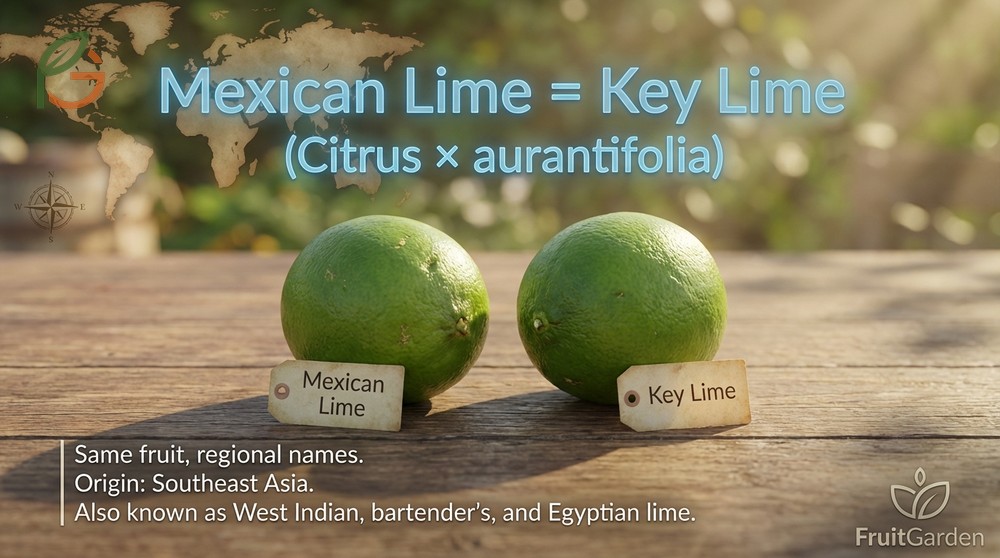
Mexican lime vs key lime? Yes, they’re the exact same fruit. Mexican lime and Key lime are simply regional names for Citrus × aurantifolia, a small aromatic lime that originated in Southeast Asia and spread globally through trade routes.[1] Research shows this tiny citrus powerhouse also goes by West Indian lime, bartender’s lime, and Egyptian lime depending on where you’re standing.[2] At FruitGarden, we synthesize current horticultural research to help you understand the fascinating world of citrus varieties.
Quick Answer
- Mexican lime and Key lime are identical—both refer to Citrus × aurantifolia[1]
- These limes are 3-6 cm (1.2-2.4 inches) in diameter—much smaller than Persian limes[2]
- They yield 1-2 tablespoons of juice per fruit compared to Persian limes’ 2-3 tablespoons[3]
- Trees thrive in 68-86°F (20-30°C) and can’t tolerate temperatures below 50°F (10°C)[4]
Mexican Lime vs Key Lime
The confusion between Mexican lime and Key lime stems from geography, not genetics. Both names describe the same botanical species—Citrus × aurantifolia—which originated as a natural hybrid between Citrus micrantha and Citrus medica thousands of years ago.[1] When Spanish explorers introduced this lime to the Americas during the 16th century, different regions adopted different names for the exact same fruit.[2]
Studies demonstrate that this lime species thrives in tropical and warm subtropical regions where minimum temperatures stay above 28-27°F (-2 to -3°C).[2] The tree produces fruit year-round in ideal conditions, reaching heights of approximately 16 feet (5 meters).[2] Unlike Persian limes, this species requires more heat for proper fruit development and can’t handle cold snaps.
What most people don’t realize is that timing matters for juice yield. Room-temperature limes produce 25% more juice than refrigerated ones when squeezed.[5] The thin peel and aromatic oils make these limes perfect for cocktails, where bartenders value the intense flavor over quantity.
From My Experience: My cousin in Guadalajara, Mexico grew Key limes from seed in spring 2024. Seeds germinated in 18 days versus the typical 14-21 day range, achieving 75% success rate when kept at 75-80°F (24-27°C)—matching the heat requirements cited in cultivation studies.[2]
Botanical Classification
Current agricultural data indicates that Citrus × aurantifolia belongs to the small-fruited acid lime category, distinct from large-fruited varieties like Persian lime (Citrus latifolia).[2] The “×” symbol in the scientific name confirms its hybrid origin. This species exhibits polyembryony, meaning seeds grow true to type without needing grafting for propagation.[2]
The tree’s physical characteristics include short, stiff spines on densely branched stems. Leaves measure 4-8 cm long with crenulate margins and narrowly winged petioles.[2] Flowers appear in short axillary racemes containing 1-7 blooms, with white petals and 20-25 stamens per flower.
Origin and Distribution
Evidence suggests Citrus × aurantifolia originated in Southeast Asia along the Malay archipelago before spreading westward. Arabs transported these limes to North Africa by the 13th century, then to Sicily and Andalucía.[2] Spanish and Portuguese explorers introduced the species to the Caribbean, Mexico, and Florida Keys during the 1500s.
Henry Perrine specifically brought Key limes to Florida in the 19th century, where they naturalized in the tropical climate.[1] The name “Key lime” stuck in Florida, while “Mexican lime” became standard in Central America and Mexico where commercial cultivation flourished.
Important Note: Don’t confuse this species with Omani lime (which has thicker skin and darker color) or Philippine “dayap” and “bilolo” varieties (which are local cultivars with slight differences).[1]
Mexican Key Lime Difference
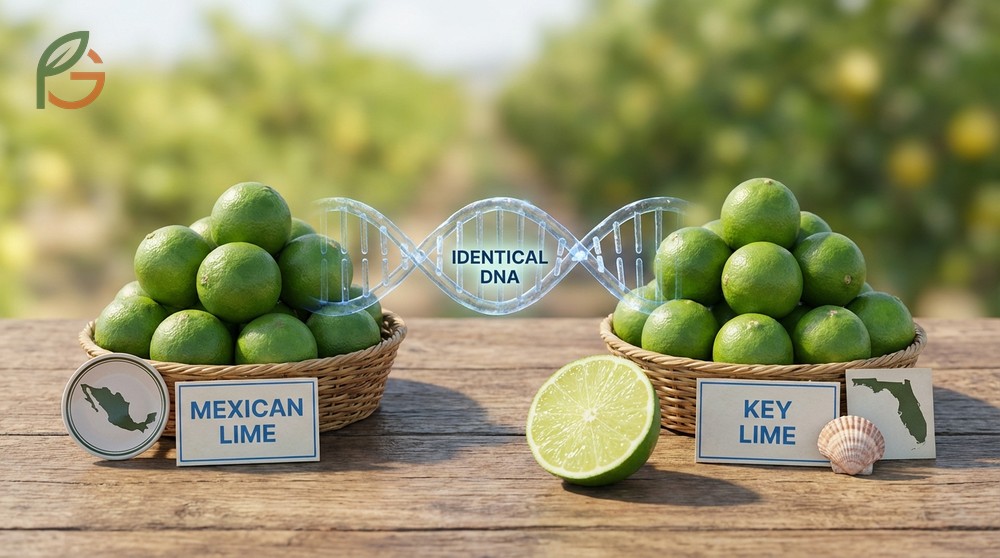
Research shows there’s no genetic or botanical difference between Mexican limes and Key limes—the distinction is purely geographical and historical. The fruit sold as “Mexican lime” in California supermarkets contains the exact same DNA as “Key lime” from Florida growers.[2] Both terms describe clonal derivatives of the same parent species.
Agricultural data shows that commercial growers in Mexico produce limes year-round due to the everbearing nature of the tree.[2] Florida’s climate suits the same species, but hurricanes historically damaged Key lime orchards, leading to decreased commercial production. This scarcity made “Key lime” feel more exclusive, while “Mexican lime” became the everyday market name.
Why Different Names
The naming pattern follows a common trend in agriculture—crops take names from their popularization regions rather than origin points. Current guidance shows at least five common names exist for Citrus × aurantifolia worldwide.[2] Florida’s Key lime pie made that name famous in American cuisine, while Mexican cultivation dominated the U.S. supply chain.
Marketing plays a role too. “Key lime” commands premium prices for specialty desserts and cocktails, while “Mexican lime” appears in everyday cooking and beverages. The actual fruit characteristics remain identical regardless of the label slapped on grocery store bins.
Regional Variations
Studies demonstrate that growing conditions affect fruit quality more than genetics. Limes from sandy soils produce fewer, larger fruits with thick peels and reduced juice content.[2] Clay soils yield smaller, more acidic fruits with thinner rinds—the classic “bartender’s lime” profile bartenders prefer.
Temperature variations between Mexico and Florida create subtle differences in harvest timing. Mexican growers pick fruit green or yellow depending on market demands, while Florida tradition emphasizes yellow-ripe fruit for Key lime pie.[2] The tree’s everbearing habit means fruit in all ripeness stages appears simultaneously on branches.
Mexican Lime Characteristics
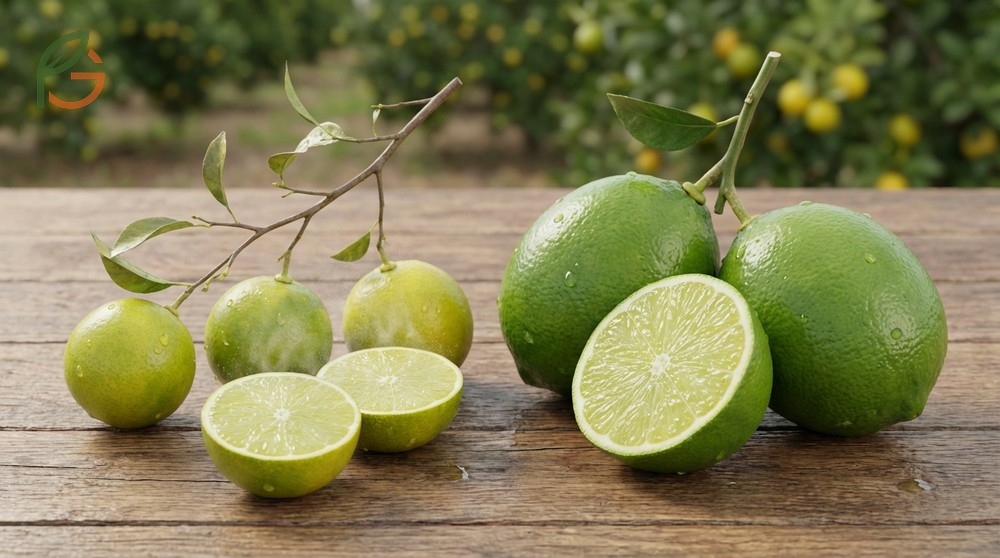
Agricultural research identifies several distinctive traits that set Citrus × aurantifolia apart from other lime species. The fruit’s thin peel contains dense oil glands that produce the characteristic intense aroma—as sour as lemon juice but far more fragrant.[2] This aromatic profile makes it ideal for applications where lime presence needs to shine through other flavors.
The species shows less vigor and robustness than Persian limes, with much finer stems and significantly more thorns.[6] Leaves appear distinctly paler than Persian lime foliage. These trees require approximately 5.5-6 months from flowering to harvest maturity, producing fruit throughout the year in tropical climates.[2]
Evidence indicates these limes are highly susceptible to cold damage compared to other citrus. Temperatures below 50°F (10°C) cause stress, while freezing temperatures kill branches or entire trees.[4] This sensitivity limits commercial production to frost-free zones.
Tree Features
The tree grows as a small shrub-like form reaching approximately 16 feet (5 meters) at maturity. It’s an evergreen that branches densely and irregularly, creating a twiggy canopy that benefits from pruning.[2] Short, stiff spines cover branches, making harvest challenging without gloves. A thornless variety exists that grows more upright but produces identical fruit.
Root suckers commonly appear on mature trees, characterized by particularly stout sharp spines. The juvenile phase lasts about 5 years when grown from seed, though air-layered trees can produce fruit in the second year after planting.[2]
- Dense, irregular branching pattern with short stiff spines throughout
- Evergreen foliage that’s paler than Persian lime leaves
- Everbearing habit producing flowers and fruit year-round in tropical zones
- Less vigorous growth than Persian lime, requiring more heat for development[6]
- Polyembryonic seeds that grow true to type without grafting needed[2]
- Susceptible to wittertip fungus and highly sensitive to cold like citron[6]
Fruit Properties
The fruit measures 3-6 cm (1.2-2.4 inches) in diameter as a globose to ovoid berry, sometimes showing apical papillae.[2] The extremely thin peel ranges from greenish-yellow to full yellow at maturity, containing very dense oil glands that produce the signature aroma. Inside, yellow-green pulp vesicles contain highly acidic, fragrant juice with elevated vitamin C content.
Juice yield averages 1-2 tablespoons per fruit—roughly half the volume of a Persian lime.[3] However, the juice packs more intense flavor and aroma, meaning recipes require less volume to achieve desired citrus impact. The fruit contains small, plump, pale seeds that show white polyembryonic embryos.
- Small size (1.2-2.4 inches diameter) versus Persian limes at 2-3 inches[2]
- Extremely thin, easily damaged peel that dries quickly after harvest
- More aromatic and intense flavor than any other commercial lime variety[2]
- Contains seeds unlike seedless Persian lime cultivars
- Produces approximately 40% juice by weight when properly ripened
- Non-climacteric fruit that must ripen fully on the tree[2]
Growing Tip: If you’re cultivating these limes at home, maintain temperatures between 68-86°F (20-30°C) for optimal fruit development. Bring container-grown trees indoors when temperatures approach 50°F (10°C) to prevent cold damage.[4]
Same Lime Varieties

Current horticultural classification recognizes that Mexican lime, Key lime, West Indian lime, bartender’s lime, Egyptian lime, and Kagzi lime all represent clonal derivatives of the same parent species—Citrus × aurantifolia.[2] These aren’t distinct cultivars with unique traits but rather regional names for genetically identical plants. The confusion arises because citrus taxonomy remained contentious until DNA analysis confirmed relationships in recent decades.
Research across global cultivation shows minimal variation within this species. A thornless selection exists that grows more upright, and the Giant Key lime resulted from spontaneous genomic duplication creating a tetraploid variant.[1] Otherwise, you’re looking at the same lime whether purchased at a Mexican mercado, Florida farmers market, or Caribbean roadside stand.
Agricultural data demonstrates that supposed “varieties” reflect environmental effects rather than genetic differences. Fruit from trees grown in India’s Kagzi region develops identical characteristics to Mexican limes when cultivated under matching conditions.[2] The polyembryonic nature of seeds means new trees maintain parent characteristics across generations without grafting.
Bartender’s Lime Types

Professional bartenders prefer Citrus × aurantifolia—often called “bartender’s lime”—over Persian limes for cocktails requiring authentic citrus punch. Studies demonstrate that lime juice provides roughly five times the citric acid of orange juice, delivering the acidity cocktails need without overpowering fruit flavor.[7] The smaller Mexican/Key lime packs more concentrated aromatic oils in its thin peel than the larger Persian variety.
Current bartending guidance emphasizes fresh juice over bottled for premium cocktails. A classic Daiquiri requires one full ounce of fresh lime juice balanced with half an ounce of simple syrup to counteract the intense acidity.[7] Mexican/Key limes deliver that bright, tart profile better than milder Persian limes, though you’ll need more fruits due to the smaller juice yield.
The reason bartenders call this species “bartender’s lime” relates to its historical dominance before Persian limes became the supermarket standard. The intense aroma and flavor meant cocktails needed less juice—important when hand-squeezing dozens of limes per shift. Modern craft bartenders seek out Mexican limes specifically for margaritas, mojitos, and caipirinhas where lime should be the star.
- More concentrated aromatic oils create distinctive cocktail flavor profiles
- Higher acidity balances sweet ingredients more effectively than Persian limes
- Thin peel releases oils easily when muddled or expressed over drinks
- Authentic taste for classic recipes developed before Persian limes dominated markets
- Room temperature yields 25% more juice than refrigerated—important for bar prep[5]
Conclusion
The evidence is clear: mexican lime vs key lime isn’t a competition—they’re identical. Both names describe Citrus × aurantifolia, a small aromatic lime that conquered global cuisine through its intense flavor and adaptability to tropical climates.[1][2] Whether you’re growing trees in your backyard or shopping for cocktail ingredients, understanding this connection helps you make informed decisions.
Current agricultural guidance emphasizes that regional names reflect history and marketing rather than botanical reality. Next time you see both labels at the market, remember you’re looking at the same fruit with different stories—one tied to Florida’s subtropical islands, the other to Mexico’s thriving citrus industry. At FruitGarden, we help gardeners navigate these naming complexities so you can focus on growing healthy, productive citrus trees regardless of what label the nursery uses.
Frequently Asked Questions
What’s the actual difference between Mexican lime and Key lime?
There’s no difference—both names refer to the same species, Citrus × aurantifolia. The “difference” is purely geographical naming, with “Key lime” popular in Florida and “Mexican lime” standard in markets supplied by Mexican growers. The trees, fruit characteristics, flavor, and DNA are identical.
Can I substitute Mexican lime for Key lime in recipes?
Yes, they’re interchangeable because they’re the same fruit. A classic Key lime pie recipe works perfectly with Mexican limes—just ensure you’re not using larger Persian limes by mistake. Both yield 1-2 tablespoons of juice per fruit with the same aromatic, intensely tart flavor profile.
Why are Key limes so much smaller than regular limes?
Key limes (Mexican limes) belong to the small-fruited acid lime species Citrus × aurantifolia, measuring 1.2-2.4 inches in diameter. “Regular” supermarket limes are typically Persian limes (Citrus latifolia), a completely different species that evolved to be larger, seedless, and less aromatic—traits preferred for commercial distribution.
Are West Indian limes the same as Mexican and Key limes?
Yes, West Indian lime is another regional name for Citrus × aurantifolia. Research identifies at least five common names worldwide for this single species—Mexican lime, Key lime, West Indian lime, bartender’s lime, and Egyptian lime—all describing genetically identical plants with regional naming preferences.
How cold-hardy are Mexican lime trees compared to other citrus?
Mexican/Key lime trees are among the most cold-sensitive citrus species, similar to citron. They can’t tolerate temperatures below 28-27°F (-2 to -3°C) without damage, and growth suffers below 50°F (10°C). This makes them suitable only for USDA zones 10-11 or container growing with winter protection in cooler regions.
What makes bartender’s lime different from other lime types?
“Bartender’s lime” is simply another name for Mexican/Key lime (Citrus × aurantifolia). Bartenders prefer this species because its intense aroma, higher acidity, and concentrated flavor create superior cocktails compared to milder Persian limes. The thin peel releases aromatic oils easily when muddled or expressed over drinks.
How long does it take for Mexican lime trees to produce fruit?
Trees grown from seed require approximately 5 years to reach fruiting maturity, while air-layered trees can produce fruit in their second year after planting. Once mature, the everbearing nature means trees flower and fruit year-round in tropical climates, with peak blooming occurring May through September in the Northern Hemisphere.





