
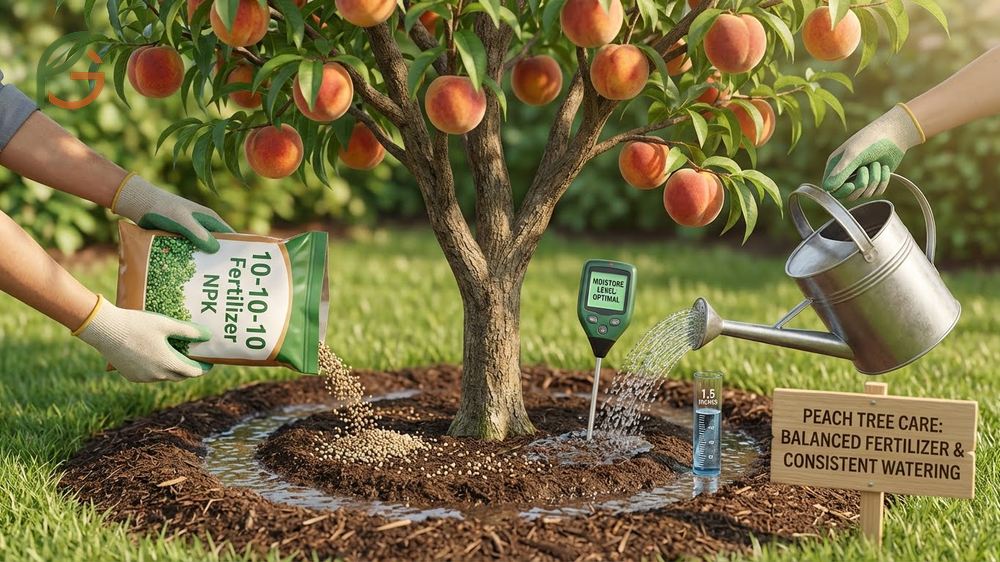
Research shows that how to take care of a peach tree centers on balanced fertilization and consistent moisture management. Peach trees need twice-yearly feeding with 10-10-10 NPK fertilizer and 1-1.5 inches of water weekly to produce quality fruit[1][2]. Most gardeners overlook timing—applying fertilizer too late reduces fruit quality and increases winter injury risk. FruitGarden compiles current horticultural data to help you master peach tree care from spring through dormancy.
Quick Answer
- Feed peach trees twice yearly: early spring (March) and late spring/early summer with 10-10-10 or 5-10-10 NPK fertilizer[1]
- Newly planted peach trees need 10 gallons every other day for two weeks, then twice weekly[3]
- Mature peach trees require 35-45 gallons daily or 1-1.5 inches weekly during growing season[2]
- Provide at least 6-8 hours of direct sunlight daily for optimal fruit production[4]
How to Take Care of a Peach Tree
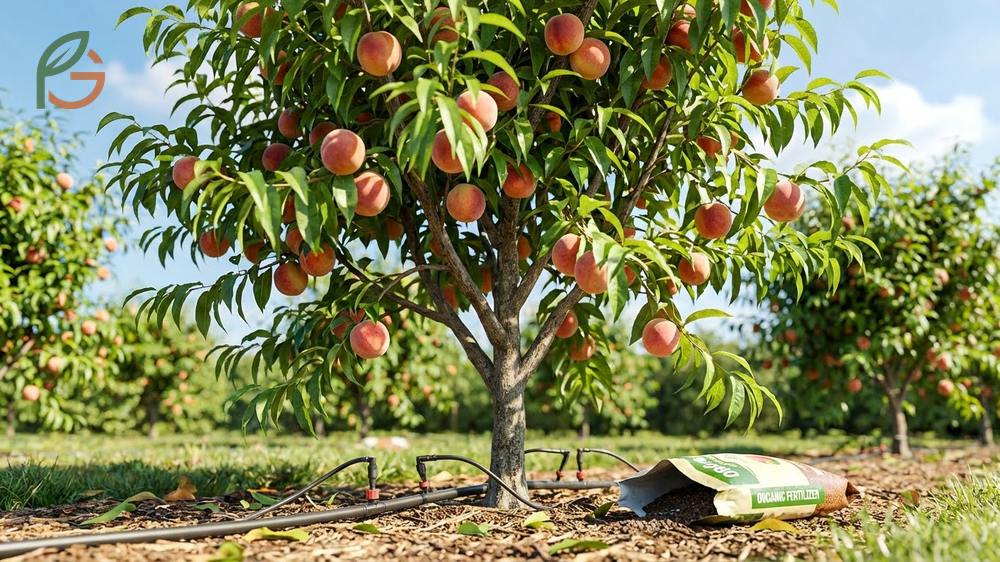
Successful peach tree care depends on understanding the tree’s nutrient and water demands throughout its lifecycle. Studies demonstrate that peach trees need 90 pounds of nitrogen per acre annually, split into multiple applications to prevent excessive vegetative growth[1]. What often gets overlooked is that timing matters more than quantity—late nitrogen applications after mid-June reduce fruit quality and increase winter injury risk.
Peach trees grow best in full sun locations with well-drained soil and consistent moisture. They’re more demanding than apple or pear trees because they fruit on one-year-old wood, requiring annual pruning and careful nutrient management. The root system spreads 15-20 feet in diameter, making water access crucial during fruit development from May through harvest.
From My Experience: My cousin in Guadalajara, Mexico planted a semi-dwarf peach variety in March 2024. He followed the twice-weekly watering schedule through summer and applied 10-10-10 fertilizer in early March and late May. By September, the tree produced 18 peaches in its second year—matching the 2-4 year bearing timeline from university studies.
Essential Peach Tree Requirements
Current agricultural guidance emphasizes five critical factors for peach tree health. Each element affects fruit size, sweetness, and overall tree vigor. Missing even one requirement reduces harvest quality significantly.
- Full sun exposure: Minimum 6-8 hours of direct sunlight daily for fruit production and disease prevention[4]
- Well-drained soil: Slightly acidic pH 6.0-6.5 prevents root rot and nutrient lockout
- Consistent moisture: 1-1.5 inches per week during growing season, adjusted for rainfall[2]
- Balanced fertilization: Two annual applications of 10-10-10 NPK in early spring and late spring
- Annual pruning: Late winter dormant pruning removes dead wood and shapes fruiting branches
Important Note: Don’t fertilize peach trees after mid-June. Late nitrogen applications stimulate soft growth that won’t harden off before winter, increasing frost damage risk and reducing next season’s fruit quality[5].
Seasonal Care Timeline
Peach trees need different care activities throughout the year. Following this schedule maximizes fruit production while preventing common problems like brown rot and peach leaf curl.
In late winter (February-early March), apply dormant oil spray to control overwintering pests before buds swell. This is also the ideal time for pruning—removing dead branches and thinning fruiting wood. Early spring (March) marks the first fertilizer application when new growth begins.
Late spring (May-June) brings the second fertilizer application after fruit sets. This is when you’ll thin fruit to 4-8 inches apart along branches[6]. Summer care focuses on consistent watering—35-45 gallons per day for mature trees during hot weather[2]. After harvest in late summer, reduce watering but don’t let trees dry out completely. Fall and early winter require minimal intervention—just monitor for pest damage and prepare pruning tools for late winter work.
Best Fertilizer for Peach Trees
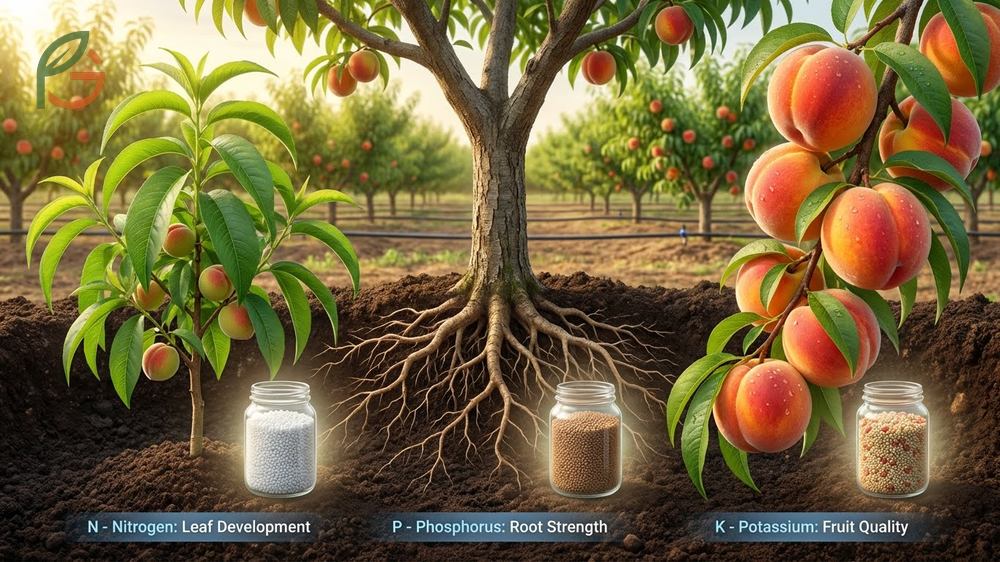
Research across commercial orchards shows that peach trees perform best with balanced NPK fertilizers applied at specific growth stages. The nitrogen component drives vegetative growth and leaf development, while phosphorus strengthens roots and potassium improves fruit quality. Commercial growers apply 50-100 pounds of nitrogen per acre annually, but excessive amounts increase pest pressure and pruning costs[1].
For home gardeners, this translates to controlled feeding schedules. Young trees (1-3 years) need lower rates to establish root systems without forcing excessive top growth. Mature bearing trees require higher nitrogen levels to support both fruit production and annual shoot growth.
NPK Ratio for Peach Trees
The ideal NPK ratio for peach trees is 10-10-10 or 5-10-10, providing balanced nutrition without over-stimulating leaf growth. These ratios deliver adequate nitrogen for healthy foliage, phosphorus for root development and flowering, and potassium for fruit size and sweetness. Studies from subtropical peach-growing regions recommend four split applications throughout the growing season for optimal nutrient uptake[1].
Young peach trees benefit from 10-10-10 applied at 1.5-2 pounds per tree in March and again in May. Mature trees can handle 13-13-13 formulations at higher rates. The nitrogen component should total 90 pounds per acre per year for bearing orchards, split between early spring and post-fruit set applications.
This table compares fertilizer timing, NPK ratios, and application rates for young versus mature peach trees across the growing season
| Tree Age | Timing | NPK Ratio | Amount per Tree |
|---|---|---|---|
| Young (1-3 years) | Early March | 10-10-10 | 1.5-2 lbs[1] |
| Young (1-3 years) | Late May | 10-10-10 | 1.5-2 lbs[1] |
| Mature (4+ years) | Late February/Early March | 13-13-13 or 10-5-20 | 2-3 lbs[5] |
| Mature (4+ years) | Late April/Early May | 15-5-25 (if crop set) | 2-3 lbs[5] |
When to Fertilize Peach Trees
Timing determines how effectively your peach tree uses applied nutrients. Early spring fertilization (late February through early March) supports new growth as buds break and leaves emerge. This first application should provide half of the tree’s annual nitrogen needs. The second application comes in late spring or early summer (late April through May) after fruit sets, delivering the remaining nitrogen to support fruit development.
For newly planted peach trees, apply fertilizer one week after planting, then again six weeks later. This establishes the tree without overwhelming young roots. Never fertilize after mid-June—late-season nitrogen prevents proper hardening off before winter, increasing frost damage risk and reducing fruit quality the following season[5].
Critical Timing Rule: Stop all nitrogen applications by June 15th. Late fertilization produces soft growth that won’t mature before winter, making branches susceptible to cold damage and reducing next year’s harvest.
Organic Fruit Tree Fertilizer
Organic options for peach trees include composted manure, aged compost, and organic NPK blends. These release nutrients slowly, reducing burn risk and improving soil structure over time. Composted chicken manure provides high nitrogen content, while aged cow or horse manure offers more balanced nutrition[4].
Apply 2-3 inches of compost around the drip line in early spring, keeping material 6 inches away from the trunk. Organic fertilizers lack guaranteed analysis values but build long-term soil health. For faster results, supplement with organic NPK blends rated 5-5-5 or 4-4-4. Blood meal adds quick nitrogen, bone meal provides phosphorus, and kelp meal delivers potassium plus trace minerals.
- Composted chicken manure: High nitrogen content (3-2-2 typical), apply 10-15 pounds per mature tree
- Aged cow/horse manure: Balanced nutrients (0.5-0.3-0.5 typical), improves soil structure, apply 20-30 pounds per tree
- Organic NPK blends: Commercial mixes like 5-5-5 or 4-4-4, follow package rates for tree size
- Blood meal (12-0-0): Quick nitrogen boost in early spring, use 1-2 pounds per mature tree
- Kelp meal (1-0-2): Potassium plus trace minerals for fruit quality, apply 2-3 pounds per tree in May
How Often to Water Newly Planted Peach Trees
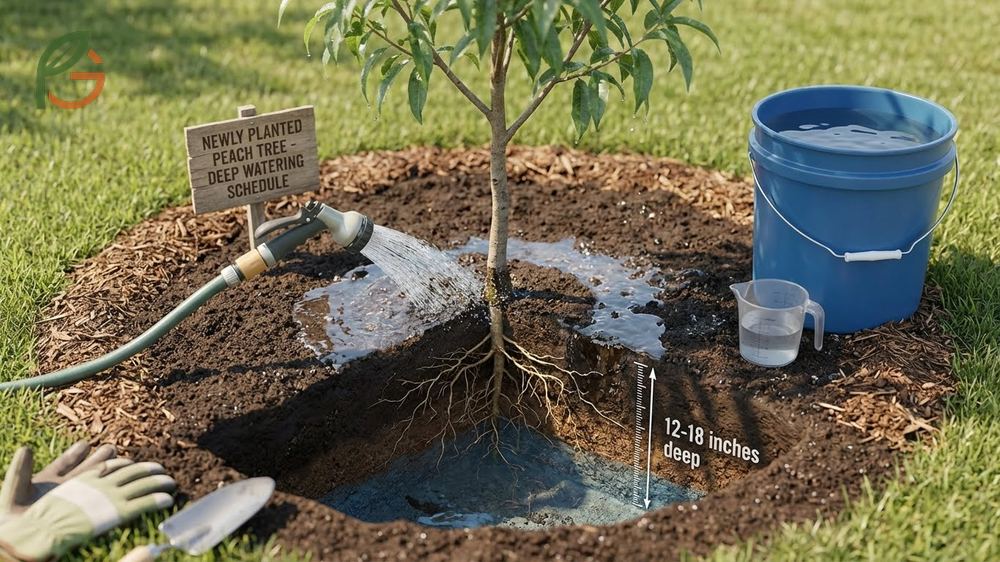
Newly planted peach trees have limited root systems that can’t forage for moisture in surrounding soil. Research shows they need frequent, deep watering to establish roots and survive the first growing season. For the first two weeks after planting, water deeply every other day with approximately 10 gallons per session[3]. This keeps soil consistently moist without waterlogging, allowing roots to penetrate 12-18 inches deep.
After the initial two-week establishment period, reduce frequency to twice weekly through month three. Each watering should still deliver 10 gallons, soaking the root zone thoroughly. From three months to one year, weekly watering suffices unless you experience drought conditions. By this stage, roots have extended outward and the tree becomes more drought-tolerant.
Watering Schedule Summer
Summer heat increases water demand dramatically. Newly planted peach trees may need daily watering during heat waves above 95°F (35°C), especially if planted in sandy soil. Monitor soil moisture 6 inches deep—if it feels dry to touch, water immediately. Mature trees need 35-45 gallons daily during peak summer or 1-1.5 inches weekly from irrigation and rainfall combined[2].
Apply water in early morning (6-9 AM) or late afternoon (5-7 PM) to minimize evaporation loss. Drip irrigation or soaker hoses deliver water directly to roots without wetting leaves, reducing fungal disease risk. Avoid overhead sprinklers during fruit development—wet fruit splits and rots more easily. A 2-4 inch mulch layer conserves moisture and keeps roots cooler, reducing watering frequency by up to 30%.
How Much Water Does a Peach Tree Need
Water requirements vary by tree age, soil type, and weather conditions. Newly planted trees need about 10 gallons per watering, delivered slowly to penetrate the root ball[3]. This equals roughly 1 inch of water if you measure with a rain gauge placed under the drip line. Mature peach trees require significantly more—35 to 45 gallons daily during active growth and fruit development[2].
The goal is deep watering that reaches 12-18 inches into soil where active roots grow. Shallow watering creates surface roots vulnerable to drought and heat stress. Use a soil moisture meter or probe to check depth—water should penetrate at least 12 inches after each session. Sandy soils drain quickly and need more frequent applications, while clay soils hold moisture longer but require slower application rates to prevent runoff.
- Leaf wilting: Leaves droop and curl inward during afternoon heat
- Premature fruit drop: Small immature peaches fall off before ripening
- Leaf yellowing: Older leaves turn yellow and drop while new growth stays green
- Dry soil: Top 6 inches of soil feels completely dry to touch
- Slow growth: New shoot growth measures less than 12 inches during spring flush
- Small fruit size: Mature peaches measure 30% smaller than expected for the variety
Overwatering Warning: Standing water around the trunk for more than 24 hours causes root rot. Peach trees need moisture but also require oxygen in the root zone. If water pools after irrigation, improve drainage before planting or build a raised bed.
How Much Sun Does a Peach Tree Need
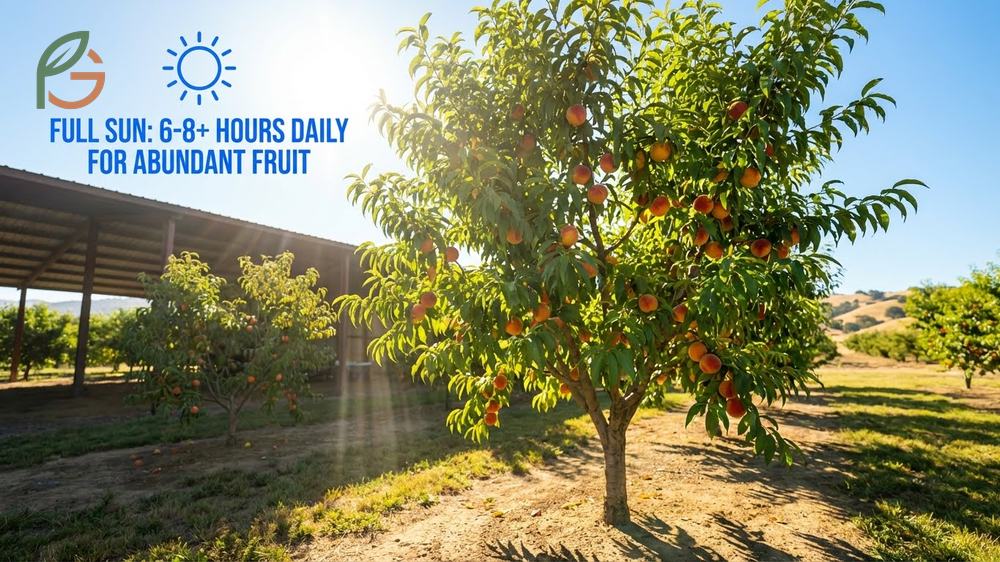
Peach trees require full sun—minimum 6 to 8 hours of direct, uninterrupted sunlight daily—to produce abundant fruit[4]. Less sunlight results in weak growth, fewer blossoms, and reduced fruit yield. They tolerate some light morning or late afternoon shade, but excessive shading leads to spindly branches, increased disease pressure, and poor fruit quality.
Sunlight drives photosynthesis that produces sugars for fruit sweetness. Trees in partial shade develop pale leaves with reduced chlorophyll, limiting energy production. They also experience higher humidity around branches, creating ideal conditions for brown rot and peach leaf curl. South or southeast-facing locations with no nearby shade from buildings or large trees provide optimal sun exposure for most U.S. growing regions.
When selecting a planting site, observe sun patterns throughout the day during spring and summer. Morning sun is critical for drying dew off leaves, reducing fungal infection risk. Afternoon sun drives photosynthesis during peak hours. Avoid planting on the north side of structures or under tree canopies—even dappled shade reduces fruit production by 40-60% compared to full sun locations.
- Reduced fruit set: Fewer flowers develop into mature peaches, cutting yields by 50% or more
- Poor fruit quality: Peaches stay small, lack sweetness, and develop pale color
- Weak branch structure: Spindly growth with long internodes makes branches prone to breaking under fruit load
- Increased disease pressure: Shade keeps foliage damp longer, encouraging brown rot and leaf curl
- Delayed ripening: Fruit takes 1-2 weeks longer to mature, reducing sugar content and flavor
Thinning Fruit on Peach Trees
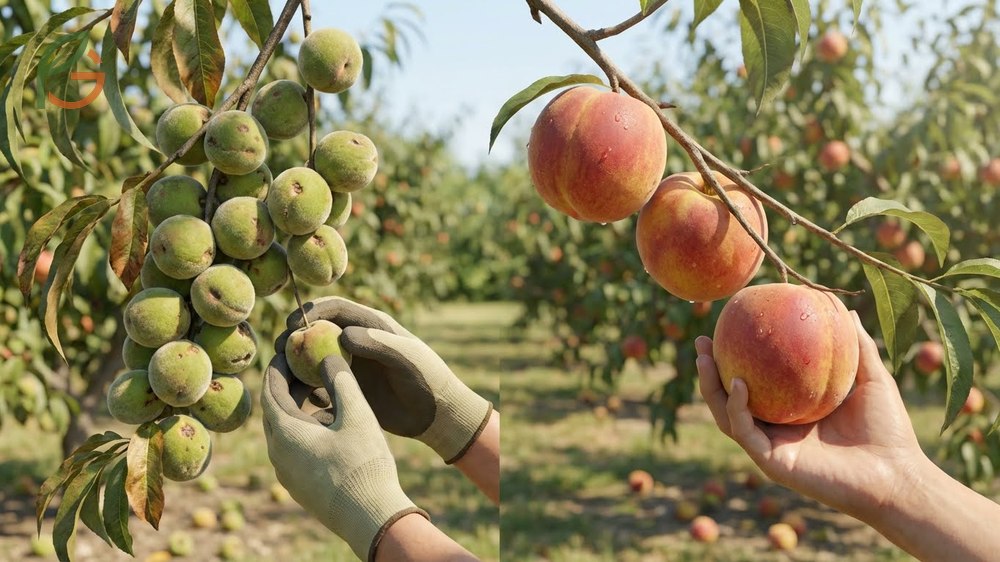
Fruit thinning improves peach size, sweetness, and overall quality by reducing competition for nutrients and water. Research demonstrates that thinning around 20 days after full bloom produces the best results—fruit weight increases and harvest quality improves significantly[6]. Without thinning, trees bear hundreds of small, mediocre peaches instead of dozens of large, sweet ones.
Current guidance emphasizes spacing fruit 4 to 8 inches apart along shoots. Closer spacing (4 inches) works for small-fruited varieties, while larger cultivars need 6-8 inch spacing for maximum size. Thinning also prevents branch breakage from excessive fruit load and reduces the tree’s tendency toward biennial bearing—producing heavily one year and lightly the next.
Start thinning after June drop, when the tree naturally sheds some fruitlets. Remove the smallest, damaged, or misshapen peaches first. Leave the largest, healthiest fruit evenly distributed along branches. Focus extra thinning effort in the lower canopy where light levels are lowest—fruit in shade never develops full size or sweetness regardless of spacing.
Hand thinning takes time but delivers better results than chemical thinners. Work through the tree systematically, checking each branch. For a medium-sized backyard tree (10-15 feet tall), thinning takes 45-90 minutes. Commercial growers thin to specific crop loads measured by fruit count per tree, but home gardeners can rely on spacing measurements. Your target is roughly one peach per 40-50 leaves for balanced nutrition distribution.
- Larger fruit size: Individual peaches grow 30-50% bigger compared to un-thinned trees
- Better sweetness: Remaining fruit receives more carbohydrates, increasing sugar content by 2-3 Brix points
- Prevents branch breakage: Reduced weight load keeps branches from splitting under heavy crops
- Reduces biennial bearing: Moderate cropping prevents exhaustion that causes off-year production
- Earlier ripening: Thinned fruit matures 5-7 days earlier than crowded fruit
- Less disease pressure: Better air circulation between fruit reduces brown rot infections
Thinning Tip: Don’t skip thinning because you want more peaches. Un-thinned trees produce twice the fruit count but each peach weighs half as much and tastes mediocre. Total yield by weight stays nearly the same, but thinned fruit sells or eats much better.
Winter Care for Peach Trees
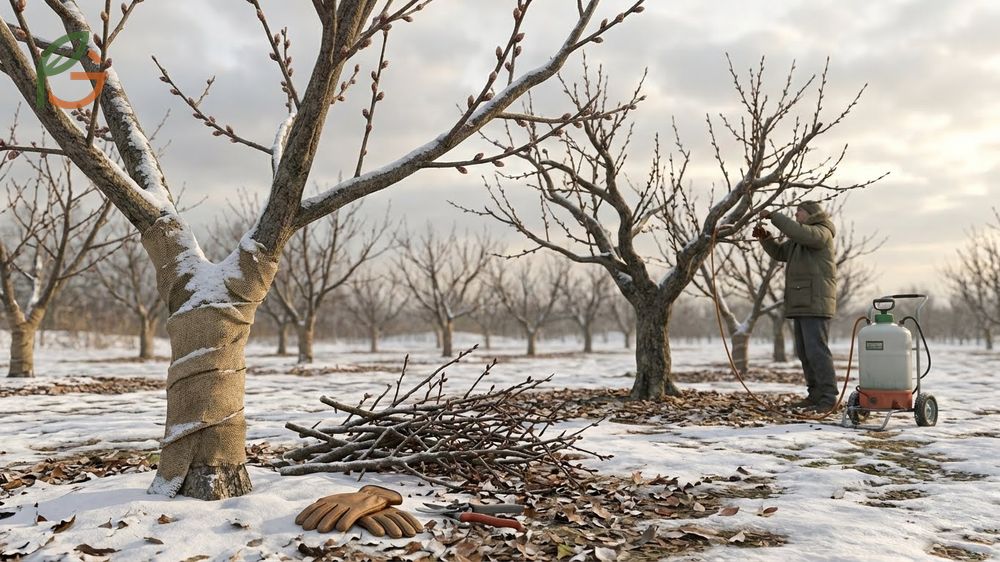
Winter dormancy provides opportunities for critical maintenance that sets up next season’s crop. Peach trees need three essential winter tasks: frost protection for young trees, dormant oil application to control overwintering pests, and pruning to remove dead wood and shape fruiting branches. Late winter (February-early March) marks the ideal window for these activities—after the coldest weather passes but before buds swell.
Dormant oil spray kills scale insects, aphid eggs, and mite populations that overwinter on bark and buds. Apply when temperatures stay above 40°F (4°C) for at least 24 hours to ensure proper coverage and effectiveness. This single application reduces pest pressure through the entire growing season, cutting the need for multiple summer sprays.
Pruning during late winter stimulates fresh, productive shoots since peaches fruit on one-year-old wood. Remove dead, diseased, or crossing branches first. Then thin the canopy to improve airflow and sunlight penetration—this reduces fungal disease and increases fruit size[6]. Avoid pruning before late February or immediately before predicted cold snaps, as fresh cuts temporarily reduce cold tolerance.
Young trees (1-3 years old) benefit from trunk wraps or white latex paint to prevent sunscald and frost cracks. Winter sun heats south-facing bark during the day, then temperatures plunge at night, causing bark to split. White protection reflects sunlight and moderates temperature swings. Remove wraps in early spring before growth starts to prevent moisture buildup and pest harborage.
- Apply dormant oil spray: Late winter application when temps exceed 40°F (4°C) for 24 hours kills overwintering pests
- Prune dead and diseased wood: Remove problem branches in late February or early March before bud break
- Thin canopy for airflow: Selective pruning improves light penetration and reduces fungal disease pressure
- Protect young tree trunks: Apply white latex paint or trunk wraps to prevent sunscald and frost cracks
- Monitor for winter damage: Check for broken branches after ice or snow and remove them promptly
Conclusion
The evidence is clear: successful how to take care of a peach tree management centers on precise fertilization timing and consistent moisture delivery. Applying 10-10-10 NPK fertilizer twice yearly—early spring and late spring—combined with 1-1.5 inches of weekly water produces healthy trees that yield quality fruit. Don’t skip fruit thinning or winter pruning; these practices separate abundant harvests from mediocre ones.
Current horticultural guidance emphasizes stopping nitrogen after mid-June, maintaining full sun exposure, and deep watering that reaches 12-18 inches into soil. FruitGarden synthesizes university research and commercial growing practices to help you avoid common mistakes like over-fertilizing late in the season or neglecting summer irrigation. By following this seasonal care timeline, you ensure your peach tree remains vigorous and productive for years to come.
Frequently Asked Questions
What is the best fertilizer for peach trees?
The best fertilizer for peach trees is a balanced 10-10-10 NPK formula. Apply it twice a year—once in early spring and again in late spring—to support healthy foliage and fruit development without promoting excessive leaf growth.
How often should I water a peach tree?
Newly planted peach trees need watering every other day for the first two weeks, then twice weekly. Mature trees require about 35-45 gallons of water daily during hot summer months or 1-1.5 inches of rainfall per week.
When is the best time to prune peach trees?
The ideal time to prune peach trees is late winter to early spring (February or March), just before new growth begins. This timing minimizes winter injury risk and allows wounds to heal quickly as the tree breaks dormancy.
Do peach trees need full sun?
Yes, peach trees require full sun, meaning at least 6 to 8 hours of direct sunlight daily. Insufficient light leads to weak growth, increased disease susceptibility, and poor fruit quality.
Why are my peaches so small?
Small peaches usually result from a lack of fruit thinning or insufficient water during the final swell. Thinning fruit to 6-8 inches apart ensures remaining peaches grow large and sweet.
How long does it take for a peach tree to bear fruit?
Most peach trees begin bearing fruit 2 to 4 years after planting. Dwarf varieties may produce sooner, while standard trees might take the full 4 years to reach productive maturity.
Can I use coffee grounds on my peach tree?
Yes, used coffee grounds can be applied around the base of peach trees as a mild nitrogen source. However, they should be composted first or used sparingly to avoid altering soil pH too drastically.





