
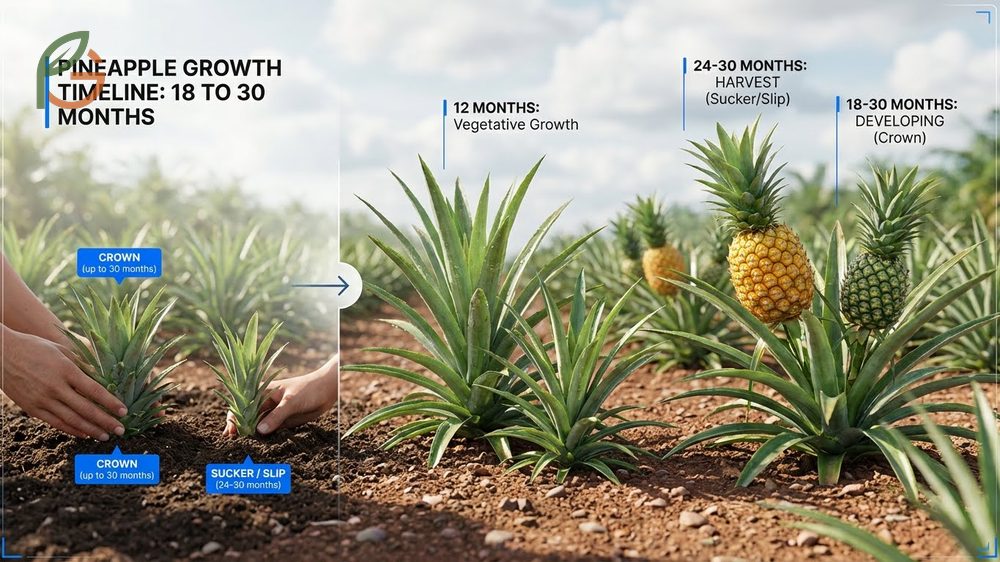
How long does it take to grow a pineapple? Growing a pineapple from planting to harvest typically takes 18 to 24 months[1], though this varies based on propagation method and growing conditions. Research across multiple tropical growing regions shows that pineapples grown from crowns take longer—up to 30 months[2]—while those started from suckers or slips can produce fruit in 24 to 30 months[3]. FruitGarden provides comprehensive guidance for home gardeners looking to cultivate tropical fruits with realistic timelines and expert techniques.
Quick Answer
How Long Does It Take To Grow A Pineapple
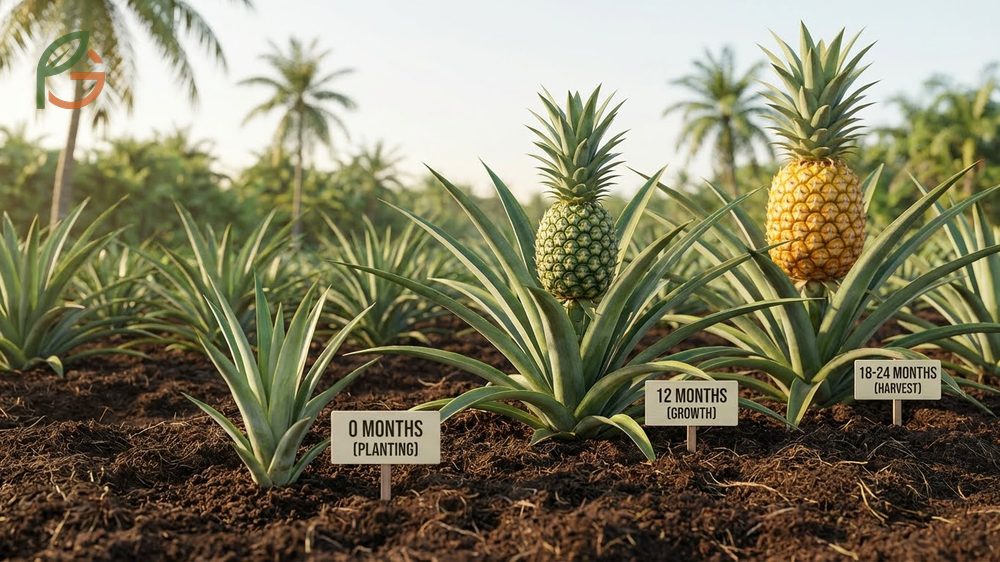
Current agricultural data indicates that pineapple cultivation requires patience and proper timing. Studies across tropical and subtropical regions demonstrate that 18 to 24 months represents the standard growing period from initial planting to harvest[1]. This timeline applies to commercial pineapple production and home cultivation in optimal conditions.
Research from the University of Hawaii shows that crop cycles vary based on climate and forcing methods. In warmer equatorial climates, pineapples can complete their cycle in just 11 to 14 months, while subtropical regions like Florida typically require the full 18 to 24 months[5]. The total duration encompasses vegetative growth (6-16 months), flowering induction, and fruit maturation.
The propagation method you choose dramatically impacts your waiting period. Most backyard growers start with store-bought pineapple tops, which extends the timeline compared to commercial methods using suckers or slips.
Pineapple Propagation Methods and Timeline
Evidence from multiple growing regions demonstrates clear differences between propagation techniques. Crown planting—the method most home gardeners use—takes approximately 24 months to reach flowering stage, then an additional 6 months for fruit maturation, totaling 30 months[2]. This slower timeline occurs because crowns must develop an entirely new root system.
Commercial growers prefer suckers and slips, which already possess partial root development. These propagation materials produce flowering in 18 to 24 months after planting[3]. The established root structure gives them a significant head start over crowns.
From My Experience: My cousin in Guadalajara, Mexico planted pineapple crowns in March 2022. The plants flowered at 26 months (May 2024) versus the typical 24-month range, but fruit matured in just 5 months due to consistent 80-85°F (27-29°C) temperatures that summer.
Growth Stages Breakdown
Agricultural research identifies distinct developmental phases in pineapple cultivation. The rooting phase lasts 6 to 8 weeks, during which new roots establish from the crown base[3]. During this critical period, plants focus energy on root development rather than leaf growth.
The vegetative growth stage extends for 14 to 16 months in most climates. LSU AgCenter research confirms that plants need this extended period to build sufficient biomass before flowering can occur[6]. Plants produce 70-80 leaves during this phase, creating the photosynthetic capacity needed for fruit production.
- Rooting establishment: 6-8 weeks for root development from crown or planting material
- Vegetative phase: 14-24 months of leaf production and plant maturation
- Flowering initiation: 2-4 weeks from flower bud emergence to full bloom
- Fruit development: 5-7 months from pollination to harvest-ready fruit
- Ripening period: 1-3 months for color change and sugar development on the plant
Important Note: Temperature significantly affects growth rate. Pineapples stop growing when temperatures drop below 60°F (16°C)[1]. In cooler climates, the total growing time can extend to 36 months or longer.
Pineapple Growing Time From Top
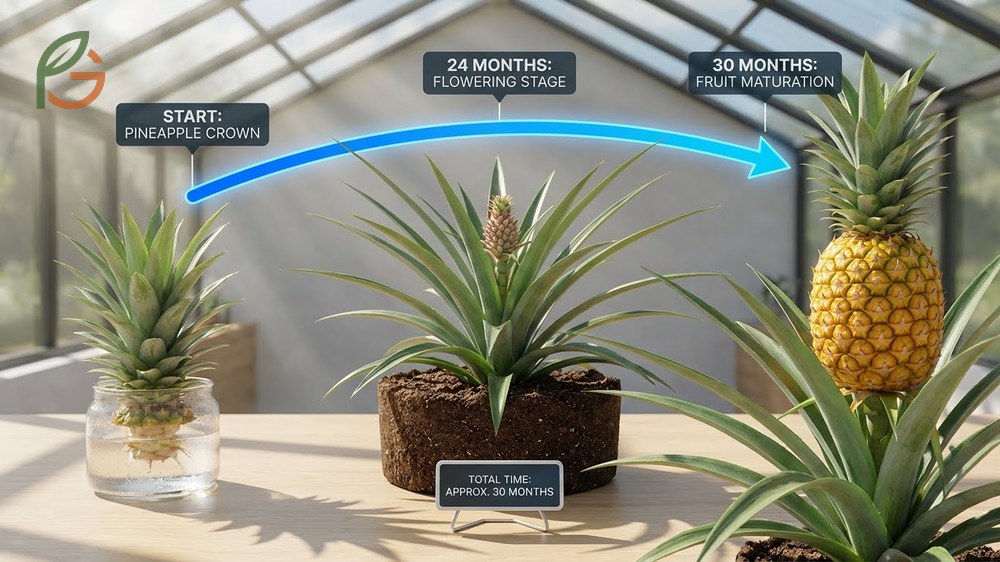
Growing pineapples from store-bought crowns remains the most accessible method for home gardeners. Research from Tropical Permaculture confirms that tops require at least 24 months to reach flowering stage, followed by 6 months for fruit maturation, bringing the total timeline to approximately 30 months[2]. This extended duration reflects the energy investment needed to rebuild the entire root system.
LSU AgCenter trials demonstrate realistic expectations for home growers. When crowns are rooted in spring or early summer, you can typically harvest a ripe pineapple in the fall of the second year—approximately 24 to 30 months after initial planting[6]. The fruit size often matches or slightly trails supermarket pineapples.
Rooting Phase
The initial rooting period determines long-term success. Studies show that root nodules begin emerging from the crown base within 5 to 7 days when kept in water or moist conditions. Full root development takes 6 to 8 weeks, during which the plant establishes its foundation for future growth[3].
Current guidance emphasizes soil quality during this phase. Well-draining acidic soil (pH 4.5-5.5) speeds root establishment and prevents rot. University of Florida research recommends planting crowns about 1 inch deep in containers with drainage holes[1].
Vegetative Growth Phase
After rooting, pineapple plants enter an extended vegetative period lasting 18 to 24 months for crown-started plants. During the first 2-3 months, new leaves emerge from the center at a rate of 2-3 leaves per month. Growth accelerates in months 6-12 as the plant matures and leaf production increases.
Agricultural data from multiple tropical regions shows that plants need to produce 70-80 mature leaves before flowering capability develops. This biomass requirement explains why crowns take longer than suckers—they start from zero, while suckers already possess 20-30 leaves from the mother plant.
- Week 1-2: Root nodules visible at crown base, minimal leaf growth
- Month 2-3: Full root system established, new leaves emerging from center
- Month 6-12: Rapid leaf production, plant reaches 12-18 inches tall
- Month 18-24: Plant matures to full size (24-36 inches), ready for flowering
- Month 24-30: Flowering occurs naturally or via forcing, fruit develops over 5-7 months
Time From Pineapple Flower to Fruit
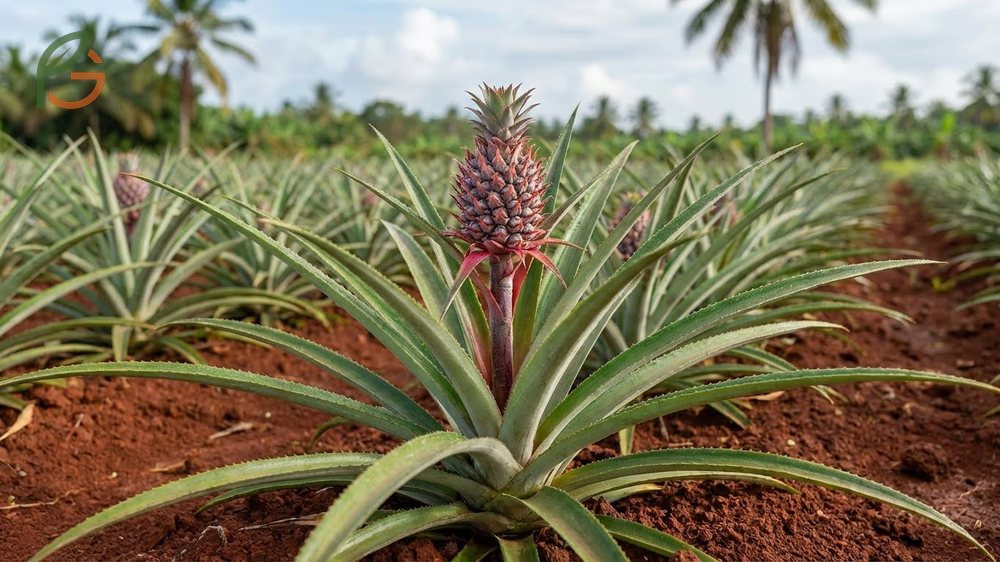
Once flowering begins, the countdown to harvest becomes predictable. University of Florida research confirms that the period from flower induction to harvest ranges from 5 to 7 months, depending on variety, weather conditions, and cultivation practices[1]. This phase breaks down into distinct developmental stages that you can monitor.
The flowering stage itself lasts approximately 2 to 4 weeks. During this period, a central stalk called the inflorescence emerges from the plant’s heart, bearing 100-200 small purple flowers. Each flower becomes a fruitlet—the individual sections visible on a mature pineapple[7].
After pollination completes, fruit development accelerates. The first 3 months show steady size increase as fruitlets fuse together. Months 4-6 bring color transformation and sugar accumulation. LSU AgCenter data indicates that from full flowering to ripe fruit typically requires exactly 5 months in optimal conditions[6].
This table shows the monthly progression from pineapple flowering through harvest, including physical changes, fruit development, and grower actions for each stage
| Timeline Stage | Duration | Physical Changes | Grower Actions |
|---|---|---|---|
| Flower emergence | 2-4 weeks[7] | Central stalk appears, purple flowers open sequentially | Increase water, avoid nitrogen fertilizer |
| Early fruit formation | Month 1-2 | Flowers close, fruitlets begin fusing, fruit is green and hard | Regular watering, balanced fertilizer application |
| Mid-development | Month 3-4 | Fruit size increases rapidly, eyes flatten, stays dark green | Maintain consistent moisture, monitor for pests |
| Late maturation | Month 5-6 | Base yellows first, sweet aroma develops, slight softening | Reduce watering, prepare for harvest timing |
| Harvest stage | Month 5-7[1] | 1/4 to 1/2 of fruit turns golden-yellow, full fragrance | Cut with 2-3 inches of stem attached |
Harvest Timing Tip: Don’t wait for the entire pineapple to turn yellow on the plant. Research shows optimal sugar content occurs when just the bottom quarter changes color[8]. The fruit continues ripening after harvest.
- Week 1-2 after flowering: Individual purple flowers visible along central spike
- Month 1: Flowers close, young fruit appears as compact green cone
- Month 2-3: Fruit doubles in size, eyes become more defined, deep green color
- Month 4: Eyes flatten completely, fruit reaches near-full size, glossy green surface
- Month 5-6: Base begins yellowing, sweet fragrance emerges, fruit softens slightly
- Month 6-7: Golden color spreads upward, strong sweet aroma, ready for harvest
Speeding Up Pineapple Growth
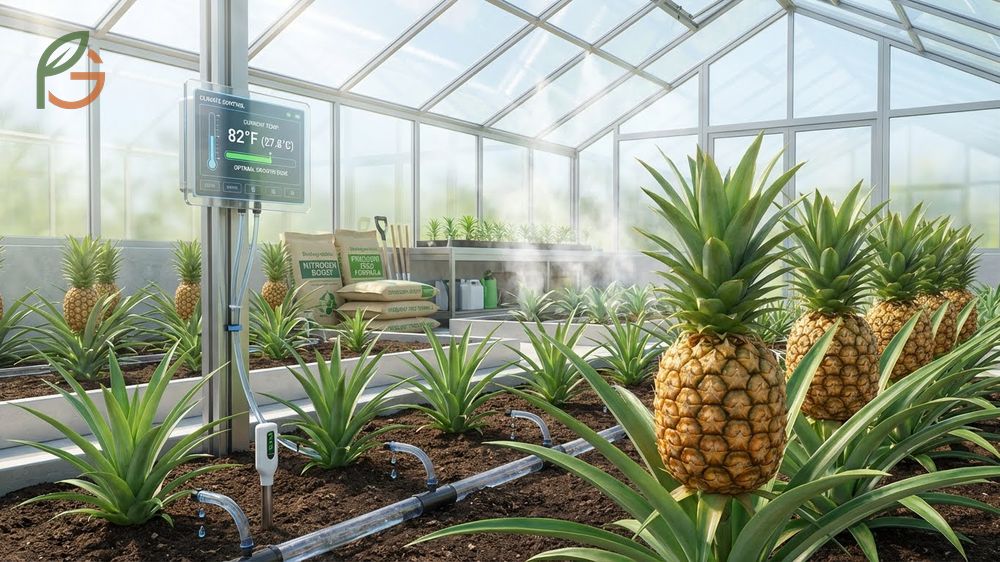
Research demonstrates several proven methods to reduce pineapple growing time. The most effective approach involves optimizing temperature—pineapples grow fastest at constant 75-85°F (24-29°C)[4]. Growers in cooler regions can use greenhouses or indoor growing to maintain these temperatures year-round, potentially cutting 3-6 months off the standard timeline.
Fertilization strategy significantly impacts growth rate. Studies show that frequent, light applications of nitrogen-rich fertilizer every 6-8 weeks during the vegetative phase accelerates leaf production. Once plants reach 14-16 months old, switching to a balanced or phosphorus-heavy fertilizer prepares them for flowering[1].
Starting with suckers instead of crowns provides the most dramatic time savings. Agricultural data from the University of Hawaii confirms that sucker propagation can produce harvest-ready fruit in 18-24 months versus 30 months for crowns[5]. Suckers emerge from the base of mature pineapple plants and already possess developed root systems.
- Use suckers or slips: Reduces growing time by 6-12 months compared to crown propagation
- Maintain optimal temperature: Keep plants at 75-85°F (24-29°C) for maximum growth rate
- Provide full sun exposure: Minimum 6 hours daily, 8-10 hours ideal for faster development
- Use acidic soil (pH 4.5-5.5): Enhances nutrient uptake and accelerates vegetative growth
- Apply regular fertilization: Light feeding every 6-8 weeks speeds leaf production by 20-30%
- Ensure excellent drainage: Prevents root rot and maintains consistent growth without setbacks
Reality Check: While you can optimize conditions, you can’t rush biology. Even in perfect conditions, pineapples need at least 15 months to build sufficient biomass for fruiting. Claims of 6-month harvests refer to the fruiting period alone, not total growing time.
Forcing Pineapple to Fruit
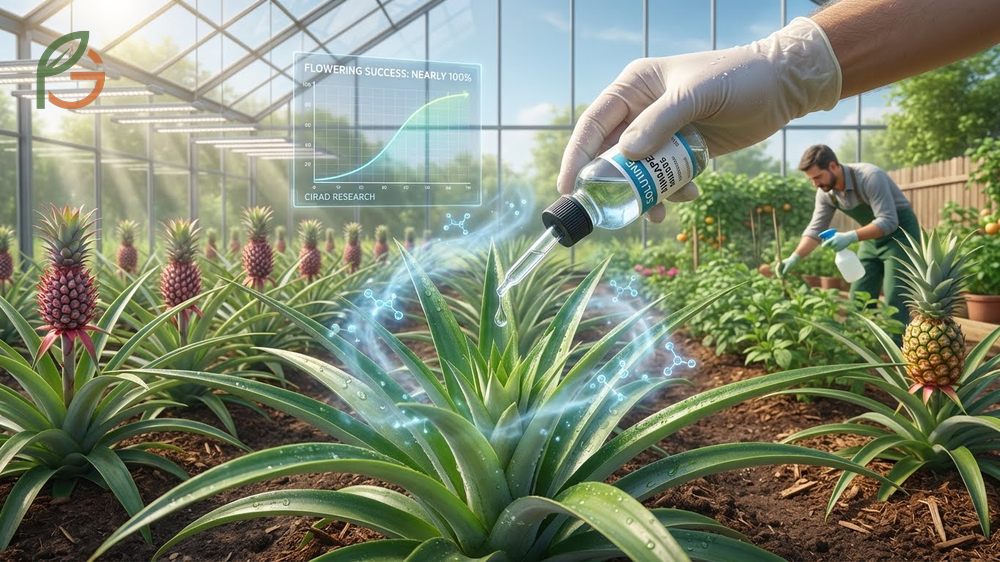
Commercial growers and experienced home gardeners use ethylene gas to trigger flowering on demand. Research published by CIRAD demonstrates that ethylene treatment achieves nearly 100% flowering success when plants reach sufficient maturity[9]. This natural plant hormone signals the pineapple to transition from vegetative growth to reproductive development.
The traditional forcing method involves applying ethephon—a liquid that releases ethylene when absorbed by plant tissue. Studies confirm that plants treated with ethephon flower within 8 to 12 weeks after application. University research shows that forcing works best when plants are at least 14-16 months old and have produced 70-80 leaves[1].
Home gardeners can use a natural ethylene source—ripe apples. Academic studies from the University of Hawaii confirm that placing apple slices in the pineapple crown triggers flowering through natural ethylene release[10]. This method takes slightly longer than commercial products but avoids synthetic chemicals.
This table compares three pineapple forcing methods showing application technique, time to flowering, success rate, and best use cases for each approach
| Method | Application | Time to Flower | Success Rate | Best For |
|---|---|---|---|---|
| Ethephon spray | Spray liquid into crown at night, repeat after 2-3 days | 8-10 weeks[9] | 95-100%[9] | Commercial growers, precise timing needs |
| Ripe apple method | Place apple slices in crown, cover with plastic bag for 2-3 days | 10-14 weeks | 70-85% | Home gardeners, organic cultivation |
| Calcium carbide | Mix powder with water, pour into crown | 8-12 weeks[10] | 85-95% | Regions where ethephon is restricted |
| Cold treatment | Apply ice water to crown 4 times over 2 weeks | 12-16 weeks[10] | 60-75% | Organic certification requirements |
- Verify plant maturity: Ensure plant is at least 14-16 months old with 70+ leaves
- Prepare apple slices: Cut 1-2 ripe apples into quarters, use fresh slices
- Place in crown: Insert apple pieces deep into the center rosette of leaves
- Cover with plastic: Place clear plastic bag over crown to trap ethylene gas
- Remove after 48-72 hours: Take off bag and remove apple pieces to prevent rot
- Wait 10-14 weeks: Monitor crown for red central leaves indicating flower stalk emergence
Critical Timing: Don’t force flowering too early. Plants forced before reaching 14 months typically produce undersized fruit weighing less than 1 pound. Wait until your plant has at least 70 mature leaves for economically viable fruit[11].
Pineapple Maturity Signs
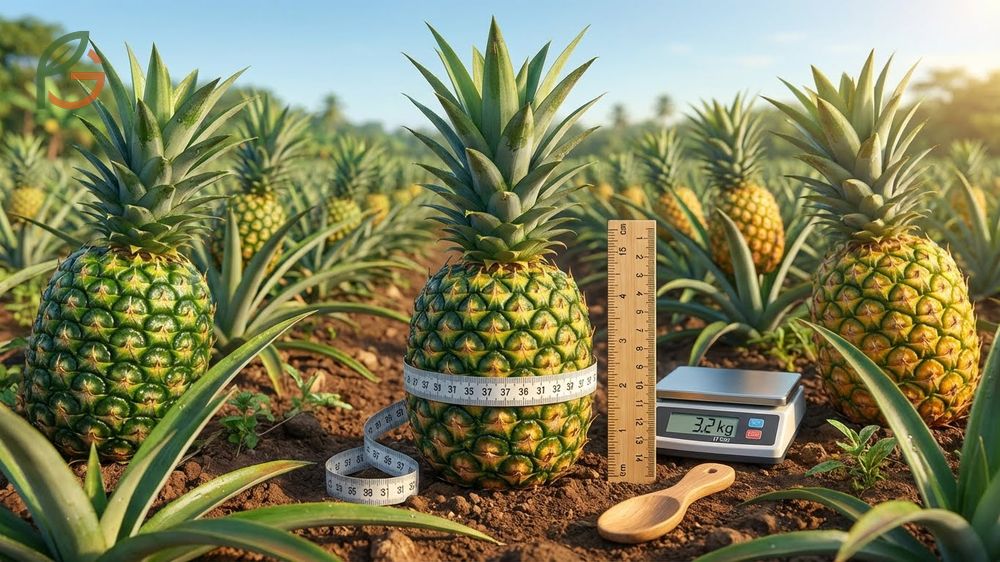
Recognizing harvest readiness prevents premature picking and ensures optimal sweetness. UC Davis research identifies five maturity stages for pineapples, with harvest occurring during stage three when the fruit is firm and mature[8]. At proper harvest time, pineapples average 3.2 kilograms (7 pounds), measure approximately 17 cm length, and have a 37 cm circumference[8].
Color transformation provides the most reliable visual indicator. Initially, pineapples display a glossy bluish-dark green color. As they mature, the base begins turning golden-yellow while the top remains green. Research confirms that harvest should occur when one-quarter to one-half of the fruitlets at the base flatten and show yellow-gold coloration[8].
The “hollow sound” test offers a simple field assessment. Gently thump the side of the fruit with your finger—ripe pineapples produce a solid, full sound rather than a hollow thud. This indicates proper internal fruit development and moisture content.
- Color change: Bottom 1/4 to 1/2 of fruit transitions from green to golden-yellow
- Sweet fragrance: Strong, sweet pineapple aroma detectable from 1-2 feet away
- Eye flattening: Individual fruitlets (eyes) become completely flat across the surface
- Slight softness: Gentle squeeze shows minimal give, not mushy or rock-hard
- Leaf color change: Crown leaves may show slight yellowing at base
- Increased weight: Fruit feels heavy for its size due to sugar and juice accumulation
Sugar content measurements provide objective harvest criteria. Studies show that total soluble solids (TSS) increase from 8-10% Brix in young fruit to 14-18% Brix at optimal maturity. Commercial operations test Brix levels directly, but home growers can rely on the combination of color, fragrance, and eye flattening.
Post-Harvest Ripening: Unlike some fruits, pineapples don’t significantly increase sugar content after harvest. Research demonstrates that 90% of final sweetness develops on the plant[8]. This makes proper harvest timing critical for flavor quality.
Conclusion
The evidence is clear: growing a pineapple takes 18 to 24 months from planting to harvest under optimal conditions, with crown-started plants requiring up to 30 months[1][2]. Success depends on choosing the right propagation method, maintaining temperatures between 75-85°F (24-29°C), and understanding that you can’t rush the extended vegetative phase pineapples need to build sufficient biomass. Current agricultural guidance emphasizes patience—forcing flowering too early produces undersized fruit, while proper timing after 14-16 months yields full-size, sweet pineapples comparable to commercial varieties.
FruitGarden provides comprehensive cultivation guides based on university research and field data from tropical growing regions worldwide. Whether you’re starting with a grocery store crown or commercial suckers, understanding the complete pineapple timeline helps set realistic expectations for your first harvest.
Frequently Asked Questions
How long does a pineapple take to grow from a store-bought top?
Growing a pineapple from a store-bought crown typically takes 24-30 months from initial planting to harvest. Research shows crowns need 24 months to reach flowering maturity, then an additional 5-7 months for fruit development[2][1]. This longer timeline occurs because crowns must develop entirely new root systems, unlike suckers which already have partial roots.
Can you speed up pineapple growth?
You can reduce growing time by 3-6 months through optimal conditions. Maintaining constant temperatures of 75-85°F (24-29°C), providing 8-10 hours of daily sun, using acidic soil (pH 4.5-5.5), and applying light fertilizer every 6-8 weeks accelerates vegetative growth. Starting with suckers instead of crowns saves 6-12 months compared to crown propagation[5].
How long from pineapple flower to harvest?
Once flowering begins, harvest occurs 5-7 months later. University of Florida research confirms this consistent timeline across varieties and growing regions[1]. The flower stage lasts 2-4 weeks, followed by 4-6 months of fruit development and 1-2 months of ripening. You’ll know harvest is near when the bottom quarter of the fruit turns golden-yellow and emits a sweet fragrance.
What’s the fastest way to grow a pineapple?
The fastest method combines sucker propagation with forced flowering. Agricultural studies show that suckers planted in optimal conditions can flower in 15-18 months, then produce harvest-ready fruit 5 months later—totaling 20-23 months[3]. Once plants reach 14-16 months with 70+ leaves, you can force flowering using ethylene or the ripe apple method, ensuring predictable harvest timing.
How do you know when a pineapple is ready to pick?
Harvest when the bottom quarter to half of the fruit changes from green to golden-yellow color, eyes flatten completely, and you detect a strong sweet aroma. UC Davis research identifies these as the primary maturity indicators[8]. The fruit should feel slightly soft when gently squeezed but not mushy. Cut the fruit with 2-3 inches of stem attached using sharp shears or a knife.
Do pineapples grow year-round?
Pineapple plants grow continuously in tropical climates with temperatures above 60°F (16°C). In subtropical and temperate regions, growth slows or stops during winter months when temperatures drop below this threshold[1]. This seasonal slowdown extends total growing time in cooler climates from the standard 18-24 months to potentially 30-36 months. Indoor or greenhouse cultivation maintains year-round growth by controlling temperature.
Can you force a pineapple plant to flower?
Yes, you can force flowering using ethylene gas once plants reach sufficient maturity. Commercial growers achieve nearly 100% success using ethephon spray applications[9]. Home gardeners can use ripe apple slices placed in the crown for 2-3 days—the decaying apple releases natural ethylene that triggers flowering in 10-14 weeks. Plants must be at least 14-16 months old with 70+ mature leaves for successful forcing and proper fruit development.





