
The difference between plantain and banana isn’t just size—it’s how you eat them. Research shows plantains pack 31g carbs per 100g compared to bananas’ 23g, with starch levels so high they can’t be eaten raw[1]. While bananas are sweet snacks you peel and eat, plantains need cooking to transform their dense starch into something edible. FruitGarden breaks down the nutritional data and cooking methods that make these tropical fruits completely different in your kitchen.
Quick Answer
- Plantains contain 31g carbs vs bananas’ 23g per 100g serving[1]
- Raw plantains have a glycemic index of 38.5, lower than bananas’ typical 50-55 range[2]
- Plantains require cooking (frying, boiling, or baking) while bananas are eaten raw
- Green plantains contain up to 27g resistant starch, making them suitable for blood sugar management
Difference Between Plantain and Banana
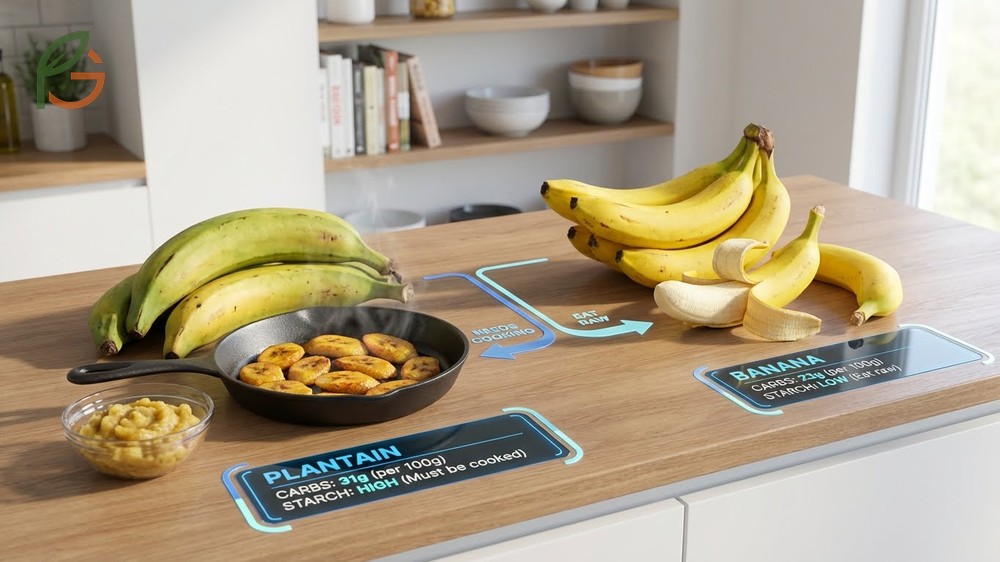
Plantains and bananas come from the same genus (*Musa*), but they’re not interchangeable in your kitchen. The core difference lies in starch content—plantains contain roughly 57g of starch per medium fruit, while bananas have only 12g[4]. This makes plantains inedible when raw, requiring heat to break down their dense carbohydrates into something your palate can handle.
You’ll eat bananas as sweet snacks straight from the peel, but plantains show up in savory dishes across Latin America, the Caribbean, and West Africa. Studies show plantains are higher in potassium (465mg vs 358mg per 100g) and vitamin A, giving them an edge for certain nutritional goals[1]. Meanwhile, bananas deliver more fiber (2.6g vs 2.3g) and work better for quick energy.
Most people don’t realize that ripeness changes everything. Green plantains taste starchy and mild, while yellow or black plantains develop sweetness that rivals bananas. Research demonstrates this transformation happens as enzymes convert starch to sugar—green plantains stay firm enough for frying, but ripe ones caramelize into soft, dessert-like dishes[4].
Botanical Relationship
There’s no botanical distinction between plantains and bananas—both are cultivars of the same species. The apparent differences result from selective breeding, with farmers choosing traits like higher starch for cooking varieties versus sweeter flesh for eating fresh[5]. Think of it like how Granny Smith and Fuji apples are different cultivars of the same fruit, bred for contrasting purposes.
Both thrive in tropical climates, growing in Southeast Asia, Central and South America, and Caribbean nations. Agricultural data shows they’re produced by herbaceous plants (technically giant herbs, not trees), reaching heights of 10-25 feet with massive leaves. What you call a “banana tree” is actually a pseudostem made of tightly packed leaf bases.
Appearance and Texture
Plantains are larger—typically 12 to 15 inches long—with thicker, tougher skin that’s harder to peel. Their flesh stays firm even when ripe, unlike bananas that soften to a creamy texture. Current data indicates plantains weigh 30-50% more than bananas at comparable ripeness stages[6].
You can spot plantains by their angular, ridged shape compared to bananas’ smooth curves. When you slice them, plantains show denser, less watery flesh that holds its shape during cooking. This structural difference makes plantains ideal for frying—they won’t disintegrate in hot oil like bananas would.
Important note: Don’t try substituting raw plantains for bananas in smoothies or baking. Their high tannin content creates an unpleasant, chalky taste that won’t blend away. Always cook plantains first, regardless of ripeness.
Plantain Banana Nutritional Value
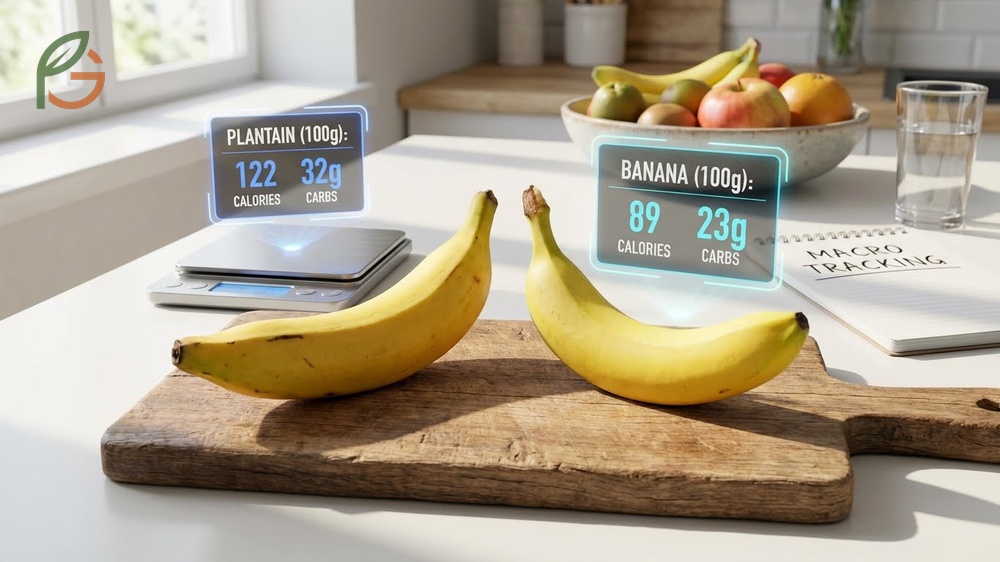
Raw ripe plantains deliver 122 calories per 100g serving compared to bananas’ 89 calories, with the extra energy coming primarily from carbohydrates[7]. You’re getting 32g carbs from plantains versus 23g from bananas, which matters if you’re tracking macros for athletic performance or blood sugar control.
Research shows both fruits are low in fat and protein, making them primarily carbohydrate sources. Plantains contain 1g protein and 0.4g fat per 100g, nearly identical to bananas’ 1.1g protein and 0.3g fat. What sets plantains apart is their resistant starch—a type of fiber that behaves differently from regular starch in your digestive system.
Studies demonstrate that resistant starch in green plantains can reach 27g per serving, dropping to 12g in ripe yellow plantains as enzymes convert it to simple sugars[3]. This explains why green plantains produce a slower blood sugar rise than bananas—the resistant starch acts like fiber, resisting breakdown in your small intestine.
Carbohydrate and Starch Content
The starch difference changes how these fruits affect your body. One medium plantain packs more than 57g of starch, while a banana contains just 12g—that’s nearly 5 times more[4]. This high starch content makes plantains filling and satisfying, but it also means they need heat to become digestible.
Current guidance emphasizes timing for blood sugar management. Eating green plantains provides resistant starch that feeds beneficial gut bacteria and produces short-chain fatty acids, which research links to improved insulin sensitivity. As plantains ripen, this resistant starch converts to sugars—yellow plantains contain roughly 14g sugar per 100g, approaching bananas’ 12.2g[1].
- Green plantains: 85-90% of carbs are resistant starch and complex carbohydrates
- Yellow plantains: 50-60% resistant starch, rest converts to sugars
- Black plantains: 10-20% resistant starch, mostly simple sugars
- Bananas (all ripeness): 2-5% resistant starch, predominantly simple sugars
- Net carbs: Plantains deliver 28.8g vs bananas’ 20.2g per 100g serving
Vitamin and Mineral Profile
Plantains win the potassium race with 465mg per 100g compared to bananas’ 358mg, making them more effective for blood pressure management[1]. They’re also significantly higher in vitamin A—45µg versus bananas’ 3µg—which supports eye health and immune function. However, bananas deliver more vitamin B6 (0.367mg vs 0.24mg), crucial for brain development and neurotransmitter production.
Evidence suggests plantains provide 10.9mg vitamin C compared to bananas’ 8.7mg, offering about 12% of your daily needs per serving. You’ll also get more iron from plantains (0.58mg vs 0.26mg), though both remain modest sources. The magnesium content stays similar at 32mg for plantains and 27mg for bananas.
- Manganese: Plantains provide 0.27mg vs bananas’ 0.26mg per 100g
- Folate: Plantains contain 26µg compared to bananas’ 20µg
- Vitamin B2: Bananas lead with 0.073mg vs plantains’ 0.052mg
- Sodium: Plantains have 5mg while bananas contain only 1mg
- Phosphorus: Similar levels at 28mg (plantains) and 22mg (bananas)
Plantain vs Banana Nutrition
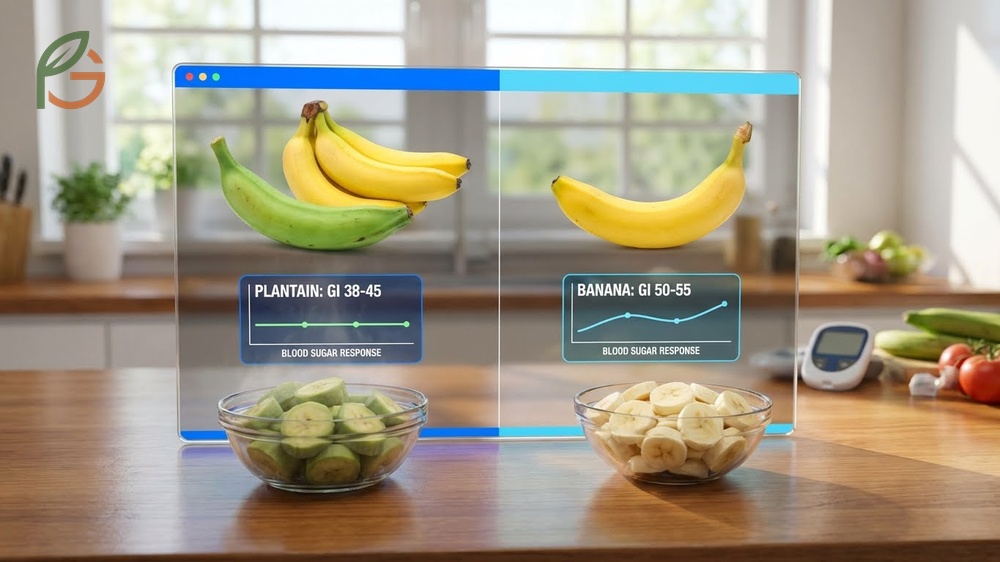
Direct comparison reveals plantains aren’t necessarily “healthier”—they’re just different tools for different nutritional goals. Research shows green plantains produce a glycemic index of 38-45, while bananas typically range from 50-55, making plantains better for blood sugar stability[8]. This 20-30% reduction matters if you’re managing diabetes or watching insulin response.
Studies demonstrate boiled unripe plantains create the slowest, most gradual blood glucose rise among all preparation methods. The resistant starch survives cooking, continuing to resist enzymatic breakdown in your digestive tract. Frying plantains raises their glycemic impact—the heat partially breaks down resistant starch, making it more digestible and faster-acting.
Current data indicates plantains provide sustained energy release over 3-4 hours, while bananas deliver quicker energy within 30-60 minutes. For pre-workout fuel, bananas win. For meals requiring long-lasting satiety, plantains perform better. The fiber content difference is minimal—2.6g in bananas versus 2.3g in plantains per 100g—so don’t choose based on that alone[1].
This table compares calories, carbohydrates, protein, fiber, potassium, and vitamin content between raw plantains and bananas per 100g serving
| Nutrient | Plantain (Raw) | Banana (Raw) | Difference |
|---|---|---|---|
| Calories | 122 kcal[7] | 89 kcal[7] | +37% higher |
| Carbohydrates | 32g[7] | 23g[7] | +39% higher |
| Protein | 1g | 1.1g | Similar |
| Fiber | 2.3g[1] | 2.6g[1] | 13% lower |
| Potassium | 465mg[1] | 358mg[1] | +30% higher |
| Vitamin A | 45µg[1] | 3µg[1] | +1400% higher |
Blood Sugar Tip: If you’re watching glucose levels, choose boiled green plantains over fried preparations. Research shows frying can increase the glycemic index by 15-20 points compared to boiling or steaming the same ripeness stage.
How to Cook Green Bananas
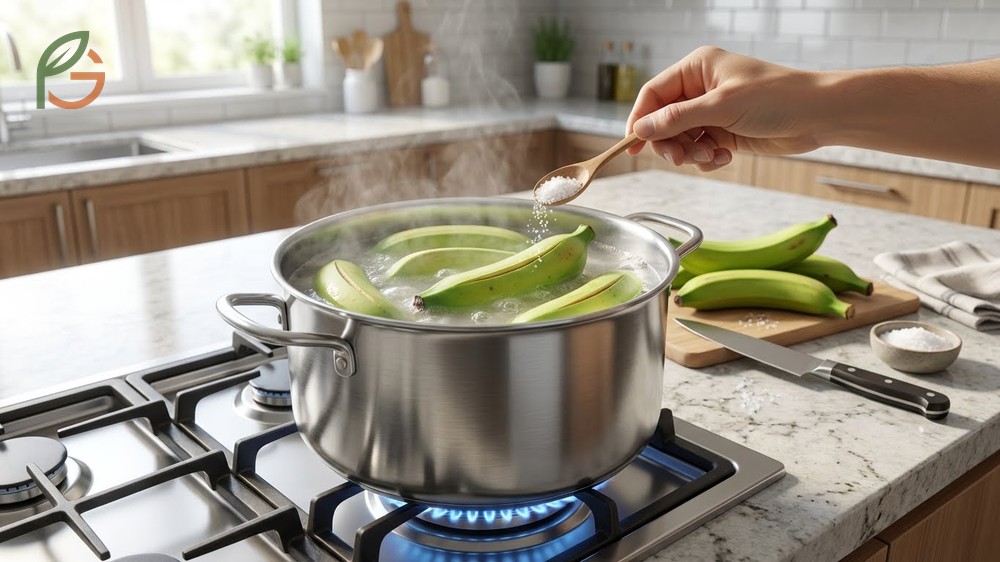
Green plantains (often called “cooking bananas”) require a different approach than yellow dessert bananas. The high starch content means you’ll need to apply heat—boiling, frying, baking, or grilling—to make them palatable. Most people boil green plantains for 15-20 minutes until fork-tender, then serve them mashed with salt and oil as a starchy side dish similar to potatoes.
Frying produces the most popular preparations: tostones (crispy, twice-fried discs) and maduros (sweet, caramelized slices). Current guidance emphasizes bringing plantains to room temperature before frying—cold fruit lowers oil temperature by up to 50°F (28°C), resulting in greasy, soggy results instead of crispy exteriors. You’ll want to maintain oil at 350°F (177°C) for tostones and 325°F (163°C) for maduros to prevent burning.
Studies show baking offers a lower-fat alternative that still delivers good flavor. Cut plantains lengthwise, brush with oil, and bake at 375°F (191°C) for 25-30 minutes, flipping halfway. They won’t achieve the same crispy texture as fried versions, but you’ll cut fat content by 80% compared to deep-frying.
How to Peel Green Plantains
Green plantains won’t peel like bananas—their thick skin adheres tightly to the flesh, requiring a knife-based method. Start by cutting off both ends, removing about 3/4 inch from each tip. Make 3-4 shallow lengthwise cuts along the ridges, scoring just through the peel without cutting into the fruit itself.
Use your thumb or a butter knife to separate the peel sections from the flesh at each cut, working your way around until all peel strips come away. Evidence suggests soaking unpeeled plantains in warm water for 10 minutes softens the skin, making removal easier—the water penetrates between peel and flesh, loosening the bond. Some cooks boil plantains with peels on for 5 minutes, then strip the softened skin by hand.
- Knife method: Cut ends, score 3-4 lines lengthwise, peel sections away
- Chunk method: Cut into 2-inch pieces, stand upright, slice peel off like pineapple
- Boil method: Boil 5 minutes with peel on, cool briefly, strip by hand
- Soak method: Submerge in warm water 10 minutes, then use knife method
- Microwave method: Pierce skin 4-5 times, microwave 30 seconds, peel loosens
Tostones vs Maduros
Tostones require green plantains and a double-fry technique. Slice plantains into 1-inch rounds, fry at 350°F (177°C) for 3 minutes until pale golden, then remove and smash flat to about 1/4-inch thickness using a tostonera (plantain press) or glass bottom. Return to oil for another 2 minutes until crispy and golden-brown. The first fry cooks the starch; the second creates the characteristic crunch.
Maduros use very ripe (black-skinned) plantains and single-fry preparation. Cut diagonally into 1/2-inch thick slices, then fry at 325°F (163°C) for 2-3 minutes per side. The lower temperature prevents the natural sugars from burning before the interior cooks through. You’ll know they’re done when edges caramelize and the interior turns golden-orange.
Research shows tostones contain more resistant starch than maduros because green plantains retain their starch structure better through cooking. Maduros deliver sweeter flavor—their converted sugars caramelize during frying, creating dessert-like richness. Don’t salt maduros before frying; add it after to balance the sweetness without drawing out moisture that would prevent caramelization.
Ripeness Stages of Plantain
Plantains progress through five ripeness stages, each suited to different cooking methods. Green plantains (stage 1) are completely starch-based, perfect for tostones, mofongo, or savory preparations requiring firm texture. Yellow-green plantains (stage 2) show 20-30% sugar conversion, working well for both savory and sweet dishes.
Yellow plantains with black spots (stage 3) hit the sweet spot for versatile cooking—they’re soft enough to mash but firm enough to hold shape when fried. Mostly black plantains (stage 4) become very sweet, ideal for maduros or baking into desserts. Completely black plantains (stage 5) turn ultra-sweet and soft, best for baking or adding to smoothies after cooking.
- Stage 1 (All green): Firm, starchy, no sweetness—use for tostones, chips, or boiling
- Stage 2 (Yellow-green): Slightly softer, minimal sweetness—good for soups or stews
- Stage 3 (Yellow with black spots): Balanced sweet-starchy—versatile for frying or baking
- Stage 4 (Mostly black): Very sweet, soft—ideal for maduros or dessert preparations
- Stage 5 (Completely black): Ultra-sweet, mushy—bake into breads or cook for smoothies
- Ripening time: 7-10 days at room temperature from green to black
Conclusion
The evidence is clear: the difference between plantain and banana determines how they function in your diet. Plantains deliver 39% more carbohydrates, lower glycemic impact, and higher potassium levels, but they demand cooking to become edible. Current guidance emphasizes choosing green plantains for blood sugar management and ripe plantains for natural sweetness that reduces added sugar needs in recipes.
Your ripeness selection matters more than the fruit choice itself. FruitGarden synthesizes current agricultural research showing green plantains provide resistant starch benefits similar to legumes, while ripe plantains function more like sweet potatoes—both valuable, just for different purposes. Master the cooking methods in this guide, and you’ll unlock plantains’ full culinary potential beyond what bananas can offer.
Medical Disclaimer
Important Medical Disclaimer: This content is for informational and educational purposes only. It’s not intended as a substitute for professional medical advice, diagnosis, or treatment. Always consult a qualified healthcare professional before making any changes to your diet, medication, or health routine, especially if you have diabetes, food allergies, or other medical conditions. Individual nutritional needs vary based on health status, activity level, and metabolic factors.
Frequently Asked Questions
Is a plantain a banana?
Yes, botanically speaking—plantains are cultivars of the same *Musa* genus as dessert bananas, with no true species distinction. The difference comes from selective breeding for higher starch content versus sweetness, making them functionally different in cooking despite shared genetics.
Do plantains taste like bananas?
No, green plantains taste starchy and mild with no banana flavor, similar to potatoes. Only very ripe black plantains develop banana-like sweetness, but they’re still less sweet and more complex in flavor even when fully ripe.
What’s the difference between green bananas and plantains?
Green bananas are unripe dessert bananas that will turn sweet and soft, while plantains remain starchy even when ripe. Plantains contain 57g starch per fruit compared to green bananas’ 12g, making plantains better for cooking applications that require firm texture throughout the process.
Are plantains good for you?
Yes, plantains provide resistant starch that supports gut health, lower glycemic response than regular bananas, and 30% more potassium for blood pressure management. However, frying adds significant calories—baked or boiled plantains offer the best nutritional profile with 200-250 fewer calories than fried preparations.
How do you boil green bananas?
Cut ends off, score the skin lengthwise, then boil with peels on in salted water for 15-20 minutes until fork-tender. The peel loosens during boiling, making it easier to remove afterward. Drain, peel while still warm, then serve mashed or sliced with salt and olive oil.
Can you eat plantains raw?
You can technically eat very ripe black plantains raw, but it’s not recommended even then. The high tannin content creates chalky, astringent taste and can cause digestive discomfort. Cooking breaks down tannins and makes starch digestible—always heat plantains regardless of ripeness for best results.
What’s the difference between plantain tree and banana tree?
There’s no visual difference—both grow from the same type of herbaceous plant (not actually trees) with pseudostems made of leaf bases. You can’t identify which fruit a plant will produce just by looking at it; the distinction appears only in the fruit characteristics after harvest.





