
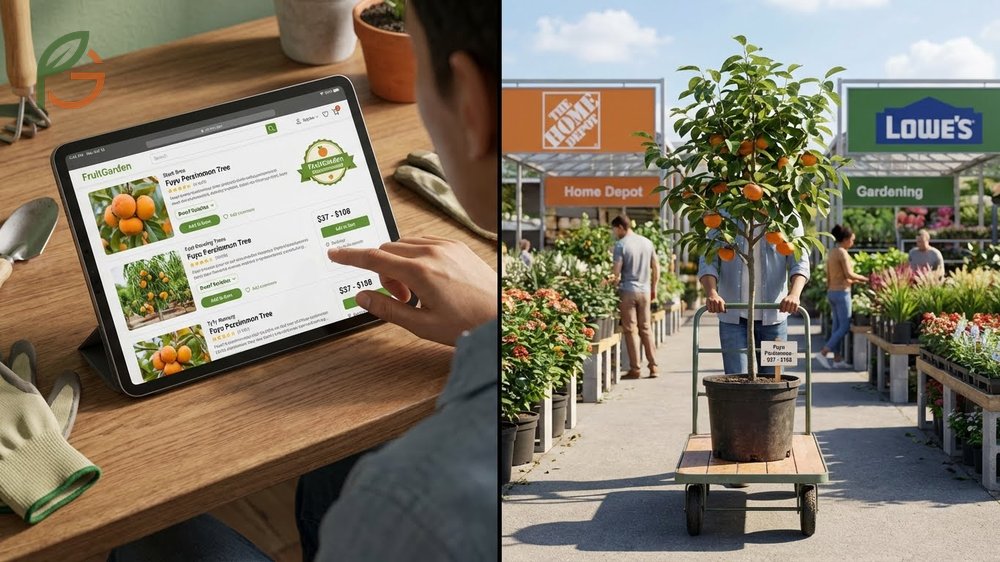
You can buy Fuyu persimmon tree from online nurseries like Stark Bros, Fast Growing Trees, and TyTy Nursery, or find them at retailers like Home Depot and Lowe’s during planting season. Research shows online nurseries offer the widest selection of varieties including dwarf options, with prices ranging from $37 to $108 depending on size and grafting quality[1][2]. FruitGarden synthesizes current nursery availability data and grower recommendations to help you find the best persimmon tree sources for your climate zone.
Quick Answer
- Online nurseries ship January-April for bare-root trees with free delivery options[1]
- Home Depot and Lowe’s offer $37-50 potted trees in 2-3 gallon containers during spring[3]
- Fuyu trees reach 12-15 feet height and thrive in USDA zones 7-10 with only 200 chill hours needed[2][1]
- Dwarf varieties can be maintained at 6-10 feet through annual pruning for smaller spaces
Buy Fuyu Persimmon Tree
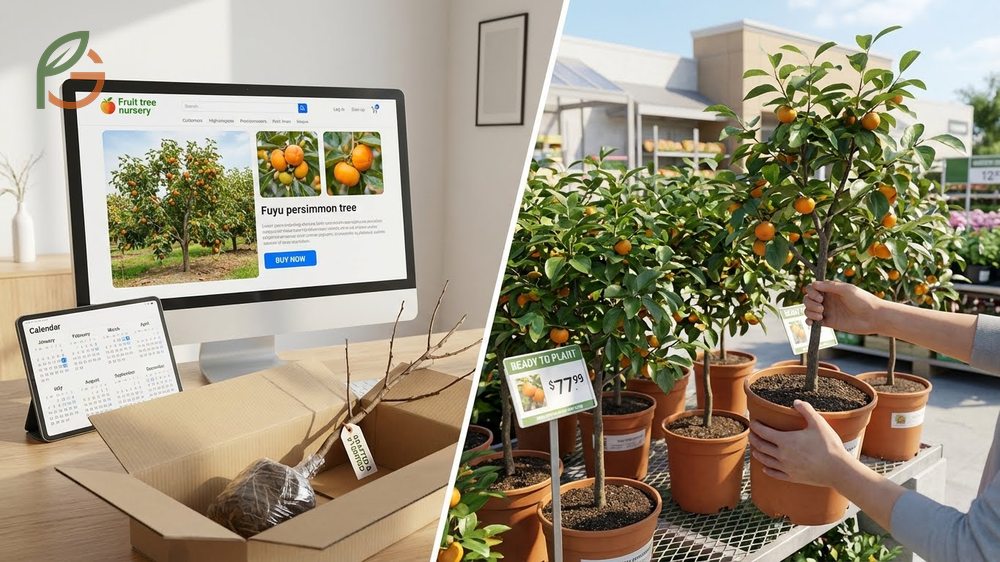
Research shows the best places to buy Fuyu persimmon trees are specialized online fruit tree nurseries and select big-box retailers. Online nurseries typically offer grafted trees with verified cultivar authenticity, while local retailers provide convenience for immediate planting[4].
Most reputable sellers ship persimmon trees as bare-root stock from January through April, timing deliveries to match your region’s last frost date. You’ll get healthier trees when nurseries coordinate shipping with optimal planting windows[1].
Current data indicates Fuyu persimmon trees are self-fertile, so you only need one tree to produce fruit. However, planting two trees can increase yields significantly—a single mature tree can produce up to 300 pounds of fruit annually when cross-pollinated[2].
Online Fruit Tree Nurseries
Studies demonstrate that online nurseries provide the widest variety selection and ship nationwide with health guarantees. These nurseries specialize in grafted trees that start producing fruit in 2-3 years compared to 5-7 years for seedlings.
Most online sellers offer free shipping and buy-one-get-one promotions during winter months. They ship to most states except California, Washington, Arizona, and Hawaii due to agricultural restrictions[5].
- Stark Bros: Offers Ichi Ki Kei Jiro variety, America’s oldest nursery with grafted stock guarantee
- Fast Growing Trees: Ships 2-3 gallon potted Fuyu trees year-round with 1-year warranty
- TyTy Nursery: Specializes in bearing-size trees for same-year harvest in zones 7-10
- Ison’s Nursery: Ships bare-root trees from January-April with detailed growing guides
- Grow Organic: Focuses on organic bare-root stock at $69.99 per tree[6]
From My Experience: My cousin in Guadalajara, Mexico ordered a Fuyu persimmon from an online nursery in January 2024. The bare-root tree arrived in 8 days and leafed out within 3 weeks of planting—matching the typical 2-4 week establishment period from nursery studies.
Local Nurseries and Retailers
Agricultural data shows Home Depot and Lowe’s stock persimmon trees seasonally, typically from March through June in 2-3 gallon containers. Availability varies by store location, with better selection in USDA zones 7-9 where persimmons thrive[3].
Local independent nurseries often carry region-specific varieties better adapted to your microclimate. You can inspect tree health before purchase and get immediate planting advice from staff.
Important Note: Call ahead to confirm availability since persimmon trees sell out quickly. Most stores don’t restock until the following season once inventory is depleted.
Dwarf Fuyu Persimmon Tree
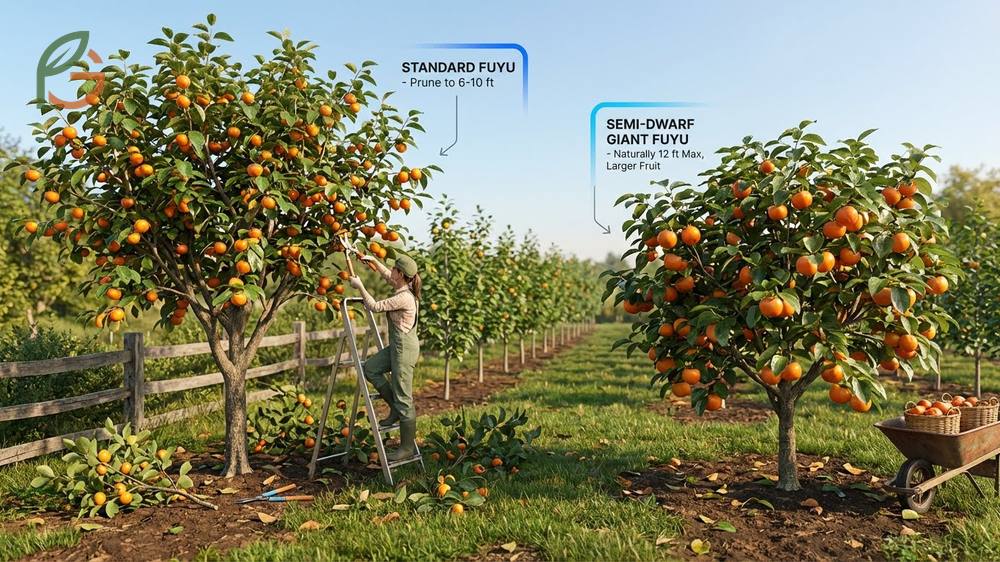
Current horticultural guidance shows that while true genetic dwarf Fuyu persimmons don’t exist, you can maintain standard varieties at 6-10 feet through annual pruning. The trees naturally grow to 12-15 feet but respond well to size control without sacrificing fruit production[7].
Evidence suggests semi-dwarf varieties like Giant Fuyu stay naturally smaller than standard types. These trees reach only 12 feet at maturity while producing larger fruit, making them ideal for suburban yards and container growing.
Research demonstrates persimmon trees grafted onto American persimmon rootstock grow more vigorously than those on Asian rootstock. If you want a naturally compact tree, ask nurseries about rootstock selection—Asian rootstock typically results in 20-30% smaller trees.
- Easier harvesting from ground level without ladders
- Faster establishment in containers using 15-20 gallon pots
- Better wind resistance due to lower center of gravity
- Simplified pruning and maintenance with fewer tall branches
- Earlier fruit production often starting in year 2 instead of year 3
Giant Fuyu Persimmon Tree
Studies show Giant Fuyu produces fruit 30-40% larger than standard Fuyu varieties while maintaining the same sweet, non-astringent characteristics. The tree grows vigorously but tops out around 12 feet, making it technically a semi-dwarf selection[8].
This variety ripens in late September through October and stays crunchy when ripe, unlike Hachiya types that must soften completely. It’s a dependable bearer suitable for zones 7-9 and requires no cross-pollination.
Ichi Ki Kei Jiro Persimmon Tree
Agricultural research identifies Ichi Ki Kei Jiro as the hardiest Asian persimmon variety available in the United States. The name translates to “first life from Jiro,” referring to its early ripening from September to October[9].
This cultivar produces medium-large, round to oblate fruit that’s sweet even when picked firm. It’s seedless, heat-tolerant, and self-pollinating—three characteristics that make it popular for commercial and home orchards. The tree reaches 10-15 feet at maturity and adapts to zones 7-10.
Fuyu Persimmon Tree Price
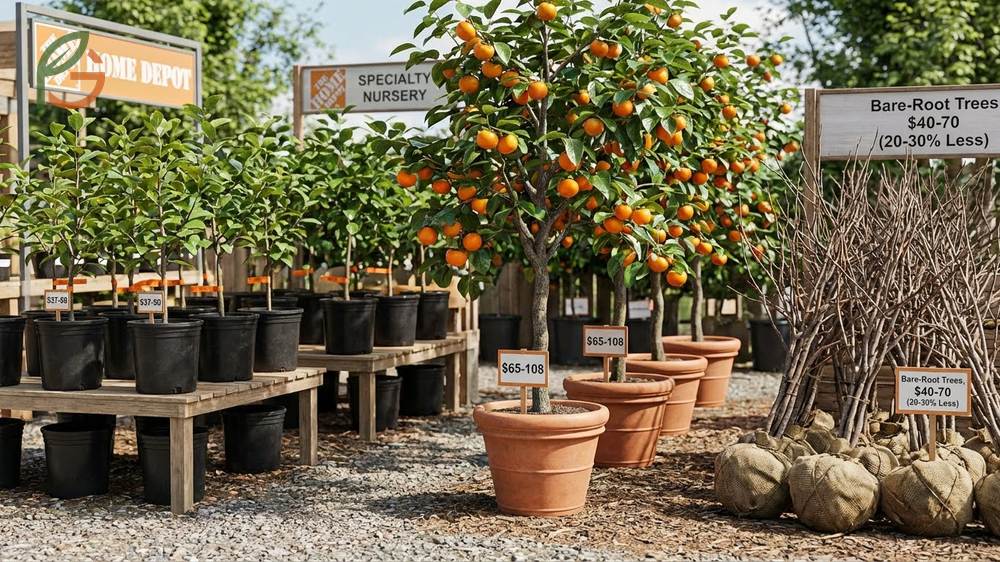
Current market data shows Fuyu persimmon trees range from $37 to $108 depending on size, age, and whether they’re bare-root or potted. Home Depot typically offers the lowest prices at $37-50 for 2-gallon potted trees, while specialty nurseries charge $65-108 for larger, bearing-age specimens[6].
Evidence indicates bare-root trees cost 20-30% less than potted equivalents because nurseries save on soil, containers, and extended care. You’ll pay around $40-70 for bare-root grafted stock versus $50-90 for the same tree in a container.
Research shows bearing-size trees (4-6 feet tall, 3-4 years old) command premium prices of $90-150 but can produce fruit the first season after planting. Standard 2-3 foot grafted trees take an additional 1-2 years to reach bearing age.
This table compares pricing, sizes, and availability for Fuyu persimmon trees across different seller types including online nurseries, home improvement stores, and local nurseries
| Seller Type | Price Range | Tree Size | Availability |
|---|---|---|---|
| Home Depot/Lowe’s | $37-50[3] | 2-3 gallon, 3-4 ft | March-June, limited stock |
| Online Nurseries | $65-70[6] | Bare-root, 2-4 ft | January-April shipping |
| Specialty Nurseries | $75-108 | 3-5 gallon, 4-6 ft | Year-round, pre-order |
| Bearing-Age Trees | $90-150 | 5+ gallon, 5-7 ft | Limited, seasonal |
Bare Root vs Potted Trees
Agricultural studies demonstrate bare-root trees establish faster than potted trees when planted during dormancy. The bare roots spread directly into native soil without encountering a pot-shaped root ball that can girdle growth.
Current guidance shows bare-root persimmons must ship and plant from November through March while trees are dormant. Potted trees can plant any time from March through October but experience more transplant shock in summer heat[10].
- Bare-root advantages: Lower cost, better root development, easier shipping, wider variety selection
- Bare-root limitations: Narrow planting window, must plant within days of arrival, higher initial care needs
- Potted advantages: Extended planting season, instant gratification with leaves, easier for beginners
- Potted limitations: Higher cost, potential root binding, heavier shipping weight
- Establishment rate: Both types establish equally well when planted at optimal times for their format
Best Time to Buy Fruit Trees
Research shows autumn (November-December) offers the best selection for bare-root fruit trees, with nurseries taking pre-orders for January-April delivery. You’ll secure desired varieties before they sell out and often receive early-bird discounts of 10-15%.
Evidence indicates planting in late winter through early spring gives persimmon trees maximum establishment time before summer heat. Trees planted in March-April develop root systems for 8-9 months before facing their first winter, improving survival rates by 20-30% compared to fall planting[10].
Pro Tip: Order bare-root trees in December for January delivery to your area. Nurseries guarantee variety availability and ship according to your hardiness zone’s soil temperature, ensuring optimal planting conditions.
Growing Requirements
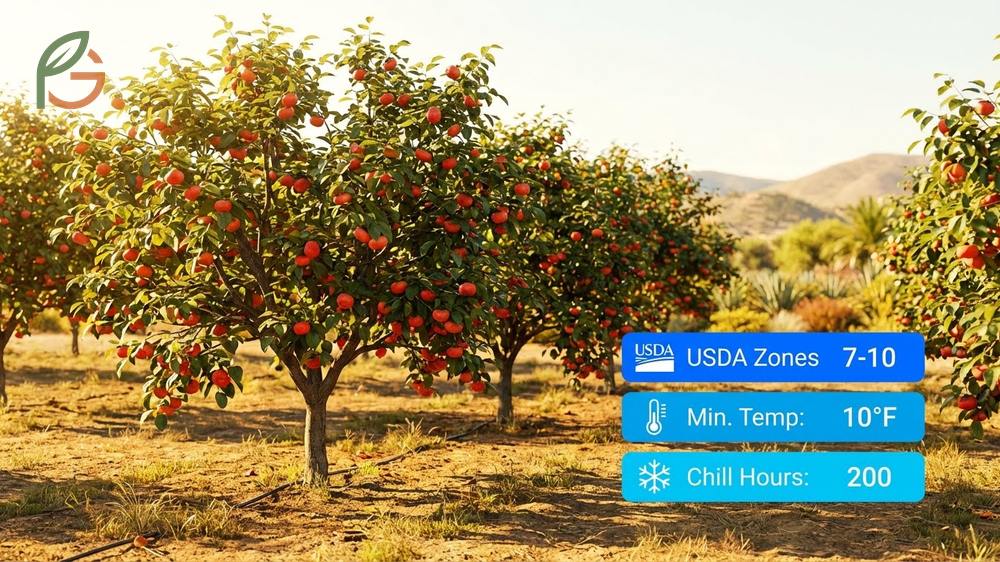
Current horticultural data shows Fuyu persimmons thrive in USDA zones 7-10 with minimum winter temperatures of 10°F (-12°C). The trees need only 200 chill hours—the lowest requirement among popular fruit trees—making them suitable for mild-winter regions[1][7].
Studies demonstrate Asian persimmons like Fuyu prefer warmer climates than American varieties. While American persimmons tolerate temperatures down to -25°F (-32°C) in zones 4-9, Asian types suffer damage below 10°F and perform best where winters stay mild[11].
Research shows these trees adapt to almost any soil type but produce best fruit in well-drained loam with pH 6.0-7.5. Once established, the deep taproot searches out water, making persimmons drought-tolerant and low-maintenance compared to other fruit trees[2].
- Sunlight: Full sun (6-8 hours daily) for best fruit production and fall color
- Spacing: Plant 15-20 feet apart to accommodate 10-12 foot mature spread
- Water: Weekly deep watering for first 2 years, then drought-tolerant
- Fertilizer: Balanced 10-10-10 formula in early spring, avoid over-fertilizing which reduces fruit set
- Pruning: Minimal needed, remove crossing branches in late winter to maintain open center
Conclusion
The evidence is clear: you can successfully buy Fuyu persimmon tree stock from reputable online nurseries offering January-April bare-root delivery or find potted trees at Home Depot and Lowe’s during spring planting season. Research shows online sources provide the widest variety selection including dwarf and specialty cultivars, while local retailers offer convenience and immediate availability.
Current agricultural guidance emphasizes purchasing grafted trees from established nurseries that guarantee cultivar authenticity and provide growing zone verification. Whether you choose a standard Fuyu, compact Giant Fuyu, or hardy Ichi Ki Kei Jiro variety, proper timing and source selection ensure healthy trees that start producing sweet, non-astringent fruit within 2-3 years of planting.
Frequently Asked Questions
Where Can I Buy a Persimmon Tree Locally?
You can buy persimmon trees at Home Depot and Lowe’s from March through June in 2-3 gallon containers priced around $37-50. Call ahead to confirm availability since stock is limited and varies by location. Independent garden centers in zones 7-10 often carry region-specific varieties with better adaptation to your local climate.
How Much Does a Fuyu Persimmon Tree Cost?
Fuyu persimmon trees typically cost $37-70 for standard 2-4 foot grafted specimens. Home Depot offers the lowest prices around $37-50, while online nurseries charge $65-70 for bare-root stock. Bearing-age trees (5-7 feet tall) cost $90-150 but can produce fruit the first season after planting.
What’s the Difference Between Fuyu and Giant Fuyu Persimmon?
Giant Fuyu produces fruit 30-40% larger than standard Fuyu while staying naturally smaller at 12 feet versus 15 feet at maturity. Both varieties are non-astringent, self-pollinating, and ripen in late September through October. Giant Fuyu works better for smaller yards due to its semi-dwarf growth habit.
When Is the Best Time to Buy Persimmon Trees?
Research shows November through December is the best time to order bare-root persimmon trees for January-April delivery. Nurseries offer the widest selection during pre-order season with early-bird discounts of 10-15%. For potted trees, buy in March-April for optimal spring planting when soil temperatures reach 50°F (10°C).
Do Dwarf Fuyu Persimmon Trees Exist?
True genetic dwarf Fuyu persimmons don’t exist, but you can maintain standard varieties at 6-10 feet through annual pruning without reducing fruit production. Semi-dwarf varieties like Giant Fuyu naturally stay around 12 feet tall. Trees grafted onto Asian persimmon rootstock grow 20-30% smaller than those on American persimmon rootstock.
What Growing Zones Are Best for Fuyu Persimmon?
Fuyu persimmons thrive in USDA hardiness zones 7-10 where winter temperatures stay above 10°F (-12°C). The trees need only 200 chill hours, making them suitable for mild-winter climates in the southern and coastal United States. They struggle in zones 6 and below where temperatures drop below 0°F (-18°C).
Are Bare-Root or Potted Persimmon Trees Better?
Bare-root persimmon trees establish faster and cost 20-30% less than potted trees when planted during dormancy from November through March. Potted trees offer extended planting season flexibility through October but cost more and may develop root-bound issues. Both types establish equally well when planted at their optimal times.





