
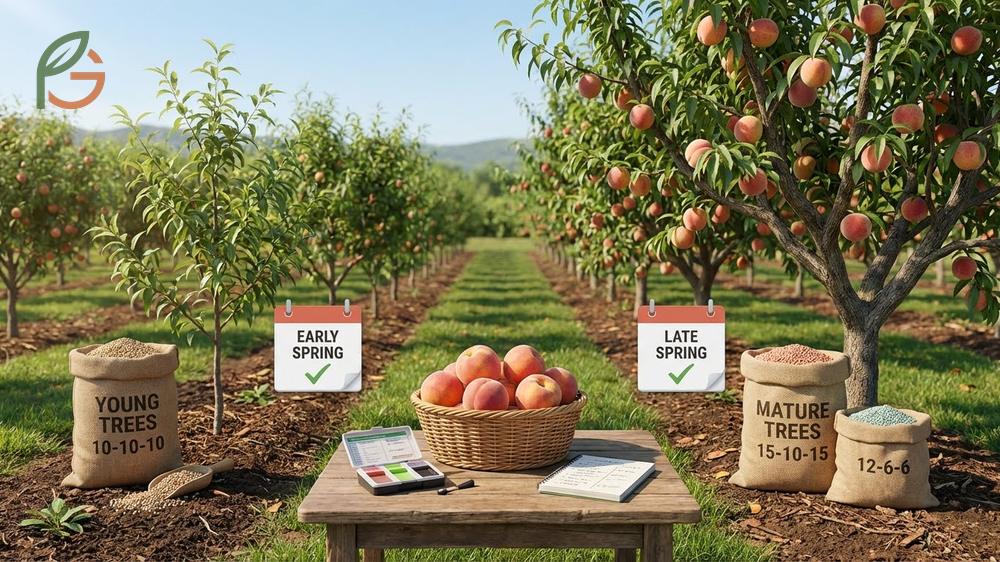
Best fertilizer for peach trees depends on tree age and growth stage. Research shows young trees thrive with balanced 10-10-10 formulas, while mature peach trees produce higher yields with nitrogen-rich 15-10-15 or 12-6-6 blends applied in early spring and late spring.[1] Current agricultural data indicates proper fertilization timing and NPK ratios directly impact fruit size, sweetness, and overall peach tree health.[2] FruitGarden synthesizes university extension research and USDA guidelines to help home orchardists achieve professional-quality peach harvests.
Quick Answer
- Young peach trees (1-3 years) need 10-10-10 balanced fertilizer at 0.75 lbs per application[1]
- Mature trees (4+ years) require 50-100 lbs nitrogen per acre annually, typically using 15-10-15 or 12-6-6 formulas[2]
- Apply fertilizer in early spring (March) and again in late spring (May) for optimal nutrient uptake[1]
- Maintain soil pH between 6.0-7.0 and supplement with micronutrients like zinc (20-50 ppm) and boron (30-70 ppm)[3]
Best Fertilizer for Peach Trees
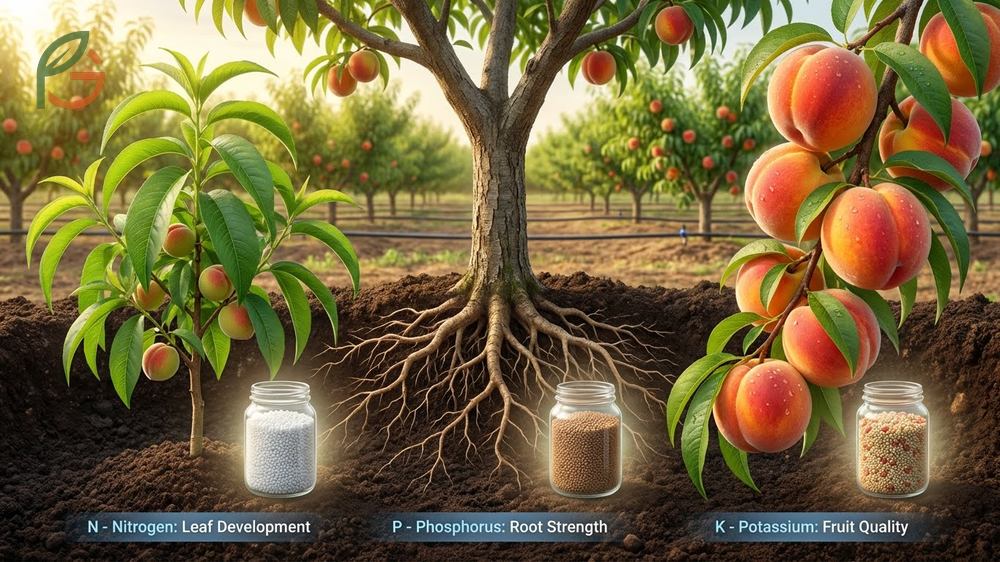
Selecting the right fertilizer transforms peach tree performance from mediocre to exceptional. Studies demonstrate that balanced NPK formulations support vigorous root development, disease resistance, and consistent fruit production across varying soil conditions.[4] Most home orchardists achieve best results with complete fertilizers containing nitrogen, phosphorus, and potassium in ratios tailored to tree age.
Young peach trees establish faster with 10-10-10 balanced formulas that promote both foliage and root growth. Mature bearing trees shift their nutrient demands toward higher nitrogen levels, making 15-10-15 or 12-6-6 blends more effective.[1] This adjustment reflects the tree’s transition from structural development to sustained fruit production.
Research shows peach orchards receiving targeted fertilization produce 20-35% higher yields compared to unfertilized controls. The quality difference appears equally significant, with properly fertilized trees producing larger, sweeter fruit with better color development.[2]
NPK Ratios Explained
NPK numbers represent the percentage by weight of nitrogen, phosphorus, and potassium in fertilizer products. A 10-10-10 formula contains 10% of each nutrient, with the remaining 70% consisting of filler materials and trace minerals. Understanding these ratios helps you match fertilizer strength to your peach trees’ specific needs.
Higher first numbers indicate nitrogen-rich formulas that accelerate vegetative growth and leaf production. Phosphorus (the middle number) drives root development and flower formation, while potassium (the final number) improves disease resistance and fruit quality.[4]
Young vs Mature Tree Requirements
Age-based fertilization strategies prevent nutrient imbalances that compromise tree health. Young trees (1-3 years) prioritize balanced growth across roots, branches, and foliage, requiring equal nutrient proportions. These developing trees receive 0.75 lbs of 10-10-10 fertilizer in March and again in May.[1]
Mature peach trees (4-10 years) demand increased nitrogen to support annual fruit crops while maintaining vigorous vegetative growth. These established trees benefit from 1-2 lbs of 10-10-10 fertilizer per application, or equivalent amounts of higher-nitrogen formulations like 15-10-15.[1] Trees bearing heavy crops may require supplemental mid-season nitrogen applications.
- 10-10-10 balanced formula: Ideal starter fertilizer for newly planted and young peach trees establishing root systems
- 15-10-15 higher nitrogen blend: Supports mature bearing trees with increased leaf production and fruit development needs
- 12-6-6 nitrogen-focused formula: Works well on soils with adequate phosphorus levels, directing nutrients toward foliage and fruit
- 16-4-8 specialized blend: Recommended for sandy soils where phosphorus retention exceeds nitrogen availability
- Slow-release formulations: Reduce application frequency and minimize nutrient leaching on sandy or well-drained sites
Important Note: Always conduct soil tests before heavy fertilization. Excessive nitrogen promotes lush foliage at the expense of fruit production and increases disease susceptibility, particularly bacterial spot and brown rot.[2]
Peach Tree Nutrition
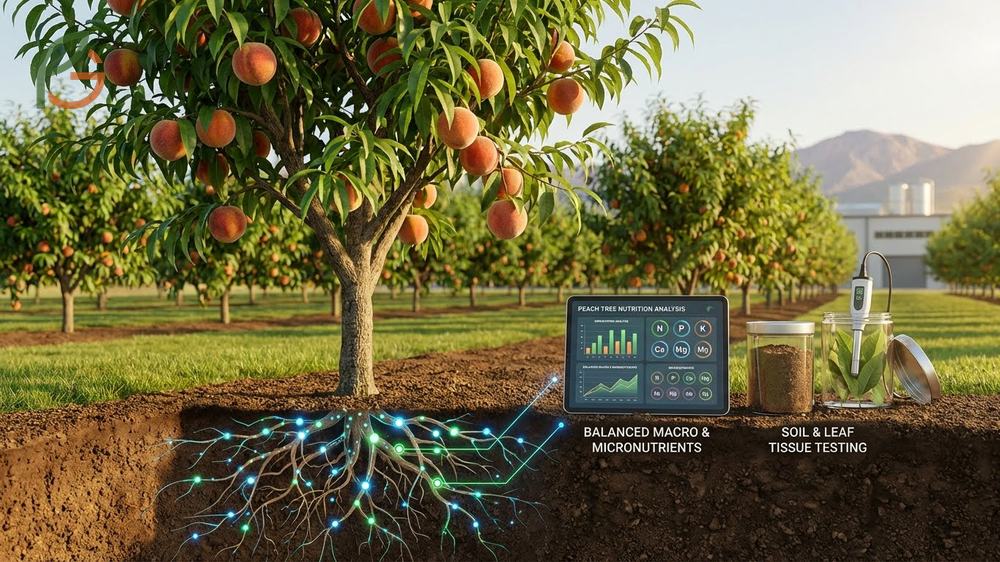
Comprehensive peach tree nutrition extends beyond basic NPK ratios to include secondary macronutrients and essential micronutrients. Research indicates balanced mineral nutrition influences not only yield quantity but also fruit storability, flavor intensity, and tree cold hardiness.[3] Commercial orchards routinely test both soil and leaf tissue to identify deficiencies before visible symptoms appear.
Proper nutrient balance prevents common physiological disorders in peach trees. Calcium deficiency causes bitter pit and flesh breakdown, while inadequate boron results in blossom blast and deformed fruit.[3] Understanding these relationships helps home growers diagnose problems quickly and apply targeted corrections.
Evidence suggests peach trees extract significant nutrient quantities from soil annually. A mature orchard producing 20 tons of fruit per hectare removes approximately 150-200 kg nitrogen, 22-44 kg phosphorus, and 200-250 kg potassium from the soil each season.[4] Fertilization programs must replace these extracted nutrients to maintain long-term soil fertility.
Primary Macronutrients
Nitrogen drives chlorophyll production and protein synthesis in peach trees, directly influencing leaf size and photosynthetic capacity. Deficient trees display yellowing leaves, reduced shoot growth, and diminished fruit size. Excessive nitrogen delays fruit maturity and reduces color development.[2]
Phosphorus supports energy transfer within plant cells and plays critical roles in flower formation and fruit set. Peach trees rarely show phosphorus deficiency symptoms due to relatively low requirements compared to nitrogen. Most soils contain adequate phosphorus reserves, making supplementation unnecessary except on severely depleted sites.[5]
Potassium regulates water movement, enzyme activation, and carbohydrate translocation in peach trees. Adequate potassium improves fruit firmness, sugar content, and storage life while enhancing cold hardiness and disease resistance.[4] Trees on sandy soils often require additional potassium due to leaching losses.
Essential Micronutrients
Zinc deficiency ranks as the most common micronutrient problem in peach orchards, causing “little leaf” disorder characterized by stunted shoots and small, narrow leaves. Healthy peach trees maintain leaf zinc concentrations between 20-50 ppm.[3] Foliar sprays of zinc sulfate applied during early leaf development correct deficiencies most effectively.
Boron influences pollen tube growth, cell wall formation, and carbohydrate metabolism in peach trees. Deficiency symptoms include blossom blast, shoot dieback, and cork-like lesions in fruit flesh. Leaf boron concentrations should fall between 30-70 ppm for optimal tree performance.[3] High pH soils frequently exhibit boron deficiency requiring annual supplementation.
- Zinc: Prevents little leaf disorder, maintains shoot vigor, optimal range 20-50 ppm in leaf tissue
- Boron: Essential for pollination and fruit set, prevents blossom blast, target range 30-70 ppm
- Iron: Drives chlorophyll formation, deficiency causes interveinal chlorosis on young leaves
- Manganese: Activates enzymes involved in photosynthesis and nitrogen metabolism
- Copper: Supports lignin formation in cell walls, enhances disease resistance mechanisms
Fertilizing Peach Trees
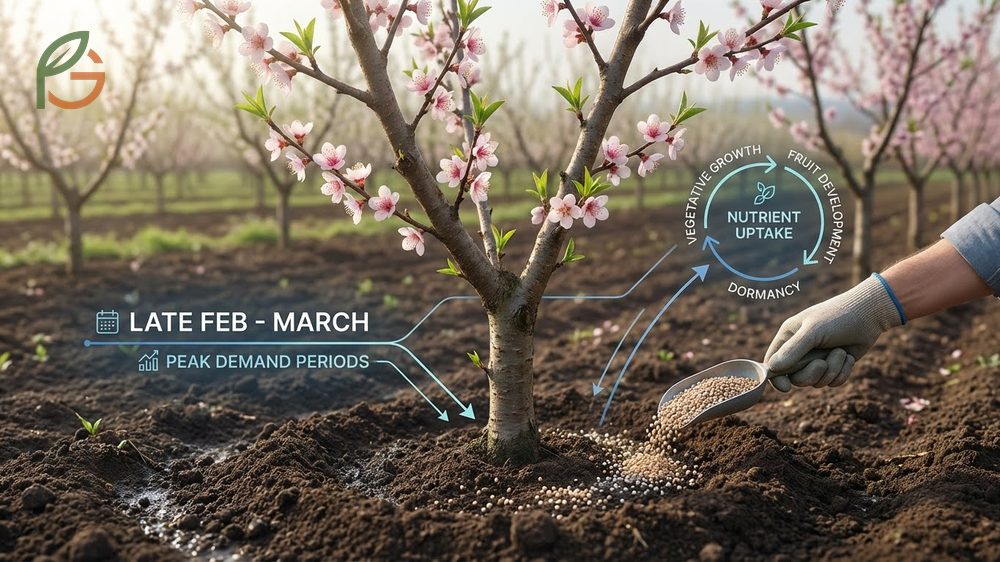
Effective fertilization timing synchronizes nutrient availability with peach tree growth cycles and fruit development stages. Applications during peak demand periods maximize nutrient uptake efficiency while minimizing waste through leaching or volatilization. Research demonstrates that split applications outperform single large doses for peach trees.[4]
Early spring fertilization (late February to March) supports rapid vegetative growth as trees break dormancy and develop new shoots. This critical application provides nitrogen for leaf expansion and provides phosphorus for root growth into warming soil. Late spring applications (May to early June) sustain growth momentum and support developing fruit.[1]
Application methods influence fertilizer efficiency and root uptake rates. Broadcasting granular fertilizer across the root zone followed by irrigation works well for established orchards. Newly planted trees benefit from banded applications placed 12-18 inches from the trunk to prevent root burn.[5] Avoid cultivating fertilizer into soil, as this damages feeder roots near the surface.
Soil pH significantly impacts nutrient availability to peach tree roots. Most nutrients become unavailable at pH levels below 5.5 or above 7.5, even when present in adequate quantities. Peach trees perform best in slightly acidic to neutral soils with pH between 6.0-7.0.[5] Test soil pH every 2-3 years and adjust with lime or sulfur as needed.
Pro Tip: Spread a 1-2 inch layer of compost over the root zone after spring fertilization. This practice improves soil structure, enhances moisture retention, and gradually releases additional nutrients throughout the growing season.
- Test soil: Collect samples from multiple locations around trees in late fall or winter for laboratory analysis
- Calculate rates: Use soil test results and tree age to determine precise fertilizer amounts needed
- Apply early spring: Broadcast fertilizer evenly under tree canopy in late February to March before bud break
- Water thoroughly: Irrigate with 1-2 inches of water immediately after application to move nutrients into root zone
- Second application: Repeat fertilization in May or early June to support fruit development and shoot growth
- Monitor response: Observe leaf color, shoot growth, and fruit size to assess fertilization effectiveness
- Adjust as needed: Increase or decrease rates the following year based on tree response and fruit quality
NPK for Peaches
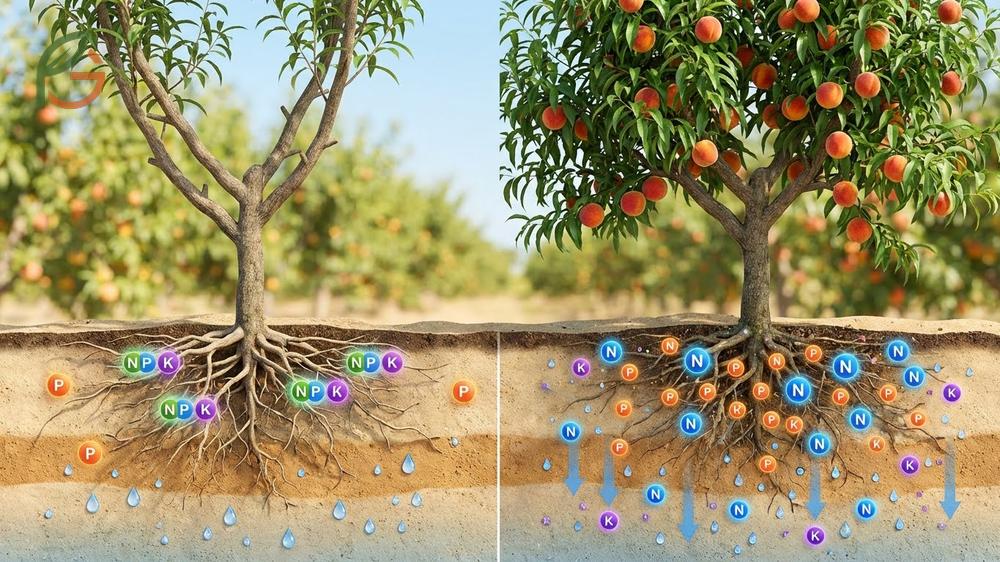
Optimal NPK ratios for peach trees shift throughout the tree’s lifecycle to match changing physiological demands. Young non-bearing trees allocate resources toward building strong scaffold branches and extensive root systems, requiring balanced nutrient inputs. Mature fruiting trees redirect energy toward annual crop production, necessitating higher nitrogen levels to support both fruit and vegetative growth.[1]
Sandy soils leach nitrogen and potassium more rapidly than phosphorus, making formulations like 12-4-8 or 16-4-8 more appropriate than balanced blends. Heavier clay soils retain all three nutrients effectively, performing well with standard 10-10-10 or 8-8-8 formulations.[5] Soil texture testing helps determine which formula best matches your site conditions.
Current data indicates excessive phosphorus applications provide no additional benefit to peach trees and may interfere with micronutrient uptake. Most agricultural soils contain adequate to high phosphorus levels from years of fertilization.[2] Base phosphorus applications on soil test results rather than following routine schedules.
This table compares recommended NPK fertilizer ratios, application rates, and timing schedules for peach trees at different growth stages from planting through maturity
| Tree Age | NPK Ratio | Amount per Application | Applications per Year |
|---|---|---|---|
| Newly planted (Year 1) | 10-10-10 | 0.12-0.25 lbs[5] | 3-4 times (spring through summer) |
| Young trees (Years 2-3) | 10-10-10 | 0.75 lbs[1] | 2 times (March and May) |
| Bearing trees (Years 4-10) | 15-10-15 or 12-6-6 | 1-2 lbs[1] | 2 times (March and May) |
| Mature orchards (10+ years) | Variable by soil type | 50-100 lbs N per acre[2] | 2-3 times (split applications) |
Organic Peach Fertilizer
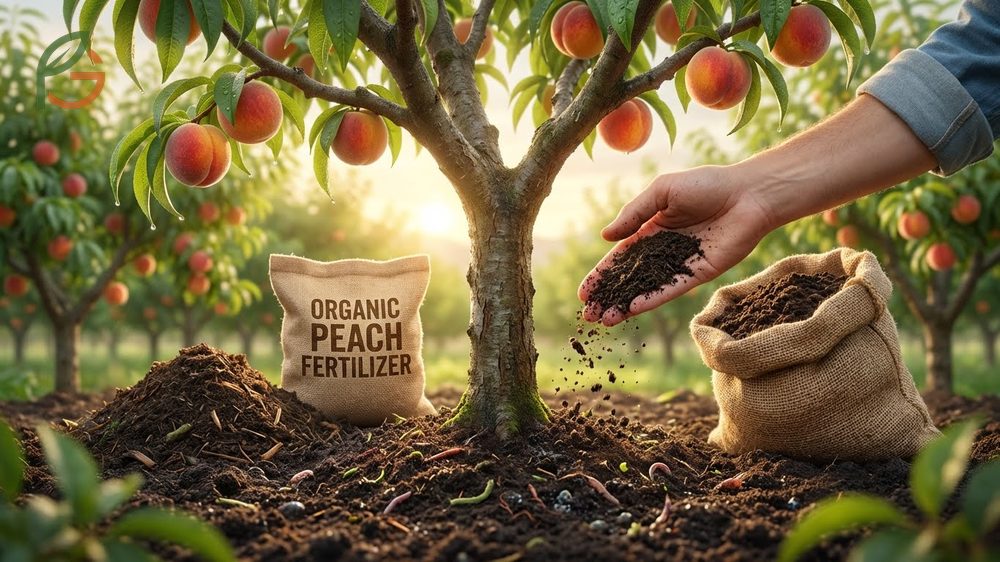
Organic fertilizers release nutrients gradually through microbial decomposition, providing sustained nutrition while improving soil structure and water-holding capacity. Compost, aged manure, and organic fertilizer blends supply NPK in lower concentrations than synthetic products, requiring larger application volumes to meet peach tree requirements. Most organic sources contain 3-5% nitrogen compared to 10-15% in conventional fertilizers.
Composted cow manure serves as an excellent nitrogen source for peach trees, typically containing 0.5-1.5% nitrogen by weight. Applying a 2-3 inch layer around the tree dripline supplies adequate nitrogen for young trees while enhancing soil organic matter content. Chicken manure provides higher nitrogen concentrations (3-5%) but requires aging for 6-12 months to prevent root burn from excessive ammonia.
Research demonstrates organic matter applications improve soil nutrient retention and reduce leaching losses on sandy sites. Soils amended with compost maintain higher available phosphorus and potassium levels compared to unamended controls receiving equivalent synthetic fertilizer applications.[6] This slow-release characteristic provides consistent nutrition throughout the growing season.
- Composted cow manure: Contains 0.5-1.5% nitrogen, improves soil structure, apply 2-3 inch layer annually
- Aged chicken manure: Provides 3-5% nitrogen, must age 6-12 months, use sparingly to prevent burn
- Blood meal: High nitrogen (12-15%), fast-acting organic source for quick greening response
- Bone meal: Supplies phosphorus (15-20% P₂O₅) and calcium, excellent for young tree root development
- Kelp meal: Delivers potassium plus trace minerals, enhances fruit quality and disease resistance
- Fish emulsion: Balanced liquid fertilizer (5-1-1), ideal for foliar feeding or fertigation systems
Application Strategy: Combine organic and synthetic fertilizers for balanced results. Apply compost annually for soil improvement while using reduced-rate synthetic fertilizer to meet immediate nutrient demands. This hybrid approach cuts synthetic fertilizer use by 30-50% while building long-term soil fertility.
Fertilizer Schedule Peaches
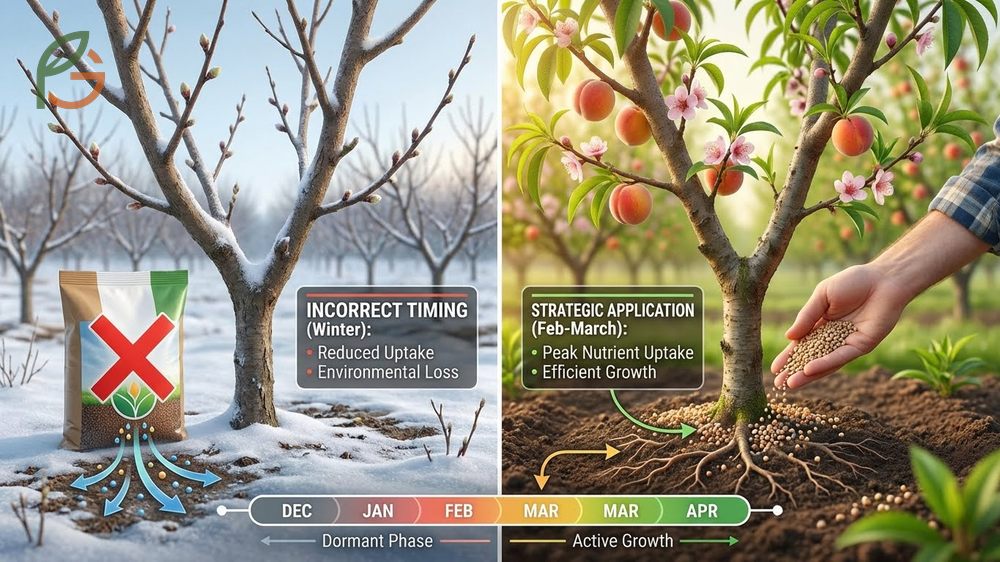
Strategic fertilizer scheduling aligns nutrient applications with peach tree phenological stages and peak nutrient uptake periods. Trees absorb nutrients most efficiently during active growth phases when root activity and metabolic processes operate at maximum rates. Mistimed applications reduce uptake efficiency and increase environmental losses through leaching or runoff.
Late winter to early spring applications (February-March) should occur 4-6 weeks before anticipated bloom date in your region. This timing allows nutrients to move into the root zone before trees break dormancy and demand rapidly increases.[2] Cold soil temperatures below 50°F (10°C) slow nutrient availability, so delay application if ground remains frozen.
The second major application occurs during fruit development, typically late May through early June. This fertilization supports rapid fruit sizing and maintains shoot growth for next year’s crop. Trees carrying heavy fruit loads may benefit from a third light application in July, but avoid fertilizing after mid-July as late nitrogen promotes succulent growth vulnerable to winter cold damage.[4]
Post-harvest fertilization (August-September) helps trees recover from fruiting stress and builds carbohydrate reserves for winter survival and spring growth. This application uses reduced nitrogen rates (45-60 kg/ha) focused on potassium to enhance cold hardiness.[4] Skip this application on young non-bearing trees that don’t experience crop stress.
| Timing | Growth Stage | Recommended Action |
|---|---|---|
| Late February – March | Pre-bloom, bud swell | Apply 50-60% of annual nitrogen, full phosphorus and potassium[2] |
| Late May – Early June | Fruit sizing, shoot growth | Apply 30-40% of annual nitrogen to sustain growth[1] |
| August – September | Post-harvest recovery | Apply 10-20% nitrogen plus potassium for winter hardening[4] |
Conclusion
The evidence is clear: best fertilizer for peach trees depends on precise matching of NPK ratios and application timing to tree age, soil conditions, and growth stage. Young trees thrive with balanced 10-10-10 formulations applied twice annually, while mature bearing trees produce maximum yields using nitrogen-rich 15-10-15 or 12-6-6 blends delivered in split applications from early spring through fruit development.[1] Proper fertilization combined with attention to soil pH and micronutrient status separates exceptional peach harvests from mediocre results.
Current university extension guidance emphasizes soil testing as the foundation for effective peach tree fertilization programs. Test results reveal precise nutrient deficiencies and prevent costly over-application while protecting environmental quality. FruitGarden helps home orchardists apply research-based practices that commercial growers rely on for consistent, high-quality peach production year after year.
Frequently Asked Questions
What is the best fertilizer ratio for young peach trees?
Young peach trees (1-3 years old) perform best with balanced 10-10-10 fertilizer applied at 0.75 lbs per tree in March and May. This equal NPK ratio supports simultaneous root, shoot, and foliage development during establishment years. Avoid high-nitrogen formulas that promote excessive vegetative growth at the expense of structural strength.
How much fertilizer do mature peach trees need per year?
Mature peach trees (4-10 years) require 1-2 lbs of 10-10-10 fertilizer per application, applied twice annually in March and May. Commercial orchards typically apply 50-100 lbs of nitrogen per acre per year, adjusted based on soil type, pruning severity, and crop load. Heavy-bearing trees may benefit from a third light application in early July to support fruit sizing.
When is the latest I should fertilize my peach tree?
Stop all nitrogen fertilization by mid-July (typically July 15th) in most temperate climates. Applying fertilizer late in the growing season stimulates new, succulent growth that fails to harden off before the first frost, leading to severe winter injury, dieback, and potential tree death.
How do I identify zinc deficiency in peach trees?
Zinc deficiency manifests as “little leaf” disorder, where leaves at shoot tips are abnormally small, narrow, and clustered together in rosettes. You may also see interveinal chlorosis (yellowing between veins) on younger leaves. Correct this with foliar zinc sprays applied during dormancy or early bud break.
Are fertilizer spikes good for peach trees?
While convenient, fertilizer spikes are generally less effective than granular fertilizers for peach trees. Spikes concentrate nutrients in small, specific areas, which can burn nearby roots while leaving the rest of the root zone under-fertilized. Broadcasting granular fertilizer ensures even nutrient distribution across the entire canopy area.
Do peach trees prefer acidic or alkaline soil?
Peach trees thrive in slightly acidic to neutral soil with a pH range of 6.0 to 7.0. Soils below pH 6.0 limit nutrient availability and should be amended with agricultural lime. Alkaline soils (pH above 7.5) often cause iron and zinc deficiencies; treat these with elemental sulfur or acidifying fertilizers.
Can I use citrus fertilizer on peach trees?
Yes, citrus fertilizers are often suitable for peach trees because they are typically high in nitrogen and contain essential micronutrients like zinc, iron, and manganese that stone fruits also require. Always check the NPK ratio and adjust application rates to match the specific nitrogen requirements of your peach tree age.





