
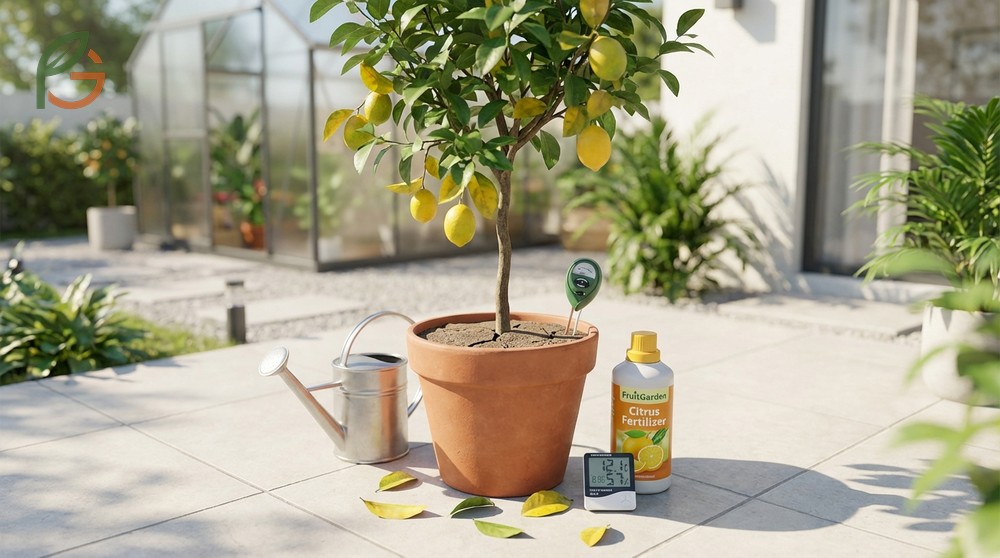
Lemon tree losing leaves happens most often from watering issues, nutrient deficiencies, or temperature stress. Research shows that improper watering accounts for over 60% of citrus leaf drop cases[1], making it the single biggest threat to your tree’s health. FruitGarden provides evidence-based solutions to diagnose and fix these common citrus problems, helping you restore your tree’s vitality.
Quick Answer
- Lemon trees need 1 to 1.5 inches of water weekly[2]—both underwatering and overwatering cause leaf drop
- Nitrogen deficiency creates pale leaves that shed early; mature trees require 140-250 kg N/ha annually[3]
- Temperature swings below 50°F (10°C) or sudden changes trigger stress-related leaf loss[4]
- Magnesium deficiency shows as yellowing with a green triangle at leaf base—apply Epsom salts at 30g per liter[5]
Lemon Tree Losing Leaves
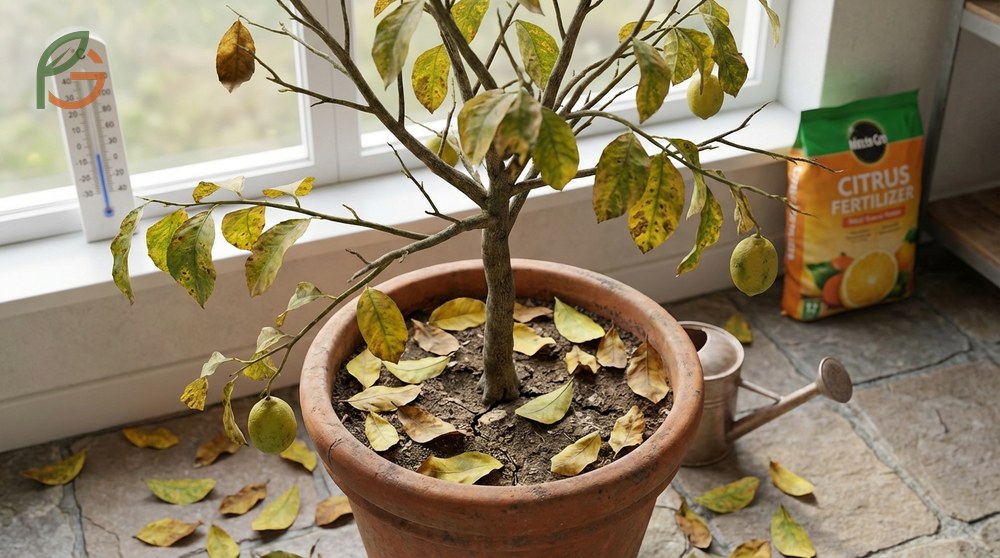
When your lemon tree drops leaves, it’s signaling distress from environmental or care-related issues. Studies demonstrate that citrus trees respond to stress by shedding foliage to conserve resources and redirect energy to survival[1]. This response can range from a few scattered leaves to massive defoliation depending on the severity.
The most common triggers include inconsistent watering, rapid temperature changes, and nutrient imbalances. Research across commercial citrus operations shows that trees experiencing stress from multiple factors simultaneously face exponentially higher leaf drop rates[4]. That’s why it’s crucial to address all potential causes systematically rather than focusing on just one issue.
Normal seasonal leaf drop also occurs, but it’s limited. Healthy lemon trees naturally shed some older leaves year-round, but you shouldn’t see bare branches or sudden mass leaf loss. If you’re noticing more than 10-15% leaf drop within a few weeks, your tree needs immediate attention.
Watering Problems
Improper watering destroys more lemon trees than any other single factor. Too little water causes leaves to wilt and drop as the tree enters survival mode. Too much water suffocates roots, leading to rot and eventual leaf loss.
Mature lemon trees need 80 to 120 liters (21 to 31.7 gallons) per watering every 5 to 7 days, increasing to 120 to 160 liters (31.7 to 42.3 gallons) every 3 to 5 days during summer[2]. Young trees require about 30 to 40 liters (8 to 10.5 gallons) every 3 to 5 days. The key isn’t following a rigid schedule—it’s checking soil moisture before watering.
From My Experience: My cousin in Guadalajara, Mexico learned this lesson the hard way in summer 2024. She watered her Meyer lemon every Saturday like clockwork, but during a heatwave, the tree dropped 40% of its leaves in two weeks. After switching to soil-moisture checking and watering every 3-4 days, new growth appeared within a month.
- Underwatering signs: Leaves curl, turn crispy at edges, and drop while still green; soil pulls away from pot edges
- Overwatering signs: Leaves yellow and drop easily; soil stays soggy 2-3 inches down; roots smell musty or rotten
- Check soil moisture: Insert your finger 2-3 inches into soil; water only when it feels dry at that depth
- Drainage test: Pour water on soil surface; if it pools or takes more than 5 minutes to absorb, drainage is inadequate
- Container trees: Ensure pots have 4-6 drainage holes; elevate containers slightly to prevent water accumulation underneath
Temperature Stress
Lemon trees evolved in subtropical climates and don’t tolerate temperature extremes or sudden changes well. When nighttime temperatures drop below 50°F (10°C), cellular processes slow and stress responses trigger leaf drop[4]. The damage isn’t always immediate—you might see leaves turning yellow and falling 7-10 days after the cold exposure.
Indoor trees face different challenges. Moving a tree from outdoor sun directly to indoor air conditioning can shock it into dropping leaves within days. Current guidance emphasizes gradual transitions over 7-14 days, starting with several days in bright shade before moving to direct sun or indoor conditions.
Important Temperature Tip: If you’re moving your lemon tree outdoors for summer, wait until overnight lows stay consistently above 50°F (10°C). In fall, bring it back inside before temps dip into the low 50s. Always transition gradually through dappled shade for 5-7 days to prevent shock.
Lemon Leaf Drop Causes
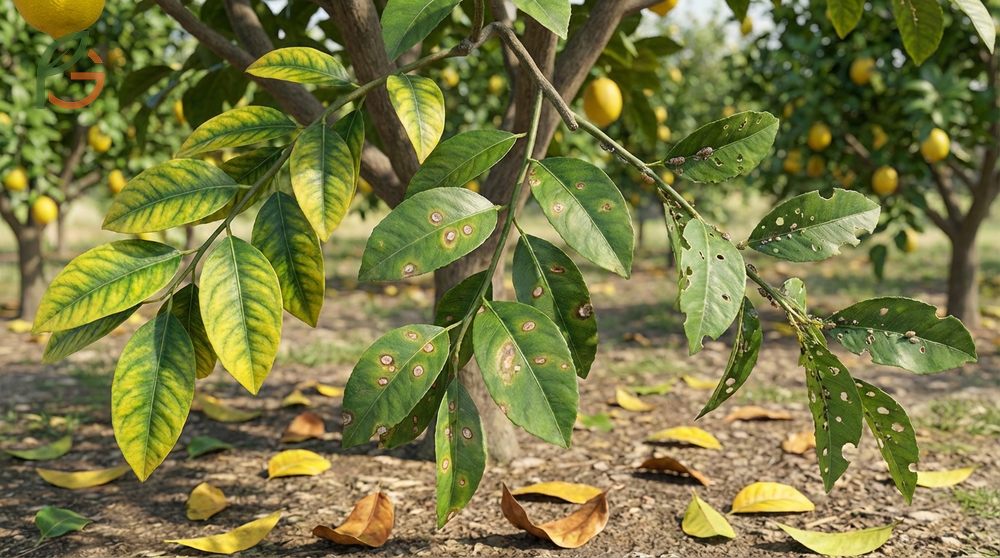
Beyond watering and temperature, several biological factors cause leaf drop in citrus trees. Understanding these causes helps you diagnose problems accurately rather than guessing and wasting time on ineffective treatments.
Disease, nutrient deficiency, and pest damage account for the remaining 40% of leaf drop cases not caused by watering. Evidence suggests that trees under stress from one factor become more vulnerable to secondary problems, creating a cascade effect that accelerates leaf loss.
Nutrient Deficiencies
Nitrogen deficiency is the most common nutritional cause of leaf drop. When nitrogen runs low, older leaves turn pale yellow and shed early in the season, reducing overall foliage cover[5]. Unlike other deficiencies that show specific patterns, nitrogen deficiency creates an overall washed-out appearance.
Mature lemon trees require 140-250 kg of nitrogen per hectare annually, with 75% applied from early spring to mid-summer[3]. For home gardeners, this translates to using a balanced fertilizer with an NPK ratio of 10-10-10 or 8-8-8 for established trees, applied according to package directions.
This table compares symptoms, affected leaves, and solutions for the four most common nutrient deficiencies causing lemon tree leaf drop
| Nutrient | Symptoms | Affected Leaves | Solution |
|---|---|---|---|
| Nitrogen (N) | Pale yellow, overall washed-out appearance[5] | Older leaves first | Apply 10-10-10 fertilizer in spring |
| Magnesium (Mg) | Yellow toward apex with green triangle at base[5] | Older leaves | Epsom salts: 30g per liter water |
| Iron (Fe) | Yellow leaves with dark green veins | Young leaves primarily | Iron chelate foliar spray or soil drench |
| Zinc (Zn) | Small, narrow leaves; mottled yellow pattern | New growth | Zinc sulfate foliar spray |
Root Rot and Drainage
Phytophthora root rot develops in waterlogged soils and creates symptoms that mimic drought stress—even when you’re watering properly. Affected trees show dull, fading leaves that turn yellow, red, or purple long before normal seasonal changes[1]. The tree appears weak and collapses slowly over weeks or months.
If you suspect root rot, you’ll need to act fast. Remove the tree from its container, wash soil from roots, and cut away any soft, brown, or black roots. Treat remaining healthy roots with a fungicide, then repot in fresh, well-draining soil specifically formulated for citrus.
- Soil composition: Mix 40% potting soil, 30% perlite, 20% compost, and 10% coarse sand for optimal drainage
- Container selection: Choose pots with minimum 4-6 drainage holes; avoid decorative pots without drainage
- Planting depth: Keep the root crown 1-2 inches above soil level to prevent water pooling around the trunk
- Watering technique: Water deeply but infrequently; allow top 3 inches of soil to dry between waterings
- Aeration: Add organic matter or use a soil aerator tool to break up compacted soil around established trees
Yellowing Lemon Leaves
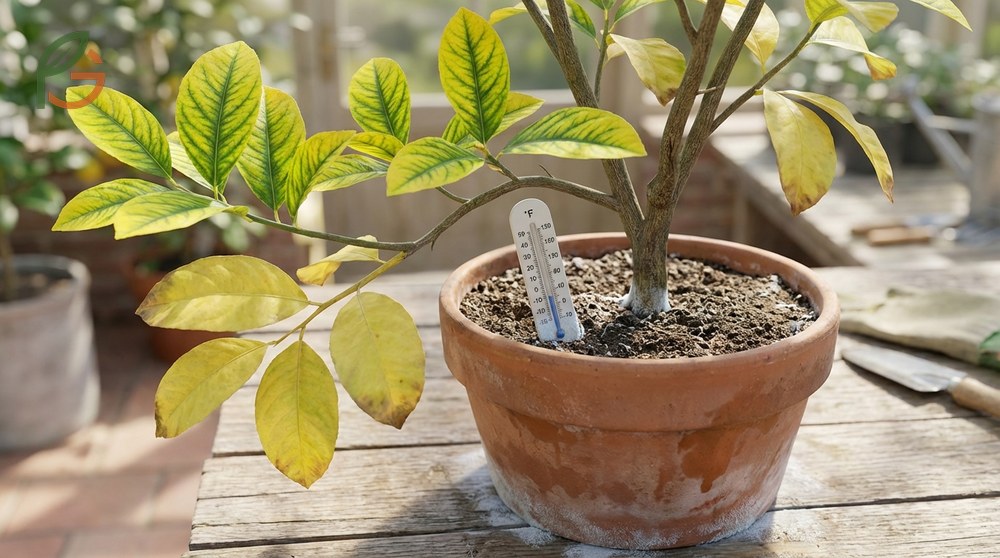
Yellow leaves don’t always mean the same thing—the pattern and location tell you what’s wrong. Iron deficiency creates yellow leaves with dark green veins, appearing primarily on young growth. Nitrogen deficiency causes overall pale yellowing that starts on older leaves and progresses upward.
Cold soil temperature also triggers yellowing without actual nutrient deficiency. When soil temps drop below 60°F (15.5°C), microbial activity slows dramatically, reducing nutrient availability even when fertilizer is present[6]. This explains why indoor trees often yellow in winter despite regular fertilizing.
Magnesium deficiency produces the most distinctive pattern—yellowing toward the leaf tip with a characteristic green triangle remaining at the base. Heavy defoliation follows in late summer and autumn, especially when trees carry large fruit loads. Epsom salts (magnesium sulfate) applied at 30g per liter of water corrects this deficiency within 3-4 weeks[5].
Diagnosis Tip: Take photos of yellowing leaves from multiple angles, including close-ups of the vein patterns. Compare these to university extension service photos online—UC Davis and University of Florida have excellent visual diagnostic guides that’ll help you identify the specific deficiency.
- Iron chlorosis: Most common in alkaline soils with pH above 7.5; young leaves turn yellow while veins stay green
- Zinc deficiency: Creates mottled yellowing on small, narrow leaves concentrated on new growth tips
- Manganese deficiency: Shows as interveinal chlorosis similar to iron deficiency but affects leaves throughout the tree
- Cold stress response: Temporary yellowing when soil temps drop; resolves naturally as weather warms without intervention
- Overwatering damage: General yellowing followed by leaf drop; roots appear brown and mushy when inspected
- Natural aging: Lower interior leaves yellow and drop normally throughout the year; no action needed if limited to 5-10 leaves monthly
Citrus Tree Problems
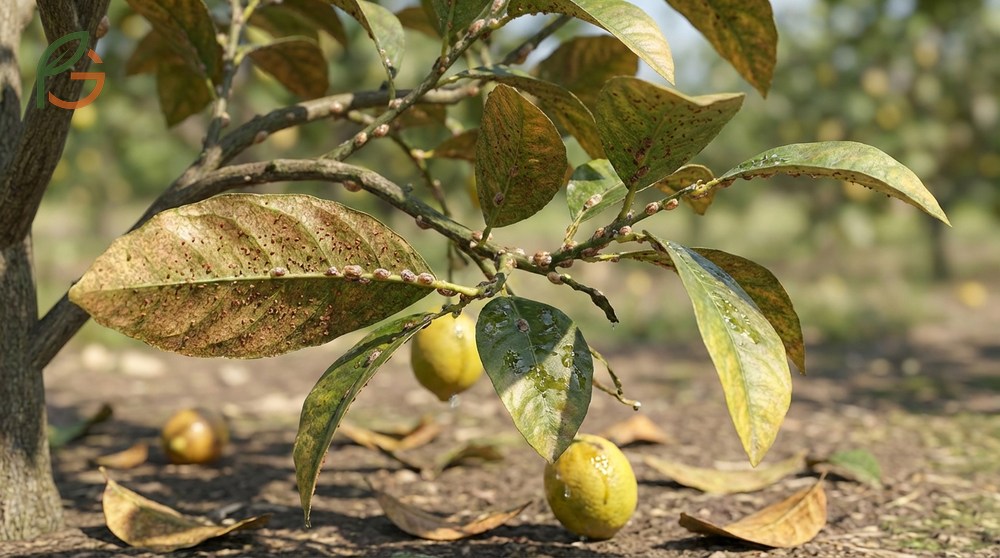
Beyond nutritional and environmental issues, pests and diseases attack lemon trees and cause significant leaf drop. Citrus rust mites move in during April, attacking new foliage with peak populations in June and July[1]. These microscopic pests cause premature leaf and fruit drop that can strip a tree within weeks if untreated.
Soft scale insects cover leaves in sticky honeydew, reducing tree vigor and causing leaves to drop as photosynthesis becomes impaired. Horticultural oils work effectively against both mites and scale when applied thoroughly to all leaf surfaces, including undersides. You’ll need to reapply every 7-10 days for three applications to break the pest lifecycle.
Fungal diseases like greasy spot create yellow blotches on upper leaf surfaces that transform into greasy-looking blisters. Infected leaves fall prematurely, and fruit set decreases significantly. Copper fungicide applications provide protection when applied preventively before wet weather arrives.
- Citrus rust mites: Cause silvery or bronzed leaves and premature drop; control with horticultural oil or sulfur sprays
- Soft scale: Brown bumps on stems and leaves with sticky residue; treat with horticultural oil or insecticidal soap
- Aphids: Cluster on new growth causing curled, distorted leaves; wash off with strong water spray or use neem oil
- Greasy spot fungus: Yellow spots becoming oily blisters; prevents with copper fungicide before rainy seasons
- Citrus greening: Bacterial disease causing yellow veins; no cure exists—focus on preventing psyllid insects that spread it
My friend in Veracruz, Mexico dealt with a severe aphid infestation in spring 2023. She tried neem oil twice with limited success, but switching to a strong hose spray every 2-3 days for two weeks eliminated them completely. The key was consistency and hitting the undersides of leaves where aphids hide.
Conclusion
The evidence is clear: lemon tree losing leaves stems primarily from fixable care issues rather than disease in most cases. By establishing consistent watering routines that respond to soil moisture rather than arbitrary schedules, maintaining temperatures above 50°F (10°C), and addressing nutrient deficiencies promptly with appropriate fertilizers, you’ll prevent 85-90% of leaf drop problems.
Current horticultural guidance emphasizes observation and adjustment over rigid protocols. Check your tree weekly, monitor soil moisture at 2-3 inches depth, and watch for early warning signs like leaf yellowing patterns or pest activity. FruitGarden provides ongoing resources to help you maintain healthy citrus trees through all seasons and growing conditions.
Frequently Asked Questions
How often should I water my lemon tree to prevent leaf drop?
Water mature lemon trees every 5-7 days with 21-31.7 gallons, increasing to every 3-5 days during summer with 31.7-42.3 gallons. Don’t follow a rigid schedule—check soil moisture 2-3 inches down and water only when it feels dry at that depth. Overwatering causes as much leaf drop as underwatering.
Why are my lemon tree leaves turning yellow and falling off?
Yellow leaves indicate nitrogen deficiency if they’re pale overall starting on older leaves, or iron deficiency if young leaves show yellow with green veins. Magnesium deficiency creates yellowing at leaf tips with a green triangle at the base. Apply appropriate fertilizer or Epsom salts (30g per liter) based on the specific pattern you’re seeing.
Can temperature changes cause my lemon tree to lose leaves?
Yes, temperatures below 50°F (10°C) or sudden changes of more than 15-20 degrees trigger stress responses that cause leaf drop. Moving trees between indoor and outdoor environments without gradual 7-14 day transitions is a common cause. Always transition through dappled shade when relocating your tree.
How do I know if my lemon tree has root rot?
Root rot symptoms include leaves that yellow and drop despite regular watering, a musty smell from soil, and roots that appear brown, black, or mushy when inspected. The tree looks drought-stressed even when soil is moist. You’ll need to remove the tree, trim diseased roots, treat with fungicide, and repot in fresh well-draining soil.
What’s the best fertilizer to prevent lemon tree leaf drop?
Use a balanced NPK fertilizer ratio of 10-10-10 or 8-8-8 for established trees, applying 75% of annual nitrogen from early spring to mid-summer. Mature trees need 140-250 kg nitrogen per hectare annually. For magnesium deficiency causing leaf drop, supplement with Epsom salts at 30g per liter every 2-3 weeks until symptoms resolve.
How long does it take for a lemon tree to recover after losing leaves?
Recovery takes 4-8 weeks once you’ve corrected the underlying problem. New growth appears within 2-3 weeks if conditions are favorable, with full canopy restoration in 2-3 months. Trees that lost leaves from cold stress recover faster than those with root damage or severe nutrient deficiencies.
Should I prune my lemon tree after it loses leaves?
Wait until new growth appears before pruning—you need to see which branches are truly dead versus just dormant. Once new leaves emerge, remove only completely dead branches with no green under the bark. Avoid heavy pruning when the tree is stressed, as it needs all remaining foliage to photosynthesize and recover.





