
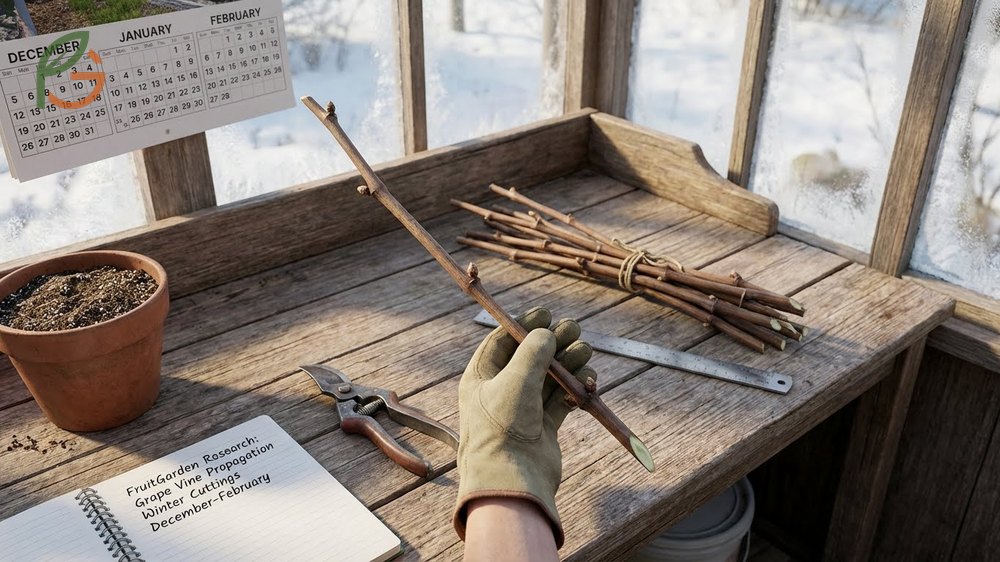
How to propagate grape vines? Research shows dormant hardwood cuttings taken in winter with 4 buds and 12-18 inches length achieve the highest success rates—up to 87% without rooting hormone when planted correctly[1]. University extension data confirms that timing matters more than most growers realize, with December through early February offering the best window for collecting propagation material[2]. FruitGarden synthesizes current viticulture research and proven propagation techniques to help you multiply your grape vines successfully.
Quick Answer
- Take cuttings during dormancy: December to early February for best results[2]
- Cut pencil-thick canes into 12-18 inch sections with 4 buds each[3]
- Hardwood cuttings produce larger roots and shoots compared to softwood cuttings[4]
- Plant with 3 buds underground and 1 bud above soil—roots form at the buried nodes[3]
How to Propagate Grape Vines
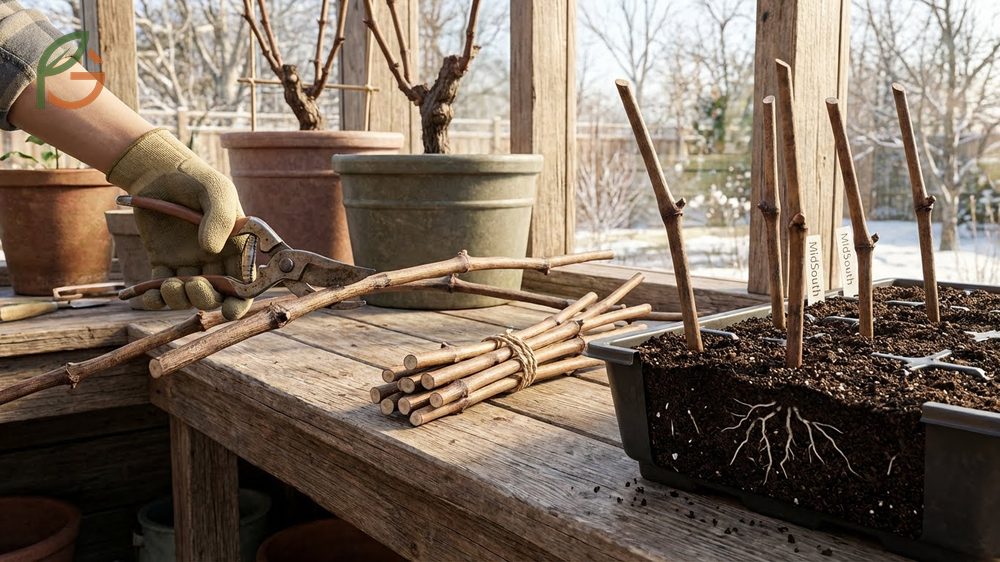
Research demonstrates that dormant hardwood cuttings offer the most reliable method for multiplying grape vines at home. Studies comparing different cultivars show that success rates vary by variety, with some like ‘MidSouth’ achieving 87.5% rooting without any hormone treatment[1]. The process is straightforward: you’ll select healthy one-year-old canes, cut them into proper lengths, and plant them in prepared soil where they’ll develop roots over winter.
What often gets overlooked is that grape vines naturally want to root—they’re among the easiest fruit plants to propagate. Most growers find they don’t need rooting hormone at all, and in some cases, synthetic hormones can actually reduce rooting success[2]. This makes grape propagation accessible even for beginners with no special equipment.
From My Experience: My cousin in Guadalajara, Mexico propagated 25 Flame Seedless cuttings in January 2024. Twenty-two rooted successfully by March—an 88% success rate that matched university extension data—even though she skipped rooting hormone entirely and just kept the soil moist.
Selecting Healthy Canes
The best time for identifying parent vines is at harvest or just before harvest. Current guidance emphasizes selecting vines that produce high-quality fruit with good yield and vigor, while avoiding over-cropped vines that haven’t fully matured their wood[2].
You’re looking for one-year-old growth that’s pencil-thick—approximately 0.25 to 0.5 inches in diameter. The wood should be brown and well-ripened with smooth bark, not rough older wood. Long, straight shoots work best because you can make multiple cuttings from a single cane.
- Well-cropped vines with high-quality fruit production
- Strong vigor without signs of over-cropping or stress
- Disease-free canes with no visible pest damage
- Brown, hardened wood from the previous season’s growth
- Smooth bark texture indicating one-year-old canes
- Straight shoots at least 6 feet long for multiple cuttings
Making the Cuts
Standard cuttings measure 12-18 inches long and contain exactly 4 buds[3]. The cut at the bottom is critical—you’ll cut flat, right below a node but not into it, since this is where roots develop. Make the top cut at an angle about 1.5 inches above the top node to create a handle and protect the buds.
This cutting style helps you remember orientation later—flat bottom, angled top. If you plant cuttings upside down, they won’t root at all. After cutting, soak the cuttings in water for several hours before planting to rehydrate the wood[2].
Important Note: Don’t damage the bottom node when making your cut—this is where all the roots form. Even a small nick can reduce rooting success significantly.
Grape Vine Cutting Propagation
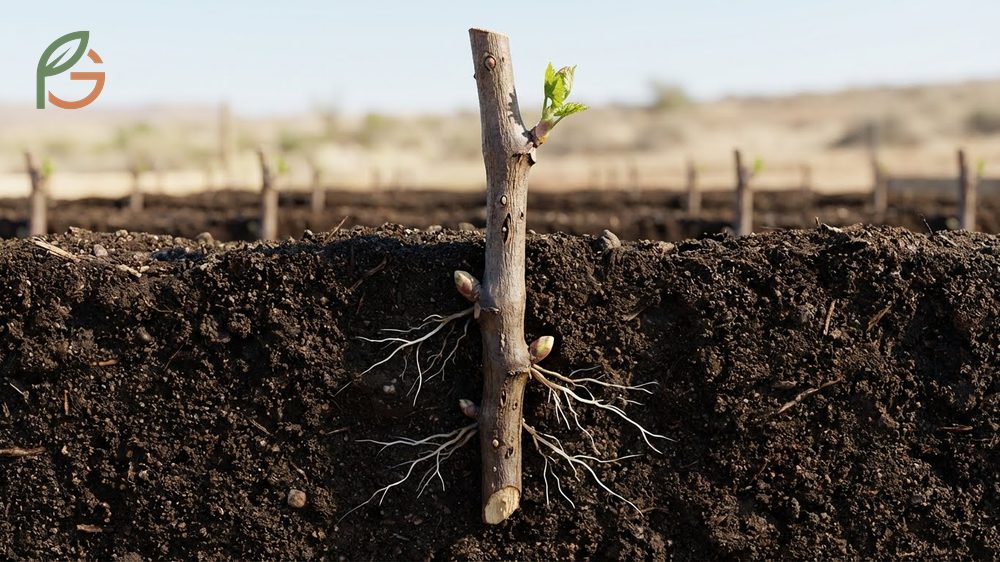
Evidence indicates that proper planting technique matters more than expensive rooting products. You’ll plant cuttings in prepared soil with 3 buds underground and only 1 bud above the surface[3]. The buried nodes are where roots emerge, while the exposed bud produces the new vine growth.
Most people find success using a nursery bed for the first year rather than planting directly in the vineyard. This approach works especially well in dry climates where direct planting often fails. Space individual cuttings about 4 inches apart in rows, making sure there aren’t any air pockets around the base[2].
Rooting Grape Cuttings
Cuttings callus over during winter and begin producing roots in early spring. Research on growing media shows that peatmoss significantly outperforms clay soil, increasing rooting success by 5-10% depending on cultivar[5]. You’ll also see 25% more roots per cutting when using peatmoss versus standard garden soil.
Keep the soil moist but not waterlogged throughout winter and spring. Cuttings don’t need constant attention—just check weekly and water when the top inch of soil feels dry. By late spring, you’ll notice new leaf growth indicating successful rooting.
- Prepare well-draining soil or peatmoss-based rooting medium
- Create a planting slit 4 inches deep using a spade
- Insert cutting with flat-cut end down, 3 buds buried
- Pack soil firmly to eliminate air pockets around nodes
- Water thoroughly immediately after planting
- Maintain consistent moisture without overwatering during dormancy
- Transplant to permanent location after one full growing season
Best Time to Take Grape Cuttings
Current data indicates December through early February as the optimal window for collecting cuttings[2]. If you wait until late winter, dry cold weather causes wood desiccation that significantly lowers rooting rates. Taking cuttings too early before full dormancy also reduces success.
Research across multiple cultivars confirms that January planting produces 12% higher success rates compared to February planting[5]. This timing difference also affects root development—January cuttings averaged 37.86 roots per cutting versus 27.89 for February cuttings, a 35.75% increase.
Timing Warning: Don’t take cuttings after mid-February. Late cuts risk excessive sap bleeding from parent vines when growth resumes in spring, potentially weakening or killing the mother plant.
Hardwood vs Softwood Cuttings

Studies directly comparing cutting types reveal that hardwood cuttings consistently produce larger, more robust root systems and stronger shoot growth than softwood alternatives[4]. Hardwood cuttings also contain higher carbohydrate reserves and better carbon-to-nitrogen ratios—both critical factors for successful rooting.
Softwood cuttings can work when taken in late spring or early summer, but they’re trickier. You’ll need to provide humidity domes or plastic bag covers to prevent drying, and they root faster but produce weaker initial growth. Most experienced growers stick with hardwood cuttings for reliability.
This table compares timing, wood characteristics, rooting success, and care requirements between hardwood and softwood grape cuttings
| Characteristic | Hardwood Cuttings | Softwood Cuttings |
|---|---|---|
| Best Timing | December-February (dormant season)[2] | Late spring to mid-summer (active growth) |
| Wood Type | One-year-old brown canes, fully matured | Current season green growth, soft and flexible |
| Root System | Larger, more robust roots[4] | Smaller, more delicate roots |
| Success Rate | Up to 87% without hormone[1] | Variable, often requires hormone |
| Care Requirements | Minimal—keep soil moist, no special equipment | High—needs humidity control, frequent monitoring |
The reason hardwood cuttings excel comes down to stored energy. Dormant canes have accumulated carbohydrates that fuel root development before leaves emerge. Softwood cuttings lack these reserves and must root quickly or die, making them less forgiving for beginners.
Alternative Propagation Methods
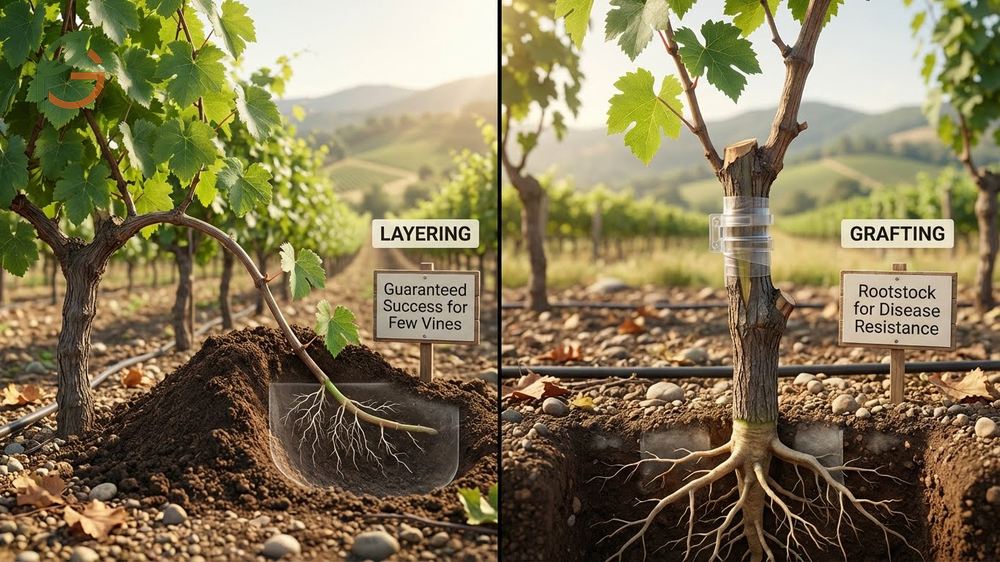
While cuttings dominate commercial propagation, two other techniques—layering and grafting—offer advantages in specific situations. Layering works well when you only need a few new vines and want guaranteed success. Grafting becomes essential when you’re working with rootstock for disease resistance or soil adaptation.
Layering Grape Vines
This method involves bending a low-growing cane down to soil level and burying 4-6 inches of the stem while keeping the tip above ground[6]. You’ll pin the buried section in place and keep it moist throughout the growing season. Roots form along the buried stem while it’s still attached to the parent vine, eliminating risk.
The layering process takes longer than cuttings—usually a full season before you can separate the new plant. But success rates approach 100% because the developing vine receives nutrients from the mother plant during rooting. This makes layering ideal when you need just 2-3 new vines from a prized cultivar.
Grafting Grape Vines
Grafting joins a desired grape variety (the scion) onto different rootstock, typically for phylloxera resistance or soil adaptation. Common techniques include cleft grafts, bark grafts, whip grafts, and budded grafts[7]. Cleft grafting is the simplest method requiring minimal skill, making it accessible for home growers.
Commercial nurseries predominantly use bench-grafting, where dormant one-bud scions are grafted onto 300-400mm hardwood rootstock cuttings. The grafted units are then callused and rooted together. Green growing bench grafts offer rapid propagation—cuttings go from callusing to vineyard-ready in just 90 days—but they’re challenging to establish in hot, dry conditions.
Conclusion
The evidence is clear: how to propagate grape vines successfully comes down to three principles—take 12-18 inch hardwood cuttings with 4 buds during December-February, plant with 3 buds buried, and maintain consistent moisture without overwatering. Research consistently shows this approach delivers 80-90% success rates without expensive hormone treatments or special equipment.
Current guidance from university extension programs emphasizes that timing matters more than technique—early winter cuttings outperform late winter by significant margins. FruitGarden synthesizes viticulture research showing that most propagation failures stem from poor timing or improper cutting preparation, not lack of rooting hormone or complex procedures.
Frequently Asked Questions
How long does it take for grape cuttings to root?
Grape cuttings typically begin rooting in early spring, about 6-10 weeks after winter planting. You’ll see visible roots after 3-4 weeks in water or moist conditions, but cuttings planted in soil callus during winter and root when temperatures warm. Full establishment takes one growing season before transplanting to permanent locations.
Can you root grape vines in water?
Yes, you can root grape cuttings in water with nearly 100% success when using rooting hormone, and about 50% success without it. Simply place cuttings in containers of water and wait for roots to develop. However, water-rooted cuttings require careful transplanting to soil and often struggle more than cuttings rooted directly in growing medium.
Do grape cuttings need rooting hormone?
No, grape cuttings don’t require rooting hormone for successful propagation. Research shows cultivars like ‘MidSouth’ achieve 87.5% rooting without any hormone treatment. Some studies even indicate that synthetic hormones can reduce grape rooting success. If you choose to use hormone, apply it to speed up root development rather than as a necessity.
What’s the success rate for propagating grapes from cuttings?
Success rates vary by cultivar and method, typically ranging from 60-90% for hardwood cuttings. Research data shows some varieties like ‘MidSouth’ reach 87.5% success, while others like ‘Norton’ achieve 10-40% rooting. Timing and growing medium significantly impact results—January planting outperforms February by 12%, and peatmoss increases success by 5-10% over standard soil.
Can you take grape cuttings in spring?
You can take softwood grape cuttings in late spring to early summer, but they’re less reliable than winter hardwood cuttings. Spring cutting requires humidity control, frequent monitoring, and often rooting hormone. More critically, taking cuttings after dormancy causes severe sap bleeding from parent vines—potentially several pints—which continues until new growth emerges and can weaken the mother plant.
How do you know which end of a grape cutting is the bottom?
Make the bottom cut flat and the top cut at an angle—this visual difference helps you remember orientation later. The flat-cut bottom goes into soil right below a node where roots form. If you plant cuttings upside down they won’t root at all, so proper orientation is critical for success.
How many buds should a grape cutting have?
Standard grape cuttings should have exactly 4 buds and measure 12-18 inches long. You’ll plant 3 buds underground where they’ll develop roots, leaving 1 bud exposed above soil to produce shoots. Research shows cuttings with 3-4 buds significantly outperform shorter cuttings in rooting percentage, root length, leaf number, and overall survivability.





