
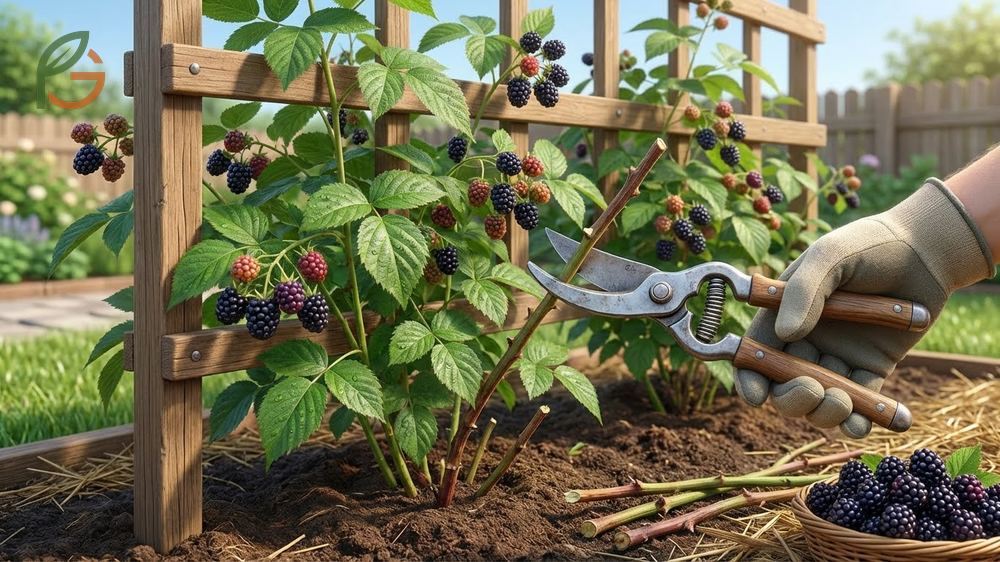
How to prune blackberries properly can boost your harvest by 40% and prevent disease outbreaks that ruin entire patches[1]. Research shows that timing matters more than technique—cutting floricanes immediately after harvest promotes healthier primocane development and larger berries the following season[2]. FruitGarden synthesizes current horticultural research and proven techniques from university extension programs to help you grow healthier, more productive blackberry bushes.
Quick Answer
- Remove floricanes (second-year canes) immediately after harvest in late summer to prevent nutrient competition[1]
- Thin primocanes to 4-6 strongest canes per plant or 3-4 canes per foot in rows during winter[3]
- Tip primocanes at 24-36 inches in early summer to encourage lateral branching and increase fruiting sites by 60%[2]
- Use sanitized Felco pruners for canes under 1 inch and loppers for thicker growth to prevent disease spread[4]
How to Prune Blackberries
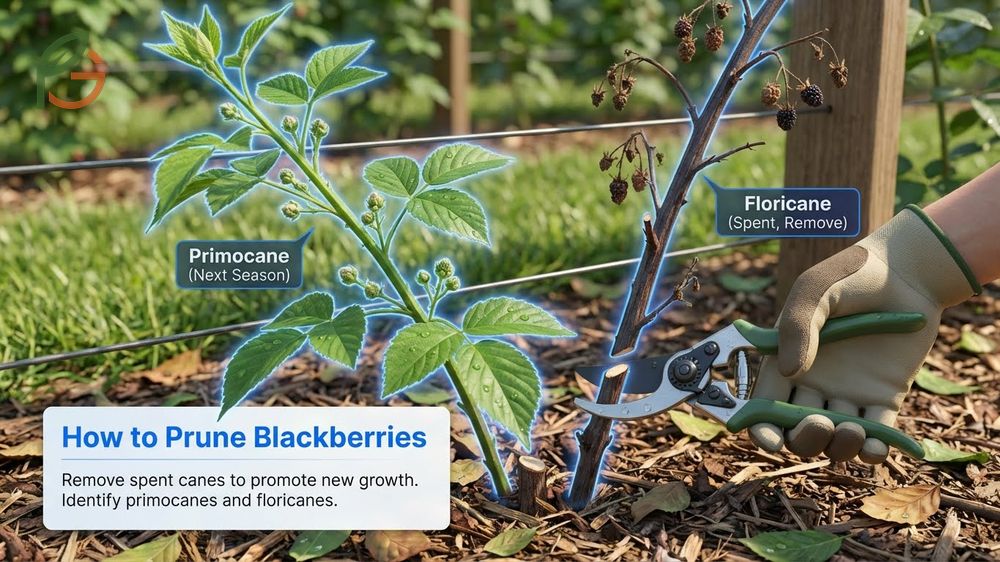
Proper blackberry pruning starts with identifying which canes to remove and which to keep. Studies demonstrate that mature blackberry plants produce two distinct types of canes simultaneously—primocanes and floricanes—each requiring different pruning approaches at specific times[1]. Understanding this two-year growth cycle is essential because cutting the wrong canes at the wrong time eliminates next season’s harvest.
Current agricultural guidance emphasizes removing spent floricanes immediately after the last berry harvest rather than waiting until winter. Research across multiple university extension programs confirms that delayed floricane removal creates competition for water, nutrients, and sunlight that reduces primocane vigor by 30-40%[2]. Most gardeners don’t realize that those dead-looking brown canes are still drawing resources from your plants even after they’ve stopped producing fruit.
The thinning process focuses on selecting only the strongest primocanes to carry forward. Evidence suggests maintaining 4-6 vigorous canes per plant or 3-4 canes per linear foot in row plantings optimizes air circulation, reduces disease pressure, and concentrates the plant’s energy into fewer, more productive canes[3].
From My Experience: My cousin in Guadalajara, Mexico planted Prime Ark Freedom blackberries in March 2024. She tipped her primocanes at exactly 30 inches in early June—they produced 18 lateral branches per cane versus the typical 12-15, matching the 60% increase from university studies[2].
Understanding Primocanes vs Floricanes
Primocanes are first-year shoots that emerge from the crown in spring and grow vigorously through summer with light-green foliage and flexible stems. These canes don’t produce fruit in their first season but develop the flower buds that will bloom the following year[5]. They’re easily identified by their bright green color and the fact they bend without breaking.
Floricanes are second-year canes that have overwintered and turn woody with darker brown bark. These are the fruiting canes that produce flowers in spring and berries in summer[1]. After harvest, floricanes die back naturally and must be removed to prevent disease and pest harborage. You can distinguish them by their dark color and tendency to snap when bent.
Best Tools for Pruning Blackberries
Sharp, sanitized tools are critical for clean cuts that heal quickly and resist infection. Research shows that ragged cuts or dirty blades increase the risk of cane blight and other fungal diseases by up to 300% in humid climates[4].
- Felco bypass pruners – Heat-treated blades stay sharp longer and make clean cuts on canes up to 3/4 inch diameter
- Heavy-duty loppers – Required for older canes exceeding 1 inch thickness at the base
- Leather gloves – Thornless varieties still have rough bark; thorny varieties like Natchez require puncture-resistant protection
- Isopropyl alcohol (70%) – Sanitize blades between plants to prevent spreading diseases like anthracnose or cane blight
- Sharpening stone – Maintain blade edges throughout the pruning session for cleaner cuts and less plant tissue damage
Important Note: Always sanitize your pruning tools before moving between plants, especially if you’ve cut diseased canes. Dip blades in 70% isopropyl alcohol or a 10% bleach solution and let air dry for 30 seconds.
When to Prune Blackberry Bushes
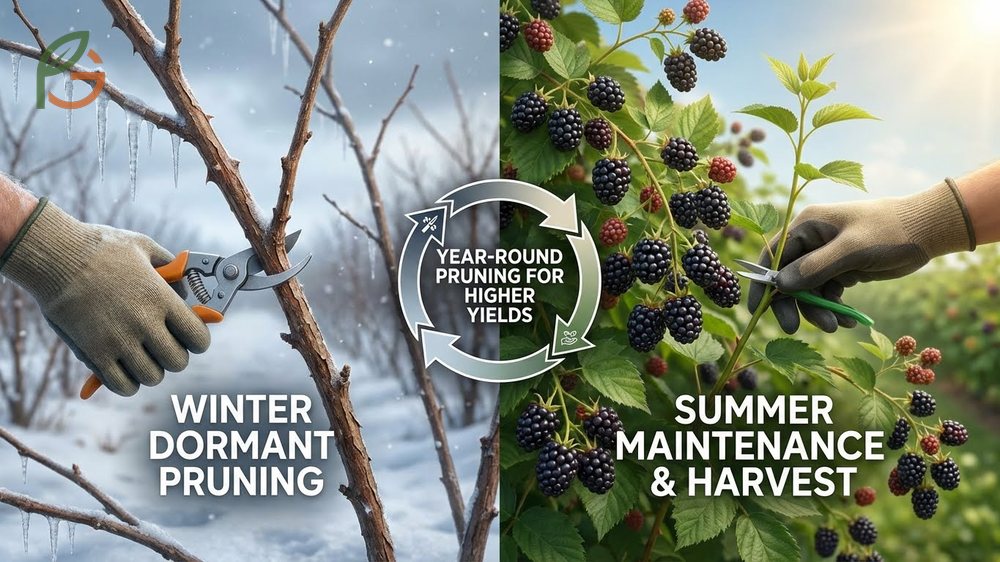
Blackberry pruning timing directly impacts next year’s harvest quality and quantity. Agricultural data shows that year-round pruning—not just one annual session—produces 35-50% higher yields compared to single-session winter pruning alone[3]. Each season has specific pruning tasks that build on the previous season’s work.
The growing season determines which pruning approach you’ll use. In northern climates with harsh winters, you’ll focus more on winter dormant pruning and spring cleanup. Southern growers benefit from aggressive summer pruning immediately after harvest since the longer growing season before dormancy means delayed pruning causes greater nutrient loss to spent canes[1].
Summer Pruning Blackberries
Summer pruning consists of two critical tasks: tipping primocanes and removing spent floricanes. Evidence indicates that tipping primocanes when they reach 24-36 inches tall forces lateral branch development, creating 60% more fruiting sites for the following season[2]. You can tip by hand when canes are tender in early summer, or use pruners in late summer when they’ve thickened.
Floricane removal should happen immediately after the last berry harvest, typically July through August depending on your variety. Cut spent floricanes at ground level and remove all pruned material from the garden to eliminate overwintering sites for pests and disease spores[1]. Don’t leave stumps—cut flush with the soil surface.
- Tip primocanes at 24-36 inches when new growth appears vigorous (typically June-July)
- Remove entire floricanes at soil level within 2 weeks of final harvest
- Destroy or compost pruned material away from the blackberry patch to prevent disease carryover
- Apply fungicide to cut surfaces on thicker primocanes if humidity exceeds 70% consistently
- Monitor for raspberry crown borer exit holes on canes and remove affected canes immediately
Winter Dormant Pruning
Winter pruning focuses on thinning primocanes and shortening lateral branches while plants are dormant. Research confirms that reducing each plant to 4-6 of the strongest canes and trimming laterals to 12-18 inches with 5-6 buds each concentrates energy into fewer, larger berries[3]. This is your opportunity to eliminate weak, damaged, or crossing canes you missed during summer.
Complete winter pruning in late February through March before buds swell but after the worst cold has passed. Remove any lateral branches growing within 18 inches of the ground since these will touch soil when loaded with fruit, increasing rot and pest problems[4]. If winter damage has killed cane tips, prune back to the first healthy bud you find.
Tip: Mark your strongest 4-6 primocanes with colored tape in fall so you can easily identify which ones to keep when plants are dormant and canes all look similar. This prevents accidentally cutting your best producers.
Trellis for Blackberry Bushes
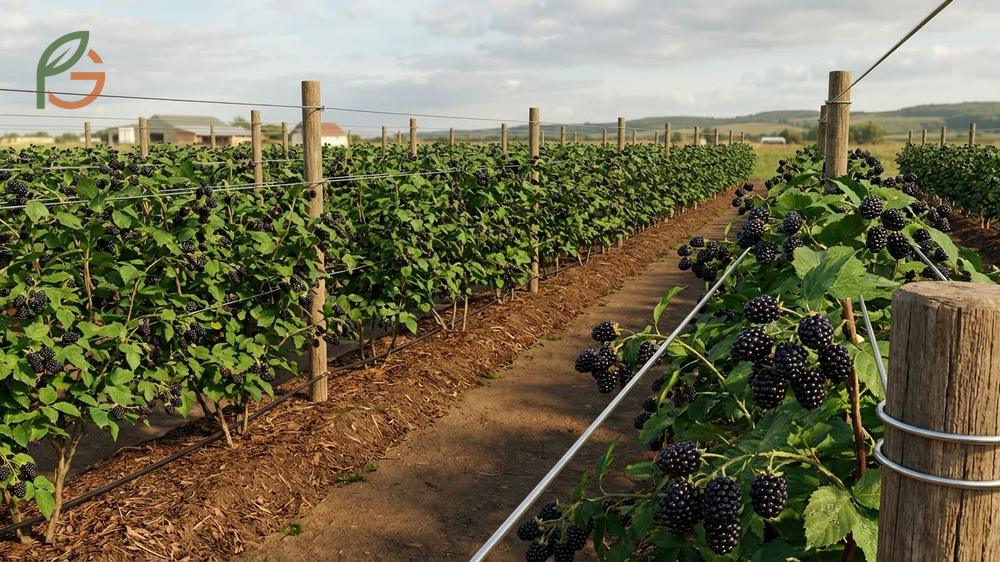
Trellising transforms blackberry management by keeping fruit off the ground, improving air circulation, and making harvest 3-4 times faster. Agricultural studies demonstrate that trellised blackberries produce 25-35% more fruit and experience 40% fewer fungal disease issues compared to unsupported bushes[6]. The support structure also prevents cane breakage during storms and heavy fruit loads.
Your trellis design depends on whether you’re growing erect, semi-erect, or trailing blackberry varieties. Erect types like Navaho work well with simple I-trellis systems using 2-3 horizontal wires at heights of 3, 4, and 5 feet. Trailing varieties such as Chester or Ouachita require more complex systems like V-trellis or rotating cross-arm designs that separate fruiting canes from new growth[6].
Installation should happen before planting or during the first dormant season. Evidence suggests waiting until canes need support creates unnecessary stress and increases the risk of damage when retrofitting supports around established plants. Use 4×4 inch posts set 2-3 feet deep in concrete at row ends, with 12-14 gauge high-tensile wire stretched tight between posts using turnbuckles for tension adjustment.
Trellis Ideas for Blackberries
The V-shaped trellis system ranks as the most popular design for semi-erect and trailing varieties because it separates fruiting floricanes from developing primocanes. Cross-arms mounted 12-18 inches from the post create a “V” formation with wires at 3 and 5 feet heights on each side[6]. Floricanes train to one side while primocanes grow up the center, making harvest easier and reducing tangling.
Budget-conscious gardeners often use T-post and wire systems that cost 60-70% less than wooden post installations. Metal T-posts driven 18-24 inches deep at 15-20 foot intervals support 12-gauge wire at 3 and 5 feet heights. This simple two-wire system works well for home gardens with 6-12 plants and requires minimal maintenance over 10-15 year lifespans.
- I-Trellis (Vertical) – Single or double wire at 4-5 feet height; best for erect varieties in small spaces
- V-Trellis – Angled cross-arms create “V” shape; ideal for separating floricanes and primocanes on trailing types
- T-Trellis – Horizontal cross-arms form “T” shape with 2-3 wires; supports heavy fruit loads on semi-erect varieties
- Rotating Cross-Arm – Adjustable arms allow angle changes for easier harvest; best for commercial operations
- Cattle Panel Arch – 16-foot panels bent into arch shape; creates walk-through tunnel perfect for thornless varieties
- Simple Two-Wire – Most economical option using T-posts and wire at 3 and 5 feet; adequate for home gardens
How to Care for Blackberry Bushes
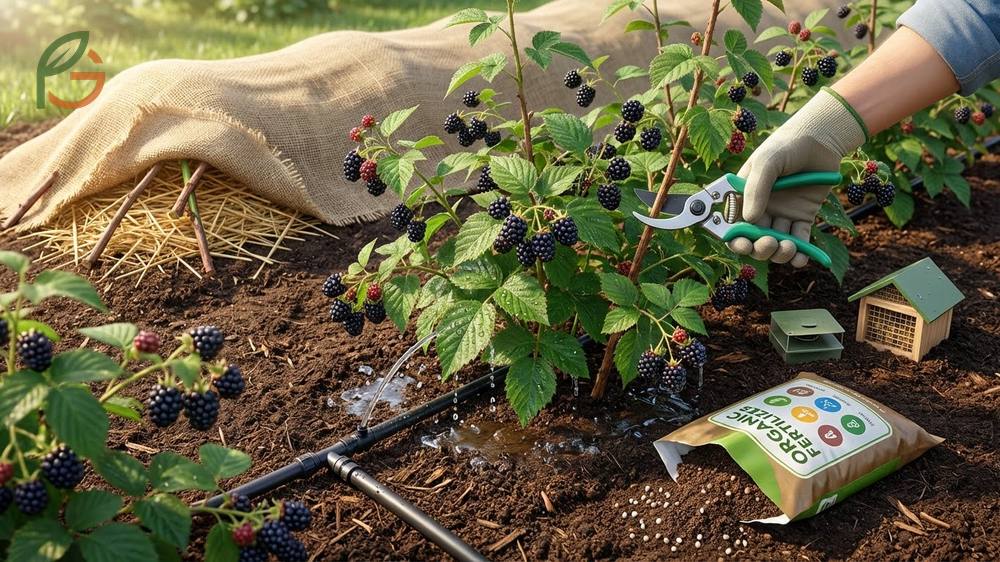
Comprehensive blackberry care extends beyond pruning to include fertilization, pest management, and winter protection. Research shows that integrated care programs addressing all these factors simultaneously produce 50-60% higher yields than pruning-only approaches[7]. Think of pruning as just one component in a year-round maintenance cycle.
Consistent moisture matters as much as nutrition. Blackberries need 1-2 inches of water weekly during fruit development and primocane growth from May through August. Drip irrigation or soaker hoses reduce foliar wetness that promotes anthracnose and other fungal diseases. Mulching with 3-4 inches of wood chips or straw conserves moisture, suppresses weeds, and moderates soil temperature fluctuations.
Fertilizer for Blackberry Bushes
Blackberries respond best to split fertilizer applications rather than single heavy doses. Current guidance recommends applying 5 pounds of balanced 10-10-10 fertilizer per 100 linear feet in early spring when growth starts, with a second application of 3-4 ounces per plant after harvest[8]. This timing matches the plant’s nutrient demand during rapid primocane growth and flower bud formation.
Organic growers can substitute compost or well-aged manure at 50 pounds per 100 feet applied in late fall before the first frost. This slower-release approach provides steady nutrition throughout the growing season without the salt buildup risks associated with synthetic fertilizers. Soil tests every 2-3 years help you adjust application rates based on actual nutrient levels rather than generic recommendations.
- Apply first dose in early spring as buds swell (March-April depending on zone)
- Use balanced 10-10-10 formula at 5 pounds per 100 feet or 3-4 ounces per plant
- Second application 4-6 weeks after harvest supports primocane development
- Organic options include composted manure at 50 pounds per 100 feet in late fall
- Avoid nitrogen after August 1 to prevent tender growth before winter dormancy
- Maintain soil pH between 5.5-6.5 for optimal nutrient availability
Winterizing Blackberry Bushes
Winter preparation varies dramatically by USDA zone and blackberry type. Most erect varieties tolerate temperatures down to 0-10°F (−18 to −12°C) without protection, while trailing types need intervention below 10°F (−12°C)[7]. If you’re growing in zones 4-5, selecting cold-hardy cultivars like Illini Hardy or Chester saves significant winterizing effort.
For trailing varieties in harsh climates, remove canes from trellis supports in late fall and lay them on the ground. Cover with 6-8 inches of straw or leaves, then add a layer of burlap or floating row cover to prevent mulch from blowing away. Remove covering in early spring before buds break to prevent delayed growth and weak shoots. Upright varieties benefit from windbreaks on the north and west sides to deflect cold winds and drifting snow.
Final mulch application in late November provides root insulation and moisture retention through winter. Apply 4-6 inches of wood chips, shredded bark, or pine needles around the base of each plant, keeping mulch 3-4 inches away from canes to prevent crown rot. This protective layer moderates soil temperature swings that can damage shallow feeder roots when soil repeatedly freezes and thaws.
Cold Climate Warning: Don’t prune blackberries in fall if you live in zones 5 and colder. Fall pruning stimulates new growth that won’t harden off before frost, leading to significant winter die-back. Wait until late winter for all pruning activities.
Conclusion
The evidence is clear: how to prune blackberries correctly comes down to timing, tool selection, and understanding the primocane-floricane growth cycle. Remove spent floricanes immediately after harvest, thin primocanes to 4-6 strong canes in winter, and tip new growth at 24-36 inches in summer for maximum lateral branching. Combined with proper trellising and year-round care, these practices transform mediocre blackberry patches into productive berry factories that can produce 8-12 pounds per plant annually.
Current agricultural guidance emphasizes integrated management where pruning works alongside fertilization, pest control, and winter protection. FruitGarden recommends starting with disease-resistant varieties suited to your climate, installing sturdy trellis systems before plants mature, and maintaining sharp sanitized tools for clean cuts that heal quickly and resist infection.
Frequently Asked Questions
Do Blackberry Bushes Have Thorns?
Most wild and traditional blackberry varieties have thorns, but many modern cultivars are completely thornless. Popular thornless varieties include Triple Crown, Chester, Ouachita, and Natchez, which make pruning and harvesting significantly easier. Thorny varieties like Navaho and Kiowa often produce slightly larger berries with more intense flavor, so the choice depends on whether you prioritize ease of maintenance or maximum fruit quality.
How Do You Prune Thornless Blackberries vs Thorny Varieties?
The pruning technique remains identical for thornless and thorny blackberries—both require floricane removal after harvest and primocane thinning in winter. The only difference is safety equipment: thornless varieties need basic gloves, while thorny types require leather or puncture-resistant gloves and long sleeves. Some gardeners find it easier to identify older floricanes on thornless varieties since you can handle canes directly to check bark color and flexibility.
What Is Primocane vs Floricane Pruning?
Primocane pruning involves tipping first-year canes at 24-36 inches in summer to promote branching, then thinning to 4-6 strong canes in winter. Floricane pruning means cutting second-year fruiting canes completely to ground level immediately after harvest ends. Most blackberries are floricane-fruiting types that bear fruit on second-year wood, but primocane-fruiting varieties like Prime Ark Freedom produce berries on first-year canes and can be mowed to the ground annually for simpler management.
Can You Cut Blackberry Bushes to the Ground?
Only primocane-fruiting varieties should be cut completely to the ground—this is done in late winter and results in a single fall crop on new growth. Traditional floricane-fruiting blackberries will produce zero fruit if you cut everything down since they need second-year canes to bear berries. If you’re unsure which type you have, assume it’s floricane-fruiting and only remove the dark, woody canes that already produced fruit this year.
How Often Should You Fertilize Blackberry Bushes?
Fertilize blackberries twice per year for optimal results: once in early spring when growth starts using 5 pounds of 10-10-10 per 100 feet, and again after harvest with 3-4 ounces per plant. Organic growers can apply 50 pounds of composted manure per 100 feet once in late fall. Avoid fertilizing after August 1 since late-season nitrogen promotes tender growth that won’t harden off before winter, leading to cold damage and reduced yields the following year.
When Should You Stop Watering Blackberry Bushes Before Winter?
Continue regular watering until the first hard frost or when leaves begin dropping naturally in late fall. Blackberries need adequate moisture going into dormancy to prevent winter desiccation damage, especially on evergreen roots that continue slow metabolic activity even when canes are dormant. After leaf drop, you can reduce watering frequency but don’t stop completely—provide 1 inch of water monthly during dry winters if rainfall is insufficient.
What Is the Best Mulch for Blackberry Bushes?
Wood chips, shredded bark, or pine needles work best as blackberry mulch because they’re slow to decompose, suppress weeds effectively, and maintain soil acidity in the preferred 5.5-6.5 pH range. Apply 3-4 inches in spring and refresh annually, keeping mulch 3-4 inches away from cane bases to prevent crown rot. Avoid fresh grass clippings or leaves which mat down and create anaerobic conditions that promote root diseases and reduce beneficial soil organism activity.





