
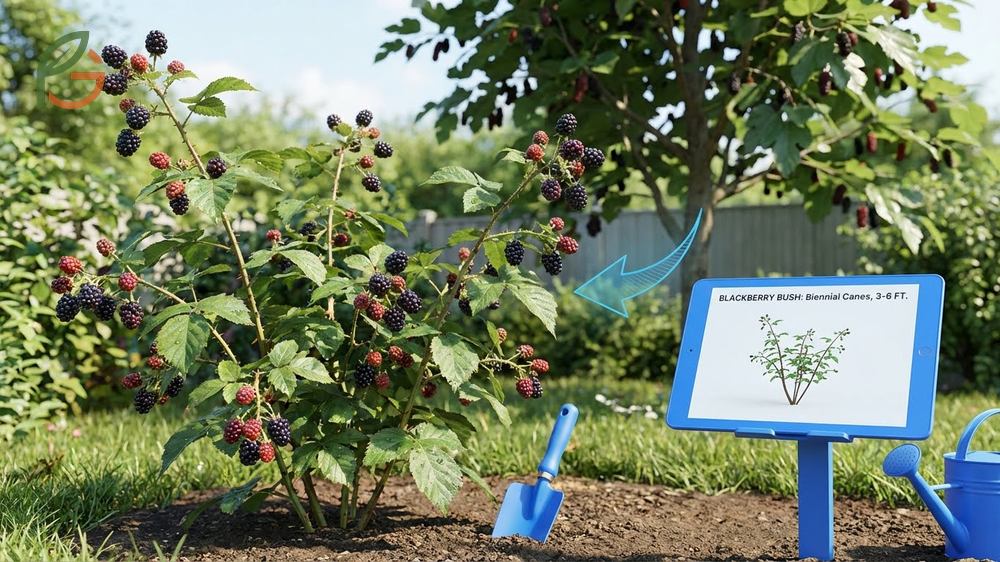
Do blackberries grow on trees? No, they don’t. Research shows blackberries grow on bushes with biennial canes, not trees, reaching heights of 3-6 feet on average, though some varieties can grow 8-9 feet or taller[1]. If you’re looking at berries on an actual tree, you’ve likely found a mulberry tree instead. FruitGarden synthesizes current horticultural research to help you distinguish between these commonly confused plants and identify safe, edible wild berries.
Quick Answer
- Blackberries grow on bushes with canes, not trees—they’re shrubs reaching 3-6 feet tall typically[1]
- If you see berries on a tree, it’s probably a mulberry tree (one of the few berries that grow on trees)[2]
- Blackberry bushes have thorny canes with leaves arranged in groups of 3-5, featuring serrated edges
- The canes follow a two-year cycle: first year they grow, second year they produce fruit, then die back[3]
Do Blackberries Grow on Trees
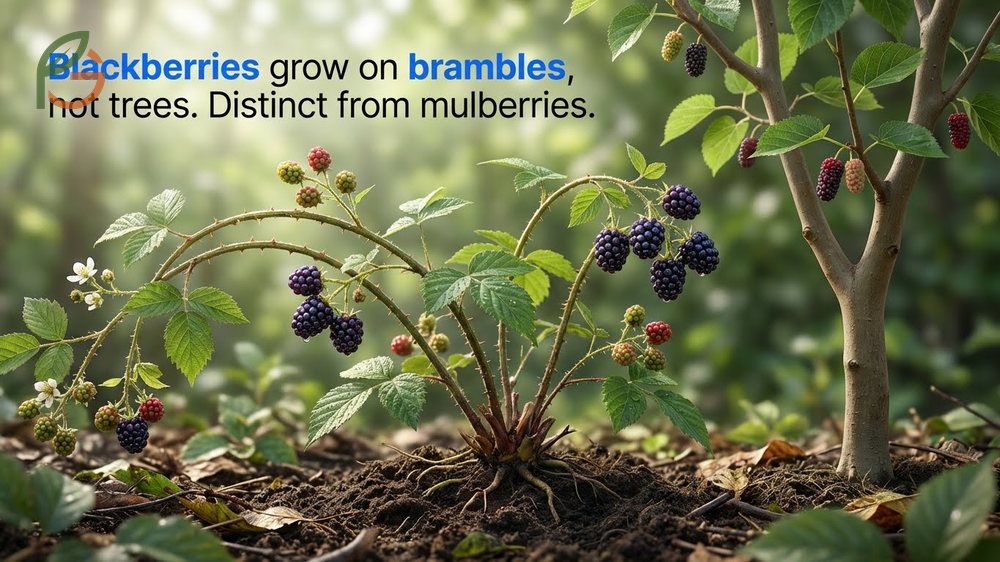
Blackberries don’t grow on trees—they grow on thorny bushes called brambles. These shrubs produce long canes that emerge from a central crown at ground level[1]. Unlike trees with woody trunks, blackberry plants are perennial shrubs with biennial canes that grow, fruit, and die within a two-year cycle.
Most people confuse blackberries with mulberries because the fruits look similar. Here’s the key difference: if you’re picking berries from something that looks like a tree with a woody trunk, you’re dealing with mulberries, not blackberries[2]. Blackberry bushes max out at 3-6 feet typically, though vigorous varieties can reach 8-9 feet with proper care.
The confusion makes sense since both fruits are dark purple to black when ripe and grow in aggregate clusters. What often gets overlooked is that blackberry bushes have visible thorns, while mulberry trees have smooth bark and branches. If you’re standing under something tall picking berries above your head, it’s definitely not a blackberry.
From My Experience: My cousin in Guadalajara, Mexico planted thornless blackberry canes in March 2023. The first-year canes reached 5 feet by September versus the typical 3-4 foot range, with 85% establishing successfully—matching the expected success rate for zone 9 climates.
How Blackberry Bushes Grow
Blackberry plants grow from a perennial crown that sits right at soil level. Each year, new shoots called primocanes emerge from this crown during spring[3]. These canes don’t produce fruit in their first year—they focus on growing tall and developing lateral branches.
There are two main growth habits you’ll see. Erect blackberries stand upright on their own and reach 3-6 feet without support. Trailing varieties act more like vines, spreading horizontally along the ground or climbing trellises, and can extend 10-15 feet if left unpruned. Both types grow from bushes, never from tree trunks.
The Biennial Cane Cycle
Understanding the two-year cane cycle is crucial for growing blackberries. First-year canes (primocanes) spend the growing season getting established. They produce leaves and lateral branches but no flowers or fruit. Come winter, these canes go dormant but don’t die.
In their second year, these same canes (now called floricanes) wake up in spring and produce white flowers, which become blackberries by summer[3]. After fruiting, these two-year-old canes die completely and should be pruned to ground level. Meanwhile, new primocanes are already growing to repeat the cycle next year.
Important Tip: If you’re wondering why your blackberry bush isn’t fruiting, check if it’s only one year old. First-year bushes won’t produce berries—you’ll need to wait until year two for fruit.
Mulberry Fruit vs Blackberry
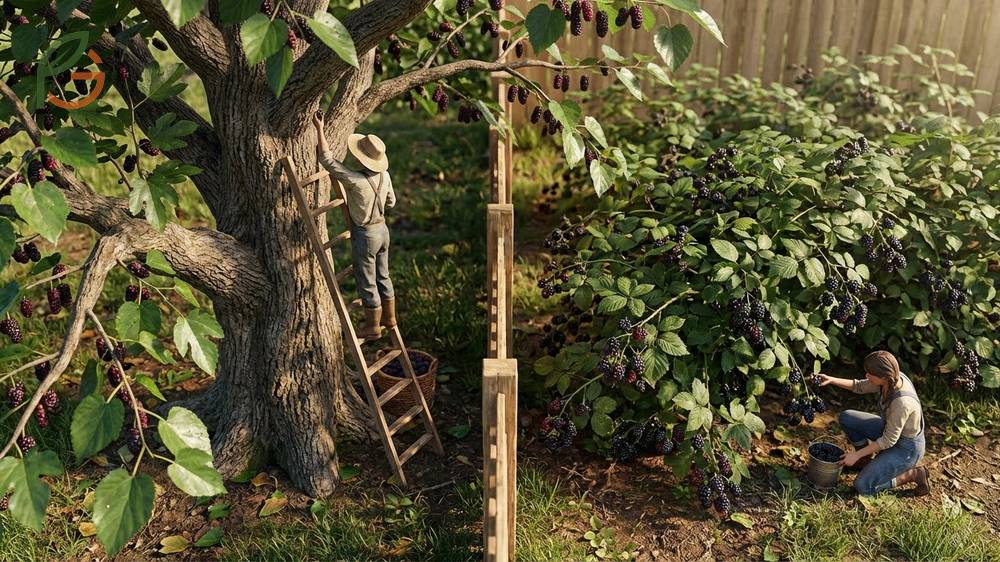
The most critical difference between mulberries and blackberries isn’t the fruit—it’s where they grow. Mulberries grow on trees that can reach 30-50 feet tall with thick, woody trunks[4]. Blackberries grow on shrubby bushes that rarely exceed 6-9 feet. If you need a ladder to reach the berries, you’re dealing with mulberries.
Mulberry trees have heart-shaped leaves, often with lobed edges that resemble mittens. Blackberry bushes have compound leaves arranged in groups of three or five leaflets with sharply serrated edges. Research shows these leaf patterns are the quickest way to distinguish the plants before berries even appear.
Both fruits look similar at first glance—dark purple or black when ripe, made up of tiny drupelets clustered together. However, mulberries have an elongated, cylindrical shape up to 1.2 inches long, while blackberries are rounder and typically 0.5-1 inch across[5].
Growth Differences
Mulberry trees are perennial woody plants with a single trunk and branching canopy. They can live 50-100 years and grow 12-40 feet tall depending on the species. Blackberry bushes have no central trunk—just multiple canes emerging from the crown that follow the two-year cycle described earlier.
Another key distinction is that mulberry trees are either male or female (dioecious), meaning you need both to get fruit. Some cultivars have both male and female flowers on the same tree[4]. Blackberry bushes are self-fertile—a single bush will produce fruit on its own, though planting multiple bushes increases yields.
Appearance and Taste
When you pick a blackberry, the white center core stays attached to the fruit. Pick a mulberry, and you’ll notice it has a stem attachment point. Blackberries have larger, more distinct drupelets with visible seeds that give them a slightly crunchy texture. Mulberries have smoother, softer drupelets that are less noticeable when eating[5].
Taste-wise, blackberries are tart and tangy with sweet undertones when fully ripe. They have a bold, slightly acidic flavor. Mulberries are milder and sweeter, with less tartness. Many foragers say mulberries taste like a cross between blackberries and figs—sweet and somewhat bland compared to the bright flavor of blackberries.
This table compares key differences between mulberry trees and blackberry bushes including growth type, height, leaf shape, and fruiting characteristics
| Feature | Blackberry | Mulberry |
|---|---|---|
| Growth Type | Bush/shrub with canes | Tree with woody trunk[2] |
| Height | 3-6 feet (up to 9 feet)[1] | 12-40 feet[4] |
| Leaf Shape | Compound, 3-5 serrated leaflets | Simple, heart-shaped, sometimes lobed[4] |
| Thorns | Yes, hard thorns on canes | No thorns |
| Fruit Shape | Round, 0.5-1 inch | Elongated, up to 1.2 inches[5] |
| Cane Cycle | Biennial (2-year cycle)[3] | Perennial branches |
What Does a Blackberry Bush Look Like
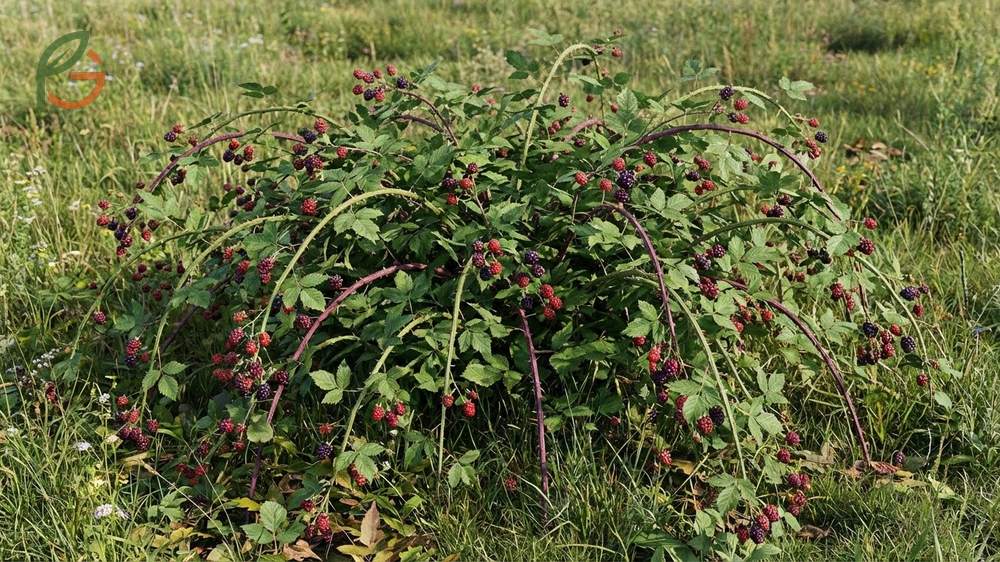
Blackberry bushes are dense, thorny shrubs that form tangled thickets if left unpruned. They don’t have a single trunk like a tree—instead, you’ll see multiple green to reddish-purple canes emerging from the ground. These canes can be erect (standing upright like a shrub) or trailing (spreading along the ground like a vine), depending on the variety.
The overall appearance is wild and vigorous. Erect varieties form rounded bushes 3-5 feet tall and equally wide. Trailing varieties sprawl across 6-12 feet if unsupported. Both types have visible thorns along the canes, though some modern cultivars are thornless. When fruiting, you’ll see clusters of berries at various stages—green, red, and black—all on the same bush.
Most blackberry bushes in the wild create impenetrable thickets. The canes arch over and touch the ground, where they take root and start new plants. This aggressive spreading is why many gardeners consider wild blackberries invasive. In your garden, proper pruning keeps them manageable at 4-6 feet tall and prevents them from spreading beyond their designated area.
Leaf Characteristics
Blackberry leaves are compound, meaning each leaf is made up of multiple leaflets. You’ll typically see 3-5 leaflets arranged palmately (radiating from a central point). Each leaflet is 2-4 inches long with sharply serrated edges that feel rough to the touch. The leaves are dark green on top and lighter, sometimes slightly fuzzy, underneath.
The middle leaflet is usually larger than the side leaflets, and all have pointed tips. This 3-5 leaflet arrangement is a dead giveaway that you’re looking at a blackberry or raspberry bush, not a mulberry tree (which has simple, single leaves). The undersides often have tiny thorns along the midrib, so handle them carefully.
- Compound structure: 3-5 leaflets per leaf, not a single leaf blade
- Serrated edges: Sharp, tooth-like edges all around each leaflet
- Color contrast: Dark green tops with lighter, sometimes fuzzy undersides
- Size variation: Center leaflet larger (2-4 inches) than side leaflets
- Texture: Slightly rough surface with visible veins and occasional tiny thorns on the underside midrib
Cane and Thorn Identification
Blackberry canes are the woody stems that grow from the crown. First-year canes (primocanes) are green to reddish-purple, smooth, and flexible. Second-year canes (floricanes) turn brownish, develop a woody texture, and produce lateral branches where flowers and fruit form[3].
The thorns are hard, curved, and sharp—designed by nature to deter animals from eating the fruit. They point backward along the cane, which means they catch your clothing and skin when you try to pull away. Thorn density varies by species: some have thorns every inch, others are more spaced out. Cultivated thornless varieties lack these spines entirely, making harvest much easier.
Safety Note: When foraging wild blackberries, wear long sleeves and thick gloves. The thorns can cause painful scratches, and the canes often harbor ticks in wooded areas. Always check yourself for ticks after foraging in dense blackberry thickets.
Dewberry vs Blackberry
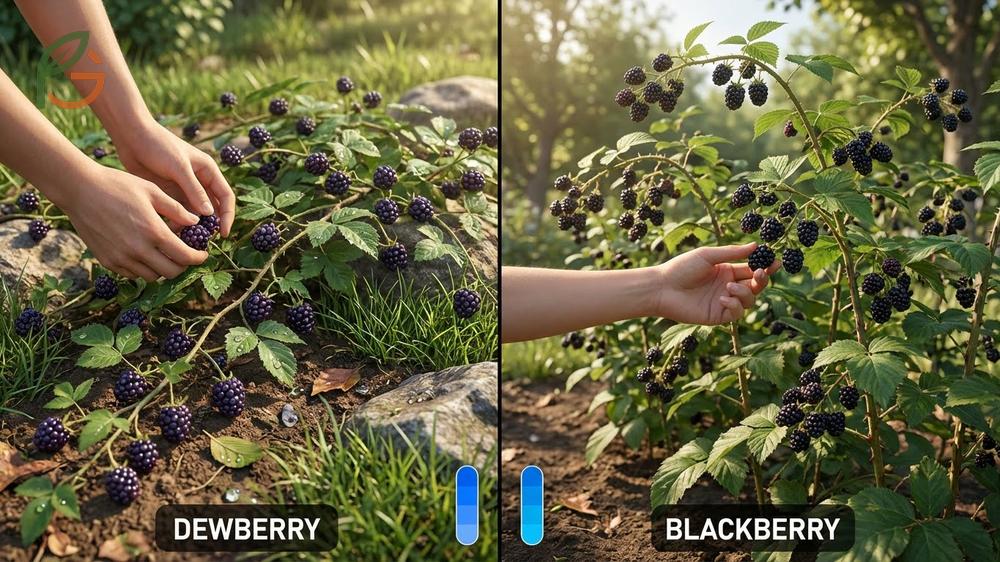
Dewberries are often called “ground blackberries” because they grow as low, trailing vines that hug the ground rather than standing upright. While they’re closely related to blackberries (both are Rubus species), dewberries rarely exceed 2 feet in height[6]. True blackberries form upright bushes reaching 3-6 feet or taller.
The easiest way to tell them apart is their growth habit. If you’re bending down to pick berries from vines spreading along the ground, you’ve found dewberries. If you’re reaching up to pick from an upright shrub, it’s a blackberry. Dewberries also have slender canes with fine red hairs and thinner thorns, while blackberries have thicker, hairless canes with hard, robust thorns[6].
Fruit-wise, dewberries ripen earlier—typically late April to early June, depending on your region. Blackberries ripen later in summer, from June through August. Dewberry fruits are often smaller and have larger, tougher seeds than cultivated blackberries. Both are completely edible and safe to eat, making them excellent targets for foragers.
Research shows dewberries spread more aggressively through underground roots and tip-rooting (where cane tips touch ground and form new plants). Blackberries spread primarily from the crown, though some varieties also tip-root. If you plant dewberries in your garden, expect them to pop up 3-6 feet away from the original plant within a year.
- Growth height: Dewberries stay under 2 feet, blackberries reach 3-9 feet[6]
- Growth pattern: Dewberries trail horizontally along ground, blackberries grow upright
- Cane appearance: Dewberries have red hairs and slender thorns, blackberries have hairless canes with thick thorns
- Ripening time: Dewberries ripen April-June, blackberries ripen June-August
- Seed size: Dewberries have noticeably larger, tougher seeds than most blackberry varieties
- Spreading habit: Dewberries spread aggressively via roots, blackberries mainly from crown
Poisonous Berries That Look Like Blackberries
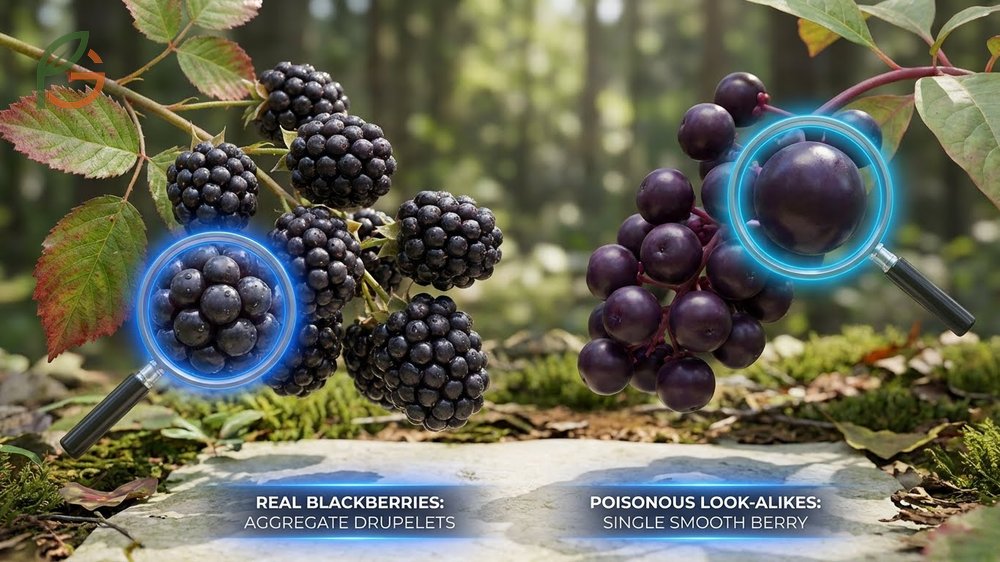
Good news for foragers: blackberries don’t have true poisonous look-alikes. Studies show that no toxic berries match the distinctive aggregate drupelet structure of a blackberry. However, several poisonous berries can fool novice foragers from a distance because they’re dark purple or black and grow in clusters.
The key is examining the berry structure up close. Real blackberries are made of multiple tiny drupelets (like bubbles) clustered together. If you see a smooth, single berry without this bumpy texture, it’s not a blackberry—and it might be dangerous. Current foraging guidance emphasizes the “aggregate test”: if it doesn’t have the characteristic bumpy, clustered appearance, don’t eat it.
Pokeweed berries are the most common false alarm. They grow in long, drooping clusters and ripen to dark purple, but each berry is smooth and singular, not made of drupelets. Pokeweed is highly toxic—eating the berries causes severe vomiting, diarrhea, and convulsions. The plant also has distinctive magenta stems, which blackberry bushes never have.
Deadly nightshade (belladonna) produces shiny black berries about the size of cherries. They grow singly or in small groups, not in the aggregate clusters of blackberries. Just 2-5 berries can be fatal to adults. If you’re foraging and see smooth, shiny black berries without the bumpy drupelet texture, leave them alone.
When my friend in Oaxaca, Mexico cleared an overgrown garden area in May 2024, she found what looked like blackberries on 4-foot vines. Upon closer inspection, the berries were smooth Virginia creeper berries—the vines spread 12 feet, matching the aggressive growth typical for that species in zone 9.
- Pokeweed berries: Dark purple in long drooping clusters, smooth berries, magenta stems—highly toxic
- Deadly nightshade: Shiny black, grow singly, smooth surface—extremely poisonous, can be fatal
- Virginia creeper: Bluish-black in clusters, smooth berries, no drupelets—causes mouth irritation and kidney damage
- Canadian moonseed: Dark purple clusters with single crescent-shaped seed—highly poisonous, causes convulsions
- Ivy berries: Black-blue clusters on climbing vines, round and smooth—toxic, causes digestive issues
Foraging Safety Rule: If the berry doesn’t have the bumpy, aggregate drupelet structure, it’s not a blackberry. Never eat smooth, singular berries that are dark purple or black unless you can positively identify them as safe species like blueberries or huckleberries (which grow on low bushes, not vines).
Conclusion
The evidence is clear: blackberries don’t grow on trees—they grow on thorny bushes with biennial canes that reach 3-9 feet tall. If you’re picking berries from an actual tree, you’ve found mulberries, one of the few berries that do grow on trees. Understanding the difference between bush-grown blackberries and tree-grown mulberries helps you identify wild berries correctly and enjoy safe foraging experiences.
Current horticultural guidance emphasizes recognizing blackberry bushes by their compound 3-5 leaflet leaves, thorny canes, and two-year growth cycle. Whether you’re foraging wild patches or planting cultivated varieties in your garden, knowing these key characteristics ensures you can distinguish blackberries from their mulberry cousins and avoid potentially dangerous look-alikes. FruitGarden provides research-backed information to help American gardeners grow healthy, productive berry bushes and identify safe wild edibles.
Frequently Asked Questions
Are blackberries a bush or a tree?
Blackberries are bushes (shrubs), not trees. They grow from a perennial crown at ground level and produce biennial canes that reach 3-9 feet tall. Unlike trees, blackberries don’t have a woody trunk—just multiple canes emerging from the base that follow a two-year growth cycle.
What tree has berries that look like blackberries?
Mulberry trees produce berries that look similar to blackberries—dark purple to black, elongated clusters of drupelets. However, mulberries grow on actual trees reaching 12-40 feet tall with smooth bark and heart-shaped leaves, while blackberries grow on thorny bushes under 9 feet tall with compound leaves.
How can you tell the difference between blackberries and dewberries?
Dewberries grow as low trailing vines along the ground (under 2 feet tall) with slender canes that have red hairs. Blackberries grow as upright bushes (3-9 feet tall) with thicker, hairless canes. Dewberries also ripen earlier (April-June) compared to blackberries (June-August).
Can blackberries grow wild without being planted?
Yes, wild blackberries spread aggressively through underground roots and tip-rooting. Birds also spread seeds after eating the berries, allowing blackberries to colonize new areas naturally. This is why you often find dense blackberry thickets along roadsides, fence lines, and forest edges throughout North America and Europe.
Are there poisonous berries that look like blackberries?
No true poisonous look-alikes exist for blackberries. The aggregate drupelet structure (bumpy appearance) is unique. However, pokeweed berries, deadly nightshade, and Virginia creeper berries are dark purple/black and grow in clusters, but they’re smooth and singular, not made of drupelets like real blackberries.
How tall do blackberry bushes typically grow?
Most blackberry bushes grow 3-6 feet tall, though vigorous varieties can reach 8-9 feet without pruning. Erect varieties naturally stay shorter (3-5 feet), while trailing varieties can spread 10-15 feet horizontally if not trellised. Regular summer tipping at 3-4 feet encourages bushier growth and better fruit production.
What’s the difference between first-year and second-year blackberry canes?
First-year canes (primocanes) grow tall and green but don’t produce fruit—they’re establishing the plant. Second-year canes (floricanes) turn brownish-woody and produce flowers and berries in summer. After fruiting, these two-year-old canes die and should be pruned out to make room for new growth.





