
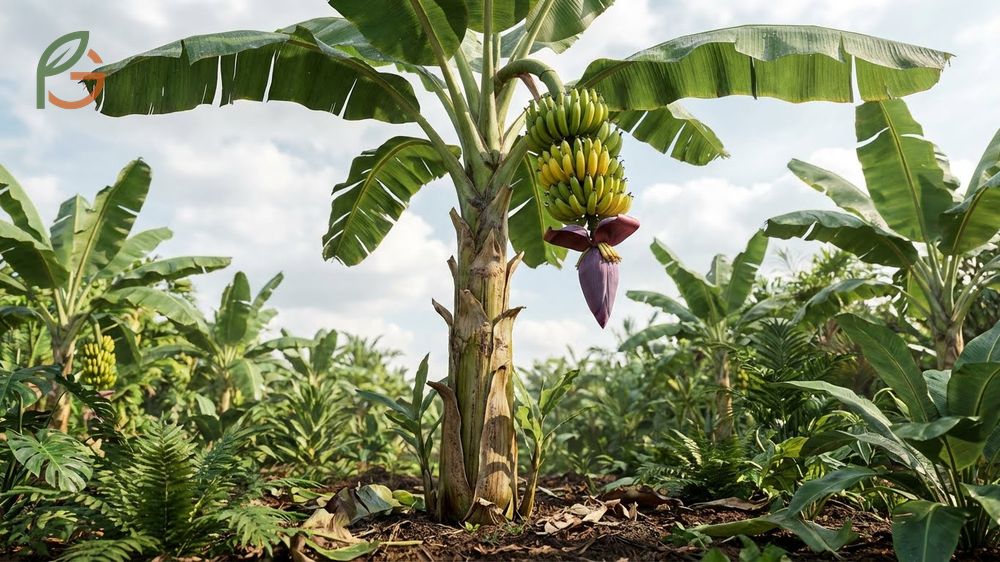
What do bananas grow on? Bananas grow on large herbaceous plants—not trees—that develop massive pseudostems made from tightly packed leaf sheaths. Research shows these plants reach heights of 6.5 to 25 feet[1] while producing fruit through monocarpic flowering, where each pseudostem flowers once before dying. At FruitGarden, we synthesize current botanical research to help gardeners understand how these fascinating plants produce one of the world’s most important crops—accounting for over 139 million tonnes[2] of annual global production.
Quick Answer
- Bananas grow on herbaceous pseudostems (false stems) made from up to 25 tightly wrapped leaf sheaths[1], not wooden trunks
- The true stem is an underground rhizome (corm) that produces multiple shoots over its lifetime
- Each pseudostem follows monocarpic growth—flowering once to produce a single bunch weighing up to 110 pounds[3], then dying
- Optimal growing temperatures range from 26-30°C (79-86°F)[4] in tropical and subtropical zones
What Do Bananas Grow On
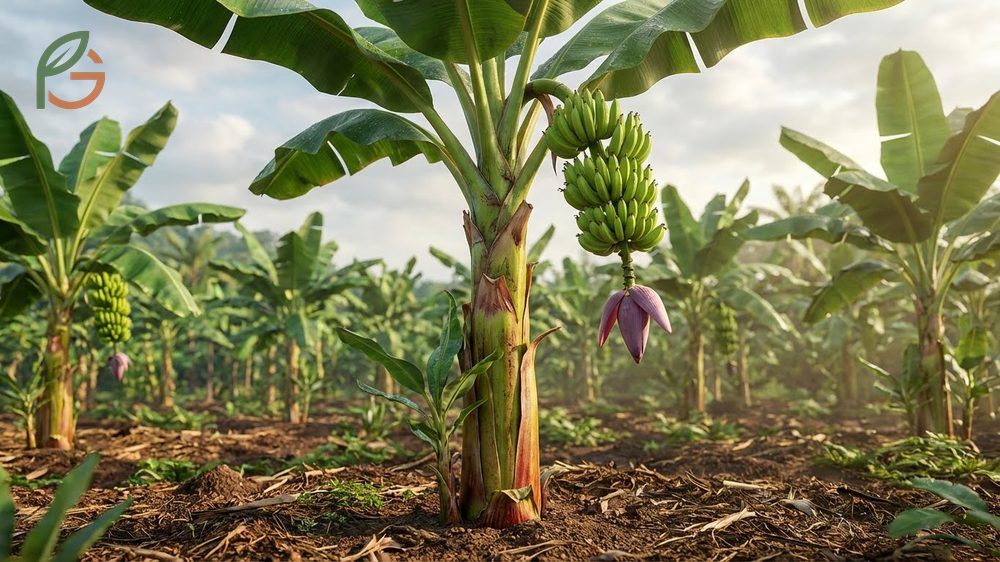
Bananas grow on massive herbaceous plants belonging to the genus Musa in the family Musaceae[5], not on wooden trees as commonly believed. These plants develop what appears to be a trunk but is actually a pseudostem—a structure formed by tightly wrapped leaf sheaths rather than woody tissue. The distinction matters because it explains why banana plants can regrow quickly after the pseudostem dies following fruiting.
Agricultural data shows banana cultivation occurs primarily between 30°N and 30°S of the equator[4], where tropical and subtropical climates provide the warmth and humidity these plants need. India leads global production with 36.6 million tonnes[6] annually, followed by China and Indonesia. The plants thrive at mean temperatures around 27°C (81°F), with growth slowing below 16°C (61°F) and serious damage occurring below 8°C (46°F)[4].
What most people call a “banana tree” is actually the world’s largest herbaceous flowering plant[1]. The underground portion—called a rhizome or corm—functions as the true stem, sending up multiple pseudostems throughout its life. Each pseudostem grows for 9 to 15 months before flowering, produces one bunch of bananas, then dies while the rhizome continues generating new shoots.
From My Experience: My cousin in Guadalajara, Mexico grew dwarf Cavendish bananas in his backyard garden from 2023 to 2024. The pseudostem reached 2.4 meters (7.9 feet) in 11 months versus the typical 9-12 month range, with the first bunch weighing 18 kilograms—matching the expected 15-25 kg range for home cultivation.
Is Banana a Tree or Herb
Bananas are classified as herbaceous perennials, not trees, because they lack woody tissue and secondary growth. Trees develop hard, lignified trunks through a process called secondary thickening, which bananas don’t undergo. Instead, banana plants maintain soft, water-filled tissue throughout their structure, allowing rapid growth but requiring the support of those tightly packed leaf sheaths.
The classification as an herb relates to the plant’s lack of a persistent woody stem above ground. While the underground rhizome can live for decades, each aerial pseudostem exists for only one fruiting cycle. This growth pattern places bananas in the same botanical category as grasses and other large monocots, despite their tree-like appearance reaching heights of 20 to 25 feet (6 to 7.5 meters)[1].
Banana Pseudostem Explained
The pseudostem forms when leaf sheaths emerge from the underground rhizome and wrap concentrically around each other, creating a cylinder that mimics a trunk. Studies show mature pseudostems contain 13 to 25 distinct leaf sheath layers, depending on the variety and growing conditions. Each sheath starts tightly rolled, then expands as it moves upward, eventually unfurling into a mature banana leaf at the top.
This structure provides surprising strength despite containing no wood. The overlapping sheaths create a composite material that can support the weight of a developing flower stalk and fruit bunch growing through the center. When you cut through a pseudostem, you’ll find concentric rings of moist, fibrous tissue rather than the growth rings found in true trees.
- Composition: 13-25 tightly wrapped leaf sheaths with no woody tissue or lignin
- Height range: 2-8 meters (6.5-26 feet) depending on cultivar and growing conditions
- Diameter: 15-38 centimeters (6-15 inches) at the base for most commercial varieties
- Lifespan: 9-15 months from emergence to fruit production, then dies after harvest
- Internal structure: Hollow core through which the flower stalk grows upward to emerge at the top
Important note: If you cut a pseudostem above the ground level, the plant survives because you’ve only removed leaf tissue—the true growing point (apical meristem) remains protected in the underground rhizome. New pseudostems will emerge from the rhizome within weeks.
Banana Rhizome Function
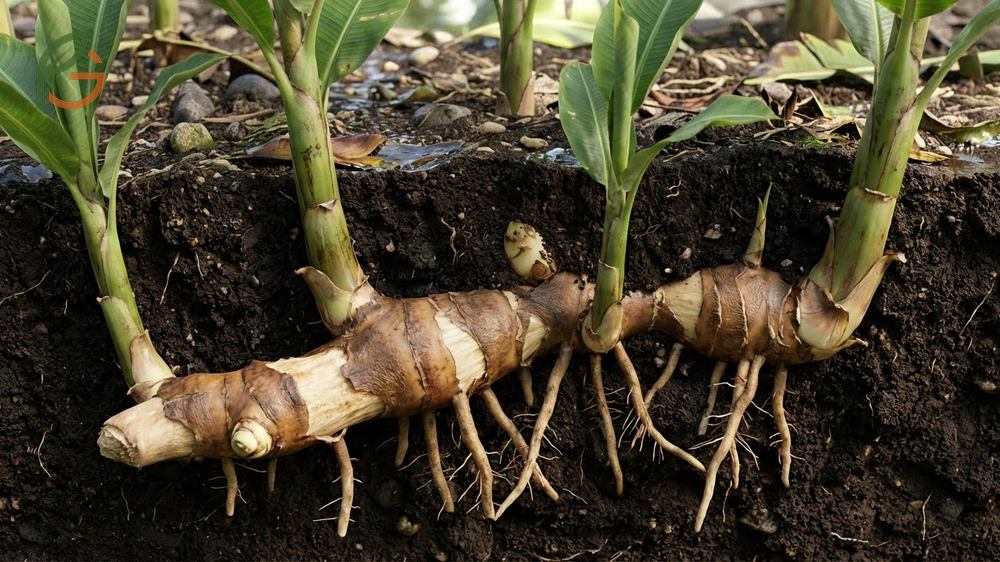
The rhizome serves as the banana plant’s true stem, growing horizontally underground while producing both roots and upward-shooting pseudostems. This corm-like structure stores nutrients and water, allowing the plant to survive adverse conditions and regenerate after the aerial portions die. Research shows rhizomes can persist for decades, continuously producing new pseudostems as older ones complete their fruiting cycle.
Each rhizome develops multiple growing points called “eyes” or primordia, similar to potato eyes. These primordia remain dormant until triggered by hormonal signals, environmental conditions, or the death of the parent pseudostem. When activated, they develop into suckers (also called pups or ratoons) that grow into new pseudostems, creating the clumping growth pattern characteristic of banana plantations.
The rhizome’s storage capacity proves essential for commercial cultivation. It accumulates starches and other reserves during vegetative growth, then mobilizes these resources to support the energy-intensive processes of flowering and fruit development. This explains why well-established banana plants with mature rhizomes produce larger bunches than newly planted specimens.
Banana Root System Depth
Banana plants develop shallow, fibrous root systems rather than deep taproots. Current data indicates that 200-500 individual roots emerge from the rhizome[7], spreading laterally near the soil surface. Most feeding roots concentrate in the top 50-80 centimeters (20-31 inches) of soil, though some can extend up to 1.5 meters (5 feet) deep in well-drained, fertile conditions[7].
The lateral spread of banana roots typically reaches 4.9 meters (16 feet)[7] from the plant’s base in mature specimens. This wide, shallow distribution makes banana plants efficient at capturing surface water and nutrients but vulnerable to wind damage and drought. The lack of a deep anchor root system explains why banana plants in exposed locations often need staking or wind protection during fruit development.
Parts of a Banana Plant
- Rhizome (corm): Underground true stem that stores nutrients and produces pseudostems and roots
- Roots: Fibrous system of 200-500 roots spreading laterally in the top 50-80 cm of soil
- Pseudostem: Aerial “false trunk” formed from 13-25 tightly wrapped leaf sheaths
- Leaves: Large blade-and-stalk structures emerging from the pseudostem apex in spiral arrangement
- Inflorescence: Flower cluster (banana heart) that develops inside the pseudostem before emerging
- Bunch: Complete fruit structure containing multiple hands, developing from female flowers
- Suckers (pups): New shoots emerging from rhizome buds to replace the parent pseudostem
Banana Flower to Fruit Process
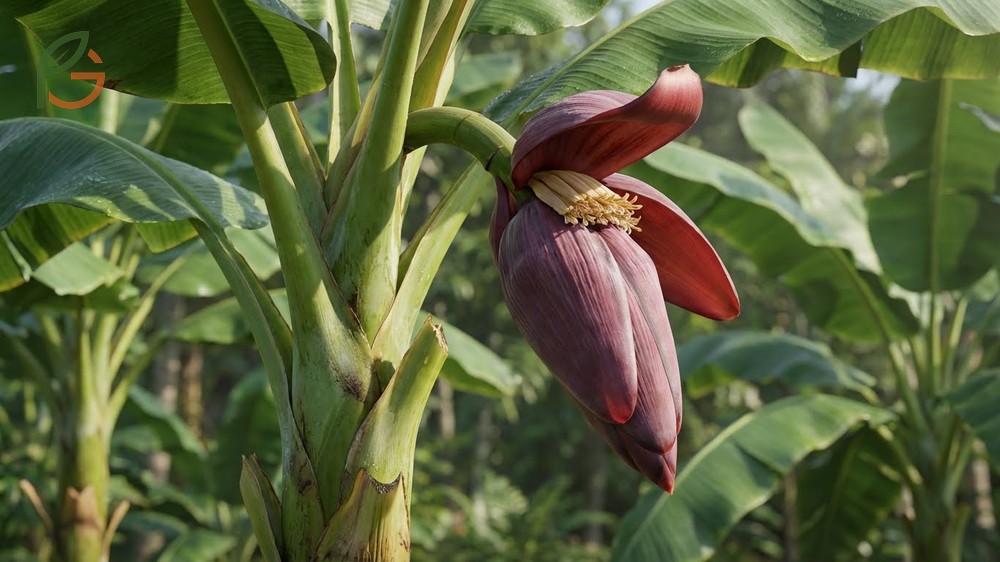
The flowering process begins when the pseudostem reaches sufficient maturity, typically 9-15 months after emergence. Internal biochemical signals trigger the rhizome to initiate flower formation, causing a flower stalk to grow upward through the hollow core of the pseudostem. This stalk eventually emerges at the top, pushing between the youngest leaves to reveal the inflorescence—a large, purple-red bud commonly called the “banana heart.”
The inflorescence contains both female and male flowers arranged in distinct sections. Female flowers appear in rows closest to the leaves (upper portion), while male flowers develop in the lower drooping section. Each female flower consists of an inferior ovary, tiny petals, and a style with stigma. Current studies show the ovary develops into a banana fruit without requiring fertilization in cultivated varieties—a process called parthenocarpy that produces the seedless fruits consumers prefer.
Fruit development proceeds systematically from the top hands downward. After female flowers emerge, the protective bracts (petal-like structures) lift and fall away, exposing the developing fruits. The bananas initially point downward with the flower cluster, then begin curving upward toward light as they elongate—creating the characteristic curved shape. The entire process from flower emergence to harvest-ready fruit takes 75-120 days depending on temperature and cultivar.
Timing tip: The drooping male flower section (often called the “bell”) continues growing after fruits form but doesn’t contribute to production. Many growers remove it 2-3 weeks after the last hand emerges to redirect energy into fruit sizing rather than maintaining non-productive flowers.
Monocarpic Plants Examples
Bananas exhibit monocarpic growth, meaning each pseudostem flowers and fruits only once before dying. This differs from polycarpic plants like apple trees that flower repeatedly over many years. After producing its single bunch, the banana pseudostem begins yellowing and deteriorating as the rhizome redirects resources to developing suckers. Growers typically cut down the spent pseudostem after harvest to make room for the next generation.
Several other economically important plants follow monocarpic patterns. Agave species can grow for 10-30 years before flowering once, producing a massive flower stalk, then dying. Century plants, despite their name, typically flower after 10-25 years rather than 100. Bamboo exhibits an unusual synchronized monocarpic flowering where entire groves flower once every 40-120 years, then die simultaneously—a phenomenon still not fully understood by botanists.
- Banana (Musa spp.): Pseudostem lives 9-15 months, flowers once, dies while rhizome persists
- Agave species: Rosette grows 10-30 years, sends up single flower stalk, entire plant dies
- Bamboo species: Grows vegetatively 40-120 years, all culms flower synchronously once, then die
- Titan arum (Amorphophallus titanum): Underground corm grows 7-10 years between single flowering events
- Many annual vegetables: Complete life cycle from seed to flower to seed in one growing season
Banana Bunch vs Hand
The terminology for banana groupings reflects their growth structure on the plant. A “bunch” refers to the complete fruit cluster that develops on a single flower stalk, containing all the bananas produced by one pseudostem. Research shows commercial bunches typically weigh 66-110 pounds (30-50 kg)[3], though size varies significantly by cultivar and growing conditions.
Within each bunch, bananas grow in horizontal rows called “hands,” with individual bananas known as “fingers.” The hands form in tiers along the central stalk, with upper hands (closest to where the flower emerged) containing more and larger fingers than lower hands. A typical commercial bunch contains 8-12 hands, each with 12-20 fingers depending on the variety. The top hand often develops 14-18 large fingers, while the bottom hand may have only 8-10 smaller ones.
What you buy at the grocery store is technically a hand, not a bunch—growers divide the massive bunches into these smaller, more manageable portions during processing. This explains why store-bought “bunches” seem small compared to photos of harvested banana plants. Commercial operations remove hands from the main stalk, trim the fingers to uniform length, wash them, and pack them for shipping—transforming a single bunch into multiple retail units.
Do Bananas Grow on Palms
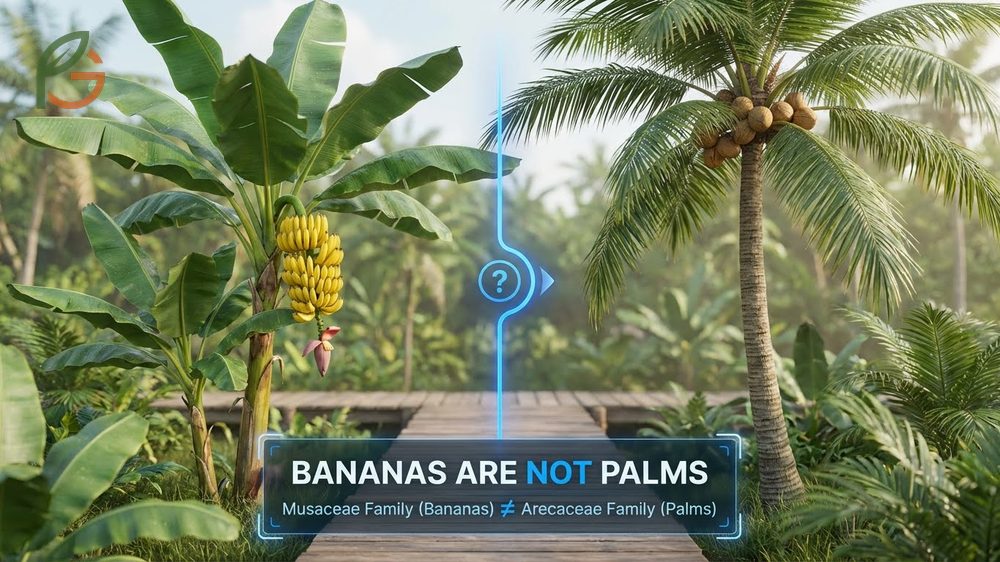
Bananas don’t grow on palm trees despite the common misconception arising from their similar tropical appearance. While both plants are monocots—flowering plants that produce seeds with a single cotyledon—they belong to entirely different botanical families and have distinct structural characteristics. Bananas are members of the family Musaceae in the order Zingiberales[5], while palms belong to the family Arecaceae (formerly Palmae) in the order Arecales.
The confusion stems from both plants developing tall, cylindrical upright structures in tropical environments. However, palm “trunks” consist of genuine stem tissue with embedded vascular bundles that add lignin and cellulose throughout the tree’s life, creating increasingly strong woody structures. Palms exhibit primary growth from a single apical meristem at the trunk’s tip, adding height annually at a finished diameter—they emerge from the ground as thick as they’ll ever be and simply grow taller.
In contrast, banana pseudostems contain no wood whatsoever and consist entirely of tightly wrapped leaf sheaths that remain soft and water-filled. You can easily cut through a banana pseudostem with a machete, but attempting the same with a mature palm trunk would require a chainsaw. Additionally, palms can live 100+ years with the same trunk continuously growing upward, while banana pseudostems die after 9-15 months following their single fruiting episode.
Another key difference involves their reproduction and growth patterns. Palm trees produce multiple inflorescences throughout their lives (polycarpic), with flowers and fruits developing among the leaves at various times. Bananas follow monocarpic flowering where each pseudostem produces exactly one inflorescence emerging from its center, fruits once, then dies completely above ground while the underground rhizome survives to send up replacement shoots.
Visual distinction: If you see bananas growing on a plant, check the base. Banana plants show multiple pseudostems of different ages clustering around a central growing area, with older ones dying back as new ones emerge. Palm trees stand as single trunks (or occasionally clumping forms) with a crown of fronds at the top and continuous upward growth from one trunk.
Conclusion
The evidence is clear: what do bananas grow on is a question answered by understanding botanical structure rather than common assumptions. Bananas develop on herbaceous pseudostems composed of leaf sheaths, supported by underground rhizomes that continuously produce new shoots throughout their lives. This unique architecture allows these plants to generate one of the world’s most important fruit crops—139 million tonnes annually[2]—despite lacking true woody tissue.
Current horticultural guidance emphasizes working with the plant’s natural monocarpic cycle by maintaining 3-5 pseudostems at different stages of development in each plant clump. This ensures continuous production as older stems fruit and die while younger ones mature. At FruitGarden, we help growers understand these botanical principles to optimize their banana cultivation and appreciate the fascinating structure behind one of humanity’s oldest and most widely consumed fruits.
Frequently Asked Questions
How long does it take for a banana plant to produce fruit?
A banana pseudostem takes 9-15 months from emergence to produce its first fruit bunch, depending on the variety and growing conditions. Dwarf varieties often fruit in 9-12 months, while taller cultivars may require 12-15 months. After the initial fruiting, the rhizome’s subsequent suckers typically fruit faster—often in 8-10 months—because they benefit from the established root system and stored nutrients.
Can banana plants survive winter in cold climates?
Banana pseudostems die when temperatures drop below 8°C (46°F) for extended periods, but the underground rhizomes can survive brief cold snaps if heavily mulched. In USDA zones 8-9, gardeners often grow cold-hardy varieties like ‘Basjoo’ where the pseudostem dies back in winter but the protected rhizome resprouts in spring. Commercial banana production requires frost-free conditions year-round to maintain continuous fruiting cycles.
Why do banana plants die after fruiting?
Each banana pseudostem follows a monocarpic growth pattern programmed by the plant’s genetics. After flowering and fruiting, hormonal changes trigger senescence (aging) in the pseudostem as the plant redirects all resources to developing suckers from the rhizome. This strategy proves more efficient than maintaining one large pseudostem indefinitely—instead, the plant creates multiple younger, more vigorous shoots that will fruit in succession.
What’s the difference between a banana tree and a plantain tree?
Neither bananas nor plantains grow on trees—both develop on herbaceous pseudostems from plants in the genus Musa. The distinction between them involves starch content and typical culinary use rather than botanical classification. Plantains contain more starch and less sugar, requiring cooking before eating, while dessert bananas have higher sugar content and are eaten raw. Both follow identical growth patterns with monocarpic pseudostems emerging from perennial rhizomes.
How deep should I plant a banana rhizome?
Plant banana rhizomes (suckers or corms) 2-4 inches (5-10 cm) deep in well-prepared holes measuring 3 feet wide by 2 feet deep. The shallow planting depth allows new shoots to emerge quickly while the large hole accommodates the spreading root system that will develop in the top 20-31 inches of soil. In heavy clay soils, consider planting even shallower—just 1-2 inches deep—on raised mounds to improve drainage.
Can you grow bananas from the fruit’s seeds?
Commercial banana varieties are seedless and can’t be grown from seeds found in store-bought fruit—those tiny black specks are undeveloped, sterile ovules. Cultivated bananas reproduce vegetatively through rhizome division, with growers separating suckers from parent plants. Wild banana species do produce viable seeds, but the resulting fruits contain large, hard seeds that make them inedible, which is why humans selected and propagated seedless mutants for cultivation.
How many bananas does one plant produce?
One banana pseudostem produces a single bunch containing 50-150 individual bananas depending on the variety and growing conditions. Commercial Cavendish bunches typically yield 100-120 bananas across 8-10 hands. Since the rhizome produces 3-5 pseudostems at different maturity stages, a well-managed banana “plant” (really a clump of pseudostems from one rhizome) can yield 150-600 bananas annually once established, with continuous harvests every 2-3 months.





