
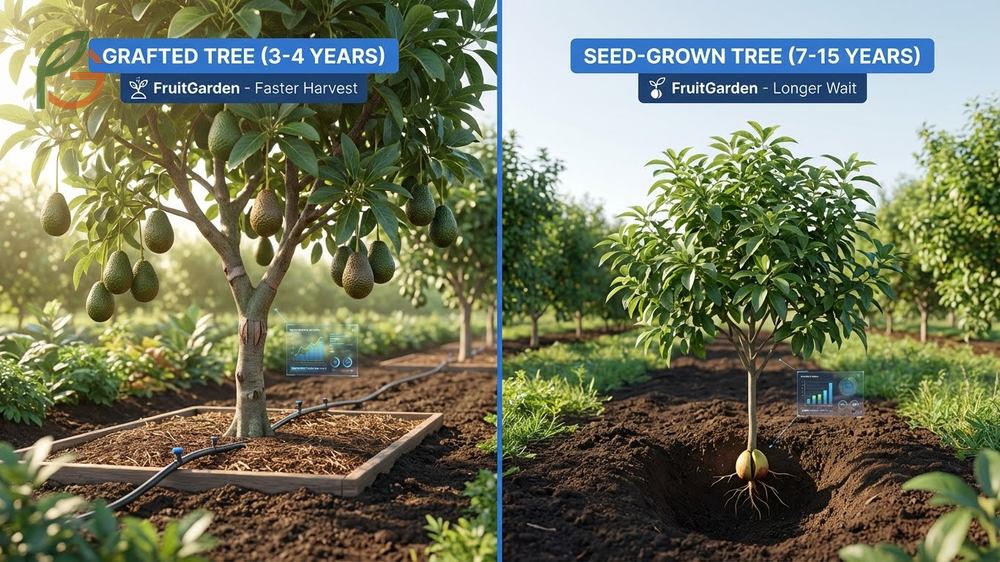
How to grow avocado fruit depends on whether you start with a grafted tree or seed. Research shows grafted nursery trees produce fruit in 3-4 years[1], while seed-grown trees can take 7-15 years[2] or may never fruit at all. At FruitGarden, we synthesize current horticultural data to help you maximize fruit production through proper pollination, climate management, and targeted care strategies.
Quick Answer
How to Grow Avocado Fruit
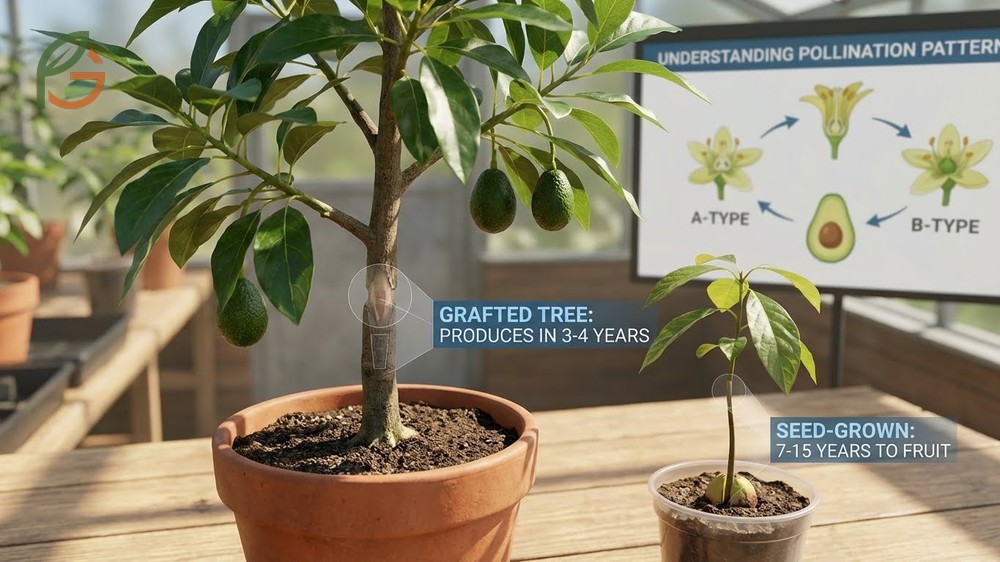
Growing avocado fruit successfully starts with selecting the right tree type. Grafted nursery trees give you a massive head start because they bypass the juvenile phase entirely and start producing in just 3-4 years[1]. Seed-grown trees, while fun as a backyard project, won’t fruit for 7-15 years[2] if they fruit at all.
You’ll also need to understand avocado pollination patterns to get fruit. Unlike most fruit trees, avocados have what scientists call “protogynous dichogamy”—a fancy way of saying each flower opens twice over two days, first as female and then as male. This quirky timing means you can’t rely on a single tree for optimal pollination.
From My Experience: My cousin in Guadalajara, Mexico planted a grafted Hass avocado in March 2021. He got his first 12 fruits in spring 2024—exactly 3 years later, matching the research timeline perfectly.
Grafted vs Seed-Grown Trees
The difference between grafted and seed-grown trees is dramatic. Grafted trees inherit the mature characteristics of the parent variety immediately, so they start flowering and fruiting much earlier. Seed-grown trees must grow through a long juvenile period where they focus solely on vegetative growth.
If you’re growing from seed as an experiment, don’t expect the fruit to taste like its parent. Avocados don’t grow “true to seed,” meaning a seed from a Hass avocado will likely produce fruit with completely different characteristics—and often inferior quality.
Choosing the Right Tree Size
Buying a larger tree—15-gallon size or bigger—can shave off a year from your wait time. Bigger trees produce more flowers in their first season, which increases your chances of getting fruit earlier[6]. However, they cost significantly more and require more careful planting.
Five-gallon trees offer the best balance for most home growers. They’re affordable, easier to handle during planting, and still fruit within that 3-4 year window. The extra year of waiting is worth the savings and reduced transplant shock.
How Long for Avocado Tree to Bear Fruit
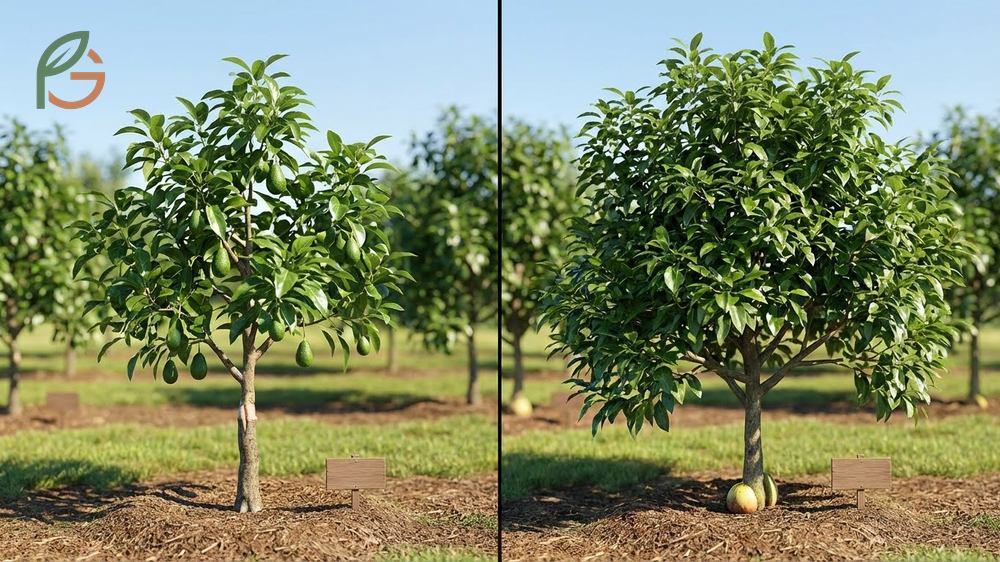
The timeline for avocado fruit production varies dramatically based on your starting point. Studies show grafted trees typically fruit in their third or fourth year after planting[1]. Your first harvest won’t be massive—expect maybe 12-30 fruits from a young tree—but production increases steadily each year.
Seed-grown trees are a completely different story. Current agricultural data shows these trees need 7-15 years[2] before they mature enough to flower and set fruit. Even then, there’s no guarantee they’ll produce quality fruit worth eating.
Timeline by Tree Type
This table compares fruiting timelines, fruit quality expectations, and first-year yields across grafted nursery trees, grafted seedlings, and seed-grown trees
| Tree Type | Years to First Fruit | Fruit Quality | First Harvest Yield |
|---|---|---|---|
| Grafted Nursery Tree | 3-4 years[1] | Matches parent variety | 12-73 fruits[6] |
| Grafted Seedling | 4-5 years[6] | Matches parent variety | 8-30 fruits |
| Seed-Grown Tree | 7-15 years[2] | Unpredictable, often poor | Varies widely |
The economic gain from avocado trees doesn’t really start until year 6. That’s when production ramps up significantly and you’re harvesting enough fruit to justify the space and effort. Mature trees at 25 years old can produce 70-80 kg (154-176 lbs)[5] of fruit annually.
Variety-Specific Differences
Not all avocado varieties fruit on the same timeline. Hass and Reed typically produce their first fruit in year 3, while Sir-Prize is known as a late bloomer that might not fruit until year 5 or 6[6]. Pinkerton can sometimes surprise you with fruit in less than 2 years if conditions are perfect.
The maturation period—from flower to ripe fruit—also varies. Most varieties need 6-12 months, but some can take up to 18 months. This means flowers that open in spring might not produce harvestable fruit until the following winter or spring.
Avocado Pollination Type A and B
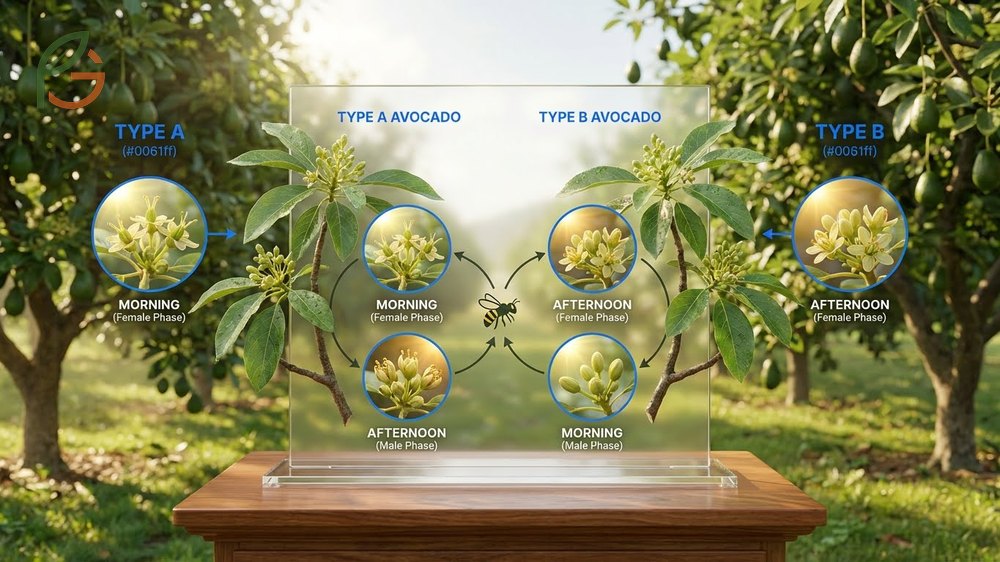
Avocado pollination is one of the most fascinating—and frustrating—aspects of growing these trees. Each avocado flower opens twice over two consecutive days: first in the female phase, then closes, and reopens the next day in the male phase. Type A varieties open as female in the morning and male in the afternoon the next day, while Type B varieties do the opposite[3].
This staggered timing means that at any given moment, some flowers are receptive to pollen while others are releasing it. Planting both Type A and Type B varieties together creates overlapping opportunities for cross-pollination throughout the day, dramatically increasing your fruit set.
Understanding Flower Behavior
Type A varieties like Hass have most of their flowers open as female during morning hours, then close and reopen as male the following afternoon. Type B varieties like Fuerte follow the opposite pattern—female in the afternoon, male the next morning. This complementary timing creates daily windows where one type releases pollen while the other is receptive.
Temperature plays a huge role in whether this synchronization actually happens. In cooler climates, the timing gets disrupted and both phases might overlap on the same day, allowing self-pollination. In hot climates, the phases separate more distinctly, making cross-pollination essential.
Important Note: Even though each mature tree produces around 1 million flowers per season, only 100-500 actually set fruit[6]. That’s a success rate of less than 0.05%, which is why proper pollination matters so much.
Best Variety Combinations
For maximum fruit production, plant one Type A and one Type B variety within 25-50 feet of each other. The most popular combination in home gardens is Hass (Type A) paired with Fuerte (Type B). Other excellent Type A options include Reed, Pinkerton, and Lamb Hass, while Bacon, Zutano, and Ettinger work well for Type B.
You can also plant two trees of the same type if you only have space for one variety. Research shows that two Type A trees together will still produce more fruit than a single isolated tree because they increase pollination opportunities through sheer flower volume[3].
- Type A varieties: Hass, Reed, Lamb Hass, Pinkerton, Gwen
- Type B varieties: Fuerte, Bacon, Zutano, Ettinger, Sir-Prize
- Best combinations: Hass + Fuerte, Reed + Bacon, Pinkerton + Zutano
- Same-type planting: Two Hass trees still outperform one isolated tree
- Spacing: Plant trees 25-50 feet apart for optimal cross-pollination
How to Make Avocado Tree Bear Fruit Faster
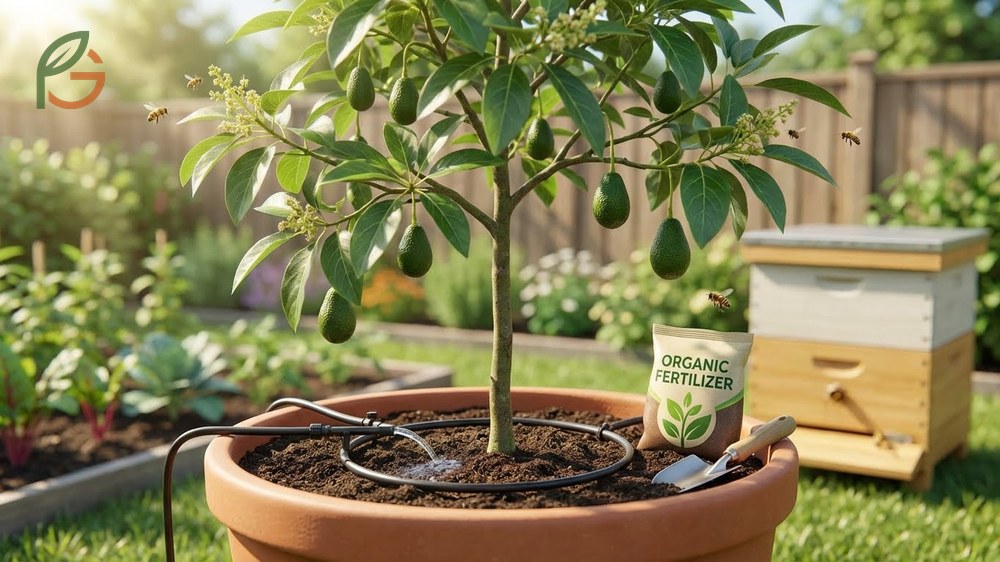
You can’t override biology completely, but several strategies can help your tree reach fruiting maturity faster. The most effective approach combines proper pollination, strategic fertilization, consistent watering, and adequate sunlight. Trees growing in optimal conditions can fruit at the earlier end of the 3-4 year range or even surprise you with a few fruits in year 2.
Avoiding stress is critical. Heat waves during flowering, irregular watering, or nutrient deficiencies can delay fruiting by a full year or more. What often gets overlooked is that this year’s care determines next year’s fruit production—avocado trees operate on a two-year cycle where they’re simultaneously supporting current fruit while initiating next season’s buds.
Hand Pollination Technique
Hand pollination can help if you’ve got a single tree or if natural pollinators are scarce in your area. The technique is simple: take a male-phase flower and gently touch it to the stigma (the little upright stick) of a female-phase flower[6]. Male flowers release pollen about an hour after opening—you’ll see yellow residue on your finger if you touch them.
Don’t expect miracles though. Studies show hand pollination only increases fruit set to about 3-8% compared to natural pollination’s already low 0.05% rate[6]. It’s worth trying on young trees to get your first taste of fruit, but it won’t replace having proper pollinator varieties planted together.
- Wait for flowers to open—male flowers release pollen 1 hour after opening
- Check if pollen is ready by gently rubbing; yellow residue indicates viability
- Remove a male flower or use a small paintbrush to collect pollen
- Touch pollen to the stigma of female flowers during their receptive phase
- Perform pollination mid-day when both phases overlap for best results
- Expect only 3-8% success rate even with hand pollination
Fertilizer for Fruit Production
Avocados are heavy feeders that need balanced nutrition to flower and fruit consistently. Nitrogen drives vegetative growth, but too much can actually cause flowers and young fruit to drop. Zinc and boron are critical micronutrients for flower development and fruit set—deficiencies in either can prevent fruiting entirely even if the tree looks healthy.
Apply a balanced fertilizer like 6-6-6 quarterly throughout the growing season. Add a zinc and boron foliar spray during the flowering period (typically spring) to support fruit set. Composted chicken manure applied in early spring provides slow-release nitrogen while improving soil structure and microbial activity.
Fertilization Warning: Excess nitrogen during flowering causes flower and fruit drop. Stick to balanced ratios and avoid heavy nitrogen applications from late winter through spring when trees are setting fruit.
- Nitrogen: Essential for growth but reduce during flowering to prevent fruit drop
- Zinc and boron: Critical micronutrients for flower development and fruit set
- Potassium: Improves fruit quality and overall tree health
- Application timing: Quarterly balanced fertilizer plus foliar spray during flowering
- Organic options: Composted chicken manure in early spring for slow-release nutrients
- Soil testing: Test annually to identify deficiencies before they impact fruiting
Climate Requirements for Avocado Fruit
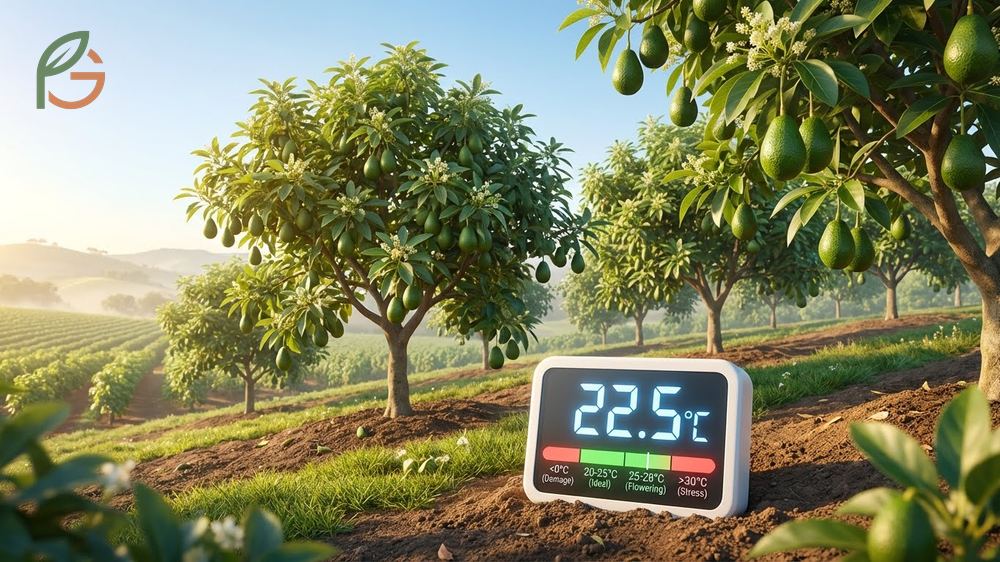
Avocados thrive in subtropical and temperate climates with moderate temperatures year-round. The ideal temperature range for fruit production is 20-25°C (68-77°F)[4], though some sources cite 25-28°C (77-82°F) as optimal for photosynthesis and flower development. Temperatures below 0°C (32°F) cause tissue damage or death, while temps above 30°C (86°F) stress trees and reduce fruit quality.
What often surprises new growers is how sensitive flowering is to temperature extremes. Pollen loses viability at around 35°C (95°F), and newly set fruit the size of BBs or peas can drop during heat waves. Cold springs delay flowering and reduce fruit set, which is why Fuerte trees (which prefer warmer springs) often fruit erratically in cooler climates.
Sunlight exposure directly correlates with flower production. Research shows that trees in full sun produce significantly more flowers than those in partial shade, translating to more potential fruit[6]. Aim for at least 6-8 hours of direct sunlight daily, with southern exposures giving the best growth in the Northern Hemisphere.
- Temperature range: 20-25°C (68-77°F) ideal for fruiting and flowering
- Cold tolerance: Tissue damage occurs below 0°C (32°F)
- Heat sensitivity: Pollen viability drops at 35°C (95°F)
- Sunlight needs: 6-8 hours direct sun daily for maximum flower production
- Water requirements: Consistent moisture without waterlogging; soil moisture 20-40%
- Soil drainage: Essential—avocados can’t tolerate waterlogged roots
Why Is My Avocado Tree Not Fruiting
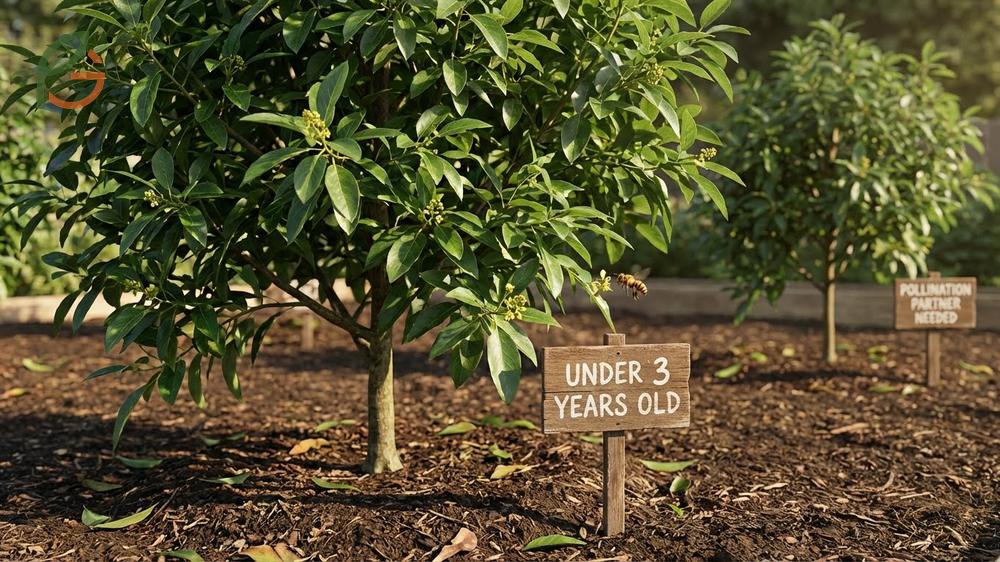
The most common reason for no fruit is insufficient cross-pollination. If you’ve only got a single tree or if all your trees are the same type (all Type A or all Type B), you’re severely limiting pollination opportunities. Even mature trees need compatible pollen sources nearby to set fruit consistently.
Age is another factor that’s easy to overlook. If your tree is under 3 years old (for grafted) or under 7 years (for seed-grown), it simply hasn’t reached reproductive maturity yet. Young trees focus all their energy on vegetative growth—building roots, trunk, and canopy—before they’re ready to support fruit production.
Water stress shows up as leaf burn—brown tips and margins—usually starting in fall and worsening through winter. Trees with significant leaf damage spend the following spring replacing those damaged leaves instead of making flowers. This creates a frustrating cycle where last year’s poor watering prevents this year’s fruiting.
Alternate bearing is a natural habit where trees produce heavy crops one year and light crops the next. The previous year’s large harvest depletes the tree’s energy reserves, leaving fewer resources for the following season’s flowering. You’ll see this most prominently in unpruned trees that haven’t had their canopy managed.
- Poor pollination: Single tree or all same-type varieties without cross-pollination partners
- Too young: Grafted trees under 3 years, seed-grown trees under 7 years
- Insufficient sunlight: Less than 6 hours daily reduces flower production dramatically
- Water stress: Inconsistent watering causes leaf burn and delays next season’s flowering
- Heat or cold stress: Extreme temperatures during flowering prevent fruit set
- Nutrient deficiencies: Lack of zinc or boron prevents flower development
- Alternate bearing: Natural cycle of heavy and light crop years
Recovery Tip: If your tree has bad leaf burn from water stress, focus on consistent deep watering for a full year to restore leaf health. The tree won’t fruit well until it goes through a complete growth cycle with minimal leaf damage.
Conclusion
The evidence is clear: how to grow avocado fruit successfully depends on starting with grafted trees for the 3-4 year timeline, planting compatible Type A and Type B varieties for cross-pollination, and maintaining optimal temperatures of 20-25°C (68-77°F) throughout the growing season. Consistent watering, balanced fertilization with emphasis on zinc and boron, and full sun exposure create the conditions trees need to transition from vegetative growth to reliable fruit production.
Current horticultural guidance emphasizes patience and proper care over quick fixes. At FruitGarden, we’ve seen that growers who focus on building healthy root systems and avoiding stress cycles achieve earlier and more consistent fruiting than those who push trees too hard with heavy fertilization or aggressive pruning.
Frequently Asked Questions
How long does an avocado tree take to bear fruit?
Grafted avocado trees take 3-4 years to bear fruit, while seed-grown trees take 7-15 years or may never fruit at all. Buying a larger 15-gallon nursery tree can reduce the wait by about a year compared to a 5-gallon tree.
When do avocado trees produce fruit during the year?
Avocados flower in spring (February-May in most climates), but fruit takes 6-18 months to mature depending on variety. Hass typically matures in 12-14 months, meaning spring flowers produce fruit the following spring or early summer.
What’s the difference between Type A and Type B avocado pollination?
Type A avocados (like Hass) open as female in the morning and male the next afternoon, while Type B varieties (like Fuerte) do the opposite—female in afternoon, male next morning. Planting both types together maximizes cross-pollination and fruit set.
How much fruit does a mature avocado tree produce?
Mature avocado trees yield 45-320 kg (100-700 lbs) annually, with most producing around 70-80 kg (154-176 lbs) by age 25. Young trees in their first fruiting season typically produce only 12-73 fruits, with production increasing steadily each year.
Can you grow an avocado tree that bears fruit from a pit?
Yes, but it takes 7-15 years and the fruit quality is unpredictable. Seed-grown trees don’t produce fruit that matches the parent, and many never fruit at all. Grafting a proven variety onto your seedling after 1-2 years gives you fruit in 2-3 additional years.
Why is my avocado tree flowering but not producing fruit?
Flowering without fruit set usually indicates poor pollination from lack of cross-pollination partners, heat stress above 35°C (95°F) during flowering, or water stress. Plant a compatible Type A or B variety nearby and ensure consistent watering during spring fruit set.
What fertilizer makes avocado trees fruit faster?
Use balanced 6-6-6 fertilizer quarterly plus zinc and boron foliar spray during flowering. Avoid excess nitrogen during spring flowering as it causes fruit drop. Composted chicken manure applied in early spring provides slow-release nutrients without overwhelming the tree.





