
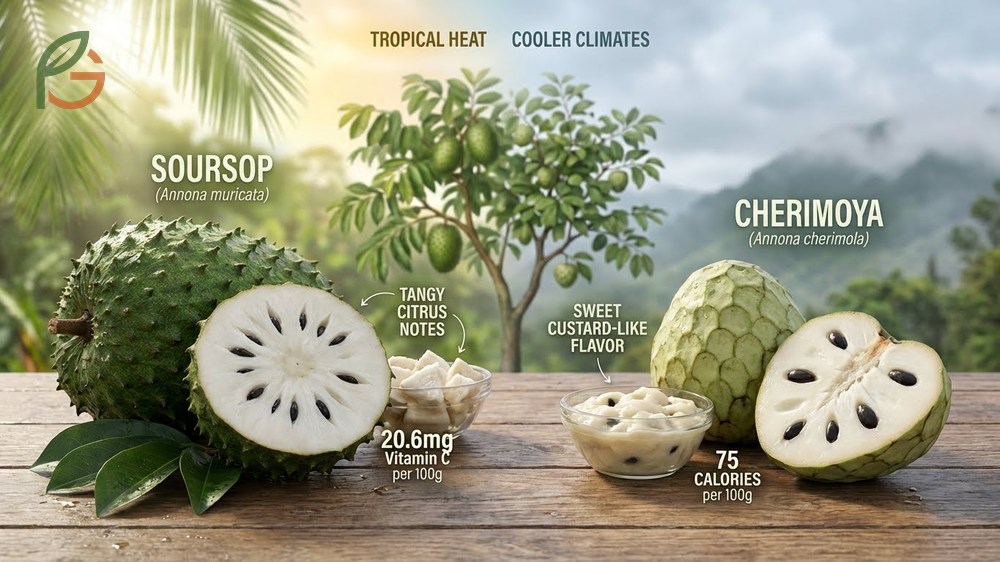
Soursop vs cherimoya—these tropical cousins from the Annonaceae family look similar but deliver completely different taste experiences. Research shows soursop (Annona muricata) brings tangy citrus notes with 20.6mg vitamin C per 100g, while cherimoya (Annona cherimola) offers sweet custard-like flavor at 75 calories per 100g[1][2]. Most gardeners don’t realize these fruits thrive in different climate zones—soursop demands tropical heat while cherimoya tolerates cooler subtropical temperatures. FruitGarden synthesizes current agricultural research to help you choose the right custard apple variety for your growing conditions.
Quick Answer
- Soursop delivers tangy, citrus-pineapple flavor while cherimoya offers sweet, vanilla-custard taste
- Soursop grows larger (up to 8 lbs) with soft spikes; cherimoya stays smaller with smooth, heart-shaped skin[3]
- Soursop needs USDA zones 10-11 with temperatures above 41°F (5°C); cherimoya tolerates brief frost in zones 9-11[4][5]
- Both provide 3g+ fiber per 100g but soursop packs 60% more vitamin C[1][2]
Soursop Vs Cherimoya
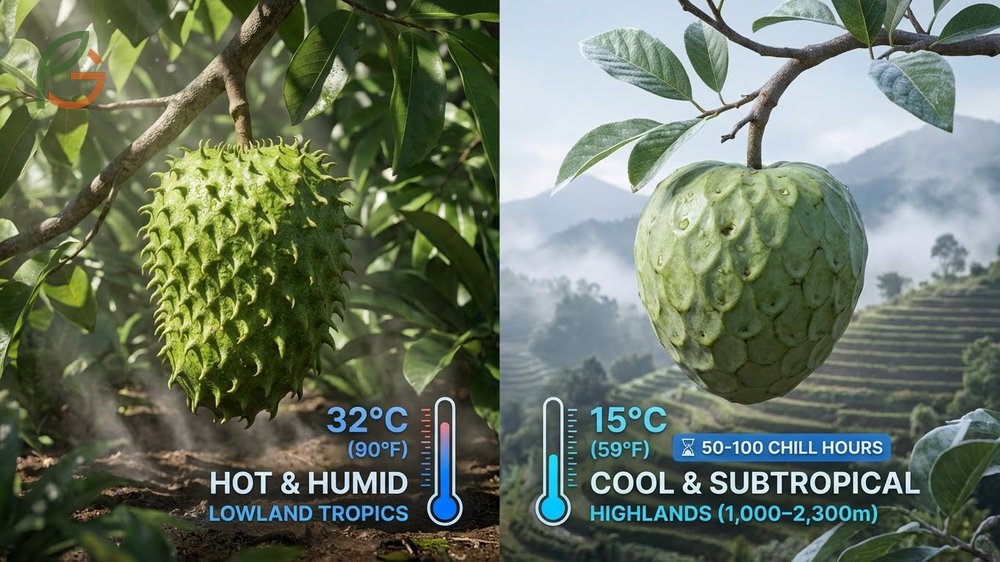
These two Annonaceae family members evolved for different ecological niches. Soursop (Annona muricata) thrives in hot, humid lowland tropics while cherimoya (Annona cherimola) prefers cooler subtropical highlands between 1,000-2,300 meters elevation[5]. This altitude difference explains why they can’t swap growing zones—soursop dies in frost while cherimoya needs 50-100 chill hours to flower properly.
Current agricultural data shows optimal soil temperatures differ dramatically. Soursop demands 25-35°C (77-95°F) soil warmth for root development, while cherimoya performs best at 15-22°C (59-72°F) mean annual temperatures[6][5]. If you’re in southern Florida or coastal California, this temperature gap determines which tree you’ll successfully grow.
The fruits mature at different times too. Soursop ripens year-round in tropical zones with a slight dry season boost, taking 3-5 months from flower to harvest. Cherimoya concentrates its crop in late winter through spring, requiring 5-8 months to develop full sweetness.
Botanical Classification
Both belong to genus Annona within family Annonaceae, which contains over 2,400 species globally. Soursop’s scientific name Annona muricata references its spiky exterior (“muricata” means covered with short hard points), while cherimola comes from the Quechua word “chirimuya” meaning cold seeds[5]. What’s surprising is that despite sharing 95% of their DNA, these species can’t naturally cross-pollinate.
Their leaf structure reveals adaptation secrets. Soursop produces glossy, dark green leaves year-round in consistent tropics. Cherimoya grows hairy, semi-deciduous leaves that drop during cooler months—a highland survival strategy[3].
Physical Appearance
Soursop fruit stretches oval to kidney-shaped, often reaching 20-30 cm long. Its dark green skin bristles with soft, curved spines that turn yellowish-green at full ripeness. A ripe soursop yields slightly to pressure and weighs 2-4 kg on average.
Cherimoya presents heart-shaped symmetry with distinctive fingerprint-like skin patterns. Its pale green surface features overlapping scales or smooth indentations rather than spines. Most cherimoyas max out at 10-20 cm diameter and 0.5-2 kg weight—noticeably smaller than soursop[3].
From My Experience: My cousin in Oaxaca, Mexico grows both fruits in his backyard microclimate—he plants soursop at the lower, warmer corner (consistently 26°C/79°F) and cherimoya 15 meters upslope where it’s 3-4°C cooler. His cherimoya thrives while neighbors’ soursop trees at the same elevation produce half the fruit.
Important Note: Don’t judge ripeness by color alone—both fruits ripen off the tree and soften significantly. Soursop’s spines turn brittle when ready, while cherimoya’s skin develops slight brown patches between scales.
Taste Texture Differences
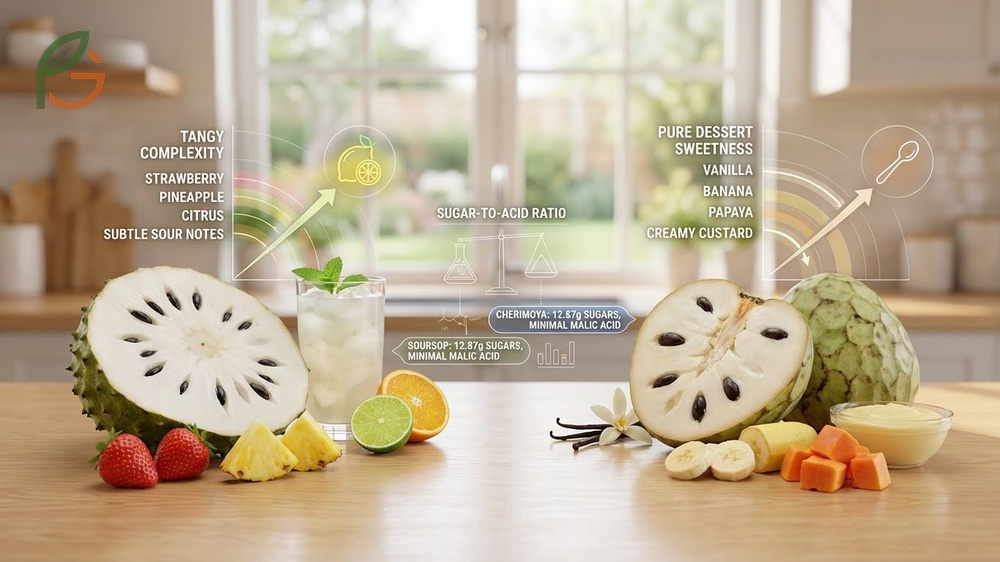
The flavor gap between these fruits surprises first-time tasters. Soursop delivers tangy complexity mixing strawberry, pineapple, and citrus with subtle sour notes—think tropical lemonade in fruit form. Cherimoya counters with pure dessert sweetness blending vanilla, banana, and papaya into creamy custard without any tartness[7].
This difference stems from their sugar-to-acid ratios. Studies show cherimoya contains 12.87g sugars per 100g with minimal malic acid, while soursop packs 13.54g sugars balanced by higher citric acid content[1][2]. That acid punch makes soursop perfect for smoothies and juices, whereas cherimoya shines eaten fresh with a spoon.
Americans often prefer cherimoya’s approachable sweetness when trying custard apples for the first time. Soursop’s tangy bite takes adjustment but wins over fans of tart fruits like passion fruit or tamarind.
Flavor Profiles
Research demonstrates that volatile compounds create these distinct tastes. Soursop produces higher concentrations of methyl esters and lactones that register as sharp, bright notes on your palate. Cherimoya synthesizes more acetate esters that read as smooth, round sweetness.
Temperature affects flavor perception too. Soursop tastes most balanced when chilled to 10-15°C (50-59°F), which tames excessive tartness. Cherimoya reaches peak sweetness at room temperature, 20-22°C (68-72°F), where its custard notes fully develop.
Texture Comparison
Soursop’s flesh separates into stringy, fibrous segments that release juice when chewed—it’s wetter and more pulpy. You can’t eat it cleanly with a spoon; most people break it apart with fingers or blend it for drinks. The texture stays consistent from skin to core[7].
Cherimoya holds together in dense, creamy spoonfuls like soft-serve ice cream. It’s drier and less juicy, with a smooth mouthfeel that coats your tongue. This firmness makes it easier to portion and serve elegantly.
- Soursop: Fibrous, stringy pulp with high juice content that requires blending or hand-pulling for clean eating
- Cherimoya: Dense, smooth custard texture that scoops cleanly with a spoon like thick yogurt
- Seed density: Soursop contains fewer, larger black seeds (20-40 per fruit); cherimoya packs more seeds (30-60) that embed throughout the flesh
- Overripe changes: Soursop turns watery and ferments quickly; cherimoya maintains structure longer but develops brown oxidation
- Freezing response: Soursop freezes well for smoothies maintaining flavor; cherimoya’s texture degrades into grainy mush when frozen
Custard Apple Comparison
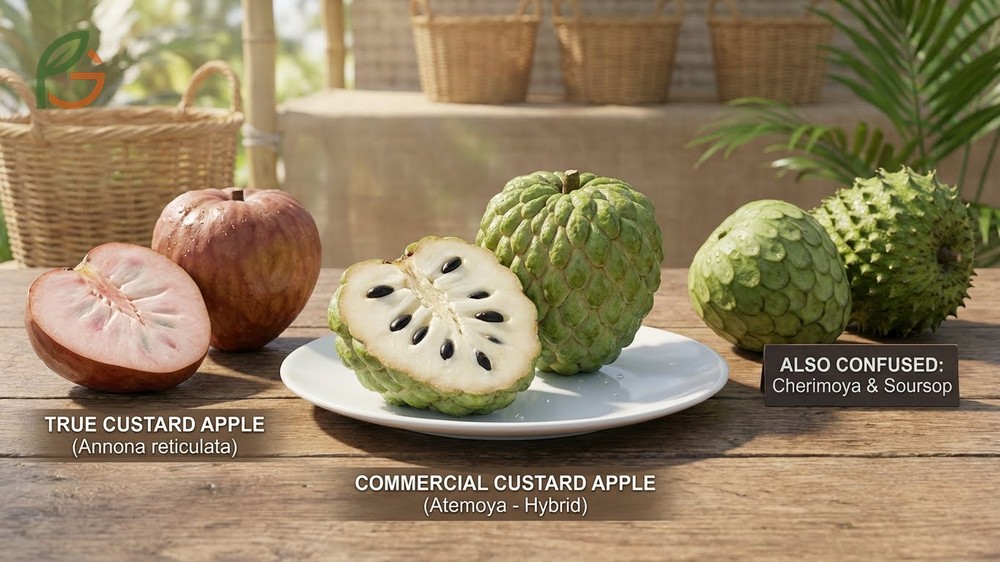
The “custard apple” name creates confusion because three different Annona species claim it. Annona reticulata (true custard apple or bullock’s heart) differs from both soursop and cherimoya with its reddish-brown skin and pink-white flesh. In commercial markets, “custard apple” often refers to atemoya—a hybrid between cherimoya and sugar apple (Annona squamosa) bred for better tropical tolerance.
Evidence shows true custard apples (A. reticulata) deliver mediocre flavor compared to cherimoya’s dessert quality or soursop’s refreshing tang. That’s why growers focus breeding efforts on atemoya hybrids that combine cherimoya’s sweetness with sugar apple’s heat tolerance.
Current naming conventions vary by region. Australians call atemoya hybrids “custard apples” while reserving “cherimoya” for pure A. cherimola. Americans use “cherimoya” and “custard apple” interchangeably, adding confusion when shoppers encounter true A. reticulata labeled as custard apple.
This table compares four Annona species showing scientific names, common names, flavor profiles, and skin characteristics to clarify custard apple family naming
| Species | Common Names | Flavor Profile | Skin Type |
|---|---|---|---|
| Annona muricata | Soursop, guanábana | Tangy, citrus-pineapple | Dark green with soft spikes |
| Annona cherimola | Cherimoya, chirimoya | Sweet vanilla-custard | Pale green with scales/fingerprints |
| Annona reticulata | Custard apple, bullock’s heart | Mild sweet, less distinct | Reddish-brown, netted pattern |
| Annona squamosa | Sugar apple, sweetsop | Very sweet, grainy | Yellow-green with distinct bumps |
Shopping Tip: Check the scientific name on plant nursery tags before buying. “Custard apple” might mean A. reticulata (inferior fruit), A. cherimola (excellent but cold-needy), or an atemoya hybrid (best for warm zones).
Annona Fruit Types
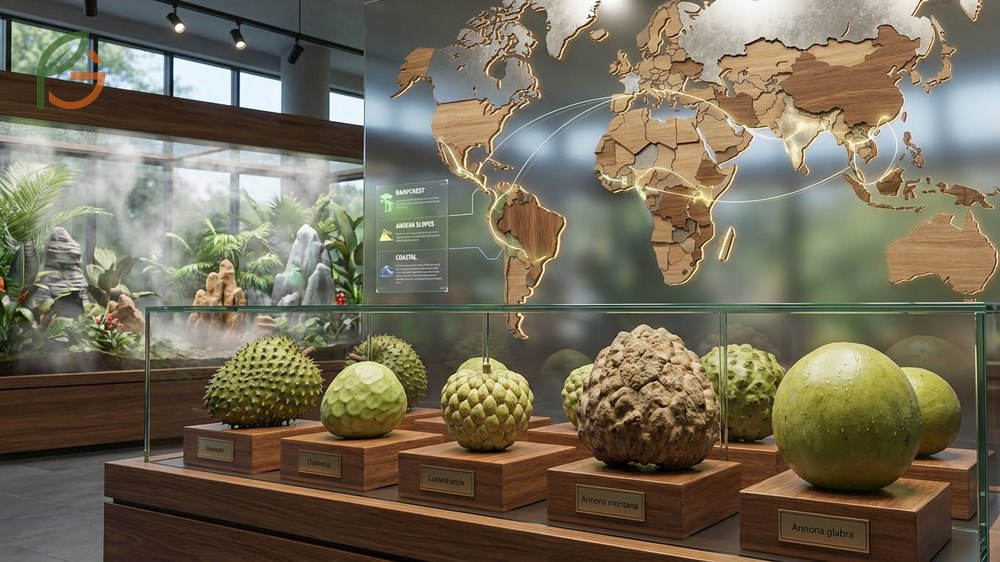
The Annonaceae family evolved across tropical Americas, Africa, and Asia over 100 million years. Agricultural research identifies five commercially important Annona species, with dozens more regional varieties cultivated locally. Each adapted to specific microclimates—from sea-level rainforests to 3,000-meter Andean slopes.
Beyond the common four species, Annona montana (mountain soursop) and Annona glabra (pond apple) serve niche markets. Mountain soursop grows larger fruits (up to 6 kg) with more acidic pulp used mainly for processing. Pond apple tolerates swampy, flooded soils where other Annonas fail but produces sour, fibrous fruit rarely eaten fresh.
Hybrid development accelerated in the 1950s when Israeli researchers crossed sugar apple × cherimoya to create atemoya. This breakthrough solved cherimoya’s pollination problems while adding heat tolerance. Today’s cultivars like ‘African Pride’ and ‘Gefner’ dominate subtropical fruit production from Florida to Queensland.
- Sugar apple (A. squamosa): Smallest fruit (7-12 cm), sweetest taste with granular texture, thrives in hot lowland tropics with dry season
- Atemoya hybrids: Heart-shaped like cherimoya but tolerates heat to 32°C (90°F), fewer seeds, balanced sweet flavor without tartness
- Ilama (A. diversifolia): Mexican highland native with pink or white flesh, alligator-skin texture, rare outside Oaxaca and Guerrero regions
- Rollinia (A. mucosa): Brazilian “biriba” with yellow flesh, lemon-custard flavor, extremely soft when ripe requiring immediate consumption
- Soncoya (A. purpurea): Central American variety with orange flesh, strong aroma, mostly used for traditional medicine rather than fresh eating
Which Fruit Sweeter
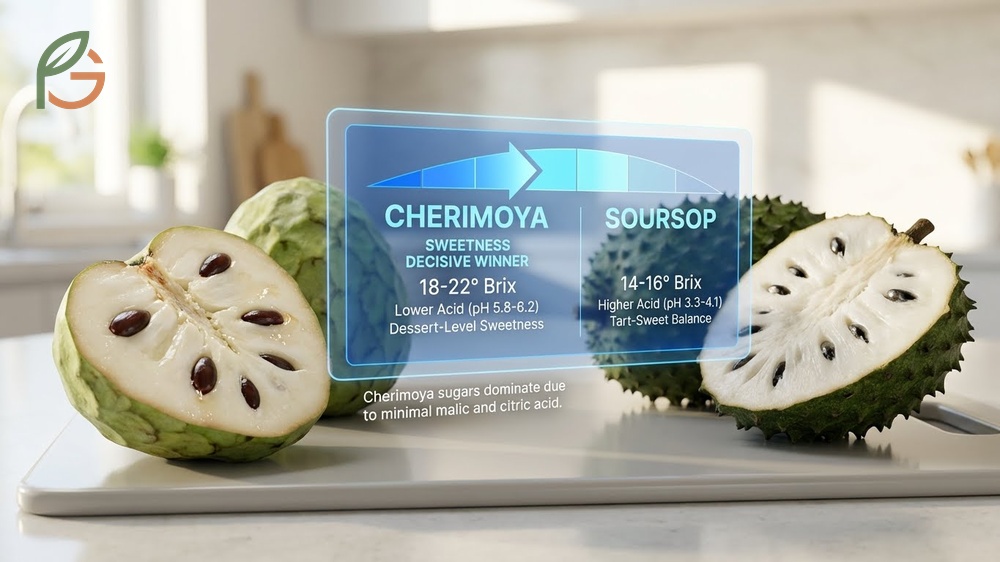
Cherimoya wins the sweetness contest decisively. Its flesh registers 18-22° Brix (sugar percentage) at peak ripeness, while soursop measures 14-16° Brix[1][2]. That 4-6 point gap translates to noticeable dessert-level sweetness in cherimoya versus soursop’s tart-sweet balance.
The acid factor matters equally. Cherimoya contains minimal malic and citric acid (pH 5.8-6.2), allowing its sugars to dominate your taste receptors. Soursop’s higher acid content (pH 3.3-4.1) masks some of its natural sugars, creating that refreshing tang that prevents cloying sweetness.
Most Americans perceive cherimoya as sweeter even though soursop technically contains more total sugars per 100g (13.54g vs 12.87g). The reason? Your tongue detects sugar-to-acid ratio, not absolute sugar grams. Cherimoya’s low acid lets you taste every bit of sweetness while soursop’s acid blocks some sugar perception.
Ripeness Impact: Underripe soursop tastes extremely sour and astringent—wait until the skin yellows and softens. Cherimoya develops full sweetness even when slightly firm, making harvest timing less critical for good flavor.
Growing Requirements
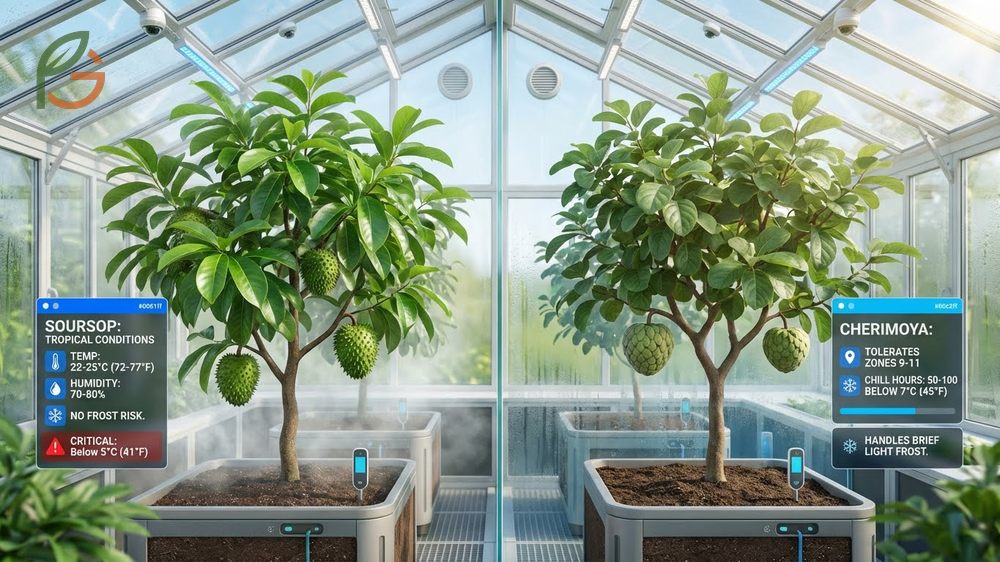
Climate matching determines success more than any other factor. Soursop demands true tropical conditions—USDA zones 10b-11 with no frost risk, mean annual temperatures of 22-25°C (72-77°F), and 70-80% relative humidity[6]. It dies at temperatures below 5°C (41°F) and suffers production drops below 15°C (59°F).
Cherimoya tolerates zones 9-11 and handles brief light frost once established. It actually needs 50-100 chill hours below 7°C (45°F) to break dormancy and flower properly. Optimal growing temperature ranges 17-22°C (63-72°F) annual average—noticeably cooler than soursop’s requirements[5].
Soil preparation differs slightly. Both prefer well-drained loam with pH 5.5-6.5, but soursop tolerates heavier clay better while cherimoya demands excellent drainage to prevent root rot. Soursop needs 2,000-2,500mm annual rainfall or equivalent irrigation; cherimoya performs well with 800-1,200mm if humidity stays at 70-80% during spring flowering[6].
- Sunlight needs: Both require 6-8 hours direct sun daily; soursop tolerates partial shade in hottest zones while cherimoya needs full sun in cooler climates[4]
- Pollination challenges: Soursop self-pollinates readily; cherimoya needs hand-pollination in most climates because flowers open female then male over 36 hours
- First harvest timing: Soursop produces 3-5 years from planting; cherimoya takes 4-7 years but atemoya hybrids fruit in 2-3 years
- Tree size management: Soursop grows 25-30 feet tall requiring annual pruning; cherimoya reaches 15-20 feet with less aggressive growth
- Pest resistance: Soursop attracts fruit flies and mealybugs requiring organic sprays; cherimoya faces fewer pest pressures but susceptible to root fungus in wet soil
- Container growing: Cherimoya adapts well to large pots (30+ gallons) for patio cultivation; soursop struggles in containers due to deep taproot
This table compares nutritional values per 100 grams of soursop versus cherimoya including calories, carbohydrates, fiber, protein, and key vitamins
| Nutrient | Soursop | Cherimoya |
|---|---|---|
| Calories | 66 kcal[2] | 75 kcal[1] |
| Carbohydrates | 16.8g[2] | 17.7g[1] |
| Fiber | 3.3g[2] | 3.0g[1] |
| Vitamin C | 20.6mg[2] | 12.6mg[1] |
| Potassium | 278mg[2] | 287mg[1] |
Conclusion
The evidence is clear: soursop vs cherimoya comes down to your climate zone and taste preference. Soursop thrives in tropical heat delivering tangy refreshment with 60% more vitamin C, while cherimoya rewards subtropical gardeners with dessert-level sweetness and cold tolerance. Current cultivation guidance emphasizes matching species to your microclimate—soursop needs consistent warmth above 22°C (72°F) while cherimoya actually benefits from winter chill hours.
For backyard growers in USDA zones 9-10, cherimoya or atemoya hybrids provide better success rates than frost-sensitive soursop. FruitGarden recommends starting with one 3-5 year old grafted tree, ensuring 6+ hours daily sun, and maintaining soil pH between 5.5-6.5 for either species.
Frequently Asked Questions
Can I Grow Soursop and Cherimoya in the Same Garden?
Yes, but only if you create distinct microclimates. Research shows soursop needs warmer locations (protected south-facing walls, lower elevations) while cherimoya tolerates cooler spots. If your property spans a 3-4°C (5-7°F) temperature gradient, plant soursop in the warmest zone and cherimoya 15-20 meters upslope or in partial afternoon shade.
Which Tastes Better for Fresh Eating: Soursop or Cherimoya?
Cherimoya wins for fresh eating due to its sweet custard flavor and clean spoon-scooping texture. Soursop’s fibrous, stringy pulp makes it better suited for smoothies, juices, and ice cream where you blend out the texture. Most Americans prefer cherimoya’s approachable sweetness when trying custard apples for the first time.
How Do I Know When Soursop Is Ripe Compared to Cherimoya?
Soursop turns yellowish-green with soft spines that break easily, yielding to gentle thumb pressure like a ripe avocado. Cherimoya develops slight brown patches between scales and softens uniformly—harvest when it gives slightly but before the skin turns fully brown. Both fruits ripen off the tree at room temperature within 2-5 days.
Are Soursop and Cherimoya Seeds Edible?
No, don’t eat the seeds from either fruit. Current safety data indicates Annona seeds contain annonacin and other compounds that aren’t safe for consumption. Always spit out or remove all black seeds before eating the flesh—there’s no nutritional benefit to consuming them and potential digestive discomfort.
Which Fruit Has More Vitamin C: Soursop or Cherimoya?
Soursop contains 63% more vitamin C at 20.6mg per 100g compared to cherimoya’s 12.6mg per 100g. That makes soursop a better choice if you’re targeting immune support, though both fruits provide moderate amounts. For comparison, an orange delivers 53mg per 100g—more than either custard apple variety.
Can I Substitute Soursop for Cherimoya in Recipes?
Not directly—their flavor and texture differences change recipe outcomes. Soursop’s tartness works in beverages, sorbets, and applications needing citrus brightness. Cherimoya’s sweet custard suits puddings, mousses, and desserts where you’d use banana or vanilla. You can substitute atemoya for cherimoya more successfully than swapping in soursop.
How Long Do Soursop and Cherimoya Trees Take to Produce Fruit?
Soursop trees fruit in 3-5 years from planting, while cherimoya takes 4-7 years for first harvest. Grafted trees produce 1-2 years faster than seedlings. Atemoya hybrids fruit quickest at 2-3 years, making them attractive for impatient gardeners who want custard apples without the wait.





