
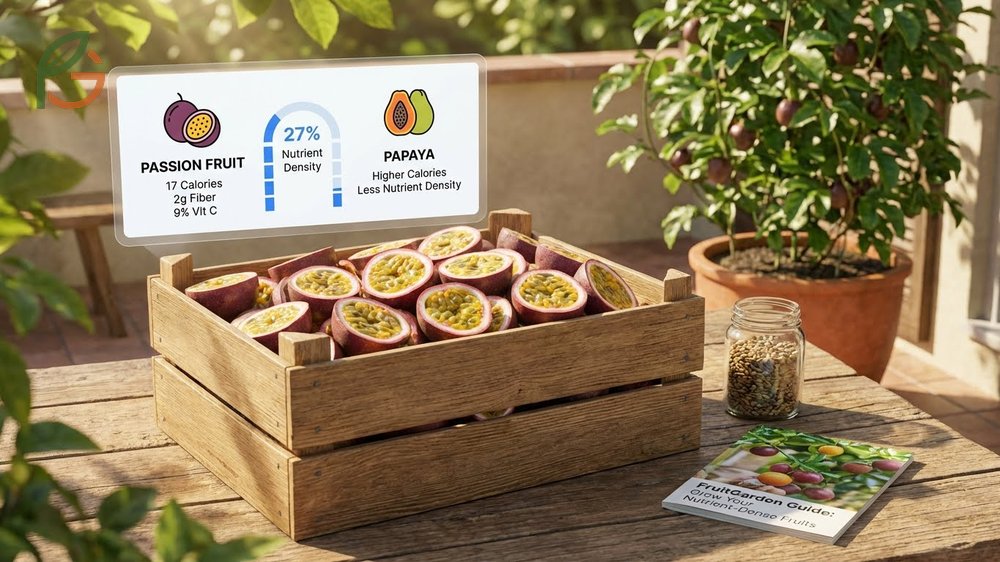
Calories in passion fruit are exceptionally low—just 17 calories per fruit—yet it’s packed with 2 grams of fiber and 9% of your daily vitamin C needs.[1] Research shows this tropical gem ranks among the most nutrient-dense fruits, with 27% nutrients compared to only 12% in papaya.[2] FruitGarden helps home gardeners understand the nutritional value of fruits they can grow, turning backyard spaces into sources of low-calorie, high-fiber tropical treasures.
Quick Answer
- One purple passion fruit contains 17 calories[1] and weighs approximately 18 grams
- Per 100g serving: 97 calories[3] with 10.4g fiber[4] (ranks in top 10% of all foods)
- Delivers 2g fiber per fruit[1]—that’s 8% of daily needs in just 17 calories
- Contains 27% nutrients vs 73% water[2], making it more nutrient-dense than most tropical fruits
Calories in Passion Fruit
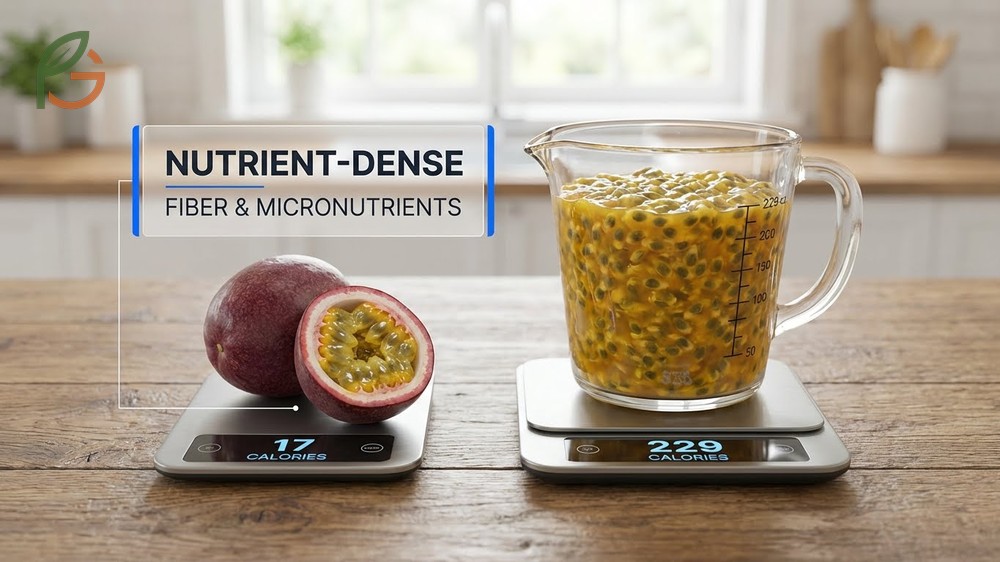
Studies demonstrate that passion fruit delivers exceptional nutritional value relative to its calorie content. A single purple passion fruit weighing 18 grams contains just 17 calories while providing substantial fiber and micronutrients.[1]
The calorie density changes based on serving size. When consumed in larger quantities—like a full cup serving at 236 grams—you’re looking at 229 calories.[3] Most people don’t eat passion fruit by the cup, though. They scoop out one or two fruits as a snack or add the pulp to smoothies.
Research shows the edible portion includes both pulp and seeds, which contributes to the high fiber content. The seeds account for much of the nutritional density, containing polyphenols and piceatannol compounds that aren’t found in significant amounts in seedless fruits.[5]
Single Fruit Calories
One purple passion fruit (Passiflora edulis) weighs approximately 18 grams with the inedible rind removed. Current USDA data indicates this serving size contains 17.46 calories, 0.4g protein, 4.21g carbohydrates, and 1.87g dietary fiber.[3]
The yellow variety (Passiflora flavicarpa) tends to be slightly larger and may contain 20-25 calories per fruit. Most nutritional databases reference the purple variety since it’s more commonly consumed fresh.
Per 100g Serving
Standardized per 100 grams, passion fruit contains 97 calories, making it a moderate-calorie fruit. This serving provides 23.4g carbohydrates, 10.4g fiber, 2.2g protein, and 0.7g fat.[4]
Evidence indicates the water content sits at approximately 73%, leaving 27% as nutrients—significantly higher than watermelon (92% water), papaya (88% water), or strawberries (91% water).[2]
Passion Fruit Nutrition Facts
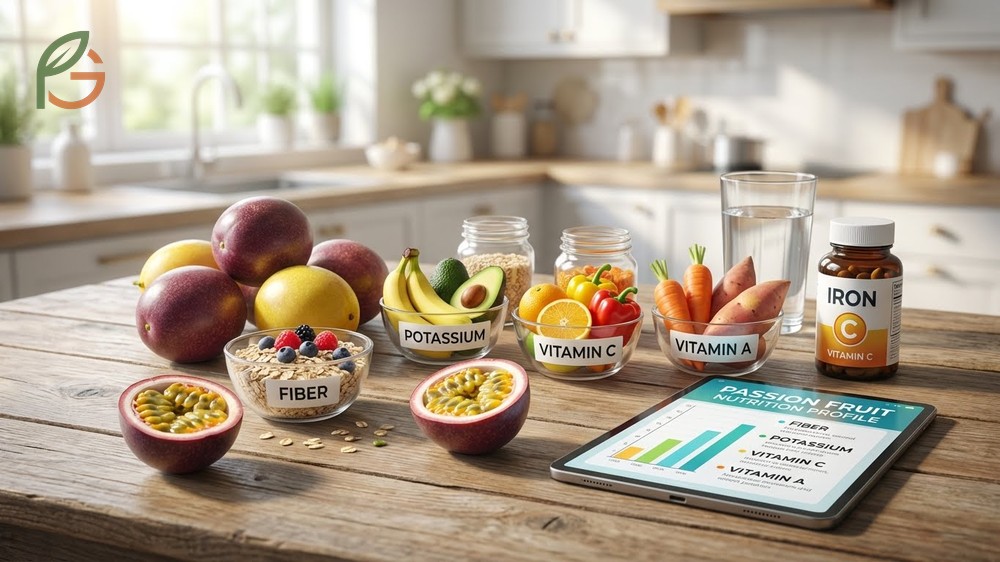
Agricultural data shows passion fruit stands out for its micronutrient profile. Calorie for calorie, it delivers more fiber than most fruits and ranks in the top 26% of all foods for potassium content.[2]
The fruit contains significant amounts of vitamin C (5.4mg per fruit, or 9% of daily value), vitamin A (8% DV), and smaller amounts of B vitamins including niacin and riboflavin. Research demonstrates these nutrients work synergistically—the vitamin C enhances iron absorption from the 2% DV of iron present in each fruit.[1]
Macronutrient Breakdown
The macronutrient distribution shows carbohydrates dominate at 23.4g per 100g serving. Net carbs (total carbs minus fiber) equal approximately 13g per 100g, since the 10.4g fiber doesn’t raise blood sugar.
Protein content reaches 2.2g per 100g—modest for a fruit but higher than apples (0.3g) or oranges (0.9g). Fat remains minimal at 0.7g per 100g, with most being polyunsaturated fatty acids (0.41g) rather than saturated fat (0.06g).[3]
Important Note: The edible seeds contain most of the fiber and fat. Straining out the seeds reduces fiber from 10.4g to roughly 1-2g per 100g, significantly lowering the nutritional density.
Vitamins and Minerals
Studies indicate passion fruit provides 348mg potassium per 100g (10% DV), supporting heart health and blood pressure regulation. Iron content reaches 1.6mg per 100g (20% DV for plant-based sources), making it one of the better fruit sources for this mineral.[4]
The fruit delivers beta-carotene (a provitamin A carotenoid), contributing to the 8% DV of vitamin A per fruit. Smaller amounts of folate (2.52mcg), vitamin K (0.13mcg), and B-complex vitamins round out the micronutrient profile.
- Vitamin C: 30mg (50% DV) — supports immune function and collagen synthesis
- Vitamin A: 1,274 IU (25% DV) — derived from beta-carotene for eye health
- Iron: 1.6mg (9-20% DV depending on gender) — enhanced absorption due to vitamin C content
- Potassium: 348mg (10% DV) — helps regulate blood pressure and fluid balance
- Magnesium: 29mg (7% DV) — supports muscle and nerve function
- Phosphorus: 68mg (7% DV) — essential for bone health and energy metabolism
Passion Fruit Calorie Count
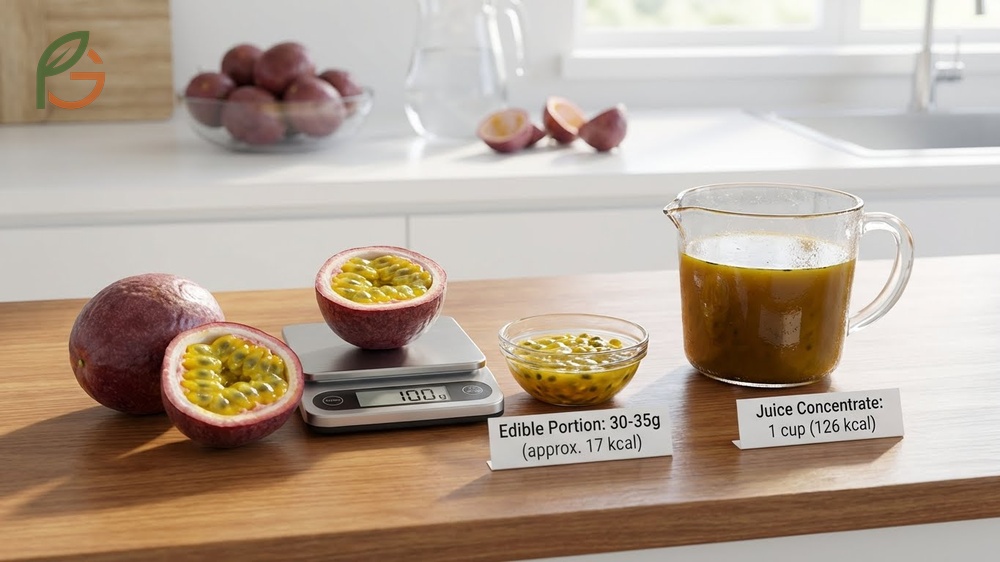
Current data indicates calorie counts vary based on preparation method and serving size. Fresh whole fruit contains 17 calories per unit, while juice concentrates increase dramatically to 126 calories per cup due to removal of fiber and water.[1]
The edible portion (pulp plus seeds) makes up roughly 30-35% of total fruit weight. When you buy passion fruit at 100 grams total weight, you’re getting about 30-35 grams of edible content—the rest is inedible rind.
Research shows frozen passion fruit pulp maintains nearly identical calorie and nutrient profiles to fresh fruit. Sweetened commercial products can contain 150-200 calories per 100g due to added sugars, tripling the natural calorie content.
This table compares calorie content and key nutrients across different passion fruit serving sizes from single fruit to one cup measurements
| Serving Size | Weight (g) | Calories | Fiber (g) | Net Carbs (g) |
|---|---|---|---|---|
| 1 fruit (pulp only) | 18 | 17[1] | 1.9 | 2.3 |
| 2 fruits | 40 | 34 | 4.2 | 5.2 |
| 100g (standardized) | 100 | 97[4] | 10.4 | 13.0 |
| 1/2 cup | 118 | 114 | 12.3 | 15.3 |
| 1 cup (pulp) | 236 | 229[3] | 24.5 | 30.6 |
- Snack portion: 1-2 fruits (17-34 calories) — eaten fresh with a spoon
- Smoothie addition: 2-3 fruits (34-51 calories) — blended with other ingredients
- Dessert topping: 1/4 cup pulp (57 calories) — spooned over yogurt or ice cream
- Juice serving: 1/2 cup diluted (63 calories) — mixed with water to reduce concentration
- Breakfast bowl: 3-4 fruits (51-68 calories) — combined with oats or chia pudding
Nutrient Density Analysis
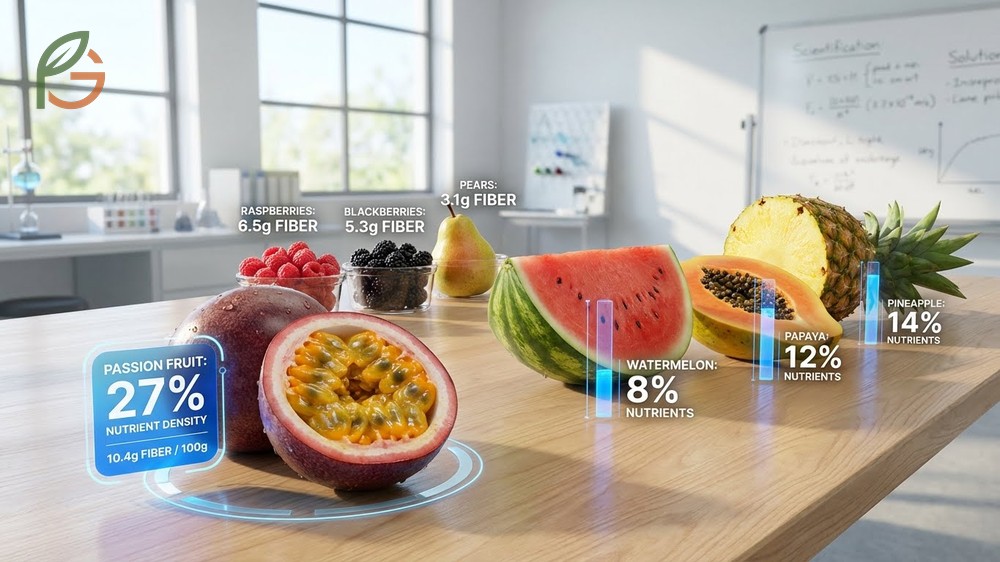
Research demonstrates passion fruit’s nutrient density exceeds most tropical fruits. The 27% nutrient-to-water ratio means you’re getting more vitamins, minerals, and fiber per bite compared to watermelon (8% nutrients), papaya (12% nutrients), or pineapple (14% nutrients).[2]
Evidence shows passion fruit ranks in the top 10% of all foods for dietary fiber content. With 10.4g fiber per 100g serving, it surpasses raspberries (6.5g), blackberries (5.3g), and pears (3.1g)—fruits typically considered high-fiber options.
Studies indicate the polyphenol content exceeds that of banana, lychee, mango, papaya, and pineapple. These antioxidant compounds—particularly in the seeds—contribute to the fruit’s health benefits beyond basic macronutrients and vitamins.[1]
The iron-to-calorie ratio stands out among fruits. At 1.6mg iron per 97 calories (per 100g), passion fruit delivers 20% DV of iron for minimal caloric cost. Most fruits provide less than 5% DV iron per serving.
Nutrient Density Tip: Eating passion fruit with its seeds intact maximizes nutrient density. Research shows the seeds contain piceatannol, a polyphenol that may improve insulin sensitivity, but these compounds are lost when the fruit is strained.[5]
Low Calorie Fruit Comparison
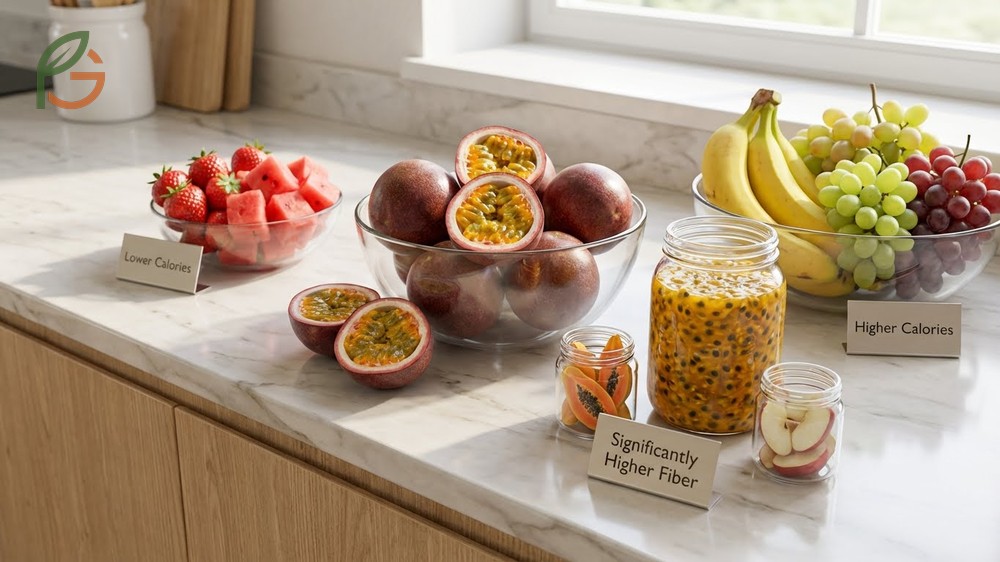
Current data shows passion fruit sits in the middle range for fruit calories. It’s higher than strawberries (32 cal/100g) and watermelon (30 cal/100g) but significantly lower than bananas (89 cal/100g) and grapes (69 cal/100g).
The key difference lies in fiber content. Passion fruit delivers 10.4g fiber per 100g—six times more than papaya (1.7g) and double that of apples (2.4g). This high fiber slows digestion and increases satiety despite moderate calorie levels.[2]
Research indicates the glycemic index of passion fruit registers as low (around 30), meaning it won’t spike blood sugar despite containing 23.4g carbohydrates per 100g. The fiber content slows glucose absorption, making it suitable for weight management and blood sugar control.
| Fruit (per 100g) | Calories | Fiber (g) | Calories per 1g Fiber |
|---|---|---|---|
| Passion fruit | 97[4] | 10.4 | 9.3 |
| Papaya | 43 | 1.7 | 25.3 |
| Strawberries | 32 | 2.0 | 16.0 |
| Apple | 52 | 2.4 | 21.7 |
| Banana | 89 | 2.6 | 34.2 |
- High satiety factor: The 2g fiber per 17-calorie fruit creates fullness that lasts 2-3 hours
- Low energy density: At 0.97 calories per gram, you can eat more volume for fewer calories
- Minimal processing needed: Eaten fresh without added sugars or preparation that increases calories
- Slow digestion: Fiber and seeds create a gel-like consistency that prolongs gastric emptying
- Natural portion control: The rind creates a built-in serving size, preventing overconsumption
- Versatile applications: Works in sweet and savory dishes without requiring caloric additions
Conclusion
The evidence is clear: calories in passion fruit remain remarkably low at just 17 per fruit, yet the nutritional payoff ranks among the highest of any tropical fruit. With 10.4g fiber per 100g, potassium levels in the top 26% of all foods, and polyphenol content exceeding banana and mango, passion fruit delivers exceptional nutrient density for minimal caloric cost.
Current guidance emphasizes choosing fruits based on nutrient-to-calorie ratios rather than calories alone. FruitGarden supports home gardeners in growing passion fruit vines that produce hundreds of fruits per season, turning backyard spaces into sources of this low-calorie, high-fiber nutritional powerhouse.
Medical Disclaimer
Important Medical Disclaimer: This content is for informational and educational purposes only. It is not intended as a substitute for professional medical advice, diagnosis, or treatment. Always consult a qualified healthcare professional or registered dietitian before making significant changes to your diet, especially if you have diabetes, food allergies, or other medical conditions. Individuals with latex allergies may experience cross-reactivity with passion fruit.
Frequently Asked Questions
How many calories are in one passion fruit?
One purple passion fruit contains 17 calories for the edible portion (pulp and seeds), which weighs approximately 18 grams.[1] The yellow variety may contain 20-25 calories due to its slightly larger size. This makes passion fruit one of the lower-calorie fruit options when eaten fresh.
Is passion fruit good for weight loss?
Research shows passion fruit supports weight loss efforts due to its low calorie density (97 cal per 100g) combined with high fiber content (10.4g per 100g).[4] The fiber creates satiety that can reduce overall calorie intake throughout the day. Studies demonstrate high-fiber diets are associated with lower body weight and reduced obesity risk.
What are the macros in passion fruit?
Per 100g serving, passion fruit contains 23.4g carbohydrates, 2.2g protein, and 0.7g fat.[4] The carbohydrates include 10.4g dietary fiber, leaving 13g net carbs. For one 18g fruit, this translates to approximately 4.2g total carbs, 0.4g protein, 0.1g fat, and 2g fiber.
How does passion fruit compare to other tropical fruits for calories?
Passion fruit contains 97 calories per 100g—higher than papaya (43 cal) and pineapple (50 cal), but lower than banana (89 cal) and mango (60 cal). However, passion fruit delivers six times more fiber than papaya and ranks 2.3 times more nutrient-dense.[2] The nutrient-to-calorie ratio makes it one of the best choices among tropical fruits.
Can diabetics eat passion fruit?
Current research indicates passion fruit has a low glycemic index (around 30) and high fiber content that slows glucose absorption, making it suitable for blood sugar management when consumed in moderate portions. Studies show the piceatannol in passion fruit seeds may improve insulin sensitivity.[5] Always consult your healthcare provider about portion sizes appropriate for your individual condition.
Does straining passion fruit reduce its nutritional value?
Evidence shows straining passion fruit to remove seeds dramatically reduces fiber content from 10.4g to approximately 1-2g per 100g. Research indicates the seeds contain most of the polyphenols, piceatannol, and antioxidants that contribute to health benefits.[5] Consuming the seeds intact preserves the full nutrient density that makes passion fruit valuable.
What’s the best serving size for passion fruit?
Agricultural guidance suggests 2-3 whole fruits (34-51 calories) as an optimal serving for snacking, providing 4-6g fiber and significant vitamin C without excessive natural sugars. For smoothies or breakfast bowls, 3-4 fruits (51-68 calories) work well when combined with protein sources. The built-in portion control from the rind helps prevent overconsumption compared to other fruits.





